Public Release: 2-Aug-2017
Harvard T.H. Chan School of Public Health
Key Takeaways:
- Human-caused carbon dioxide emissions lower the nutritional value of staple crops, increasing the risk for dietary deficiencies among the world’s most vulnerable people.
- This study provides further evidence for the need to curb human-caused CO2 emissions.
Boston, MA – If CO2 levels continue to rise as projected, the populations of 18 countries may lose more than 5% of their dietary protein by 2050 due to a decline in the nutritional value of rice, wheat, and other staple crops, according to new findings from Harvard T.H. Chan School of Public Health. Researchers estimate that roughly an additional 150 million people may be placed at risk of protein deficiency because of elevated levels of CO2 in the atmosphere. This is the first study to quantify this risk.
“This study highlights the need for countries that are most at risk to actively monitor their populations’ nutritional sufficiency, and, more fundamentally, the need for countries to curb human-caused CO2 emissions,” said Samuel Myers, senior research scientist in the Department of Environmental Health.
The study will be published online August 2, 2017 in Environmental Health Perspectives.
Globally, 76% of the population derives most of their daily protein from plants. To estimate their current and future risk of protein deficiency, the researchers combined data from experiments in which crops were exposed to high concentrations of CO2 with global dietary information from the United Nations and measures of income inequality and demographics.
They found that under elevated CO2 concentrations, the protein contents of rice, wheat, barley, and potatoes decreased by 7.6%, 7.8%, 14.1%, and 6.4%, respectively. The results suggested continuing challenges for Sub Saharan Africa, where millions already experience protein deficiency, and growing challenges for South Asian countries, including India, where rice and wheat supply a large portion of daily protein. The researchers found that India may lose 5.3% of protein from a standard diet, putting a predicted 53 million people at new risk of protein deficiency.
A companion paper co-authored by Myers, which will be published as an Early View article August 2, 2017 in GeoHealth, found that CO2-related reductions in iron content in staple food crops are likely to also exacerbate the already significant problem of iron deficiency worldwide. Those most at risk include 354 million children under 5 and 1.06 billion women of childbearing age–predominantly in South Asia and North Africa–who live in countries already experiencing high rates of anemia and who are expected to lose more than 3.8% of dietary iron as a result of this CO2 effect.
These two studies, taken alongside a 2015 study co-authored by Myers showing that elevated CO2 emissions are also likely to drive roughly 200 million people into zinc deficiency, quantify the significant nutritional toll expected to arise from human-caused CO2 emissions.
“Strategies to maintain adequate diets need to focus on the most vulnerable countries and populations, and thought must be given to reducing vulnerability to nutrient deficiencies through supporting more diverse and nutritious diets, enriching the nutritional content of staple crops, and breeding crops less sensitive to these CO2 effects. And, of course, we need to dramatically reduce global CO2 emissions as quickly as possible,” Myers said.
###
Funding for the study was provided by the Bill & Melinda Gates Foundation and by the Winslow Foundation.
“Estimated Effects of Future Atmospheric CO2 Concentrations on Protein Intake and the Risk of Protein Deficiency by Country and Region,” Danielle E. Medek, Joel Schwartz, and Samuel S. Myers, Environmental Health Perspectives, online August 2, 2017, doi: 10.1289/EHP41
“Potential rise in iron deficiency due to future anthropogenic carbon dioxide emissions,” M. R. Smith, C. D. Golden, and S. S. Myers, GeoHealth, Early View article, August 2, 2017, doi: 10.1002/2016GH000018
Visit the Harvard Chan School website for the latest news, press releases, and multimedia offerings.
Harvard T.H. Chan School of Public Health brings together dedicated experts from many disciplines to educate new generations of global health leaders and produce powerful ideas that improve the lives and health of people everywhere. As a community of leading scientists, educators, and students, we work together to take innovative ideas from the laboratory to people’s lives–not only making scientific breakthroughs, but also working to change individual behaviors, public policies, and health care practices. Each year, more than 400 faculty members at Harvard Chan School teach 1,000-plus full-time students from around the world and train thousands more through online and executive education courses. Founded in 1913 as the Harvard-MIT School of Health Officers, the School is recognized as America’s oldest professional training program in public health.
Disclaimer: AAAS and EurekAlert! are not responsible for the accuracy of news releases posted to EurekAlert! by contributing institutions or for the use of any information through the EurekAlert system.
How appropriate: Here is a story of Winslow
Enjoy!
If tomato plants are subjected to too much nitrogen, they just produce nice thick green stems and lots of leaves, but hardly any fruit.
So, this is why greenhouse growers use carbon dioxide generators to get the CO2 levels in their greenhouses up to between 1,000 and 1,200 parts per million, versus planet Earth, which has JUST gotten back up to only 400 parts per million. And in those days of the dinosaurs and HUGE plant growth, when CO2 was WAY up there closer to 2,000 or more, parts per million, many times more than today, they were protein deficient?
And of course, NASA has been reporting on its website that, via satellite measurement, green plant life on Earth has increased by about 6% in recent years, and they state it’s probably from increased CO2. So if we want a greener greenhouse and greener planet, we want to REDUCE carbon dioxide?
Sounds like a Bad Joke to ME!
This a case of a glass half empty taken to the extreme by alarmists. There has been quite a bit of research done on elevated CO2 levels in greenhouses, in open top chambers in the field and in free air concentration enrichment in the field. I am involved in agricultural extension and at a recent presentation that I attended where the presenter had done a survey of the research, he summed it up by saying that for every increase in 100 ppm CO2 we can expect a yield increase of 10-15 %. (This is not a straight line, but it is a good generalization.) So, you get much more yield. Because the increased rate of photosynthesis due to the extra CO2, the amount of sugar (and starch) relative to protein and other nutrients like iron and zinc mentioned in the article rises. But you have way more yield! And you can feed the extra to animals and have really high protein from the meat, so you are way ahead. This should be a good news story because of the extra food we will be able to produce but they have twisted it up into a bad news story.
The fact is that you get at least as much protein as you would have under lower CO2, but higher yield over all.
This is simply idiotic. Just an excuse and smokescreen to try to counter the fact of CO2 fertilization.
Into the Lion’s Den walks Peta….
“3 square meals per day”
Utter bollox. We are all here sitting inside a machine that evolved eating one meal every 24 or 48 hours, even longer if sufficient water was available.
“People will become malnourished”
They already are, BADLY malnourished. See all those fat distended bellies around you. Those hapless folks are filling their faces with epic amounts of useless muck and letting their bodies sort through it for the essential nutrients it needs. Because the nutrients are not there, the poor souls eat ever more.
“Wheat, rice, corn etc are ‘staples’ and we need the protein”
Yes and no. Millions upon millions of chemicals will analyse in the lab as ‘protein’ – all you need is a sugar with a nitrogen atom bolted into it. Plant proteins are mostly all the wrong shapes and sizes. To our immune systems they appear as intruders: viruses, bacteria and other unpleasantness. But protein, like water, is sticky stuff. The alien plant proteins attach to vital things and in the immune system’s attempt to move them out, vital things get damaged.
How many different auto-immune diseases do you want, is 200+ not enough?
“With sufficient food we are all living longer”
In purely numeric terms yes. But how exactly do you count the last 10 years of increasing numbers of lives spent as helpless cabbages? 10+ years of baby-like helplessness, barely able to move or walk and utterly demented – unable to remember the faces/names of even your wife and children.
It makes your relatives desperately sad and your ‘carers’ desperately rich. What a mess. We wouldn’t do that to a cat, dog, horse, cow or anything other than a fellow human.
Is that A Life?
Again, that is the plant proteins, attaching themselves to your nerve/brain cells where your immune system is reluctant to go.
Cancer
Even before the proteins destroy your nervous system, unsaturated fats float around your system. The double bonds within them (that’s what makes them ‘unsaturated’) break open all over the place, when and wherever they like. Usually the immune system picks up the damage but eventually, those strings of unwanted free-radical reactions ‘get lucky’ They, sooner or later, switch off the apoptosis mechanism in a cell. It could be any cell any where and lo-and-behold, you’re endowed with an immortal cell that keeps replicating every 28 days (typically). That’s cancer.
Carbohydrate.
Photosynthesis makes only one thing and one thing only.
Glucose.
For both carbon and water, the glucose molecule is a match made in heaven – they both get to go around in groups of 6 and the water gets to keep a lot of its properties. Not least its insatiable affinity for itself.
This makes it perfect for plant building. It is The most perfect Lego building block there ever could be. It stacks fantastically in all three dimensions and not only does it lock itself together, it is self-adhesive. Perfect for making starch, cellulose and lignin.
Yes, our bodies need/use glucose for energy. But we make it ourselves, on demand, as where and when it’s needed. We make it by slicing bits off saturated fat molecules. We do that because it is difficult to control, because of its water affinity.
There-in lies the problem. Animal cells are supremely sensitive to their water content and environment. Glucose can/will disrupt those things. Badly. Plants cells, where glucose originated can handle being dehydrated now and again. Animal cells can not. Not even once.
It is wicked stuff especially as it is addictive- it promotes Dopamine release.
We become sugar (glucose in actuality) addicts and just like addicts of every other Dopamine promoting substance, we will insist that there is No Problem right until our dying day.
Plant protein is the “… wrong shape …” & an immunological antagonist? Please explain this for me.
I assume you wrote for brevity & so simplified how free radicals are not only produced under abnormal cellular conditions. Granted cancer cell mitochondria are unable to produce enough energy if you are on a ketogenic “diet”.
Yeah, I’d like to see that one too. Especially for the sake of my vegetarian family members… A good 20 yesrs of zero animal products and more healthy than me. Like to see the explanation of that one…
Peta….
I have no idea where you got this stuff from but it isn’t even close to the truth. I would suggest you take a look at a decent biochemistry textbook to understand life’s metabolic processes a little better. That might teach you something about glycolysis, gluconeogenesis, Beta-oxidation, nucleic acid biosynthesis, protein synthesis, the TCA cycle, the urea-ornithine cycle, the role of ATP, etc. etc. etc.
Please don’t pollute this site with nonsense. As a species, we are better nourished today than we ever were…….as somebody else pointed out, “When was the last major famine?”…..Oh! And BTW, have you noticed that most kids today grow taller than their parents, pretty much everywhere!
I second your comment. Lubert Stryer’s biochemistry book is a good start.
Peta’s post is a compendium of non-facts, random bullshit, and outright lies…with a few true statements strewn about for texture.
This is what happens when people learn some words and a tiny smidgen of science.
Truth mixes with nonsense and morphs into hand me down folk knowledge that is in many ways far worse than complete ignorance.
And as we have all no doubt seen countless times, it is accompanied by a supreme arrogance…like a 14 year old who has decided he knows everything.
Have not followed comments, but the lead article is wrong.
People will simply eat more weight of food if its protein content is reduced.
END OF HYPOTHESIS. Geoff.
I don’t think you’ve thought that through…
If they eat more, then given its already processed, then far, far more will need to be grown?
So we need more “protein” concentrate food stuffs, like beef? No?
The protein content of various varieties and individual crops of wheat and other grains varies quite a bit, and much of this is on purpose.
Bread wheat makes crappy pasta, and vice versa.
Just a glance at randompedia shows that:
“Wheat is an important source of carbohydrates.[9] Globally, it is the leading source of vegetal protein in human food, having a protein content of about 13%, which is relatively high compared to other major cereals,[11] but relatively low in protein quality for supplying essential amino acids.[12][13] When eaten as the whole grain, wheat is a source of multiple nutrients and dietary fiber.”
13% huh? Not bad, for the price. But the quality of that protein? Tsk tsk…naughty wheat! It is mostly gluten. Poison! Yeah, for a few people out of a thousand…and even that is now in dispute from some quarters.
But drilling down slightly reveals the following mélange of factoids:
“-Protein content. Bread wheat protein content ranges from 10% in some soft wheats with high starch contents, to 15% in hard wheats.
-The quality of the wheat protein gluten. This protein can determine the suitability of a wheat to a particular dish. A strong and elastic gluten present in bread wheats enables dough to trap carbon dioxide during leavening, but elastic gluten interferes with the rolling of pasta into thin sheets. The gluten protein in durum wheats used for pasta is strong but not elastic.
-Grain color (red, white or amber). Many wheat varieties are reddish-brown due to phenolic compounds present in the bran layer which are transformed to pigments by browning enzymes. White wheats have a lower content of phenolics and browning enzymes, and are generally less astringent in taste than red wheats. The yellowish color of durum wheat and semolina flour made from it is due to a carotenoid pigment called lutein, which can be oxidized to a colorless form by enzymes present in the grain.”
Human beings are omnivores.
We can survive for long periods of time on nearly anything.
I have known people who seemed to survive chiefly on potato chips and Dr. Pepper.
I myself was said by some relatives to have gotten through most of my teen years on a diet of grilled cheese and bell peppers.
If you are starving to death, bread will save your life.
If you are eating to much, it will pack on the pounds.
But some say that being very skinny is the pretty much the fountain of youth, and being fat is a death sentence.
Actual evidence that is not from studies of the miniature people known as laboratory rats is not so clear cut however.
Whatever is true for one person may or may not be true of another, generally or specifically.
As with everything, we exist as individuals on a bell curve of various traits and characteristics.
Some people are virtually or completely immune to diseases, toxins and outright poisons that will kill most others. And some are very sensitive to one or more things, succumbing to insults to our person that do not affect most very impactfully.
There are few things that will kill 100% of a large number of people.
There are few cures or remedies that will successfully treat everyone with a particular ailment either.
But the basic fact is very evident: Human beings are supremely adaptable and hardy.
Evidence for this is hard to miss, although many seem to not have noticed.
In particular, increasingly impossible to ignore evidence is mounting, that it is difficult to kill a person with food.
imagine that!
Oh, link for the above quotes from Isittruepedia?:
https://en.wikipedia.org/wiki/Wheat
Table in this article shows that for major food staple crops, wheat is second only to soybeans for overall protein content, listed at 12.5 % vs 13% for the soybeans.
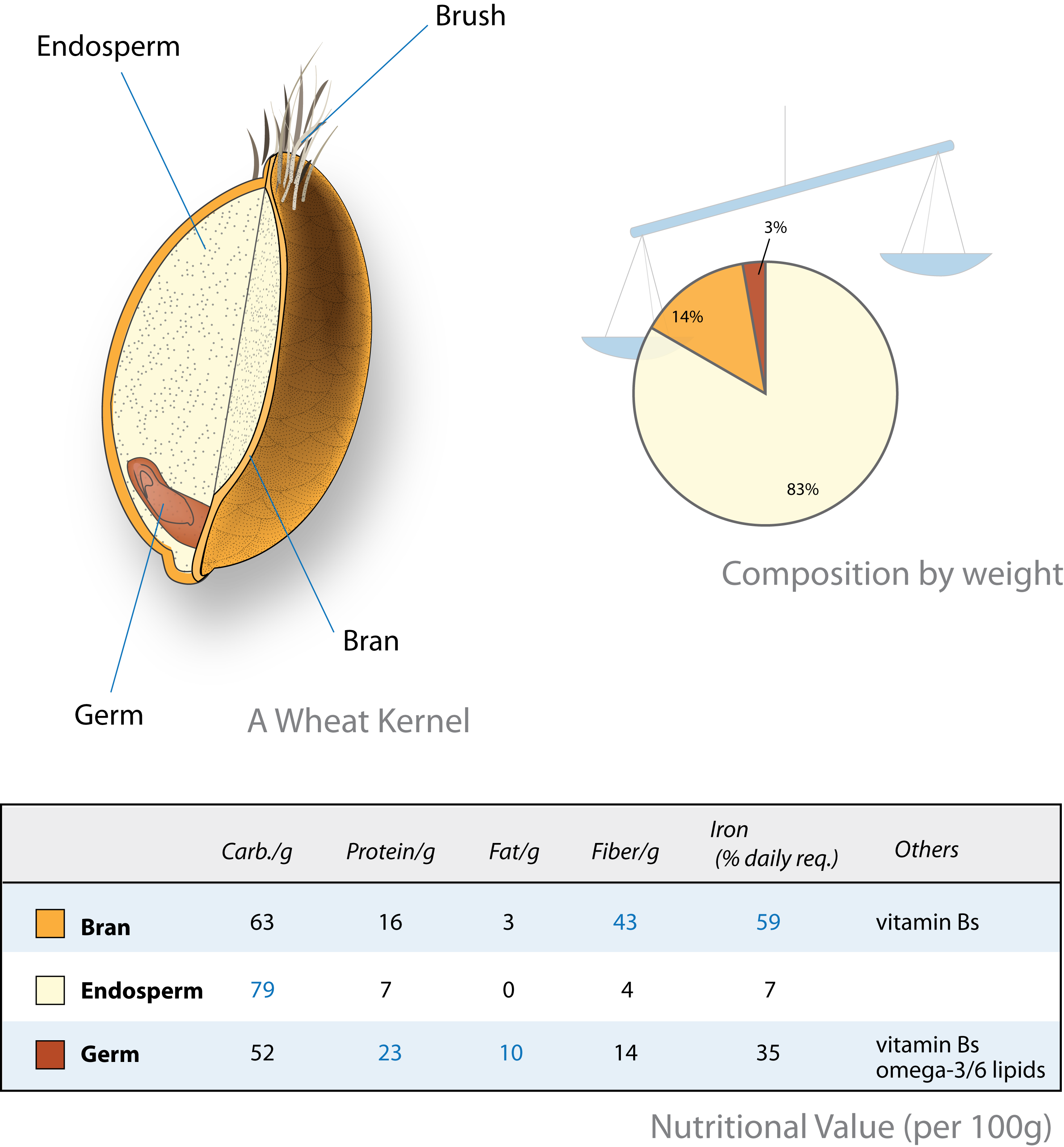
But people widely perceive that soybeans are high in protein and wheat…not so much.
Note too that elsewhere it is stated, again, that protein in some wheat is as high as 15%.
Humans need specific amino acids in certain amounts, or our health can suffer.
Note that by the time wheat is processed, much of the protein has been removed with the bran and the germ.
There are good reasons for this. As in all things, tradeoffs and accommodations for certain factors are made…such as that storing wheat with the bran intact can cause it to become rancid.
This is absolute nonsense I used to grow maize and wheat and other crops for grain . we tried to grow biscuit wheat that has to have a low protein value to make top quality biscuit flour . We could not get our protein down low enough and our wheat had to be sold to the feed market for chickens and pork production .The reason was that our soils were to rich in nitrogen and we did not apply any artificial nitrogen to the wheat .The farmers in the South Island of New Zealand could grow quality biscuit wheat as their soils did not have the organic matter that ours did . Adding some nitrogen would soon lift the protein in any crop any where in the world .These people are so ignorant of basic crop husbandry
+++++
Thanks for that.
They do not seems to even know much about actual nutrition, about wheat and the various varieties and uses, nor about the normal variations as the causes and usefulness of such.
About all they do seem to know is that CO2 is very bad and everything about it is harmful.
I recall back in the 1990s when the few vocal skeptics then objecting to CAGW alarmism began to point out the benefits of CO2, and the next thing anyone knew, studies were released which purported to show that CO2 increases cause weeds to grow faster, but not useful plants trees or crops!
An obvious lie and not even remotely plausible, the warmistas nevertheless grabbed onto this lie and in five minutes it became what the scientifically obtuse call a “scientific fact” in the eyes of the gullible, the credulous, and the disingenuous.
We see the lack of background knowledge in all things alarmists do and say…complete ignorance of Earth history or even human history among those who supposedly are experts on the long term consequences of higher CO2, lack of the basic knowledge on subjects such as chemistry and biology, or concepts such as homeostasis, or on the part of the people who purport to be experts on the biological consequences of how changing water chemistry affects the ability of aquatic organisms to thrive, just to cite a few examples.
Knowing what they are talking about, or getting things right, or even keeping the various parts of the narrative internally consistent…these things matter not a bit to warmistas.
Getting the next grant and publishing the next barrel of alarmist pigslop nonsense is all that really matters.
It may be worse than we thought. We’re all going to die!
That may be the only true statement that the warmistas have ever made.
Here is a study that says the opposite.
http://www.co2science.org/articles/V20/jul/a5.php
Dear Harvard School of Public Health: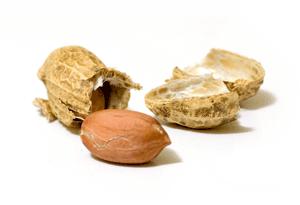
The answer to your protein deficiency problem is one peanut. You claim high CO2 concentrations will reduce the protein content of rice by 7.6%. A cup of rice contains 4.3 g of protein. Hence, it will decrease by 0.3 g. About 26% of peanuts weight is protein. One peanut weighs 2.6 g and its protein is 0.7 g. Twice more than enough to fill your protein deficiency. Why is Harvard worrying about peanuts?
Why would you eat wheat for protein? Protein exists only in trace amounts. Added to that, increased protein in wheat is usually a sign a plant stress. One way to increase protein content is to subject the wheat to drought conditions.
you don’t eat wheat or rice for protein…
you eat it because that’s what you’ve got/can afford…
unlike UK or USA there are large parts of the world where they are on a staple diet… a few staple foods is what they eat/grow/can afford
if the protein content in a staple food goes down…
Do you read what you type? So you get plenty of “protein”, from life-stock I guess in the UK. That planet destroying food source that you can afford?
Griff,
It appears that you are as basic information challenged regarding nutrition as on all other topics about which you consider yourself qualified to comment.
It is impossible to subsist on wheat or rice alone. At a minimum you need a legume to make complete protein with the grains, plus sources of other nutrients.
If I’m a poor person subsisting largely on grains and legumes for protein, with the odd bug, then I’d be happy to have more CO2 in the air, making C3 plants 30% more abundant. If indeed the rice, wheat and barley had proportionately a little less nitrogen (not in evidence in the real world), it wouldn’t matter because I have so much more of it to eat for the same price, and the legumes I need to eat with the grains will contain more amino acids, thanks to more CO2.
Dear Mr. Newark,
Can I call you Hell?
Please look up some basic facts before the write.
If took even ten seconds to look it up, you would find that the protein in wheat is the largest single source of protein in the world food supply.
Since when is 10% to 15 % a trace amount?
Wheat is second only to soybeans for protein content among staple crops.
In fact, the amounts of protein in these overlap, when one accounts for variability…all things exist in a range of values.
The bran and germ removed during processing of wheat are a major component of some animal feeds.
Plus you confuse poor Mrs. Griff when he disagrees with your misapprehensions but does so for the wrong reasons.
The amount of protein a person “needs” in a day is far below what most easily get from foods.
Most of human caloric intake requirements are for the purpose of cellular metabolism…we burn it for the energy we need.
Protein is not required for this, in fact it is not an efficient way to get calories…our bodies need to expend energy to get the energy out of protein.
Which is why high protein diets cause one to lose weight.
The same is true of fats…we need to convert it chemically in our bodies in order to burn it or even store it.
Which is why most fat stored in our body is from consumed carbs and sugars…not from fat or protein.
We need some protein, but you do not need to know much, to know that only starving people do not get enough of it.
And if the protein content goes down by 7% but the amount that can be grown goes up by twice that, or the price goes down by 30%, are you ahead or behind, nutritionally speaking.
But none of this matters anyhow…the story is made up bullshit, like everything warmistas say.
It is amazing to see how dumb and easily cowed people can be.
Let them eat meat!
Griff would just love everyone else descend into energy and food poverty. Love you too Griff!
How did the dinosaurs thrive then?
Few grains in their diet.
Grass did evolve in the Late Cretaceous, but it wasn’t a big part of the flora.
In 2005, grass phytoliths were found in dino dung from the end of the Cretaceous:
https://www.livescience.com/3912-dung-reveals-dinosaurs-ate-grass.html
Previously, there was no evidence for grass from the Mesozoic. So only toward their demise did nonavian dinos dine on grass.
Apropos of CO2, the two main clades of grasses (aside from small groups which diverged early in grass evolution) are starkly divided by their photosynthesis pathways. The PACMAD clade (sugar cane, corn, sorghum and millet) contains all those grass species which have evolved C4 pathways (repeatedly), plus many which retain the ancestral C3 pathway. Its sister BOP clade (named for bamboo, rice and the Pooidae, the “cool season” grasses like wheat, oats, rye and barley) is all C3.
C4 and CAM photosynthesis evolved in response to the cooling and drying of the world during the Oligocene, Miocene, Pliocene and Pleistocene Epochs, accompanied by dangerously lowering CO2 levels. They can get by on remarkably little CO2.
Yeah, but what the public really wants to know is how will these changes affect the alcohol content in my beer?
Less protein, more starch, means your beer will have more “kick” and be less cloudy.
That is, you will have better beer.
You are welcome, BTW. 🙂
“They found that under elevated CO2 concentrations, the protein contents of rice, wheat, barley, and potatoes decreased by 7.6%, 7.8%, 14.1%, and 6.4%, respectively.”
How much elevation? 2%, 10%, 500%, google %? This detail should be included in the report otherwise it is useless.
As obesity and gluttony are the major problems facing the “health” of Americans today…
I say that as an overweight overfed American, BTW. I do not come at this issue “from a distance”.
Even the poor in the USA are frequently overfed.
The whole point is silly. The protein we need is trivial compared to the supply.
Most of the world suffers from way too much food and too much protein, not a shortage
Those places with shortage have political issues, not technical ones.
This despicably twisted piece of propaganda shows the desperate and craven lengths the Climagesterium will go to to hide the inconvenient fact of global greening due to CO2.
‘the populations of 18 countries may lose more than 5% of their dietary protein by 2050’
I don’t care who you are, that’s SCARY!!!
We should immediately ban the use of elevated CO2 levels in greenhouses. This is offensive, exposing innocent plants to a toxic gas. This must stop, now!