From the “well maybe there was a hiatus after all” walkback department. Even Mann is on board with this paper.

By MICHAEL BASTASCH AND DR. RYAN MAUE
More importantly, the paper discusses the failure of climate models to predict or replicate the “slowdown” in early 21st century global temperatures, which was another oft-derided skeptic observation.
“In the early twenty-first century, satellite-derived tropospheric warming trends were generally smaller than trends estimated from a large multi-model ensemble,” reads the abstract of Santer’s paper, which was published Monday.
“Over most of the early twenty-first century, however, model tropospheric warming is substantially larger than observed,” reads the abstract, adding that “model overestimation of tropospheric warming in the early twenty-first century is partly due to systematic deficiencies in some of the post-2000 external forcings used in the model simulations.”
The paper caught some prominent critics of global climate models by surprise. Dr. Roger Pielke, Sr. tweeted “WOW!” after he read the abstract, which concedes “model tropospheric warming is substantially larger than observed” for most of the early 21st Century.
It’s more than a little shocking.
Santer recently co-authored a separate paper that purported to debunk statements EPA Administrator Scott Pruitt made that global warming had “leveled off.” But Santer’s paper only evaluated a selectively-edited and out-of-context portion of Pruitt’s statement by removing the term “hiatus.”
Moreover, climate scientists mocked Texas Republican Sen. Ted Cruz for talking about the global warming “hiatus” during a 2015 congressional hearing. Instead, activist scientists worked hard to airbrush the global warming slowdown from data records and advance media claim that it was a “myth.”
Santer and Carl Mears, who operate the Remote Sensing System satellite temperature dataset, authored a lengthy blog post in 2016 critical of Cruz’s contention there was an 18-year “hiatus” in warming that climate models didn’t predict.
They argued “examining one individual 18-year period is poor statistical practice, and of limited usefulness” when evaluating global warming.
“Don’t cherry-pick; look at all the evidence, not just the carefully selected evidence that supports a particular point of view,” Santers and Mears concluded.
Cruz’s hearing, of course, was the same year the National Oceanic and Atmospheric Administration (NOAA) released its “pause-busting” study. The study by lead author Tom Karl purported to eliminate the “hiatus” from the global surface temperature record by adjusting ocean data upwards to correct for “biases” in the data.
Democrats and environmentalists praised Karl’s work, which came out before the Obama administration unveiled its carbon dioxide regulations for power plants. Karl’s study also came out months before U.N. delegates hashed out the Paris agreement on climate change.
Karl’s study was “verified” in 2016 in a paper led by University of California-Berkeley climate scientist Zeke Hausfather, but even then there were lingering doubts among climate scientists.
Then, in early 2016, mainstream scientists admitted the climate model trends did not match observations — a coup for scientists like Patrick Michaels and Chip Knappenberger who have been pointing out flaws in model predictions for years.
John Christy, who collects satellite temperature data out of the University of Alabama-Huntsville, has testified before Congress on the failure of models to predict recent global warming.
Christy’s research has shown climate models show 2.5 times more warming in the bulk atmosphere than satellites and weather balloons have observed.
Now, he and Santer seem to be on the same page — the global warming “hiatus” is real and the models didn’t see it coming.
Santer’s paper argues the “hiatus” or “slowdown” in warming “has provided the scientific community with a valuable opportunity to advance understanding” of the climate system and how to model it.
What’s interesting, though, is Santer and his co-authors say their paper is “unlikely to reconcile the divergent schools of thought regarding the causes of differences between modeled and observed warming rates.”
In other words, the “uncertainty monster” is still a problem.
Reprinted via CC license from the Daily Caller News Foundation
The paper:
Causes of differences in model and satellite tropospheric warming rates
Benjamin D. Santer, John C. Fyfe, Giuliana Pallotta, Gregory M. Flato, Gerald A. Meehl, Matthew H. England, Ed Hawkins,
Michael E. Mann, Jeffrey F. Painter, Céline Bonfils, Ivana Cvijanovic, Carl Mears, Frank J. Wentz, Stephen Po-Chedley, Qiang Fu & Cheng-Zhi Zou
Abstract:
In the early twenty-first century, satellite-derived tropospheric warming trends were generally smaller than trends estimated from a large multi-model ensemble. Because observations and coupled model simulations do not have the same phasing of natural internal variability, such decadal differences in simulated and observed warming rates invariably occur. Here we analyse global-mean tropospheric temperatures from satellites and climate model simulations to examine whether warming rate differences over the satellite era can be explained by internal climate variability alone. We find that in the last two decades of the twentieth century, differences between modelled and observed tropospheric temperature trends are broadly consistent with internal variability. Over most of the early twenty-first century, however, model tropospheric warming is substantially larger than observed; warming rate differences are generally outside the range of trends arising from internal variability. The probability that multi-decadal internal variability fully explains the asymmetry between the late twentieth and early twenty-first century results is low (between zero and about 9%). It is also unlikely that this asymmetry is due to the combined effects of internal variability and a model error in climate sensitivity. We conclude that model overestimation of tropospheric warming in the early twenty-first century is partly due to systematic deficiencies in some of the post-2000 external forcings used in the model simulations.
https://www.nature.com/ngeo/journal/vaop/ncurrent/full/ngeo2973.html
Ryan Maue this morning on Twitter:
https://twitter.com/RyanMaue/status/877173782858924033
What the heck is firelight, and why do you use that term?
And 80% of the sun’s firelight ought to still try to warm the surface. OTOH, the surface will still be radiating as much as it did before. That’s what I would call cooling.
Firelight kinda reminds me of Tom Swift in the Caves of Nuclear Fire, http://www.tomswift.info/homepage/nucfire.html
On 16 October,2014 the Australian Broadcasting Corporation broadcast the Catalyst program, ” Global Warming Pause.
See http://www.abc.net.au/catalyst/stories/4107264.htm
Two of the co-authors of the Santer et al 2017 paper, English and Meehl were interviewees together with Kevin Trenbath opposed to Judith Currie, Garth Paltridge and others.
Unsurprisingly, the conclusion of the program was ,” all things considered, there was no warming pause.”
The prospects of any apology, correction or clarification are nil.
Does this mean I have to stop believing in the pause?
Getting the history right to getting the climate conclusions correct;
http://www.aim.org/aim-column/why-the-russians-conceived-the-global-warming-scam/?utm_source=AIM+-+Daily+Email&utm_campaign=Daily%20Email%20Jun-20-2017&utm_medium=email
When Russian collusion was daily, mainstream NYTimes backed and lingers to this day.
A new phobia “Homeostasisphibia”. It could catch on
* Homeostasisphobia
Johnny come lately. Santer must have recognized the divergence in model simulations and real world observations at least a decade ago: simply couldnt let go of the funding gravy train. Congress needs to get Trump’s proposed budget passed. Cuts are on the way. MAGA
For at least the ;last 5 years I have been arguing something similar on my web site – http://www.climatedata.info. In particular in a blog post almost five years ago I identified the significance of the AMO in global temperature. You can see it at:
http://www.climatedata.info/discussions/blogger/index.php?id=3913438606057810510
“Because observations and coupled model simulations do not have the same phasing of natural internal variability, such decadal differences in simulated and observed warming rates invariably occur.”
It’s not complicated to extrapolate a 65-69 year AMO period envelope, they would have a natural variability amplitude error rather than a phasing error. That’s the price to pay for hiding the 1970’s decline.
“Here we analyse global-mean tropospheric temperatures from satellites and climate model simulations to examine whether warming rate differences over the satellite era can be explained by internal climate variability alone. We find that in the last two decades of the twentieth century, differences between modelled and observed tropospheric temperature trends are broadly consistent with internal variability. Over most of the early twenty-first century, however, model tropospheric warming is substantially larger than observed; warming rate differences are generally outside the range of trends arising from internal variability.”
Again suggesting a Nat Var cycle amplitude error, and a too rapid modelled warming trend.
Here is some pertinent information on Mr. Ben Santer:
http://www.breitbart.com/big-government/2017/06/20/delingpole-the-pause-in-global-warming-is-real-admits-climategate-scientist/
“The fact that Ben Santer is involved in this embarrassing retraction – his admission on the Pause is bad enough, but what the paper says about the unreliability of the computer models is breathtaking in its implications – will be particularly piquant to those who remember his prominent role in the Climategate emails.
Santer revealed himself to be one of the nastier and more aggressive members of Michael Mann’s “Hockey” team when he emailed one of his colleagues:
Next time I see Pat Michaels at a scientific meeting, I’ll be tempted to beat the crap out of him. Very tempted.
(Climatologist Pat Michaels, now of the Cato Institute, incurred Santer’s wrath by being one of the first climate scientists to pour cold water on Catastrophic Anthropogenic Global Warming theory. In other words, Michaels made the disgusting, punishment-worthy error of using actual science and being right).
But perhaps Santer’s lowest point was the occasion where he effectively hijacked one of the early IPCC Assessment Reports and ramped up the scaremongering in a way that had rather more to do with political activism than it did to science.
I describe it in my book Watermelons:
Ben who? Well quite. Unless his name rings a bell as the guy from the Climategate emails who wanted to “beat the crap out of” climate sceptic Pat Michaels, you almost certainly won’t have heard of him. Yet in the mid-90s this climate modeling nonenity was somehow placed in the extraordinary position of being able to dictate world opinion on global warming at the stroke of a pen.
He achieved this in his role as “lead author” of Chapter 8 of the scientific working group report on the IPCC’s Second Assessment Report (SAR). Nothing to write home about there, you might think, except that Santer was personally responsible for by far the most widely reported sentence in the entire report: the one from the Summary for Policy Makers (the only part of the IPCC’s Assessment Report most people actually bother to read) claiming “the balance of evidence suggests that there is a discernible human influence on global climate.”
But was this line actually true? Was this really a fair summary – the kind of summary the IPCC purports rigorously and definitively to give of us – of the general state of scientific understanding at that particular moment? Er, well not according to some of the scientists who’d contributed to that chapter of the report, no.
The original version of the chapter – as agreed on and signed off by all 28 contributing authors – expressed considerably more doubt about AGW than was indicated in Santer’s summary. It included these passages:
“None of the studies cited above has shown clear evidence that we can attribute the observed changes to the specific cause of increases in greenhouse gases.”
“No study to date has positively attributed all or part (of the climate change observed) to (man-made) causes.”
“Any claims of positive detection and attribution of significant climate change are likely to remain controversial until uncertainties in the total natural variability of the climate system are reduced.”
“When will an anthropogenic climate be identified? It is not surprising that the best answer to the question is “We do not know.”
Strangely, none of these passages made it to the final draft. They were among 15 deleted after the event by Santer, who also inserted a phrase entirely of his own to the effect that “the body of statistical evidence” now “points to a discernible human influence on climate.” In other words the chapter did not represent the “consensus” position reached by 28 scientists. What it in fact represented was the scientifically unsupported opinion of one man, Benjamin D Santer.”
end excerpt
Ben Santer is one of the guys who just “made it up out of thin air” when promoting claims that humans are causing the climate to change. He used his position to fool and scare millions of people into doing irrational things like spending billions of dollars on windmills.
The Deceivers should be punished for spreading these costly, harmful lies. Look at the problems they have caused.
The simple reason why the models are wrong is that all the establishment scientists make the same gross error of scientific judgement and ignore the millennial temperature cycle which peaked in 2003/4.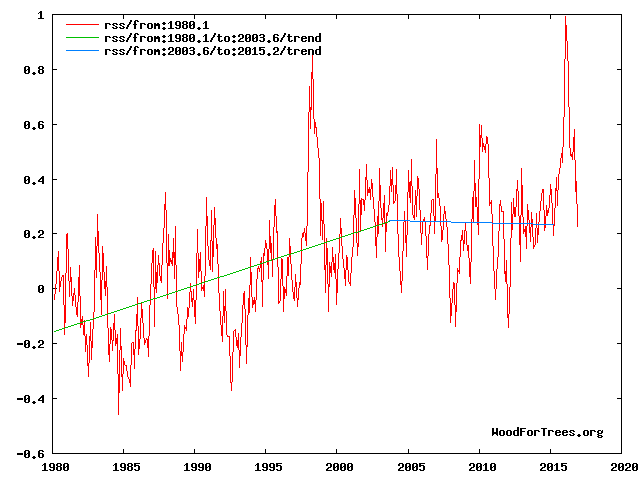

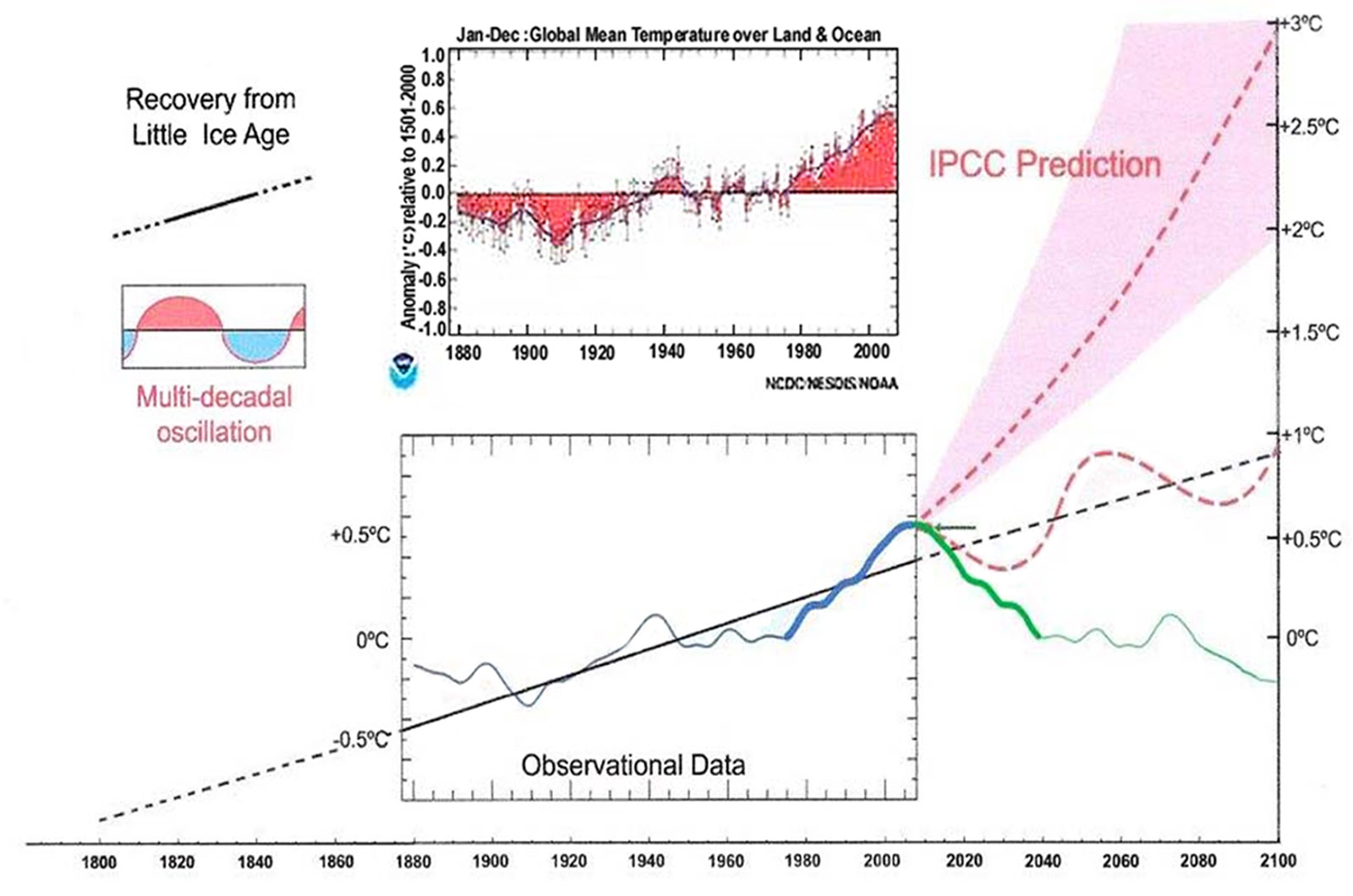
Climate is controlled by natural cycles. Earth is just past the 2004+/- peak of a millennial cycle and the current cooling trend will likely continue until the next Little Ice Age minimum at about 2650.See the Energy and Environment paper at http://journals.sagepub.com/doi/full/10.1177/0958305X16686488
and an earlier accessible blog version at http://climatesense-norpag.blogspot.com/2017/02/the-coming-cooling-usefully-accurate_17.html
Here is the abstract for convenience :
“ABSTRACT
This paper argues that the methods used by the establishment climate science community are not fit for purpose and that a new forecasting paradigm should be adopted. Earth’s climate is the result of resonances and beats between various quasi-cyclic processes of varying wavelengths. It is not possible to forecast the future unless we have a good understanding of where the earth is in time in relation to the current phases of those different interacting natural quasi periodicities. Evidence is presented specifying the timing and amplitude of the natural 60+/- year and, more importantly, 1,000 year periodicities (observed emergent behaviors) that are so obvious in the temperature record. Data related to the solar climate driver is discussed and the solar cycle 22 low in the neutron count (high solar activity) in 1991 is identified as a solar activity millennial peak and correlated with the millennial peak -inversion point – in the RSS temperature trend in about 2004. The cyclic trends are projected forward and predict a probable general temperature decline in the coming decades and centuries. Estimates of the timing and amplitude of the coming cooling are made. If the real climate outcomes follow a trend which approaches the near term forecasts of this working hypothesis, the divergence between the IPCC forecasts and those projected by this paper will be so large by 2021 as to make the current, supposedly actionable, level of confidence in the IPCC forecasts untenable.”
See Fig 4 from the link.
The RSS cooling trend in Fig. 4 and the Hadcrut4gl cooling in Fig. 5 were truncated at 2015.3 and 2014.2, respectively, because it makes no sense to start or end the analysis of a time series in the middle of major ENSO events which create ephemeral deviations from the longer term trends. By the end of August 2016, the strong El Nino temperature anomaly had declined rapidly. The cooling trend is likely to be fully restored by the end of 2019.
For an obvious example if the inflection point see Fig 11
And for the forecast of the coming cooling and comparison with the IPCC fantasies see Fig 12
Fig. 12 compares the IPCC forecast with the Akasofu (31) forecast (red harmonic) and with the simple and most reasonable working hypothesis of this paper (green line) that the “Golden Spike” temperature peak at about 2004 is the most recent peak in the millennial cycle. Akasofu forecasts a further temperature increase to 2100 to be 0.5°C ± 0.2C, rather than 4.0 C +/- 2.0C predicted by the IPCC. but this interpretation ignores the Millennial inflexion point at 2004. Fig. 12 shows that the well documented 60-year temperature cycle coincidentally also peaks at about 2004.Looking at the shorter 60+/- year wavelength modulation of the millennial trend, the most straightforward hypothesis is that the cooling trends from 2004 forward will simply be a mirror image of the recent rising trends. This is illustrated by the green curve in Fig. 12, which shows cooling until 2038, slight warming to 2073 and then cooling to the end of the century, by which time almost all of the 20th century warming will have been reversed.
Taken directly from the transcript of the Congressional Hearing on Climate Science, 29 March 2017:
Dr. MANN: “Well, thanks for the question, and I would say, you
know, that statement that the satellite data somehow disprove
human-caused climate change, it’s what I can an RUS. It’s a ridiculously
untrue statement. And the surface and near-surface temperature
records—in fact, if we can show Exhibit A from my written
statement here, it shows that all of the surface and near-surface
temperature records agree that there’s a steady long-term pattern
of warming. That’s true for the temperatures measured by
thermometers at the surface, the balloon measurements in the
lower atmosphere, and both John’s satellite data set and other estimates
from the same satellite data.
Now, I should point out that that’s John’s satellite data set after
it’s been corrected for numerous errors that he had made over the
years and which came to light because of other attempts by other
researchers to reproduce his results, and ultimately now with those
corrections, his satellite record is basically consistent with these
other records. They all show long-term warming, and I would add,
by the way, that if he is right, that the mid and upper troposphere
are not warming as fast as the models say, and there’s a paper just
out a week ago by Ben Santer, Susan Solomon, Presidential Medal
of Science winner, a very austere team of climate scientists that
has shown that his claim of the observations not showing the
model predicted warming in the mid and upper troposphere is
largely an artifact, an artifact of the fact that he’s mixing in stratospheric
temperatures. The stratosphere actually cools. In global
warming, the lower part of the atmosphere including where we
live, the troposphere warms, the stratosphere cools. His satellite estimates
actually smear some of that cooling stratosphere into what
he’s calling the upper troposphere, and that’s the reason for the
discrepancy, and if he was right that it was warming less quickly
than the models predict, it would actually imply the opposite of
what he claimed earlier. It would imply a higher climate sensitivity
because it turns out that one of the negative feedback, one of the
ameliorating effects, so-called lapse rate feedback, would not be as
strong as we think it is, so it would actually mean that the climate
is even more sensitive to increasing greenhouse gas concentrations.”
Given that the paper published yesterday would have almost certainly have been written already when Dr Mann gave his testimony, I am finding it difficult to reconcile his testimony with his name being on the paper.
Clarification of the paper:
Nature Geoscience (2017) doi:10.1038/ngeo2973
Received 23 December 2016 Accepted 22 May 2017 Published online 19 June 2017
I find it strange Dr. Mann didn’t mention any of this at the hearing, his argument then seems to be completely at odds with a paper with his name on it that was written and submitted to a journal for review 3 months earlier.
That’s because he’s an activist weasel, not a scientist.
Mann is a weasel and “scientist” based on his college degree, not his work.
= he’s a weaseltist
This post presented as Mann lawsuit bait.
Mann owes his entire career to the IPCC catchy graph to dupe people for ten years. A lead author just out of grad school?
David Fair, anybody that knows anything about climate science knows who Michael Mann is. Nobody in climate science knows who David Fair is.
..
Nuff said
And glad of that I am, Michael darby! My reputation is intact among honest people.
Richard Greene, several scientists using different proxies and different statistical techniques have replicated Mann’s findings. How do you address that?
Ha, ha, ha, ha …..
Correct David Fair, having no reputation is a good thing for you.
Well, Michael darby, another twit on the climate threads, I see.
Is it correct for me to conclude that by calling me a “twit” that you’ve got nothing more than name calling in your line of reasoning?
No, Michael darby, calling you a twit is my estimate of the futility of carrying on a rational discourse with you. You throw out B.S., seemingly at random.
David Fair, calling people names hurts your “reputation.”
Not with those familiar with the ramblings of the twits.
I thought RUS was a rodent of unusual size (The Princess Bride, sorry no clip). Appropriate? (ad-hom, I know, but I couldn’t resist. . . )
To me this confession that a hiatus exists and covers the beginning of the twenty-first century is just the beginning. What is left out is the existence of a hiatus in the eighties and nineties as well. In 2008 I was working on my book (What Warming?) and noticed that global temperature in the eighties and nineties had been steady for eighteen years. I used those data in figure 15 in the book but was amazed to see flat temperature section become an upsloe warming section. I protested but was ignored. So when my book was printed I added a note about this to the preface of the book. That too was ignored and this phony warming is still there as part of the official temperature curve used by the IPCC, NCDC, NOAA and the Met Office. In 1979 I had a paper called “Karl et al. do not know that we have two hiatuses, not one” on fhe web site WUWT (Watts Up With That). When the paper came out a snutnose by the name of Bob Tisdale accused me of having fabricated the data and shot off his mouth like true believer in global warming. . I have a statement from NASA proving that there was no warming there at that time.
Arno Arrak you do not understand modern climate “science”.
Let me ‘splain it to you:
The future climate is known with great certainly — runaway global warming.
The past climate is constantly changing.
Just when you think you see a hiatus, it will slowly disappear and never be seen again.
Based on my ten year analysis of monthly average temperature data, when you first receive the data you should NOT use it for anything.
Print it out and throw the printout it in a drawer for 20 years.
After aging the data for 20 years, you will find it was way off originally, and had to be repeatedly revised to better match the climate models.
A hiatus is not a hiatus — it is an error in the measurements that will gradually be “corrected” with small adjustments every year.
We know it is an error because it doesn’t match the computer model projections.
Everybody who is anybody knows the temperature can’t remain flat while CO2 rises.
Who do you trust — ordinary people, some probably drunk, reading outdoors thermometers, or just guessing the numbers because it’s too cold to go outside …. or the work of brilliant scientists using supercomputers?
How could anyone trust ordinary people over supercomputers?
A hiatus — now you see it … then it’s gone!
I really think golbal warming is a joke and has nothing to do with us humans on earth , now i do think it has to do w nature weather changes people all the time , it prob did many thousands of years ago and now this turn of the centry its coming around again or shifting again we cant control mother nature let mother nature take its course.
Sez the Mann-Bear…
“We conclude that model overestimation of tropospheric warming in the early twenty-first century is partly due to systematic deficiencies in some of the post-2000 external forcings used in the model simulations.”
Doesn’t look to me like he’s admitting the models are bad. The full Science article is paywalled, so I didn’t read it, but looking at the references I found several that claim volcanic aerosols (aka forcing) in the stratosphere are increasing since 2000. That includes Susan Solomon’s search for an excuse for the Pause, and Mann et al. seem to be buying into it. I’d guess the full text of the article (again, I have better uses for my money that to pay for this cr*p) claims that the “systematic deficiencies in some of the post-2000 external forcing” means they should have thrown in Solomon’s fake volcanism.
BTW, that’s the same Solomon who disputed my claim that the absence of Chichon and Pinatubo cooling after 1995 is responsible for most of the warming since then. Now she claims that volcanoes less than a tenth as large can cause a Pause, and Mann et al. seem to be jumping on board.
They’re not saying the models don’t work, but will simply change the selective inputs to make them “work better”.
But again, i haven’t read the full article.
I mistrust models.
I have no special mistrust of climate models, I mistrust all models of complex systems with no experimental validation. Here are six reasons why.
Reason #1: My cousin runs an advisory service for institutional investors (hedge funds, retirement funds, stock market funds etc. etc.) Here is the beginning of his latest post 16 June ’17
”
There were 3 great reads yesterday. First was Neil Irwin’s article in the NY Times “Janet Yellen, the Fed and the Case of the Missing Inflation.” He points out that Yellen is a labor market scholar who anticipated the sharp decline in the unemployment rate. However the models on which the Fed has relied anticipate higher levels of inflation. Yet every inflation measure that the Fed uses has fallen well short of the Fed’s 2% stability rate. If they continue raising short-term rates in the face of low inflation, then “real” rates could restrain future economic growth.
Second was Greg Ip’s article “Lousy Raise? It Might Not Get Better.” Greg makes the point that tight labor markets are a global phenomenon in many industrialized countries, yet wage inflation remains muted. Writes Greg “If a labor market this tight can’t generate better pay, quite possibly it never will in Germany & Japan.”
Third was an article by Glenn Hubbard (Dean of Columbia Business School & former chairman of the Council of Economic Advisors under George W. Bush). His Wall Street Journal op-ed was titled “How to Keep the Fed from Following its Models off a Cliff.” Hubbard suggests that Fed officials should interact more with market participants and business people. And Fed governors should be selected because of their varied life experiences, and they should encourage a healthy skepticism of prevailing economic models.
Serious money was spent developing these models. Do you think that climate is in some way simpler than the US economy, so that they are more likely to be accurate? I do not.
Reason #2: Americans are getting fatter yet living longer, contradicting the model that being mildly overweight is bad for you. It is far too long to go into so here’s the link — https://luysii.wordpress.com/2013/05/30/something-is-wrong-with-the-model-take-2/.
The first part is particularly fascinating, in that data showed that overweight (not obese) people tended to live longer. The article describes how people who had spent their research careers telling the public that being overweight was bad, tried to discount the data. The best quote in the article is the following ““We’re scientists. We pay attention to data, we don’t try to un-explain them.”,
Reason #3: The economic predictions of the Congressional Budget Office on just about anything –inflation, gross national product, economic growth, the deficit — are consistently wrong — http://www.ncpa.org/sub/dpd/?Article_ID=21516.
Reason #4: Animal models of stroke: There were at least 60, in which some therapy or other was of benefit. None of them worked in people. It got so bad I stopped reading the literature about it. We still have no useful treatment for garden variety strokes
Reason #5: The Club of Rome, — dire prediction based on a computer model which got a lot of play in the 70s. For details see — https://luysii.wordpress.com/2017/06/01/a-bit-of-history/. The post also has a lot about “The Population Bomb” and its failed predictions and also a review of a book about “The Bet” between Paul Ehrlich and Simon
Reason #6: Live by the model, die by the model. A fascinating book “Shattered” about the Hillary Clinton campaign, explains why the campaign did no polling in the final 3 weeks of the campaign. The man running the ‘data analytics’ (translation: model) Robby Mook, thought the analytics were better and more accurate (p. 367).
Depends upon what you mean by “model”. Computer programs of course can be GIGO, but the models which supercomputers were designed to run, ie reactions in hydrogen bomb explosions, do work. Unfortunately, the supercomputers in Colorado were hijacked by “climate scientists”, who aren’t scientists and don’t know spit, so to speak, about the climate.
The Copernican model of the “universe” was superior to the Ptolemaic, but it required tweaks, which corrections came before earth’s motion in the solar system could be directly observed. So that model worked.
Various models of the atom have gotten better with time as well.
#2 is wrong
Getting fatter does not cause living longer.
Medical advances and fewer deaths in childbirth cause longer average lifespans.
In fact, at least US baby boomers are LESS HEALTHY than their parents at the same stages of life.
The underweight people include those with cancer who lose weight as they are dying.
That skews the averages.
#6 is wrong.
I didn’t care for the book Shattered because I din’t trust the quotes to be accurate, and nothing was sourced so it could be verified.
The polls in 2016 were not as accurate as usual because some Trump supporters felt threatened and decided to keep their opinions secret.
But Hillary’s internal polls showed the mid-west states she eventually lost were too close to call.
My source for that claim is now deleted Tweets by the man in charge of the polls– angry that Shrillary blamed him (among her 24 excuses for losing) — he said she decided to ignore poll data that was pretty good.
Maybe she ran out of energy for campaigning and it was easier to slow down and assume she was going to win.
Everybody else did.
Trump was like a whirling dervish in the last week, acting as if it wasn’t over until it was over
(from my favorite New York City philosopher Yogi Berra) .
Agree. As I said ” I mistrust all models of complex systems WITH NO EXPERIMENTAL VALIDATION.”
Without validation they are not models — they are opinions.
Quote: “Tropospheric warming not as large as predicted”.
You can say that again. Has there been any warming at all? I have been searching for long term data on this, but is does not seem to exist.
One of the best datasets is from CERES, and this article by Eshenbach indicates that the data from CERES is good. But CERES shows no tropospheric warming at all. (Measureing downwelling LR radiation, is the same as measuring tropospheric temperatures.). See Eschenbach’s fig 5. But CERES data does not go back that far.
Eschenbach article…
https://wattsupwiththat.com/2015/02/21/the-tao-calculated-surface-datasets
But…
The big but here, is that if there has been no tropospheric warming, then CO2 CANNOT be increasing the greenhouse effect. The greenhouse effect is completely dependent upon tropospheric warming, so if there has been no increase in temperature, then increasing CO2 is doing NOTHING to warm the surface.
This confirms that AGW does not exist – well, not at least from CO2.
A more likely culprit is industrial soot settling on ice sheets. If ice sheets melt, and insolation absorbtion increases, this can have a far greater effect on surface temperatures than C02.
Ralph
Great comments all, and great to see the site thriving like this while Anthony takes his well earned vacay.
Great comment from TA about Santer’s role in AR2, inserting on only his say so, the “discernible human fingerprint” that hadn’t been discerned by the whole WG1 staff and contributors. Santer, the man, is truly an evil player in all this.
I so want to think that this paper is something of a climb down from the consensus position, but I do fear it actually signals something else.
I think this is the setup, and next comes the punch line. The setup is to agree via this paper that there has been a pause/hiatus. But I think the real meaning of “partly due to systematic deficiencies in some of the post-2000 external forcings used in the model simulations.” is that there is a paper coming that will lay out those forcings, correct that deficiency.
Maybe it will be some new version of the aerosols argument, more coal burning in China or maybe this time in India, or maybe a rerun of the more volcanism argument, or maybe some new argument linked to generating more aerosols in another way.
Santer and Mann are just too invested in this, if there indeed is some kind of walkback coming from some of the alarmist camp, no way will it be led by those two. Too deeply committed. Wish I didn’t think it was so, but I think there’s another shoe to drop.
tw
The aerosols were here from 1940 to 1975, when they suddenly disappeared.
My theory is they took a wrong turn and are out in space somewhere.
There’s no reason they couldn’t make another wrong turn and return to Earth
when they are needed to explain some cooling?
I’ve always been puzzled by how natural climate change suddenly stopped in 1940,
and CO2 took over as the “climate controller” …
(1) Yet big, strong CO2 was overpowered by “aerosols” from 1940 to 1975, and
(2) There was a flat temperature trend from the early 2000’s to 2015.
This is not going according to the theory.
Someone ought to teach CO2 what it means to “control the climate” —
(1) and (2) are simply not acceptable under a good “controller”.
Richard, about 20 years ago, in response to a NOAA graph showing no temperature growth from the 1930’s thru 1980, I had an email exchange with its poster at NOAA. I pointed out that CO2 had risen significantly in that period, but temperatures didn’t start rising until after then. His response was that the U.S. Clean Air Act had so cleaned up the atmosphere that aerosols no longer disguised CO2 warming.
Having no reason to dispute that, I forgot about questioning the global warming meme. That is, until a few years ago. Now I know it is all unfounded modelturbation. Aerosols are whatever an individual modeler wants them to be. Likewise, ECS is whatever an individual modeler wants.
“Our results show that temperature records of at least 17 years in length are required for identifying human effects on global-mean tropospheric temperature.”
Temperature naturally tends to create non-linear dynamics and chaos patterns so maybe more than 17 years? i am guessing maybe 60 or 90. Please see
https://papers.ssrn.com/sol3/papers.cfm?abstract_id=2990384
17 years without warming means nothing.
27 years without warming means nothing.
67 years without warming means nothing.
127 years without warming means nothing.
The “magic number” is 128 years.
Now you give us 128 years without global warming and maybe, just maybe,
one or two warmunists will want to “fine tune ” their 1988 climate model.
The grand question has not been touched in all comments:
“Why did an alarmist paper, which contradicts alarmist warming,
comes out now, 2017?´” ….They could have stayed silent on that
models failed and that models have inherent systemic errors!
……. it is not that those guys found their way back to truth in science,
the aim of the paper is rather well conceived and must have a
strategic aim:
I came up with the following thought: Global temps will go DOWN
the next 2 – 3 years, and those guys already anticipate this.
They therefore decided to take the forward strategy:
“Admit a small error now and call for model corrections”.
This will save them 2 – 3 years later (and temps down) to admit
much larger errors and accusations of lyeing to the public.
The other possibility is that global warming is about to pick up after a 18 year hiatus. I draw your attention to the largest AGW signal in the world, the intensification of the subtropical ridge in the southern hemisphere.
Which has absolutely nothing whatsoever to do with a fourth molecule of CO2 per 10,000 dry air molecules.
Pretty poor misrepresentation of what was in those studies. It is reasonable to review the estimates for the negative and positive forcings.
Don’t try to be funny comrade Harry, it doesn’t suit you.
The subtropical ridge is intensifying, just like the Klimatariat said it would, so there is a strong possibility that the hiatus will come to an end very soon.
So, how does one reconcile this?
https://energyfactor.exxonmobil.com/perspectives/broad-carbon-tax-coalition/?utm_source=email&utm_medium=newsletter&utm_campaign=Perspectives
It used to be that 15 years without “global warming” would falsify the hypothesis. Now essentially no period without it can show the antiscientific dogma false, nor even cooling.
So admitting to the obvious 17-year “hiatus” in GW between the 1999 and 2016 super El Nino peaks no longer has any negative effect on the conveniently unfalsifiable hypothesis. Take out the 2010 El Nino, another totally natural spike, and there was cooling during that interval.
This admission makes “climate scientists” appear more scientific without harming their funding under a more skeptical administration, which appears to be the goal.
Does this mean that Micheal Mann is going to sue himself?