
Guest essay by Eric Worrall
A right wing think tank with members from Chancellor Merkel’s own Christian Democratic Union Party has urged a radical change to German Climate Policy.
CDU right attacks Merkel’s climate crisis
Stand: 03.06.2017 17:19 h
Challenging Merkel: The right CDU-wing “Berlin Circle” denies loud ARD studio a “solitary role in the greenhouse effect” on global warming – and calls for a U-turn in climate policy of Chancellor.
By Arnd Henze, ARD-Hauptstadtstudio
Two days after the decision of US President Donald Trump to cancel the Paris climate agreement, the conservative wing in the CDU also demands a radical change in climate policy for Germany.
In a statement submitted to the ARD Capital Studio, the “Berlin Circle”, which includes numerous federal and communal politicians of the Union, calls for an end to “moral blackmail” by climate research and the “farewell to German special targets” greenhouse gases.
Doubt in scientific models
The declaration was presented today at an internal meeting of the “Berliner Kreis” in the parliamentary groups of the CDU / CSU in the Reichstag in Berlin. The authors, among them Philipp Lengsfeld and Sylvia Pantel, are contesting a “solitary role of the greenhouse effect” and oppose a one-sided negative view of the consequences of global warming.
Thus, “the opportunities associated with the melting of polar sea ice (ice-free northern passage, new fishing opportunities, raw material extraction) are probably even greater than possible negative ecological effects“. The world climatic IPCC had developed into a kind of “world salvation circus”. However, the “increasingly aggressive political objectives, in particular the CO2 reduction targets” were based on the model calculations.
…
Read more (original German): http://www.tagesschau.de/inland/konservative-cdu-klimawandel-101.html
Note: The above was translated with Google Translate, the title was hand tweaked to fix a grammatical mistake
Complaints about the economic and social impact of Germany’s radical green Energiewende policy appear to be on the rise. While it seems likely Energiewende still enjoys substantial public support, critics have blamed the policy, and the extreme electricity price rises driven by the switch to renewables, for hurting poor people.
Green Europe is Killing 40,000 Poor People a Year
by JAMES DELINGPOLE 30 Mar 2016
Europe’s suicidal green energy policies are killing at least 4o,000 people a year.
That’s just the number estimated to have died in the winter of 2014 because they were unable to afford fuel bills driven artificially high by renewable energy tariffs.
But the real death toll will certainly be much higher when you take into account the air pollution caused when Germany decided to abandon nuclear power after Fukushima and ramp up its coal-burning instead; and also when you consider the massive increase in diesel pollution – the result of EU-driven anti-CO2 policies – which may be responsible for as many as 500,000 deaths a year.
But even that 40,000 figure is disgraceful enough, given that greenies are always trying to take the moral high ground and tell us that people who oppose their policies are uncaring and selfish.
…
Read more: http://www.breitbart.com/london/2016/03/30/green-europe-is-killing-40000-poor-people-a-year/
Even the German Left is worried about energy prices, though they refuse to name the reason for the price rises.
Over 300,000 poverty-hit German homes have power cut off each year
2 March 2017
Each year between 2011 and 2015, electricity providers cut off power to at least 300,000 German households who could no longer afford to pay their bills, the government revealed on Thursday.
The number of houses which could not afford electricity payments varied between 312,000 and 352,000. The power cut-offs were normally due to poverty, with people on state welfare very often affected.
Meanwhile in 2015, 44,000 households had their gas supply cut off.
The government announcement – in response to a parliamentary question by Die Linke (the Left Party) – also revealed that between 15.7 percent and 16.7 percent of people in Germany are threatened with poverty.
“Energy poverty in Germany is a silent catastrophe for millions of people, especially in the cold, dark winter months,” said Eva Bulling-Schröter, energy spokeswoman for Die Linke.
…
Read more: https://www.thelocal.de/20170302/over-300000-poverty-hit-german-homes-have-power-cut-off-each-year
Der Spiegel didn’t pull any punches, back in 2013;
Germany’s Energy Poverty
How Electricity Became a Luxury Good
Germany’s agressive and reckless expansion of wind and solar power has come with a hefty pricetag for consumers, and the costs often fall disproportionately on the poor. Government advisors are calling for a completely new start.
By SPIEGEL Staff
September 04, 2013 07:15 PM
If you want to do something big, you have to start small. That’s something German Environment Minister Peter Altmaier knows all too well. The politician, a member of the center-right Christian Democratic Union (CDU), has put together a manual of practical tips on how everyone can make small, everyday contributions to the shift away from nuclear power and toward green energy. The so-called Energiewende, or energy revolution, is Chancellor Angela Merkel’s project of the century.
“Join in and start today,” Altmaier writes in the introduction. He then turns to such everyday activities as baking and cooking. “Avoid preheating and utilize residual heat,” Altmaier advises. TV viewers can also save a lot of electricity, albeit at the expense of picture quality. “For instance, you can reduce brightness and contrast,” his booklet suggests.
…
Chancellor Merkel and other European leaders who support green energy like to portray themselves as secure, a united front against climate skeptics. But the reality is green energy is failing to deliver affordable power, and shows no prospect of ever delivering affordable power.
It is only a matter of time until support for green power collapses world wide, even in committed countries like Germany. The only question is how long Germans and other Europeans will put up with large numbers of poor people and pensioners quietly freezing to death during their long, dark winters.
What happened to those millions of green jobs we were promised?
Amazing what the pols lie about.
Off topic a bit but relevant: When Obama become an Illinois state senator about 1998 or so (dates are my weak point), the state had a one billion dollar budget surplus. Now, Illinois state bonds are one notch above junk and the state is heading towards a Puerto Rican type crisis. The point is, the pols can really, really, screw things up. That is not a theoretical statement.
“What happened to those millions of green jobs we were promised?”
Well there are millions of these subsidised jobs going around and the unemployed deplorables are green with envy so what part of that didn’t you get? You didn’t think there was enough deficit spending to go around for you too did you? The nerve of some deplorables beggars belief!
As an Australian, the chart clearly demonstrates there are not enough people here. Wd need a few million more to get our per capita ratio down.
We have plenty of Muslims you can have. They will likely rape your children and stab you in the face with a 12″ hunting knife but they’re going cheap anyway …
Those members of the CDU-wing “Berlin Circle” responsible for that paper have already been executed at dawn by the Klima-Gestapo.
Many others were sent to the wilderness.
“Germany’s agressive and reckless expansion of wind and solar power has come with a hefty pricetag for consumers, and the costs often fall disproportionately on the poor.”
I think this should be emphasized. All these schemes end up falling disproportionately on the poor. All these green schemes raise electricity prices on the least able to afford the increase. Green reality is not good for poor people. It’s time for some common sense.
And if you point that out to them, the responsible politicians will solve the problem by taxing the middle class to subsidize the poor energy costs.
I’ve seen a figure of 330,000 German households a year disconnected … but as there are 40.2 million German households as of 2014, that means only 0.8% a year are disconnected. It’s hard to find good US figures, but I see suggestions the figure is 5% in the US..
Also,
“the average power bill is a fairly small part of (German) household budgets. Germans consume only a third as much electricity as Americans do. Their power bills are thus not so large.”
https://energytransition.org/2015/05/german-power-bills-low-compared-to-us/
The link makes no sense. We use 400Kw/month for $32.00. With an electric dryer and oven, and electric heat in 30% of the house. We have 3 months frost free. Also use an electric pump for lawn and garden irrigation, and another pump for potable water from a well for the house. We only use 1/3 more electricity than the alleged average German household for 70% less cost.
A comparable German household would not use electric pumps, might not use a dryer and would be less likely to use electric heating or as much of it (high insulation levels). It would also have efficient appliances, LEDs and maybe a solar panel…
So what do they use for water where there is no water system to tap into? And you don’t address how German power bills are actually much more than those in the US, nor to what benefit. Nonsense all the way down.
What is the definition of c/kWh? How is it determined country-wide? I am not aware of any method that would compare cost of electricity truthfully. Germany, or the US, the cost changes from region to region, from season to season (8 cents to 14 cents in one year), the monthly bill contains a dozen of charges that have nothing to do with electricity – it’s the politicians way to collect money such as for renewables subsidies – residential rate, business rate, and dozen of other variables that may change from month to month, let alone year to year. Please someone enlighten me.
Here you are.
https://de.statista.com/statistik/daten/studie/252029/umfrage/industriestrompreise-inkl-stromsteuer-in-deutschland/
https://www.stromauskunft.de/strompreise/strompreise-2016/
Merkel’s shut down of their nuclear plants and replacement by coal plants somehow was never able to rile Obama the coal killer. Obama was a lying jerk who our illustrious left wing press protected ,
even when the facts of his treasonous views were obvious as could be. A nation with an “elite” this stupid and biased makes the hated Confederacy seem a model of constitutional govt, which, by the way, it was, unlike Lincoln’s dictatorship.
Who did they scatterplot? It’s an excellent piece of work.
“Berlin Circle” denies loud ARD studio ” should be: “Berlin Circle” denies according to ARD studio”
What’s so hard about asking the Max Planck Institute to do an unbiased science evaluation of climate models and model predictions? Oh I forgot, this is about politics not real science or fact checking.
Germany didn’t just go with any renewable energy, it went with the highest cost versions of renewable energy back when solar panels were lower efficiency and at least 4x the cost of competitive prices today. And it did so with the highest cost format of solar with mostly rooftop instead of utility scale or community scale. It did help grow and mature the industry, at German expense of course. I also wonder what the cumulative efficiency loss rate is of those old panels over the last 15-20 years.
below is the way I try and sum it all up:
During that time, the world had spent trillions of dollars to subsidize solar and wind power and batteries, yet their combined usage never exceeded 1% of the worlds energy needs. Solar, wind, and batteries have been around for about 80 years, progressing all the time. But, do you really think solar and wind are a viable energy source if they can’t compete by now, even with huge government subsidies? It is also a double whammy because they are wasting wealth (as explained in the next paragraph) and reducing something good, C02 plant food.
You will read articles and reports of low priced solar and wind energy. These reports are not honest and are not adding in all costs of solar and wind when compared to fossil fuels, nuclear, and hydroelectric. Yes, the sun is free and wind is free, but the cost of manufacturing solar and wind plants, the process of changing the sun and wind into energy, the limited time the wind is blowing and the sun is shining, all the problems solar and wind cause to the grid, and many other reasons, a few mentioned below, make solar and wind very expensive, especially when you take into account government subsidies at all levels costing taxpayers. Solar and wind are not concentrated and are weak energy sources. Only about 15% of the solar and wind energy is turned into electrical energy (loss of efficiency and it isn’t sunny or windy 100% of the time), and sometimes solar and wind do not produce energy for days at a time. Solar and wind only produce when available, not when needed. But we need electricity 100% of the time. When they are making comparisons to fossil fuels, often numbers are used as if solar and wind are running 100% of the time without back up, which doesn’t happen. Either expensive batteries are needed, and / or more reliable energy sources (like fossil fuels) are needed as a backup. An extremely wasteful endeavor. In other words, for every extra solar and wind farm, an extra fossil fuel generation plant, and a battery plant needs to be built as back up, most of the time. Ie; two or three plants required verses just one, when you start with solar and wind. With solar and wind, it is not easy to forecast the exact wind speed and gusts, and cloud cover every moment of every day, causing unpredictable erratic interruptions that can destabilize and can crash the grid, requiring all other sources to compensate and synchronize for the complications. Almost always left off of the comparison is the extra cost to build transmission lines that need to be wider and sturdier. It is very expensive to start and stop fossil fuel backup plants to cover for these erratic interruptions. You will often see fossil fuel costs compared using the expensive stop and start prices, because many governments now are requiring solar and wind to have first priority. A huge hidden subsidy for solar and wind, because it forces higher costs on the fossil fuel backups. Most of the world is not windy enough. Or the wind gusts too much and puts surge strain stress on the equipment. Or it is too cloudy or not sunny enough during certain seasons of the year. Solar and wind may work optimally a few hours a day, and sometimes not for days at a time. Solar and wind don’t work below freezing. Solar loses efficiency as it gets hot. Solar and wind farms lose efficiency each and every year. But comparisons are made to fossil fuels when solar and wind are working full time, at optimal levels, optimal locations, optimal conditions, and the plant is new. Fossil fuels plants work optimal almost all the time in almost all locations and in almost all conditions and for many years. Solar and wind farms take up a huge land foot print for how little energy they actually produce, but land prices are not taken into account when comparing to fossil fuel plants. For example, to power Singapore without fossil backup, you would need an area tiled with solar panels 13 times the size of Singapore. Fossil fuel plants only take up a very small footprint. You can build solar and wind plants in the deserts where land is affordable, but then you have the extra costs of long and extra sturdier transmission lines, loss in power over the longer transmission lines, extra costs of workers needing to drive long distances to work, and windblown sand damage, haze, humidity, and heat which reduces optimal energy production, extra maintenance costs to constantly keep blades, turbines and panels clean and repaired after sand, tornedo, hail storms, and bird droppings. Large solar and wind farms cause despoiling to landscapes, kills plants, trees, grass, and kill birds and wild life by the thousands which is left off cost comparisons to fossil fuels. A large portion of the cost of solar and wind farms is up front, expecting to get a return in many years down the road, but it rarely works out that way, and often new and improved technologies are discovered. The upfront expenditures, end up being a waste and obsolete, but still paid for by taxpayers. The energy consumed to design, manufacture, install, maintain, administer, build and fortify renewables power plants, usually exceed the total energy they produce during their entire lifetime (without tax and rate payer assistance). Solar and wind are not very “green” or are not “renewable” from the perspective that they use large quantities of rare elements and millions of tons of concrete, steel, copper, and fiberglass, and many toxic chemicals, some nasty stuff, that are not biodegradable – that use large amounts of fossil fuels to mine, purify, and construct. And when solar farms and wind mills become obsolete and are thus decommissioned, you can’t recycle a good portion of the components. Thus, you are left with some nasty toxic none biodegradable externalities never included in cost comparisons for solar and wind. The propaganda calls these power sources “green” and “renewable?” Often the C02 produced in manufacturing the solar and wind farms is more than the C02 “saved” during the lifetime of the “renewable” plant. If solar cells where increased just 100 times in the US, it would bankrupt the government. Germany tried to go mostly with solar and wind, and thus their electric prices skyrocketed 3 to 4 times as expensive to get to just 11.1% usage. On top of that, German tax payers were burdened with huge subsidy bills. South Australia did the same thing and there has been five black outs in the last six months alone, as well as skyrocketing electricity prices. And this is on top of huge subsidies to solar and wind farms, paid for by the tax payers as well as the rate payers. And we, in California, are talking about 50% solar and wind usage for the future? What do you think our electricity prices and government subsidies will need to be? The propaganda is constantly telling us that solar, wind, and batteries are almost affordable enough, that silicon prices are dropping fast and a breakthrough in batteries are almost here. But they don’t tell you that most other components are going up in price because the price of the rare elements are increasing. If silicon dropped to free, solar still would not be close to competitive. Granted silicon lasts a long time, but most of the other components degrade very fast, especially open to the elements, unlike fossil fuels and nuclear and hydro-electric that have double the useful life, and maybe triple or quadruple then most batteries (usually left off cost comparisons) and are not nearly as exposed to the elements. Almost all vendors in the supply chain for solar and wind, from the beginning to the end of the manufacturing process, get tax credits, exemptions, rebates, subsidies, cheap guaranteed low or no interest rate loans, and government grants to the manufactures. Thus, solar and wind appear way less expensive than they really are because each supplier can charge way below market prices because they are being subsidized in so many ways. Where fossil fuels have the extra costs of burdensome regulations, tariffs, fines, taxes, and litigation costs by organizations like the Sierra Club. If there was an even playing field, solar and wind wouldn’t even be close to competitive. If you look at direct subsidies, fossil fuels get only about $0.02 per megawatt hour of subsidies (almost nothing), versus $25 per megawatt hour for wind & $129 per megawatt hour for solar. Over 1,000 to 5,000 times as much direct subsidy for wind and solar than for fossil fuel energy sources per megawatt hour of power produced, when you combine everything. In other words, if you got rid of government’s meddling, solar and wind wouldn’t even be closely competitive 99.9% of the time. Without tax p
ayer held and government force, solar and wind would just be used in niche applications. Home and business roof top solar are even worse when it comes to total net efficiency without government, tax payer, and non-solar utility user’s subsidies. Taxpayer subsidies shift the costs from consumers to taxpayers. When taxpayers subsidize the build out of solar and wind power plants, they are destroying wealth. Nuclear and hydro electric energy do not give off C02, but the green movement tries to ban and get rid of them? If manmade CO2 emissions were a real threat, nuclear power and hydro would be the only viable option. But most in the green movement want to ban them also. Solution: let energy sources compete on a fair / even playing field that doesn’t cost the tax payers or rate payers. Too many solar and wind companies are filling for bankruptcy because the economics don’t work, Coal, nuclear, and gas companies are filing for bankruptcy because the regulations don’t work. Viable industries are being bankrupted to promote non-viable industries – the regulation state at its worst. Solar and wind are wealth destroying technologies. Through history, man has constantly progressed to more dense energy sources. Now this climate change movement is trying to push us backwards to less dense energy sources that don’t work as well. Most people don’t realize that newer modern fossil fuel plants give off almost no real pollutants, just C02, unlike years ago.
sorry this was so long.
[there’s this FANTASTIC NEW INVENTION ….it’s called a PARAGRAPH. Try it sometime. -mod]
But in those countries most advanced in the move to renewables, considerable proportions of electricity and at least some transport/heating is now supplied by renewable energy…
e.g Germany: 32% renewable electricity, Spain nearly 50%, UK 25%
Don is right (even if long). Merkel is a blithering idiot. Like with her idiotic immigration policies, she foolishly clings to these hopeless notions of green energy as well as, “oh, we can handle more Muslim immigrants.” It is about time the right wing of CDU/CSU began this pushback against the coalition-forced drift of the party leftward on the renewable energy issue. I hope it continues.
from the graph: looks like 20ct per installed 1000W per capita.
has the german Energiewende installed 100 GW renewables?? its true you see all roofs with pv panels there (if its not dark, foggy and rainy like its always, bwahaha)
The hard core sometimes admit their goal is to cut energy use drastically. To perhaps a quarter of present value. High energy prices are a sure way to ration energy.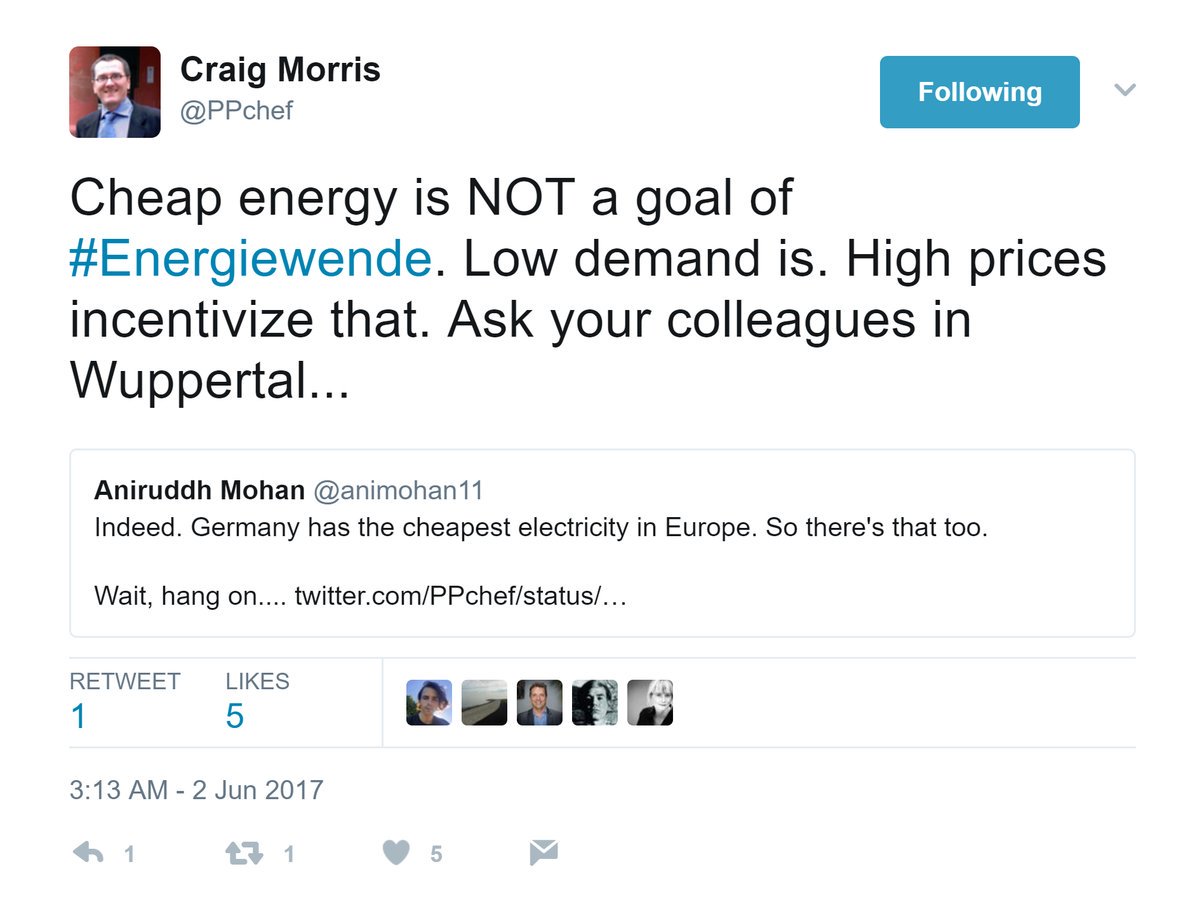
Craig Morris is an author of ‘Energy Democracy’. The book’s website says:
What an idiot. No idea how the poorest have to struggle to pay their electricity bills. Men of his ilk are bad by ignorance and bias.
Germany increased its electricity generation in 2016 and its electricity exports.
Of course, the problem is: the more technology you rely upon, the more you try to “conserve” energy, the more energy you end up using. Go read some of Robert Bryce’s fine work on this problem. So Craig Morris is just another idiot like Merkel. They dream of unicorns.
The intent of driving the cost of energy up has nothing to do with “saving Gaia.” At least not because of CO2. The intent it to drive population down – high energy costs, no heat, deaths in even cool weather. The other half of the two bladed axe being used on human population is higher energy costs, higher food costs, more deaths due to malnutrition. There is no other realistic way at looking at it. Those with wealth will survive the human purge being done by making affordable energy unavailable. Anyone not looking at this picture from this angle needs to get off the recreational drugs they are on.
If you got rid of the presumed excess 5 billion people, then the amount of CO2 being produced – humans do breath – would go down dramatically, and it wouldn’t matter if the cost of energy was brought back down so the remaining “serfs” can survive while the wealthy enjoy the fine life and rich variety that Gaia offers.
It’s hard to see how widespread solar PV could be cost effective in Germany and Denmark, considering their high northern latitude.
+1 I don’t envision that many 6000 square foot single story homes with ‘good’ roof orientation considering the pitch necessary to slough off snow.
Well the UK just got a record 8GW of a 35GW working day demand from soalr in May on a 12GHW installed capacity.
Germany gets a huge amount of solar for 8 months of the year
http://www.sma.de/en/company/pv-electricity-produced-in-germany.html
so imagine what India with over 300 perfect soalr days a year in Delhi gets… or even the US SW.
Griff get it through your thick scone with unreliables- http://anero.id/energy/wind-energy/2017/may
and solar output is worse than that with its cloudy dips and night time zero flats. These unreliables sans storage simply engage in dumping on the grid and bludge off thermal insurance without paying any insurance premiums. It would be like you owning a car with nano solar paint and bragging how you run around on free solar and look how it zooms at midday, forgetting to tell folks about the gasoline cab that picks you up and runs you around at dusk that they’re all subsidising.
It’s called the fallacy of composition dude so think about that if everyone ran around with nano solar paint cars and there was no more gas. Walkies Griff.
Solar output doesn’t blip on and off with every passing cloud…
and demand is much less overnight…
There are many places where peak demand is during the day when solar is at its maximum.
today UK was getting largest part of its electricity from wind around 8 am – just over 25% and another 75 from solar.
Oops! 75 = 7%
When you compare the electricity prices of different countries, you should also compare the average wage.
If the average wage in Germany is twice that of Romania and Poland, perhaps it’s quite understandable the the ¢/kWh is twice as high too.
Only if you expect labour to account for virtually all of the factor cost involved in electricity production, which seems like an odd assumption.
Yes that’s true, but still you need to adjust for “purchasing power parities” of different countries, not just use basic exchange rate conversions.`
http://reneweconomy.com.au/graph-of-the-day-average-electricity-prices-around-the-world-24207/
Even adjusting for PPP Germany still is the most expensive though.
The scatterplot chart accompanying this essay is a most telling statement against the efficacy of relying on current renewable electricity generation technology on a large (nationwide) scale. It should be furnished to various political commentators for their information.
https://www.bloomberg.com/news/articles/2017-06-08/german-renewables-record-probably-won-t-last-long-in-green-push
Clean power supplied two-thirds of Germany’s power at one point on Wednesday…