‘Weak or non-existent’ El Nino is a factor
Forecasters at NOAA’s Climate Prediction Center say the Atlantic could see another above-normal hurricane season this year.
For the upcoming Atlantic hurricane season, which runs from June 1 through November 30, forecasters predict a 45 percent chance of an above-normal season, a 35 percent chance of a near-normal season, and only a 20 percent chance of a below-normal season.
“As a Florida resident, I am particularly proud of the important work NOAA does in weather forecasting and hurricane prediction,” said U.S. Secretary of Commerce Wilbur Ross. “These forecasts are important for both public safety and business planning, and are a crucial function of the federal government.”

Forecasters predict a 70 percent likelihood of 11 to 17 named storms (winds of 39 mph or higher), of which 5 to 9 could become hurricanes (winds of 74 mph or higher), including 2 to 4 major hurricanes (Category 3, 4 or 5; winds of 111 mph or higher). An average season produces 12 named storms of which six become hurricanes, including three major hurricanes.
These numbers include Tropical Storm Arlene, a rare pre-season storm that formed over the eastern Atlantic in April.
“The outlook reflects our expectation of a weak or non-existent El Nino, near- or above-average sea-surface temperatures across the tropical Atlantic Ocean and Caribbean Sea, and average or weaker-than-average vertical wind shear in that same region,” said Gerry Bell, Ph.D., lead seasonal hurricane forecaster with NOAA’s Climate Prediction Center.
Strong El Ninos and wind shear typically suppress development of Atlantic hurricanes, so the prediction for weak conditions points to more hurricane activity this year. Also, warmer sea surface temperatures tend to fuel hurricanes as they move across the ocean. However, the climate models are showing considerable uncertainty, which is reflected in the comparable probabilities for an above-normal and near-normal season.

“NOAA’s broad range of expertise and resources support the nation with strong science and service before, during and after each storm to protect lives and property and enhance the national economy as we continue building a Weather-Ready Nation,” said Ben Friedman, acting NOAA administrator. “From our expert modelers to our dedicated forecasters and brave crews of our hurricane hunters, we’ll be here to warn the nation every step of the way this hurricane season.”
NOAA brings exciting new observing, modeling, forecasting and communications tools to the table this year to improve our hurricane warning capabilities and aid public readiness:
- Even before its final positioning, the sophisticated camera on NOAA’s new GOES-16 satellite will give our hurricane forecasters a sneak peek at its greater image resolution, sharp detail and rapid-refresh rate. One of the powerful instruments aboard GOES-16, the lightning mapper, will allow forecasters to see lightning strikes that build within tropical cyclones – a possible signal of strengthening.
- The combination of two high-resolution hurricane models will improve forecast guidance for the National Hurricane Center this season. The upgraded Hurricane Weather Research Forecast model adds better representation of storms at higher vertical resolution, and has advanced data assimilation and improved physics. With these upgrades, the model can improve intensity forecasts by as much as 10 percent and track forecasts by as much as seven percent. NOAA’s Environmental Modeling Center also is replacing the Geophysical Fluid Dynamics Laboratory Hurricane Model with a new hurricane model called HMON, for Hurricanes in a Multi-Scale Ocean-Coupled Non-Hydrostatic, which has superior track and intensity forecast skill.
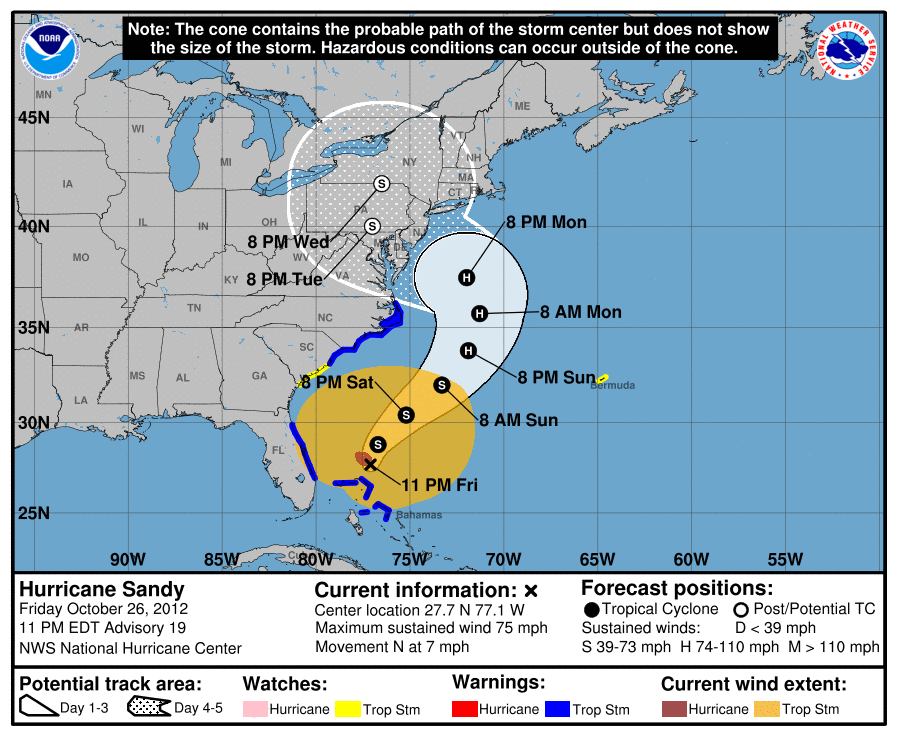
- NOAA’s National Hurricane Center is providing a suite of new forecast and communication tools this season. Forecasters there will issue Storm Surge Watches and Warnings operationally this year, in addition to issuing advisories, watches and warnings for disturbances that aren’t yet a tropical cyclone but still threaten land with tropical storm or hurricane conditions within 48 hours. The center added a new experimental visualization tool so the public can easily see when damaging winds are forecast to reach their community. Also, beginning this year, the public will be able to click on the hurricane track cone graphic and see how far outside of the cone hurricane and tropical-storm-force winds extend, which can be hundreds of miles.
“Regardless of how many storms develop this year, it only takes one to disrupt our lives,” said Acting FEMA Administrator Robert J. Fenton, Jr. “Get ready now with these easy, low-cost steps that will leave you better prepared and will make all the difference: Have a family discussion about what you will do, where you will go and how you will communicate with each other when a storm threatens; Know your evacuation route; tune into your local news or download the FEMA app to get alerts, and finally – listen to local authorities as a storm approaches.”
The 2016 season was the most active since 2012, with 15 named storms, including 7 hurricanes and 4 major hurricanes.
NOAA will update this outlook in early August, just prior to the peak of the season.
NOAA also issued seasonal hurricane outlooks outlooks for the eastern Pacific and central Pacific hurricane basins. An 80 percent chance of a near- or above-normal season is predicted for each region. The eastern Pacific outlook also calls for a 70 percent probability of 14 to 20 named storms, of which 6 to 11 are expected to become hurricanes, including 3 to 7 major hurricanes. The central Pacific outlook calls for a 70 percent probability of 5 to 8 tropical cyclones, which includes tropical depressions, tropical storms and hurricanes.
I live in Florida and these pre-season predictions are just water cooler subjects. The real predictions that matter come when there is an active hurricane and the prediction path puts it at or near landfall. THEN what NOAA does becomes very important. BTW, my seasonal hurricane prep isn’t determined by what the long term predictions say.
Exactly!
I do find these forecasts amusing. Many have stated that what NOAA is saying is really the opposite in that there is a greater than average chance it will be a lower season.
However, and as pointed out by others, their real job is to talk all through events as they happen and that is where I believe they fail and consistently overplay storms to the extent that people actually think they have experienced storms that they have not.
That is dangerous when the next big one really hits.
I think they have doctored the wind speed for years.
I found the noaa bouy website years ago. I have never seen wind speeds from buoys or land based weather stations that were anywhere near what was being reported as a hurricane passed.
I’m not sure what they mean.
Are they referring to the average (over an unspecified period of time) or the “New Normal” (again, over an unspecified period of time) or above what “The Climate Models” have predicted…projected but failed to materialize?
Nature has finally provided a bunch of tornadoes. Maybe they figure Nature will finally provide a few of the hurricanes the Manniquines “projected” Man would cause?
PS No intention to sound heartless toward those suffering from what are Natural weather events.
Just heartless toward those who mannipulate and twist such events for political and/or personal gain.
Do they really mean “above normal” or do they mean “above average”? The two are very different. “Above normal” means outside the range which makes up the present average, whereas…well I’m sure you get the point.
Wow when they make predictions they really go out on a limb, don’t they! Looks like they’ve got all the bases covered, they can make excuses no matter what happens. Why do we even pay people to do this?
“Forecasters at NOAA’s Climate Prediction Center say the Atlantic could see another above-normal hurricane season this year.”
Another? When was the last time we had an above-normal hurricane season? 2005?
Have they determined what is normal, or what is the long term average? 😉
Wait long enough and there will be another cat 5 in the Gulf of Mexico. And every year that there isn’t a land falling hurricane only increases the odds for the next year. Keep predicting the end of the world, and some day it will happen. Be sure to send me your money so I can prevent that from happening. I can’t stress how important it is that I take control of everything, we don’t have much time left, the window of opportunity is closing. Sound familiar?
I used to read stories about how the ancient Romans and Greeks would forecast the future by examining the entrails of birds and what not, and I would wonder how they could ever have been so gullible and foolish. And now I see that the only difference between then and now is that we just like to make our superstitions prettier than they did.
TSR (Tropical Storm Risk) released “TSR lowers its forecast and predicts Atlantic hurricane activity in 2017 will be about 30% below the long-term average.” in April. Their forecast is at their web page http://www.tropicalstormrisk.com/. Just for comparison purposes…
“with 15 named storms, including 7 hurricanes and 4 major hurricanes.” And how many made landfall? Each year they predict a high number of storms will strike the US, and each year their predictions fail more people refuse to listen to them. Instead, perhaps, just maybe, they should concentrate on tracking storms WHEN they develop and work on having a much more successful rate for telling people where hurricanes will ACTUALLY make landfall. Ya know? Instead of trying to scare people months before hurricanes actually, ya know, start forming.
I think it is a good idea to look at the high latitude storm patterns. Tropical storms are just another way the atmosphere attempts to equalize the differences between the tropics and the polar regions. Thus far, the northern hemisphere has had a very active storm pattern. Mid to spring negative AOs helped induce unseasonably cold weather across Europe and Central Asia. Even North America has seen several bouts of storms and heavy snow-fall as late as May. If this continues into summer, and El Nino develops (which I think it will), NOAA is going to bust its Hurricane forecast.
Isn’t a 45% chance of an above-normal *anything* the same as saying there is a 55% chance of a normal-or-below *anything*?
Or is my engineer brain failing to grasp the deeper subtleties of scientifical handling of simple subtraction that require a minority probabilityto be reported as the likely case if it has the effect of scaring people into doing what you want?
They’ve said this every year for the last 4 years and have been wrong every time.
However, they eventually will be right, and all the liberals will then rejoice in their scientific acumen, and claim that this is irrefutable proof of global warming.
The NHC does of great job of predicting strength and location of tropical storms 5-10 days ahead of time, but not such a great job more than two weeks out. (can’t predict which butterflies will be flapping their wings) https://en.wikipedia.org/wiki/Butterfly_effect
Wikipedia has Atlantic hurricane season since 1950. I put these data, through 2016, into a stats program.
“Forecasters predict a 70 percent likelihood of 11 to 17 named storms.”
Of these seasons, 45% have had from 11 to 17 named storms. Median is 11.
From “2 to 4 major hurricanes” happens for 50% of these seasons. Median is 2.
IOW, this will be a quite average year. Nothing out of the norm. Do be prepared – flashlights, water, and other provisions.
Per Al Dork, we are supposed to be getting more major hurricanes. The Pearson “r” correlation between Year and # Major Hurricanes should be “positive,” i.e., a statistically significant result greater than zero, approaching 1. I get -0.07, p = 0.58.
I think a tropical depression is cured with a margarita. Been my experience, anyway.