Global temperatures have dropped 0.5° Celsius in April according to Dr. Ryan Maue. In the Northern Hemisphere they plunged a massive 1°C . As the record 2015/16 El Nino levels off, the global warming hiatus aka “the pause” is back with a vengeance. He writes:
Some good news to end April, global temperature anomaly has fallen to only +0.1°C today (snapshot) … graphic is like stock market trace

Global Ocean Temperatures Drop To Pre-El Nino Levels

Despite NOAA’s Denial, A Growing Number Of Studies Confirm the Global Warming Hiatus
Despite widespread denial among climate activists, a growing number of scientific research papers in recent months have confirmed the global warming hiatus, trying to explain its possible reasons (for the latest studies see here, here and here). The latest study claims that the Southern Ocean played a critical role in the global warming slowdown.

h/t to the GWPF
Dr. Roy Spencer says while there was a plunge at the surface, the lower troposphere is still holding warmth, but what is clear is that the effects of the El Niño are over:
The Version 6.0 global average lower tropospheric temperature (LT) anomaly for April, 2017 was +0.27 deg. C, up from the March, 2017 value of +0.19 deg. C (click for full size version):

The global, hemispheric, and tropical LT anomalies from the 30-year (1981-2010) average for the last 16 months are:
YEAR MO GLOBE NHEM. SHEM. TROPICS
2016 01 +0.54 +0.69 +0.39 +0.84
2016 02 +0.83 +1.16 +0.50 +0.98
2016 03 +0.73 +0.94 +0.52 +1.08
2016 04 +0.71 +0.85 +0.58 +0.93
2016 05 +0.54 +0.64 +0.44 +0.71
2016 06 +0.33 +0.50 +0.17 +0.37
2016 07 +0.39 +0.48 +0.29 +0.47
2016 08 +0.43 +0.55 +0.31 +0.49
2016 09 +0.44 +0.49 +0.38 +0.37
2016 10 +0.40 +0.42 +0.39 +0.46
2016 11 +0.45 +0.40 +0.50 +0.37
2016 12 +0.24 +0.18 +0.30 +0.21
2017 01 +0.30 +0.26 +0.33 +0.07
2017 02 +0.35 +0.54 +0.15 +0.05
2017 03 +0.19 +0.30 +0.07 +0.03
2017 04 +0.27 +0.27 +0.26 +0.21
The UAH LT global anomaly image for April, 2017 should be available in the next few days here.
The new Version 6 files should also be updated soon, and are located here:
Lower Troposphere: http://vortex.nsstc.uah.edu/data/msu/v6.0/tlt/uahncdc_lt_6.0.txt
Mid-Troposphere:http://vortex.nsstc.uah.edu/data/msu/v6.0/tmt/uahncdc_mt_6.0.txt
Tropopause:http://vortex.nsstc.uah.edu/data/msu/v6.0/ttp/uahncdc_tp_6.0.txt
Lower Stratosphere: http://vortex.nsstc.uah.edu/data/msu/v6.0/tls/uahncdc_ls_6.0.txt
Cooler temps in the presence of increased C02… what the?! 😉
Andrew
It’s natural variation when they drop. It’s human caused when they rise! Always! /sarc
Other way around.
Cooler temps? It says clearly in the article the anomaly is still positive.
Mat, the line squiggled downward. Isn’t that cooling? Or is everything warming no matter which way the line goes?
Andrew
On the way down
from a rise far too small and short-lived to conclude the stop in warming EVER ceased.
Given the data we now have:
For UAH: There is no statistically significant warming since December 1993;
For RSS: There is no statistically significant warming since October 1994;
For Hadsst3: There is no statistically significant warming since May 1997.
(Source: Werner Brozek, ed. by J. T. Facts, https://wattsupwiththat.com/2017/04/11/la-nina-puzzle-now-includes-february-and-march-data/ )
the stop in warming is.
*********************************
Warming may, indeed, resume. So far, it has not.
BOTTOM LINE:
CO2 UP. WARMING STOPPED.
This has never been explained away by the AGWers.
…. it’s a travesty that we can’t. {NOT! — lolol}
Kevin Trenberth
Janice says…
………………………………………………………………………….
For UAH: There is no statistically significant warming since December 1993;
For RSS: There is no statistically significant warming since October 1994;
For Hadsst3: There is no statistically significant warming since May 1997.
(Source: Werner Brozek, ed. by J. T. Facts, https://wattsupwiththat.com/2017/04/11/la-nina-puzzle-now-includes-february-and-march-data/ )
…………………………………………………………………………….
Well that’s according to Mr. Stokes somewhat puzzling definition of statistical significance which is quite broad and looks at each one alone with no consideration of their agreement.
Actual temp changes 1993 to 2017
HadCrut +0.43 deg
GISS +0.61 deg
RSS + 0.30 deg
UAH +0.28 deg
The four data sets have an average monthly correlation of 0.81 so they agree more than they disagree. All are up. The chance of achieving these four results with some kind of Monte Carlo are shockingly low.
Just how low? I might just run the numbers
On the way down
from a rise far too small to conclude the stop in warming EVER ceased.
Given the data we now have:
For UAH: There is no statistically significant warming since December 1993;
For RSS: There is no statistically significant warming since October 1994;
For Hadsst3: There is no statistically significant warming since May 1997.
(Source: Werner Brozek, ed. by J. T. Facts, https://wattsupwiththat.com/2017/04/11/la-nina-puzzle-now-includes-february-and-march-data/ )
the stop in warming is.
Warming may, indeed, resume. So far, it has not.
BOTTOM LINE:
CO2 UP. WARMING STOPPED.
This has never been explained away by the AGWers.
…. it’s a travesty that we can’t.
K.T.
It’s like the business community talking about a “negative increase” – whichever way one looks at it CO2 is increasing whilst temperature is dropping
Mat, UAH’s anomaly over their baseline is still .27deg. A]so the anomaly in April actually increased over March. Same is true with HadSS. NCEP anomaly actually declined from March. Anthony’s point is that temps have declined to levels a bit below those prior to the the most recent El Nino.
Roscoe commented on Global temperatures plunge in April – “the pause” returns.
“For UAH: There is no statistically significant warming since December 1993;”
this is very false.
uah lt v6.0 warming since 1/2014 is 0.31 +/- 0.16 C (error = 95% CL), well above the 95% confidence limit
this changes with autocorrelation
but werner b has said several times he doesn’t understand a.c.
and he never includes it in his
calculations.
in my experience werner’s calculations are nothing
but meaningless numerology.
The calculations were from Stokes. I’m not sure how to do the confidence intervals. It’s not straightforward statistics in this situation because of several mitigating factors.
I did, however, take the monthly changes in UAH and scale them to zero so there were equal chances of rising or falling temps. Then I randomly put together a time series with the data 1000 times.
I thought this would show the chance of replicating the observed warming very unlikely. But I was wrong.
When taken together, the four data sets (UAH GIS HADC RSS) randomly simulated more warming than actually observed 350 times!
This seemed way off to me until I thought about it more. The total UAH warming since 1993 is 0.28. The average monthly change in UAH is 0.10. There were 291 months. So all it takes is three more months of warm than cold. So if the score is 147 warm and 144 cold with an average change of 0.10, then you have exceeded your 24 year anomaly of 0.28.
Just because it’s not “statistically significant” doesn’t mean the earth isn’t warming. All trends from all data sets in the entire fossil fuel era ending in 2017 are positive. If you go back to the 1970s, the trends are almost certainly significant.
The problem is that we don’t measure global mean temperature very well. We claim that we do, but then why do the 4 data series I referenced have such different values? That indicates uncertainty which when quantified produces big standard deviations which then produces big confidence intervals and thus, low significance.
I would welcome other number crunching by people with more expertise in this problem. But I was quite convinced by the numbers I ran that the last quarter century has not met any reasonable measure of significance.
@crackers345
Do you have discalculia? Last I checked, 1993 looked nothing like 2014. But YMMV.
roscoe, thanks, but i dont care where the
calculations are from. i know the math and how to
do confidence limits and include
autocorrelation and can do
my own calculations.
the results are as i stated.
trying to claim that uah shows no warming
since 1993
is just junk.
crackers345
“roscoe, thanks, but i dont care … trying to claim that uah shows no warming since 1993 is just junk.”
I never claimed that UAH shows no warming. I clearly stated that it shows 0.28 deg of warming since 1993. I also pointed out numerous times that all trends in all fossil fuel era data to 2017 are warmer. On this thread, I expressed near certainty that it was statistically significant since 1993 but when I ran numbers myself, I backed off that assertion. I welcomed other calculations. You provide insults but no data.
There was also no ‘statistically significant’ pause from 1998 to whenever. All trend uncertainties from 1998 overlapped with prior warming trends.
If a ‘pause’, or slowdown wants to be claimed, better to avoid statistical significance altogether and stick to the mean trend. Which is warming since 1998.
barry:
You write this false news
In the unlikely event that you believe what you have written then try telling the UN Intergovernmental Panel on Climate Change (IPCC) and not us.
Box 9.2 on page 769 of Chapter 9 of IPCC the AR5 Working Group 1 (i.e. the most recent IPCC so-called science report) is here and says
GMST trend is global mean surface temperature trend.
A “hiatus” is a stop. And “the observed GMST trend hiatus” is the observed “Pause”.
Richard
The general trend is up, what is it that you don’t understand?
mountainape5,
“The general trend is up…”
And I should care because…
Andrew
.. lost in thoughts?
The rate of the “up” is the important issue.
The general trend since….1979? 1879? 1679? The question to smug people like you is how much do you think it is caused by CO2? And are you trying to say we should radically change things to stop CO2 emissions?
To all, please don’t let these ignorant trolls upset you. All they want is responses and unfortunately I had to respond to state the obvious.
Back into your hole, troll.
I’ve said there has been an underlying warming trend ( thank goodness) and co2 isn’t the cause. There are several things that we know of that can cause global cooling. It’s that one thing that causes global cooling in the absence of the the others that concerns me. Or it could be, it doesn’t matter, it’s just time according to fibonacci numbers.
The predictive power of fibonacci numbers is truly astounding. That and fractal geometry.
CAGW has interwoven the argument of co2 causing the slight warming we’ve had so well, it is difficult to acknowledge that there has been some warming without acknowledging the co2 part. I do not acknowledge co2 as the cause.
Then there is if it’s been so warm, and temperature is falling, where is the heat hiding ? In the oceans ? There is a direct way of measuring that, thermal expansion. It’s not there. I do believe CAGW on thermal expansion. I did the math, and if it was as warm as it should be, we wouldn’t be measuring SLR in millimeters or some distant rise 100 years from now.
The general trend is up.
================
the trend depends on your choice of starting point. for example, the trend over the past 6000 years is definitely DOWN. the same is true over the past 4 million years.
Which general trend? The 65 million year trend?


The 5.5 million year trend?
The the Holocene trend?
Perhaps you are talking about the trend since the start of the modern warm period around 1850?
I think we are discussing a fossil fuel era time scale.
How about the 542 million-year trend?
Also down.
As is of course too the 4.5 billion-year trend, since earth started out covered by an ocean of molten rock. However at intervals thereafter, it was also covered oceans of frozen water.
The length of time over which that arbitrary trend continues is not predictable.
The “general trend” in ML CO2 is UP almost monotonically if you filter out the yearly cyclic variation.
But at times the Temperature trend is down, which is in the opposite direction to the CO2,
So the two of them cannot be tightly linked, compared to something else that can make the Temperature gdown, no matter the CO2 rise.
That’s what YOU don’t seem to understand.
G
I’m not linking the uptrend with the rise of the CO2, choosing not to see the warming for the sake of the ‘other side’ is just dumb.
So funny. Measurements that show the planet has stopped warming for one month and deniers use the data. When the same organisation shows the planet keeps hitting record temperatures they are unreliable or made up or its a conspiracy. Which is it? Ha ha!
“Measurements that show the planet has stopped warming for one month”
Because for one thing, it illustrates AGW as intermittent, if AGW is even possible.
So now we are to the the question is AGW even possible?
If climate science can’t explain the wiggles, it can’t explain anything.
Andrew
Temperatures have been dropping since the peak of the recent El Nino. It’s been a lot longer than one month.
What is it with these trolls and their inability to do even the most basic of research?
I love it when warmists don’t see the irony of what they say. Yes, the data has been fiddled but when even their corrupt data shows cooling then it must really be cooling. Well, until they fiddle it again to make it appear to be warming again.
Just as funny as using an ENSO event a a “pause buster.” The “record temperatures” are in hundredths of a degree and are not statistically significant. Also, they are the result of “adjustments” to the data. Simply the fact that the “record” requires “adjustments” to exist is evidence that the record is not robust, maybe not even real.
Time for some new adjustments!
And a new round of “the dog ate my global warming” excuses!
Prolly more warm got down deep into the ocean ; )
JohnKnight
The oceans are, indeed, deep.
And wide.
The science is settled – we are told repeatedly, trying to drown out the intermittent bits of decent, observation based comment.
The whole thing is a scam – a fraud, indeed.
Auto
it only “feels” cooler. The models say it’s actually warmer. Don’t be confused by your senses (and your shivering as I was yesterday)
Yes we haven’t really got record breaking cold in the US and Europe, we are imagining the snow and frost as well.
They were only local! All over the places! /sarc
You won’t get to record breaking cold until the continent is re-glaciated. :)…but that would be climate recurrence?
What you gonna believe, the models or your lying eyes?
There is some evidence that people are influenced by their own experience. link
It has been observed that older people are more likely to be skeptics. link It is said that older people are more conservative. It is also true that they have more experience with the climate. I suspect that both of those factors increase skepticism. They also have more experience being lied to by politicians and experts.
commieBob … us older people also have more experience with failed doomsday scenarios. I survived the coming ice age scare of the 70’s. Those ‘science reports’ scared the snot out of me. When I heard Algore claim that the ‘the debate was over, the science was settled,’ I actually stood up and yelled at the radio. What debate? I don’t remember any debate! A skeptic was born.
Does anybody else remember how quiet New Year’s Eve was when we hit the year 2000? Not a lot of partying … we were scared. All the power would shut down, planes falling out of the sky. Hmmff. I know, I know … programmers were working overtime all year fixing Y2K errors. Still, can’t help but feel like I was bamboozled … again.
Ozone hole. Acid rain. Nuclear annihilation. Zombie apocalypse. The 2nd Coming was supposed to happen before the year 2000, too. (I spent 6 months in a foster home in the 60’s who were Pentecostal.)
I can’t count the number of scares I’ve lived through by now. No more! I refuse to let them scare me, again. Or guilt me out by telling me it’s my fault. PHOOEY!
I was working. IT. A colossal bore, but necessary due to all the ones that were scared. Still, I am not upset. My income (and work hours) went up 50% in 1999 due to the scare. Not until this year did my income finally exceed that year’s income.
I knew we were safe. But it was because we started preparing for it back in the mid 90s. But the YSM did not tell you that.
I wonder which climate models have cooling built into their algorithms
[All those that go unfunded the next fiscal year.
Only those that go unfunded the present fiscal year. .mod]
@TeaPartyGeezer: That’s a great synopsis of the last 50 years worth overhyped, fearmongering, hysterical attempts at change via doom mongering. The cover of Time in our house was constantly informing me how I was going to die because of ice age/famine//lack of ‘energy’/ozone holes from mom’s hairspray/etc. The schtick wears a tad thin after a while. I’m just disappointed that you didn’t end your reply to commieBob with “…now you kids get off my lawn!”
My friends in Seattle say they are still waiting for Spring to arrive. They are told it will arrive mid week only to be followed by more cool damp weather on the weekend.
How long is the pause now please? Are we anywhere near getting Monkton-style analysis showing 20+ years?
Linear trends will show an upward trend due to the position of the recent El Nino. However, we know there was no warming prior to the El Nino and we have cooled back to equal or lower temperatures than existed before the El Nino. Clearly, the pause is still in effect. This is why I looked at ENSO neutral months only to get a better feeling and that analysis showed a flat trend since 1997.
No child born since 1984 has experienced a month with a below average global temperature.
No child born in the history of man has experienced an above average global temperature. All have experienced above, below and normal LOCAL temperatures.
Your statement is stupid.
those kids today do not know how lucky they are.
Depends on how you measure average. If you use the last 3000 years instead of the last 30, we’ve been below average for several hundred years.
Tony tell me again how we are measuring the Earth’s average temperature with sufficient accuracy to “know” that?
tony mcleod, no child born since 10,000 BCE has experienced a month with above average global temperature.
It has not warmed significantly in a human generation. No kid graduating high school this month has lived through global warming. Sad!
High school? They are half way through college already.
Children won’t know what warming is!
Ground here is covered with global warming from yesterdays storm. My poor garden…
fret not. If the ground was warm to begin with all those CO2 molecules piling up can’t help but trap the heat in your garden.
It must be hiding in the deep ocean (or maybe Karl’s closet).
Per Joe D’Aleo (behind a paywall, sorry), the upcoming El Niño is having some issues with warmer waters holding in the ENSO regions. Maybe a weak one or warm La Nada. Also per the last two solar cycles, the pattern on the way from peak to bottom was El Niño, La Nada, El Niño and La Niña. So far we seem to be following that pattern for this cycle as well.
We’ve gone through the first El Niño and coming up on the La Nada (although a very weak El Niño may take it’s place). Is it possible the solar cycle influences the high pressure over Darwin and low pressure over Tahiti than controls the trades in the eastern and central tropical Pacific? Will be very interesting to watch the global pressures as this solar cycle runs its course.
rbabcock
The ENSO cycle as a whole exerts a warming effect (mainly poleward pumping of warm water by La Niña). Thus a period of climate cooling may be associated with ENSO neutrality without pronounced El Niños or La Niñas. What some authors refer to as a changed “ground state” of the Pacific.
It is unfortunate that last year’s very strong El Nino was not followed by a La Nina. If 2017 had been a La Nina year it would make it difficult for the IPCC to write AR6. back to back El Ninos (if that is what occurs) will give them a life line.
Richard
If we’re cheering on cooling 😎 here, then I would beg to differ. As Bob Tisdale clearly showed, a strong La Nina although causing short term SST cooling, in the longer term caused a much greater warming with almost global extent, due to a pulse of equatorial warm water being pumped poleward. This caused the big global temperature step-up after 1999. I have argued previously that the 2016 el Nino was of the Modoki type, not engaging the Bjerknes feedback and being characterised by mid Pacific rather than eastern Pacific (Peruvian) el Nino SST warming. My further prediction / guess would be that unlike the classic el-Nino – La Nina cycle, the Modoki equivalent would not ramp up global temperatures but instead lead to stasis or possibly cooling (if Pacific equatorial heat instead dissipates to space).
I am with ptolemy2 on this one. The effect of continued ‘warmth’ in the E Pacific is merely showing us the loss of heat into space. Source: the ocean. Net effect: systemic cooling.
My point is a political one.
If there is a La Nina then this has a short lived effect on temperature anomalies producing both cooler satellite data, and cooler global thermometer data.
AR6 will be written in 2017/18. I do not know what the cut off date is for the publication of papers, but if La Nina conditions were seen and continued throughout 2017 and into early 2018, then there would be further papers on the re-emergence of the pause, and/or on ever lower figures for climate sensitivity to CO2.
In fact if one looks at the model assemble (the Spencer plot), one does not need much lower temperature anomaly satellite data and balloon data running into 2018 before all the models, or at any rate all but 2 models to be outside there 95% confidence levels.
I am merely observing that if 2017 is a cool year (and this now appears unlikely given the present ENSO conditions), the IPCC would find it much more difficult to continue to maintain their position on climate sensitivity, and much difficult to skim over the problem of models running hot and the divergence with satellite data and balloon data.
With ENSO positive conditions, the IPCC will find it relatively easy to fudge this issue, as the Karl paper demonstrates.
richard verney May 1, 2017 at 10:13 am
2015-16 El Nino was followed by a weak La Nina JAS 2016 to NDJ 2017 and hence there is no question of a back to back El Nino. In 2017 there has not been and 3-monthly seasonal period with ONI index +0.5 C or more. In fact the last available ONI index is JFM 2017 which is just +0.2 C.
5-1-2017 1030am and 38 degrees here mid-maine.
lot of 32-33 deg mornings. cold is hurting even my hostas and they are pretty much nuke proof….
In the past week+ I’ve had two daily highs about 25°F below average with the rest of the days 10-20°F below average. Minnesota is already too cold and it is snowing in parts of the state again.
The high temperature from around Garden City to Liberal KS was 39 degrees F below average yesterday — 36 F when average is 75 degrees. That was a heck of a winter storm, luckily the only major crop growing there right now is hard winter wheat.
The National Weather Service predicts 2-3″ snow on Mt Katahdin (elevation 5267′) today…
I forgot to see if it happened but would not surprise me.
yay it hit 42 now, yesterday 5-1-2017 never got above 38 here
Well, it is warm here (suburban Austin TX) but it snowed yesterday in Amarillo.
I heard from family that it snowed in El Paso over the weekend.
There are currently snow drifts of 6’+ in western KS.
C’mon!! Tom, you had a TORNADO the other day! It was all over the news. We’ve been told it’s the end of theworld. Sheesh, how ya gonna overcome such a tragedy? I mean, AGW has hit Texas hard……hasn’t it? /s
There is a taste for disaster stories, just that the scenario varies depending on your backround. Whatever happened to Harold Camping? or Paul Ehrlich?
A difference in air temperature of 0.1 Celsius would be imperceptible to humans, but if you are a climate “scientist” or one of the other hangers-on depending upon grant money, it makes conclusive proof of AGW. Never let facts get in the way of greed.
Difficulty, the thermometers margin of error is 0.4…..I love when the data set is more precise than the instruments used to provide the data…..
Clif. I doubt that with a standard analogue thermometer you could tell the difference between say, 20.1 or 20.0 Celsius.
What data series is Dr. Ryan Maue’s statement based on?
The chart heading says NCEP CFSR CFSv2 http://cfs.ncep.noaa.gov/cfsr/
The global weather models are initialized every hour. A grid is established of 2mT for the whole globe. Save this data and you have a global time series in real time.
It’s a nice alternative to satellite and sfc based thermometer data but it has some issues as well… longer term doesn’t account for UHI and some other issues.
Unfortunately, those of us that are saying that global temperatures are likely to decrease for the next few decades are probably going to be correct.
Pretty much a saw off. Warmer is better for nearly all the planet but then again it might finally be enough to stop the madness if we get a few decades of cooling.
Naw, they’re already screaming about ‘Climate Change.” As if the climate never changed before. NOW we know why Mann’s hockystick was so important.
John Harmsworth – I doubt it. They will either claim credit for stopping the disastrous warming – Obama has already made noises in that direction; or it will be “We told you so, AGW causes cooling, we must stop burning fossil fuels or it will get worse and we’ll all
burnfreeze”.Belief in AGW is not an evidence-based position. Do you see any apologies when a religious sect says the world will end at 6:30 pm on such-and-such a date, and it doesn’t? They just move the date and start over.
Once a believer has been infected with the belief, it’s very hard to get free of it. It’s an infection, in fact, a VIRUS OF THE MIND
One of the reasons the surface data is showing the cooling first is that the warmth from the open water in the Arctic takes awhile to work it’s way through the atmosphere. While temperatures have just about returned to average near the surface in the Arctic, satellite data will not reflect the loss of those warmer waters for a couple of months.
It would appear that the satellite is less sensitive to cold SST than it is to warm SST, probably due to convection. Warm waters drive more convection and thus carry warm air up to the troposphere where the satellite measures the temperature, however, cold waters drive less convection and do not in the same way drive/carry cold air high into the troposphere.
Reposting from David’s Greenland article today:
This year’s Arctic sea ice winter maximum was about the same as other recent years, just ever so slightly lower. What is “unprecedented” however is how slowly Arctic sea ice is melting this year.
The 30-year median melt in April is 1.175 million square kilometers. This year it was only 730,000 sq km. March melt was also lower this year.
As predicted here, sea ice extent is headed for the normal range. It’s already higher than on April 30 this year than it was in 2016 and 2015. Unusually cold Arctic SST, which even NOAA has grudgingly acknowledged but downplayed, is the main reason for the slow thaw, but air temperatures in the region are also back close to average.
http://nsidc.org/arcticseaicenews/charctic-interactive-sea-ice-graph/
Griff could still luck out on his assertion that this year was “sure” to set a new record low, if there are yet again August cyclones in the Arctic, but he has already been shown wrong that the ice would stay well below normal all year.
Tony Mcleod bet me that the geographical north Pole would be ice free this year, if he loses he can no longer post on WUWT. i have tried to explain to these guys that a low maximum has very little bearing on the minimum. I tried to get Griff to go for the same bet but he wouldn’t bite could have gotten 2 birds with one throw but oh well.
Bob,
If he loses, Tony will be back, even if it means getting a new IP address. Too bad Griff didn’t bite.
You, others and I all tried to explain how sea ice works. The lower ice this winter just meant that more heat was lost to space, hence cooler water, meaning slower melt. Pretty simple, really.
Of course, a polynya might briefly form at the North Pole. Would that count?
What’s the definition of “ice free”? Unfortunately that is hole that you can drive a whole fleet of distractions through.
Chimp
Griff can handle that – he/she/its been below normal he/she/its entire existence
MarkW May 1, 2017 at 11:08 am
What’s the definition of “ice free”? Unfortunately that is hole that you can drive a whole fleet of distractions through.
I believe the bet was that the north pole could be reached by sailing over open ocean, last year two research ships tied up next to the pole in open water, so it’s a far from certain bet.
I would have gone with something like no ice within 10 miles of the pole.
Poor Griff might have to take all the ice cubes out of his freezer and watch them melt to have a good cry!
Javert Chip May 1, 2017 at 12:49 pm
Funny, if not sadly so true.
What he doesn’t get is bottoming behavior. Oh, well, check that. He very may get a lot of that.
Anyway, if Arctic sea ice were a stock, now would be a good time to buy. Hasn’t made a new low since 2012, and even if it does, it won’t be much lower. It tried in 2015 and 2016, but could only about equal the first low in 2007.
The three-year intervals 2007-09, 2010-2012 and 2013-15 all averaged about the same, with one low year each. I’d expect 2016-18 to show in the same narrow range, despite getting off to a low start last year. At least one of 2017 and 2018 is liable to be a higher year, as were 2009, 2013 and 2014, or they could both end up in between, like 2008, 2010 and 2011. Three more low years like 2015 and 2016 seem improbable.
Anthony, speaking of sea Ice, it’s time to retire, or drastically reduce the content of, the Sea Ice page on this site. Most of the charts don’t update due to, as I recall you explaining, a change in WordPress. It’s really a confusing mess as it stands. Too bad too, because it really was an interesting part of the site in its day.
Maybe instead of displaying half a dozen or so charts of extent and area, most of which no longer update, just pick out one or two functional ones and drop the rest? It’s particularly confusing this time of year because most of the charts quit updating about now, so they look current but the data is a year old.
Bet stands Bob.
Fly from Svaalbard to the pole an see no ice. This year.
If Co2 is the definitive control knob, how is this even possible? Where did all that heat go if not to space, past all of that co2 that is supposed to be blocking it?
$64 question there.
$64 TRILLION dollar question.
Looks like the amount of human CO2 remaining n the atmosphere from us dropped since about 2000 ..If I am reading this paper correctly ..
–
The extra CO2 stimulated the biomass increase so much over the past decades ..a “pause” has occurred ..If this ain’t “temporary” as the author seems to believe ..Who needs ..Paris ?
–
Recent pause in the growth rate of atmospheric CO2 due to enhanced terrestrial carbon uptake
Nature Communications 7, Article number: 13428 (2016)
doi:10.1038/ncomms13428
–
“Since the start of the twenty-first century, however, the airborne fraction has been declining (−2.2% per year, P=0.07; Fig. 1b), despite the rapid increase in anthropogenic emissions (Fig. 1b).”
https://www.nature.com/articles/ncomms13428/figures/1
You just hit on one of my pet peeves on climate models. Hansen apologists (1988 fcst) like to claim that “Scenario B” verified but that is ridiculous. Clearly the “business as usual” Scenario A happened… and then some with Chinese emissions… i call it Scenario A+
But the earth ‘ate’ a lot more of the CO2 than anticipated
So, another source of climate model error is present that no one talks about … uncertainty over emissions and how much remains in the atmosphere
Hansen essentially got lucky… Emissions were much higher than anticipated but uptake was also much higher. And his forecast still overforecast by 2.5 to one
So, in summary, climate models do a poor job with perfect CO2 input. Going forward, we have no idea what the CO2 emissions and uptake will be. That source of error is rarely acknowledged
global warming destroyed my cherryblossoms with frost.
it also did damage a lot of my plants….
Yup, near Chicago, first day of May, the next three of five nights will be below 40 degrees F.
Tomato seedlings in a small green house will need some extra insulation.
Hmmmmmm – Man made global warming is on hiatus? Must be global manopause….
Running on the cool and very rainy side of historical averages, here in the Great NorthWet.
Mannopause …
I wonder how they will try to bust it this time – Karl II? Basically cooling the past temperatures to reflect a new ice age actually occurred in the 70s.
The fall in temperatures may be only short lived. According to the ENSO meter, it looks like we may be in for a double El Nino.
If so, one may envisage an increase in the temperature anomaly,within the next few months. It looks as if 2017 may shape up to be another warm year. Of course, this may be the result of a natural event (ie., El Nino), rather than CO2 driven, but that will not stop the alarmists spinning the warmest year on record, or perhaps the second warmest year on record (2017) following on from the warmest year on record (2016).
The timing of a double El Nino (if that is what happens) is unfortunate given that we will soon be in the run up to AR6. It would have made the job of the IPCC far more difficult if 2017 had been a La Nina year.
See my response to your comment above.
https://wattsupwiththat.com/2017/05/01/global-temperatures-plunge-in-april-the-pause-returns/comment-page-1/#comment-2491175
I have. Thanks for your observation, but see my further reply.
NOAA has rated 2017 as a Weak La Nina year so far.
It is now looking like there will be no El Nino. Cooler waters showing up in Nino 1-2.
I tried to explain the temperature-anomaly graphs to a friend like this:
Imagine (I said) that the vertical axis is not tenths of a degree but tenths of a gallon, and we are adding or subtracting water from a basin. 0.1gal (about a cup and a half) in, 0.2 out, 0.3 in and so on.
Then I asked, Is this a problem? When she looked confused, I pointed out, “It depends on the size of the basin we’re talking about.
“If it’s a dishpan, it might be an issue; it could overflow. But if it’s your backyard swimming pool, the ‘gallons in/gallons out’ chart would look exactly the same — but the change is downright trivial. Even if it’s your bathtub, are you worried?”
Then I told her that, in terms of degrees of temperature, what she was being shown was the gallons in/gallons out, without any information on the size of the “basin”.
The “basin”, I said, is 288 “degrees deep”, so to speak; sort of like six/6 standard bathtubs if we’re talking gallons. Is a whole gallon, or two, a problem for six/6 standard bathtubs?
She agreed that it was not. I may finally have gotten through to her. We’ll see.
The difference between 40F and 90F looks pretty small when mapped on a Kelvin chart, but it means wearing a coat vs shorts and flip-flops.
Yes, we get those fluctuations on a daily basis sometimes.
Likewise the “measured” average temperature changes would look pretty small when graphed between 5°C and 25°C.
What’s withe the desperate, hyperbolic character of this thread? “The pause” is back with a vengeance?? Hahahaa.
You are so right. In reality, the pause never went away. ENSO neutral months show no warming for over 20 years.
Sure they do. Trend in ENSO neutral months is 1.1 deg C per century.
Here is the data
how many centuries?
Sorry Roscoe but your link fails. However, I suspect you are using surface data and not the much higher quality satellite data over the past 20 years which is what I used.
I generally use Wood for Trees data. Skeptics always want to use UAH. Warmists want to use GISS. WTI is more robust and averages 2 surface and 2 satellite sets.
WFT has UAH data. If you cannot find it, look harder.
I won’t put too much trust in what is coming from the satellites. What is the reason, exactly, why we are now in version 6? It is globally cooling at a fairly constant rate looking at minimum and maximum temperatures.
[but for some reason nobody looks a global maxima and minima]
Minima are falling at an average rate of ca. -0.01K per annum since 2000.
Corrections for orbital drift and adjustments for the instruments as they change over time.
MarkW
As the sun’s polar magnetic fields fall, so would the escape of the most energetic particles also intensify a bit.
Earth’s atmosphere is protecting us against this by forming more ozone, peroxides and N-oxides. Hence, the global cooling. Unfortunately the probe material measuring your beloved data sets has no such protection. How many times can you correct for degeneration of the probes’ material until it is completely burned up?
My beloved?
Are you really going to go there?
Just because the data isn’t showing what you want to see is not sufficient to prove that the data is bad.
PS: You quite clearly have no idea what you are talking about. Satellites don’t degrade in the manner you describe.
From Roy Spencer’s V6 post (see above):
One might ask, Why do the satellite data have to be adjusted at all? If we had satellite instruments that (1) had rock-stable calibration, (2) lasted for many decades without any channel failures, and (3) were carried on satellites whose orbits did not change over time, then the satellite data could be processed without adjustment. But none of these things are true. Since 1979 we have had 15 satellites that lasted various lengths of time, having slightly different calibration (requiring intercalibration between satellites), some of which drifted in their calibration, slightly different channel frequencies (and thus weighting functions), and generally on satellite platforms whose orbits drift and thus observe at somewhat different local times of day in different years. All data adjustments required to correct for these changes involve decisions regarding methodology, and different methodologies will lead to somewhat different results. This is the unavoidable situation when dealing with less than perfect data.
After 25 years of producing the UAH datasets, the reasons for reprocessing are many. For example, years ago we could use certain AMSU-carrying satellites which minimized the effect of diurnal drift, which we did not explicitly correct for. That is no longer possible, and an explicit correction for diurnal drift is now necessary. The correction for diurnal drift is difficult to do well, and we have been committed to it being empirically–based, partly to provide an alternative to the RSS satellite dataset which uses a climate model for the diurnal drift adjustment.
What is the reason, exactly, why we are now in version 6?
A total of about 16 satellites used over time and different sensor systems. And in the case of UAH errors in their algorithms.
The 4 main temp data series have diverged wildly since 2000. UAH RSS GISS HadCrut. The fact that they are so different yet all purport to measure the same thing is telling. Bottom line, the errors bars in global temperature measurement are much bigger than claimed. If they weren’t, all would show essentially the same thing. They don’t.
If you compare the changes in UAH version 6 to the changes introduced by Karl et al, you may see why I was stuck that V6 changes are carefully considered small adjustments, whereas Karl et al felt like another “hide the decline” “do whatever it takes” to get rid of the pause. They did have to sacrifice the rate of temperature increase, but that may have directly led to the Paris CoP attempt to reduce the rate of temperature increase from 2C° to 1.5°
The V6 changes are at http://www.drroyspencer.com/2015/04/version-6-0-of-the-uah-temperature-dataset-released-new-lt-trend-0-11-cdecade/
Most of the warming is in the arctic regions in their winters anyway. Where humans live warming has been much less in the past 50 years but the global temp skewed by the arctic. This provides a huge hint as to why its water vapor, since increases in water vapor make have a much larger effect on where its cold and dry. So warming of the oceans, which is handled nicely in Grays paper,
http://tropical.atmos.colostate.edu/Includes/Documents/Publications/gray2012.pdf
and is a product of scales as long as centuries in the making, with yearly oscillations such as enso events, releasing more water vapor into the air which gets transported into the arctic ( and antarctic) are causing the global temps to be skewed since the increase in the arctic temps in winter time ( see DMI) vs summer are actually telling the true story! ( MUCH ADO ABOUT NOTHING) You know when it comes down to it, it seems as usual this by Mencken is spot on “The whole aim of practical politics is to keep the populace alarmed — and hence clamorous to be led to safety — by menacing it with an endless series of hobgoblins, all of them imaginary.” And, “The urge to save humanity is almost always only a false face for the urge to rule it.”
the problem of course is we have a media and committed despotic zealots that have another agenda and are simply using this for it
Thanks for the link, Joe!
Well said, and thanks!
RIP Dr. William M. “Bill” Gray, Father of Hurricanology and brave climate change skeptic, gone just over a year now (1929–2016). A huge loss to the world and science.
Joe
true enough
warming in the Arctic has been more than normal, but in Antarctica there has been no warming lately.
My results are also showing that there was no warming in the SH but warming in the NH was about 0.024K/annum giving me an average of 0.012K/annum over the past 40 years.
My point is that the warming is – and never was – ‘global’ and it probably won’t last for too much longer.
Hence the theory of global warming [by man] is fake.
Let me tell you what my theory is.
Come down 1 km into a gold mine here and notice the sweat coming down your face. How big is that elephant in our room? It is big. Real big. Going by the movement of the magnetic north pole, that elephant has been moving. Quite a distance. North east……
You aren’t going to try and push that core moving nonsense yet again?
The biggest reason for the warmer arctic ocean is the positive phase of the AMO which started about 1995. ?itok=1Kdwhlgn
One could also give an assist to volcanism along the Gakkel Ridge.
https://www.nature.com/nature/journal/v409/n6822/full/409808a0.html
Joe, have you seen this new “pause” paper ? Not ,not that “pause” .although it is also mentioned .. The pause in atmospheric fraction CO2 remaining from our emissions .. Planetary Biomass growth of past decades big enough to start wiping out our emissions faster than we pump em out !
–
Am I reading this correctly ?
–
Recent pause in the growth rate of atmospheric CO2 due to enhanced terrestrial carbon uptake
Nature Communications 7, Article number: 13428 (2016)
doi:10.1038/ncomms13428
https://www.nature.com/articles/ncomms13428/figures/1
“Since the start of the twenty-first century, however, the airborne fraction has been declining (−2.2% per year, P=0.07; Fig. 1b), despite the rapid increase in anthropogenic emissions (Fig. 1b).”
Yes, some day governments will wake up to the benefits of CO2 and REQUIRE the burning of fossil fuels to keep CO2 levels high.
The current benefit of elevated CO2 in the past 50 years is ~$200 per person on the earth just in foodstuff production alone.
Not so fast, my friends…
The headline and data presented here are misleading. First, the CFS data that Maue is referencing only dropped 0.18 deg from March to April on a monthly average basis.
Temps in Feb and March were really hot. All the April cooling did was take us back to levels from last summer and fall.
………………
Also, since Jan 1, 2000, these are the temperature trends in deg C per century…
HadCrut 1.59
GISS 2.24
RSS 1.01
UAH 1.12
CFS 0.15
………………
It is obvious there was a “pause” in the warming somewhere in the 1998-2014 window but the el nino spike in 2015-2016 was pretty impressive and it’s not obvious yet if that will abate completely or be a “step up”.
………………
Since Jan 1, 1979, these are the temperature trends in deg C per century…
HadCrut 1.72
GISS 2.18
RSS 1.35
UAH 1.26
CFS 0.90
………………
Interesting that the warming rates are so different. Calls into question our ability to accurately measure global temp. Is the noise greater than the signal?
……….
A couple of other hot items
… global sea ice dropped more than 3 std deviations below mean last year for the first time ever.
… the CRN data… pristine data network of sensors in the USA, has a trend line of +6.2 deg C per century since Jan 1, 2005.
I see no reason for skeptics to be jumping for joy here. The data are still pretty hot.
There’s never a reason to jump for joy when temperatures are falling. A warmer world is a better world for life to thrive. This is why I was a bit baffled by Ryan Maue’s statement “Some good news to end April.” I don’t think this is good news at all.
We’re not jumping for joy. It’s just that CO2 activists are an oppressive bunch trying to control the world, literally.
The IPCC models said that the best estimate of warming with the current scenario of increasing CO2 levels was 4.0 deg Celsius this century, with a likely range of 2.4 to 6.4 degrees C per century. Even with the just completed El Nino, the data sets show none of the trends are within the lower bounds of the projections. If “pretty hot” is colder than the minimum warming expected by dozens of different models created based on the same hypothesis, shouldn’t the skeptics at least feel validated?
https://www.ipcc.ch/publications_and_data/ar4/wg1/en/spmsspm-projections-of.html
My point is that the temperature trend is higher despite claims to the contrary here. Model performance is a whole different animal.
I was curious about the CRN report, so I went and eyeballed it and put a trend line through the annual averages. You can rest assured there is no significant trend at 90% confidence levels, although the residues don’t look well behaved.
You can sense this just by looking.
The trend is +6 deg C per century. I didn’t eyeball it. I calculated it. I have not calculated the significance. It is only 12 or 13 years old.
I guess the point is we are agreed that the trend you cited as a “hot item” isn’t significant. It also appears that you understand that short time periods that bounce around are unlikely to be particularly meaningful, so why present it as such?
When there are reports of rising temperatures, do they mean rising
temperatures, or do they mean rising mean temperatures? There is
a difference. After all, if night times are less cold than before, this
will result in an increase in the mean temperature. And consider Day 1
with a range of 10-20, and Day 2 with a range of 12-19. Day 1 has the
higher maximum temperature, and Day 2 has the higher mean temperature.
Perhaps someone can tell me which of these two is the ‘hottest’, a term
now much favoured by climate scientists, to their eternal discredit.
I’ve been asking this for years. They are only reporting mean temps. Plus, we can have the same issue during the changing seasons.
I will answer with a question of my own. Which has more heat, bare ground at -10C or 2 feet of snow in the same location at -5C? A greater combination of increased air temp and sunshine will be required to warm the -5 situation but IPCC geniuses don’t think about this very hard. I think it probably matters when Antarctica is adding billions of tons of snow every year. This mass is a huge reserve of negative enthalpy. Recent reports indicate that Greenland is also adding mass. Higher air temperatures add moisture to the air which falls as rain and snow. Rain saturated ground likewise offsets higher air temps but the IPCC seems unaware of phase change impact on short term readings, preferring to think everything is worse than they thought.
I got a logging ir thermometer, and a logging weather station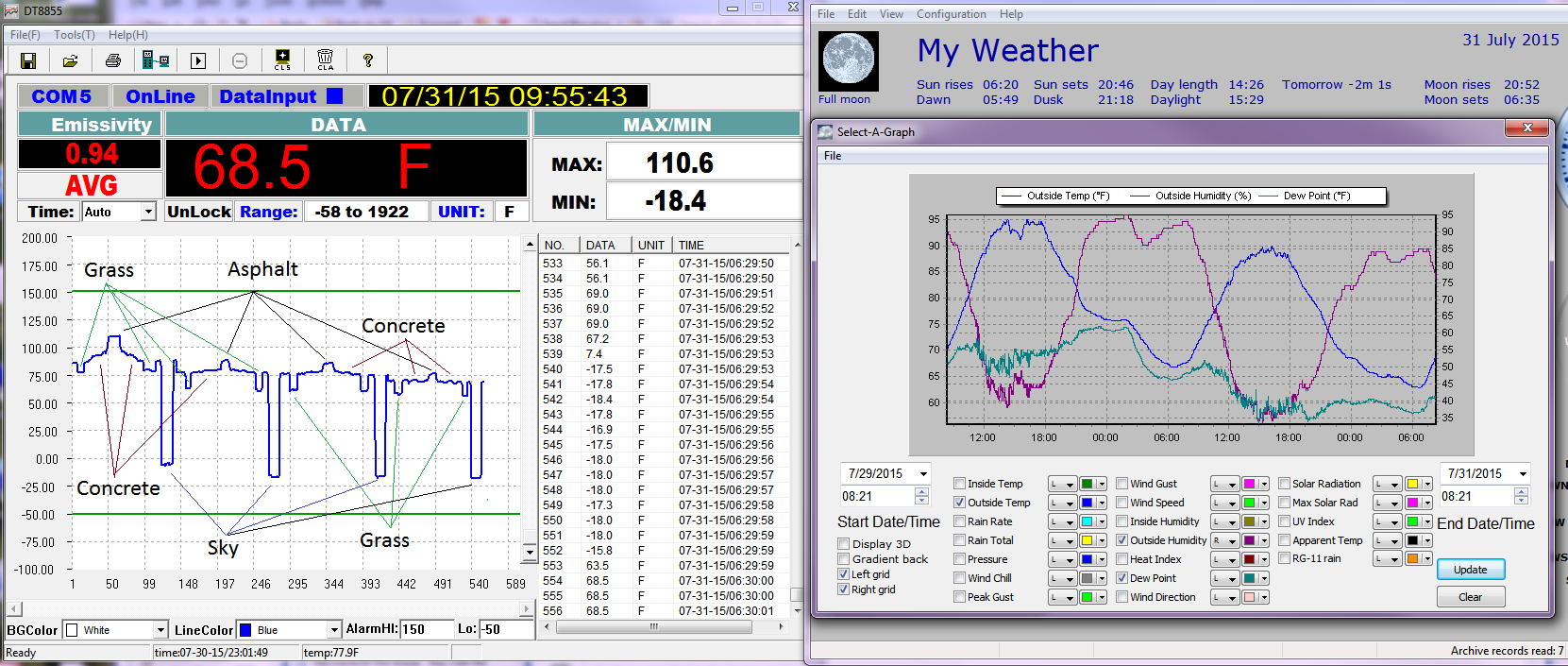 to go with the air force’s daily station data
//platform.twitter.com/widgets.js
Here are the UAH anomalies for Aprils since the last super El Nino:
1997: -0.26
1998: 0.74
1999: 0.01
2000: 0.05
2001: 0.20 Warmer
2002: 0.23 W
2003: 0.15 Cooler
2004: 0.14 C
2005: 0.33 W
2006: 0.07 C
2007: 0.14 W
2008: -0.13 C
2009: -0.01 C
2010: 0.32 W
2011: -0.04 C
2012: 0.11 W
2013: 0.05 C
2014: 0.11 W
2015: 0.08 C
2016: 0.71 W
2017: 0.27 C
For April at least, the 2016 El Nino was cooler than the 1998. In this century (2001-17, incl), eight years have been warmer than the preceding year, while nine have been cooler.
Median for this century is +0.14. Aprils ranked from coolest to warmest:
2008: -0.13
2011: -0.04
2009: -0.01
2013: 0.05
2006: 0.07
2015: 0.08
2012: 0.11
2014: 0.11
2007: 0.14
2004: 0.14
2003: 0.15
2001: 0.20
2002: 0.23
2017: 0.27
2010: 0.32
2005: 0.33
2016: 0.71
Note that the eight coolest Aprils of the seventeen all occurred 2008-15, ie later in the century. Of the nine warmest Aprils, most were weak (2004-05 & 2006-07), moderate (2002-03 & 2009-10) or very strong (2015-16) El Nino years..
http://ggweather.com/enso/oni.htm
And, yes, I know that the peak heat of the 2016 El Nino (Feb) was higher than for 1998 (Apr).
Thirteen-month drop after 2016 El Nino peak (Feb): 0.64 degrees.
Thirteen-month drop after 1998 El Nino peak (Apr): 0.78 degrees.
Setting aside the fact of different months, note that the 2016 peak was 0.09 degrees warmer than in 1998, and the drop 0.06 greater in 1998 than 2016. If these differences be entirely due to manmade GHGs, which of course they aren’t, then the fingerprint is tiny and of no concern. It’s a good thing.
Warming of 0.09 degrees in 18 years means 0.5 degrees per century.
ENSO between the VSENs:
1997-98: Very Strong El Niño
1998-99:
1999-2000:
2000-01: Weak La Niña
2001-02:
2002-03: Moderate El Niño
2003-04:
2004-05: Weak El Niño
2005-06:
2006-07: Weak El Niño
2007-08: Moderate La Niña
2008-09:
2009-10: Moderate El Niño
2010-11: Moderate La Niña
2011-12: Weak La Niña
2012-13:
2013-14:
2014-15:
2015-16: Very Strong El Niño
2016-17: Weak La Niña
http://ggweather.com/enso/oni.png
Nine La Nadas, four La Niñas (not Las Niñas) and four El Niños between the two VSENs. That the 2016 VSEN was followed by a La Niña rather than a La Nada is IMO noteworthy.
Also a longer time between VSENs. Eighteen years from 1998 to 2016, versus fifteen years from the previous one in 1983.
Not what you’d expect to see in a warming world, IMO.