Guest post by David Middleton
Introduction
When debating the merits of the CAGW (catastrophic anthropogenic global warming) hypothesis, I often encounter this sort of straw man fallacy:
All that stuff is a distraction. Disprove the science of the greenhouse effect. Win a nobel prize get a million bucks. Forget the models and look at the facts. Global temperatures are year after year reaching record temperatures. Or do you want to deny that.
This is akin to arguing that one would have to disprove convection in order to falsify plate tectonics or genetics in order to falsify evolution. Plate tectonics and evolution are extremely robust scientific theories which rely on a combination of empirical and correlative evidence. Neither theory can be directly tested through controlled experimentation. However, both theories have been tested through decades of observations. Subsequent observations have largely conformed to these theories.
Note: I will not engage in debates about the validity of the scientific theories of plate tectonics or evolution.
The power of such scientific theories is demonstrated through their predictive skill: Theories are predictive of subsequent observations. This is why a robust scientific theory is even more powerful than facts (AKA observations).
CAGW is a similar type of theory hypothesis. It relies on empirical (the “good”) and correlative evidence (the “bad”).
The Good
Carbon dioxide is a so-called “greenhouse” gas. It retards radiative cooling. All other factors held equal, increasing the atmospheric concentration of CO2 will lead to a somewhat higher atmospheric temperature. However, all other things are never held equal in Earth and Atmospheric Science… The atmosphere is not air in a jar; references to Arrhenius have no signficance.

Atmospheric CO2 has risen since the 19th century.

Humans are responsible for at least half of this rise in atmospheric CO2.

While anthropogenic sources are a tiny fraction of the total sources, we are removing carbon from geologic sequestration and returning it to the active carbon cycle.

The average temperature of Earth’s surface and troposphere has generally risen over the past 150 years.

Atmospheric CO2 has risen and warming has occurred.
The Bad
The modern warming began long before the recent rise in atmospheric CO2 and prior to the 19th century temperature and CO2 were decoupled:

The recent rise in temperature is no more anomalous than the Medieval Warm Period or the Little Ice Age:

Over the past 2,000 years, the average temperature of the Northern Hemisphere has exceeded natural variability (defined as two standard deviations from the pre-1865 mean) three times: 1) the peak of the Medieval Warm Period 2) the nadir of the Little Ice Age and 3) since 1998. Human activities clearly were not the cause of the first two deviations. 70% of the warming since the early 1600’s clearly falls within the range of natural variability.
While it is possible that the current warm period is about 0.2 °C warmer than the peak of the Medieval Warm Period, this could be due to the differing resolutions of the proxy reconstruction and instrumental data:

The amplitude of the reconstructed temperature variability on centennial time-scales exceeds 0.6°C. This reconstruction is the first to show a distinct Roman Warm Period c. AD 1-300, reaching up to the 1961-1990 mean temperature level, followed by the Dark Age Cold Period c. AD 300-800. The Medieval Warm Period is seen c. AD 800–1300 and the Little Ice Age is clearly visible c. AD 1300-1900, followed by a rapid temperature increase in the twentieth century. The highest average temperatures in the reconstruction are encountered in the mid to late tenth century and the lowest in the late seventeenth century. Decadal mean temperatures seem to have reached or exceeded the 1961-1990 mean temperature level during substantial parts of the Roman Warm Period and the Medieval Warm Period. The temperature of the last two decades, however, is possibly higher than during any previous time in the past two millennia, although this is only seen in the instrumental temperature data and not in the multi-proxy reconstruction itself.
[…]
The proxy reconstruction itself does not show such an unprecedented warming but we must consider that only a few records used in the reconstruction extend into the 1990s. Nevertheless, a very cautious interpretation of the level of warmth since AD 1990 compared to that of the peak warming during the Roman Warm Period and the Medieval Warm Period is strongly suggested.
[…]
The amplitude of the temperature variability on multi-decadal to centennial time-scales reconstructed here should presumably be considered to be the minimum of the true variability on those time-scales.
[…]

The climate of the Holocene has been characterized by a roughly millennial cycle of warming and cooling (for those who don’t like the word “cycle,” pretend that I typed “quasi-periodic fluctuation”):


These cycles (quasi-periodic fluctuations) even have names:

These cycles have been long recognized by Quaternary geologists:

Fourier analysis of the GISP2 ice core clearly demonstrates that the millennial scale climate cycle is the dominant signal in the Holocene (Davis & Bohling, 2001).

The industrial era climate has not changed in any manner inconsistent with the well-established natural millennial scale cycle. Assuming that the ice core CO2 is reliable, the modern rise in CO2 has had little, if any effect on climate.
The Null Hypothesis
What is a ‘Null Hypothesis’
A null hypothesis is a type of hypothesis used in statistics that proposes that no statistical significance exists in a set of given observations. The null hypothesis attempts to show that no variation exists between variables or that a single variable is no different than its mean. It is presumed to be true until statistical evidence nullifies it for an alternative hypothesis.
Read more: Null Hypothesis http://www.investopedia.com/terms/n/null_hypothesis.asp#ixzz4eWXO8w00
Follow us: Investopedia on Facebook
Since it is impossible to run a controlled experiment on Earth’s climate (there is no control planet), the only way to “test” the CAGW hypothesis is through models. If the CAGW hypothesis is valid, the models should demonstrate predictive skill. The models have utterly failed:


The models have failed because they result in a climate sensitivity that is 2-3 times that supported by observations:

From Hansen et al. 1988 through every IPCC assessment report, the observed temperatures have consistently tracked the strong mitigation scenarios in which the rise in atmospheric CO2 has been slowed and/or halted.
Apart from the strong El Niño events of 1998 and 2015-16, GISTEMP has tracked Scenario C, in which CO2 levels stopped rising in 2000, holding at 368 ppm.

The utter failure of this model is most apparent on the more climate-relevant 5-yr running mean:

This is from IPCC’s First Assessment Report:

HadCRUT4 has tracked below Scenario D.

This is from the IPCC’s Third Assessment Report (TAR):

HadCRUT4 has tracked the strong mitigation scenarios, despite a general lack of mitigation.
The climate models have never demonstrated any predictive skill.
And the models aren’t getting better. Even when they start the model run in 2006, the observed temperatures consistently track at or below the low end 5-95% range. Observed temperatures only approach the model mean (P50) in 2006, 2015 and 2016.

The ensemble consists of 138 model runs using a range of representative concentration pathways (RCP), from a worst case scenario RCP 8.5, often referred to as “business as usual,” to varying grades of mitigation scenarios (RCP 2.6, 4.5 and 6.0).

When we drill wells, we run probability distributions to estimate the oil and gas reserves we will add if the well is successful. The model inputs consist of a range of estimates of reservoir thickness, area and petrophysical characteristics. The model output consists of a probability distribution from P10 to P90.
- P10 = Maximum Case. There is a 10% probability that the well will produce at least this much oil and/or gas.
- P50 = Mean Case. There is a 50% probability that the well will produce at least this much oil and/or gas. Probable reserves are >P50.
- P90 = Minimum Case. There is a 90% probability that the well will produce at least this much oil and/or gas. Proved reserves are P90.
Over time, a drilling program should track near P50. If your drilling results track close to P10 or P90, your model input is seriously flawed.
If the CMIP5 model ensemble had predictive skill, the observations should track around P50, half the runs should predict more warming and half less than is actually observed. During the predictive run of the model, HadCRUT4.5 has not *tracked* anywhere near P50…

I “eyeballed” the instrumental observations to estimate a probability distribution of predictive run of the model.
Prediction Run Approximate Distribution
2006 P60 (60% of the models predicted a warmer temperature)
2007 P75
2008 P95
2009 P80
2010 P70
2011-2013 >P95
2014 P90
2015-2016 P55
Note that during the 1998-99 El Niño, the observations spiked above P05 (less than 5% of the models predicted this). During the 2015-16 El Niño, HadCRUT only spiked to P55. El Niño events are not P50 conditions. Strong El Niño and La Niña events should spike toward the P05 and P95 boundaries.
The temperature observations are clearly tracking much closer to strong mitigation scenarios rather than RCP 8.5, the bogus “business as usual” scenario.
The red hachured trapezoid indicates that HadCRUT4.5 will continue to track between less than P100 and P50. This is indicative of a miserable failure of the models and a pretty good clue that the models need be adjusted downward.
In any other field of science CAGW would be a long-discarded falsified hypothesis.
Conclusion
Claims that AGW or CAGW have earned an exemption from the Null Hypothesis principle are patently ridiculous.
In science, a broad, natural explanation for a wide range of phenomena. Theories are concise, coherent, systematic, predictive, and broadly applicable, often integrating and generalizing many hypotheses. Theories accepted by the scientific community are generally strongly supported by many different lines of evidence-but even theories may be modified or overturned if warranted by new evidence and perspectives.
This is not a scientific hypothesis:
More CO2 will cause some warming.
It is arm waving.
This is a scientific hypothesis:
A doubling of atmospheric CO2 will cause the lower troposphere to warm by ___ °C.
Thirty-plus years of failed climate models never been able to fill in the blank. The IPCC’s Fifth Assessment Report essentially stated that it was no longer necessary to fill in the blank.
While it is very likely that human activities are the cause of at least some of the warming over the past 150 years, there is no robust statistical correlation. The failure of the climate models clearly demonstrates that the null hypothesis still holds true for atmospheric CO2 and temperature.
Selected References
Davis, J. C., and G. C. Bohling, The search for patterns in ice-core temperature curves, 2001, in L. C. Gerhard, W. E. Harrison, and B. M. Hanson, eds., Geological perspectives of global climate change, p. 213–229.
Finsinger, W. and F. Wagner-Cremer. Stomatal-based inference models for reconstruction of atmospheric CO2 concentration: a method assessment using a calibration and validation approach. The Holocene 19,5 (2009) pp. 757–764
Grosjean, M., Suter, P. J., Trachsel, M. and Wanner, H. 2007. Ice-borne prehistoric finds in the Swiss Alps reflect Holocene glacier fluctuations. J. Quaternary Sci.,Vol. 22 pp. 203–207. ISSN 0267-8179.
Hansen, J., I. Fung, A. Lacis, D. Rind, Lebedeff, R. Ruedy, G. Russell, and P. Stone, 1988: Global climate changes as forecast by Goddard Institute for Space Studies three-dimensional model. J. Geophys. Res., 93, 9341-9364, doi:10.1029/88JD00231.
Kouwenberg, LLR, Wagner F, Kurschner WM, Visscher H (2005) Atmospheric CO2 fluctuations during the last millennium reconstructed by stomatal frequency analysis of Tsuga heterophylla needles. Geology 33:33–36
Ljungqvist, F.C. 2009. N. Hemisphere Extra-Tropics 2,000yr Decadal Temperature Reconstruction. IGBP PAGES/World Data Center for Paleoclimatology Data Contribution Series # 2010-089. NOAA/NCDC Paleoclimatology Program, Boulder CO, USA.
Ljungqvist, F.C. 2010. A new reconstruction of temperature variability in the extra-tropical Northern Hemisphere during the last two millennia. Geografiska Annaler: Physical Geography, Vol. 92 A(3), pp. 339-351, September 2010. DOI: 10.1111/j.1468-459.2010.00399.x
MacFarling Meure, C., D. Etheridge, C. Trudinger, P. Steele, R. Langenfelds, T. van Ommen, A. Smith, and J. Elkins. 2006. The Law Dome CO2, CH4 and N2O Ice Core Records Extended to 2000 years BP. Geophysical Research Letters, Vol. 33, No. 14, L14810 10.1029/2006GL026152.
Moberg, A., D.M. Sonechkin, K. Holmgren, N.M. Datsenko and W. Karlén. 2005. Highly variable Northern Hemisphere temperatures reconstructed from low-and high-resolution proxy data. Nature, Vol. 433, No. 7026, pp. 613-617, 10 February 2005.
Instrumental Temperature Data from Hadley Centre / UEA CRU, NASA Goddard Institute for Space Studies and Berkeley Earth Surface Temperature Project via Wood for Trees.
“Note: I will not engage in debates about the validity of the scientific theories of plate tectonics or evolution.”
Oh, go on. You know you want to, really.
Since we are told these models are based on physics, why does climate science accept/reject on a 2 sigma standard [ p value 0.05] rather than 5 sigma [p value 0.0000003] that is used for high energy physics? This isn’t a snark, I really wish I knew why. Even industrial quality control procedures require a 3 sigma process control [p value 0.003]. I suspect the answer will demonstrate some fundamental misunderstanding on my part, but I will be better off for learning what it is!
Hassling about 2σ p-levels isn’t a climate science preoccupation. It’s more a WUWT thing. But 2σ is the level used in many biological and other branches of science. It is a filter to say when a hypothesis that emerges from results can be taken seriously. That is not a common situation in climate science, where hypotheses emerge from physical reasoning. Deciding on a level to be used for the control of production processes, for example, is something quite different.
Translation: Climate science can’t meet the minimum standards required for all other branches of science so we declare ourselves to be an exception.
Choosing a fixed significance level is an element of a bad statistical practice known as the “null ritual”. RA Fisher, who is often credited as having invented null hypothesis statistical testing wrote
Essentially the proper significance level (and if we are doing this properly the required statistical power) depends on the nature of the problem, and especially issue such as the plausibility of the null and alternative hypotheses a-priori (unfortunately frequentist statistics can’t express these as probabilities, so the sort of subjectivity they hoped to eliminate from statistics creeps back in here, but in a hidden manner that is often missed/ignored).
This is illustrated very nicely by this XKCD cartoon:
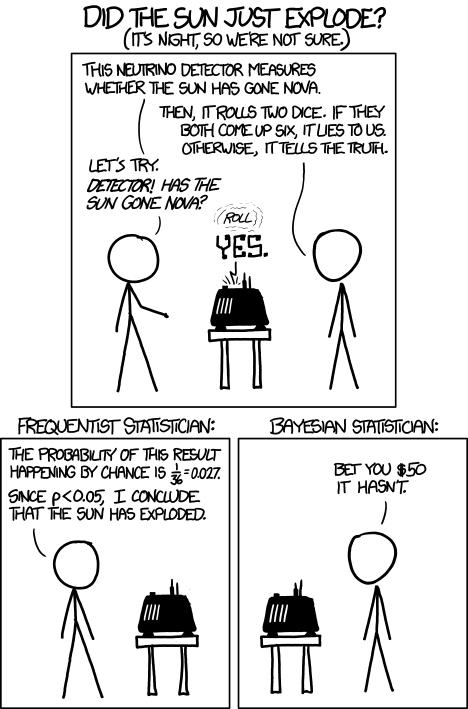
The frequentist statisticians error here is following the “null ritual” and using a significance level of 0.05 without considering whether that is sensible. The probability that the Sun actually has gone nova is vanishingly small, so not rejecting the null hypothesis that it has gone nova on the basis of a 1/20 chance of observing the result if that were true is ridiculously credulous.
You are doing a lot better than most, by at least questioning, rather than just unthinkingly adopting the “Null ritual”, which is what most do.
>>
Sun actually has gone nova
<<
What are you (or the cartoonist) trying to say here? From an astronomy point of view, it’s nonsense. The model of most novae is that they are close binaries with one a compact object–such as a white dwarf. Obviously the Sun doesn’t have a companion star. If by “going nova” you mean “going supernova,” then that statement might make more sense. But type II supernovae (or type Ib/c) require stars with far more mass than the Sun.
In any case, I would bet billions or trillions of dollars, because the event would never happen. And if by some quirk of fate it did happen, then I’d only have to stall for about 9 minutes. The neutrino blast would kill all of us, and there would be nobody to collect.
Jim
Jim wrote “From an astronomy point of view, it’s nonsense. ”
of course its nonsense, it is a “humerous” cartoon, the purpose of which was probably to suggest Bayesian statistics are superior to frequentist statistics (which isn’t the case, both have their advantages and disadvantages). It does however provide a very good illustration of why you shouldn’t unthinkingly adopt some particular significance level without considering the purpose and nature of the experiment.
It is a bit like illustrating relativity with an analogy about a tram car approaching the speed of light. That is also obvious nonsense, but though experiments, analogies and cartoons are often like that, even when they are illustrating a perfectly valid point.
Of course taking a thought experiment/analogy/cartoon far too literally is a great way of evading/diverting the discussion of the central point it raises, which in this case was how to set the significance level. Well done.
Jim Masterson – my sincere apologies for being grumpy/rude, I should know better.
The point is the cartoon is about statistics not astronomy, and most people reading it won’t know the difference between a nova and a supernova or that the sun is too small to do something that interesting.
actually, perhaps the fact that the Sun is too small to go supernova and that it can’t go nova is part of the subjective prior knowledge that the Bayesian is including in his decision, that the frequentist ignores because he is following the “null ritual” (the cartoon is actually misrepresenting the proper fruequentist approach and it is actually a criticism of what Gergrenizer calls “mindless statistics”).
When people misuse terms, I don’t know if they know what they are doing or if they’re clueless. The idiot on the left is assuming that it did happen, because double sixes are rare. If the guy on the right knows that a “nova” can’t happen, then he knows the detector is lying (got double sixes). His stupidity is not betting more. If a real supernova occurred, the resulting neutrino blast would destroy the detector and all living things (no need to wait 9 minutes as I previously said).
In realty, no one knows the correct answer to scientific measurements and must make educated guesses at the truth. There’s no book with the answers in the back. These number games are sometimes just games.
Jim
Something is wrong with Fig 3. The “likely natural ranges” are a nonsnse. But the thick red curve is also wrong. FF emissions alone would create nearly 400 ppm rise. Details here.
The reason that the extrapolations are nonsense is that the pre-1900 rise is not “natural”. It was caused by land clearing, particularly in N America, Australia etc. That was well under way by 1850 – details here. And land clearing has continued, but not with exponential rise.
The investopedia definition of null hypothesis is completely muddled. The null hypothesis does not “propose” no statistical significance. You can’t even talk about statistical significance until you have formulated a null hypothesis and tested whether it could explain the observation. If it could, then you could say that the observations are not statistically significant, relative to an alternative hypothesis.
“AGW or CAGW have earned an exemption from the Null Hypothesis principle “
That is gibberish. There is no such principle. What you quote from Berkeley has nothing to do with the Null Hypothesis. They do give a standard statistical definition of the NH which has no suggestion of any “principle”.
And your claim that CO2 causes warming is not a scientific hypothesis is not true. Le Chatelier’s principle, say, is perfectly scientific, but doesn’t have numbers. The proposition that if you jump out of a plane you will hit the ground very hard does not have numbers, but is still worth taking note of.
“The reason that the extrapolations are nonsense is that the pre-1900 rise is not “natural”. It was caused by land clearing, particularly in N America, Australia etc. …”.
===========================
“Although there are no written documents describing the intentional, controlled burning of forests, it is believed that the cumulative impact of burning by Native Americans profoundly altered the landscape. When first encountered by Europeans, many ecosystems were the result of repeated fires every one to three years, resulting in the replacement of forests with grassland or savanna …” (Wiki).
“For thousands of years, Aboriginal Australians burned forests to promote grasslands for hunting and other purposes. Recent research suggests that these burning practices also affected the timing and intensity of the Australian summer monsoon …” (The ConversationJanuary 12, 2012).
“For thousands of years, Aboriginal Australians burned forests”
And CO2 remained stable. They didn’t start burning more forests in about 1850. That was the arrival of Europeans, who didn’t just burn forests (which recover). They obliterated them.
Post hoc ergo propter hoc.
The argument that there was a “natural” increase starting about 1850 that can be extrapolated is post hoc. It makes no sense to do that without looking for cause. And the mass clearing by Europeans is a matter of history, and can be quantified. That is done here, and is the basis for the plots in the above link. The land clearing emissions match (with the AF factor) the observed increase.
This is I assume one estimate of the net effect of land use change post 1850, I think from the same source in a graphic form, which indicates not much relative change 1850 — 1950 while the CO2 concentration went from ~275 — ~315 ppm:
http://appinsys.com/globalwarming/GW_5GH_CO2Sources_files/image007.jpg
Increasing CO2 can cause increasing temperature (ceteris paribus) and vice versa.
The hypothesis that land use change alone, in the absence of significant human emissions, can account for that CO2 concentration to increase which can in turn account for the temperature increase particularly 1910 — 1945 is implausible IMHO.
“indicates not much relative change 1850 — 1950 while the CO2 concentration went from ~275 — ~315 ppm”
It doesn’t need to change. From 1850-1900 it’s about 600 Mtons C/year. That equates to about 0.22 ppm/year. So that base rate would explain a 22 ppm change in a century, but the rate did go up. Anyway, the point here is that it would be a change of 11 ppm from 1850-1900, and fig 3 shows about a 15ppm change (and there was some FF emission). So you can’t say that the 1850-1900 change was natural and extrapolate it, which is what seems to be done in Fig 3.
Nick writes
From the reference, clearly that didn’t start in 1850 at 500Mtons. It must’ve been happening well before then and reached 500Mtons by 1850. So is there evidence of that?
Nick reasoned
If those figures are straight from the Houghton figures, then they probably dont include the effect of sinks…which could account for around half of the CO2 you’re suggesting may have accumulated earlier than thought.
dikranmarsupial writes
You’ve just jumped from GHGs warm the atmosphere to more GHGs warm the atmosphere more. That may well be the case but your jump isn’t part of the science you’re using to make the claim with.
The red curve is the cumulative anthropogenic emissions from cement production and fossil fuel use, converted to ppm CO2 and added to the CO2 value from the DE08 core at the start of the CDIAC emissions table.
 ?w=680
The CDIAC table has the total carbon emissions as 402,068 million metric tons C from 1751-2014. That’s 402.07 Gt C. 1 ppm by volume of atmosphere CO2 = 2.13 Gt C. 402.07/2.13 = 188.8 ppmv CO2 total emissions from cement production and fossil fuel use.
The CDIAC land use data start in 1850; so it’s kind of useless for estimating pre-industrial CO2 shifts. Humans living on this planet is a “natural” thing. We live by altering the landscape (agriculture). I should have characterized it as the pre-industrial rather than natural trend.
That said, all of the estimates of pre-industrial Holocene CO2 levels, not derived from Antarctic ice cores (Greenland ice cores and plant stomata), indicate that >300 ppm was routine.
The Null Hypothesis is the default position.
The Null Hypothesis (H0) for AGW is that there is no statistically significant correlation between CO2 and temperature which supports the assertion that CO2 emissions have caused most of the recent climate change. The models have not rejected H0 or supported the alternate hypothesis (a statistically significant correlation between CO2 and temperature which supports the assertion that CO2 emissions have caused most of the recent climate change).
Now, if the models were configured to yield a lower climate sensitivity to CO2, they probably would reject H0 and support the alternate hypothesis that AGW is relatively insignificant.
What I quoted from Berkeley is the definition of a scientific theory, particularly its predictive nature. I’m not sure why this confused you.
Trenberth clearly did assert that AGW merited an exemption from the Null Hypothesis by reversing the burden of proof.
The Law of Superpostion doesn’t have numbers either. But it is a “concise, coherent, systematic, predictive, and broadly applicable” explanation of sedimentary stratigraphy.
More CO2 will cause some warming, is not a “concise, coherent, systematic, predictive, and broadly applicable” explanation of an enhanced greenhouse effect.
A doubling of atmospheric CO2 will cause the lower troposphere to warm by ___ °C, is a “concise, coherent, systematic, predictive, and broadly applicable” explanation of an enhanced greenhouse effect.
Definition of “principle”…
https://www.merriam-webster.com/dictionary/principle
The Null Hypothesis is the fundamental assumption it is a principle:
http://www.statisticshowto.com/what-is-the-null-hypothesis/
It is commonly accepted that increasing atmospheric greenhouse gasses lead to increased global mean surface temperatures.
And common thinking is wrong.
Which is not a scientific hypothesis. It is a generality. It is arm waving.
dikranmarsupial writes
The IPCC says ” The best estimate of the human-induced contribution to warming is similar to the observed warming over this period”
Take a null of no warming. Show there is warming. Attribute it all to CO2 by building models that are tuned that way. Claim there is no other way we could have warmed. Simples.
“Which is not a scientific hypothesis. It is a generality. It is arm waving.”
No the greenhouse effect is a scientific hypothesis, there is a physical mechanism identified, observations to support it (e.g. that the Earth is over thirty K above its grey-body temperature), and it is falsifiable. You may not accept it, but that doesn’t mean it isn’t an accepted “fact” within the scientific community.
The “greenhouse” effect is a valid scientific theory. I stated this at the beginning of the post.
The assertion that anthropogenic CO2 emissions have significantly enhanced the “greenhouse” effect is the falsified hypothesis.
This is arm waving:
This is a scientific hypothesis:
dikranmarsupial writes
You’ve just jumped from GHGs warm the atmosphere to more GHGs warm the atmosphere more. That may well be the case but your jump isn’t part of the science you’re using to make the claim with.
“The assertion that anthropogenic CO2 emissions have significantly enhanced the “greenhouse” effect is the falsified hypothesis.”
Your shifting the goalposts noted – a physical hypothesis that has been falsified is by definition falsifiable, and hence would be considered scientific, at least by Popperians. To be a falsified hypothesis, then we need to have observations that the theory of the greenhouse effect forbids (taking into account all relevant sources of uncertainty). That has not happened. A lack of a statistically significant trend does not mean the alternate hypothesis has been falsified, especially if the statistical power of the test is low (because the magnitude of the expected trend is small compared to the magnitude of the noise, given the period usually considered – 30 years is the WMO guideline), especially if the start date has been cherry picked to coincide with ENSO, which is a principal source of “noise”.
Did you even read the post?
Why do you guys always accuse skeptics of cherry picking a start date? The comparison has always been backwards from today. Right now after the recent El Nino, there is a trend again and if it turns out to be a step increase it’ll likely persist.
appologies, I misunderstood your point, I’ll try again, now that I hopefully get it.
was phrased to match the definition of the null hypothesis that you cited:
The null hypothesis, H0 is the commonly accepted fact; it is the opposite of the alternate hypothesis.
except that I didn’t use the word “fact” because if one of your hypotheses is a fact, there is no point in performing the test in the first place. I could indeed have expressed it better, but that is just missing the point, which is that assuming no trend or no relationship between anthropogenic emissions and temperatures would violate the definition of a null hypothesis that you gave.
Of course I could indeed have said something along the lines of
however you can’t directly test that by looking at the observations we actually have because we also need to state the range of natural variability that is plausible under the theory. The models (which are implementations of the theory) show that a period of a decade or two with little or no warming is not unexpected, and a proper comparison of models and data (i.e. not making errors, such as using a single year baseline period) shows no model-observation inconsistency (the observations lie in the spread of the model runs). Nick is more expert on this topic than I am.
Either way, if you take what is generally accepted as being the null hypothesis, then that is inconsistent with using a null hypothesis of no warming.
However, the definition of a null hypothesis that you gave is actually little better than the previous one, as it assumes that you are trying to refute something that is generally accepted. That is not always the case, actually the null hypothesis should be essentially the opposite of whatever it is you are arguing for. So if you are arguing that there is no AGW, then your null hypothesis should be that the underlying rate of warming is what the models suggest it is. If you are trying to show that there is AGW, then your null hypothesis should be that there is no warming. Hypothesis tests are not symmetric, so it is perfectly possible to perform the test both ways and get a non-significant result on both occassions, which would just be an indication that the period is too short to give a reliable indication either way.
That is not the null hypothesis:
https://en.wikipedia.org/wiki/Null_hypothesis
The default position is “that there is no relationship between two measured phenomena.”
Actually when Ben Santer analysed the models back in 2011, he concluded that it was unlikely that a period of 17 years could pass without the AGW signal showing. But it happened. Did you guys re-evaluate your views of the models at that time?
TImTheToolMan wrote
Can you give me examples of where before the recent El-Nino climate skeptic blogs used a start date corresponding to Neutral/La Nina conditions instead of the 1998 El-Nino, to match the conditions of the finish date at that time? A better approach is just to use a time period long enough for ENSO not to make much difference, which is the 30 years that the WMO guidelines suggest.
TimTheToolMan wrote
no, that is not what the paper said, what the paper said was
So far from saying it is unlikely that a period of 17 years could pass without an AGW signal showing, it is saying that 17 years is the minimum window that you might reasonably expect to detect an AGW signal. An that is also for a randomly selected 17 year period, rather than a period selected after having looked at the data (i.e cherry picked), in other words if you look at the minimum sliding length window of 17 years, you wont have to look for very long before multiple hypothesis testing means you will find one without a significant trend.
You still don’t get it do you. You look backwards from today to see how far backwards you can go and get no trend. If it’s a few years it’s noise but at 18 or so years is became relevant. You’ll find lots of examples of people on both sides who cherry pick dates for their arguments but the strong skeptical argument doesn’t do that.
TimTheToolman wrote
I note you ducked the challenge. Looking backwards from today to see how far back you can go and get no significant trend violates the statistical assumption of the test (which assumes the period considered is a random sample) and introduces the multiple hypothesis testing problem (as you have tested the same data more than once), which is never corrected for in the analyses on skeptic blogs that I have seen.
If that’s your interpretation then Santer is saying nothing because how much time might you need? 30 years? 100 years? No. Santer’s analysis is what it is.
What test? The one that puts the models’ ability to forcast into doubt?
TimTheToolman wrote
Like everything in statistics, the more data you have the more reliable inferences you can draw, 17 years is the minimum, that is what “at least” means, which is what he actually wrote. If you have a longer period, then the more reliable the conclusions you can draw. 30 years is better, as I said it is the WMO guideline for reliable estimation of a trend, for precisely this reason.
TimTheToolMan wrote “What test?”
LOL. Perhaps you ought to actually read Santer’s paper.
David,
“402.07/2.13 = 188.8 ppmv CO2 total emissions from cement production and fossil fuel use.”
Yes, sorry, not sure how I wrote 400, I mean 188. But Fig 3 does not show a 188 rise. 188+277=465. It siws about 140ppm.
“The CDIAC land use data start in 1850; so it’s kind of useless for estimating pre-industrial CO2 shifts.”
It says that land use emission was about 0.55Gtons/year in 1850 and continued at about that rate to 1900. That would be .26 ppm/year, or 28.9 ppm from 1788 to 1900. Total rise in that time was about 35 ppm. Now the pre-1850 rate was probably less than .55 Gt/yr, but it’s still a stretch to say that the whole 35 ppm was natural, especially as FF use was also not zero.
“The Null Hypothesis (H0) for AGW is that there is no statistically significant correlation between CO2 and temperature which supports the assertion that CO2 emissions have caused most of the recent climate change. “
No, again that makes no sense. Statistical significance is a result of testing the NULL hypothesis; it cannot be part of it. You could say “no correlation”, but that is easily rejected. What you need is a hypothesis that says that past CO2 has fllowed some stochastic distribution independent of temperature. Then you can test subject to that distribution.
“What I quoted from Berkeley is the definition of a scientific theory”
It is quoted in support of some nonsense statement about the “Null Hypothesis principle”. There is nowhere else that any definition of what that “principle” might be.
Trenberth did not claim an “exemption”; you have not said what this is an exemption from. He said that the default assumption for statistical testing should be that there is warming as observed. If you could reject that, it would be interesting. Rejecting a hypothesis of no warming is no longer interesting. And a failure to reject that (or anything) is just a failure.
“More CO2 will cause some warming”, is not a “concise, coherent, systematic, predictive, and broadly applicable” explanation of an enhanced greenhouse effect.”
That is a straw man. People going back to Arrhenius have made a much more elaborate statement than that. But even “More CO2 will cause some warming” is predictive.
“The Null Hypothesis is the fundamental assumption it is a principle”
You haven’t said what the “principle” is. Your last quote says that the NH expresses “commonly accepted fact”. So what is the principle? “Commonly accepted facts” are always right? The whole point of the use of NH with statistics in science is that NHs are often rejected, and so science progresses. What Trenberth is saying is that yet another rejection of the hypothesis of no warming is not progress.
dikranmarsupial suggests
Newton’s laws of motion have no numbers associated with them, either. But they, along with the first and second laws of thermodynamics (which also have no numbers), are virtually the only actual laws of nature humans can claim to have discovered.
Newton’s law of motion, the first and second laws of thermodynamics are“concise, coherent, systematic, predictive, and broadly applicable” explanations of basic scientific principles.
More CO2 will cause some warming, is not a “concise, coherent, systematic, predictive, and broadly applicable” explanation of an enhanced greenhouse effect.
A doubling of atmospheric CO2 will cause the lower troposphere to warm by ___ °C, is a “concise, coherent, systematic, predictive, and broadly applicable” explanation of an enhanced greenhouse effect.
When the AGW crowd can fill in the blank, they will have rejected the null hypothesis and actually have a scientific theory.
Nick, in response to [“AGW or CAGW have earned an exemption from the Null Hypothesis principle “
That is gibberish. There is no such principle. What you quote from Berkeley has nothing to do with the Null Hypothesis. They do give a standard statistical definition of the NH which has no suggestion of any “principle”.]
The ‘AGW or CAGW…’ comment links to a paper by Trenberth [2011, AMS], not Berkeley Earth [where Trenberth wrote: “Given that global warming is unequivocal, the null hypothesis should be that all weather events are affected by global warming rather than the inane statements along the lines of “of course we cannot attribute any particular weather event to global warming”]. ie: I don’t believe the author said the Berkeley Earth called for the exemption from the null hypothesis test [rather than principle]. At least my reading of it was that he used the BE description as justification why no such ‘exemption’ is warranted [or whatever it is that Trenberth was calling for. I would call it inversion of standard null definition protocol].
What Trenberth said was:
“Given that global warming is unequivocal, the null hypothesis should be that all weather events are affected by global warming rather than the inane statements along the lines of “of course we cannot attribute any particular weather event to global warming”. That kind of comment is answering the wrong question.”
He’s not stating a “principle”. I have never seen a coherent statement of any NH “principle”. He is simply talking about the kind of statistical test that should be done – always an open question. The “null” in null hypothesis means that if it can explain the results, we haven’t learnt anything. He’s saying that if a result accords with AGW, that is no surprise (because it has happened so often). You may disagree, but that is his view. It’s the issue of “answering the wrong question”.
Nick Stokes:
You display your usual degree of veracity when you write
I have repeatedly explained the matter to you most recently on WUWT a week ago, but you try to pretend the scientific method does not include a null hypothesis and only the infinite variety of null hypotheses used by statistics exist.
The Null Hypothesis of the scientific method is a requirement that exists because the scientific method uses the principle of parsimony which is often called ‘Occam’s Razor’. This says that an explanation is not scientific if it adopts an assumption that is not needed to explain a phenomenon that is not in evidence. This principle is e.g. why the Laws of Physics are assumed to be the same everywhere and e.g. why the existence of God is not a scientific question.
So, I again post the “coherent statement” of the scientific Null Hypothesis which you say you have refused to read. It is as follows.
The Null Hypothesis of the scientific method says it must be assumed a system has not experienced a change unless there is evidence of a change.
The Null Hypothesis is a fundamental scientific principle and forms the basis of all scientific understanding, investigation and interpretation. Indeed, it is the basic principle of experimental procedure where an input to a system is altered to discern a change: if the system is not observed to respond to the alteration then it has to be assumed the system did not respond to the alteration.
In the case of climate science there is a hypothesis that increased greenhouse gases (GHGs, notably CO2) in the air will increase global temperature. There are good reasons to suppose this hypothesis may be true, but the Null Hypothesis says it must be assumed the GHG changes have no effect unless and until increased GHGs are observed to increase global temperature. That is what the scientific method decrees. It does not matter how certain some people may be that the hypothesis is right because observation of reality (i.e. empiricism) trumps all opinions.
Please note that the Null Hypothesis is a hypothesis which exists to be refuted by empirical observation. It is a rejection of the scientific method to assert that one can “choose” any subjective Null Hypothesis one likes. There is only one Null Hypothesis: i.e. it has to be assumed a system has not changed unless it is observed that the system has changed.
However, deciding a method which would discern a change may require a detailed statistical specification.
The Null Hypothesis has had profound effects. For example, Michelson-Morley Experiment (MME) was conducted in 1887 which was before statistics formulated its own version of null hypotheses. The MME failed to detect movement of the luminiferous ether. This failure of the MME to detect movement of the luminiferous ether required adoption of the scientific Null Hypothesis that there is no movement of the luminerous ether. And that conclusion that there is no movement of the ether led to most modern physics and our modern electronic communications. However, there is now some evidence that the MME was inadequate to detect movement of the luminiferous ether that may exist.
In the case of global climate in the Holocene, no recent climate behaviours are observed to be unprecedented so the Null Hypothesis decrees that the climate system has not changed: i.e. there is no reason to suppose that climate changes now happening have different cause(s) to the causes of similar climate changes in the past.
Importantly, an effect may be real but not overcome the Null Hypothesis because it is too trivial for the effect to be observable. Human activities have some effect on global temperature for several reasons. An example of an anthropogenic effect on global temperature is the urban heat island (UHI). Cities are warmer than the land around them, so cities cause some warming. But the temperature rise from cities is too small to be detected when averaged over the entire surface of the planet, although this global warming from cities can be estimated by measuring the warming of all cities and their areas.
Clearly, the Null Hypothesis decrees that UHI is not affecting global temperature although there are good reasons to think UHI has some effect. Similarly, it is very probable that AGW from GHG emissions are too trivial to have observable effects.
Empirical evidence indicates that net feedbacks in the climate system are negative and, therefore, any effect of increased CO2 will probably be too small to discern because natural climate variability is much, much larger. This concurs with the empirically determined values of low climate sensitivity.
As I state above, empirical – n.b. not model-derived – determinations indicate climate sensitivity is less than 1.0°C for a doubling of atmospheric CO2 equivalent. This is indicated by the studies of
Idso from surface measurements
http://www.warwickhughes.com/papers/Idso_CR_1998.pdf
and Lindzen & Choi from ERBE satellite data
http://www.drroyspencer.com/Lindzen-and-Choi-GRL-2009.pdf
and Gregory from balloon radiosonde data
http://www.friendsofscience.org/assets/documents/OLR&NGF_June2011.pdf
Indeed, because climate sensitivity is less than 1.0°C for a doubling of CO2 equivalent, it is physically impossible for the man-made global warming to be large enough to be detected (just as the global warming from UHI is too small to be detected). If something exists but is too small to be detected then it only has an abstract existence; it does not have a discernible existence that has effects (observation of the effects would be its detection).
To date there are no discernible effects of AGW. Hence, the Null Hypothesis decrees that AGW does not affect global climate to a discernible degree. That is the ONLY scientific conclusion possible at present.
Richard
“This failure of the MME to detect movement of the luminiferous ether required adoption of the scientific Null Hypothesis that there is no movement of the luminerous ether.”
The prior expectation was in fact that the experiment would detect motion relative to the ether. No particular assumption about there being no movement of the ether – whatever that means. And of course, the outcome was that there wasn’t an ether at all. None of that fits into the framework of a unique null hypothesis.
And it’s change relative to what that is the lack of coherence in our statement. But the basic problem is that despite a number of very loud posts, you haven’t produced any reference to back up your assertions.
richardscourtney writes “The Null Hypothesis of the scientific method says it must be assumed a system has not experienced a change unless there is evidence of a change. ”
On the other thread that richard mentions, I repeatedly challenged him for a verifiable reference to support the claim that there was a definition of the null hypothesis in scientific method other than the usual statistical definition), and he repeatedly replied with insults and a complete absence of a verifiable reference for such a usage. This strongly implies it is of Richards own imagination. I suspect Richard is just promoting a naive statistical misunderstanding (known as the null ritual) to an element of scientific method, and is too obstinate to accept his error, and so resorts to insults and ad-hominems.
Greenhouse gasses have strongly influenced planetary temperatures throughout geological time. It is a violation of Occam’s razor to suppose that greenhouse gasses don’t affect climate when they are released from anthropogenic sources, rather than natural ones.
Nick Stokes and his anonymous clack:
The lie I have refuted was that Stokes had seen no “coherent statement of any NH “principle” “.
I again provided the coherent statement of the Null Hypothesis which is irrefutably a basic principle of the scientific method.
Stokes is still telling lies in attempt to justify his pseudoscience.
Richard
anonymous troll who posts as dikranmarsupial:
Congratulations on your slaying of a straw man when you write
I know of nobody who has claimed “greenhouse gasses don’t affect climate when they are released from anthropogenic sources, rather than natural ones” and I am certain you cannot cite anybody who has.
Richard
richardscourtney wrote:
for which you are unable to provide a verifiable reference so we don’t have to accept it entirely on your authority. I did at least make the effort to look for such a reference, which is more than you are apparently willing to do. The OED only gives the standard statistical definition. Google book’s n-gram viewer finds no examples of the phrase prior to its introduction in statistics by Fisher. Google scholar indexes no papers that use the phrase prior to its statistical usage.
Richardscourtney wrote
richardscourtney wrote
Indeed, increasing levels of greenhouse gasses in the past have caused similar climate changes in the past (e.g. PETM, but most of the changes have been more gradual as the increases in GHGs have been more gradual). Thus if the null hypothesis is that the climate system has not changed, that includes its response to GHGs, so we would expect to see rising temperatures in response to our GHG emissions. Unless of course there is something different about anthropogenic emissions to natural GHG emissions.
dikranmarsupial: It is a violation of common sense to assume that all greenhouse gases have the same impact and that the level of greenhouse gases don’t matter in how much an increase in any of them will impact the climate.
Your logic boils down to this. Greenhouse gases keep the planet 33C above what it would be without them.
CO2 is a greenhouse gas. Therefore the models are correct.
dikranmarsupial: You claim that increases in greenhouse gases have caused increases in temperature in the past.
OK, show your evidence.
Every chart that I am aware of shows that there is little correlation between CO2 levels and global temperatures.
>>
The MME failed to detect movement of the luminiferous ether. This failure of the MME to detect movement of the luminiferous ether required adoption of the scientific Null Hypothesis that there is no movement of the luminerous ether.
<<
Unfortunately, I’ll have to agree with Mr. Stokes. I’ve read Michelson-Morley 1887 several times. They discuss the various possible theories for aberration including using water-filled telescopes and they discuss their experimental set-up. The purpose of MM 1887 was to measure the speed of the Earth through the “fixed” luminiferous ether. They produced a null result which means it made no difference what direction they pointed their light ray setup. Special Relativity actually explains the MM 1887 null result, aberration, and the speed of light appearing in Maxwell’s equations better than Lorentz’s theory and without the need for the “luminiferous ether.” Add to that the idea that light is a particle that sometimes acts as a wave, and there’s no need for light to have a medium in the vacuum of space to wave.
Jim
dikranmarsupial:
You write
So, we now have to add a lack of ability at reading comprehension to your other demonstrated failings; viz. stupidity and being a ‘useful idiot’ of Nick Stokes.
In this thread I have repeatedly cited empirical derivations of climate sensitivity being ~0.4°C for a doubling of CO2 equivalent: I state HOW MUCH temperature is expected to rise in response to a rise of atmospheric CO2 concentration In fact, I concluded the post your statement quotes by saying
It is not possible for a sane person to equate what I wrote with meaning “there is something different about anthropogenic emissions to natural GHG emissions”. Your assertion is as wrong as Stokes pretending there is no scientific null hypothesis.
Richard
Jim Masterson:
Your nit-pick agrees with what I wrote.
I used the MME as an illustration and not as a dissertation on that experiment. Your nit-pick in attempt to support Stokes says
But I cited the MME as illustration of my explanation that
I see no difference between your nit-pick and my statement that
an explanation is not scientific if it adopts an assumption that is not needed to explain a phenomenon that is not in evidence
which is formalised as being the scientific Null Hypothesis; viz.
The Null Hypothesis of the scientific method says it must be assumed a system has not experienced a change unless there is evidence of a change.
Richard
>>
Your nit-pick agrees with what I wrote.
<<
Yes, I agree it was a nit-pick. However, there is a difference between getting a null result in an experiment and the “null hypothesis.” I don’t consider MM 1887 as an attempt to test some null hypothesis. It was to measure the speed of the Earth through the ether. I might add that your original quote referred to the speed of the ether, which is definitely not what MM 1887 tried to measure. And it was Einstein that said we didn’t need the ether, not Michelson-Morley.
Notice that the purpose of the ether was to explain why the speed-of-light appears in Maxwell’s equations. Also, since light (electromagnetic radiation) was considered to be a wave, it needed something to wave.
>>
This principle is e.g. why the Laws of Physics are assumed to be the same everywhere
<<
The concept dates back to Galileo. It’s the basis of relativity, and why we believe that the laws of physics are invariant under various transformations. It’s interesting that people may believe in the invariance of physical laws, but don’t like the result–relativity.
Jim
Jim Masterson:
I replied to a comment you made about an explanation I provided to Stokes. My reply said
Your reply to that says
Yes, as you say, “The concept dates back to Galileo”.
This is one of many examples that – as I have told Stokes – the scientific Null Hypothesis predates the existence of statistics by centuries.
But I don’t know why you have implied I “don’t like” “rel@tivity”. That implication is untrue: I have never – not ever – given any suggestion of it and in this thread I have not mentioned rel@tivity.
Richard
>>
Your reply to that says . . . .
<<
You skipped over my reply which addressed your “null hypothesis” comment.
>>
But I don’t know why you have implied I “don’t like” “rel@tivity”.
<<
It was just a general comment. It wasn’t specifically addressed to you, but it was made in reference to your statement on invariance. My dad, for example, disliked relativity. I have run across others with the same opinion. I didn’t know your exact position on relativity–so ignore that part of my comment,
Jim
“Greenhouse gasses have strongly influenced planetary temperatures throughout geological time.”
When?
http://i90.photobucket.com/albums/k247/dhm1353/Phan_CO2.png
http://i90.photobucket.com/albums/k247/dhm1353/NEO_CO2.png
http://i90.photobucket.com/albums/k247/dhm1353/LawMob1.png
The industrial era rise in atmospheric CO2 doesn’t even break out of the Cenozoic noise level:
http://i90.photobucket.com/albums/k247/dhm1353/Cen_CO2_zps49992aaf.png
The “Anthropocene” CO2 level is almost indistinguishable from “sustained and severe carbon starvation” levels:
http://i90.photobucket.com/albums/k247/dhm1353/GeoCO2.png
David Middleton:
Upthread you say
No. I refer you to one of our 1995 papers.
(ref. )
It provides our analyses which show the atmospheric CO2 concentration would probably be the same if the CO2 emission from human emissions were absent; n.b. absent humans emitting CO2 the atmospheric CO2 concentration would probably be the same.
Those analyses show the short term sequestration processes can easily adapt to sequester the anthropogenic emission in a year. But, according to each of our six different models, the total emission of a year affects the equilibrium state of the entire carbon cycle system. Some processes of the system are very slow with rate constants of years and decades. Hence, the system takes decades to fully adjust to a new equilibrium. So, the atmospheric CO2 concentration slowly changes in response to any change in the equilibrium condition.
Importantly, each of our models demonstrates that the observed recent rise of atmospheric CO2 concentration may be solely a consequence of altered equilibrium of the carbon cycle system caused by, for example, the anthropogenic emission or may be solely a result of desorption from the oceans induced by the temperature rise that preceded it.
The most likely explanation for the continuing rise in atmospheric CO2 concentration is adjustment towards the altered equilibrium of the carbon cycle system provided by the temperature rise in previous decades during the centuries of recovery from the Little Ice Age.
This slow rise in response to the changing equilibrium condition also provides an explanation of why the accumulation of CO2 in the atmosphere continued when in two subsequent years the flux into the atmosphere decreased (the years 1973-1974, 1987-1988, and 1998-1999).
And this understanding is supported by the measurements made by the OCO-2 satellite. Stephen Wilde provides this plot of atmospheric CO2 concentration provided by the OCO-2 satellite together with his summary of what it shows.
The OCO-2 satellite measurements indicate that ALL the CO2 from human activities is sequestered by sinks local to its emission sites. Hence, it is observed that the CO2 from human activities is not overloading those local sinks and is not available to overload other sinks.
Richard
Ooops. The missing reference is
Rorsch A, Courtney RS & Thoenes D, ‘The Interaction of Climate Change and the Carbon Dioxide Cycle’ E&E v16no2 (2005)
Sorry
Richard
richardscourtney April 17, 2017 at 11:37 pm
The most likely explanation for the continuing rise in atmospheric CO2 concentration is adjustment towards the altered equilibrium of the carbon cycle system provided by the temperature rise in previous decades during the centuries of recovery from the Little Ice Age.
http://towardsthefinalhour.com/wp-content/uploads/2016/02/overview20220co2.jpg
Aha. Now I begin to understand the sense of the word ‘recovery’.
Thanks for the hint!
I would like to point out that your entire article is WRONG and INCOMPETENT because you incorrectly called “CAGW” a hypothesis when it is only a POSTULATE.
prjindigo,
Considering that your statement about “postulate” comes to a strong conclusion, I think that you should have defended how what appears to be a ‘distinction without a difference’ justifies such a condemnation. After all, common synonyms for the verb “postulate” include ” put forward · suggest · advance · posit · HYPOTHESIZE · propose · assume · presuppose · presume · take for granted.” You come across as just trying to demonstrate your superior command of English in a rather petty way. Please be so good as to explain just why “postulate” is so superior to “hypothesis” and why it really makes a difference.
I might not have wasted so many decades not carrying on studying physics, if the teachers had shown me how surprising it often is. AGW misses the vital point: that we are dealing with gases. These, to a man, are not tied down, by definition. Gravito-density eg lapse rate, may thwart radiation near the surface. But, as Maxwell noted in eg ‘Theory of Heat’, gases simply exercise bouyancy instanter and very vigourously on the touch of heat. Like I do from a hot seat. But all gases take the heat energy with them, and quickly, to the net-radiative point and also further, to the tropopause. Any ghg absorption, if not instantly re-emitted, is preemptively lifted up and away. Them is the Gas Laws, no exceptions folks. This process is only boosted and hugely by H2O phase-changes, Water Vapour starting out as a gas only half as massive as air, but with vast latent heat to supercharge the job. By about 80 percent. CO2 rather prefers to carry on as the basis of life. Some people should get wary of falsely accusing such a fine and caring gas, before they annoy it……
Ah yes, Airs; JAXA; now Nasa OCO2. Guess they are silent because they are busy eating their hats. Fries and salad with that, Sirs. More sauce?
Seems to me the null hypothesis is even simpler.
At the heart of CAGW hypothesis: more CO2 = more temperature
Therefore, if there was ever a time when there was significantly more CO2 in the atmosphere than now and the temperature was significantly colder than now, the hypothesis is wrong, no?
Poor Richard:
You say
It seems we agree. Above I wrote
The reason Stokes and his clack reject use of the Null Hypothesis is because it rejects their unsupported assertions of CAGW.
Richard
No, this is an extremely naive approach to statistical hypothesis testing known as the “Null ritual”. The null hypothesis should play the role of a devils’ advocate to enforce a degree of self-skepticism on the experimenter. Essentially speaking the null hypothesis should be the opposite of the argument the researcher wants to make. Most often the experimenter wants to claim that there is a difference, so usually the null hypothesis is that there is no difference, but assuming that this is always the case reflects a fundamental misunderstanding of the purpose of a null hypothesis statistical testing. So if you want to use the trend in global surface mean temperatures (GMSTs) to argue that there has been global warming, then the appropriate null hypothesis is that the trend is zero. However if you want to argue that there is no warming, or that there had been a slow down in the rate of warming, your null hypothesis should be that warming has continued at the same rate as before. Using the lack of statistically significant warming, with a null hypothesis of a zero trend (without considering statistical power of the test, which is what you need to do if you don’t use the devil’s advocate null hypothesis), is a serious misuse of statistical testing as it completely negates the mechanism for enforcing self skepticism as it is assuming you are right a-priori.
actually “A null hypothesis is a type of hypothesis used in statistics that proposes that no statistical significance exists in a set of given observations. ” doesn’t even make sense. The “null ritual” null hypotheses is that there is no difference, and the difference is said not to be statistically significant unless the probability of an effect at least as large as that actually observed is sufficiently unlikely if the null hypothesis is true. Clearly whoever wrote that definition has a rather poor grasp of statistical hypothesis testing.
dikranmarsupial :
What is a troll?
Any anonymous oik who posts untrue assertions (often as personal attacks) as a method to disrupt serious debate.
The scientific Null Hypothesis is as I explained above: it is an immutable scientific principle for the reason I explained. And, as you know, it is NOT the multiplicity of null hypotheses used in statistical hypothesis testing.
Richard
richardscourtney wrote
Someone who keeps making the same unsupported assertion and repeatedly responds to requests to provide a verifiable reference to support it with insults and ad-hominems?
I on the other hand have provided the OED for the definition of a null hypothesis, I have cited journal papers supporting my position, I have even gone out and searched for the reference to support your position that you were unwilling to provide (and not found one). I’d say that was decidedly un-troll-like, but normal behaviour for a scientific discussion. It is ironic that you accuse me of personal attacks in the same sentence in which you call me an “anonymous oik”. Note as I pointed out, I post here pseudonymously, rather than anlnymously, having revealed my identity here and elsewhere on more than one occasion. So if you must call me an “oik”, at least make it “pseudonymous oik” (who isn’t bothered by your insults as they demonstrate the paucity of your position, rather than mine ;o)
I frequently see comments on sites like Watts Up from people who say that there is no greenhouse effect.
Which is when the reply ‘well disprove it and collect a Nobel’ is an appropriate one.
One of the issues with the skeptic position – and arguing against it -is that it embraces a wide range of opinion on climate change from ‘the greenhouse effect physics is wrong’ through it is not warming to there is an ice age starting.
Really, scepticism needs a consistent thesis. Climate change has one.
Here you go.
Where’s my prize?
Oh, actually I just prove one GHG rules all the others, does that count?
Water evaporates into air because the air is dry not necessarily because it is warm. Warm air will hold more moisture, but the relative concentration is the primary motivator that moves the water not the temp.
I don’t necessarily disagree, but dew points went up, likely from ocean cycles, and not temp, as rel humidity has gone down some.
One constant with Griff, when he knows he can’t win an argument, he starts lying about what others have said.
Since the supposition of Griff’s claim is an easily provable lie, everything that follows from that supposition is nothing but nonsense.
Griff,
I take it that you have not read Chamberlain’s Method of Multiple Working Hypotheses. Entertaining more than one or two explanations can be productive.
Griff April 18, 2017 at 3:35 am
I have over 800 views of my papers on Writerbeat, copies posted on WUWT and to numerous engineering institutions and climate science “experts” and NO ONE yet has explained why I am wrong. CAN YOU!!!
http://writerbeat.com/articles/14306-Greenhouse—We-don-t-need-no-stinkin-greenhouse-Warning-science-ahead-
http://writerbeat.com/articles/15582-To-be-33C-or-not-to-be-33C
So what would the earth be like without an atmosphere?
The average solar constant is 1,368 W/m^2 with an S-B BB temperature of 390 K or 17 C higher than the boiling point of water under sea level atmospheric pressure, which would no longer exist. The oceans would boil away removing the gigatonnes of pressure that keep the molten core in place. The molten core would rupture flooding the surface with dark magma changing both emissivity and albedo. With no atmosphere a steady rain of meteorites would pulverize the surface to dust same as the moon. The earth would be much like the moon with a similar albedo (0.12) and large swings in surface temperature from lit to dark sides. No clouds, no vegetation, no snow, no ice a completely different albedo, certainly not the current 30%. No molecules means no convection, conduction, latent energy and surface absorption/radiation would be anybody’s guess. Whatever the conditions of the earth would be without an atmosphere, it is most certainly NOT!!!! 240 W/m^2 and 255K.
“The condition of thermodynamic equilibrium is necessary in the statement, because the equality of emissivity and absorptivity often does not hold when the material of the body is not in thermodynamic equilibrium.”
The atmosphere is NOT!!!!!! in thermodynamic equilibrium so GHE “back” radiation is NOT possible.
“In thermodynamic equilibrium there are no net macroscopic flows of matter or of energy, either within a system or between systems.”
Which means no conduction, convection or latent heat (net macroscopic flows) processes otherwise, as is the case with the real atmosphere, S-B and Kirchhoff ideal applications are null and void.
It’s the water vapour that does the warming! Not the CO2. I speed read this and think I know most of the arguments about the data and the models’ inadequacies. Inadequately complex. In spite of all the data the above nowhere seems to explain the core and basic assumption of climate models – that warming is caused by water vapour levels affected by the 400ppm CO2 that itself has no significant effect on global warming through the solar radiative balance. No other causes are seriously considered, as thsi one must be proved t justfy the fraud on the science fact that is renewable energy, supposedly the way to reduce the bad CO2 emissions (NOT carbon, which is required for all life, Carbon dioxide the natural gas that moves the relatively tiny amount of life giving carbon atoms around the massive rocky planet.
The models assume CO2 in the atmosphere causes a change in the amount of water vapour in the atmosphere, the major greenhouse gas, to create the much larger effects required to create any significant change, by an amplification or “forcing” assumtions put into the model as hypotheses, Feyman’s scientific “guesses” – which keep being denied and significantly reduced by experimental observations to make these models track reality. This appriach has been chosen as a smoking gun cartoon villain, as the amplificay tion of harmless on its own CO2 increase is large enough to create a disaster scenario if you exagerate the hypothetical linkage with the much greater effect of water vapour. Think over ampified band’s feedback.
But, as amply demonstarted above, these models do not predict statistically significant change as advertised, Rather Gaia seems to kick in, negtaive feedback, and “soon” the next ice age will gradually take care of “global warming” if the planet behaves as it has the last Million or so years, flipping beteen two stablish states of low and high aldedo. The smoking gun is clear and well documented, it’s variable planetary orbit eccentricity, plus axial tilt and precession in that orbit.
. Sometime in the next few thousand years. Plenty of hard evidence for the cause and periodicity. This brings me to the point. If not CO2 linked to water vapour, what else could cause such changes? No one wants to ask unfunded non PC questions like this in science as unquestionable religion we now have
I have no doubt there are other models that could use different assumptions to predict climate change , but they won’t get funding or objective science applied, because they don’t fit the rhetoric or funding that is only targetting the proof of CO2 related global warming. The opposite of science method that sets up a hypothesis then tries to disprove it, first by the authors before publication, then by independent experts anywhere after publication. They can’t do this. Very obviousl, as above. The very fact th such a approah is demoised by cimate change scientists is a smoking gun in itself. “Methinks they do protest to much” , as non cintist will wrote.
But that’s not the real fraud, its the fraud on the science fact it is used to justify renewable energy as deployed on the grid, that must make net CO2 emissions per unit energy worse.
STOP WORRYING ABOUT UNPROVABLE CLIMATE CHANGE “SCIENCE” AND FOLLOW THE MONEY. IF CO2 BASED CLIMATE CAHNGE IS CAUSING AGW, RENEWABLE SUBSIDIES IMPOSED IN ITS NAME ARE MAKING IT WORSE, VERSUS GAS REPLACING COAL AND NUCLEAR BOTH, CHEAPER, WHOLLY SUSTAINABLE AND ADEQAUTE FOR ALL OUR NEEDS AT ZERO CARBON, IN ENGINEERING FACT. NO CONSENSUS REQUIRED. CLIAMTE CHANGE= RENEWABLES IS A SNAKE OIL FRAUD, A CLIMATE CHANGE PROTECTION RACKET BY LAW. LEGALISED EXTORTION. MALFEASANCE. Based on unprovable either way fear of the unknowable. That clear enough? Do the arithmatic (Sir David MacKay, FRS)
Follow the money. CLimate change research is not open minded. It must justify and support the multi $Trillion renewables subsidy industry that makes insiders rich well before its effects can ever be known (we’re all dead, they got rich fast) based on a dodgy one cause climate hypothesis, whose cause renewables generally make worse per KWh – in energy science fact. That’s the real science denial, the energy fraud enacted in its name that can only make its supposed cause of CO2 emissions worse.
CAVEAT: I am not pro anything except science fact, and this is absolute in energy generation and emissions, no models or hypotheses required. BUT Climate change models are bad science, closed mind, single cause related (CO2) for a reason – to support the science fiction of snake oil renewable energy cures that simply can’t deliver in science fact. Why cliamte so called scientists seek proof for it in the noise of systems they simply can’t predict with their woefully simplified and under subscribed models. They might as well be priests casting Runes for real insight they can prove. But the fear of climate change and the ritual cures and sacrifices to the false renewable gods of CO2 make insiders rich at our expense so it’s a living for the people doing it, at the expense of a superstitious, fearful, scientifically illiterate hence easilly deceived population.
Other ideas? To me all this climate modelling is scrutinising noise on far too short a periodicity, human time scales not planetary, in the short warm spell, a few 10,000s of years, in which our civilisation and sciences have developed between very observationally predictable 100,000 year ice ages. THis real hange, still only between 10 degree K limits and 400 foot ocen level change. What price the great Barrier Reef then?No use for the Channel Tunnel, just walk/drive, etc. THWant a smoking gun, a real substantive one?
This may be caused by a massively increased annual 30% gravitational variation as our orbit around the sun changes, from near zero now, severely rattling the planets plates and molten core as well as causing 30% annual radiative variation (inverse square law and the orbital extremes gives that fact, not a model or guess) – this makes seasons more extreme ias we move from a circular orbit towards maximum eccentricity, and start to cool as the ice spreads, albedo increases until we gradually enter the stable state of the next ice age (Sun still ensures ice can’t get too near the equator, and their is still water vapour based warming, just less, etc.). Interestingly this ends very suddenly in geological record, in a few hundred years, so something FAR bigger than climate probably causes it, perhaps undersea volcanicity from increased tectonic shifts as the core gets rattled around more. Maybe a magnetic pole switch?nb: I calculate the Sun’s gravity to 180 times the moon’s, if you want scale the Sun’s gravity force on the earth is 3.6X10^22 Newtons vs, 2.04 X10^20 for the moon. Check it your self, its based on the masses, the orbital radii and F=Gm1.m2/r^2
Follow my name, I have proof you are right.
I know I am right, not because I am very bright, but because that’s how the IPCC models are predicated. But poorly reported so few people have any idea what they are talking about on this subject, at the most basic level, nor do they care, as long as they have the basis for an assertion.
Be that as it may, you did get it right, which is better than a lot of very bright people because they they don’t look past the assumptions they make or accept.
Or just look at the post above this one.
The best answer to a long comment is a short one.
http://hdl.handle.net/2060/19790010343
http://tinyurl.com/m2ad2r3
Ha, Ha. I think that says Yeh, probaly, but we can’t be sure – if I speed read it properly ;-). Doesn’t matter either way because, of course, the climate change hypothesis is an unprovable one whatever the reality, no control plant for a start. THis is a distraction away from the real agenda – the easy money being made with renewables in the name of CO2 reduction = climate change amelioration, when renewables net effect on the grid is to make CO2 emissions worse of course. The easy guaranteed renewable subsidy money industry is the real driver of climate change propaganda, not the real science. Never mind the climate, follow the money.
If one is look 👀 ing for a concise, robustly and parsimoniously argued statement refuting the basis for AGW alarm 🚨, then this article is the best I’ve seen in a while. It says simply and with authority, “climate changes, always has, live with it”.
What I would like to see is an in depth look at why biological indicators like pollen and midges give diametrically opposed temperature reconstructions compared to isotope ratio methods. Note the ice cores are not the only isotope methods, there are sea floor sediment cores that with isotopes give results similar to Greenland and Antarctica ice cores.
The isotope data shows big fluctuations over the Holocene such that the 20th century is not exceptional. Pollen and midges however show slower more smoothed changes such that the 20th century is exceptional. Some of these bio ondicators are so vague that they barely resolve the Holocene.
They can’t both be right. It makes no sense to blur them all together Shakun-style, unless your objective is to deceive rather than clarify. My money is with the isotope methods. Some input from Javier and others on this would be appreciated.
I am sorry, but you leave me wondering how populations capable of believing in AGW evolved? 🙂 Therefore a debate in Evolution is called for…
Again, it just amazes me that anyone thinks they can predict the behavior of a complex CHAOTIC behaving system (or even systems) of many variables by using only one of the variables. Its like trying to accurately predict the orbit of a star around its center of mass of an 3 or more star orbital system, using only the mass and velocity vector of the one star. You can ignore the aberrant orbital behavior all you want, but after a while the star isn’t where it should be according to your calculations. The first step to a more accurate model in this case is to recognize how many bodies are orbiting each other (or how many variables are there?) We have not even taken that step in climate prediction.
CO2 sensitivity is a factor, but it isn’t going to be the only one when dealing with climate. Good luck at trying to model the climate system with no understanding of how many variables are important.
The problem, as the author notes, is that as long as the focus is to keep tweaking the models to match what has already happened, it has near zero predictive value, and likely will always have near zero predictive value. For example, adding more sine waves to a signal can better match the data a function has produced, but may not have any value on understanding what the function WILL produce – that takes understanding (or sheer luck).
Robert of Texas on April 18, 2017 at 8:38 am
Good luck at trying to model the climate system with no understanding of how many variables are important.
Maybe you start here:
https://climexp.knmi.nl/selectfield_cmip5.cgi?id=someone@somewhere
http://cmip-pcmdi.llnl.gov/cmip5/data_getting_started.html
This is a very good report. BUT…
It is much too technical for 90% of the people who need to understand the topic.
What can you do for people with a lower level of technical capability?
Say… a high school education???
I can’t do much for them. I lack the patience to be a teacher.
TCE:
I suspect your requirement may be met by an updated version of my speech in 2008 to the St Andrews University Student Union Debate on the motion ‘This House Believes There is Need to Take Action to Prevent Global Climate Change’.
The motion was proposed by three speakers and was opposed by Neils-Axel ‘Niklas’ Morner, Viscount Christopher Monkton, and me.
Niklas, Christopher and me expected to lose the debate because the students had been subjected to pro-AGW propaganda throughout their young lives, but we consoled ourselves with the knowledge that we had all the evidence so would win the arguments. In the event we won both the arguments and the vote.
Each of the six speakers spoke for a strictly limited time of 3 minutes. A proposer spoke first, then me, then the second proposer, then Niklas, then the third proposer, and finally Christopher before debate was opened to the floor prior to taking of the vote.
I copy my speech below.
Richard
Address to St Andrews University Student Union Debate
Madam President, Friends:
Climate change is a serious problem. All governments need to address it.
In the Bronze Age Joseph (with the Technicolour Dreamcoat) told Pharaoh that climate has always changed everywhere: it always will. He told Pharaoh to prepare for bad times when in good times, and all sensible governments have adopted that policy throughout the millennia since.
It’s a sensible policy because people merely complain at taxes in good times. They revolt if short of food in bad times. But several governments have abandoned it and, instead, are trying to stabilise the climate of the entire Earth by controlling it.
This attempt at global climate control arises from the hypothesis of anthropogenic (that is, man-made) global warming (AGW).
AGW does not pose a global crisis but the policy does, because it threatens constraint of fossil fuels and that constraint would kill millions – probably billions – of people.
There’s no evidence for man-made global warming; none, not any of any kind.
The existence of global warming is not evidence of anthropogenic global warming because warming of the Earth doesn’t prove human’s warmed it. At issue is whether humans are or are not affecting changes to the Earth’s temperature that have always happened naturally.
The AGW-hypothesis says increased greenhouse gases – notably carbon dioxide – in the air raise global temperature, and anthropogenic emissions of carbon dioxide are increasing the carbon dioxide in the air to overwhelm the natural climate system.
But empirical evidence says the hypothesis is wrong.
1. The anthropogenic emissions and global temperature do not correlate.
2. Change to atmospheric carbon dioxide concentration follows change to global temperature at all time scales.
3. Recent rise in global temperature has not been induced by rise in atmospheric carbon dioxide concentrations.
Global temperature fell from 1940 to 1970, rose to 1998, and has fallen since. That’s 40 years of cooling and 28 years of warming. Global temperature is now similar to that of 1990. But atmospheric carbon dioxide concentration has increased at a near constant rate and by more than 30% since 1940. It has increased by 8% since 1990.
4. Rise in global temperature has not been induced by anthropogenic emissions of carbon dioxide.
Over 80% of the emissions have been since 1940 and the emissions have been increasing at a compound rate. But since 1940 there have been 40 years of cooling with only 28 years of warming. There’s been no significant warming since 1995, and global temperature has fallen since the high it had 10 years ago.
5. The pattern of atmospheric warming predicted by the AGW hypothesis is absent.
The hypothesis predicts most warming of the air at altitude in the tropics. Measurements from weather balloons and from satellites both show cooling at altitude in the tropics.
So, the normal rules of science say the AGW-hypothesis is completely refuted.
Nothing the hypothesis predicts is observed, and the opposites of some of its predictions are observed.
But some people promote the hypothesis. They’ve several reasons (personal financial gain, protection of their career histories and futures, political opportunism, and…). But support of science cannot be one such motive because science denies the hypothesis. So, additional scientific information cannot displace the AGW-hypothesis and cannot silence its advocates. And those advocates are not scientists despite some of them claiming they are.
Advocates promote AGW using three kinds of pseudo-science.
They use ‘argument from ignorance’. This isn’t new. In the Middle Ages experts said, “We don’t know what causes crops to fail: it must be witches: we must eliminate them.” Now, experts say, “We don’t know what causes global climate change: it must be emissions from human activity: we must eliminate them.” Of course, they phrase it differently saying they can’t match historical climate change with known climate mechanisms unless an anthropogenic effect is included. But evidence for this “anthropogenic effect” is no more than the evidence for witches.
Advocates rely on not-validated computer models.
No model’s predictions should be trusted unless the model has demonstrated forecasting skill. But climate models have not existed for 20, 50 or 100 years, so they cannot have demonstrated forecasting skill.
Simply, the climate models’ predictions of the future have the same demonstrated reliability as the casting of chicken bones to predict the future.
Avocates use the Precautionary Principle saying we should stop greenhouse gas emissions in case the AGW hypothesis is right. But that turns the Principle on its head.
Stopping the emissions would reduce fossil fuel usage with resulting economic damage. This would be worse than the ‘oil crisis’ of the 1970s because the reduction would be greater, would be permanent, and energy use has increased since then. The economic disruption would be world-wide. Major effects would be in the developed world because it has the largest economies. Worst effects would be on the world’s poorest peoples: people near starvation are starved by it.
The precautionary principle says we should not accept the risks of certain economic disruption in attempt to control the world’s climate on the basis of assumptions that have no supporting evidence and merely because they’ve been described using computer games.
So, global warming is not a global crisis but the unfounded fear of global warming is. It threatens a constraint of fossil fuel use that would kill millions – probably billions – of people.
Thankyou.
I’m willing to help.
A million dollars? Chump change. If one could actually predict climate with any sort of granularity you could be a billionaire. The fact they are not says a lot actually. They need grants because their science is not good enough to make money from on its own.
Does not have to be even year to year. Decadal scales are fine. Tell me with any useful and repeatable level of accuracy when the next California drought is going to be (sorry about your last one) and I will make you a billionaire (and you could probably get a Nobel too actually….). Tell me when the Northwest Passage will be open for shipping. Tell me where the greening of arid lands will happen fastest – you can be rich!
Of course we will start with your money in case you are wrong 🙂
No correlation between warming and emissions
https://papers.ssrn.com/sol3/papers.cfm?abstract_id=2956179
In the 1980s when I was involved in some double-blind testing of audio equipment, I found that the term “null hypothesis” was frequently misunderstood, and often led to confusion.
And the confusion was among people who were often engineers, or had other science degrees.
I don’t know why “null hypothesis” caused so much confusion, but I decided to never use it again (until today).
I have not read any of the comments here … and wondered if the word still causes any confusion.
Complicated words are not required for clear, understandable communications.
It’s confusing, in part, because the goal in science is to nullify the null hypothesis.