‘Irreversible’ changes to the Earth provide striking evidence of new epoch, University of Leicester experts suggest
Geological critics of a formalised Anthropocene have alleged that the idea did not arise from geology; that there is simply not enough physical evidence for it as strata; that it is based more on the future than on the past; that it is more a part of human history than the immensely long history of the Earth; and that it is a political statement, rather than a scientific one.
Members of the international Anthropocene Working Group, including professors Jan Zalasiewicz, Colin Waters and Mark Williams of the University of Leicester’s Department of Geology and Dr Matt Edgeworth of the University’s School of Archaeology and Ancient History, have considered these various criticisms at length.
In a paper published in the journal Newsletters on Stratigraphy, the 27 co-author group suggests that the Anthropocene has already seen irreversible changes to the Earth, rather than just to human societies.
Professor Zalasiewicz explained: “As a striking and novel concept, the Anthropocene has attracted considerable support from geologists but also a range of criticism, questioning whether it should really join the Jurassic, the Pleistocene and other well-known units on the Geological Time Scale.
“This criticism is an essential part of the testing of this concept – for the Anthropocene to be taken seriously, the science behind it must be robust and based on sound evidence.
“Our research suggests changes to the Earth have resulted in strata that are distinctive and rich in geological detail through including such things as artificial radionuclides, plastics, fly ash, metals such as aluminium, pesticides and concrete.
“And, while the term does reflect change of significance to human society, and may be used in social and political discussions, it is based upon an independent reality.”
The Anthropocene – the concept that humans have so transformed geological processes at the Earth’s surface that we are living in a new epoch – was formulated by Nobel Laureate Paul Crutzen in 2000.
It has since spread around not just the world of science, but also across the humanities and through the media into public consciousness.
It is now being analysed by an international group of scientists – the Anthropocene Working Group – as a potential new addition to the Geological Time Scale, which would be a major step in its global scientific recognition.
Professor Mark Williams said: “These responses do not mean that the Anthropocene will be instantly formalised. There is still much work to do to gather the evidence for a formal proposal based upon a ‘golden spike’ – a physical reference point in strata, somewhere in the world, to define the beginning of this proposed new epoch.
“And, the benefits of formalising the Anthropocene, both for geologists and for wider communities, still need to be demonstrated in detail. But, these comprehensive responses show that the Anthropocene cannot be dismissed as a scientific fad.
“Humans really have made epoch-scale changes to the Earth’s geology, and analysis of these changes towards their formalisation in geology will continue.”
###
The paper, ‘Making the case for a formal Anthropocene Epoch: an analysis of ongoing critiques’, published in the journal Newsletters on Stratigraphy is freely available online at: http://www.ingentaconnect.com/content/schweiz/nis/pre-prints/content-nos_00_0_0000_0000_zalasiewicz_0385_prepub
If the professors who promote the anthropocene, allied as their thinking is with luddite fanatics, have their ultimate way, here is what I predict. In a far distant future travelers from another world may indeed look at our strata and note a layer with much plastic, refined metals, concrete, and other signs of progress, and wonder how it all came to an end.
There’s another good one: the “Ludditeoscene.” Or how about the “Adjustobscene.” ;-D
‘Adjusobscene’! I like it.
It seems to me that we have epoch’s describing almost everything. Epoch’s also have subperiods called “ages”. The Pleistocene has four ages whereas the Holocene does not yet have any. The current epoch is the Holocene which includes the last 11,700 years. That seems to parallel closely to the “Anthropocene”. In fact, I would argue that the “Anthropocene” and the “Holocene” are the same epoch — otherwise, what separates the Holocene from other interglacial periods?
Wikipedia includes this note (not referenced) “The Holocene also encompasses the growth and impacts of the human species worldwide, including all its written history, development of major civilizations, and overall significant transition toward urban living in the present.”
Calling a new era of the Holocene the “Anthropocene” seems incredibly egotistical. This decade would be dominated by climate change shenanigans, but why not begin the “Anthropocene” with the scientific revolution or the atomic age or the computer age or the beginning of worldwide exploration or the beginning of genetic experimentation?
Agreed – the Holocene already has our “impacts” covered. This is just politically motivated vocabulary meant to perpetrate the Climate Change Eco-Fascism.
Considering it isn’t even possible to prove we’ve left the Pleistocene, the idea of an Anthropocene is largely BS. Give us a few hundred thousand years to deposit a thick layer of styrofoam and circuit boards over the Earth’s surface — Then we’ll have something to consider.
An anthropocentric, self-aggrandizing theory looking for evidence. Backward science again.
Datanotcene. [sound it out]
If we are not careful, 5000 years from now it will be known as the “Plutonium Layer”.
MM. In which case it will be extensively mined…
Can they even demonstrate any measured change in the rate of warming?
Certainly not with the tidal gauges or satellite lower troposphere measurements
The anthropocene epoch was rescinded on November 8, 2016. Check your calendars, it was a fake epoch.
Yes, the Anthropocene was just a ‘pause’ prior to the Trumpopocene.
Thumb on the Scales, or Totsopocene.
Bovinexcrementocene.
Hypeocene
Now we are entering an age of stupidity. Ilithiocene?
“Silliacademicsocene”.
Boy there is a lot of “scenery” around here.
Seen but not heard
‘Irreversible’ changes to the Earth provide striking evidence of new epoch, University of Leicester experts suggest”
YAWN! ZZzzzzzzzz………………………………………………
I have no problem with Anthropocene. A new period and subperiod are required because the Neoglacial period and the Sub-Atlantic subperiod, both ended with the LIA.
During the Holocene subperiods (Boreal, Atlantic, Sub-Boreal, Sub-Atlantic) last ~ 2500 years and periods (Holocene Climatic Optimum, Neoglacial) ~ 5000 years.
The new subperiod could be Anthropocene, while the new period could be the Preglacial.
Anthropocene doesn’t mean that we are driving the climate, it can also mean that we believed we could change the climate, or that we became aware of long term climate changes.
The name is not important. The important thing is that we realize the change that has taken place with the LIA.
http://i.imgur.com/GiJgCwo.png
The “change” you speak of is only the length of the averages. Using averages of different lengths creates a false impression – it is scientific fraud.
The more recent the geologic time period, the more “granularity” can be ascribed to it.
We can “see” much detail of the Holocene than we can of prior Quaternary interglacial stages. So, there’s no problem with breaking it down into more deatailed subperiods.
“Periods” don’t end with “-cene”. These are more significantly historical periods than geologic periods. Ironically, the suboreal page on Wikipedia says, “During the subboreal the climate was generally dryer and slightly cooler (by about 0.1 °C) than in the preceding Atlantic, but still was warmer than today.”
I wonder how that passed through the climate change censors on Wikipedia.
I watched a documentary (Called 1173 BC”) which spoke at length about the end of the Bronze Age which happened to coincide with massive climate cooling and tectonic activity which led to worldwide droughts (and subsequent invasions of the “sea peoples”.) The period prior to this was clearly much warmer than today and was accompanied by a sustained period of peace and international commerce.
Sort of like now.
The termination can be changed at any time to accommodate classification changes like Paleocene -> Paleogene.
Indeed the Holocene is just the last of a long list of interglacials within the Pleistocene, so for all practical purposes the Pleistocene hasn’t ended, and the Holocene is just a convenient name for our interglacial.
In any case we do need however a new name for the climatic period after the LIA, as the Neoglacial has been mostly reversed, even if we don’t need a new geological period. This was my proposal in a recent article:
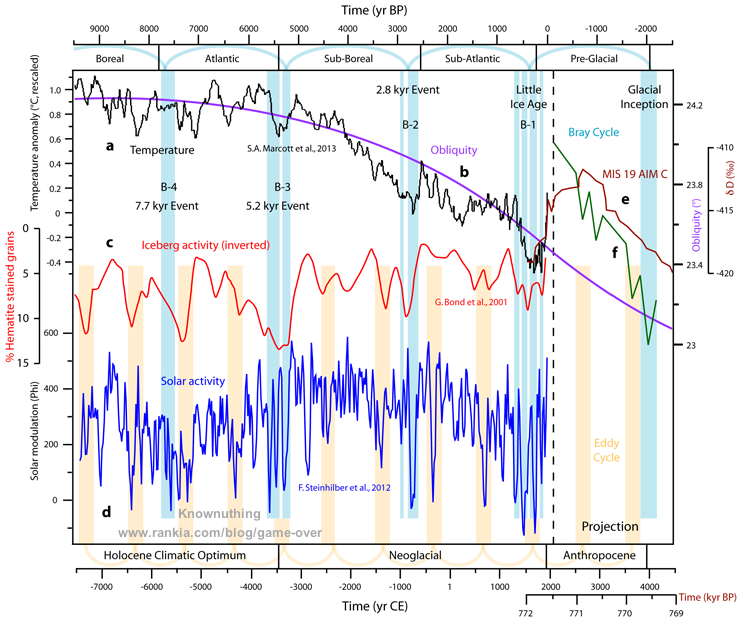
Figure 18. Solar cycles and temperatures during the Holocene. Major palinological subdivisions of the Holocene (names on top) match a 2500-yr regular spacing (light blue arches on top). (a) The global temperature reconstruction (black curve; Marcott et al., 2013 by the differencing method with proxy published dates) has been rescaled in temperature anomaly to match biological, glaciological, and marine sedimentary evidence, resulting in the Holocene Climate Optimum being about 1.2°K warmer than LIA (see Appendix). (b) The general temperature trend of the Holocene follows the Earth’s axis obliquity (purple), and significant downside deviations generally match the lows of the ~ 2400-year Bray cycle of solar activity (light blue bands labeled B-1 to B-4 that correspond to similar bands in previous figures). (c) Significant negative climate deviations manifest also in strong increases in iceberg detrital discharges (red curve, inverted; Bond et al., 2001) that generally agree well with the lows in the ~ 2400-year Bray cycle and ~ 1000-year Eddy cycle (orange bands) of solar activity. (d) Solar activity reconstruction (Steinhilber et al., 2012) shows that the majority of grand solar minima correspond very well with Bond events and tend to occur at the lows of the Bray (light blue bars) and Eddy (orange bars) cycles. Significant Holocene climate changes tend to occur when Bray and Eddy cycle lows coincide, like at the Mid-Holocene Transition that ended the Holocene Climatic Optimum and started the Neoglacial period, and the LIA that started the Current Warm Period, now proposed to be named Anthropocene. The regular spacing of the ~ 1000-yr Eddy cycle is shown by orange arches at bottom. Solar cycles can be projected into the future, when the situation could be analogous to interglacial MIS 19 (Marine Isotope Stage) AIM C (Antarctic Isotope Maximum) that is likely to represent a natural global warming event at 771 kyr BP (e). Considering all these factors, temperatures can be projected into the future (f) defining a Pre-Glacial period that could end around 4000 AD in the next glacial inception.
By the way, that article has a lot of information on cultural changes caused by climatic changes during the Holocene, including the 3.2 kyr event.
https://judithcurry.com/2016/09/20/impact-of-the-2400-yr-solar-cycle-on-climate-and-human-societies/
An Anthropocene sub-stage within the Holocene would be reasonable.
My only problem is the name and “cene” ending that makes it sound like an epoch. An epoch requires a type section, otherwise it isn’t an epoch. There isn’t even an agreed type section for the Holocene, so it formally is not an epoch and should be renamed as well. After the next glacial period, our descendants can measure some sections and decide what to call the Holocene and how to divide it. This is another case of someone trying to replace data with a model and we know how that works out!
Anthropomian… Anthropomonian… Anthrporeal… just don’t have the same “ring” as Anthropocene.
Maybe the Anthropic Substage. The bottom member would be the first appearnce of Styrofoam and the top member would be the last appearance of Homo sapiens in the future fossil record. Dr. Zaius would probably approve.
Periods within the Pleistocene carry the ~ian termination (Calabrian, Ionian, Tarantian), so a more correct name would be Anthropian.
Ceramic, brick, cement, glass. There are a lot of man-made durable materials that can be found in sediments even if plastics tun out not to last enough.
Another problem that should be settled is the lack of proper name for glacial and interglacial periods. The MIS denomination, while convenient has a lot of problems, and names are usually regional, for example the Eemian in Europe is the Sangamonian in the US, and the Ipswichian (UK), Mikulin (Russia), Kaydaky (Black Sea), Valdivia (Chile) or Riss-Würm (the Alps) elsewhere. The same goes for glacial periods, the Weichselian glaciation is also the Vistulian, Würm, Devensian, and Wisconsian.
The geologists have a lot of cleaning to do in their house before getting to the Anthropocene. At least finally last year climatologists agreed on what is and what isn’t an interglacial:
Past Interglacial Working Group of PAGES. Interglacials of the last 800,000 years. Rev. Geophys. 54, 162–219 (2016).
https://www.repository.cam.ac.uk/bitstream/handle/1810/252679/Berger_et_al-2016-Reviews_of_Geophysics-VoR.pdf?sequence=5&isAllowed=y
Javier,
It would appear that your recommendations are based on recent temperature regimes rather than stratigraphic markers.
Historically, epochs have been named with a suffix of “cene” and have lasted for tens of millions of years, with the notable exceptions of the Pleistocene and Holocene. As many here have remarked, even using the term Holocene is a departure from past practices and essentially covers what some want to call the Anthropocene. I think that Any May’s remark below summarizes the situation well.
Periods within the Pleistocene carry the ~ian termination (Calabrian, Ionian, Tarantian), so a more correct name would be Anthropian.
Ceramic, brick, cement, glass. There are a lot of man-made durable materials that can be found in sediments even if plastics tun out not to last enough.
Another problem that should be settled is the lack of proper name for glacial and interglacial periods. The MIS denomination, while convenient has a lot of problems, and names are usually regional, for example the Eemian in Europe is the Sangamonian in the US, and the Ipswichian (UK), Mikulin (Russia), Kaydaky (Black Sea), Valdivia (Chile) or Riss-Würm (the Alps) elsewhere. The same goes for glacial periods, the Weichselian glaciation is also the Vistulian, Würm, Devensian, and Wisconsian.
The geologists have a lot of cleaning to do in their house before getting to the Anthropocene. At least finally last year climatologists agreed on what is and what isn’t an interglacial:
Past Interglacial Working Group of PAGES. Interglacials of the last 800,000 years. Rev. Geophys. 54, 162–219 (2016).
https://www.repository.cam.ac.uk/bitstream/handle/1810/252679/Berger_et_al-2016-Reviews_of_Geophysics-VoR.pdf?sequence=5&isAllowed=y
Periods within the Pleistocene carry the ~ian termination (Calabrian, Ionian, Tarantian), so a more correct name would be Anthropian.
Ceramic, brick, cement, glass. There are a lot of man-made durable materials that can be found in sediments even if plastics tun out not to last enough.
Another problem that should be settled is the lack of proper name for glacial and interglacial periods. The MIS denomination, while convenient has a lot of problems, and names are usually regional, for example the Eemian in Europe is the Sangamonian in the US, and the Ipswichian (UK), Mikulin (Russia), Kaydaky (Black Sea), Valdivia (Chile) or Riss-Würm (the Alps) elsewhere. The same goes for glacial periods, the Weichselian glaciation is also the Vistulian, Würm, Devensian, and Wisconsian.
The geologists have a lot of cleaning to do in their house before getting to the Anthropocene. At least finally last year climatologists agreed on what is and what isn’t an interglacial:
Past Interglacial Working Group of PAGES. Interglacials of the last 800,000 years. Rev. Geophys. 54, 162–219 (2016).
https://www.repository.cam.ac.uk/bitstream/handle/1810/252679/Berger_et_al-2016-Reviews_of_Geophysics-VoR.pdf?sequence=5&isAllowed=y
Andrew Revkin? Naomi Oreskes? Authors?
Joke.
Wouldn’t “hubriscene” be more apt ?
If this new Epoch is to be a layer on top of other layers to be in the future under another layer does this mean the Earth is getting bigger ?
No. Earth is the original recycling fanatic.
Maybe this idea of an era defined by human activity is not worth debating much. But other geological eras are defined on the basis of what life did: the evolution of oxygen-producing photosynthesis radically changed the whole planet, and the last 560 million years is called the Phanerozoic, i.e. the era of visible (large, complex, eukaryotic) life. In the last 10,000 years or so, the human species has certainly exerted a major impact on the Earth and the biosphere, via hunting and extermination of animal species, systematic agriculture, cities, technology, mining and waste production. It’s not bad to simply recognise these facts.
PH,
It isn’t just what life did, (after all most of the Earth’s history was lifeless!). More commonly it is physical features that geologists call disconformities, unconformities, and non-conformities that have served as markers of the end of one era and the beginning of another. These represent periods of time in which there was either little deposition of sediments (hiatus), or periods of ocean transgression where erosion took place along the seashore, or long periods of continental erosion that removed whole mountain ranges and created significant loss of the rock record. Thus, there is a missing fossil record as well. While elevated iridium content is a defining characteristic of the Cretaceous boundary, it can generally be recognized in the field as a thin carbonaceous layer. These are events typically driven by plate tectonics or cataclysmic astronomical events such as a bolide impact. These geologic processes created basins of deposition, formerly called geosynclines, that accumulated tens of thousands of feet of sediments. Humans haven’t come close to having such an influence.
Anything short of a nuclear holocaust that destroys everything on Earth, and sets the groundwork for evolution of new life forms, there is no widespread, defining rock features that would be mappable with continuity in any future geologic mapping. Such an event might be an appropriate marker for the end of an “Anthropocene.” The then future geologists cant worry at that time about some defining marker of the beginning of the “Anthropocene.” However, this is all speculation and the proposal ignores the tradition of a significant break in the rock record that is usually clearly visible in outcrops over large areas of the Earth.
Some of the things being cited as evidence for the “Anthropocene” are clearly anthropologically important, but they are not ‘geological’ as we have come to know the term. Without the benefit of hindsight, we can’t be sure just how visible Man’s influence will be millions of years from now.
Life arose on Earth about four billion years ago, so only the first ~500 million years were lifeless.
But you’re right that not all geological divisions are based upon what life did then. Some of the eons, eras, periods and epochs are however named after the type of living things found in them. But not all, by any means.
Chimp,
When the geologic time scale was created, geologists basically thought that life started in the Cambrian, and everything that happened before that was largely unknown. Thus, the model for eras, periods, and epochs was based on stratigraphy and the breaks in the stratigraphic record. The observation that fossils changed between stratigraphic units was a freebie that came along with the stratigraphic divisions. The names of the eras acknowledge the presence and evolution of life, but they are not named for a particular life form. Thus, we don’t have a ‘Dinozoic’ or ‘Dinocene.’ Other than the “Carboniferous,” nothing comes immediately to mind as being a naming strategy based on a particular species of life. Even there, it was named for the abundant coal deposits, not a particular form of life other than generic cellulosic forms the grew in swamps and turned into coal.
There is no historical precedent for the equivalent of “Anthropocene.”
I haven’t been keeping up with the changes in the geologic time scale, so I could be wrong about this. If I am wrong, I will gladly acknowledge it.
It’s not a matter of recognizing current facts.
The issue it what sort of mark the current facts will make in the future geologic record.
David,
And my position is that nothing Man is currently doing will result in the kind of unconformities that have served as markers for past divisions of time. The ‘fossils’ that Man has been leaving behind since the first piece of flint was worked have been evolving into more complicated and sophisticated tools. However, it is essentially a continuous record that has not been broken by geologic events of the magnitude of an orogeny. While we may be contributing to an onlap of the oceans along the coastlines, it seems that, in most places on Earth, isostatic rebound and plate tectonics activities overwhelm what increase in sea level seems to be taking place. I can’t imagine anything that Man is doing will create another great seaway in the interior of North America such as was the situation during the Cretaceous.
I assume that only the complete extinction of humans can lead to any future geologic epoch.
Then there would be no one to name or document it.
The next dominant life form would name it.
I’m calling them the “Roach people”.
Anthropocene? O really? Another fine example of the white patriarchy at work in academia.
If there were any social justice in the world the 27 authors should immediately make a grovelling apology via twitter for their lack of diversity and rename it the LGBTIscene.
/sarc
“In a paper published in the journal Newsletters on Stratigraphy, the 27 co-author group suggests that the Anthropocene has already seen irreversible changes to the Earth, rather than just to human societies.”
What “reversible” changes ever happened?
I’m okay with this as long as we rename the geological periods during which the dinosaurs lived as the “Dinopocene”.
Anthroporcine…humans lining up at the trough.
Oh that is good.
Ha!
The trougherati.
The term ‘anthropocene’ is a completely neutral scientific one for sure.
see: Roy Scranton: Learning to Die in the Anthropocene – Reflections on the End of Civilization
[youtube https://www.youtube.com/watch?v=N0yUX12ZoTA&w=560&h=315%5D
When doing neutron activation analysis of rock samples in college in the 80’s I was told we were using a steel cylinder manufactured prior to 1945 as the detection chamber because anything manufactured after that date would have higher than natural levels of radioactivity emitting from the steel. That would seem to indicate that sediments deposited everywhere after that date would be clearly distinguishable from those deposited earlier by their radioactivity.
I would argue that that is one important criterion for defining an epoch: it must be detectable in the rocks that are laid down, whether by chemical means, fossils, change of environment, etc. That’s one way I think those who argue for the beginning of agriculture as a significant line miss the mark – it affects existing sediments but may not clearly alter the nature of new ones, especially in it’s early days.
Of course it’s already been pointed out in other threads that the Holocene definition already includes influence by man.
So while the bomb was a big historical event, and a recognizable geologic one, does it warrant a subdivision of an epoch that already recognizes man’s influence? Ya got me.
After a few hundred thousand years, the radioactive signal will be pretty much gone.
That’s true for most of the radioactive products but the original enriched uranium from a fission bomb will be around for a long, long time.