Guest post by David Middleton

MARCH 22, 2017
Record precipitation, snowpack in California expected to increase hydro generation in 2017
For the first time since 2011, California’s drought is significantly weakening—a result of one of the wettest winters on record. California has experienced record levels of precipitation this winter, and unlike last winter, cooler temperatures over the 2016–2017 winter season have enabled the precipitation to build up snowpack (the total accumulated snow and ice on the ground). High precipitation and snowpack levels, both of which supply hydroelectric generators throughout the year, suggest that hydroelectric generation in California in 2017 will significantly exceed 2016 levels.
Although the drought state of emergency declared by California authorities in January 2014 is still in place, drought conditions have noticeably improved, and the northern half of the state is no longer classified in any stage of drought severity. The area of the state classified as being in exceptional drought (D4), the most extreme category, has dropped to zero, a significant improvement over the 40% and 35% of the state’s land area classified as being in exceptional drought in March 2015 and 2016, respectively. However, 23% of the state—mostly regions in the south—is still in a moderate drought (category D1) status or worse. Mandatory water restrictions, enacted for the first time in the state’s history in April 2015, remain in effect in California. State officials are expected to wait until the full winter season ends in April to amend or rescind the state’s emergency drought declaration.
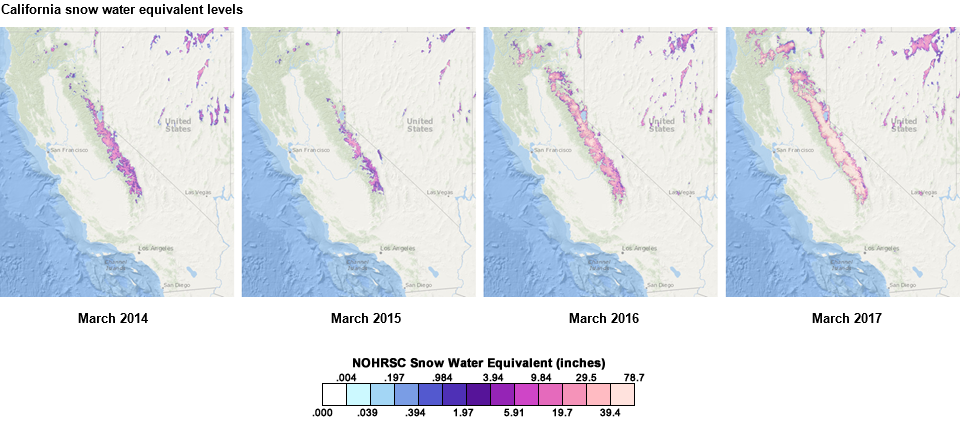
Snowpack levels have increased significantly from the near-zero levels measured in the Sierra Nevada Mountains in April 2015. As of March 21, 2017, the California Department of Water Resources reported that statewide snowpack was 158% of normal for that date. A more important metric when considering snowpack is the snow water equivalent (SWE)—the total amount of water contained within the snowpack. California’s SWE levels have noticeably increased this year, and as of March 21, the California Department of Water Resources reported that the statewide snow water equivalent was also 158% of average for that date.
[…]
Snowpack and SWE are strong drivers of hydroelectric generation because runoff from melting snowpack feeds hydroelectric plants in the spring and summer months. California’s hydroelectric generation increased through most of 2016, especially toward the end of the year. Total 2016 hydroelectric generation in California was well above the 2013–2015 range and was nearly as high as the longer-term, pre-drought generation average over 2001–2010. High levels of SWE from the 2016–2017 winter suggest increases in hydroelectric generation in California later in 2017.
[…]


So much for California’s “unending drought.”
Addendum

It’s a shame that they can’t find a way to make green, clean, “low carbon”, renewable energy instead of all this DIRTY non renewable hydro. BAH.
Oh, this can not possibly be true! It is never, not ever forever, going to snow or rain in Cali ever again!!!!!! Gov Brown said it so of course it is fact!!!!!
So now there will be regular rain and snow every year, right?
Absolutely not going to revert to years of drought interrupted by exceptional wetness?
worst drought in 500 years ended by exceptional weather event doesn’t look like the old climate to me…
You’re confused.
The drought (“worst in 500 years” — your words) was the exceptional event.
[caption id="attachment_167342" align="alignnone" width="960"] California Precipitation Index (NOAA)[/caption]
Griff,
machines never ever made me no harm.
people do.
tell why.
The rains should stay average or higher for the next several decades. Next winter is very likely to be an above average winter for NorCal and the PNW. It may even be a bigger winter for rain than this one.
Exceptional wetness occurred do to prolonged laughter leading to loss of bladder control, maybe!
Ever heard of 1862? Old enough climate for you?
Griff, how come you never told about
“worst drought in 500 years ended by exceptional weather event doesn’t look like the old climate to me…”
________________________________________
What’s that new insight on
‘500 years’.
Regards – Hans
My right thumb is swollen, blue, and throbbing.
Perhaps a work accident.
~ 3 years ago I had the same with the left index finger.
After a tetanus injection, I thought that was done.
Obviously wishfull thinking.
/ the streaks on the fingers are high yellow + deep blue /
Thanks for asking – ICHTHOLAN made it.
https://www.google.at/search?q=ichtholan&client=ms-android-samsung&prmd=isvn&lr=lang_en&sa=X&ved=0
https://youtu.be/OLpgtGDwsRs
The wound plaster begin to dissolve. After lashing the fringes with the lighter.
Fuk.
Get to the doctor!
Define ‘regular’ in California. LA is no Bergen, Norway.
Once the Final Four is over Griff, you should start a new pool ; which “permanent drought” will continue first? Texas or California?
“Record levels of precipitation”
Sure. If by “record” you only accept records from a few decades past. If, instead, you take “record” to mean actual record, then, no. California as a whole did not experience record precipitation.
Record is a function of all space-time volumes.
Where is the research study to determine the advance of the Palisade Glacier in the Sierra Mountains? Surely with all this snow pack the glacier will be advancing at an alarming rate.
Given its current rate of advance one could extrapolate that it will bury the Owens valley within decades!
I believe Mark Twain had a similar sarcastic comment regarding extrapolating the reduction in length of the Mississippi River as it cut off ox bows each season.
Has anyone an update on Lago Popoo in Bolivia. This lake was a poster-child of global climate change a few years back when it dried up (as it had done before). I can see it is raining in the area but no word on the lake levels.
It has come back nicely, but you have to know spanish to find out:
http://cnnespanol.cnn.com/2017/01/12/renace-el-poopo-el-segundo-lago-mas-grande-de-bolivia-recupera-el-70-de-sus-aguas-tras-secarse/
Thanks!
What is Gov. Brown going to do if there isn’t climate fear mongering to fill his busy little day .
Balance a budget ? Nah… a bit to much reality for Moonbeam .
I would be interested in looking at the original data of the addendum.
Does someone here know where it is and how I can access it?
Click on NOAA in the caption.
Thx.
Climate “Science” on Trial; Did Cosmic Rays End the CA Drought?
https://co2islife.wordpress.com/2017/03/22/climate-science-on-trial-did-cosmic-rays-end-the-ca-drought/
Thanks for the info, co2islife, should have read your post before asking my question below….
Better late than never…LOL. Thanks for the comment and be sure to share.
Has anyone wondered why California had so much more rain this year than last year, an El Nino year? And everyone forgets our near record 2004-05 rainy season when there was barely any El Nino happening. Maybe someone can wrest some research money out of the CO2 hoard and study this a little. Sure would be helpful to have a better understanding of the factors that contribute to increased rainfall in California, at least to us Californians….
It was the Russians who did it (of course):
http://www.drroyspencer.com/2017/03/the-russians-hacked-our-winter-weather/
Just left the grocery store -there is a sign on the register commenting that the reason the price of lettuce has sky rocketed is that the fields in the Southern California desert region (Imperial valley) and Yuma, AZ areas are too wet. Bummer…
And still California’s Central Valley Water Project has only allotted farmers 65% of their contracted water allocations for 2017.
Wattsupwiththat?
http://www.zerohedge.com/news/2017-03-23/are-enviros-trying-kill-farming-california-2017-water-allocations-imply-yes
http://www.zerohedge.com/sites/default/files/images/user230519/imageroot/2017/03/23/2017.03.23%20-%20AG.jpg