Decommissioning of world’s first offshore wind farm offers an opportunity to see how industry costs have changed over the past 25 years.
Guest essay by T. A. “Ike” Kiefer, CAPT, USN (ret.)
Lifetime Performance of World’s First Offshore Wind Farm

The first offshore windfarm in the world has just been decommissioned and is now being torn down ( http://www.windpoweroffshore.com/article/1427436/dong-begins-vindeby-decommissioning-pictures ). Its lifetime performance specs are illuminating in comparison with recent wind industry data, and alternative generation options.
1991 Vindeby Offshore Wind Farm – Denmark
Years of Operation: 1991-2016 (25)
Capital Cost: 75M Kroner = $13M (1991USD) = $23M (2017USD)
Number of Turbines: 11 @ 450 kW
Lifetime Generation: 243 GWh
Nameplate Capacity: 4.9 MW
Average Power Output: 1.1 MW
Cost/Nampepate Capacity: $2.65/Watt (1991USD), $4.7/Watt (2017USD)
Lifetime Capacity Factor: 22%
Cost/Effective Output: $12/Watt (1991USD), $21/Watt (2017USD)
Levelized Capital Cost: $53/MWh (1991USD), $95/MWh (2017USD)
Levelized VOM Cost: $65/MWh (Estimated using $130/kw-hr industry figures for 2015)
Lower Bound of LCOE: $160/MWh (2017USD)
2015 Industry Performance Data for Offshore Wind (http://www.windpowermonthly.com/article/1380738/global-costs-analysis-year-offshore-wind-costs-fell ).
Cost/Nameplate Capacity: $5/Watt
Capacity Factor: 40%
Cost/Effective Output: $12.5/Watt
O&M Costs: $130/kW-yr
Lower bound of LCOE: $150/MWh (2015USD), $154/MWh (2017USD)
Conclusions:
1. While turbines are getting larger, able to operate at lower wind speeds, and improving their capacity factors, the total lifecycle cost per unit of energy provided from offshore wind has not perceptibly decreased from 1991 to 2015. Higher costs of O&M for larger turbines farther offshore seems to consume savings from higher capacity factors.
2. As it is uncontrollably variable and weather dependent, offshore wind generation remains uncompetitive with gas and coal which are half the cost (~ $70/MWh LCOE) while providing fully dispatchable and weather-independent power that is of much higher value to a power grid.
NOTE: Somehow, the original posting got deleted. I’m unsure how this happened. Unfortunately, comments that were linked to it disappeared as well. This is the second posting recovered from the original source. -Anthony
,blockquote>NOTE: Somehow, the original posting got deleted. I’m unsure how this happened. Unfortunately, comments that were linked to it disappeared as well. This is the second posting recovered from the original source. -Anthony
Sooo…”nothing to see here”? 😎
On my computer a number of comments on this post showed up under the post about the “Medical Society Consortium”
same in my case.
They are still there.
Now where are the comments for the MedicalSocCon?
Seems there are moths in the computers this week.
The rest of the comments missing here, you will find at the “Medical Society Consortium” post…..
For any one interested in following.
cheers
Yeah, I saw that too. Very confusing at first.
Not moths Russians. They are everywhere. Probably a few under the bed right now. Lol.
If it isn’t climate change it’s Russians.
Or Russians controlling the weather 🙂 Haven’t heard that since the 80’s 😉
Ha!
First the Linux server, now this.
It’s a conspiracy I tell ya.
one is not connected to the other.
Postings for this seem to be under another article (at least they are all about windmills):
“Watch out for the ‘Medical Society Consortium on Climate and Health’”
Big oil didn’t kill windmills, an excel spreadsheet did.
+1
(Source: p. 5 of Ruth Lea’s analysis here: The Folly of Windpower http://blackmain.taylorpartners.co.uk/wp-content/uploads/2011/11/Ruth-Lea-The-Folly-of-Wind-Power-2011-10.pdf )
There is much more than cost associated with sourcing energy. If the citizens of a country do not want nuclear energy then no matter how good the economic or environmental case, there will not be nuclear energy as it would be political suicide for the Government that sanctions it. Similar with all other types of energy generation, the public, holds a huge influence whether that influence is based on solid financial data or irrational perceived fears or purely on what it looks like in the landscape. Those making the decisions are voted in and out by the citizens and not by the accountants.
Your comment makes absolutely no sense. The government of South Australia is about to be voted out because it can not supply reliable electricity. The people of SA are almost begging for reliable coal or gas fired power.
In the calculation, is that VOM for off shore wind farms or just wind farms generally?
I have found it difficult to find audited VOM numbers.
This is specifically offshore wind data. Quoted from the Windpower Monthly article that is linked:
For the time being offshore windfarms in Denmark do not pay for connection to the grid. It is payed by Energinet and all consumers in the country. It is considered a common responcibility to make the connections to these unpredictable energy sources. In older times some windparks were compensated if the connection failed. It might have changed now, but i am not sure. It is anyway a part of the contract with the state for the conditions to build the park.
It is interresting to se the data for this first windpark, and compare them in the future to newer parks.
Are you saying the numbers quoted in this article DO NOT include cost of connection? Even though it could include several miles of marine grade underwater cable or towers? And I guess I’m really asking for a much more detailed description of the costs shown. If I’m evaluating a money decision I want to know ALL costs, no matter who or what pays for it, and I can’t be sure we got that from these “official” figures.
Economic Reality illuminates the bloated costs or ‘Green Energy’ + Government Subsidies.
Arrgh…’of’
“or” works, too. 🙂
as far as i can see, the LCOE can be what ever you want it to be. eg the Australian climate council consider the LCOE to be higher for coal now than wind, which is typical of the lies being spread by them and nearly everybody else in the so called renewables industry.
not only is the LCOE itself a fudge figure, the application of it is too. scam, scam, scam. it seems that none of the people that matter are able to see the simple fact that this is just a way of scamming more money from tax payers, or they just dont care and are complicit.
re:
You’ll need some mighty strong proof to establish that assertion to any meaningful degree. That is, given current wind power technology, any “improvement” is highly likely to be too small to be meaningful.
Hm. Looks like ANOTHER article (like A. Comendador’s recent one promoting the “GW” of AGW) whose main point is not the stated one, but, rather, to push enviroprofiteering, here, Big Wind.
I refer to wind and solar as “grid disrupters”. That’s about all they do. They have negative value.
tabnumlock:
You rightly say
People wanting explanations of your statements can find them here.
Richard
Nowhere is that more true than in the Pacific NW, where we can’t optimize our enormous hydropower because of the demands of the dark, satanic windmills using the same grid.
Unless coupled with sufficient storage to firm up and time shift their output, I’d have to agree. And any storage, of course, pushes them further out of economic competitiveness with dispatchable thermal generation.
Storage does not fix the low energy output nor the need for many, many acres of land, wildlife deaths, etc. A 19th century energy source for a 21st century world is not doable with anything but utter inefficiency.
Need to study the difference between MW capacity and MWh energy.
Construction ratios are couched in terms of capacity, $/MW or $/kW. $2.65/W = $2,650/kW. Need to compare based on same ratios. Power industry uses $/kW.
Production is energy, $/kWh etc. At the facility O&M expenses are $/MWh. Your home bill is $/kWh. Demand charges are in kW.
It’s the difference from the monthly car payment (demand, capacity) and the monthly gasoline bill (energy).
I can’t tell if the authors have no idea or just conflate the terms to confuse.
Too many of these studies are done by youngsters fresh out of somewhere with no editor who understands the topic.
@ur momisugly Nicholas S.
I’m in the industry. I know the diff between power and energy, capacity and generation. Would you kindly point out specifically what mistake you think I have made above?
O&M for wind and solar are normally calculated per MW-yr, not MWh. This is because these sources do not have fuel costs that are proportional to MWh as fossil fuel generation does. They have relatively flat annual costs proportional to the fixed size of their plants, and the O&M contracts are typically a flat fee per MWh with an annual escalator for inflation.
“a flat fee per MW”
As it should.
Those figures for wind may not contain side effect costs because its power must be backed up by reliable capacity.
And Moltex Energy is estimating a levelized cost of production for their molten salt reactors as “significantly less than $40 per MWhr.” And that is valuable power that can be produced on demand
and it can load follow as well. Its power has a value far, far greater than wind power.
Yes the real question is what is the cost of these unreliables should they more correctly only be permitted to tender electrons to the grid that they can guarantee 24/7 all year round (ie short of mechanical breakdown). The molten salt and battery sectors would want answers to that as much as the thermal generators but most importantly electricity users. It’s the fundamental question the unreliable spruikers ignore for the obvious but the outcomes like South Australia are increasingly begging the question.
Probably the wind industry hacked you as there are some disturbing facts here to analyse.
What to me is a telling tale is that the pylons are not being fitted with newer turbines. You would think with them in place the cost to keep going would be significantly less. Does this means that the infrastructure such as pylons do not last either?
Seawater salt corrode soner or later.
Before the original comments disappeared, Griff assured us that offshore windmill farms posed no threat to birds, because in future they would be positioned farther away from avian migratory paths. No comment on whether those bird-friendly positions also were windy.
But last year a Scottish court disagreed with Griff’s anti-environmental wishful thinking:
http://www.telegraph.co.uk/news/2016/05/12/birds-scupper-2bn-offshore-wind-farm/
Diving gannets are the coolest:

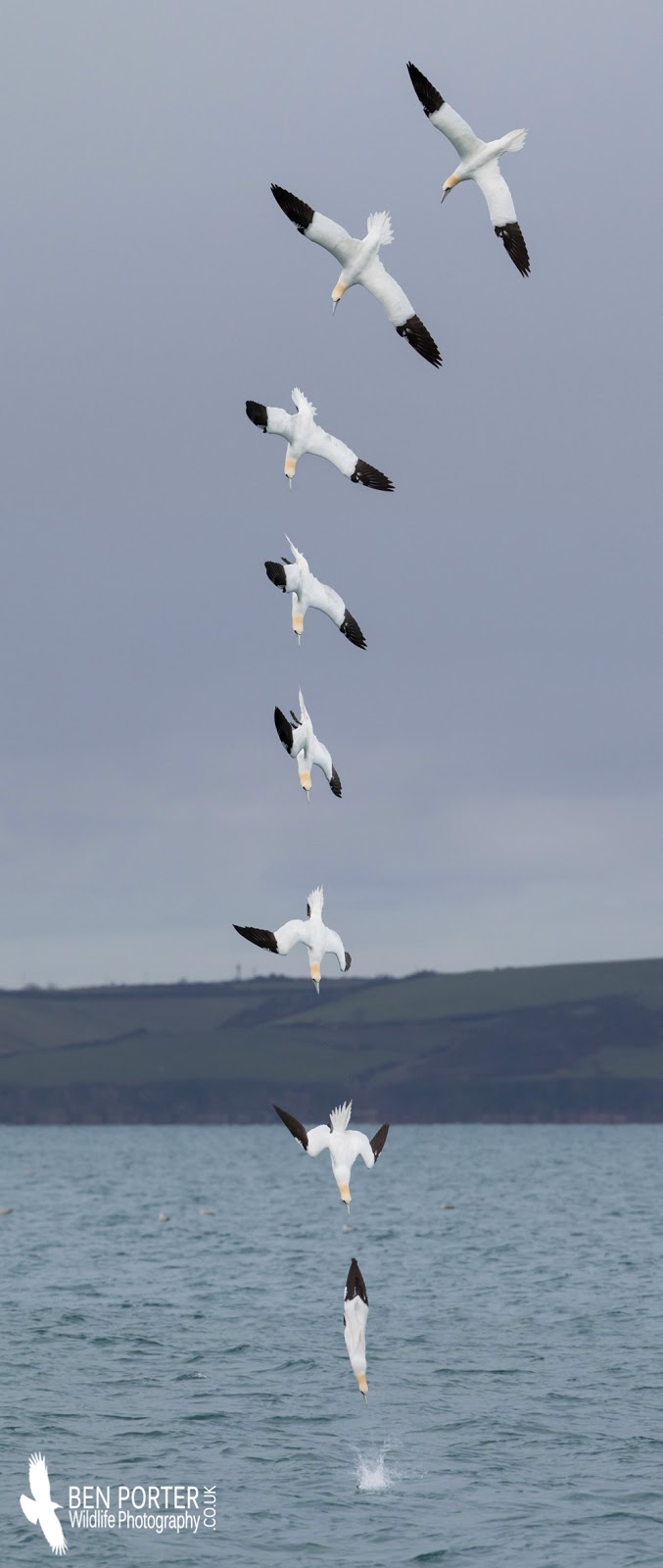
But their swarming behavior around schools of fish give the lie to Griff’s lack of worry. Bird migration routes have nothing to do with it. Gannets go where the fish are.
Well I note that having examined the evidence, they did NOT build the windfarm
so also they did NOT build the extension to the London array which was in the wintering grounds of the Red Throated Diver (Loon to US folk)
Offshore wind planning also takes note of feeding and wintering bird populations as well as migration routes and coastal migration routes.
They don’t put them where the birds go.
(The sea between Norway/Sweden and Denmark is on a north/south non-seabird migration route)
Predicting exact migration routes and home domiciles of birds is not within human capability. As stated, the birds go where the fish are. If the turbines drive out or kill all the fish in the area, then the birds would probably stay away. Not sure killing or driving out fish is environmentally friendly, but whatever. Wind people seem determined to destroy the planet in order to save it.
So show us all these imaginary sites with a good wind profile but with no effect on resident or migratory birds. Then please factor in effects on marine life.
Not to mention bats, which do follow their insect prey out to sea.
There is no way around the fact that wind farms are ecological black holes, sucking ever more living things into their vortices of death and destruction.
Has anyone informed the birds about this?
Gannets are amazing. I especially like the way they follow each other in the middle picture.
… only kidding.
As far as an energy grid is concerned…………. Renewables = Scam.
There’s not much else to say really.
I wouldn’t go that far. In a place with low population in a very windy location backed up by copious hydro they almost make sense. The ones in New Zealand seem to be doing OK.
It isn’t hard to make wind economic. You just need to get rid of most of your population, move your country to the roaring forties, turn up the annual rainfall level, and install a few extra mountain ranges with massive hydro schemes. Easy.
Well spoken.
One of the main objectives of renewables is to save the use of fossil fuels. Does anyone have any figures on the actual amount of fossil fuel that is saved when all factors such as fuel used to build the renewable and the actual fuel saved by the electrical load being reduced by the renewables? My understanding that the throttle down of a conventional power plant doesn’t save much fuel.
Indeed, a coal-fired plant has to just keep going, notwithstanding the transient contributions from wind turbine/bird killers and solar panels.
James Francisco:
You say
It is often worse than that. Throttle down of a conventional power plant reduces the plant’s efficiency and, therefore, the plant then usually increases its fuel consumption although it produces less electricity.
Emissions are proportional to fuel used. In 2003 David Tolley (the then Head of Networks and Ancillary Services, Innogy (a subsidiary of the German energy consortium RWE) said of windfarms in the UK,
(NETA is the New Electricity Trading Arrangements, the UK’s deregulated power market.)
Richard
And, of course, this is what the greenies want people to do for “Earth Hour”, failing to understand that power plants don’t just STOP. So all those deluded people out there ‘doing their part for the planet’ are actually WASTING fossil fuel.
I find the great irony is that Wind Turbines can’t even make themselves. I would also like some scrutiny on these figures particularly in regard to the economic life.
“I’m in the industry. ”
So Ike what do you do in the industry?
If I sound skeptical, it is because I was a nuke officer and power in the nuclear power industry from 1980. My father was also in navy anti-sub aviation from 1937 for 40 years.
The latter taught me to know BS when I hear it. Not that I do not love a good sea story.
The former makes me wonder why anyone would bother to analysis 1991 offshore wind.
However, I was surprised the numbers were as good they were. I was expecting a lot worse.
@Retired Kit P,
The numbers are not meant to meant to be all-inclusive. They ignore the offloaded costs of buffering and backup (spinning reserve, contingency reserve, ramping peaker plants) and grid integration (new transmission lines, ancillary grid services such as storage, etc.). The intent of the post was to do an apples-to-apples comparison across 25 years. Using IEA/ Wind Power Monthly cost figures was intentional so as to give the most favorable case for current performance. The key takeaway was that, with these very generous conditions, offshore wind power is found to have made almost zero progress in becoming more economical in a quarter of a century.
I appreciate your skepticism and your Navy service. I earned my enlisted Dolphins on USS Pollack (SSN-603) in 1985. Brief bio:
Ike, thanks for your response. My first watch station as a machinist mate was TG watch on a WWII tin can in 1971. I learned I had a passion for making electricity. The navy sent me back to college under the NESEP program.
There is a huge difference between producing power and grid interaction and small public utilities that distribute power from the grid. Ike you should stop claiming experience that you do not have.
From Ike’s bio I see he is good at avoiding direct questions too. Even more curious why someone in in East Mississippi would care about EU offshore wind.
Providing power is a public service and not a free market. It is my opinion, that if the public wants renewable energy, it is the job of the power industry to provide it.
That is something Ike has experience with and I would like his views.
Ike and I share the benefits of common experience with lessons learned. The SSN Thresher sinking during sea trials, the the fire on the USS Forrestal, and TMI changed how the navy and the nuclear industry did things.
The USSR did not learn from the lessons from TMI, because we were stupid and they were not. As a result, Chernobyl did not have an emergency plan to avoid exposure after a reactor accident. However, at a US nuke plant I received a week training concerning the lesson learned from Chernobyl.
As an engineer, I do not think wind and solar is a good way to make electricity. If society wants wind and solar, so be it.
@Kit,
Condescending stabs from across the ether are beneath our dignity, as are backhanded appeals to authority and ad hominem attacks. If you want to test what I know, ask a specific question. If you dispute a claim I have made, offer up your evidence.
I also advise caution in denigrating local power companies and co-ops. They are the ones who have to answer to the end customers, and it behooves them to keep abreast of what goes on in the board rooms of their wholesale suppliers, as well as in the halls of government. They have to make wholesale power purchase contract decisions with 10-year lead times, so the community tends to keep track of the supplier’s generation fleet composition and dispatch profile and fuel switching, and even debt load and pension liabilities. Local power companies watch commodity prices and upstream energy activities, as well as policy and regulation that affect G&T as well as D. What happens at FERC and NERC and EPA and DOE touches local power companies directly and indirectly. They also watch emerging technology and are the first to feel changes in the power consumer’s tastes and desires. America’s 900 rural power co-ops are some of the most politically active and well-informed institutions in the nation.
Intriguing and small world.
My Brother enlisted in the early 1970s, qualified to run a nuclear power plant, was assigned to SSN-690 USS Philadelphia.
He left our nuclear Navy service just before 1980.
About the same time I was in. Reagan improved things a lot for the navy.
25 years is that it? A coal, gas or nuclear plant would last much longer, produce much more power from the investment and not need coal gas or nuclear to be running alongside to back it up for when the wind’s too strong or not blowing.
Colour me unimpressed.
James Bull
Will the piers be left behind as a navigational hazard?
That will only be decided after the in-depth pier review.
No, they are dismantling the lot.
So all you posters endlessly on about how the landscape will be permanently disfigured by end of life wind turbines, please note.
So far Griff you are the only poster inferring that.
But it was okay to disfigure the landscape for the 25 year operational period?
Googling abandoned wind plants will yield some interesting results, which do not agree with Griff. (Since Google rarely “shares” such info, I take that to be a sign that there’s a lot more abandoning going on than Griff lets on to.)
Would that include the rock berm at Kentish Flats now awash at low tide? Bit of a shock if you encounter it late at night in what was safe deep water for a yacht.
If they ever are dismantled fully, which I doubt, since the power companies required by law to do so will just declare BK, the vast, hideous, mass-murderous wind “farms” in my region will cost more than the value of the energy they produced during their environmentally destructive life times.
They will remain eyesores and blots upon the landscape forever. Not to mention taking high quality farmland out of production. Monuments to Leftwing Lunatic folly.
“No, they are dismantling the lot.”
Skanky, YOU don’t know anything of the kind, and nobody else believes you know anything of the kind.
Apart from the financial gain, why do you lie on behalf of spivs like “Sir” Reg Sheffield, “Lord” Deben, Chris Huhne and a myriad other dishonest trough-snouting scum who couldn’t care less about the damage they do to the environment and the suffering and death they cause to the weak, the poor and the elderly?
Don’t you realise what sort of an impression of you that produces?
Now go and apologise to Dr. Crockford for lying about her in order to please you spiv paymasters.
A real good ( 100%) demolition would cost millions per unit.
Perhaps Retired Kit P has a brother, in the demolition business ( ha, ha )
When I got to 22% capacity factor, I stopped reading and had a good laugh.
So in summary, this offshore wind farm:
1. Produced electricity costing more than twice as much as coal or gas fuelled power stations
2. It only lasted 25 years
3. The 2x costs did not include the cost of connection to the grid
4. The 2x costs did not include the cost of backup/reserve to cover intermittency
5. The capacity factor is just 22% of nameplate
So its very expensive, unable to run a grid and the stated capacity has little relation to what it can actually generate. Trading standards anyone, next time a green says we can run our grid on “renewables”?
The one reported factor not listed is how many birds this installation killed over its lifetime. Of course the beauty of offshore windfarms is that they don’t leave any birdkill evidence….
I think you summed it up there nicely, ThinkingScientist.
Windmills are the worst idea evah! People who think windmills are a good idea are living in a fantasy land.
everything I have seen is that the windmils have significant mechanical problems and do not make 25 years without serious repair cost. main bearing failures at 3 to 7 years of service.
@General P.
The data from longitudinal studies bear out your suspicion. For 30 offshore wind farms studied in Denmark, the normalized capacity factor fell from an average of 39% at age 0 to 15% at age 15. Clearly, maintenance was not keeping up. http://www.pfbach.dk/firma_pfb/gordon_hughes_wind_farm_perf_2012.pdf