Guest post by David Middleton
From the No Schist, Sherlock files…

The “record low wintertime maximum extent” still looks pretty icy.
| OSLONatural swings in the Arctic climate have caused up to half the precipitous losses of sea ice around the North Pole in recent decades, with the rest driven by man-made global warming, scientists said on Monday.
The study indicates that an ice-free Arctic Ocean, often feared to be just years away, in one of the starkest signs of man-made global warming, could be delayed if nature swings back to a cooler mode.
Natural variations in the Arctic climate “may be responsible for about 30–50 percent of the overall decline in September sea ice since 1979,” the U.S.-based team of scientists wrote in the journal Nature Climate Change.
Sea ice has shrunk steadily and hit a record low in September 2012 — late summer in the Arctic — in satellite records dating back to 1979.
The ice is now around the smallest for mid-March, rivaling winter lows set in 2016 and 2015.
The study, separating man-made from natural influences in the Arctic atmospheric circulation, said that a decades-long natural warming of the Arctic climate might be tied to shifts as far away as the tropical Pacific Ocean.
“If this natural mode would stop or reverse in the near future, we would see a slow-down of the recent fast melting trend, or even a recovery of sea ice,” said lead author Qinghua Ding, of the University of California, Santa Barbara.
[…]

But wait! What’s that? It looks like an ominous email!!!
But in the long term the build-up of man-made greenhouse gases would become an ever more overwhelming factor, he wrote in an e-mail.
Oh no!!! A scientist “not involved in the study” is now confirming the ominous email!!!
“Looking ahead, it is still a matter of when, rather than if, the Arctic will become ice-free in summer,” said Ed Hawkins, of the University of Reading, who was not involved in the study.
“This is the worst of the worst catastrophes in the world! Oh, it’s crashing … Oh, the humanity! Honest, I can hardly breathe. I’m going to step inside where I cannot see it.”
Please say it ain’t so!!!
The melt of the Arctic is disrupting the livelihoods of indigenous peoples and damaging wildlife such as polar bears and seals while opening the region to more oil and gas and shipping.

On a somewhat more serious note…
NATURE CLIMATE CHANGE | ARTICLE
Influence of high-latitude atmospheric circulation changes on summertime Arctic sea ice
Qinghua Ding, Axel Schweiger, Michelle L’Heureux, David S. Battisti, Stephen Po-Chedley, Nathaniel C. Johnson, Eduardo Blanchard-Wrigglesworth, Kirstin Harnos, Qin Zhang, Ryan Eastman & Eric J. Steig
Nature Climate Change (2017) doi:10.1038/nclimate3241
Received 26 July 2016 Accepted 03 February 2017 Published online 13 March 2017
Addendum
Perspective: NSIDC Arctic Sea Ice Index Interactive Graph


The five earliest years of data plot near +2 standard deviations. The five most recent full years of data plot near or just outside of -2 standard deviations. Ding et al., 2017 conclude that up to half of the difference is due to the NAO and other natural climate fluctuations.

Exactly when did we transition over to this kind of certainty on the proportions of natural and human caused?
I wonder what the error term is on that estimate. I’m guessing the real error term is that “Natural variations in the Arctic climate “may be responsible for about 30–50 percent of the overall decline in September sea ice since 1979 … +/- 50%.”
That’s quite a claim. Now can they separate flea-fart methane from cow-fart methane effects? I really want to experience such feats of separation. How did they tag the human melting, and how did they tag the natural melting? How did they track it and keep track of such a clear division over the years?
Oh, ohkay, Jim, let’s admit that SOME natural causes might figure in, but how much should we say, …. 20%, 30%, more. Well let’s just go with 30% to 50% – it shows a range of uncertainty, within which we can still blame a lot of it on humans. 50% is a good midway figure. It sounds intelligent and looks good on paper.
The mythology continues.
Here’s an analysis of the academic article in question from Carbon Brief:
https://www.carbonbrief.org/humans-causing-up-to-two-thirds-arctic-summer-sea-ice-loss-study-confirms
According to Roz Pidcock’s article:
“Rising greenhouse gas emissions are responsible for at least half, possibly up to two-thirds, of the drop in summer sea ice in the Arctic since the late 1970s, according to new research. The remaining contribution is the result of natural fluctuations, say the authors.”
I’m surprised at the welcome being given to a paper co-written by Eric J Steig of “Steig et al” Antarctic Warming infamy.
I do hope his statistics-fu has come along since 2009.
Sadly, I think he’s incapable of progress. Though I did like his work on firn diffusion from a long time ago
Are the natural variations that caused past sea ice extent fluctuations the same as those that are causing the current one? That is the question.
Interesting in terms of magnitude. Meanwhile, surface temperature rise is more or less, 33% +/- GHG, 33% +/- other human caused (albedo mods, direct thermal flux, irrigation, etc), 33% +/- Ma Nature. So not too far off in terms of magnitude. Onward …
David – An Arctic indigenous person of my acquaintance asks me to tell you to “go f(r)@ck yourself”!
What should I reply on your behalf?
Fake news website. Total crap.
That is a harsh verdict on WUWT
Science News is a fake news Website? Or the journal Nature Climate Change?
This finding is interesting because it explains why antarctic ice is disappearing faster than the IPCC reports have all suggested. They assumed only anthropogenic warming and were unaware of the extra natural warming. If this is correct it lends more credence to the IPCC reports.
Antarctic sea ice hasn’t been disappearing. Until this super El Nino year, it was steadily increasing while Arctic ice declined, then stabilized.
IPCC has it all wrong, as in everything else.
Chimp – You seem to be the one that “has it all wrong”?
Arctic ice hasn’t “stabilized”. What makes you think it has?
If the Arctic Sea Ice Index was a stock, it would have established a support level at an annual average of 10.6 million sq km.
It’s actually demonstrated a quadruple bottom since 2007.
AFW,
The observations show that it has not made a new low since 2012, which only slightly exceeded the lows of 2007 and 2016. That is classic bottoming behavior.
As David says, if it were a stock Arctic sea ice would be flashing a Strong Buy signal, having formed a triple bottom.
Thus, there is no reason to imagine that it will keep getting lower, although it would be a good thing if it did return to its summer lows of the Medieval, Roman, Minoan, Egyptian and Holocene Optimum Warm Periods, ie most of the Holocene. We probably won’t be that lucky however, as the long term climatic trend remains cooling.
Chimp, I said antarctic when I meant arctic. Slip of the fingers, or brain. Nevertheless, if you substitute arctic the point stands. Arctic ice has reduced faster than IPCC estimated, and this natural component may be the reason why.
Is this an example of a Dead Polarbear Bounce or the opposite?
The first IPCC report (figure 3.8) contained a plot of Arctic Ice during the 1970s. It showed that in 1974, the minimum sea ice extent was circa 2 million sq. km below that of the 1979 level that is always used today from which to make the alarmist claims about dramatic loss of Arctic Ice. 1874 Arctic Ice extent is about the same as seen during the 2000s apart from a couple of years here and there.
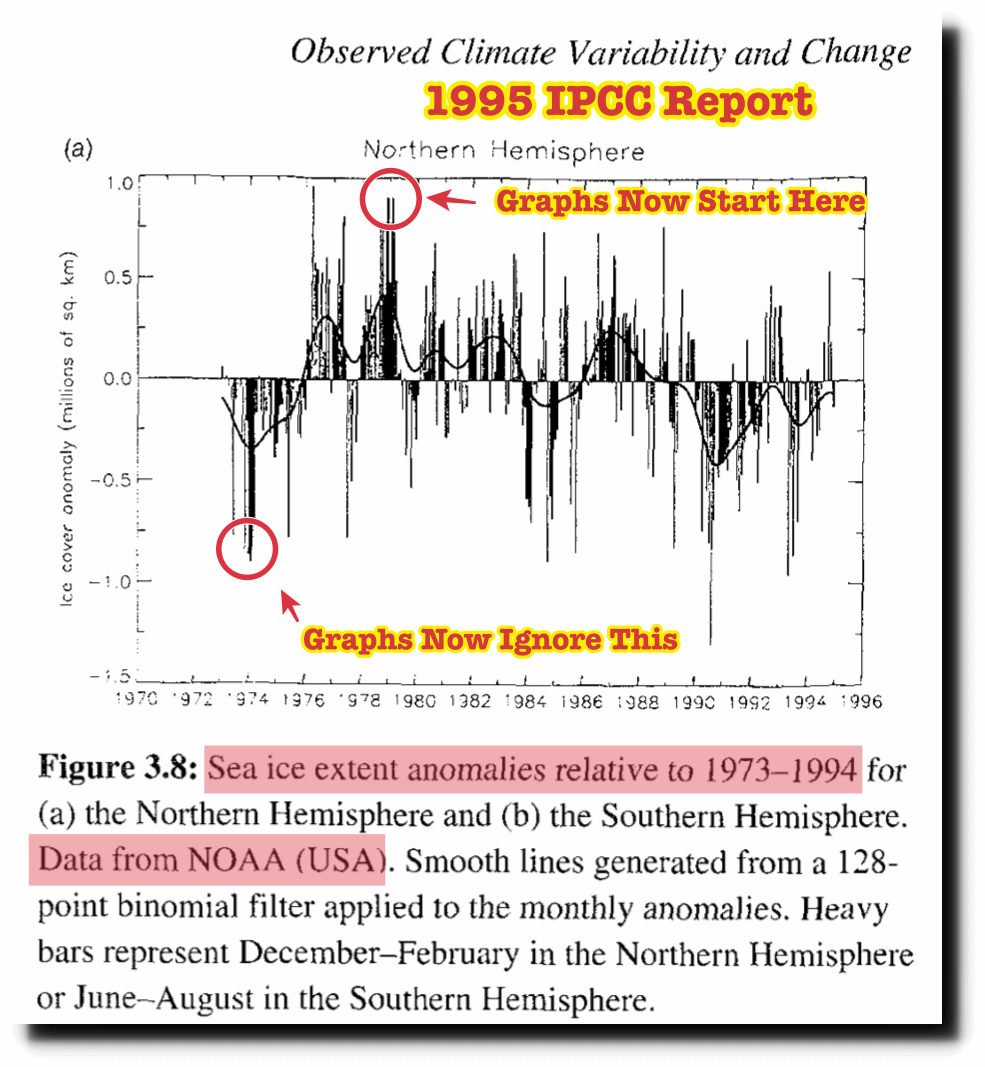
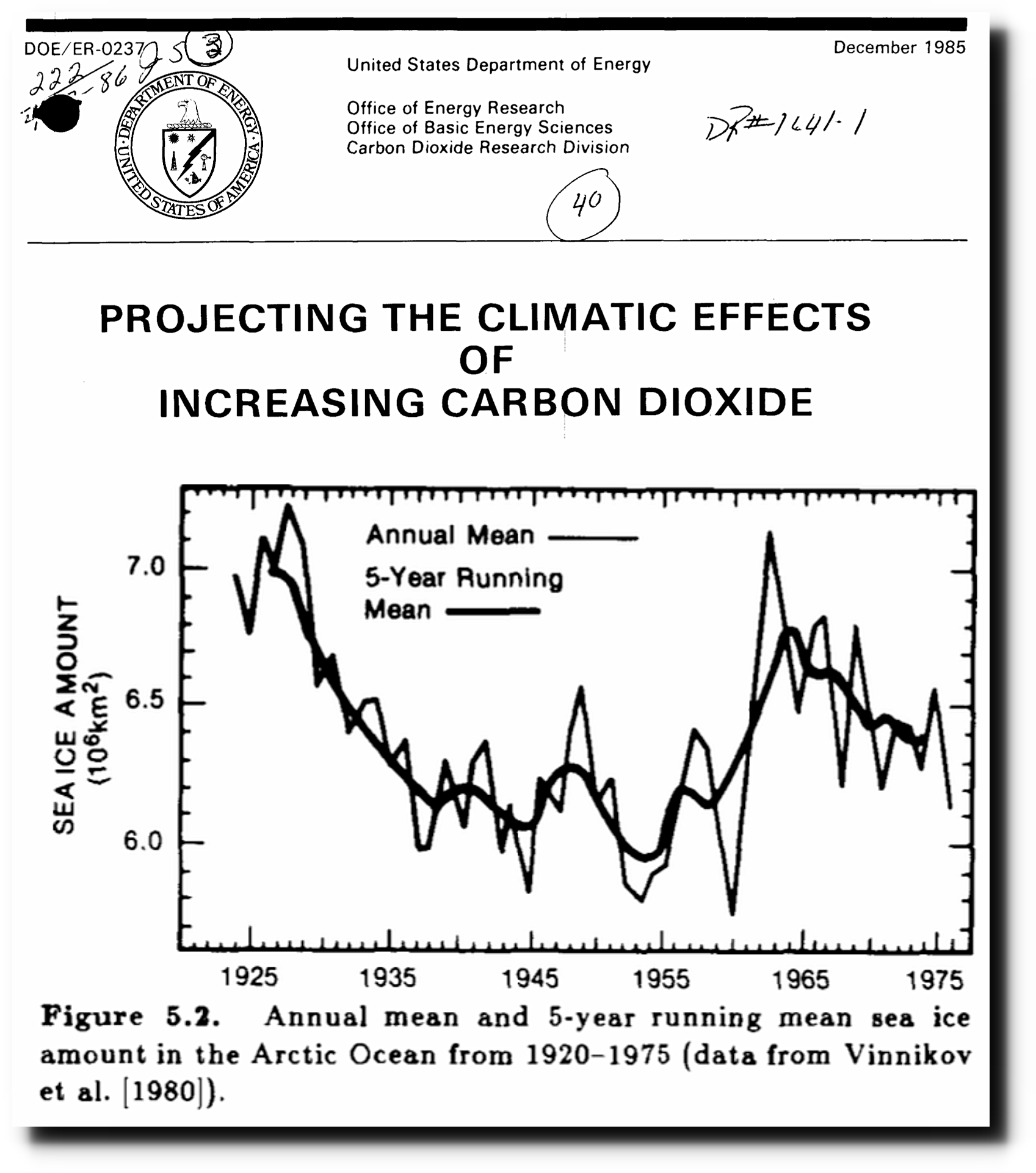
Minimum Arctic Ice extent of about 5.8 million sq km was seen many times during the 20th century. There is nothing anomalous about today’s level of Arctic Ice extent, and it appears that Arctic Ice extent waxes and wanes in cycles, possibly in accordance with the unidentified natural variations mentioned in the subject matter of this post. I am sure that you will have read the Vinnikov et al 1980 paper. I set out their plot from the US Department of Energy 1985 Report since this is easier to paste.
What is strange about today when compared with say 1837, 1945, 1953/54, 1960?
“The IPCC works by assessing published literature (see IPCC Factsheet – What literature does the IPCC
assess?). ***It does not conduct its own scientific research ***. For all findings, author teams use defined language to characterize their degree of certainty in assessment conclusions 2 .”
1979 starts from a high. Had they started from say 1936, or say 1945, the position would look very different, and far less scary.

Richard,
Do you have a link to that DOE publication?
I’m sure I have the link somewhere David, but what’s the point?
Apart from other issues that graph covers a different “domain” to the current NSIDC extent metric.
I would like to see if I can correlate the older data to the satellite derived data… I’m a geologist… I correlate things.
DM try here
http://archives.aaas.org/docs/Projecting_Climate_Effects_Increasing_CO2.pdf
This is the version in my records:
https://www.osti.gov/scitech/biblio/5885458
I see this chart often: I consider it useless as it does not quantify what the arctic ocean area covered is, not does it continue to date to give us a comparison with other data.
and where did it come from?
“I see this chart often: I consider it useless as it does not …”
… Agree with your alarmist Guardianista nonsense religion, Skanky? Does Drillbit Dana not agree with it than?
I don’t think anyone gives a flying dog’s bollock what YOU consider useful or otherwise, you scientifically illiterate, mendacious, misogynistic little propagandist.
Have you apologised to Dr. Crockford yet?
I’ve added this to the post…
Addendum
Perspective: NSIDC Arctic Sea Ice Index Interactive Graph
[caption id="attachment_166478" align="alignnone" width="1880"] Chart 1: NSIDC Arctic Sea Ice Extent: 1981-2010 Median and first five years of data (1979-1983)[/caption]
[caption id="attachment_166479" align="alignnone" width="1880"] Chart 2: Chart 1 plus five most recent full years of data (2012-2016).[/caption]
[caption id="attachment_166480" align="alignnone" width="1880"] Chart 3: Chart 2 with +/- 2 standard deviations (natural variability) instead of 1981-2010 median.[/caption]
The five earliest years of data plot near +2 standard deviations. The five most recent full years of data plot near or just outside of -2 standard deviations. Ding et al., 2017 conclude that up to half of the difference is due to the NAO and other natural climate fluctuations.
[caption id="attachment_166481" align="alignnone" width="350"] If humans were the cause of the entire decline in Arctic sea ice extent, it would barely be anomalous. Since we’re only responsible for about half of it… Yawn.[/caption]
Have you tried doing a similar analysis using Arctic sea ice volume David?
See my “chart” above.
Albedo doesn’t really notice volume.
David – Whilst you could state it more clearly I agree that “albedo doesn’t really notice volume”.
But what’s your point? Sticking with your dubious stock market metaphor, there’s not even been a “double bottom” on Arctic sea ice volume at this time of year,
My point is that the kinves stopped falling in 2007.
afwetware. where will you get measured volume data for the arctic , it doesn’t exist.
How do you know the volumes? Until very recently that’s only been modelled. So there’s no historical data. Plus PIOMAS substantially disagrees with PIPS the older and in my humble opinion better model. So, the phrase…. It’s only a model… springs to mind..
David/Chimp – That’s curious, my “chart” seems to have vanished! Let me try once again.
Arctic sea ice isn’t a stock. Even if it were, take a look at this extremely bearish “chart” of February PIOMAS Arctic sea ice volume:

No doubt you can see the recent downside breakout? The trend is your friend until the bend in the end, but in this case the bend is in the direction of the trend!
Sea ice may not be a stock… but a quadruple bottom is 33% better than a triple bottom.
The extent has to recover before the volume.
that is a notional chart created by guesswork . not a measurement of sea ice volume in the arctic.
Again. Definitely only a model. Please try harder. Better still read more. Stay awake in lectures etc etc
Chilly – It’s not “a measurement” and it’s not “created by guesswork” either.
Bunny – The Ding, Schweiger et al. paper under discussion here is also based on the output of “models”. Why did David even bother writing his article if model outputs are mere “guesswork”, using Chilly’s elegant turn of phrase?
Both – Please be less patronising in future.
I wrote the article so I could have a reason to use the Anchorman and Home Alone gif’s… /Sarc
Models are tools, often very useful tools. But they aren’t observations.
So is PIOMAS a useful tool IYHO?
How about PIPS as recommended by Bunny, or ACNFS, or GOFS? Or even CICE as mentioned by Ding et al., 2017
Models are useful tools.
Tools have to be used properly.
When models are substituted for observations, the tool is being used improperly.
Sea ice extent is, to some degree model-based. The raw satellite images have to be calibrated to produce a sea ice extent map. Sea ice volume estimates basically take the same observations and employ a more complex model to generate a sea ice volume map.
The PIPS output was regularly tested by the Navy who were apparently very happy with it. PIOMAS not so much. But hey ho. You pays your money and you make your choice. You were saying with certainty that volumes have declined in line with PIOMAS estimates and personally I think that level of certainty is inappropriate.
Bunny – Now you’re putting words in my mouth. FYI what I said was:
“No doubt you can see the recent downside breakout? The trend is your friend until the bend in the end, but in this case the bend is in the direction of the trend!”
PIPS was superseded by ACNFS many moons ago. Where does that one stand in your pantheon of models. And how about the still more recent GOFS?
What is this trying to show? We see that the first 5 years cluster about 2sd above the average and the last 5 years cluster about 2 sd below the average. This clearly shows a massive decrease. Some of those lines are go way below the 2sd. What is this trying to prove? It seems to demonstrate that sea ice extent is reducing very significantly over this period.
It’s demonstrating that the sea ice extent has rarely exceeded natural variability.
Why do you think the variability displayed in those graphs is natural? They only go from 1979, which is when man-made is said to be significant.
Because the definition of natural variability is +/- 2 standard deviations.
But, it’s a good point. There are no comparable measurements of sea ice extent before 1979. So there is no way to know exactly how the 1979-2016 period compares to the early 20th century or Medieval Warm Period.
David there has recently been an assemblage of all the many and detialed sources on arctic ice extent going back to 1850.
and yes, we do have a very good idea of the extent back to that date and yes, we now see much lower extent than at any date in that period.
This article gives a useful summary and links to the research
https://www.carbonbrief.org/guest-post-piecing-together-arctic-sea-ice-history-1850
“First, there is no point in the past 150 years where sea ice extent is as small as it has been in recent years. Second, the rate of sea ice retreat in recent years is also unprecedented in the historical record.”
Yes, griffie, there is ice covering the Arctic Sea in winter time, and always will be. Glad you finally admit the truth.
” may be responsible for about 30–50% of the overall decline in September sea ice since 1979″
Hence, human CO2 emissions account for 50-70% of the overall decline. What a surprise.
Not.
**could be delayed if nature swings back to a cooler mode.**
Really? They actually admitted that!
“If this natural mode would stop or reverse in the near future, we would see a slow-down of the recent fast melting trend, or even a recovery of sea ice,” said lead author Qinghua Ding
Sorry, Dr. Ding, but that should be
“If this natural mode stopped or reversed in the near future, we would see a slow-down of the recent fast melting trend, or even a recovery of sea ice.”
No subjunctive “would” in the “if” clause.
(It’s OK as the past tense of “will”.)
Yes, I saw this same article yesterday on Reuters News, and a week or so ago, another article about the Northwest Passage being open enough now to offer cruises on an 800++ foot cruise ship for a mere $28,000. The ship has a golf range, too, if anyone is interested.
It’s a shame, isn’t it, that the planet can handle itself and doesn’t really need us to do anything except pick up after ourselves?
So the swings are natural. What about the roundabouts?
Based on my limited experience driving in the UK, roundabouts are evil.
No, not at all, way more efficient than the US 4-way intersection. But maybe you should google “The Magic Roundabout” in Swindon. You look at it and think “Whoever thought that up was mad!” but it works if you apply and stick to the rules.
When we went to the UK in 2006, we rented a car at Heathrow and drove from London to Bath. The M4 was fine. The “streets” in Bath were a nightmare. However, the worst part was returning the car to Heathrow. I was relying on a navigation device to guide me and it directed us into a roundabout that must have had 15 exits. The problem was that the navigation device was too slow. By the time it said, “take next exit,” we were past the exit. Needless to say, I managed to take all 14 wrong exits… 😉
I see you have visited Milton Keynes…
For once Geoff makes an eminently sensible observation. Milton Keynes is the spiritual home of both the roundabout and the concrete cow. On the plus side traffic does normally move quite easily….
Rounabouts, Milton Keyens? Well, at least they have them. Basingstoke was planed to have them but the local authority ran out of money. So no has none, but is called “Doughnut city”…
As for Bath, Bath is an old OLD city David. In fact people suffering from “Devonshire colic” used to visit Bath, to bathe in the baths, floating semi-weightless, cleansing the body. Of course this turned out to be lead poisoning.
I’ve never understood why Americans get into such a tizzy about roundabouts. It can’t be from driving on the other side of the road. It takes me about five minutes to get used to that when I change countries. Some deep-rooted belief that these things are un-American? But I recall driving round one on the way from Bangor to Boston in the US. (They called it a”rotary”, but it was just a big roundabout.) Puzzling.
Ah, well. “Time for bed”, said Zebedee.
Hey Patrick – in Hemel Hempstead they have a roundabout which consists of 7 mini roundabouts around a central roundabout.
Scares the heck out of me…
Warm air would take a long long long time to melt an iceberg. Warm water is what is melting the ice. With the polar winds changing direction, more ice will be kept is the cold polar region, so my bet is that the ice will be thickening, not thinning in the future. Tony Heller does a great job tracking those changes.
Climate “Science” on Trial; Sea Ice Sophistry
https://co2islife.wordpress.com/2017/01/28/climate-science-on-trial-sea-ice-sophistry/
Tony Heller is not a credible source or observer… he repeatedly cherry picks manipulates and I’m afraid falsifies arctic sea ice data.
The central arctic is warming… there are more storms bringing warm wet air into the central arctic in winter.
The ice has not thickened due to that this winter.
the central arctic is only warming in winter months , it is how the planet sheds excess heat. the ice has thickened this winter due to storms piling up newly formed ice on top of existing ice and mass ridging occurring due to same stormy winter. this melt season will be very interesting to watch.
I think the issue is more warm water is flowing to the Arctic. It is hard to believe near zero temperatures will melt that much ice. Also CO2 LWIR won’t warm water. Either way, it is hard to believe CO2 is the cause.
bitchilly – yes it will be a scary spectator sport watching the ice this year.
Co2 I think the point is in part it has not thickened as less heat was lost from the ocean and less bottom freeze occurred…
(plus the storms have broken up the ice)
and yes, there is a tongue of warm water running up the W coast of Svalbard…
Chilly – Do you actually have any evidence for your assertion that “the ice has thickened this winter due to storms piling up newly formed ice on top of existing ice and mass ridging occurring”?
Model outputs don’t count of course, since they are mere “guesswork”!
“Griff March 15, 2017 at 4:42 am”
Neither are you, Al Gore or The Guardian.
Yes, it is water that melts the vast majority of sea ice. The +AMO provides the warmer water and when the winds blow the ice toward the Atlantic that water melts more ice. The NAO is one of the reasons we get these winds.
This year has seen the winds blowing back toward the Pacific more often. This keeps the ice in the Arctic and thickens the ice. However, it also makes the extent look smaller because the warm Atlantic water blown toward the ice eats away at the edges.
In general this set up should lead to a larger summer minimum. But, that is also affected by the May-July winds and August storms. That is why it is impossible to predict at this time of year.
Yep, that was my understanding, and none of those natural events are caused by CO2.
No, that is not right.
There have been a series of strong storms across the arctic this winter which have blown the ice in many directions…
This does not necessarily thicken the ice… much ice has been exported out the Fram Strait to melt, much has been dispersed around Svalbard and the Kara Sea and in and out the Bering Strait.
given the ice thickness (not very) it is possible to predict rapid melt out in some areas and a very likely summer minimum in ‘bottom 3’ territory.
Qinghua Din lead author, has signed off on other papers with Willie “oilcan” Song, collector of 1+ million dollars from oil, energy & business PR propaganda poopers. G.D. has devoted many of his years to finding “natural variation” warming constructs. Hopefully, Willie shared more than a few bucks with his co-hort.
OMG, not that silly, long refuted nonsense. The money did not go directly to Willie Song. Step away from the propaganda, litesong.
Not refuted at all Richard
https://insideclimatenews.org/news/05042016/willie-soon-climate-change-contrarian-harvard-smithsonian-donors-trust-dark-money
Soon published 11 studies in nine scientific journals without disclosing that fossil fuel interests financed the work.
[snip – that’s out of line, and I just noticed this comment – you are now on moderation -Anthony]
How does this possibly meet the site policy standards?
[it doesn’t and has been deleted – filter didn’t catch his style, now it will -Anthony]
While Griff is wrong, the insults are definitely way out of line.