By Andy May
A key question to think about, do renewable fuels decrease fossil fuel use, or do they increase it?
What are the costs of using renewable energy? The sun and wind are free, does that make wind and solar power free? Biofuels require power to plant crops, make fertilizer and spread it, harvest the plants, make and transport the ethanol. Solar and wind require power to produce, transport and install the equipment. All renewable energy sources require lots of land per megawatt of electricity produced. We will not be able to determine a cost for renewable power in this essay, but we can discuss the components of the calculation and provide some context.
The energy return on investment (EROI)
Energy used to make a fuel, like a biofuel, has to be much less than the energy output for the fuel to be useful. The metric commonly used is known as “energy return on investment” or EROI. It is computed by dividing the usable energy in a fuel by the energy consumed to make the fuel. Thus, an EROI of one means just as much energy was used to make the fuel as we can get out of it. This calculation is complex and as a result, estimates for any given fuel can vary a lot. Often local factors dominate the calculation so comparing one fuel to another using this metric is tough (see figures 1 and 2). Notice the range of values for oil and gas, they depend very much on location, the type of crude oil or gas, the time period used, local regulations and infrastructure. It is very hard to pin down a value for a fuel because local economics, quality and timing have such a huge impact.
Hall, et al., 2014 describe four different EROI calculations. The standard EROI is computed at the point of origin, the well head, the ethanol plant or the factory making the wind mills or solar panels. This can leave out a lot of energy required to utilize the fuel and backup intermittent sources, like wind and solar. The second calculation takes place at the point of use, this includes refining and transporting the fuel, the Extended EROI includes the energy required to use the energy, such as maintenance, friction losses, etc., finally they describe the societal EROI which includes the actual gains from a fuel for society. This latter has yet to be achieved due to its complexity. None of the calculations include (except possibly the last one, which has not been done yet) the cost of fossil fuel backup for solar and wind generation. Often the values calculated do not include capacity correction factors to account for downtime.

Figure 1, source Hall, et al., 2014.

Figure 2, source Hall, et al., 2014.
So, EROI calculations are not standard or complete and are difficult to compare to one another. It is especially difficult to compare technologies to one another, for example natural gas to solar or wind. But, even so, most calculations show that corn-based ethanol has an EROI of only 1.25:1 (Kiefer, 2013). When we consider the loss of energy when using ethanol in a vehicle, this is a negative return. Cars and trucks are not perfectly efficient, so breakeven has been estimated to be around 3:1 by Hall, et al. (2009). According to Kiefer, even ancient Rome did better with grain for slaves, oxen and horses, their maximum EROI was about 4.2:1. In building the colosseum the EROI was 1.8:1. Kiefer also reports that, because modern society requires so much energy, when the overall EROI drops below 6:1 the economy contracts and we are at risk of recession.
Much later, coal-fired steam engines came along with an EROI of 10:1 or more. In the early coal mining days extracting coal was very easy since it was accessible at the surface or very near the surface. This was a good thing because early steam engines were very inefficient. However, as coal fired steam engines improved and proliferated they replaced slave labor so the social and economic benefits were large. Some historical published EROI values for coal are shown in figure 3 from Hall, et al., 2014.

Figure 3, source Hall, et al., 2014.
Our civilization depends very much on EROI as the surplus energy (energy not used in obtaining and using fuels) defines our affluence. Because we currently enjoy a large energy surplus, we can spend our time doing things other than simply growing food and gathering wood for shelter, heat or cooking.
Energy consumption or energy efficiency?
It is well documented that wealth and standard of living are closely related to energy consumption. This is worth repeating and emphasizing, it is energy consumption that is strongly related to our wealth and standard of living. Obviously, energy consumption is related to price, the cheaper energy is, the more we consume and the better off we are. But, price is secondary to consumption. Timothy Garrett (2011) has shown that every additional 9.7 milliwatts consumed increases our global wealth by one 1990 US dollar. Other documentation of the intimate relationship between energy consumption and wealth can be seen here and here. The quickest way to raise people out of poverty is to supply them with energy and the quickest way to throw more into poverty is to take it away or make it unaffordable. See this article in Spiegel Online for more details.
While Stephen Chu and the IEA may think energy efficiency will save energy overall, history says this is not so. Energy use is subject to “Jevons Paradox” which states that greater energy efficiency leads to lower energy costs and more energy consumed. This counteracts most of the efficiency gains, improves the economy, our standard of living and leads to still more energy use. Today, because of energy consumption, fewer people are needed to grow our food and build our houses. One might think in an affluent country, like the US, a market would become saturated with energy consuming goods, like cars, air conditioners, and refrigerators. This is not likely longer term, since new products, all using energy, will be invented and, if attractive, will be bought and used. When I was a young child we did not have a television in the house, now my wife and I are empty-nesters and we have three televisions, four computers, two computer tablets and two smart phones. They all use energy. It’s quite simple really, consumption goes up faster than efficiency improves.
While EROI is the ideal way to compare the quality of fuels and energy sources, the calculation is complex and fraught with problems. Another way to look at energy sources is through the levelized cost of electricity. Both the US EIA and the International IEA have attempted these calculations and while they come up with different numbers they mostly agree qualitatively. The EIA computes the costs for the United States and the IEA computes them for the whole world, this is part of the reason for the differences. The results are summarized in table 1 below in US$/MWh. Both sets of numbers are corrected for downtime, that is wind is corrected for the time the wind does not blow, solar is corrected for nighttime and cloudy days, and coal and natural gas are corrected for maintenance time. However, unlike regular maintenance, solar and wind downtime is not planned or controllable and these numbers do not reflect the cost of the required (nearly) 100% idling fossil fuel backup for windless nights, thus the solar and wind estimates are lower than reality. Given how dependent wind and solar are on the weather, we can only imagine the boom in meteorology that must be occurring!
For the most part the renewable technology used in all countries is the same, the difference in costs reflect differing prices (for example coal or natural gas prices), fuel quality or the cost of differing regulations. Modern coal power plants in the US and Europe have all had pollution control equipment installed for decades and as the table shows these plants produce electricity for $80 to $100 per megawatt-hour. But, “CCS” (carbon sequestration) to remove non-toxic carbon dioxide from a coal plant effluent is very expensive. Carbon dioxide is inert and not a toxic gas like sulfur dioxide or mercury and is very difficult and expensive to remove. This raises the cost of coal power plant electricity to $140 per megawatt-hour in the US.

Cost of renewable energy sources
Renewable energy sources have many advantages, but they tend to have low EROI values and their use raises electricity costs. In table 1 we can see that renewable power averages about twice the cost of the cheapest alternative. These estimates do not include the cost of fossil-fuel backup for wind and solar. Nuclear power is the cheapest source of power in Europe and natural gas is the cheapest in the US due to shale gas production.
The Wall Street Journal has reported that Germany’s electricity costs have risen 60% due to their subsidies of renewable energy. This has lowered their GDP, standard of living and competitiveness. BASF, SGL Carbon, Basi Schöberl GmBH and Siemens have all moved operations from Germany or are planning to, due to the high cost of energy.
Wind and Solar Power
Wind and solar are intermittent because the wind doesn’t always blow at the right speed and the sun doesn’t always shine. According to Hall, et al. (2014), good EROI calculations for solar and wind are not available at this time. This is largely because solar and wind are highly dependent upon fossil fuel backup and are essentially “subsidized by” higher EROI fossil fuels and exactly how to account for this is not known. According to Hall, et al. (2014):
“Alternatives such as photovoltaics and wind turbines are unlikely to be nearly as cheap energetically or economically as past oil and gas when backup costs are considered. … Any transition to solar energies would require massive investments of fossil fuels. Despite many claims to the contrary—from oil and gas advocates on the one hand and solar advocates on the other—we see no easy solution to these issues when EROI is considered.”
A clear example of the problem can be seen in Germany, where some 32% of installed energy capacity is from wind and solar. Just because solar and wind are installed and can produce 32% of the required power doesn’t mean they actually do. Demand fluctuates and so does wind speed and incoming solar radiation. Electricity in 2016, cost Germans 39 cents per kilowatt-hour, versus 27 cents for the rest of Europe and about 11 cents for Americans, this has cost Germany jobs and businesses. Because of regulations that require all renewable power be purchased, there are times electricity prices are negative (paying people to take electricity) in Germany. Because 100% fossil fuel backup is necessary, the German and UK governments must pay for idle fossil fuel capacity, because emergency backup is essential for a stable grid. These payments are called “capacity payments” and can be thought of as subsidies for coal power plants. These payments are above and beyond the normal excess power generation capacity required in the absence of renewable power purchase mandates.
One factor about wind power generation that is often overlooked is the space required. In table 1 we see that offshore wind generation is 2 to 3 times the cost of land wind generation. Yet, onshore windmill farms produce less than 2 W/m2 of land, this means to make any significant contribution to our power grid an enormous amount of land must be taken up. For comparison, corn-based ethanol produces 0.315 W/m2 of land, which is even worse. A modern oil field, on average, produces 90 W/m2 of land. The late David Mackay in his ebook “Sustainable Energy” estimates that even if 10% of the UK were covered in windmills they would not generate enough energy for the country.
Commercial solar has a similar space problem (6 W/m2), rooftop solar does not. But, solar has a severe capacity utilization problem. In 2012, Germany had an installed solar power electricity generation capacity of 254 TWh (terra-Watt hours), but it only produced 19.3 TWh of electricity, 8% of rated capacity. In other parts of the world the usable electricity from solar is higher, but it almost never exceeds 30%. German usable wind power is about 17% of capacity. By way of comparison most fossil fuel power plants achieve capacity factors of over 80% and nuclear 94%. It is the uncontrolled and unplanned intermittency and the wasted power generation that results in high costs. Further, although the stated goal of using renewables is to lower carbon dioxide emissions, the fact is Germany’s CO2 emissions have gone up. The country’s fossil fuel backup is coal because they have shut down their nuclear power plants.
Biofuels
The US mandate to use biofuels, mainly corn or cellulosic ethanol, has been a disaster. When the Renewable Fuel Standard (RFS) was enacted in 2005 it was hailed as a step toward energy independence, but it has been fraught with unintended consequences. Ethanol has a lower energy density than gasoline and when they are blended, the resulting fuel gets fewer miles-per-gallon than the original gasoline. Using corn to make fuel raises food prices around the world, which hurts the poor. And because corn requires fertilizer, growing more corn can be an environmental hazard. Further, ethanol, whether from corn, sugarcane or cellulose requires so much energy to produce it either barely breaks even on EROI or is negative, in that it may take more energy to make ethanol than it delivers.
As Captain Ike Kiefer writes in “Twenty-First Century Snake Oil,”
“Some prominent figures and pundits argue that biofuels will increase our domestic supply of transportation fuel, end our dependence upon foreign oil, reduce military vulnerabilities on the battlefield, and generally improve national security. Biofuels are further promised to reduce fuel price volatility, reduce polluting emissions, reduce greenhouse gases, and even stimulate the economy. These arguments all fall apart under scrutiny. … uncultivated biomass produces biofuel yields that are far too small, diffuse, and infrequent to displace any meaningful fraction of US primary energy needs; and boosting yields through cultivation consumes more additional energy than it adds to the biomass. Furthermore, the harvested biomass requires large amounts of additional energy to upgrade it into the compact, energy-rich, liquid hydrocarbon form that is required for compatibility with the nation’s fuel infrastructure, its transportation sector, and especially its military. When the energy content of the final product biofuel is compared to all the energy that was required to make it, the trade proves to be a very poor investment, especially in consideration of other alternatives. In many cases, there is net loss of energy.”
Ethanol is corrosive, it contains oxygen, it attracts water, and can cause steel to crack. This means that it cannot be put in normal pipelines and often has to be trucked. Engines, pipelines and storage tanks have to be specially modified for ethanol, increasing costs and lowering EROI.
Some claim that burning wood produces “good” CO2 because the trees cut down for fuel will be replaced by trees that will absorb the CO2. This may or may not be true, but either way the cost of cutting down trees, planting new ones, preparing and transporting the wood to a power plant is so high, the EROI of burning wood is very low. It is much lower than the EROI of burning coal, even with a full set of pollution scrubbers on the coal burning power plant.
As Senator Roger Wicker said last year:
“Ending the RFS [Renewable Fuel Standard] would … save money for consumers. For example, biofuels like ethanol in the fuel supply mean drivers are paying for fewer miles per gallon of gasoline. The Institute for Energy Research says the RFS has cost consumers an additional $83 billion since 2007.”
“In the last Congress, I introduced legislation to prohibit gasoline blends with 15 percent ethanol, which have been shown to cause engine damage.”
Nicolas Loris of the Heritage Foundation has written:
“Enacted in 2005 and expanded in 2007, the Renewable Fuel Standard—the ‘ethanol mandate’— decrees that American oil refiners must include a minimum amount of renewable fuel each year, increasing to 36 billion gallons by 2022. Fifteen billion gallons may come from corn-based ethanol; the remainder must come from other biofuels.”
As of July, 2014 only 50,000 gallons of cellulosic ethanol had been produced for the year, although the EPA target was 17 million. The EPA has repeatedly cut the cellulosic ethanol blending requirement, but the actual production remains extremely low. The customer (the refiners and the public) cannot buy what does not exist, but is punished for not buying it. According to Nicolas Loris:
“… until 2012, no cellulosic ethanol had been produced because it was not commercially viable. In 2012, only 20,000 gallons had been produced—far short of the 8.65 million gallon revised target. Consequently, refiners had to pay millions of dollars in waiver credits or surcharges to comply with the EPA’s minimum volume requirements. Refiners pass those costs on to the consumer, further inflicting economic pain caused by the RFS. In January 2013, a Washington, D.C., Circuit Court of Appeals ruled that the EPA’s target was an “unreasonable exercise of agency discretion” and vacated the cellulosic ethanol requirement required by the RFS.”
Not only has cellulosic ethanol production fallen far short of the government mandate, it has provided fertile ground for con-men and hucksters of all sorts. KiOR was supposed to produce cellulosic ethanol in Mississippi and was provided with millions of dollars in subsidies to help them get going. In November of 2014 they filed for bankruptcy and shut down after producing very little ethanol. The Mississippi Attorney General Jim Hood then said:
“[KiOR was] one of the largest frauds every perpetrated on the State of Mississippi.”
The reasons behind KiOR’s failure were simple, they couldn’t get their technology to work and when they did manage it, yields were far lower than KiOR had claimed. The plant was supposed to produce 13 million gallons of biofuels a year, it produced 133,000 gallons in 2013, sold another 97,000 gallons in early 2014, and then shut down.
Another failed cellulosic ethanol plant was recently sold to Alliance BioEnergy by Ineos Bio, which could not get their process to work. Alliance BioEnergy has just finished testing their new “CTS” process for converting cellulose to ethanol. Time will tell if this process proves commercial. Other companies that tried to make cellulosic ethanol have also gone bankrupt, these include KL-Energy, Range Fuels and Codexis biofuels. Codexis still supplies enzymes to pharmaceutical companies, but has shut down their cellulosic ethanol company.
In March of 2014 Mark Peplow wrote an article on cellulosic ethanol in Nature. He showed a map of facilities in North America, figure 4 is his map, updated by the author.

Figure 4 (Source Nature, modified and updated by the author)
While the 2014 Nature article was very upbeat and optimistic, the Abengoa facility, which was to “start commercial production in the next few months” is shut down and Abengoa has filed for Chapter 15 bankruptcy. In May of 2016 Scientific American published a more up-to-date article on cellulosic ethanol, entitled “Whatever Happened to Advanced Biofuels?” They summarized the situation in this way:
“Cellulosic fuels’ main hurdle seems to be economic. In April, 2012 Blue Sugars Corp. of South Dakota produced the first batch of qualifying cellulosic ethanol, a little more than 75,500 liters, then promptly went out of business. In 2013 no cellulosic ethanol was produced but by last year—after several DoE-supported plants came online—all five of those biorefineries produced a total of 8.3 million liters of cellulosic ethanol, according to the U.S. Environmental Protection Agency, which administers the RFS. Already, Spanish multinational corporation Abengoa’s cellulosic ethanol plant—which opened in 2014 in Hugoton, Kans.—sits unused due to technology troubles as well as Abengoa’s bankruptcy. That plant consumed a $132-million loan guarantee as well as a $97-million grant from the DoE before idling.”
The EPA now requires 1.2 billion liters of cellulosic ethanol for 2017, which will never happen. Only 8.3 million liters were sold in 2015 and probably less than 10 million liters were sold in 2016. We are now 12 years past the ethanol mandate and there is not even one commercial cellulosic ethanol plant in production. It seems very unlikely we will see one soon.
Captain Ike Kiefer summarized the situation quite well in this WUWT comment on March 1, 2017:
“The technological feasibility of cellulosic ethanol is readily assessable for those willing to look and think. It is essentially the same challenge as a paper mill making paper from trees, except after extracting the cellulose, you are trying to make a very expensive additional conversion from solid to liquid that involves the steps of colonization and fertilization, fermentation, distillation, and dehydration. And the liquid product (ethanol) has a lower market value than the solid (paper). [This is a] pretty awful business model, especially when we know paper mills are barely hanging on. Also, when the EROI of corn ethanol is less than 2:1 … and it is chemically 5 times harder to hydrolize cellulose than corn starch, there is a pretty good chance EROI is going to be upside down for cellulosic ethanol.”
Finally, we need to consider that numerous studies show that more than 70% of the increase in food prices around the world are due to making biofuels according to Kiefer’s paper. Both the World Food Program and the Food and Agriculture Organization of the United Nations have called for all G20 nations to drop their biofuels subsidies. Grain prices have increased for the poorest consumers as much as 50%, increasing hunger and malnourishment for the global poor.
Conclusions
While it is clear that fossil fuels and nuclear are cheaper, more flexible and more reliable than renewables, it is less clear by how much. Kiefer reports that, since 2007, the military has spent $68 million on 1.35 million gallons of biofuel, over $50 a gallon. This does not include the cost of federal and state biofuel subsidies. Conventional fuel would have cost the military $8 million. As Hall, et al. (2014) concluded solar and wind cannot be used without lower EROI fossil fuels or nuclear power to back them up, they are not “base load” technologies. Corn based ethanol requires a lot of fossil fuel energy to grow and transport the corn and even more to make the ethanol. Cellulosic ethanol is not currently economic and may never be. As discussed in Kiefer’s paper and others, renewables are not displacing fossil fuels, they are accelerating their use. The only way to displace fossil fuels and nuclear power, is to produce renewable fuels that have a higher EROI than either fossil fuels or nuclear. This can happen if the fossil fuels or nuclear EROI goes down or the renewable EROI goes up, but it must happen. Otherwise renewables are simply a parasite on conventional power and as renewable use goes up, fossil fuel and nuclear will go up, just like in Germany and Denmark today.
Currently, the true cost and EROI of renewables is unknown. The only way to compute it accurately would be to find a renewable fuel that is made using only itself as a source of energy. As an example, this would mean a solar powered factory for solar cells and panels, solar powered vehicles and equipment for transportation and construction, backup batteries made in a solar powered, factory, etc. Would this facility be economically viable? What about analogous facilities for ethanol and wind? But, no such facilities exist, so we don’t know. Only when the dependence of renewables on fossil fuels and nuclear power is fully understood, will the calculation will be possible. To compute the true, backed up, EROI of solar, biofuels and wind requires deciding where to draw the line between costs that should go into the fossil fuel EROI calculation and costs that should go into the renewable EROI calculation. This is not a trivial problem. But, the final EROI for renewables, once calculated, are all likely to be less than 3:1, which is the practical lower limit and clearly in recession territory.
Thanks for a probing analysis. As a world development report concluded: In places where energy is expensive, people are paid little for their labor, and they live in poverty. Where energy is cheap and reliable, people are paid much more for their efforts and have a higher standard of living.
You have alluded to the additional problem that wind and solar power create for the grids where they are added on. Some additional material on this is in a post,
https://rclutz.wordpress.com/2016/09/24/climateers-tilting-at-windmills-updated/
Great posts, thank Ron. I think most commenters here (including me) will agree with this from Gail Tverberg:
“Few people have stopped to realize that intermittent electricity isn’t worth very much. It may even have negative value, when the cost of all of the adjustments needed to make it useful are considered.”
I agree. Without political dictats, intermittent power should sell at a deep discount.
This article should draw fire from the biofuels advocates. The figure given for coal powered electricity looks high, but I need to do research.
Correct. EIA used 30 coal plant life, actual is ~48. They also used a discount rate equivalent to a $15/ton carbon tax. Details in guest post True Cost of Wind at Climate Etc. The ‘correct’ numbers are $56/MWh for CCGT, ~$65 for coal withou CCS, and $146 for wind.
Does the coal EROI include site cleanup and restoration? I believe that solar and windmill sites do not which would drastically increase cost numbers for those “renewables”.
These figures are all pretty much wrong
I dunno what is up with the data, but renewable energy is 2-3 times more expensive than quoted here.
Carbon intensity – tonnes per GWh CO2 – has remained the same in Denmark and gone up in Germany post massive renewable adoption.
And the so called levelised costs are net of government inducements: large capital projects with low O&M costs like windfarms crucially depend on rate of interest on capital – if green banks are lending at very low rates, they are massively advantaged over e.g. nuclear.
Also the figures for wind and solar usually don’t include the cost of infrastructure improvements needed to connect them to the grid, nor the cost of capital. There is a pretty good paper that uses more current figures at https://collapseofindustrialcivilization.files.wordpress.com/2016/05/ferroni-y-hopkirk-2016-energy-return-on-energy-invested-eroei-for-photo.pdf
However, oil, gas, and coal are simply natures way of storing solar energy, while wind is due to solar energy and orbital dynamics.
“Grain prices have increased for the poorest consumers as much as 50%, increasing hunger and malnourishment for the global poor.”
I would have put this up near the top as a cost of biolfuel. Biofuel is evil. “Alternative” strategies that include the use of biofuels are evil.
Any honest calculation of “social cost” (and subsequent taxes to ameliorate it) would remove biofuels completely from any consideration.
The “social cost” of them has been the rise of ISIS, radicalization of Turkey and other Middle East nations, the waves of terror activity in Europe… Add these up and divide by production, and you are probably well over fifty dollars per gallon of “renewable” fuel.
That is actually a very dishonest calculation of so-called “social cost”. There is zero $ per gallon. The existence of rat organizations like ISIS and terrorist activity is pure evil and stands by itself. To blame that on civilization is brain dead stupid.
@pyeatte – Of course pure evil never rises to power thanks to economic disruptions that threaten peoples’ most essential requirements.
Pull the other one, ignoramus.
On the other hand biofuels in tropical and subtropical areas with good water supply seems to be a positive, because agricultural prices go up and this encourages small farmers to stay on the land. This leads to a positive feedback because it reduces urbanization, less poor migrate to the cities, which in turn have lower crime, and higher wages for the poorest strata. These poorer strata can afford slightly higher food prices, and the overall wealth transfer is from the richer to the poor, who work for it in a fairer environment. An additional wealth transfer takes place because the oil import bill for the country is reduced (or it can export more oil). This was the result of a model I saw assembled by a graduate student, and it seemed to be done right. It doesn’t apply to the USA, where biofuels have to be heavily subsidized.
The Kettle Brand potato chips I’m snacking on make an interesting claim about biodiesel on their package. After bragging about converting 100% of their excess vegetable oil into biodiesel, they make the claim that it emits 78% less CO2 than petroleum diesel. Since this article says that bio fuels emit about the same CO2 as fossil fuels, I decided to look it up. Apparently, they base their claim that biodiesel emits so much less CO2 on the idea that “carbon dioxide released during fuel combustion is offset by the CO2 captured by the plants from which biodiesel is produced.” This is misleading because they do not take into account the energy required to grow, harvest, and process the plants used to make the oil they use. If you’re going to subtract emissions based on plants being renewable, shouldn’t you also have to add in emissions that result from producing and processing the plants used to make the bio fuel?
@Louis
Since we had the same chip for lunch I will be nice.
The correct way to determine such claims is using life Life Cycle Analysis (LCA) per ISO 14000. The comparison would be between the old method getting rid of used vegetable oil and using it for fuel.
At the house, it goes to the landfill. If the old disposal method of making chips was in an industrial boiler that burned it, bio diesel would not reduce CO2.
The argument that burning wood leads to a good CO2 is a bit absurd when applied to a commercial scale energy operation. A healthy acre of hardwoods will absorb about 15 tons of CO2 a year. Burning a cord of quality hardwood will produce about 8000 lbs of CO2. Depending on the quality of the wood, the size of the home, the efficiency of the wood burner, etc, you can probably heat a home with three-four cords of wood. Seems like it might be a wash.
It should be easy to get 3 cords of wood out of a 1-2 acres a year. But here’s the problem, commercial operations require heavy equipment, and lots of diesel for both logging and transportation. Add the carbon-based vehicle fuels into the equation and a lot more CO2 will be produced than absorbed. Also need to look at the economics from the land-owners perspective. If I have an acre of healthy mature hardwood trees the value as saw-logs, to produce lumber, is 10-12 times the value of firewood. I’m not going to allow anyone near that plot with equipment that can damage the trees, (just being in the forest with a log skidder will mess up a lot of stuff).
However, when applied to a personal-scale situation it might be a valid argument. The amount of CO2 produced to heat one home with wood is trivial compared to the amount of CO2 that is absorbed by a well-maintained 2-acre wood lot, and a guy with a small chainsaw and pickup truck to clean it up and haul it over to the house burns only a modest amount of gas.
After a couple of crop rotations, you are going to need to start adding fertilizer to replace all the nutrients that are being sent to the power plants instead of being allowed to rot and return to the soil.
Besides being a radwaste hazard! Up to 100 times the allowable levels from nuclear plants…
https://www.thefreelibrary.com/Wood+ash%3a+the+unregulated+radwaste.-a011202524
RADWASTE-Farber-1991
From: Science News: The Weekly Newsmagazine
A Science Service Publication
Volume 140, No.6, August 10. 1991
Wood Ash: The unregulated radwaste
“While cleaning ashes from his fireplace two years ago, Stewart A. Farber mused that if trees filter and store airborne pollutants, they might also harbor fallout from the nuclear weapons tests of the 1950s and 1960s. On a whim, he brought some of his fireplace ash to Yankee Atomic Electric Companies’ environmental lab in Boston, Mass., where he manages environmental monitoring. Farber says he was amazed to discover that his sample showed the distinctive cesium and strontium ‘signatures’ of nuclear fallout-and that the concentration of radioactivity “was easily 100 times greater than anything (our Lab) had ever seen in an environmental sample.”
…
Industrial wood burning in the United States generates and estimated 900,000 tons of ash each year: residential and utility wood burning generates another 543,000 tons. Already, many companies are recycling this unregulated ash in fertilizers. The irony, Farber says, is that federal regulations require releases from nuclear plants to be disposed of as radioactive waste if they contain even 1 percent of the cesium and strontium levels detected in the ash samples from New England. If ash were subject to the same regulations, he says, its disposal would cost U.A. wood burners more than $30 billion annually.”
The goal of using biofuels is that it would be a wash. Compare this to fossil fuels where the CO2 generated is not absorbed anywhere else. So, it all goes into the atmosphere. This is the logic as to why biofuels have a seat at the table.
The truth is that it is not a wash, because it takes energy to harvest it and transport it. Corn based ethanol is particularly energy intensive.
read my entire post, you just repeated my argument from the second paragraph
” Compare this to fossil fuels where the CO2 generated is not absorbed anywhere else.”
Not so. The current “greening” of the planet is where at least some of it is going.
In standard metric units:
At best a hectare of forest, or of any carbon fixing biological device called plant, may produce 30 tons per year of a biomass with 15-20’000 KJ/kg heating value. This corresponds to the transformation of an energy of 1.5-1.8 W m-2, or 0.4-0.6% of the average solar input.
Why bother making more calculations?
With PV panels achieving 15% or more (and in the excellent form of electricity), a better solution would be to cover the corn belt with silicon panels. It would make a much more plentiful harvest!
Nature may be an amazing construct, but it is not geared for optimal energy conversion, rather, and more modestly but more challenging, for survival.
I take it you didn’t actually read the article.
“Add the carbon-based vehicle fuels into the equation and a lot more CO2 will be produced than absorbed.” Certainly more will be produced than absorbed, but whether this is “a lot” more is arguable. It is also feasible that low value by-products of saw-logs could be used for fuel. Equally transport of the fuel will emit yet more CO2. It will clearly be less than 100% absorbed, but exactly how much less needs to be worked out.
The U.S. EPA has not only demonized CO2, but also PM2.5 carbon particles. In fact, EPA cost-benefit analysis for all criteria pollutants is based on specious linkage to PM2.5 particles and their very impeachable model of PM2.5 mortality. However, the EPA does not seem to have grasped the perversion of promoting combustion of wood at home and at power plants as “renewable” and “climate friendly” when it is more acutely devastating to human health than climate change according to their own models. EPA and the World Health Organization (who has chosen to believe EPA uncritically), estimate that 4 million people die each year from PM2.5, mostly from burning wood and charcoal indoors. The entire system of ranking the social costs and benefits of all emissions needs to be redone in a rational and scientific way. Demonizing any single emissions guarantees sub-optimal outcomes. Exclusively targeting CO2 reduction guarantees only that emissions will be shifted to other greenhouse gases (methane from farming, nitrous oxide from fertilizer, sulfur hexaflouride from solar panel manufacture), and is currently resulting in increased polluting emissions (nitrate runoff from biofuels farming, increased VOC and ozone and PM2.5 from ethanol in gasoline, increased mine tailings and heavy metals from rare earths used in wind turbine generator magnets and solar panels, etc.). We are doing a lot of immediate harm in the name of inconsequential efforts to change uncertain predictions for 100 years in the future.
+10
You do not mention sugar cane ethanol, probably because it is specifically banned in the USA, but it seems to be doing pretty well in Brazil.
Is it banned or just not competitive since import restrictions keep US sugar prices well above the world price?
You are correct — it is not banned. It is controlled through artificially high sugar prices in the United States.
Oh. You mean the U.S. d-EPT of agriculture? Artificial (value-price) inseminated business.
As of 2012, the import tariff on ethanol has been removed. Only the sugar tariff exists..as it has since 1789.
Henry Ford was wrong about ethanol being a superior motor fuel. The reasons against it are as numerous as the stars. Where engine failure is to be minimized, it is specifically banned and that is in aviation.
Outdoor power equipment repair is a rapidly growing issue, all due to the instability of gasoline due to ethanol. And considerable fuel is wasted due to this instability not to mention the increased Reid Vapor Pressure allowed due to EtOH and associated vapor emissions. Then we have acetaldehyde emissions…
I stand corrected. Brazil has exported ethanol to the USA in large quantities. Recently due to price fluctuations the USA has exported ethanol to Brazil.
Keith, you are correct, I bought a very expensive lawn mower just 2 years ago. at $1200. It kept stalling from day one , so back and forth to the dealer who finally told me to start using non ethanol gas. It has worked fine since then, not a hick-up since, he was in the (for him) lucrative position to bill the company that made the unit three “warranty” vouchers.( nice scam if you have no morals and I wonder how many times he did this, and yes the manual actually said 10% ethanol was okay and btw I am using nothing but non ethanol gas in my lovely 4×4 SUV which we do need in our climate ).
RE Henry Ford: The reason Henry pushed ethanol as a major source of motor fuel is simple, When he was beginning to build cars (and he wanted to sell them) there was little or no infrastructure to provide fuel along the travel routes. If your car had a range of 50 miles you could go only 25 miles and then return to your source. Ethanol was the only practical fuel which could be produced by farmers (they already knew how to make whisky!) for use in their equipment. If he could make his own fuel on the farm he was not tied to a less than reliable source.
Cane sugar and Brazil are not doing so well. Brazil’s construction of new cane ethanol plants peaked in 2009. http://i67.tinypic.com/qotxqq.jpg The number of operating refineries peaked at 464 in 2011 and closures have brought the number down to 360 in 2015, with those remaining running at 80% capacity. http://i66.tinypic.com/29fqmj4.jpg The Brazilian government reneged on a promise to build an ethanol pipeline to bring product to the cities, and also reneged on credits to cane growers for the 2012-13 drought. The government is also kicking themselves for missing the wave of high oil price and not developing their massive offshore pre-salt oil discoveries before the present global oil glut set in. The government in 2015 tried to boost domestic ethanol production and consumption by increasing the fuel blending limit to 27% and by adding an 80 UScent/gal tax on gasoline while dropping all taxes on ethanol. While this will likely increase ethanol consumption by displacing some gasoline, it is doing it by raising the retail price of both gasoline and ethanol, which is a very harmful thing to do to a nation in recession.
I have examined Brazilian calculations of 8:1 EROI for cane ethanol. When the proper formula is applied, I get 2:1 — the same as U.S. growers got when then tried cane sugar ethanol on U.S. soil, and the best that corn ethanol can do in the USA. In fact, the Brazilians are looking to build a new corn ethanol plant in Brazil http://biofuels-news.com/display_news/10366/summit_breaks_ground_at_brazils_first_largescale_corn_ethanol_plant . Their sugar cane farming practices are unsustainable, which is why they have to keep clearing new land. They are hoping that GM corn will do better on their soil than it does in the U.S. But there is no free lunch. Once the initial soil budget of nutrients is exhausted, you can’t get energy out without putting it back in. EROI really is the fundamental metric for energy, and the energy economy underpins the food and fiscal and manufacturing economies.
Am I reading Table 1 wrong? The way I read it, it appears that in the US, onshore wind is the cheapest electrical generator, while coal is almost twice the cost.
I think you are reading the table right. The information conveyed does not include all the costs. As noted above “backup” costs for solar and wind are not included. There is a big difference between energy that has capacity value. More treatment here – https://judithcurry.com/2014/12/11/all-megawatts-are-not-equal/
Good explanation planning.
Two things here. First all sources of power require backup. Second, electric power is a public service. If the public wants pixie dust power, we give them pixie dust power.
I am old school. I like a 25% reserve margin. Of course the same pixie dust folks are the same ones who do not pay for the needed reserve margin.
Jeff, The EIA calculation has some serious problems, but I didn’t want to dwell on them, the post is a little too long anyway. I want to second “planningengineers” recommendation, his article is very good. I will highlight two quotes from it here that are important and relevant:
“The average cost of solar and wind will need to be significantly below the average cost of conventional generation well before wind and solar can begin to approach general competitiveness on a cost basis.”
“Without proper detailed alternative studies, we can’t really begin to estimate the costs of a transition to renewables. Projections, based on average costs [like Levelized Cost estimates], that suggest we can transition to renewables at reasonable costs are worthless if they do not address the many ways in which MWs are not equal.”
What he or she is saying, is that the electricity produced by solar, wind and biofuels, may not be worth the same as the electricity produced by conventional dispatchable fossil fuel or nuclear plants. This is a point I very much agree with.
Why would you think biofuels is not dispatchable like coal?
Andy, just curious as to why you wrote “may not” in the sentance “….may not be worth the same as the electricity produced by conventional dispatchable fossil fuel or nuclear plants.”
Doug, unfortunately the EROI and LCOE calculations we have today are all speculative in my opinion. I suspect they are qualitatively correct. I think they are good enough to show that renewables are not economic or useful, but they are not good enough for quantitative use. So, I felt, given the uncertainty, “May not” was appropriate.
RKP: biofuels are dispatchable, they just are not economic. They cost more in fossil fuels than we can get out them. I’m not aware I ever said otherwise.
Jeff.
I think that the main point of this particular post is to explain why the real cost of something that may look cheaper in comparison, could be actually in reality way too expensive and in the long ran even way to prohibitive to rely on as a means of prosperity and progress.
Of course the electricity from wind may look in comparison in a table cheaper than electricity from coal, because contrary to coal case , people are forced and dictated to pay for it’s production and in the same time the same people are forced to pay for it’s consumption regardless of the cost-efficiency and the losses due to such a silly enterprise, which contrary to the most of the rest is definitely outside the meaning and the “spirit” of the free market enterprise…….
The similar but the far much worse case of the biofuels clearly explain this handicap…….where people are not only forced and dictated to pay for production and in the same time pay also for the consumption, but people are forced also to pay for consumption where there actually is not even production in accord with what has already previously and continuously been payed by the people………..indeed stupid…
Life in North Korea is far much cheaper than in USA…….a human life there is far much cheaper than that of a domesticated animal in USA! (especially when considering energy and it’s production-consumption metric)
No free market enterprise there, or any kind of free enterprise at all……..
That is what I think this blog post trying to explain and highlight, if I am not wrong…
cheers
Whiten: You are not wrong.
Andy May
March 13, 2017 at 12:51 pm
Thank you Andy……For this enlightening blog post of yours….I really like it a lot.. 🙂
Very clear and to the point, on my view…..
cheers
You are reading it right and its essentially greenwash.
I did these calcs. a longish time ago, but basically
Coal: 4-6c a unit
Gas- 5-6 cents a unit
Nuclear 2-12c a unit – older plants were built fast and cheap. Modern plants are harassed by regulatory ratcheting
Hydro 2-6c depending in site.
Onshore wind around 12-15c a unit, site depenedent
Offshore wind 20-30c a unit.
Solar 50c a unit
This is the price with pollution capture but no CO2 capture at a notionally level cost of capital of 7%.
I . e a level plating field with no govt intervention on anything.
Can only comment on German prices:
– Onshore somewhere between 5-10c
– Offshore more expensive, but there has been a bid for 5c per unit recently, so it’s getting cheaper
– Solar 7-12 c (rooftop solar is on the expensive side of this range)
Doesn’t include backup capacity however.
In short, renewable drivers, not technology. Shifting and obfuscating environmental disruption throughout the energy cycle.
The environmental lobbies are a propaganda arm of party, industry, and academia. That doesn’t mean that “green” technology does not have value, for example in high density population centers, but that its significance, especially in large-scale operations, has been intentionally distorted, which has been a first-order cause of developmental misalignment.
Some additional important aspects of EROI for renewables that should be properly evaluated and included are maintenance, decommissioning, and disposal of equipment, as well as determining a useful equipment lifetime. I suspect these costs are often underestimated or even left out, perhaps intentionally. There also can be liability costs when equipment fails, such as from solar panel fires or wind turbine blades falling off for example. I even read recently about an illness syndrome possibly caused by low frequency sound for those living close to wind turbines, and if true, this would add medical liability costs.
KiOR was to produce a syncrude from pine. Not cellulosic ethanol. That was Range Fuels and Coskata. Both also failed.
KiOR had a contract to have their biocrude upgraded offsite to BTX so they could claim they were producing “green gasoline” even though BTX is only a minor fraction of the lighter hydrocarbons in gasoline. And biocrude has a pH of about 2.0 and rapidly polymerizes due to oxidative instability, so it must be speedily shipped in special tankers to refineries with special stainless steel piping to handle the high acidity and process it before it gels into rubber. Of course, the wood feedstock was costing them more than they could ever get for true gasoline, let alone biocrude or BTX.
The financial penalty for using unreliable power generators, like wind/solar, is that backup capacity must not only exist but be online, and even if normally that would be true, when power is accepted by wind/solar (often by law) but not reliable power generators, then those reliable generators will operate at reduced capacity, which mathematically means their cost per kWhr of power they produce will increase accordingly. Obviously a power plant can produce its cheapest power if operated at near capacity. Fuel for the plants, which is virtually the only thing saved by accepting wind/solar, is often a minor cost of operating the plant – nuclear plants, for example pay 3/4th of a cent per Kwhr for their uranium fuel and natural gas prices are far below what they once were, allowing those typse of power plants to be operated as baseload plants rather than just as peak demand plants previously when gas prices were quite high. So adding wind/solar does not allow a grid to retire any existing reliable capacity and the utilization of those plants will be reduced, resulting in higher unit power costs. Some renewable folks have the bizarre belief that batteries will transform wind/solar into reliable power generators. This is utter nonsense. Batteries do not produce power, they simply store power. Wind and solar energy can be absent for periods of time
that will exceed the batteries’ storage capacity and when the wind and solar energy return, how will those batteries be restored to fully charged and power provided for the grid at the same time, without reliable excess capacity? Unreliable power generators have very large hidden side effect costs, which, naturally, their proponents ignore. Nuclear plants, for example, typically only power down every year or 18 months for refueling, but they schedule those refueling events to correspond
to the period of the year when energy demand is lowest (Sping and Fall) and their capacity not required. While powered up, their capacity is nearly always at or above 100%. So that 94% capacity
figure must be viewed as a misleading statistic. In reality, nuclear plants have the ability to operate above 100% whenever their power is required. Recently anti-nukes have pointed out the losses being sustained by nuclear plants in the Midwest and elsewhere where the grid is accepting significant wind and solar inputs and not purchasing all of the power the nuclear plants produce. Since virtually all of the expenses of operating a nuclear plant are fixed, regardless of how much of their output is bought, their income quickly dropped below expenses. However, the nuclear plant operators had an advantage in all this and played their trump card when they announced they would shut down several of their plants because of income losses. If that happened,then the grid would not have the backup required by the wind/solar generators and the grid would be unstable. So now the Illinois govt agreed to pay the nuclear plants a rate that would keep them open. If they had not done so, they would have had to open nat gas plants, which would likely eliminate all of the emissions saved by wind/solar.
When the government imposes a cost, it isn’t a subsidy if the government compensates for that cost.
The government does not compensate for anything. Tax payers do all of the compensation, Thank You.
Arthur: Good points. I do not think that your statement “Fuel for the plants, which is virtually the only thing saved by accepting wind/solar” is quite right though. Just staying open is a significant cost, salaries, regulatory costs, costs of everyday operation and maintenance are significant also – besides the fuel. Otherwise plants would never be completely shut down.
He is correct. Fuel is a variable cost. It is what is saved if electricity is temporarily available from elsewhere. The fixed cost, things you mention, continue on, whether the plant runs or not.
Gamecock: If we assume the fossil fuel plant stays open and idling regardless, then fuel is the only cost. If we assume (as some do) that renewables can replace fossil fuels, the ultimately all of the fossil fuel plants will be closed and fixed costs will be saved in addition to fuel. If all fossil fuel plants stay open and idling as back up, then intermittent renewables (wind and solar) are useless, which is one point of my post.
Please explain how you derived the $.39 cost of electricity per KwH in Germany. Most articles I read state about $.30. Same as Denmark.
Are there additional fees/taxes of the consumer bill? Some articles say it will rise to about $.40 by 2025
Jim,
Eurostat reports 0.3 Euros per kwh as of November 2016 for residential customers. In dollars it depends on the exchange rate, which is currently 1.07 (32 cents US). But, the Euro has been much higher recently ($1.40 in 2014). I think the Daily Caller article I cited must have used a larger conversion for Euros to US$.
“The Wall Street Journal has reported that Germany’s electricity costs have risen 60% due to their subsidies of renewable energy. This has lowered their GDP, standard of living and competitiveness.”
It’s obvious that subsidies of renewable energy are detrimental to Germany’s economy. Why can’t German politicians see this?
The biggest reason why they don’t see it, is because they don’t have to pay any political penalties for not seeing it.
Could this German executive be telling the truth? He says the government is ‘fooling the public’.
http://notrickszone.com/2017/03/04/basf-executive-calls-german-energiewende-a-huge-botch-government-fooling-the-public/comment-page-1/#sthash.Jk9uxkFw.dpbs
Sommer, I think Mr. Hambrecht, CEO of BASF, is correct.
There is the dollar and cents cost but missing a point, to true believers there is an unquantifiable cost of saving the world from humanity. Much like someone places a higher value on a luxury car brand, to them the extra cost is well justified intangible as it is. For the greens, closer the EROI gets to 1:1 the better. The problem is You, not the source of energy or how much it costs. Logic will not prevail over feelings.
An EROI below 3:1 is not sustainable, ultimately we would run out of energy and be back at a subsistence economy, those of us that survived the loss of energy anyway. Most people would die, most of the rest would be enslaved to work for the leaders. We would be like Europe in the 1700’s.
Andy could you elaborate why <3:1 leads to a subsistance economy?
This is a very interesting argument but I can never fully follow it. In the case of renewables, where wind and sun has essentially no costs and is in no danger of being depleted, why would the EROI be the limiting factor? Obviously there are constraints, but not EROI. Price is determined much more by labor and material costs. Other constraints such as land use, intermittancy, and materials are valid but not directly related to EROI itself.
I would be concerned if the EROI of renewables was <1:1 but that is clearly not the case.
Cheers,
Benben
Here’s a link
The economy only works because there are surpluses. If each of us couldn’t produce more stuff than we need, there wouldn’t be an economy because there would be no trade.
The question is about the size of the required surpluses. To maintain our current, rather wonderful, standard of living, we have to produce large surpluses. For instance, each American farmer feeds 155 people. link To achieve that, the farmer has to have large investments in land, machinery, seed, fertilizer, etc.
Every living organism depends on an EROI. If the organism has to expend more energy getting and digesting food than it gets from that food, then it dies.
If we’re willing to live as hunter-gatherers, we can have a small EROI but most of us will have to die because the planet doesn’t have sufficient carrying capacity to support us all.
Fossil fuels have allowed us to have surpluses that have allowed some people to spend their lives improving technology rather than having to grub around merely to survive. Because of surpluses, technology has allowed us to live long healthy lives. EROI is just a way of talking about one particular surplus.
Thanks commieBob, you nailed it. benben, Producing energy is only part of the process, the world has to use the energy AND make a profit while doing so for the energy to be effective. That required ratio is 3:1. Now, our current lifestyle, in the first world, is even more demanding. If we are to live the way we are used to we require a 6:1 ratio. See Hall, et al., 2014 cited in the post for details of the calculation.
Thanks CommieBob, I’ll take a look at it. But hey, renewables come out pretty good (18:1 for wind according to Hall 2008, and a very wide range for solar, but modern solar is expected to be around 5:1 iirc, and future stuff like perovskite is through the roof).
I went to a lecture by some MIT people on this topic a couple of weeks ago, they looked at the EROI of energy storage. Li-ion had a pretty abysmal 2:1, while compressed air was at ~180:1. I guess it’ll take a couple of years before everything shakes out, but it seems renewables have definitely turned the corner in the past year and are incredibly competitive in a large part of the world.
Looks like in a couple of years the greenies and the WUWT crowd can celebrate cheap energy together! Ha.
Take that with a grain of salt. People have been working on compressed air powered cars for a long time. link Clearly there are technical problems.
On the other hand there are fireless locomotives. link
Compressed air storage is one of those things that totally looks like it should work …
EROI essentially describes the nutritional value of the food of civilization. The higher the EROI, the greater energy-intensity of life can be supported for each individual. It must be remembered that an organism like civilization needs a lot of energy for non-productive but essential overhead tasks such as defense, maintenance and repair. Only if there is still a surplus after these tasks are handled can their be development, growth, and reproduction. In America today, each person is served by electricity and natural gas and liquid fuels that do the work of about 300 slaves of the Roman era — especially in transportation and electrical appliances. Our modern worker productivity is a function of the multiplied strength and speed and skill of machines and robots and computers that replace humans performing menial tasks. A 2:1 EROI will sustain a civilization of slaves and oxen labor where virtually everyone has to spend all their waking hours providing for their own subsistence. A 3:1 EROI will provide an agricultural age civilization with enough individuals who have sufficient freedom from menial labor to experiment and innovate with technology that will enable a spiral climb in EROI and QOL. a 6:1 EROI is necessary to barely sustain a modern, post-industrial civilization on the edge of recession as demonstrated by historical analysis of 20th century energy and recessions. A 10:1 EROI and beyond is where healthy growth is possible.
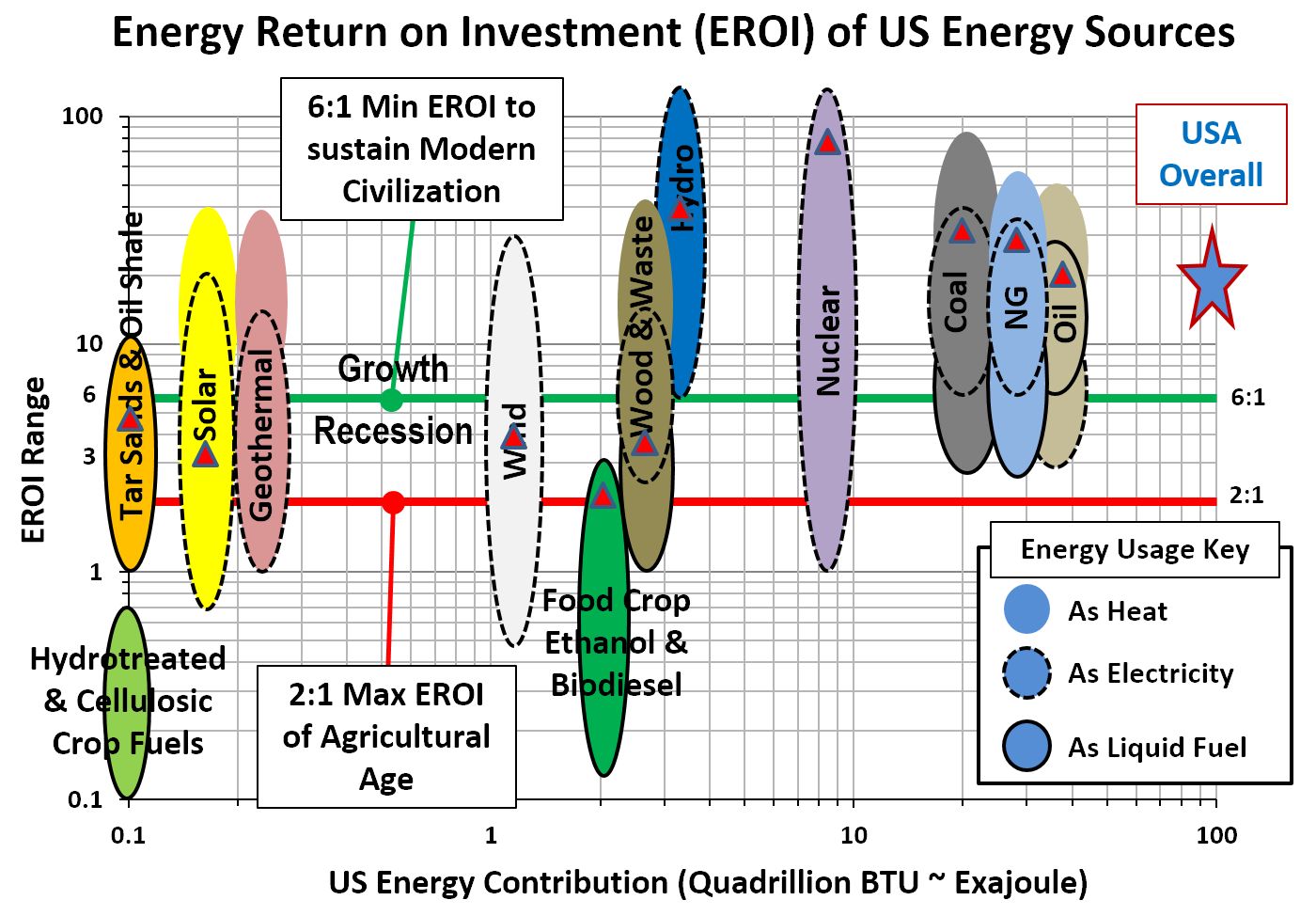
The EROI charts in this post are flawed in that they treat EROI year by year instead of accounting for the multi-year delays that often exist between energy and capital investment and the energy return from that investment. For example, investments made from 1973 to 1986 paid off in low oil prices and magically increasing reserves from 1986 to 2003. Crude oil to finished gasoline EROI was likely never higher than 30:1 at any point in history, and seldom less than 6:1. It is today likely far better than 10:1. EROI depends upon specific end use and all the lossy energy transformations necessary to get to that use. Natural gas EROI is about 30:1 if used for heat, but about 15:1 if used for electricity. Coal is about 80:1 if used for heat, but about 30:1 if used for electricity. This chart reflects the current state of my research into EROI. The ellipses are the historical ranges and the red triangles (where they appear) are the likely current values.
http://i63.tinypic.com/24cfr5e.jpg http://tinypic.com/m/jrbllf/1
Here is Captain Kiefer’s chart of EROI’s
benben,
Energy storage by itself has an EROI < 1 because it is not an energy source. If used properly, it can however, enhance the EROI of an actual energy source. Specifically intermittent sources like wind and solar. So far though, it has a pretty dismal record.
Thanks for the elaboration Ike Kiefer,
I went through the 2009 paper. The theory makes perfect sense for agrarian societies, where there is a linear relationship between labor and energy and money, and ecosystems, where there is the same relationship minus the money. But in the modern world, not so much. Hall et al. base a lot of their conclusions on very back of the envelope calculations of energy intensity per GDP. But what does that mean if the central bank can just print a couple of trillion $$ whenever they feel like it? Furthermore, it seems to me that the real relationship is between labor input and energy output, and with advances is robotics and IT, that seems to going in the right direction.
Finally, the EROI of renewables is pretty good, so the whole discussion is moot anyway. Andy, why did you not point that out in your article above?
benben, to a first approximation simply printing money will just get wiped out by inflation, so will not affect GDP.
That’s fine, but then they insist that EVERYONE else also participate in their delusions.
Expect a jeremiad from Kit in 3, 2, 1, …
Timothy Garrett (2011) has shown that every additional 9.7 milliwatts consumed increases our global wealth by one 1990 US dollar.
They did not show this. They used a thermodynamic model of society.
“To this end, I proposed a thermodynamically-based framework for the evolution
of civilization wealth and its rate of energy consumption at globally integrated scales.”
They say the argument that climate cannot be predicted because weather is uncertain is wrong, because climate is constrained by top-down energy considerations. You don’t need to know all the activity at micro level to predict the big picture. They argue that society may be modeled in the same way. This is an interesting but speculative idea. The argument is usually rejected here.
Seaice: You might reject Garrett’s analysis, but the relationship between energy consumption and wealth or standard of living is well documented. I cited other sources as well.
Andy, fair enough -there is a very strong correlation and I don’t dispute that cheap energy has been essential to our development. It is just that that was put a bit too strongly. I don’t reject Garrett’s analysis, but it does not show what you said it did. No big deal, but these little misunderstandings have a way of taking on a life of their own.
I also thought is was interesting to mention the idea of a thermodynamic model of society.
Howard T. Odum put forward a thermodynamic model nearly half century ago. (Environment, Power, and Society, 1971, “Potatoes partly made from oil”). Was sometimes considered father of “Ecological Engineering,” controversial then and now, not so much for the thermodynamics but for the applications. Ph.D. on biogeochemistry of Strontium. Father was a sociologist. It showed.
I read Garrett’s paper the other way — Each additional dollar of cumulative GDP wealth adds 9.7 mW to the power appetite of civilization. Then EROI determines how much of today’s accumulated surplus energy must be used to supply tomorrow’s increased energy needs. If EROI is not high enough, today’s surplus dwindles and becomes a deficit, which is an economic recession aka contraction. High EROI is anabolic metabolism, low-EROI is catabolic metabolism.
Overall a good article, but I have a few issues. I will only address one though:
“One might think in an affluent country, like the US, a market would become saturated with energy consuming goods, like cars, air conditioners, and refrigerators. This is not likely longer term, since new products, all using energy, will be invented and, if attractive, will be bought and used.”
This is not true. In the United States energy use per capita peaked in 1979 and is currently at the same level as in 1967. You can run your computers, smart phones, and TVs all today for less actual kW than was used for a CRT in the 1980’s. Additionally some metrics will absolutely saturate – miles traveled per year. Imagine we had the speed and cost so that anyone in the US could travel NY to LA and home again as a commute. Do you honestly believe that travel would grow further from that point? It is possible to say that there is substantial headroom for growth right now, but to claim that it will never saturate is far too strong a statement.
Along those lines – the top uses of energy are 1) industrial processes 2) heating/air conditioning 3)transportation. Far down the list are non-heating electricity uses. If personal transportation has an end point and heating/ac have a logical endpoint then the claim would need to be that industrial processes and marginal uses will be the bulk of future growth. We have grown industrial output substantially since the 1970’s, but the total energy use is flat over 45 years. Claiming industry will bring growth in energy use is wishcasting. The marginal use cases (electronics, appliances) are actually on a downward trend. Yes, a new device can be invented that will use electricity. However, that device is likely to replace something that uses more electricity right now. For instance – streaming a movie via netflix uses far less energy than driving to Blockbuster. Reading the news on your computer uses far less energy than printing a newspaper. Color programmable LED lights use far less energy than a 60W incandescent, and so on. Personally I have a difficult time thinking of anything new over the last decade that didn’t replace a higher energy option.
Yes we watch more TV, but that has a saturation point too (24 hours per person per day, 365 days per year).
TV’s use less energy than they did a generation ago. On the other hand 75 inch screens didn’t exist a generation ago. I guess there is a limiting factor in how large the largest wall in your house is.
Chadb: “In the United States energy use per capita peaked in 1979 and is currently at the same level as in 1967.” Picking one country in a global economy is fraught with difficulty. We import most of our manufactured goods now, this was not true in 1979. Essentially, we have exported our industrial energy consumption. Global energy consumption is up and will continue to rise as standard of living rises around the world. I do not think any of the devices I mentioned were made in the US, but the first television my Dad bought was an Admiral, made in the USA. The largest users of energy in the US (and in the world I think) are industrial and commercial users.
Thank you, I was hoping for that. Yes, we do import most of our manufactured goods. However, we still manufacture much more today than we did in 1979. That is, in the manufacturing industry we use fewer btu’s for every $ of value created. You may further respond “yes, but still not a fair comparison since we tend to import high energy intensity products (steel) while producing goods for which energy is a relatively low portion of value (pharmaceuticals).” I will go ahead and grant you this point and follow up with – the actual amount of steel used per person in the US has gone down since we are no longer building an interstate highway system from scratch. So even granting that we import more stuff and that we import high energy intensity products we still use fewer btu per capita than in 1979.
By the way, it isn’t a small decline – it’s 17%. If we compare fossil fuel use per capita the decline is bigger, 26% since 1979 with the extra 9% made up from a combination of renewables and nuclear.
Chadb, very insightful, I like that argument. But, the US, Europe and Japan have very high standards of living, as the rest of the world catches up with us, we may not be advancing very fast. I still think using the US is picking an unrepresentative extreme. Average India and the US and you may be better off, or better yet use the whole world. I don’t think using one country works.
I think chadb’s data supports the idea that prosperity is not necessarily linked to greater energy consumption and in the west we have disconnected the two. However, much of the rest of the world will probably continue to use mire energy as they develop as they have not reached the point that the USA has – they still have not built all those roads and people still don’t travel much. The point they reach will almost certainly be less energy consumption per unit of wealth than was the case for the USA since they can skip those power hungry TVs.
I don’t see a saturation point either. People today already want true hoverboards and flying cars and space tourism — extremely energy-intensive. When the two-order of magnitude breakthrough in energy storage happens that allows electricity to surpass refined petroleum in energy and power density (nuclear batteries? LENR? Mr. Fusion?), energy demand will skyrocket to supply the new wave of tech.
Brilliant analysis of this issue! I agree with most of the points made above but I was under the impression that the EROI for sugarcane derived ethanol in Brazil is much more favourable than that from corn or other sources (~8 EROI is the number I remember for Brazil EtOH but I’m not certain of that). Anyway, it doesn’t make any sense to grow fuel crops due to the problem of displacement of food crops from the limited supply of arable land. Also, despite lots of hype about wonder crops like jatropha that grow on poorer soil and algae that don’t need soil (both of these for biodiesel), yields have been exaggerated by proponents and don’t cut it commercially. Hydrocarbons are the cheapest most widely available energy source and will remain so for a long time to come.
Growing conditions for sugar cane are better in Brazil than they are are in the US.
Thanks Phil. Sugar based ethanol is certainly better than corn or cellulose, I don’t know why it isn’t used in the US. I suspect the very strong sugar lobby has something to do with it. We have a lot of trade barriers set up to stop the importation of sugar and sugar based ethanol. Sugar costs a lot more in the US than in Brazil.
Florida sugar is controlled by the Fanjuls…a extremely strong sugar lobby
See Captain Kiefer’s comments on sugar based ethanol above. He thinks Brazil’s calculations are optimistic.
I might point out that the revolutionary new molten salt nuclear reactors, which are inherently,totally safe (even from terrorist attacks), have placed estimated build costs at under $2 per watt, or about 1/3rd that of current nuclear and have lower fuel costs and lower nuclear waste output (about half) , will produce power at a levelized cost of less than $35 per Mwhr , which will be the lowest cost of any technology. They can also operate as load following producers, ramping their output up and down to follow grid demand, which no current nuclear plants (or coal baseload plants) can do.
Aurthur, this is a serious question, why do you think we do not have any such reactors? They seem to be a great thing, but their absence seems to indicate that there is some problem.
Seaice1, Many of the designs are still being worked on. Then there is the multi-year approval process of the NRC at over $800 per hour. I would say in the not too distant future. As for your comment that Will Happer should not be commenting on climate change…. Few know the atmospheric chemistry and physics of gasses better than WH due to his work on the Sodium Laser Star Guide.
Ric – thank you for the answer. I think there is too much fear of nuclear energy and it is probably over-regulated. It needs to demonstrate not just safety but almost that it is risk-free before acceptance. Nothing is risk free.
You have misinterpreted what I said a while ago. I did not say Happer should not comment on climate change. Anyone can comment on climate change. I pointed out that the list of publications which was very prominent in the article and intended to demonstrate authority (why else would it be there?) did not contain any papers on climate.
I am cautious of people talking outside their expertise. As I have said frequently – listen to doctors when they tell you that sugar can cause diabetes. Be cautious when doctors tell you that a sugar tax should be introduced to solve the diabetes problem. That does not mean people cannot contribute outside their narrow specialty. A great many valuable contributions have come from such “outsiders” and a fresh angle can lead to insights.
Whilst people can make valuable contributions outside their field, they can also make elementary blunders, so it is good idea to treat their pronouncements with caution.
I know Happer works on atmospheric phenomenon that have some connection to climate, but his area of expertise is not on that interaction with climate.
@s1 what exactly has Dr Happer said and how is it out of his intellectual grasp?
Pop Piasa. I refer you to the answer I just gave. Ric Haldane thought I said in an earlier post that Happer should not be commenting on climate change. He did not get it quite right. I described my position above and I don’t think I can put it any more clearly. You will notice that I never said anything about Happer’s intellectual grasp.
@SE1
What field of science is most qualified to speak on climate? I personally think those who self-identify as climate scientists are some of the least qualified. Judging by the outcome of the models they make, they have a poor comprehension of the atmospheric physics involved. The use of scare tactics and bandwagoning and public shaming to enforce orthodoxy is more religious than scientific. So are the opaque protocols for collecting and manipulating “data” that, when reverse engineered at great pains by skeptics, reveal corrections of a magnitude that not only exceed the claimed error margins, but reverse trends extant in the raw data. I will add that anyone who has ever used the words “incontrovertible” or “the science is settled,” or who has advocated lies or exaggerations to push policy decisions a la Stephen Schneider in any field of scientific inquiry should be forever disqualified from claiming the title of scientist. IMO, the AGU and the APS are currently disqualifying themselves as scientific organizations because of their political posturing.
First and foremost, we need more physicists and chemists and hard science disciplines involved in climate science. Will Happer is exactly that type. Second, the broader scientific community needs more open access to the data and “corrections.” There should be an online master repository for raw global temperature measurement data populated by all nation’s accredited science organizations, rather than proprietary data sets each managed by their cloistered priesthood. Truth stands on its own. Only lies require the support of church and state. For the sake of science and public safety, we need to discredit the bumbling smock-wearers and publicity hounds like Bill Nye who don’t know the difference between radiative and convective heat transfer, think CO2 traps photons, set up fraudulent demonstrations that require IR light to pass through glass, or claim that all warming since 1750 is purely anthropogenic. In short, climate science has a lot of growing up to do.
arthur4563 ‘ load following producers…..which no ‘coal baseload plants’ can do.
All coal-fired generation can load follow, the newer a coal generator is the more likely it is to run baseload because of economics not engineering capability. As it ages its will run mid-merit, the peaking/back-up as it gets old. Please understand how generators operate in an integrated centrally dispatched electricity grid.
All commercial US nuke plants are designed to load follow too.
Great idea, but not commercially available till the early 2030s. At the earliest.
Griff
March 13, 2017 at 11:09 am
———
Griff, please, please do not misunderstand me……..you are the one and the only celebrity here at WUWT, as far as I can tell…..
I really do like you, even when I try so hard to keep away from replying or arguing with you…you really rock in your own way..:)… You really are hilarious…..in a good way.. :)… up to some point…
Please accept it,,,, you are addicted……… to WUWT….and that is not Anthony’s fault…and you know it, I think…
cheers
A second problem I have is with Germany as the sole comparison point. Just because Germany does something stupidly does not mean every application is bad. Any comparison to Germany needs to be tempered with a comparison to ERCOT. The main Texas grid is fairly isolated and managed 15% wind integration into the grid last year. Additionally they have some of the lowest electricity prices in the US. But the feed in tariff… completely irrelevant. Take that 15%, add $22/MWh and you still get lower rates than most of the US. Are there tradeoffs – absolutely, However, ERCOT manages a high level of intermittent wind, delivers power reliably, and has some of the lowest electricity rates in the world. On top of this ERCOT is planning a further capacity growth in wind, and substantial additions in solar. In ERCOT solar is financially feasible because it is guaranteed to be on during the “hundred hottest hours.” In fact, in this isolated high (and growing) renewable grid substantial interconnection capacity is being planned in order to export electricity to the south-east.
Germany has managed renewables poorly, so has Australia and California. However, that is more due to their idiotic command and control structure than the underlying technology. The technology can compete when the market is free.
chadb, very valid points (ERCOT, see here http://www.ercot.com/ ) is exceptionally well managed and handles a small (<20%) renewable power capacity quite well. But, Texas does subsidize renewable power. Also Texas has a lot of cheap natural gas and two large nuclear power plants, not to mention the coal plants. They do a good job, no doubt, but how much extra do we pay in Texas because of the renewables? My point is, no one knows for sure, and we should know. I live in East Texas and pay between 5 cents and 13 cents for electricity, average over the last year, about 8 cents. Mostly from natural gas. My daughter once signed up for "green energy" guaranteed "all renewable." She got a huge bill once in August (4 figures!)and spent an hour on the phone finding out what was wrong. She was paying 36 cents a kwh for West Texas wind power. She switched to a plan to buy the cheapest energy, she paid 10 cents.
A second problem I have is with Germany as the sole comparison point. Just because Germany does something stupidly does not mean every application is bad. Any comparison to Germany needs to be tempered with a comparison to ERCOT. The main Texas grid is fairly isolated and managed 15% wind integration into the grid last year. Additionally they have some of the lowest electricity prices in the US. But the feed in tariff… completely irrelevant. Take that 15%, add $22/MWh and you still get lower rates than most of the US. Are there tradeoffs – absolutely, However, ERCOT manages a high level of intermittent wind, delivers power reliably, and has some of the lowest electricity rates in the world. On top of this ERCOT is planning a further capacity growth in wind, and substantial additions in solar. In ERCOT solar is financially feasible because it is guaranteed to be on during the “hundred hottest hours.” In fact, in this isolated high (and growing) renewable grid substantial interconnection capacity is being planned in order to export electricity to the south-east.
Germany has managed renewables poorly, so has Australia and California. However, that is more due to their idiotic command and control structure than the underlying technology. The technology can compete when the market is free.
This is a good review of the “internalized cost of energy” for a variety of energy sources … but it also curiously ignores the cost of producing hydrocarbon fuels for vehicle power, as if such fuels don’t themselves consume large quantities of energy in their production and transport to the end user, and thus re somehow “free” … which of course, if you think about it for about one millisecond, is obviously not true.
Every barrel or oil of therm of natural gas has very high costs associated with it. The cost of technology R&D, the cost of exploration and confirmation, the cost of production, the cost of transport (which can vary wildly, from pipelines to tanker ships to trains to trucks). There is no single definitive cost of HC vehicle fuel because the component costs necessary to deliver the fuel to a vehicle or aircraft vary wildly by HC source type and location. It’s been reported recently that the typical American oil and gas producer in the Bakken or Permian Basin can still make a profit at oil priced around $33 a barrel … while the Saudis are able to produce a barrel of oil in their oil fields for but 10 dollars a barrel. Of course, that still does not include the cost of transportation to the end user.
And of course, as the author pointed out, internal combustion vehicles are very inefficient users of chemical energy, mostly due to waste heat of combustion as well as internal mechanical losses. Typical chem energy input to usable shaft horsepower ranges from around 3 to 1 to as much as 4 to 1. Whereas electric motive power systems (either plug in electric or hydrogen fuel cell) typically enjoy total motive system efficiency of around 1.1 to 1 to 1.5 to 1.
All in all, trying to level the playing field including all internalized costs of production, either in currency or in energy inputs, is a very complex and difficult calculation.
The biggest objection to renewables is the “backup power” need. However, that problem results only because energy storage from renewables is not generally available on a mass production scale. Chemical batteries tend to be expensive modes of energy storage, but that is not the only path to storage. Others include using renewables to store energy chemically, such as by electrolysis of water into hydrogen fuel, or “pumped storage” which has been used for more than a century with hydroelectric power plants. Perhaps a near term technology breakthrough in energy storage will eliminate that problem altogether.
When calculating how much energy electric cars use, you have to factor in how much energy is lost from production to wheel. When all factors, not just the in car factors are taken into account, the so called efficiency advantage disappears completely.
Those factors are already included.
As to drilling costs, I didn’t include the energy cost to make the factory that makes the cars and the batteries either. And for the same reason.
Mark – the point on vehicle energy consumption using internal combustion engines is that no matter how the energy is produced and transported, the IC engine still wastes between 67% and 75% of that energy. An electric power plant does not. A plug in electric only losses 1% in the recharge cycle (kw-hr in vs. kw-hr out), and the electric motors typically range between 95% and 98% efficient in converting electric energy to shaft horsepower. Hydrogen fuel cell vehicles don’t do quite as well because there are losses in the fuel stack and voltage regulator subsystems, but they’re all well above 70% kw-hr in vs. kw-hr out at the wheels vs. 25-33% for IC vehicles. In other words, IC engines waste most of the energy we pump into them.
The production of hydrogen fuel for FVCs is already in existence – we’ve been producing vast quantities of hydrogen gas for more than a century for manufacturing of chemical feedstocks and, actually, in the refining of crude oil. Hydrogen fuel can also be produced easily from cracking of natural gas or ammonia, both widely distributed via pipelines and tanker trucks throughout the US and other developed nations. The only thing that’s been lacking to date is the final transport to consumer fuel stations. But that is just a pump, or a nat-gas cracker … after all, we don’t pipe gas and diesel to C-stores – we truck it there, just as we can truck LNG or ammonia to the very same retail outlets. At the handful of retail hydrogen stations in California, however, the cost of transporting and dispensing fuel to consumers is dirt cheap – around $1 per GGE (gallon gas equivalent) – less than half the cost of gas or diesel.
IC engines are very convenient vehicle power plants, but we’ve wrung just about as much fuel efficiency out of them as is practical, because we bump up against the implacable realities of waste heat and mechanical losses. Electric vehicles, wither plug-ins, hybrids, or FCVs are a game changer in increased energy efficiency. They also produce less air pollution on our roads, and they’re quieter, and they require less maintenance than IC vehicles.
If your goal is clean fuel FCs face difficulty getting clean H2 by chemical means and if you do electrolysis from clean electricity you throw away another third of the energy i.e. down to the levels of ICEs.
You are going to have to supply a reference for this one.
Duane, the point is that while power plants are more efficient than IC engines, all of that efficiency is lost transmitting the electricity from the power plant to the car.
Duane,
” A plug in electric only losses 1% in the recharge cycle (kw-hr in vs. kw-hr out)…”
Nonsense. The losses from the output of the battery charger into the battery may initially only be 1%, but the charger itself has losses too. The best chargers will lose anywhere from 5 – 10% in converting the AC from the receptacle to the DC used to charge the batteries. These are mostly resistive losses that show up as heat (the charger gets warm/hot). Then there are the transmission losses from the power plant to the home, which is around 5%. Also, current battery technologies have internal losses. Even if a battery is not being discharged, it will still lose charge over time, and this represents additional loss. For LiON batteries, this loss gets worse as the temperature decreases, making electric cars even less useful in cold climates. So your simplistic %1 figure is very misleading at best.
Duane…
Tanker shipment is a surprisingly efficient way to move crude oil and adds only about 2 US cents to the cost of a gallon of gasoline. In most countries, (except the US) government taxes represent a huge chunk of the cost of fuel – typically >50% in European countries – so hydrocarbons are already heavily penalized (while so-called renewables are subsidized) but are still the best transport fuels for many reasons.
Electricity is also a great “fuel” for vehicles and, yes, electric motors are pretty efficient but first you have to consider where that electricity comes from. If the electricity is thermal (from coal) the efficiency is only 30-40%, from combined-cycle gas turbine perhaps 50-55% but you also have to factor in transmission losses of perhaps 7%, too. Battery technology for storage and the time taken for recharging are major issues for electric vehicles although progress is obviously being made. As for massive storage on a grid scale, there are limited options – chemical storage is difficult to scale up and pumped storage is generally restricted by geography and topography, despite new ideas like “underwater reservoirs”. Current pumped storage worldwide represents about ~150GW last time I looked and this is <5% of generating capacity.
Hydrogen is a no go even if made by electrolysis from solar PV. It's energy density is extremely low (29% of the energy density of gasoline on a v/v basis), it needs to be stored at high pressure, is flammable or explosive across a wide range of concentrations in air. If you want to use a gaseous fuel, it's better to use LPG or CNG – much cheaper, more widely available, safer and more efficient on an energy density basis.
Actually, you’re quite wrong about relatively energy density of hydrogen vs. gasoline. A single kg of hydrogen gas provides slightly MORE than one gallon of gasoline equivalent chemical energy, which gallon weighs more than 2.7 kg. But that’s not all – that’s just the intrinsic chemical energy density of the fuel itself.
But there is also the energy losses in the IC engine, which as I point out above, range from 67% to 75% of the intrinsic fuel energy input being wasted. Hydrogen fuel cell vehicles average about two or more times the fuel conversion efficiency at the wheels as do IC engines. The EPA GGE-based mileage rating on the Honda FCX Clarity is 68 mpg for a 5-passenger midsized sedan, most of whose same class IC competitors have EPA ratings of 26-30 mpg.
Consequently, due both to the fuel itself and the power plants that use it, in terms of “usable energy” the hydrogen fuel is actually far more dense on a weight basis.
Energy density per kg is higher for hydrogen. Energy density per liter (or gallon) is quite a bit lower and requires very high pressures or low temperatures. If weight is the limiting factor then H would have an advantage in the energy density regard. A liter of liquid hydrogen weighs just 70g, compared to 1000g for water. Liquid hydrogen requires cryogenic temperature At 700 bar gaseous hydrogen at room temperature has a density of 42 g/L. This very low density and special storage conditions (700 bar is no joke) means hydrogen will always have big problems as a fuel.
IC engines are not very efficient, but if the power comes from electricity we must consider the efficiency of the electricity generators as well. These are more efficient than IC engines but only by a few percent. When we add in nuclear, hydro and other renewables we are getting an advantage, but we then have to remove transmission losses. So electric cars powered from the mains are a bit more efficient than IC engines at the moment.
However, their pollution is generated in power stations where it is easier to install remediation and the effects are not as pronounced as in the middle of cities. They provides a significant benefit for air quality in urban areas. They also offer energy security advantages as they can use electricity generated from any source, whereas the IC can only use liquid fuel, primarily from petroleum.
Duane….
If you read my original post, you will note that I very clearly said hydrogen has a lower density on a v/v basis i.e. volume NOT mass. As seaice1 correctly commented, and I had previously alluded, storage of hydrogen for practical use is a problem – cryogenics at -253C and/or very high pressure. LPG and CNG are much easier and safer in this regard and have higher effective energy densities. Nobody denies that hydrogen would be a wonderfully clean fuel but the practical problems of implementation are significant while other fuels are much easier, cheaper and safer to use. As Robert Zubrin said, hydrogen is “just about the worst possible vehicle fuel”!
Regarding seaice1’s comment on ICEs, they don’t actually require liquid fuels, as I know he knows that but the comment was a little misleading. The fuel is, of course vapourized prior to ignition so ICEs run well on gaseous fuels, too. Dual-fuel vehicles that can be switched from gasoline to CNG are widely used in various countries already (Malaysia, Thailand, Pakistan to name a few).
I agree that, in the long term, electric cars are probably the best option, depending on how the electricity is generated and distributed and the grid necessarily upgraded to cope with the increased demand of such initiatives. Hybrids are a good stepping stone, in the meantime.
Phil, yes, I meant fuels that are conveniently transported and stored as liquids with a high energy density.
Duane, a successful and economic energy storage device that would eliminate fossil fuel backup for renewables has not been invented yet – maybe some day. But, the economics of producing fossil fuels and delivering it at an EROI of 10 to 150, are well known. The EROI goes up and down as prices change and the world economy changes, but overall it is usually well above 10:1. We do not know the numbers for renewables yet, but from what I’ve seen while researching this post, they are not even close to economic without really cheap storage. My friends in the fossil fuel industry will be encouraged that the more renewables are used, the more fossil fuels will be sold. Renewables are great for fossil fuels. But, for the world at large? Renewables are a disaster.
The EROIE for gasoline is not a fixed number, because the energy required for production from the field and transport to refineries and again to end users is not fixed, and varies widely by location and production method as I noted above. Saudi crude requires relatively little energy and cost to produce at the wellhead, while it costs a many times that in both energy and dollars to produce oil in the major US land based fields, and even more so in remote deep ocean drilling. But the overall industry wide EROIE for gasoline is somewhere around 5 to 1 and dropping. Considering the end user losses of 67 to 75% for IC engines, the mechanical energy yield at the wheel is getting down to less than 2 to 1.
Duane, your numbers are way off. Recheck them. I’ve helped analyze many conventional and unconventional oil and gas projects over the last 45 years and I’ve never seen a project with an EROI less than 10:1. The economic ones, that were actually developed were all well over 50:1. A 5:1 project wouldn’t pass the laugh test. If I proposed one I’d have been fired on the spot and rightly so. The problem with EROI is everyone chooses what to include and what not to include, so the metric becomes useless.
Your Table 1 for the USA shows onshore wind and solar at nowhere near “twice the cost of the cheapest alternative,” natural gas. But if their EROI is so bad, why is the cost of their electricity not astronomically higher than all non-renewable alternatives? Isn’t the cost of fossil-fuel backup built into the price? Or is government just distorting the price with subsidies so much that the table is essentially useless?
/Mr Lynn
The “world” ratio is in the neighborhood of twice.
The cost of electricity is astronomically higher in some places, particularly places with high reliance on solar and offshore wind.
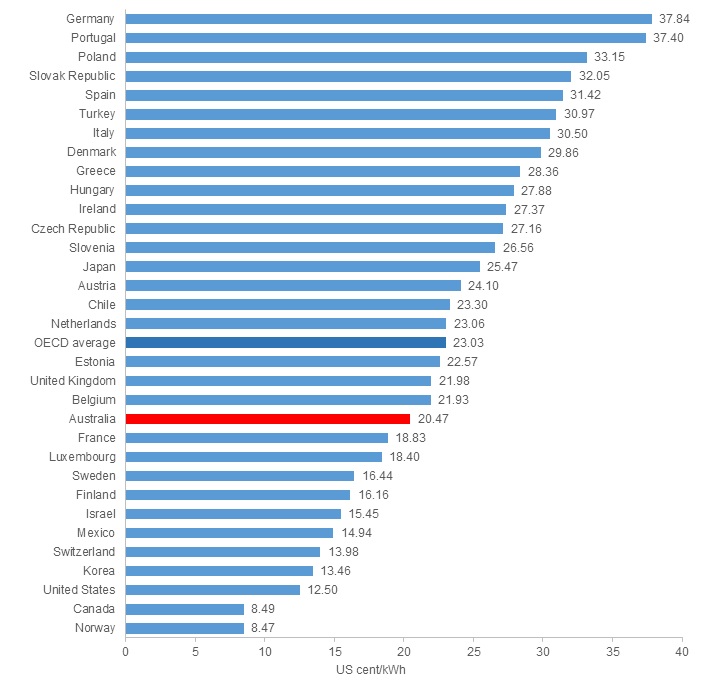
Onshore wind, in the US, is comparable to coal and natural gas. Consumers generally don’t receive a bill itemized by electricity source. If your electricity is generated 60% from natural gas, 20% from coal, 15% from wind and 5% from solar PV, your net price wouldn’t be seriously affected even if the utility was forced to pay $0.30/kWh for the solar PV. The LCOE, using the US LCOE’s for coal, gas and wind and 300 for solar, of such a distribution would be $0.08/kWh. If you eliminated the wind and solar and had 30% coal and 70% natural gas, it would still work out to $0.08/kWh.
So long as the renewables are a small fraction of total generation, the higher costs don’t really make much difference.
I suppose that explains why solar continues to be generalized this way at the policy level and WUWT even though the range of costs within solar is huge. The high-cost rooftop solar lobby also benefits from this distortion.
Willis Eschenbach is one of my favorite writers at “Watts Up With That” which bills itself as “the world’s most viewed site on global warming and climate change”. If you are at all skeptical about global warming, you should read it regularly so that you can understand why the proper attitude towards claims of CAGW (Catastrophic Anthropomorphic Global Warming) is skepticism bordering on disbelief. Lots of the commentary is provided by or linked to real scientists, such as Roy Spencer and Judith Curry.
Willis analyzed the relationship between the retail price of electricity and national amounts of “renewable” generating capacity.
“Obama May Finally Succeed! by Willis Eschenbach on August 3, 2015
https://wattsupwiththat.com/2015/08/03/obama-may-finally-succeed/
His chart shows that the retail price of electricity should be expected to increase by 0.0002 U.S.$ for each additional KW of installed renewable generating capacity. R^2 = 0.84, p-value = 1.5E-8.
He says: “That is a most interesting result. Per capita installed renewable capacity by itself explains 84% of the variation in electricity costs. …
Today, President Obama said that he wanted 28% of America’s electricity to come from renewable energy by 2030. …
Currently, we get about 4% of our electricity from wind and solar. He wants to jack it to 28%, meaning we need seven times the installed capacity. … this means that the average price of electricity in the US will perforce go up to no less than 43 cents per kilowatt-hour. …
Since the current average US price of electricity is about 12 cents per kilowatt-hour … that means the true price of electricity is likely to almost quadruple in the next 15 years.”
David and Rud, regarding “Onshore wind, in the US, is comparable to coal and natural gas.”
With todays subsidies that is true, especially in West Texas, Oklahoma and Kansas where the wind blows most of the time and at a favorable speed. But, it depends on where you are – it is not a very good source in Germany for example.
However, even in West Texas the wind stops now and again and we need fossil fuel backup. That is where and why it fails. I came to the conclusion that wind mills and commercial solar panels are little more than boat anchors for this reason. Personal farm wind mills, roof top solar, remote solar and wind, sure. Otherwise, buying them just sells fossil fuels and little else.
The down side to Texas wind power is that the windiest seasons are spring and fall. Wind works OK in Texas; but the periods when it most needs backup are the periods of highest electricity demand.
Regarding grid penetration, Texas is pretty close to “Peak Wind.”
Poland is second in your table and overwhelmingly is powered by coal.
German power prices are high, but canny Germans use less electricity than (for example) people in the US, plus they are likely to have shares in community owned renewables and/or their own solar panels.
I don’t think the Poland number on that graph is accurate.
 ?w=720

https://wattsupwiththat.com/2015/08/03/obama-may-finally-succeed/
http://bazonline.ch/ausland/europa/das-ist-doch-absurd/story/20816080
The EIA onshore wind number is grossly wrong. See comment below.
Yeah Table 1 shows onshore wind as a lot cheaper than coal and nuclear. Lower EROI does not mean higher prices, because energy is dirt cheap compared to labor and materials, so the correlation between EROI and costs of an energy source is tenuous at best. In fact, renewables + storage are the cheapest option in many places in the world right now.
When it comes to renewables, I just love “piling on”…
There are 7.33 barrels of oil in a metric ton. 90 million metric tons of crude oil is 660 million barrels. Assuming an average refinery output, the burning of the refined fuels from 1 barrel of crude oil yields 0.43 ketric tons of CO2.
660 million barrels of crude oil would yield about 283,671,000 metric tons of CO2.
1 million BTU worth of coal yields about 220 lb of CO2. 1 short ton of coal yields about 20 million BTU. 1 ton of coal yields about 2.2 tons of CO2. 600 million metric tons (661 short tons) would yield about 1,319,999,621 metric tons of CO2.
Irony can be so ironic.
That’s a lot of big numbers. I wondered what the energy needed to make the turbines was compared to the energy generated. Quick back of the envelope I make it 2.5 x 10^19J/year from wind. Energy needed for the steel about 1.5 x 10^19J. That is takes a good part of the first year to “pay for” the energy needed for the steel to make the turbines.
This is in the ball park of 5-8 months payback for the energy of a wind turbine, so I probably have not mos-placed a zero, although I would not stake my life on it. Lets round it up to a year.
So if the turbine lasts 20 years, we get 19 years generation after “paying for” the energy needed to build it.
So whilst it is true that wind power need coal (at least at the moment), it is also true that using coal needs 20 times as much coal as wind.
While the coal-fired plant never needs any wind.
And the wind power plant will always need natural gas, coal or nuclear power… Because it’s not always windy.
Yeah, I guess my point is that putting huge numbers for global consumption and emissions sounds like a lot, but without context it doesn’t tell us much. Rather like those pieces saying “this wind farm generates enough power for 30,000 houses” or something like that. I think that this it trying to convey a feeling of “a lot” without actually giving us the information to decide if it really is a lot.
“While the coal-fired plant never needs any wind.” I don’t think we are going to run out. The wind needs something, but it does not in principle have to be fossil based. Currently there is no installed alternative.
Great link, thanks David.
Of course there are steel plants considering renewably derived hydrogen (Linz) or tidal lagoons (South Wales)
70% of the steel in the world is made with coal. Coal is kind of an essential ingredient in coke. I don’t know of any steel plants that use tidal lagoons for coke.
Came across this which illustrates how much coal is used for steel production:
” There have been various attempts to calculate how much land you would have to devote permanently to rotational wood harvest for each tonne of steel to be made annually. The estimates vary between two and seven hectares per annual tonne, depending on species, climate, soil and process efficiency. Clearly the world is not going to devote 2-7 billion hectares (13%-50% of the global land area) – or even a small fraction of that – to steel making, and nor should it.”
http://coalaction.org.nz/carbon-emissions/can-we-make-steel-without-coal
ALL fuel is free…
collecting it & converting it to useful energy costs
The EIA onshore wind LCOE number is grossly wrong (low). 1. It uses a 30 year life when ‘actual’ is at best 20 for big turbines. 2. It excludes the PTC subsidy. 3. It assumes capital costs come down when in fact they have been rising since ~2006. 4. It omits the cost of intermittency backup. 5. It understates the additional transmission cost by ~1/3. 6. It uses a 35% capacity factor when the last decade actual is 31%. APE and I calculated a more ‘correct’ LCOE using 10 percent penetration on Texas’ Ercot grid. The ‘correct’ number is ~$146/MWh. Details in guest post True Cost of Wind at Climate Etc.
Thanks Rud, good post. Time will tell what the true cost of wind power is, but it is probably closer to your figure than the EIA figure for sure. Here is the link for others: https://judithcurry.com/2015/05/12/true-costs-of-wind-electricity/
Thanks Andy. I was ipadding or would have captured and provided that link.