Guest essay by David Archibald
One of the most accurate ways of predicting the amplitude of the next solar cycle is to derive it from the strength of the solar polar fields at solar minimum. And you don’t have to wait for solar minimum. An accurate assessment can be made four years before minimum, which is where we are at the moment. This graphic shows the last 40 years of solar polar field strength data:

Figure 1: Solar Polar Field Strength 1976 – 2016 (source Wilcox Solar Observatory)
And this graph shows that data averaged and all converted to a positive sign:

Figure 2: Solar Minima relative to Solar Polar Field Strength 1976 – 2016
It is evident from Figure 2 that solar polar field strength has an early peak and then relaxes by an average of 12 units to solar minimum before falling away. The recent peak value was 53 in 2016. Therefore the field strength is likely to be 40 at the 24/25 solar minimum. How that value translates to peak amplitude of Solar Cycle 25 is shown in the following graphic:

Figure 3: Deriving peak amplitude of the following cycle
A monthly smoothed maximum sunspot number of 62 is derived for Solar Cycle 25. This would probably be around 2025. This is almost down to Dalton Minimum levels.
In terms of other interesting aspects of solar behaviour, the F10.7 flux has settled into a narrow range:

Figure 4: F10.7 Flux 2014 – 2016
The F10.7 has been in a narrow range over the last two months and is now only just above the immutable floor of activity of 64, though it may be three years to solar minimum.

Figure 5: Oulu Neutron Count 1964 – 2016
The neutron flux caused by galactic cosmic rays is at a rate equivalent to that three years prior to the 23/24 solar minimum. Skies should be getting cloudier according to Svensmark’s theory which will ameliorate the Earth’s “fever.”.
My prediction for the peak sunspot number of Cycle 25 is a monthly count of 62.
David Archibald’s next book is American Gripen: The Solution To The F-35 Nightmare.
In the Netherlands we have a ice skating event in a nothern provence of the country. This is a 200+ km skating event on natural frozen water and only happens once in a few years when the ice is think enough. I compared this to the solar cycles and found that in the lower solar activity years we have a chance on the event. I have put blue dots at the actual event and a red one when it was very close. Now I know this is totally unscientific but I thougt it was interesting.
http://imgur.com/a/8ALap
Normally correlation is not causation, but repeated correlations? The jury is still out on this one, but two years from now I would be sharpening my skates!!!
A dust cloud between earth and sun de-blobbed the Pacific Blob. What is next the dismantling of CAGW?
What stands out to me is how much weaker the sun is at this stage of cycle 24 then was predicted. All the solar metrics are below what was forecasted at this point in the solar cycle. With the minimum for this cycle still way off until 2019 this might mean solar flux levels sub 80 for a long time to come.
Then again like the climate never bet the ranch on any one prediction. There are still many unknowns out there despite advances.
http://www.swpc.noaa.gov/products/solar-cycle-progression
Solar running much lower then projected.
Not really as the red line on the NOAA graph is not correct to begin with. It is based on the maximum value of 90 which should have been 80.
If that is the case why have they not adjusted it?
NOAA has something against adjusting 🙂 Except temperatures, of course. But if you want to see the latest prediction, look here: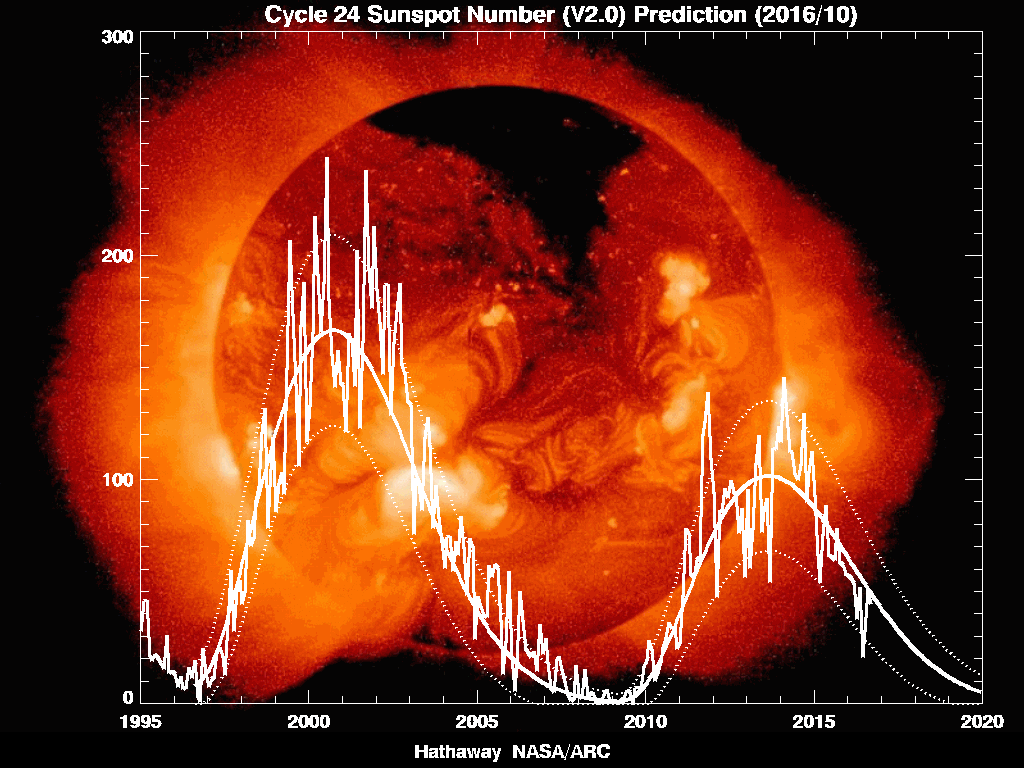
They do not have this cycle hitting bottom until 2019 and 2020 which means years of solar quiet which has not been the case since the Dalton Minimum. Even the 2008-2010 solar lull was only 2 years long.
So what it looks like is maybe 3 to 4 years of sub 80 solar flux readings which I do not think has happened since the Dalton solar minimum ended.
If SC25 is a bit stronger than SC24, the cycle will not be extraordinary. So when you say “it looks like…” you have nothing to base that on except wishful thinking.
Cyclical prediction shows that solar activity should be lower than average for the next couple of decades, but higher than average from 2035 to 2090. Everything else being equal, we should see no global warming, and perhaps slight cooling for the 2020-30’s with a return to global warming for the second half of the 21st century. Ocean oscillations and volcanic eruptions might affect this outlook.
http://i.imgur.com/j2hbCiv.png
Javier, this solar cycle estimate based on past solar cycles has been done to death, so to speak,. it is wrong on so many levels.
You have no clear understanding of the mechanics behind this sun spot record, so why should you be trusted with forecasting it!
“G4” is a farce… The time-line is wrong, pulling random statistical patterns from your butt does not work.
This crap right here, in your graph is the same nonsense I have seen in other data, what next? are you going to conform solar observations to your forecast?
The doted line in the graph above shows a dishonest bias, I wonder what it agrees with! Hmmm, take it away my eyes are burning with the stench!!!
“Ocean oscillations….might affect this outlook”.
Nice little escape clause there. It means that as the temps continue to rise over the next five years in complete disregard to solar cycles you will be able to continue to claim it has nothing to do with anything humans are doing.
What are humans doing?
In fact, “temps” as you arrogantly put it are cooling off… go stuff yourself dick face, . Temperature is a temporary measurement,, ‘Tony McLeod’ aye? are you related to Conner? Where have I heard that fictional name before? if you’re going to start swinging swords There will be only one, it will not be your good simpleton self sir.
[And with this comment, you are PERMANENTLY BANNED from WUWT – Anthony]
It is not worth responding to that Sparks individual, but I can discuss your comment, Tony.
It is not an escape clause. It is an acknowledgement that climate integrates multiple signals and does not depend from a single one, be it CO2, solar or internal variation. As this article is about solar cycle prediction, that is what I have presented.
Possibilities are:
– My solar prediction is good enough and temperatures follow the expected solar-induced pattern. Great.
– My solar prediction is clearly wrong but temperatures follow the expected solar-induced pattern. Then I got the cycles wrong, but the causality still right.
– My solar prediction is clearly wrong and temperatures do not follow the expected solar-induced pattern. Then I am wrong on all accounts.
– My solar prediction is good enough but temperatures do not follow the expected solar-induced pattern. Then I got solar cycles right but solar effect is lower than I thought. Unless a volcanic eruption or ENSO variability can account for the disparity.
I don’t know what worries you. This prediction both of solar activity and temperatures has quite clear conditions for failure. If temperatures increase at the rate they did between 1976-1998 for the next 10 years I am clearly wrong. If they shown the lack of increase of 2003-2014 then either I am right or I have been lucky.
Science is that simple unless we are talking about the CO2 hypothesis, that it is unfalsifiable as it explains one thing and the opposite. that is obviously not science but belief.
If they shown the lack of increase of 2003-2014 then either I am right
No, as cyclomania is not science. To be right, you have to be right for a physical reason, i.e. a theory that explains the physics of why you are right.
Happy Holidays, Leif.
Calendars were developed millennia before there was any understanding of the physical reason. They successfully predicted the seasons and equinoxes. No physics requirement. Now you will tell me that calendar makers were wrong.
No, I tell you that the calendar makers were not scientists. They were right for the wrong reasons, e.g. that the whole universe revolved around the Earth. Or that the Sun god was riding on his chariot across the heavens and went to hide behind tall mountains in the North.
They did what could be done at the time. They produced valuable knowledge and successfully predicted seasons for farmers, and solar and lunar ephemerides for religious ceremonies. No doubt they were respected as the wiser at their time.
Today we have hundreds to thousands of scientists analyzing periodicities in their data by fast Fourier, wavelet or several other techniques. Even if they do not know the physical basis for the periodicities they find, their results are considered science by colleagues, referees, and journal editors, and they are sustained by their academic institutions and funding bodies.
So your opinion on this matter is only your personal opinion. Worth the proverbial two cents. We first identify the relevant cycles, demonstrate that they do happen and have the purported effect on climate, and then we will try to identify their physical causes if our knowledge is already sufficient for that. It is impossible to know if we have sufficient knowledge to explain our observations. Alfred Wegener collected a plethora of evidence on the continental drift, and he was right, however science was delayed for 20 years because people like you demanded a physical mechanism that could not be provided until sea bed drilling was available.
They produced valuable knowledge and successfully predicted seasons for farmers, and solar and lunar ephemerides for religious ceremonies.
Their beliefs were indeed religious and so are beliefs in cycles. Believing in something without knowing why [or in spite of knowledge] is akin to religion.
Alfred Wegener collected a plethora of evidence on the continental drift,
Cycles are not ‘evidence’, especially if they have no physical backing. Wegener’s theory was based on a lot of physical evidence. Your cycles are not. Mere correlation is not evidence:
http://www.tylervigen.com/spurious-correlations
But I do realize that no amount of actual evidence [of which we have plenty] against your cyclomania can sway you away from it. Some people would rather go the stake for their beliefs.
Again, your two cents only. The scientific literature is full of studies on cycles, because they reflect the reality that a lot of things work according to cycles, from women hormones to glaciations. Of many we know why but for others we don’t and that doesn’t make them any less real.
You like to talk about things as if you were the one deciding them. Some sort of scientific Pope. Sorry, Leif, you don’t decide what constitutes evidence and what not. Again the scientific community does that, and the scientific literature is full of evidence about cycles.
I understand that you don’t like cycles, and that you have a poor opinion of them and the people who study them. I am fine with that but you shouldn’t talk from a position of superiority as it is strictly your opinion and nothing else. It actually reflects the astrophysicists failure to find a mechanism for the solar variability cycles that paleoclymatologists are observing. Perhaps your strong reaction against cycles, that are a perfectly natural occurrence, reflects the desire to dissimulate the inability of astrophysicists to provide an explanation. It is clear that your knowledge is not as complete as you think it is. Everything that we know about cycles longer than 22 years hasn’t come from studying the Sun. Yours is an infant science with only a few decades of adequate observations. Your certainty against cycles is not based on knowledge. Your personal attacks against me reflect that. You should be above all that if you really knew what you were talking about.
Everything that we know about cycles longer than 22 years hasn’t come from studying the Sun. Yours is an infant science with only a few decades of adequate observations
The sunspot cycle [yes, there is such a thing] has been described as the longest running science experiment, now over 400 years running. The problem is not cycles per se, but the wish of cyclomaniacs to ascribe them to unknown physical causes where none are needed as stochastic variations are enough. But, as I said, cycles have for some people become a sort of religion far removed from science.
And with three complete oscillations of the centennial cycle, now with the fourth low taking place right on schedule. But you do not have an explanation for the centennial cycle. What do you do? You claim it doesn’t exist. We see that all the time. Whatever evidence doesn’t fit the hypothesis gets, ignored, discarded or adjusted. Now you just need to discredit or attack anybody pointing towards the evidence. You are just playing your role as gatekeeper. We have seen that very often in the CO2 wars not to recognize it.
But you do not have an explanation for the centennial cycle
The literature contains several attempts of an explanation [e.g. https://pdfs.semanticscholar.org/133d/14fff7ae841d244baaae67be1b24f7089b98.pdf ], none of them compelling and none generally accepted as valid. “One interesting note on the Gleissberg “cycle” is that it has been shown to have changed periods from 7.5 to 8.5 solar cycles over the last 200 years, which is perhaps a hint that this isn’t really a cycle so much as some sort of chance clustering of chaotic data.”
Tobias et al. (2006) and Bushby and Tobias (2007) note that even weak stochastic perturbations to the parameters of flux transport dynamos produce substantial changes to the activity cycles. They conclude that the solar dynamo is deterministically chaotic and thus inherently unpredictable.
Cyclomania without understanding of the process[es] is not science.
And what’s up with the lack of occurrence of meridional flow inside of the sun, which is responsible for the occurrence of cycle 25. at the end of 2010 is about to begin. But it didn’t happen . Currently we have at least 55 months of delay .LARGE SCALE FLOWS IN THE SOLAR INTERIOR H. M. Antia
They did begin. All is cool on that front.
lsvalgaard December 22, 2016 at 9:45 am
They did begin. All is cool on that front.
———————————————————
Something up thar is not flowing the same as it had been, just by looking …
http://www.solen.info/solar/polarfields/polarfields_large.png
And on the heliospheric boundary front..
The AGU 2016 Voyager reports an interface that is not consistent or uniform across the interface.
Areas where the interstellar magnetic field drapes builds up and strengthens. In another nearby area where it drapes and weakens, then dissapates energy and density into interstellar space. Different dynamic regions occurring simultaneously along the nose.
In – out – and all around …
Something up thar is not flowing the same as it had been, just by looking
On the contrary, everything is going according to plan, nothin’ unusual.
For the heliopause: what happens there has no influence on what happens where we are.
Hi Doc
That needs to be taken with a bushel of salt. Ratio of 0.7 (your formula, before SSN recalibration) it took about 7 years to build SC24 to its max, but up to now there were barely 7 months in which to build the SC25max to the similar peak.
http://www.vukcevic.talktalk.net/PFc.gif
Or have you abandon the Babcock-Leighton dynamo model.
It helps if one knows what one is talking about, and you do not. That ‘SC25’ peak is an artifact due to the fact that the north polar fields have not stabilized yet, so the annual variation due to the ‘tipping’ back and forth of the solar axis [as seen from Earth] does not cancel out. The North minus South difference is only meaningful after stabilization. You could see the same artifact back in 2003.
http://www.leif.org/research/Vuk-Failing-39.png
You can usually take my words as Gospel truth when it comes to the polar fields.
Ah, trying to get out of the hole, eh…
According to B-L model and your widely publicised 0.7 x formula, next cycle is built up from to sets of magnetic ‘remnants’ drifting to the poles. To get sufficient number of spots ‘reincarnated’(?!) and magnetically ‘amplified’ (?!) it takes period of time for this process to build-up the ‘seed’ volume for the next cycle.
For the SC24 it took 7 years (PF at100 x 0.7 =70) to get SC24max to about 70 (your long standing prediction from 2005, which came about, as far as we know, to be close enough.
Now you are saying that about 7 months (up to date, future will tell if that is going to be longer, and how much) is sufficient to produce similar volume and strength of the ‘reincarnation’ and magnetic ‘amplification’.
B-L physics if correct, is clear enough, but your application to the SC25max prediction doesn’t fit in, unless of course you abandon B-L model.
Now you are saying that about 7 months (up to date, future will tell if that is going to be longer, and how much) is sufficient
As I said: you do not know what you are talking about. And display your usual learning disability. Let me try again:
http://www.leif.org/research/Vuk-Failing-39b.png
What you think is the recent ‘peak’ is an artifact due to the annual variation not not cancelling out because the North pole has not stabilized yet. The same happened back in 2003 as you should be able to see [but probably can’t]. One last time: what we see is just business as usual and the poles are still strengthening. The HMI data [where we have corrected for the foreshortening at the poles shows this clearly:
http://jsoc.stanford.edu/data/hmi/polarfield/
http://www.leif.org/research/HMI-Polar-Fields-now.png
Vuk:
Perhaps a simpler way to make you understand the issue is this:
It took four years [2000 to 2004] for the polar fields in cycle 23 to increase from zero and reach stability which allows prediction. For cycle 24 it has taken three years so far and we are not yet there. Perhaps next year will get us to the top. In this respect SC24 is much like SC23, so everything is just progressing normally.
I think you accidentally or intentionally talking cross purpose.
What I am saying and you have difficulty in comprehending is that in the order to see the SC25’s possible magnitude it is required few (3 to 5) years of a steady pole-ward drift of remnants from the current cycle. That has not happened up to this moment in time in order to justify equally strong SC25 prediction.
If the theory is valid it is unlikely to happen since currently there are not numerically sufficient number of sunspots to provide those remnants. Of course the SC24 may burst to life again to provide ‘many’ peaks as you use to tell us, but only two materialised so far, and they have long gone.
If polar fields strengthen in future as you keep saying they will, then they are not generated by drifting ‘bits’ of the old spots (the spots source has dried up), which would mean that current (B-L) theory is ‘null an void’.
Have a good Xmas.
your last comment appeared while I was typing mine; it looks you finally got there.
years of a steady pole-ward drift of remnants from the current cycle. That has not happened up to this moment
You still don’t get it. It has happened very nicely. The South pole started its steady drift in 2014.0 and reached stability in 2016.0. The North pole started in 2014.5 and is still climbing steadily just as it should. It will probably reach stability next year at a level a bit higher than where it is now:
http://www.leif.org/research/HMI-Polar-Fields-now.png
it looks you finally got there
You mean, I got through to you. Got you off the silly 7 month claim, so that you now finally realize how correct I have been all along. It is indeed a first that you have understood anything.
This period in solar activity( 2016 -2020) has a good chance to be the least active 4 year solar period since the Dalton Minimum..
I don’t think so. 1900-1902 would probably have been less active, as SC25 does not look to be exceptionally weak: polar fields are already stronger than at the last minimum and still growing.
That is only 2 years and I thought 2008-2010 was weaker then 1900-1902 ?
Up to now what 4 year period has had the highest % of solar flux readings below 80?
I am trying to get a gage of this current weakness.
Thanks
That is only 2 years
1900-1901-1902 is three years.
We only have solar microwave flux measurements since 1947.
SSN for some low minima:
1901 4.6
1913 2.4
2008 4.2
thanks
Anthony, my comments are being withheld again… I suppose the first 10 years you didn’t like my opinion, Moderators grow up! can I have a list of moderators btw 🙂 thanks.
https://youtu.be/uNoJ9YHtqq0
lsvalgaard December 22, 2016 at 6:35 pm
Something up thar is not flowing the same as it had been, just by looking
On the contrary, everything is going according to plan, nothin’ unusual.
For the heliopause: what happens there has no influence on what happens where we are.
————————————————————–
Happy Christmas, Dr. S. and V.
On March 20, 2015 one of the most important and spectacular celestial events in Norway in our century takes place: A total solar eclipse On Spitsbergen. Due to the weather conditions in this time of the year Svalbard is beyond competition regarding expected visibility. On the North Pole the Sun will become totally eclipsed as it comes into view after 6 months of polar night. This happens only every 400 000 – 500 000 years! In the Norwegian mainland more than 90 % of the Sun will be eclipsed.
http://www.svalbard2015.no/pictures/highres/NASA_-_Total_Solar_Eclipse.jpg
http://media-cache-ak0.pinimg.com/736x/65/1b/8e/651b8ee608da6e454d93184cd47a90c7.jpg
It would appear Dr. S., that one of the Voyagers is located where the Interstellar Magnetic Fields drapes and multiplies in strength. Just the opposite for the other Voyager.
As the sun plows through the Interstellar Magnetic Field there are pile up zones. What types of fluxes does the pile up produce?
Coining a new cycle.
The Interstellar Magnetic Field pile up regions and broken regions over solar cycle.
magnetic flux and galactic cosmic rays flux
http://www.solen.info/solar/polarfields/polarfields_large.png
The solar wind is what piles up out there.when a 400 km/sec wind hits a 20 km/sec interstellar ‘wall’. The pile up is what helps modulate the galactic ray flux. Remember: the interstellar medium cannot influence the sun.
Thanks Dr. S..
Is interesting to consider how that region interacts, we are starting to to define it a bit more clearly.
Solar wind piles up and interstellar magnetic fields pile up. Sounds like dynamic zones. Zones of piled up interstellar magnetic fields that could be near 80-90 AU in length on a given side of the nose. With an adjoining escape zone of broken field lines, followed by another pile up zone and so on… around the heliospheric perimeter we go.
Changes in the interstellar magnetic field strength over a solar cycle in those regions of ISMF pile ups is also interesting.
Is there a period of time over solar cycle that the coronal and polar holes diminish?
Is there a period of time over solar cycle that the coronal and polar holes diminish?
The polar holes shrink and disappear for soem years around solar maximum. Low latitude coronal holes can be found at all phases of the solar cycle, but especially during the declining phase.
March 20, 2015 SDO/AIA
http://www.spaceweather.com/images2015/20mar15/coronalhole_sdo_blank.jpg
GEOMAGNETIC ACTIVITY: Minor (G1-class) geomagnetic storms are underway around the Arctic Circle. These are, essentially, reverberations from the March 17th CME strike amplified to storm-strength by a newly-arriving solar wind stream. High-latitude sky watchers should remain alert for auroras on March 20th.
http://www.svalbard2015.no/pictures/highres/NASA_-_Total_Solar_Eclipse.jpg
I have to ask, in 2016, how many days was Earth’s magnetic field impacted, under the influence of, high speed solar winds from coronal holes? Which coronal holes were sometimes rather large and persistent for days at a time?
Including today.
THE SOLAR WIND CONTINUES TO BLOW: For the fourth day in a row, Earth is inside a stream of solar wind blowing out of a large hole in the sun’s atmosphere. This is causing magnetic unrest and bright auroras around the poles. Wind speeds are expected to exceed 600 km/s for at least one more day, so Arctic sky watchers should remain alert for auroras on Dec. 25th.
Solar wind
speed: 689.8 km/sec
http://www.spaceweather.com/images2016/25dec16/coronalhole_sdo_blank.jpg
In the previous (2015) SDO image the NORTHERN polar coronal hole was not yet ..
how many days was Earth’s magnetic field impacted, under the influence of, high speed solar winds from coronal holes?
Typically there are two high-sped streams from two coronal holes per solar rotation each lasting about week, so about half of the time the Earth would be in a stream.
Here is a typical rotation [right now]:
http://hirweb.nict.go.jp/sedoss/solact3/do?d=2016%2c11%2c29
Not much of a break from the Galactic Cosmic Ray fluxes, for the solar cycle 24 …
Even though some of the coronal hole wind speeds can reach up to 700 km/sec…
http://www.nmdb.eu/nest/data/upload/chart.png
Not much of a break from the Galactic Cosmic Ray fluxes, for the solar cycle 24
Just as the usual variation for a low cycle. Nothing special or alarming there.
lsvalgaard December 25, 2016 at 1:46 pm
The solar wind is what piles up out there.when a 400 km/sec wind hits a 20 km/sec interstellar ‘wall’. The pile up is what helps modulate the galactic ray flux.
Remember: the interstellar medium cannot influence the sun.
—————————————————————–
I will try and remember the above.
If you try and remember the below.
That the reconnection, interaction, co-rotating regions at the heliosphere boundary, dwarf the sun itself, with respect to the size scale of aforesaid regions.
Thank you for all your responses Dr. S. Have a great day.
That the reconnection, interaction, co-rotating regions at the heliosphere boundary, dwarf the sun itself, with respect to the size scale of aforesaid regions.
Which is completely irrelevant as far as the sun itself is concerned, just as peeing in the Atlantic Ocean does not influence the flow of the Mississippi river past San Louis…
So nothing for me to ‘remember’, but well lots for you to learn.
lsvalgaard December 26, 2016 at 9:48 am
That the reconnection, interaction, co-rotating regions at the heliosphere boundary, dwarf the sun itself, with respect to the size scale of aforesaid regions.
Which is completely irrelevant as far as the sun itself is concerned, just as peeing in the Atlantic Ocean does not influence the flow of the Mississippi river past San Louis…
So nothing for me to ‘remember’, but well lots for you to learn.
————————————————————-
And so..
The analogy works both ways Dr. S.
Our little star on galactic size scales comes to mind here.
Our little sun, burning through the galaxy is but a ‘drop in the bucket,’ of the universe.
We all have much to learn about aforesaid super sized reconnection, interaction, co-rotating regions of interstellar space and what efffects they are having on little stars and dwarfs and such…
The analogy works both ways Dr. S.
No, it does not. The solar wind protects us against all that interstellar stuff.
The prediction from this article is stating, “a deep Solar Minimum in 2019-2020.”
I’m seeing a sort of pendulum of ISMF swinging back and forth across the heliosphere. Not so much of a pile of fields on the nose directly, but along the sides adjacent to the nose….
Nov. 15, 2016:
Tony Phillips
The sun has looked remarkably blank lately, with few dark cores interrupting the featureless solar disk. This is a sign that Solar Minimum is coming. Indeed, sunspot counts have just reached their lowest level since 2011. With respect to the sunspot cycle, you are here:
http://services.swpc.noaa.gov/images/solar-cycle-sunspot-number.gif
The solar cycle is like a pendulum, swinging back and forth between periods of high and low sunspot number every 11 years. These data from NOAA show that the pendulum is swinging toward low sunspot numbers even faster than expected. (The red line is the forecast; black dots are actual measurements.). Given the current progression, forecasters expect the cycle to bottom out with a deep Solar Minimum in 2019-2020.
Solar Minimum is widely misunderstood. Many people think it brings a period of dull quiet. In fact, space weather changes in interesting ways. For instance, as the extreme ultraviolet output of the sun decreases, the upper atmosphere of Earth cools and collapses. This allows space junk to accumulate around our planet. Also, the heliosphere shrinks, bringing interstellar space closer to Earth; galactic cosmic rays penetrate the inner solar system and our atmosphere with relative ease. (More on this below.) Meanwhile, geomagnetic storms and auroras will continue–caused mainly by solar wind streams instead of CMEs. Indeed, Solar Minimum is coming, but it won’t be dull…….
http://news.spaceweather.com/sunspot-cycle-at-lowest-level-in-5-years/
Also, the heliosphere shrinks, bringing interstellar space closer to Earth
It doesn’t matter if the heliosphere extends form 90 AU to 110 AU. As long as we are inside it, the actual size of the heliosphere is irrelevant.
Dear Dr. Svalgaard – off topic somewhat, but what is your view of Valentina Zharkova et. al.’s principal component analysis method for predicting future solar cycles? I read several mainstream articles a few months ago that referenced her research, so I took a look at her paper. The authors predict a phase shift during SC 26 that “will result in significantly reduced amplitudes of the summary curve and, thus, in the strongly reduced solar activity in Cycle 26, or the next Maunder Minimum lasting in 3 cycles 25 -27.”
I appreciate any light you can shed on the matter.
Regards,
William
William December 27, 2016 at 12:42 pm
https://wattsupwiththat.com/2016/08/09/solar-physicist-sees-global-cooling-ahead/
“”””lsvalgaard August 9, 2016 at 10:11 am
Looks like a rehash of last year’s. Now as then, the ‘theory’ is thoroughly debunked:
http://www.leif.org/EOS/1512-05516-Zharkova-Fail-by-Usoskin.pdf
A two-wave dynamo model was recently proposed by Zharkova et al. (2015, Zh15 henceforth), which aims at long-term predictions of solar activity for millennia ahead and backwards. Here we confront the backward predictions for the last 800 years with known variability of solar activity, using both direct sunspot observations since 1610 and reconstructions based on cosmogenic nuclide data. We show that the Zh15 model fails to reproduce the well-established features of the solar activity evolution during the last millennium. This means that the predictive part for the future is not reliable either
Simply plotting the ‘theoretical’ values against observations how how wrong they are:
http://www.leif.org/research/Zharkova-2015-Double-Dynamo-Fail.png
They e.g. have the timing wrong, e.g. saying that the Dalton Minimum was around AD 1750, while it should have been around 1815.””””
Since they are so clearly wrong, why do you bother bringing it up?
Reminds me of a conjurer from the 1970s, Uri Geller, who claimed to be able to bend spoons by mind control. Even after blind tests showed that he had cheated in at least half of the cases, true believers kept saying that ‘but in the other 50% it was the real thing’.
I don’t think this is completely inaccurate and may provide some information as to what is happening up thar on Ol’ Sol. That it doesn’t, precisely, to the letter, hindcast, doesn’t mean we should through this baby out with the bath water.
Two principal components of solar magnetic field variations and prediction of solar activity on multi-millennium timescale
http://adsabs.harvard.edu/abs/2016cosp…41E2176Z
Zharkova, Valentina; Popova, Helen; Zharkov, Sergei; Shepherd, Simon
Abstract
We present principal components analysis (PCA) of temporal magnetic field variations over the solar cycles 21-24 and their classification with symbolic regression analysis using Hamiltonian method. PCA reveals 4 pairs of magnetic waves with a significant variance and the two principal components with the highest eigen values covering about 40% of this variance. The PC waves are found to have close frequencies while travelling from the opposite hemispheres with an increasing phase shift. Extrapolation of these PCs through their summary curve backward for 5000 years reveals a repeated number of ~350-400 year grand cycles superimposed on 22 year-cycles with the features showing a remarkable resemblance to sunspot activity reported in the past including Maunder, Dalton and Wolf minima, as well as the modern, medieval and roman warmth periods. The summary curve calculated forward for the next millennium predicts further three grand cycles with the closest grand minimum (Maunder minimum) occurring in the forthcoming cycles 25-27 when the two magnetic field waves approach the phase shift of 11 years. We also note a super-grand cycle of about 2000 years which reveal the 5 repeated grand cycles of 350 years with the similar patterns. We discuss a role of other 3 pairs of magnetic waves in shaping the solar activity and compare our predicted curve with the previous predictions of the solar activity on a long timescale based on the terrestrial proxies. These grand cycle variations are probed by Parker’s two layer dynamo model with meridional circulation revealing two dynamo waves generated with close frequencies. Their interaction leads to beating effects responsible for the grand cycles (300-350 years) and super-grand cycles of 2000 years superimposed on standard 22 year cycles. This approach opens a new era in investigation and prediction of solar activity on long-term timescales.
That it doesn’t, precisely, to the letter, hindcast, doesn’t mean we should through this baby out with the bath water.
Yes we should, as that should be the fate of any theory with failed predictions [especially hindcasts].
As with any thing that doesn’t work out that well doesn’t mean we can’t learn from it. Or figure out something else. It’s a lot easier if someone teaches you Pythagoras theorm than to figure it out your self. ..
doesn’t mean we can’t learn from it. Or figure out something else
Yes, one learns from failures. Hopefully, the scientists involved will do that.
lsvalgaard December 31, 2016 at 8:07 pm
———————————————————
Out of “Chaos,” Dr. S.
The 11 year solar cycle is NOT exactly 11 years. The 22 year magnetic solar cycle is NOT exactly 22 years. The solar hemispheric differential in sunspot preference is NOT exact either.
Out of “Chaos.”
The interstellar background and magnetic fields are not homogeneous over the time scales as once thought, either.
The sliding of “Piled-UP,” Interstellar Magnetic Fields (ISMF), down the flanks of the Heliosphere bubble, may take “100-120 years” to complete.
Which makes this statement from the above abstract, very interesting to me.
“The PC waves are found to have close frequencies while travelling from the opposite hemispheres with an increasing phase shift.”
Happy New Year and thank you for the responses…………………………………………………………..
The interstellar background and magnetic fields are not homogeneous over the time scales as once thought, either.
There is good evidence that they are [cosmic ray sky is very uniform]. What is not homogeneous is the spatial scale created by the solar wind. Everything is driven from the inside, not the outside.
“The PC waves are found to have close frequencies while travelling from the opposite hemispheres with an increasing phase shift.”
Since the theory is a complete failure, such statements have little value or interest.
lsvalgaard January 1, 2017 at 7:46 am
The interstellar background and magnetic fields are not homogeneous over the time scales as once thought, either.
There is good evidence that they are [cosmic ray sky is very uniform]. What is not homogeneous is the spatial scale created by the solar wind. Everything is driven from the inside, not the outside.
__________________________________
We are working on this aspect Dr. S. We have an even newer map than the ones depicted below.
The maps have been referred to as being over processed.
..””One of the challenges in interpreting the CMB data is that it’s very heavily processed. Some skeptics argue it’s too processed, “”..
A Cold Cosmic Mystery Solved:
Astronomers discover what might be the largest known structure in the universe that leaves its imprint on cosmic microwave background radiation.
Synopsis: A very large cold spot that has been a mystery for over a decade can now be explained.
http://www.ifa.hawaii.edu/info/press-releases/ColdSpot/
http://www.ifa.hawaii.edu/info/press-releases/ColdSpot/20x10_200.jpg
The Cold Spot area resides in the constellation Eridanus in the southern galactic hemisphere. The insets show the environment of this anomalous patch of the sky as mapped by Szapudi’s team using PS1 and WISE data and as observed in the cosmic microwave background temperature data taken by the Planck satellite. The angular diameter of the vast supervoid aligned with the Cold Spot, which exceeds 30 degrees, is marked by the white circles. Graphics by Gergő Kránicz. Image credit: ESA Planck Collaboration.
None of this has anything whatsoever to do with solar activity or current interstellar conditions, but rather what the universe looked like billions of years ago.
Here is what the intensity of cosmic rays looks alike across the sky:
http://imagine.gsfc.nasa.gov/Images/science/galaxy_cr.gif
Your map has a lot of grey area Dr. S. lol would that be negative or positive?
It means that there is no measurable variation at all across the sky. No matter in what direction you look, the cosmic ray intensity is always the same, showing that the interstellar medium is so homogeneous that it washes out any intrinsic variation the galactic cosmic rays might have.
http://wwwmpa.mpa-garching.mpg.de/mpa/institute/news_archives/news1101_planck/fig5.jpg
Fig. 5: These nine images show temperature maps of the whole sky as measured by Planck through its nine frequency channels, after the signal due to the Cosmic Microwave Background (CMB) has been removed. The dominant feature in all maps is evidently the diffuse emission from the Milky Way, which differs over the wide spectral range probed by Planck. In the case of the highest frequencies probed by Planck, above 100 GHz, these are the first full-sky high-resolution maps ever recorded.
Image: ESA / Planck Collaboration
Pricilla Frisch et al. think we might be near the edge of the Loop I super bubble. Would you like a lookey see?
A MYSTERIOUS RING OF MICROWAVES
06/06/2016 4:00 pm
http://www.esa.int/spaceinimages/Images/2016/06/A_mysterious_ring_of_microwaves
Fifty years ago, astronomers discovered a mystery. They called it Loop I. Today, we still have not fully resolved the mystery of how this giant celestial structure formed but we do now have the best image of it, thanks to ESA’s Planck satellite.
Loop I is a nearly circular formation that covers one third of the sky. In reality, it is probably a spherical ‘bubble’ that stretches to more than 100º across, making it wider than 200 full Moons. Its absolute size, however, is extremely uncertain because astronomers do not know how close it is to us: estimates to the centre of the bubble vary from 400 light-years to 25 000 light-years.
What they do know is that the structure shows up in many different wavelengths, from radio waves to gamma rays. Planck sees Loop I in microwaves. This image’s colours reflect the polarisation – the direction in which the microwaves are oscillating.
….The most popular interpretation places Loop I close to us. If this is correct, it could be related to the ‘Scorpius–Centaurus OB Association’, a region of high-mass star formation that has been active for over 10 million years. Loop I could well be a supernova remnant, a giant bubble hollowed out by the explosion of stars in the OB association.
It is likely that the stars responsible for Loop I have long since dispersed, so what we see is the ‘smoke’ rather than the ‘fire’ of the explosions…..
http://www.esa.int/var/esa/storage/images/esa_multimedia/images/2016/06/a_mysterious_ring_of_microwaves/16022238-1-eng-GB/A_mysterious_ring_of_microwaves_node_full_image_2.jpg
again, this has absolutely nothing whatsoever to do with solar activity or the variation of cosmic rays across the sky.
lsvalgaard January 1, 2017 at 1:55 pm
again, this has absolutely nothing whatsoever to do with solar activity or the variation of cosmic rays across the sky.
—————————————————
Below, is the distrubution/arrival direction into the heliosphere of GCR/CR.
Note the dates Dr. S. this would have been the last minimum.
Hopefully we get another survey at minimum with solar polarity change for this coming cycle.
Large-Scale Anisotropy In Cosmic Ray Arrival Direction
with Rasha Abbasi and Juan Carlos Díaz-Vélez
…”””The IceCube map shown above was determined using the data collecetd by IceCube-22 string configuration. The data were collected from June 2007 to March 2008 (226 livetime days), and they consist of 4.3•109 events with a median cosmic ray energy of about 20 TeV. The median angular resolution of the cosmic muon events is about 3° (not to be confused with the angular resulution IceCube can reach in the reconstruction of neutrino-induced events).”””…
http://icecube.wisc.edu/~desiati/activity/anisotropy/large/relint.png
The figure above (from Abbasi R. et al., ApJ Letters, 718, L194, 2010) shows the first observation of the anisotropy in arrival direction of multi-TeV cosmic rays in the southern hemisphere. The map (in equatorial coordinates) shows the relative intensity of cosmic rays arrival directions. The colors show that the arrival direction distribution is anisotropic and it is visibly the continuation of a similar observation in the northern hemisphere (in the figure from Tibet-III Air Shower Array, Amenomori M. et al., Science 314, 439, 2006, map courtesy of Kazuoki Munakata).
A similar distribution is observed with the IceCube-40 string configuration (that collected data from March 2008 to May 2009).
http://icecube.wisc.edu/~desiati/activity/anisotropy/large/significance.png
The figure above (Simona Toscano, Segev BenZvi, Stefan Westerhoff) is the PRELIMINARY skymap of statistical significance of the cosmic rays arrival direction as observed by the IceCube-40 string configuration (15•109 events in 324 livetime days). In this case each declination band is normalized according to the actual distribution in declination, which peaks between -50° and -65° in declination.
http://icecube.wisc.edu/~desiati/activity/anisotropy/large/