
Previously on WUWT, I covered this contest. At that time, Doug J. Keenan stated:
There have been many claims of observational evidence for global-warming alarmism. I have argued that all such claims rely on invalid statistical analyses. Some people, though, have asserted that the analyses are valid. Those people assert, in particular, that they can determine, via statistical analysis, whether global temperatures are increasing more that would be reasonably expected by random natural variation. Those people do not present any counter to my argument, but they make their assertions anyway.
In response to that, I am sponsoring a contest: the prize is $100 000. In essence, the prize will be awarded to anyone who can demonstrate, via statistical analysis, that the increase in global temperatures is probably not due to random natural variation.
Doug J. Keenan writes today:
In November 2015, I launched a Contest, with a $100,000 prize: to spot trends in time series—series that were similar to the global temperature series. You blogged about it: “Spot the trend: $100,000 USD prize to show climate & temperature data is not random“.
The Contest has now ended. The Solution and some Remarks have been posted. Briefly, no one came close to winning. Some of the people who entered the Contest are well known researchers.
Many people have claimed that the increase in global temperatures (since 1880) can be shown, statistically, to be more than just random noise. Such claims are wrong, as the Contest has effectively demonstrated. From the perspective of statistics, the increase in temperatures might well be random natural variation.
From his blog: http://www.informath.org/Contest1000.htm
18 August 2016
A paper by Lovejoy et al. was published in Geophysical Research Letters. The paper is about the Contest.
The paper is based on the assertion that the Contest “used a stochastic model with some realism”; the paper then argues that the Contest model has inadequate realism. The paper provides no evidence that I have claimed that the Contest model has adequate realism; indeed, I do not make such a claim. Moreover, my critique of the IPCC statistical analyses (discussed above) argues that no one can choose a model with adequate realism. Thus, the basis for the paper is invalid. I pointed that out to lead author of the paper, Shaun Lovejoy, but Lovejoy published the paper anyway.
When doing statistical analysis, the first step is to choose a model of the process that generated the data. The IPCC did indeed choose a model. I have only claimed that the model used in the Contest is more realistic than the model chosen by the IPCC. Thus, if the Contest model is unrealistic (as it is), then the IPCC model is even more unrealistic. Hence, the IPCC model should not be used. Ergo, the statistical analyses in the IPCC Assessment Report are untenable, as the critique argues.
For an illustration, consider the following. Lovejoy et al. assert that the Contest model implies a typical temperature change of 4 °C every 6400 years—which is too large to be realistic. Yet the IPCC model implies a temperature change of about 41 °C every 6400 years. (To confirm this, see Section 8 of the critique and note that 0.85×6400/133 = 41.) Thus, the IPCC model is far more unrealistic than the Contest model, according to the test advocated by Lovejoy et al. Hence, if the test advocated by Lovejoy et al. were adopted, then the IPCC statistical analyses are untenable.
I expect to have more to say about this in the future.
01 December 2016
Regarding the 1000 series that were generated with the weak PRNG (prior to 22 November 2015), the ANSWER, the PROGRAM (Maple worksheet), and the function to produce the file Answers1000.txt (with the random seed being the seventh perfect number minus one) are now available.
Cowpertwait P.S.P., Metcalfe A.V. (2009), Introductory Time Series with R(Springer). [The analysis of Southern Hemisphere temperatures is in §7.4.6.]
Shumway R.H., Stoffer D.S. (2011), Time Series Analysis and Its Applications(Springer). [Example 2.5 considers the annual changes in global temperatures and argues that the average of those changes is not significantly different from zero; set Problem 5.3 elaborates on that.]
Give the man props. He put it out there with real money attached. That is guts ball. Nobody took the prize, so he is THE MAN.
I think that before we can discuss the intricacies of statistics surrounding the data, we first have to establish that the data itself is trustworthy. Lately, as I have read various articles on this topic, my very trust in the data has faltered, and so intricate discussions about possible crap data merely give us intricate crappy discussions.
QUESTIONS that linger in my mind (and these aim at the basic foundation blocks of the science):
(1) the very validity of “global average temperature” as a legitimate measure,
(2) even more, the very validity of any numerical average as a legitimate measure of planetary well being,
(3) the truth value of temperature-station data, given historical variations in world-wide station density,
(4) the accuracy of satellite projections of atmospheric temperatures from radiance measures, which seem to be plagued by continual “adjustments” due to one limitation or another of instrumentation or methodology, and the truth behind said needs for said “adjustments”,
(5) uncertainty (in MY mind) about what it is that ARGO actually measures, given that the ocean (I thought) has currents that might vary in temperature, via separation layers, and how does one know if it is a current or an ambient mass that is being sampled (my ignorance, perhaps).
If I had assurance that the global average were really legitimate, that the global average were really a legitimate measure of planetary well being, that temperature stations were well distributed and tightly controlled with unfailing consistency in data gathering, that satellite measures were more straightforward with fewer necessary “adjustments”, that ARGO was really measuring what we might call (CAN we?) any one fluid mass temperature, … then maybe I could start to embrace intricate statistical discussions about the data.
As is, I’m too preoccupied with … garbage in/garbage out.
Since temperature is an intensive property of the spot being measured, it cannot be averaged with a temperature measurement from a totally different spot and result in something physically meaningful. It’s that simple.
Was Doug Keenan ever able to draw any conclusions from the tree ring data that he spent years trying to get hold of from Queen’s University of Belfast?
Professor Mike Baillie, the man who collected most of that data, called the ruling a “staggering injustice”. He explains his opinion below.
https://www.theguardian.com/environment/2010/may/11/climate-science-tree-ring-data
In part:
“To put the record straight, I am neither a climatologist nor a dendro-climatologist. I have no academic stance on human-caused global warming except that, as a scientist reviewing the issue from an evolutionary perspective”
and
“Finally, regarding intellectual property and the release of data under FOI, when a dendrochronologist measures the widths of the growth rings in a sample, he or she has to make multiple decisions with respect to the starts and ends of the rings, problem rings, and so on. Repeated measurement of the same sample, will not give exactly the same measurements. The number of rings must be the same, but the actual measured widths will not be. This means that the ring pattern of a tree-ring sample carries the “intellectual fingerprint” of the dendrochronologist who measured it, every bit as much as this text carries my intellectual fingerprint. In my opinion, tree-ring patterns are therefore intellectual property and should not be handed out as if they are instrumental climate data.”
“In my opinion, tree-ring patterns are therefore intellectual property and should not be handed out.”
Fine then shove them up the place where the sun don’t shine. They are of no more interest to me than the work of the 7th grade poetry slam.
I don’t believe I was responding to you my friend.
But thanks anyway for your erudite comment.
Most illuminating
Oh wow. Did Mike Baillie really SAY those things???
“when a dendrochronologist measures the widths of the growth rings in a sample, he or she has to make multiple decisions with respect to the starts and ends of the rings, problem rings, and so on. ”
IOW-
Measuring the growth of tree rings is not an exact science, and thus the data collected from them is subject to bias and should be used sparingly and with error margins plainly posted and considered.
“Repeated measurement of the same sample, will not give exactly the same measurements. The number of rings must be the same, but the actual measured widths will not be.”
IOW-
Even the same scientist measuring the same sample over and over again cannot reproduce his own work with accuracy.
“This means that the ring pattern of a tree-ring sample carries the “intellectual fingerprint” of the dendrochronologist who measured it, every bit as much as this text carries my intellectual fingerprint. In my opinion, tree-ring patterns are therefore intellectual property and should not be handed out as if they are instrumental climate data.”
Definition:
“Intellectual property (IP) refers to creations of the mind, such as inventions; literary and artistic works; designs; and symbols, names and images used in commerce.”
IOW-
Tree ring sample patterns are creations of the mind, inventions, and have NO PLACE BEING USED AS IF THEY ARE INSTRUMENTAL CLIMATE DATA!!!!!
“In my opinion, tree-ring patterns are therefore intellectual property and should not be handed out as if they are instrumental climate data.”
Did Baillie pay for the collection and study of those tree rings out of his own pocket? Was he paid to perform those studies by the taxpayers? If no to the former and yes to the latter, he has ZERO IP rights.
The simplest test of all is to take a page from the police lineup.
Take a temperature time series from a random time period, and mix it in with a 9 random walks. Ask climate scientists to pick out the real time series. The human eye is very good at picking out patterns, so if temperature is not random, an expert eye should spot the difference.
Repeat this over and over, and see what percentage of right answers the climate scientists achieve. If they get roughly 10% correct, then that is a fairly strong argument that temperature is a random walk.
https://en.wikipedia.org/wiki/Seven_states_of_randomness
If the new theory of solar activity being a product of two solar dynamos variously cancelling and reinforcing each other at the sun’s surface is correct then it seems that Mr. Keenan will have to award his prize money. Definitely not random (because predictable) and solar accumulation analyses fit well with the temperature record. (Accumulation accounts for hysteresis. If looking at solar activity levels ahistorically the correlation is not to global temperature but to the rate of change of temperature.)
Calling Leif Svalgaard ….
Great discussion thus far. I agree with Rud Istvan that if 1920-40 canot be told from 1975-2000, but the advocates are claiming a different cause, the global CO2 caused warming advocates have a terminally lame argument. Pure random noise is a simplfying case, and easier to play with than what is probably the true standard as noted by Ristvan in this thread and lsvalgaard and Eschenbach in the threads on solar and climate cycles is autocorrelated “noise”, a record with no signal to find.
The warming 1920-1940 can be explained almost entirely by natural variation.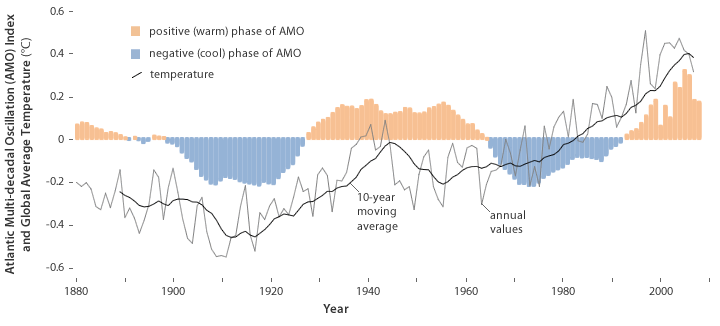
We had a +ve PDO regime …
http://2.bp.blogspot.com/-Fkg790Q3b8o/VMRGN17t2oI/AAAAAAAAHwo/GTCVnmku248/s1600/GISTempPDO.gif
We had a warm AMO….
We did not have any strength in GHG forcing until around 1970, when it broke free of the -ve forcing caused by aerosols….
http://eesc.columbia.edu/courses/ees/slides/climate/hansen/figure11.gif
In short, the warming since around 1970 has been overwhelmingly Anthro.
Prior not.
The 1920-1940 warming cannot be equated with present in terms of causality.
No, it’s not.
In short, the warming since around 1970 has been overwhelmingly Anthro.
Prior not.
An absolute wrong statement.
All of the warming from 1970 -98 is due to natural variations which were influenced by strong solar activity overall during this time period. This started to change in 2005 when solar entered a period of weak activity which is going to be showing up now and this will then clarify that all of the warming up to the end of the last century as natural.
“In short, the warming since around 1970 has been overwhelmingly Anthro.”
Rubbish.
“In short, the warming since around 1970 has been overwhelmingly Anthro.”
Absoutely correct.
But not because of the accumulation of greenhouise gasses.
Since 1970, SO2 emissions into the troposphere have been reduced by more than 30 Megatonnes. The resultant cleaner air will naturally cause temperatures to rise (just as the cooling from large a volcanic eruption ends when its aerosols settle out of the atmosphere).
““In short, the warming since around 1970 has been overwhelmingly Anthro.”
“No it’s not”
“Rubbish.”
If yoy say so Micro/Cat.
No, actually measurements prove it. You do remember science involves looking at measurements and then making sense out of them, right? Measurements Trumps models, measurements trump theory.
Measurements that prove you are wrong, that all you warmists are wrong.
But I don’t expect you to understand this, it’s complicated, and maybe you’re just not knowledgeable enough on active systems.
Toneb December 8, 2016 at 2:14 pm
Interesting.
THAT is supposed to prove that “In short, the warming since around 1970 has been overwhelmingly Anthro.” ?
This only prove that you pretend Nature is made of only two phenomenons, PDO and AMO, than you use a false dichotomy (“since this is not AMO+PDO, then the only possibility left is man-made GHG”). then you add a graph that beg the question from a notorious activist more than scientist (Hansen), and, voilà. You pretend to have proven the thing.
The very fact that you have to rely on so weak rhetorical tricks to make your point, proves you wrong.
TH, I ‘stand on the shoulders of giants.’ It was Richard Lindzen of MIT that first made this observational argument. All I did was verify it statistically, then cite it in the SPM to AR4. I did have the honor of visiting him in his MIT office weeks before his retirement, to receive his personal critique of the climate chapter of The Arts of Truth. To my amazement, he critiqued the entire book, not just the limate chapter. His critique was deservedly severe. The Svalbard footnote to Wegener’s Continental Drift example is just one of the direct results of his gracious and very biting inputs. For the record, I bought him our lunch at the MIT faculty cafeteria. A great honor.
Interesting! Freely given scientific insight! Not minor league tree ring intuitions from a single rock in the East Atlantic. squirrelled away from view and comparative analysis. Come to think of it I don’t recall Einstein keeping his findings to himself either. I guess not all scientists are alike.
I believe that Mankind’s burnng up the Earth’s finite resources of fossil fuels as quickly as possible is not such a good idea and I would like to use AGW as another reason to conserve but the AGW conjecture is just too full of holes to defend. From the data I have seen we are in an interglacial period that is gradually ending but the descent into the next ice age may be many thousands of years off. So far the current intergalcail period has not been as warm as the previous one which exhibited more ice cap melting and higher sea levels yet CO2 levels were lower than today. In the current intergalcail period we are still warming up from the Little Ice Age much as we warmed up from the Dark Ages Cooling Period. On a shorter time scale we have come to the end of of the late 20th century warming cycle and will most likely enter a cooling cycle like which occoured during the middle of the 20th century. On an even shorter time scale we are feeling the effect of ocean caused weather cycles and beyond that it is all random variations most likey caused by weather.. There is correlation with natrual phenomena but not Man’s adding CO2 to the atmosphere. From the work that has been done with modeling, our current climate change is caused by the sun and the oceans. There is no real evidence that CO2 has any effect on climate. There is no such evidence in the paleoclimate record and plenty of scientific rational to support the idea that the climate sensivity of CO2 is areally zero.
Man’s adding of CO2 to the atmosphere because of the burning of fossil fuels in unpresidented and if more CO2 really caused global warming then according to Ithe IPCC’ plethora of models it should be significantly warmer then it actually is. The IPCC model’s inability to predict today’s global temperatures in an indicator that there is something wrong with the AGW conjecture. I believe that CO2 caused global warming is harded coded into the simulations but not the real nature of climate change.
A most important task for the IPCC is to make a very accurate determination as to the climate sensivity of CO2. In their first report the IPCC published a wide range of what they considered possible values for the climate sensivity of CO2. In their last report they published the exact same range for their guess as to what the climate sensivity of CO2 really is. So after more than two decades of study the IPCC has found nothing that would allow them to narrow their range of guesses one iota. If the IPCC found any real evidence that CO2 affected climate then they should have been able to make a more accurate estimate as the the climate sensivity of CO2 but such has not happened. I can only conlcude that the IPCC has found no real evidence that CO2 affects climate.
The AGW conjecture claims that the reason the Earth’s surface is on average 33 degrees C warmer than it would otherwise be without the atmosphere is because of the heat trapping action of gasses with LWIR absorption bands, But these gasses do not really trap heat because of their LWIR absorption bands becaue good absorbers are also good radiators. In the troposphere, in terms of heat energy transport, conduction, convection, and phase change transport dominate over LWIR absorption band radiation so any radiation effect CO2 might have must be rather trivial. From first principals one can derive that the Earth’s surface is 33 degrees C warmer because of the heat capacity of the armosphere and the pressure gradient and has nothing what so ever to do with the LWIR absorption properties of trace gasses. It is gravity that limits cooling by convection that provides a convective greenhouse effect that acocunts for all 33 degrees C. There is no evidence of an additional greenhosue effect caused by so called greenhouse gasses. Without the radiant greenhouse effect, the AGW conjecture falls apart. Actually the better heat trapping gasses would be those without LWIR radiation bands because they take on heat related energy via conduction, convection, and phase change but they are relatively inefficient in radiating out any energy in the LWIR.
It has been shown that the initial calcualtions of the climate sensivity of CO2 are too great by more that a factor of 20 because waht was neglected in the colculations is that a doubling of CO2 will slightly lower the dry lapse rate in the troposphere which is a cooling effect which would counteract most ot the radiamatric effect that CO2 might have. That is typical of the AGW conjecture, it is based on only partial science. If CO2 really affected climate then one would expect that the increase in CO2 over the past 30 years would have caused at least a measureable increase in the dry lapse rate but such has not happened.
Another issure is H2O climate realated feedback to changes in CO2. The AGW conjectuer recognizes that H2O is the primary greenhouse gas and takes note that warmer temperatures will cause more H2O to enter the atmosphere which should cause more warming because H2O is a greenhouse gas with LWIR absorption bands. But what the AGW conjecture neglects is that fact that H2O is a major coolant in the Earth’ atmosphere moving heat energy from the Earth’s surfact to where clouds form via the heat of vaporization, Acocrding to energy balance models, H2O moves more heat energy then by both convection and LWIR absorption combined. Then there is the issue of clouds. The cooling effect of H2O is further evidenced by the fact that the wet lapse rate is significantly less than the dry lapse rate which indicates that H2O must have a cooling effect.
@ur momisugly Walter Sobchak
December 8, 2016 at 11:51 am: Indeed he has and he is, Walter. Unlike the flower children and their suppliers.
Tyndall actually showed experimentally the wrongness of CAGW, beforehand, when he made sure his IR receiver was cooled in his superb practical demonstrations. Prof Woods and Konrad Hartmann are among those who did the job too, in other ways.
JC Maxwell and others realised that the Poisson relationship on the Gas Laws, as well as the nature of equipartitional competition for atmospheric energy transfer, means the density-choke on radiation is bypassed. That is why NASA etc, data over the solar system prove the effect is gravito-thermal, not ‘greenhouse’. And Standard Atmospheres have no need to bother with CO2 for reasons such as these. Planes cannot rely on belief systems either…..
ristvan at 12:10 pm
Regarding your first paragraph, your detailing of this is correct and kindly appreciated.
Regarding your last paragraph, this claims that “Keenan’s series are not autocorrelated”; in fact, the series are strongly autocorrelated. (Three submodels were used to generate the series: ARIMA(3,1,2), fractional Brownian motion, a nonlinear variant of ARMA(0,2).)
logicalchemist at 1:16 pm
Definitely.
Regarding statistical models generally, such models are always used when drawing inferences in statistics. For example, when the IPCC inferred, via statistics, that temperatures are increasing more than could be reasonably attributed to random natural variation, that required a model. The IPCC acknowledges this in its most-recent Assessment Report. For a detailed discussion of all that, see my critique of the IPCC Report. For something brief and very general, see the Wikipedia article “Statistical assumption“.
Well, you should have said so in your challenge. I really dislike defending the indefensible. Your website challenge NEVER said it used three different ARiMA models to generate the 1000 series. That is, on your part, confounding the terms of your language challenge. Makes your bet statistically infeasible, period. Cheat. Worse, your challenge was not what you yourself represented. Worse than just bad form. Very glad yourn WUWT comment highlighted. Less glad I got dupped into taking up your kudgles. Very glad you came clean and I can now rescind. Oh my, dupped again despite all my cautions.
Thanks for your technical reply. I repeal everything previously said in your stats favor. Cheating in my book is not allowed. To all denizens, sorry I previously defended the now indefensible of using three different random number permutations in what was explicitly (I thought had checked) represented as one set of PRND series. So the challenge was impossible from the beginning. BS was right for the wrong reasons.
Strange, someone creates a random dataset time 1000 then insert a random number of FIXED 1 degree per century trend and asks people to state 90 percent of the dataset, random or random plus trend.
You now say you need the randomness to be created in a certain way! Why?
The competition was to find someone who could detect a trend within random data, are you now saying only certain subsets of random data are allowed?
Are you suggesting that if the data had been less random, more people would have have a better chance of finding the trending records? Of course you are.
Do we ask the global temperature record to be of a certain subset of randomness?
Global temperature datasets are what they are, maybe edited beyond fixing but thats what we got.
The competition was to find someone who could ‘see’ into apparent random datasets, from unknown origin and declare a trend. Even when the trend has been communicated to you in advance.
It is now clearly apparent that it is not possible to determine a defined trend in random data.
To say you have been given the wrong type of random data is sour grapes.
I now understand more clearly why Keenan updated his test data when he found that his chosen method of randomness was not random enough.
To sit there and push the dataset though all of the available statistical functions within R does not deserve winning any prize at all in my view.
If you can find a fixed 1 degree trend inserted into truly random data, I and the rest of the world will be impressed.
Nick Stokes December 8, 2016 at 3:39 pm
Thanks, Nick. I was kinda moving slow, reading this’n’that, looking out at the rain, and a good belly laugh was exactly what I needed to jump-start my higher unconsciousness … well done. Changed the arc of my day.
w.
There have been several comments about the series of numbers used in the challenge not being representative, etc. I recall the climate guy Lew (avoiding moderation there hopefully—I do know his full name) gave a bunch of economists a test using temperature data and “The experts were told that the data referred to agricultural output and were asked questions about whether the agricultural output had “stopped”.” The economists rejected the “pause” theory and that proves the pause is not real. Seems to me if Lew can go that far afield in determining whether statistical analyses are “real” or not, there should have been no problem with the methods Keenan used.
Would have be interesting to have ask pollution experts, after presenting them the data as a city pollution monitoring.
I guess they would have stated that pollution output had “stopped”.
Why the difference ?
Agricultural experts know of underlining mechanisms, that keep pushing output up ; the data do not invalidate their view, so they keep it. Up it keeps going, despite of natural variations.
Pollution experts on the other hand would certainly view the data as a hint than some curbing pollution steps had been done, with some efficiency.
Global warming fails the random natural variation contest
It failed “a” random natural variation contest. I didn’t think it was possible, on the information given, to be 90% correct in 1000 decisions. It was a seat of the pants guess based on experience in ROC analysis in signal detection and medical diagnosis As to possible global warming, I don’t think it is possible on present evidence to estimate the hypothesized (and I think likely) real CO2 effect The data are so well known (despite the history of adjustments), and the underlying processes so inaccurately estimated, that you can easily (and will be able to for a long time), generate sample paths from a random process against which any reasonable CO2 signal can’t be reliably determined.
I have often written that if you know the signal you can estimate the noise, and if you know the noise you can estimate the signal; when when you know neither you are stuck in a swamp of competing models that all fit equally well, and with inadequate information to know which pair of noise/signal models is most accurate for the future.
I think you have shown pretty well what I only guessed at.
If the “noise” or CO2-independent process really has a period of about 950 years, then on present evidence the CO2 signal might be close to 0.
+1
Brilliant
Global warming fails the random natural variation contest
“Our motto is, we take you everywhere, but we get you nowhere”.
— A Chorus Line.
This whole thing looks a bit silly to me (but it’s generated a lot of comments).
Warmists say that post-1970 warming is due to human CO2 emissions.
Sceptics/skeptics (mostly) say that periods of warming and cooling in the post-1880 instrumental record are mostly due to natural cyclic variation, possibly with a modest contribution from CO2 post-1970.
Along comes wonder-boy and says – it’s only random variation.
Well, if you look at paleothermometry, of which there’s a shed-load been generated in the last few decades, the cycles are obvious and randomness hasn’t a hope of explaining anything.
In the 135 years of data that Mr. Keenan agonizes over, you can see a ±60-year cycle emerging that (quite probably) correlates with and could be caused by the AMO. Once you start looking at the bigger picture, the ±1,000-year cycle is obvious, and then there’s the glacial-interglacial “cycles”, each of which may actually comprise 2 or 3 of the 41,000-year Milankovich cycles.
Sorry Mr. K, the only randomness is the spiky data over time frames of 1 or 2 years.
Reading the comments has been fun though – warmists and sceptics making the same points. Never thought I’d see that!!!
All random sets show some … random cycles. Without any thing cycling to run the system.
You have to pinpoint a precise process to be sure this is not random.
We know for sure that weather has daily and yearly cycle because we know why, that’s because of variation in exposure to the sun.
We cannot be sure that there any ±60-year ±1,000-year or ±41000-year climate cycles just because we “saw” them in quite short data (and only two run is quite short, they could be only group wave interference), we have to assign them a proper mechanism that explain their influence.
AMO ? remember that the “O” stand for “oscillation”, which is NOT synonymous of “cycle”. Their are oscillations everywhere, dry – rainy, cold – hot, but much of them are still randomly timed, you know that rain will come some day after dry , but you cannot know if this will be in a day or a week.
So now we have some warming with no proven cause. The anti-CO2 crowd posits a cause and says the cause is proven because the temperature has risen. Then they say the temperature must rise because the cause is proven! Any reasonable look at the historical record shows this circular argument is simplistic to the point of being obtuse. It is religion and politics. The science is struggling to breathe!
It seems CO2 is the focus without much evidence that concentration levels have statistical defined effect on global warming. But we need a villain! The computer models have been useless. I have not been impressed with how much influence 0.4% (CO2) of the atmosphere has on temperature. Perhaps low volcanic activity is a factor. I am convinced that something else is affecting climate much more than poor little CO2!
“I am convinced that something else is affecting the climate much more than poor little CO2”
Your intuition is correct.
The control knob fork climate change is simply the amount of .of sulfur dioxide aerosol emissions in the troposphere.
Google: “It’s SO2, not CO2”
400 ppm equals .04%.
Lots of things that look random are merely very complex. But if you manage to figure out the underlying mechanism you can make predictions, within limits.
I just didn’t understand what Doug J. Keenan intended to prove.
Of course his challenge was impossible … so what ?
Everybody knows (or should) that a trendy data-set do not prove that a dice is crooked, or that a non trendy data-set do not prove the dice to be honest. It just gives you a clue, a hint.
You have to look at the dice, not his output.
But, still, the data is a hint. Climate dice “Could” be fair. But it is fair to suspect it may be not, and to wonder what’s load it (if something).
Aphan, December 8 at 2:43 pm
Exactly.
MikeN, December 8 at 3:23 pm and at 3:42 pm
If Shollenberger claims that he could have won the Contest with the weak PRNG, then why does he not back that up with specifics? In particular, what method could he have used to win? I do not know of any method to win (other than cracking the encryption). Shollenberger cannot present any method, because there is no method. His false claim is another example of him spreading disinformation.
Reality check, December 8 at 4:02 pm
There was no objective measure of whether those economists were right. Rather, the economists were using their subjective judgment. Some econometricians did enter the Contest: none of them did better than chance. Thus, the claim that econometricians can determine whether a line is random/trending is counter-evidenced, by the Contest. Interestingly, though, it appears that the econometricians themselves believed that they could make such a determination: else they would not have entered the Contest. In other words, the econometricians appear to be honest, and are making an honest error.
Smart Rock, December 8 at 7:41 pm
This comment claims that “the cycles are obvious and randomness hasn’t a hope of explaining anything”. The claim is false: illusory cycles commonly appear in autocorrelated time series. This is an important topic that is taught in courses on time series. Illustrating this is one of the purposes of the Contest. As a physical example, consider the Pacific Decadal Oscillation, which many geoscientists claimed had an “obvious” cycle: Roe [Annu.Rev.EarthPlanet.Sci, 2009] discusses the PDO, fits a simple time-series model to the data, and notes “By these statistical measures, the PDO should be characterized neither as decadal nor as an oscillation”. Simply put, the PDO is essentially a random, autocorrelated, series.
Ristvan, December 8 at 7:55 pm
First, before you publically accuse someone of dishonor, you should be sure of your facts. You have not done so.
Second, the 1000 generated series were time series, and the defining characteristic of time series is autocorrelation. Thus, any reasonable person familiar with time series would realize that the series were autocorrelated: as indeed most people did. Moreover, if there were no autocorrelation in the 1000 series, then the Contest would be obviously unwinnable. Additionally, the Contest web page states that the Contest model has greater likelihood than the IPCC model, which is autocorrelated.
Regarding the accuracy/quality of the global temperature record, I certainly agree that the record is severely problematic. The Contest demonstrates that even if the record were good, though, proper statistical analysis would still conclude that a plausible explanation for the increase in temperatures is random natural variation.
No, it really wouldn’t. It mostly illustrates that you have set up a contest to demonstrate something concerning a topic about which you know very little (of course, I’m discounting – at the moment – that you do know something, but are doing this to intentionally mislead). A statistical test alone cannot tell you that the increase in temperatures is random natural variation, even if you do find a random walk that happens to match the observations. Determining the cause of the warming requires models that take the underlying physics into account and they largely rule out that this can simply be due to random natural variation.
Bs, you should understand this graph of measurements, and you should know that it means co2 doesn’t not control cooling at all.
While autocorrelation, per se, need not imply any true oscillations, it’s
the behavior of the acf that is indicative. If, in the stationary case,
the acf declines monotonically (aside from sampling uncertainty), then
there are various noise processes (white, pink, red) with monotononically
decaying power densities that may be responsible for the data variations.
If, on the other hand, there are significant oscillations in the acf, then
we have spectral peaks and the presence of true, albeit random, oscillations of limited
predictability.
Compared to Keenan’s purely theoretical approach to the question of
detecting secular trends in ARIMA-modeled time series, the physical problem
is even more challenging. As shown in the link below, the power density of
del-18O isotope variation from the GISP2 ice-core shows several significant
spectral peaks of various bandwidths emerging from a background of red
noise:
http://i1188.photobucket.com/albums/z410/skygram/graph1.jpg
“I just didn’t understand what Doug J. Keenan intended to prove.” The contest stated the terms this way: “First, 1000 random series were obtained (for more details, see below). Then, some of those series were randomly selected and had a trend added to them. Each added trend was either 1°C/century or −1°C/century. For comparison, a trend of 1°C/century is greater than the trend that is claimed for global temperatures.
A prize of $100 000 (one hundred thousand U.S. dollars) will be awarded to the first person who submits an entry that correctly identifies at least 900 series: which series were generated without a trend and which were generated with a trend.”
So basically it was a test of statistical skill at determining which elements in those series had a trend superimposed and which were just random walks. His assertion seems to be that no one who claims to see this sort of trend in global average temps actually has the skill to separate random from known trending series. Whether this experimental design actually proved that is another question [above my skill set to assess, mainly because I’m not quite sure how the criteria for ‘success’ of 900 out of 1000 right was determined, probably some sort of sigma calculation(*)], but I think that was the goal of the contest.
(*) Keenan had this comment in his remarks; “That is, the analysis effectively shows what can be done by a person who has studied some statistics, but who has no training in time series. The analysis concludes that such a person should expect to correctly identify 854 ± 10 of the 1000 series. (Note that identifying 900 series is required to win the Contest.)”
I’m just uncertain about how the 900 threshold calculation was done. Also I haven’t been able to determine how many of the 1000 elements of the series were just random vs how many had a rising or falling trend superimposed. I only heard about this yesterday so the fault there is probably mine.
Ian W December 8, 2016 at 3:26 pm asks:
“So – show the scientific empirical evidence of CO2 raising atmospheric heat content…”
I have long been concerned about this issue, as mere temperature does not tell the whole story. Surely humidity measurements are part of the meteorological record, and could be brought into play to answer Ian W’s question. And given that kinetic energy is a function of windspeed, and barometric pressure is a measure of potential energy, surely all these measurements could be harnessed to show whether or not the energy content of the atmosphere has actually changed?
I have averages and daily differences, enthalpy dry, and a separate just water, clear sky calculated solar both perpendicular to the sun, and flat on earth for each station with data, oh, and averages based on doing the averaging while the temp is expressed as a radiant flux, and after converted back to a temp.
For the various large areas on the planet, stations with =>360 daily samples per year, and 365 samples per year. It’s in these two zip files. All csv files.
https://sourceforge.net/projects/gsod-rpts/files/Reports/Ver%203%20beta/
Nick Stokes December 9, 2016 at 2:43 pm
More of your lawyerlike obfuscation. The issue is not whether there were or weren’t “internet archives” in 1995, that’s just your red herring.
The issue is that Lonnie and his wife REFUSED TO SHOW THEIR TAXPAYER-FUNDED DATA TO ANYONE BUT THEIR FRIENDS until the chorus of objections got too loud … and even then they did the minimum. Your claim is that they posted “a stack of contributions” after being hounded for for years to do it, which is true … but I note that always the lawyer, you didn’t claim that they archived everything … cute. Real cute.
Nice try, Nick, but pretending that the Mosely-Thompsons are honest scientists just makes people point at you and laugh. You are tarring yourself with their brush … seems foolish to me, defending unethical scientists, but hey, it’s your choice …
w.
Willis,
“The issue is that Lonnie and his wife”
The issue, as so often, is that people here resist getting simple facts right. It is just not true that “The Thompsons don’t archive their data”. Lonnie Thompson is (or was in 2013) by far the largest contributor to the archive.
You have a whole lot of gripes about data access in the past. None of that makes it true that “The Thompsons don’t archive their data”.
S’well – and even me able understanding!
Thanks – Hans
Forgot the citation
”
When doing statistical analysis, the first step is to choose a model of the process that generated the data. The IPCC did indeed choose a model. I have only claimed that the model used in the Contest is more realistic than the model chosen by the IPCC. Thus, if the Contest model is unrealistic (as it is), then the IPCC model is even more unrealistic. Hence, the IPCC model should not be used. Ergo, the statistical analyses in the IPCC Assessment Report are untenable, as the critique argues.”
Thanks v’
Someone help me out here. Is there any way a retired lawyer with no training in statistics can make any sense out of this post? Other than taking a course in statistics of course.
I have much interest in the agw debate but get lost in the technical threads.
The subject here is very important – is there a global warming signal in the various temperature series. Who does one believe if one lacks the tools to form one’s own opinion?
Both sides are passionately argued, and at the end, there’s no common ground. Or have I missed it?
Sorry, I’ve tried a couple of times to leave a summary here, but it keeps disappearing down the bit-bucket.
scraft1,
This entire thread is about a contest designed for one purpose only….to silence people who claim that according to statistical analysis, there is no way that the warming occurring since 1950 (I think that’s the date the contest centered in…not sure….but insert whatever date it was based on) could be JUST natural variation. That according to statistical analysis, it HAD to be something OTHER than natural….ie…human caused. (Of course this means one has to assume that scientists have figured out absolutely everything there is to know about this planet and it’s climate, quantified every single one of those things to a precise and easily acknowledged degree of accuracy, and eliminated every single one of those factors EXCEPT human influence. Which has not happened.)
Nothing more, nothing less. It wasn’t based on physics, or experiments or evidence or anything else people are trying to insert into it. The contest was solely about statistical analysis of the data.
And, Keenan designed a test that showed, that even the most sophisticated, expert analyst could NOT determine exactly that using statistical analysis. It’s not possible. Not with the data we currently have. He proved that people who say such things are idiots/liars/uninformed.
Now, is there a global warming signature in the various temperature series? That is a whole different argument/topic. And I’ll leave that for those who want to discuss that with you. But here’s the point….again….if there IS a signal in the temperature series….we have ZERO way to determine WHAT is causing that signal. Could be CO2. Could be the Sun. Could be vulcanism. Could be bad data. Could be bad equipment. Could be manipulation. Could be the Sun and volcanoes AND plate shifting AND bad data AND…….or…if correlation is causation (to some nutjobs) then it could very well be the amount of polyester that has been produced since 1950!!
” The contest was solely about statistical analysis of the data. “
It wasn’t about analysis of the data. No climate data was in the contest. Doug made up some synthetic datasets using models of his own, which had a natural tendency to generate trends (but could not possibly have generated the real data, being unphysical). Then he invited people to discriminate the components of trend which belonged to the models he made up, and which to an artificial addition that he made. A mug’s game, and nothing whatever to do with climate.
Can someone find a source for this
i.e., who is claiming, using statistical analysis, that there is no way that the warming since 1950 could be just natural variation?
I think it is a garbled version of something from D3 of the AR5 SPM:
“It is extremely likely that more than half of the observed increase in global average surface temperature from 1951 to 2010 was caused by the anthropogenic increase in greenhouse gas concentrations and other anthropogenic forcings together. The best estimate of the human-induced contribution to warming is similar to the observed warming over this period. {10.3”
You could interpret that to mean no way the warming was natural. But it isn’t based on statistical analysis.
Nick, there are a set of cover-your-ass statements in the IPCC documents, concerning possible chaotic climate and natural effects, which the IPCC ignores in practice. It is anthropogenic all the way down in their policy prescriptions, which is what you are trying to deflect.
Nick,
Thanks, I assumed it was based some what on the recent attribution statement.
Exactly.