From NASA/GODDARD SPACE FLIGHT CENTER and the ” sporadic and incomplete measurements, so let’s use an estimate” department.
See How Arctic Sea Ice Is Losing Its Bulwark Against Warming Summers
Arctic sea ice, the vast sheath of frozen seawater floating on the Arctic Ocean and its neighboring seas, has been hit with a double whammy over the past decades: as its extent shrunk, the oldest and thickest ice has either thinned or melted away, leaving the sea ice cap more vulnerable to the warming ocean and atmosphere.
“What we’ve seen over the years is that the older ice is disappearing,” said Walt Meier, a sea ice researcher at NASA’s Goddard Space Flight Center in Greenbelt, Maryland. “This older, thicker ice is like the bulwark of sea ice: a warm summer will melt all the young, thin ice away but it can’t completely get rid of the older ice. But this older ice is becoming weaker because there’s less of it and the remaining old ice is more broken up and thinner, so that bulwark is not as good as it used to be.”
Direct measurements of sea ice thickness are sporadic and incomplete across the Arctic, so scientists have developed estimates of sea ice age and tracked their evolution from 1984 to the present. Now, a new NASA visualization of the age of Arctic sea ice shows how sea ice has been growing and shrinking, spinning, melting in place and drifting out of the Arctic for the past three decades.
“Ice age is a good analog for ice thickness because basically, as ice gets older it gets thicker,” Meier said. “This is due to the ice generally growing more in the winter than it melts in the summer.”
In the early 2000s, scientists at the University of Colorado developed a way to monitor Arctic sea ice movement and the evolution of its age by using data from a variety of sources, but primarily satellite passive microwave instruments. These instruments gauge brightness temperature: a measure of the microwave energy emitted by sea ice that is influenced by the ice’s temperature, salinity, surface texture and the layer of snow on top of the sea ice. Each floe of sea ice has a characteristic brightness temperature, so the researchers developed an approach that would identify and track ice floes in successive passive microwave images as they moved across the Arctic. The system also uses information from drifting buoys as well as weather data.
“It’s like bookkeeping; we’re keeping track of sea ice as it moves around, up until it melts in place or leaves the Arctic,” said Meier, who is a collaborator of the group at the University of Colorado and the National Snow and Ice Data Center in Boulder, Colorado, the center that currently maintains the Arctic sea ice age data.
Ice in motion
Every year, sea ice forms in the winter and melts in the summer. The sea ice that survives the melt season thickens with each passing year: newly formed ice grows to about 3 to 7 feet of thickness during its first year, while multi-year ice (sea ice that has survived several melt seasons) is about 10 to 13 feet thick. The older and thicker ice is more resistant to melt and less likely to get pushed around by winds or broken up by waves or storms.
The motion of sea ice is not limited to its seasonal expansion and shrinkage: Except for coastal regions where sea ice is attached to the shore, the sea ice cap is in almost constant movement. The primary driver of sea ice movement in the Arctic is wind and there are two major features in the Arctic circulation: the Beaufort Gyre, a clockwise ice circulation that makes ice spin like a wheel in the Beaufort Sea, north of Alaska, and the Transpolar Drift Stream, which transports ice from Siberia’s coast toward the Fram Strait east of Greenland, where the ice exits the Arctic basin and melts in the warmer waters of the Atlantic Ocean.
“On a week-to-week basis, there are weather systems that come through, so the ice isn’t moving at a constant rate: sometimes the Beaufort Gyre reverses or breaks down for a couple weeks or so, the Transpolar Drift Stream shifts in its direction … but the overall pattern is this one,” Meier said. “Then the spring melt starts and the ice shrinks back, disappearing from the peripheral seas.”
The new animation shows two main bursts of thick ice loss: the first one, starting in 1989 and lasting a few years, was due to a switch in the Arctic Oscillation, an atmospheric circulation pattern, which shrunk the Beaufort Gyre and enhanced the Transpolar Drift Stream, flushing more sea ice than usual out of the Arctic. The second peak in ice loss started in the mid-2000s.
“Unlike in the 1980s, it’s not so much as ice being flushed out -though that’s still going on too,” Meier said. “What’s happening now more is that the old ice is melting within the Arctic Ocean during the summertime. One of the reasons is that the multiyear ice used to be a pretty consolidated ice pack and now we’re seeing relatively smaller chunks of old ice interspersed with younger ice. These isolated floes of thicker ice are much easier to melt.”
“We’ve lost most of the older ice: In the 1980s, multiyear ice made up 20 percent of the sea ice cover. Now it’s only about 3 percent,” Meier said. “The older ice was like the insurance policy of the Arctic sea ice pack: as we lose it, the likelihood for a largely ice-free summer in the Arctic increases.”
###
Just like Walt Meier, I much prefer old ice with my whisky. It has a far more wholesome taste. I have been toying with the idea of getting a research grant to determine why the old ice has a more wholesome taste than new ice.
That’s fair dinkum.
Along with some Japanese tourists, I once savored 40,000 year old ice in my whisky. I tried to be objective, but obviously that’s impossible.
Old air released from pockets in the ice, redolent of decaying mammoth flesh seemed to me to have a je ne sais quoi fragrance which enhanced the experience and released the chemicals in the scotch.
http://sites.uci.edu/zlabe/files/2016/10/sit_PIOMAS_mask.gif
UC Irvine – Earth System Science Ph.D. Student
Cornell University – Atmospheric Sciences B.Sc.
Twitter: @ZLabe
Website: http://sites.uci.edu/zlabe/
Yes, we know that 1979 was an EXTREME, up there with the LIA
Pity this little phttt student didn’t do more research about Arctic sea ice levels prior to the LIA, especially prior to the Neoglaciation period. But not paid to do that, is he/she!
Imagine the MASSIVE benefits to having open Arctic sea lane for at least some part of the year !!!
True. The year 1979 was at or near the Arctic sea ice high for the previous century. IPCC doesn’t show the satellite data from the 1960s and ’70s obtained from unspecialized imagery. Not to mention sea ice maps from earlier in the 20th century.
Icelandic Sea ice index tells a story.
oopsie…. forgot the pic…. nice Semillon, bottle all gone (with some very nice Tassie salmon etc )
Oh yeah, real turning point at 1979. Damn cherry pickers.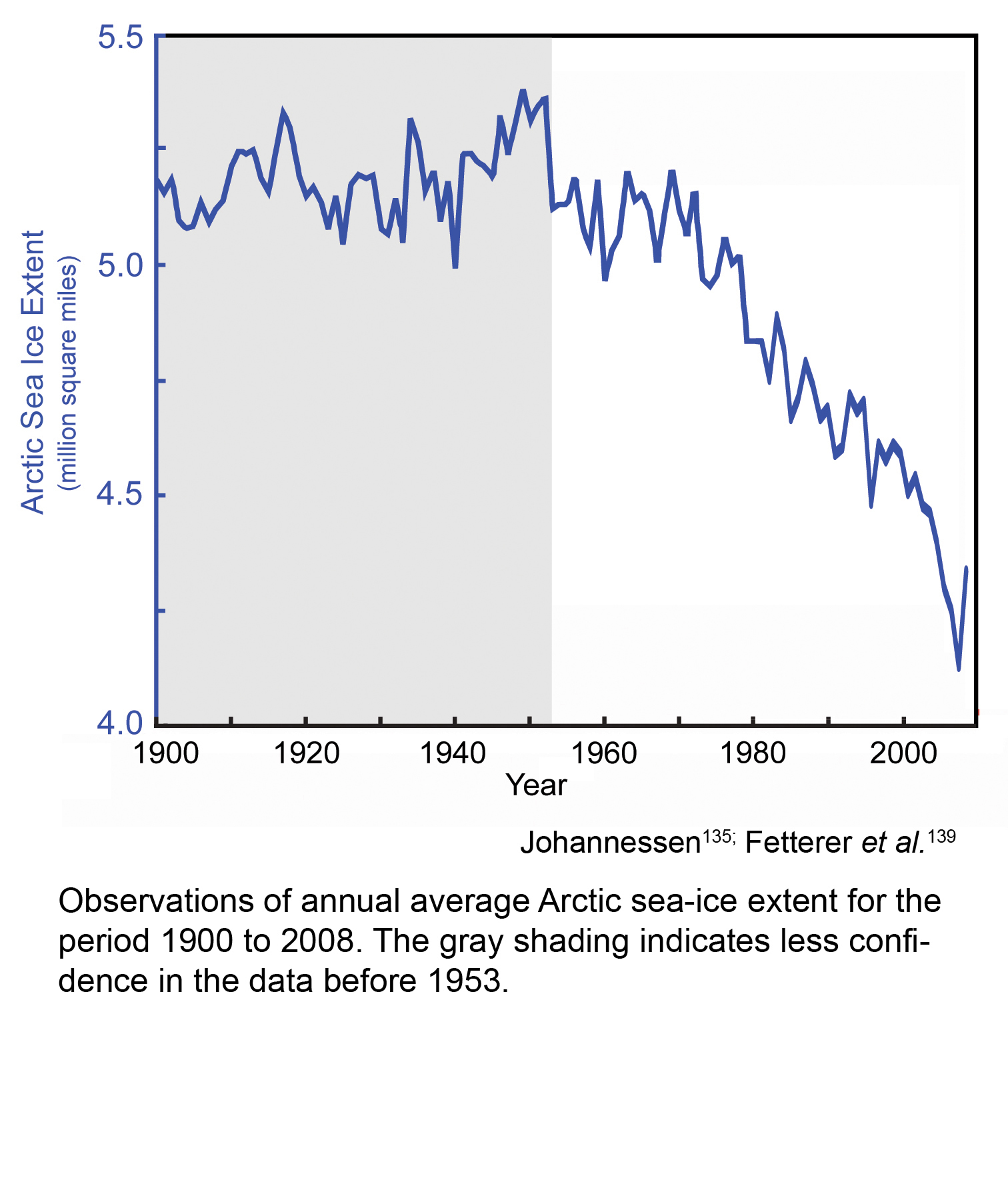
Previous to 1970’s is a load of BULWARKS. A modelled fabrication.
Look at the actual data from Iceland, and forget the Bulwarks from whoever was paid to FABRICATED that graph.
Fetterer, is at NSIDC with Serreze.. climate troughers unanimous !!
No paid bias there… none whatsoever. !!
The very fact that they say “observations” of annual average sea ice from 1900 – blah blah….
immediately tells you it is a LOAD OF HOGWASH. !
Observations DON’T EXIST !!
And where they do, as in the Icelandic sea ice index, they counter the fabrication you have posted.
Global temperatures were warmer in the 1940’s and 1950’s than the 1970’s. The station instruments covering the Arctic also showed this, so how do warmer temperatures cause more sea ice? Blatantly obvious that the Arctic sea ice graph pre 1970’s is a load nonsense and not actually from observations.
thanks tony , looks pretty bad huh? So what is it showing?
A beautiful example of how “earth science” PhDs can be so deliberately misleading in the way they present data.
First note that this is model output NOT data. He picks out the month of August so as to get the most dramatic changes but it still looks pretty bad. It looks like the Arctic “nearly ice free” by 2016 doesn’t it? Why won’t all the deniers accept the reality of what is happening?
Now look at the colour scale. Black has been chose represent 1.5m or less of ice cover. It’s the same as open water!
Why? Doesn’t ice of 1.5m “count”?
Someone from the National Hurricane Centre was recently deploring the lack of trust people have in scientists. This kind of thing is the reason why. Graphic effects being use to mislead the viewer. You need certain amount of scientific training and a familarity with graphs and data to spot the “tricks” being employed to fool the layman.
Frankly : a load of bulwarks
Nice BS graphic. Anything less then 1.5m of ice gets coloured black like it has disappeared. Odd that.
Good enough for seals to haul out on; good enough polar bears to hunt baby seals on; good enough Inuits to drive their show mobiles on and cut holes to go fishing …
Apparently not regarded as significant for “PhD student” ZLabe.
science by Tweet is NOT science, it’s political activism.
Are you blind?
Are you drunk ?
It is a shocking sea ice volume graph excluding 1.5m or less volume ice. Everything expected in a person supporting propaganda not science.
Shall I bother to include a global temperature graph missing any warming by 1 c to make it as equally awful as this one?
No, I won’t because it would be a waist of time.
You guys will absolutely love this one. BTW, ’15 is low and ’16 is falling of the cliff.
Walt Meier announces, publishes or releases his claim that older thicker ice is declining; without actually posting any factual information.
Dr. Meier continues on mixing in just enough reality to make his overall claim plausible.
Only that animation at the end, is exactly what it is titled. An animation, powered by some model.
If that is the reason so many polar adventurers are trying to measure ice thickness in the Arctic?
For what purpose is Dr. Meier out showing models while making more claims about polar ice loss? If Meier is half the polar ice scientist he believes himself to be, he should be studying why the polar region ice cycles are in opposition. Just as they are on many other of our Solar System’s planets.
This kind of nonsense, coming from Dr. Meier gives one pause; enough loss of reality in Dr. Meier’s presentations, causes readers and followers of Arctic/Antarctic science to be concerned about Walt’s ability to accept scientific reality.
The supposed loss of albedo due to summer sea-ice decrease has been at least partly compensated by the increase in cloud albedo due to evaporation:
http://www.pmel.noaa.gov/arctic-zone/detect/detection-images/climate-cloud-mamseries.jpg
Any loss of albedo from Arctic sea ice has been compensated for many times over by increase of Antarctic sea ice at lower latitudes.
The gain in Antarctic sea ice is about five times as albedo positive as any presumed loss in Arctic sea ice, not only from extent but because of the angle of the sun at the lower latitudes to which Antarctic sea ice reaches.
Interesting , now how about some more resent data? There have been some significant changes in the Arctic since the first OMG minimum event in 2007.
Greg:
Exactly the type of data Dr. Meiers should be pondering.
Nice Graph!
I saved a link to it.
It also makes me worry just a tad about pushing the plant hardiness zone where I live.
The muscadine grapes may still survive a number of winters.
The date palms and orange trees will have to wait. 🙁
Greg
So what is the graph telling you ???
Why does the Arctic sea ice minimum move towards the end of September as it does on occasion. ???
Bulwark. LOL. There are no absorbing surfaces in the area. It is the angle of the sun to the planet. That is all.
But those warming summers won’t stop Global Warming from causing colder winters.
https://thinkprogress.org/stronger-cold-spells-likely-in-north-america-as-the-polar-vortex-is-shifting-7225c56569c2#.ga661e67w
Global warming brings longer, deeper COLD spells. (and zero warming)
You KNOW it makes sense!
Joe Romm will explain it to you. 😉
sometimes it does.
Look up the effects of a blocking high in winter and the increase in blocking highs as a result of climate change
Ah yes, the ever miraculous “Global Warming”!
It will wash your dishes, but cause them to get dirtier.
It causes droughts and floods, less rain and more rain, less snow and more snow!
GW causes cold weather, warm weather, tepid weather and freezing weather!
GW causes snow in unusual places, just ignore the historical records reporting previous snow.
GW wreck marriages, causes less and more pregnancies, changes the sex drive of plants and fish.
Somewhere on yon internet, people are keeping track of every new claim for what “Global Warming” evoked by CAGW true believers seeking to gerrymander their religion to encompass all weather.
It’s very clear from your comments you are not a student of quantum mechanics. Nuff’ said.
Maybe I should have added a smiley 🙂 or /sarc on that…
Bartleby:
Are you planning on playing dice with Global Warming?
No worries here, I’m good.
Ok, predictions for next year’s Arctic minimum.
I’ll go with 2.75 million sq km. smashing the 2012 low.
Just to preempt the idiots who will try to claim I actually want to see the ice disappear because I’m a communist human-hater, just post your prediction, if you’re game.
No , you are just a moron you has never bothered to look at the real history of Arctic sea ice.
If you had you would know that during the first 3/4 or so of the current interglacial, there was often pretty much zero summer sea ice.
The current level is actually anomalously HIGH compared to the Holocene average.
That’s because we are only a tiny molehill above the COLDEST period in the last 10,000 years.
I suspect it will be much the same as this year, maybe a bit higher.
Its what happens as the cooling sun starts to take affect over the next several years that will be interesting.
I hope you have plenty of rags to wipe the egg off your face.
So you are saying about 4 million plus Andy? I hope your right, 5 would be better.
Actually, the massive economic benefits from lower summer sea ice means that LOWER numbers would be better. Unfortunately, probably not going to happen.
Take the Arctic back to the before the LIA.. finally a RECOVERY to more open Arctic waters, instead of the EXTREMES of 1979, and before that, the LIA,
Does this hurt your brain?
http://realclimatescience.com/2016/10/starting-their-graph-at-the-right-year-to-produce-maximum-fraud/
Quoting Tony Heller is not evidence…
He has a track record of being utterly wrong about sea ice, when he is not being deliberately misleading about it.
This must hurt your brain…? http://realclimatescience.com/2016/10/starting-their-graph-at-the-right-year-to-produce-maximum-fraud/
4.6 million square kilometres tony .
Thank you chilly.
So far:
bit chilly 4.6
Andy about 4.2
tony 2.75
Any other takers? Feel free to explain your reasoning.
“See How Arctic Sea Ice Is Losing Its Bulwark Against Warming Summers”
http://ocean.dmi.dk/arctic/plots/meanTarchive/meanT_2016.png
http://ocean.dmi.dk/arctic/meant80n.uk.php
WARMING SUMMERS,where are these warming summers???????????????
That was something I noticed. The summer do not seem warmer according to the observations, but the winters certainly are. That would suggest that it is not an issue of summer ice melting faster than usual, but a lower rate of re-freeze which is reducing ice volume.
As long as water is in contact with ice it will stay at the same temperature (the freezing point of the ice), that’s why you put ice in your drinks!
It’s very likely that the difference is down to warmer water underneath, so the surface above the ice or near the surface, makes little difference during summer. The key component in this the AMOC and therefore the AMO.
The atmosphere above the Arctic is very warm now and has been for the last few weeks.
Joe Bastardi at Weatherbell has been mentioning this for some time now. On his last Saturday summary he starts discussing Arctic WEATHER at about 9:18.
To get to the free content at Weatherbell click this link.
http://www.weatherbell.com/premium/#joe-bastardi
Then click the “Premium” tab at the top and the latest Daily Update and Saturday Summary videos will pop up.
Temperature at 2 meters in the northern hemisphere.
http://pamola.um.maine.edu//DailySummary/frames/GFS-025deg/ARC-LEA/T2/01.png
http://hockeyschtick.blogspot.com.au/2012/07/nasa-data-shows-arctic-was-warmer-in.html
The thickness of the sea ice.
http://ocean.dmi.dk/anim/plots/ice.arc.1.png
And let’s not forget, in 1903 , Amundsen navigated the Northwest passage.
In 1994 Larson sailed a route near Banks Island.
Neither of those routes was passable when the Northabout sped through on there powerful fossil fuel engines earlier this year .
The current Arctic sea ice level is nothing untoward whatsoever.
Much higher than before Neoglaciation. Probably quite a bit higher than during the MWP and RWP.
The best outcome for people living up there would be for further reductions in summer sea ice. The economic benefits would be massive.
Unfortunately, the NATURAL cycles have now turned, and increasing sea ice will most likely be the decadal outlook.
Amundsen did not navigate the NW Passage in 1903, it took until 1906 to complete the passage.
He was MAPPING at the time. That was his job.
I’m guessing you don’t comprehend the difference.
AndyG55 October 30, 2016 at 12:08 pm
He was MAPPING at the time. That was his job.
I’m guessing you don’t comprehend the difference.
I comprehend what he was doing very well, I’ve read his books describing the journey, have you?
“The North-West Passage: Being the Record of a Voyage of Exploration of the Ship Gjoa, 1903-1907: Volumes 1 & 2”
Before anchoring at Gjoa Havn for the winter in september 1903 they had run aground twice, had an engine room fire and been battered in a 4 day long storm which forced them to throw supplies overboard, they were ready to overwinter!
Larsen’s single season transit was in 1944. You are correct about the route.
Unfortunately, the NATURAL cycles have now turned, and increasing sea ice will most likely be the decadal outlook.
Based on what, your gut feeling?
One of those natural cycles is the AMO. The AMO has plateaued in it’s positive phase. Based on past performance this is an indicator it will be heading towards negative.
This again?
Taking 2 years in a small strengthened boat is not the same as being able to sail a massive cruise liner through without any interference from ice whatever.
there is no comparison from pre 1990s passage of NWP and what has happened on a near yearly basis since – completely open water passage for any size of ship.
Just with a modest sized icebreaker removing the interference from ice you mean?
pbweather October 31, 2016 at 8:11 am
Just with a modest sized icebreaker removing the interference from ice you mean?
Icebreaker was apparently doing a great job judging by this view from the bridge of Crystal Serenity passing through the NW Passage.
http://www.maritime-executive.com/media/images/article/Photos/Cruise_Ships/Cropped/Crystal%20serenity%20under%20way%20nwp%20northwest%20territories%2016×9.jpg
What this actually shows is how unimportant sea ice extent is to climate. The Arctic is the tail of the dog. The climatocracy should consider the implications that ice on top of water actually acts as an insulator.
…tracked their evolution
fromout of 1984 to the presentThere, FIFY
I think they forgot about winter! You know, when the Sun is gone for 6 months and temperatures drop to -40C.
The sea surface temperatures in the Arctic have already dropped to -30C in some places and the most of the basin is below 0C already (noting that the Arctic sea ice forms at -1.9C to -0.5C depending on the location in the basin – some of it is not as salty).
This is produced from a variety of satellites. SSTs on October 29, 2016.
Yet on this date the seaice extent is at its lowest level during the satellite era.
http://nsidc.org/data/seaice_index/images/daily_images/N_stddev_timeseries.png
Amazing! Isn’t it Phil?
With temperatures well below the temperature to freeze sea water; just what is happening to the ice that forms?
http://arctic.atmos.uiuc.edu/cryosphere/NEWIMAGES/arctic.seaice.color.000.png
Seriously, AtheoK?
you know that this display has been bust since spring when the satellite went out?
Wrong data from a bust satellite is your evidence?
Try this…
https://seaice.uni-bremen.de/amsr2/index.html
Be sure to note the extent graphs: lowest figure at this date in the satellite record -currently lower than 2012
Yet within 2 sigma, so perfectly ‘normal’.
The satellite looks bu99ered, again.
The same is happening at the Antarctic also.
stevekeohane October 30, 2016 at 8:19 am
Yet within 2 sigma, so perfectly ‘normal’.
More like 4 sigma!
ATheoK October 30, 2016 at 6:59 am
Amazing! Isn’t it Phil?
With temperatures well below the temperature to freeze sea water; just what is happening to the ice that forms?
As has been pointed out by others the image you posted is compromised by satellite problems. You must have known this because immediately above that image they post the following (in bright red text):
“Special Sensor Microwave Imager and Sounder (SSMIS) on the Defense Meteorological Satellite Program (DMSP) F-17 satellite that provides passive microwave brightness temperatures (and derived Arctic and Antarctic sea ice products) has been providing spurious data since beginning of April. Working on resolving problem or replacing this data source.”
Here’s a satellite image showing a non-frozen Hudson Bay contrary to your spurious image.
Does nobody here look at the ice thickness/age figures?

There is indeed very little old/thick ice left in the arctic…
How can you dispute that?
http://www.cpom.ucl.ac.uk/csopr/seaice.html
and 2010 for comparison
http://www.cpom.ucl.ac.uk/csopr/seaice.html?thk_period=0&select_thk_vol=select_thk&season=Autumn&ts_area_or_point=all&basin_selected=0&show_cell_thickness=0
And
with 2012 for comparison
Did I miss something? The cpom.ucl.ac.uk/csopr/seaice…. has data all the way back to 2010? What a source for trends!!!
Griffypoo:
You do love false reality.
That ice thickness graphic is all modeled. If you check the background pages you can even find where they ‘modded’ the program to add forcings to the model.
Here is one Arctic photograph:
Check out close detail of the “open water” areas; note the large patches of either slush or wet ice. Easily greater than 15%, but not counted in the official totals.
That little reflectance discussion.
Yet the question should be is the water navigable to ordinary shipping or will it require ice breaking.
You would delight many people if you would undertake that navigable ice challenge.
http://nsidc.org/data/seaice_index/images/daily_images/N_bm_extent_hires.png
Or if you prefer, here is a relatively live satellite imagery:
http://www.nrlmry.navy.mil/nexdat/CONUS/focus_regions/Arctic-x-x/x-x-x/night_vis/viirs/20161015.224005.npp.viirs.Night-Vis-IR.Arctic.covg94p1.x.res4km.jpg
Yeah and it matches the data verified by observation and is consistently modelled so allows for year on year comparison.
You show me your evidence its is exactly as thick and old as ever…
Verified by observation?
Who has actually been drilling ice cores on floating ice in the Arctic?
You Griffypoo?
Consistently modeled… What does that mean?
Models are programs. The accomplish tasks the programmer sets in code.
Models that repeatedly reach the same result are hard coded to reach that result.
People who accept model output as real data need psychiatric help, and perhaps crayons, rubber blocks and full time care.
Griff, and has nobody here read about the shenanigans going on with multi-year ice data? See http://realclimatescience.com/2016/04/nsidc-caught-cheating-yet-again .
Rich.
no.
because you are quoting Tony Heller and he just makes stuff up
There you go Griffypoo!
Someone just like you!
Though I doubt Tony Heller will consider you a friend.
There will still be warmer in the Arctic because the polar vortex in the stratosphere is broken.
http://www.cpc.ncep.noaa.gov/products/stratosphere/strat_a_f/gif_files/gfs_t30_nh_f00.png
Jumping the speed of the solar wind, which led to the breakdown of the polar vortex.
http://files.tinypic.pl/i/00834/avvo6shk1bng.gif
http://files.tinypic.pl/i/00834/ktfgtynlbfgd.png
The best I can say about the article: Use of the predicate “When we first started measuring…” in any written or presented climate research result, is a reliable proxy for the presence of unadmitted bias.
I interpret it a little differently but in the same vein Pamela; to me it’s code for “don’t ask us how long we’ve been measuring…” It’s a cheap trick since people are accustomed to paleo records reaching back millions of years without understanding the lack of precision and accuracy in those estimates.
Contemporary, instrument based measures have little provenance, but most folks don’t understand that and so are easily drawn into filling in “unprecedented” without actually being prompted by the author.
Well, I think I have to call b.s. on the basic assumption that thickness equals age for sea ice. This ice gets pushed around by wind and currents, especially when there is open water. The result of this is the ice pushes up into ridges and folds over. These thick blocks may be more likely to last longer and “age”, but they are also more resistant to additional folding and growth. Their movements after they form will determine how long they last. Much randomness in this process. Maybe they should model it. Regardless, thick, folded ice can be years old or days old. There is no direct correlation.
er.. no.
there is a direct age/thickness relationship, as measured by observation:
http://www.mdpi.com/2072-4292/8/6/457/pdf
“Ice age is a good analog for ice thickness because basically, as ice gets older it gets thicker,” Meier said. “This is due to the ice generally growing more in the winter than it melts in the summer.”
There has to be times throughout history when ice generally grew less in the winter than it melted in the summer, right?
Otherwise we’d be back in a full blown ice age with mile thick ice in US instead of this almost perfect interglacial.
Geez, some people don’t know when they got it good.
The bulwark also never gave way on Joseph Conrad’s Patnain Lord Jim. But the captain and crew, imagining disaster, still abandoned ship in an act of cowardice.
Ice mass is currently increasing both in Antarctica:
http://www.nasa.gov/feature/goddard/nasa-study-mass-gains-of-antarctic-ice-sheet-greater-than-losses
and Greenland:
http://www.dmi.dk/en/groenland/maalinger/greenland-ice-sheet-surface-mass-budget/
How does this spell global warming justifying denying citizens electricity and taxing air?
why do you hate babies so much?
It turns out babies are worse than we thought!!!
Researchers at Oregon State University have discovered that babies breathe out a toxic gas which is killing the planet, and that green color in plants is unnatural and caused by human CO2 emissions and toxic baby breath (normally they should be pink or purple).
Warming oceans mean more evaporation creating more snowfall but is obviously causing sea ice to shrink at both poles. I know, I know, it can be quite confusing.
Although I would usually like to agree, 2016 is a low ice year for the Antarctic as well. So, to put this out there, because the Arctic is gaining so slowly, because the Antarctic had a big loss in September, we are at the lowest extent globally since satellite records began. Of course, worth pointing out that in the last 4 years or so, 3 of those had record high Antarctic ice. It’s important to cherry picking comes.
Why do we think we know what the sea ice coverage should be? It’s been changing ever since we started looking and we haven’t even been looking all that long.
We are observing a trend – a downward trend.
and we know that without there being old and thick ice that downward trend is likely to be quicker.
Griff, I’m not sure you know what a trend is. You observed a trend until 2007. You observed a new tend since then and it isn’t in the direction you want, overall.
When the line from left to right is tilted down to the right, I know what I’m seeing.
John October 31, 2016 at 8:54 am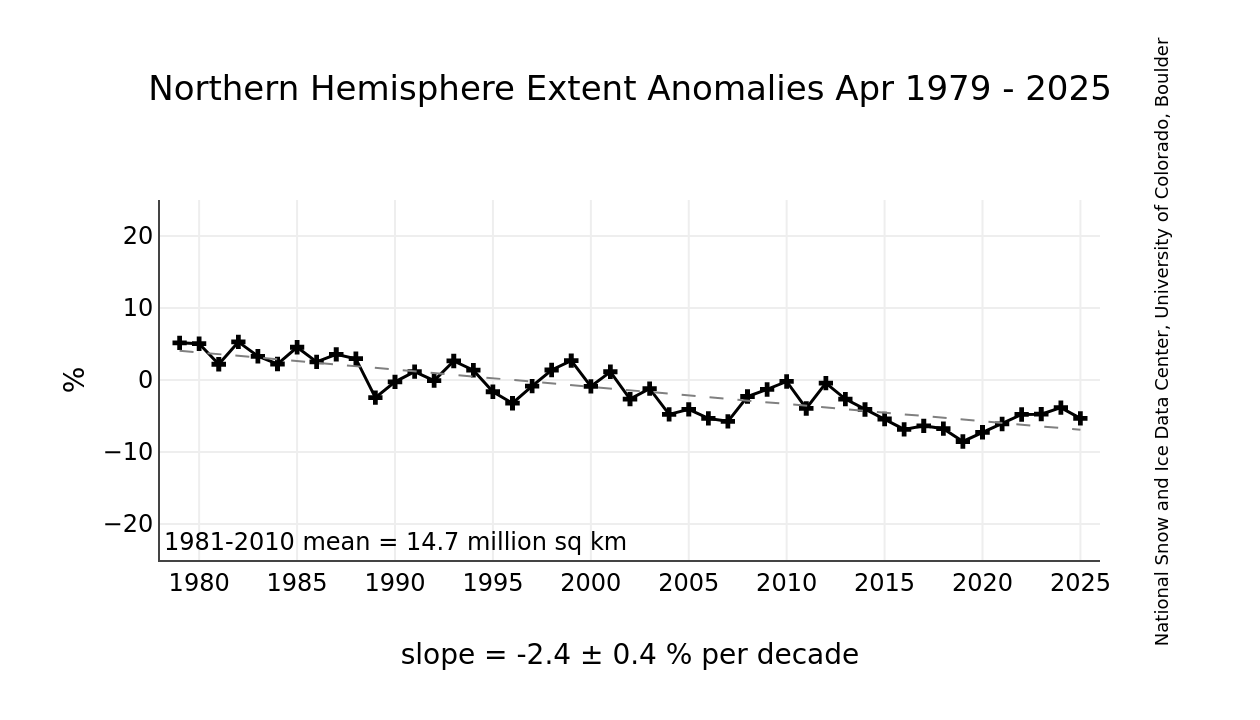
Griff, I’m not sure you know what a trend is. You observed a trend until 2007. You observed a new tend since then and it isn’t in the direction you want, overall.
Are you sure about that?
Griff writes: “We are observing a trend – a downward trend.”
No doubt. New York is free of permanent ice now. With luck that trend you observe will continue at least until I’m dead, after which its someone else’s problem. You’ve chosen to make a value judgment conflicting with mine; for some unknown and unstated reason, you believe the trend should be towards more ice. I disagree and I believe I have good reason.
Why are you concerned the climate is warming?
The graph cherry-picks the start point. There is Arctic ice extent data for the years prior to the chart, showing much lower ice extent anomaly. The low was 1974, about 1.2 million square km less than 1990. Ice extent rose rapidly to the anomaly in 1979, which was 1.8 million square km higher than 1974.
If these earlier data were included in the chart, the straight-line slope would be entirely different, and likely an inappropriate summary for the dataset.
Yes, optimal would be ‘no ice’.
That’s all very well until where you live catches up with the Artic and is 6 or 8 degrees hotter than now.
https://forum.arctic-sea-ice.net/index.php?action=dlattach;topic=230.0;attach=37783;image
Well, the arctic was near normal temperatures most of the summer, hence the fast melting in Spring didn’t deliver a record low for summer months. Not everything is about Co2, you know.
Re shrinking arctic sea ice area: Could it be that we are encountering another satellite sensor biting the dust again? Because this draft looks very suspicious to me: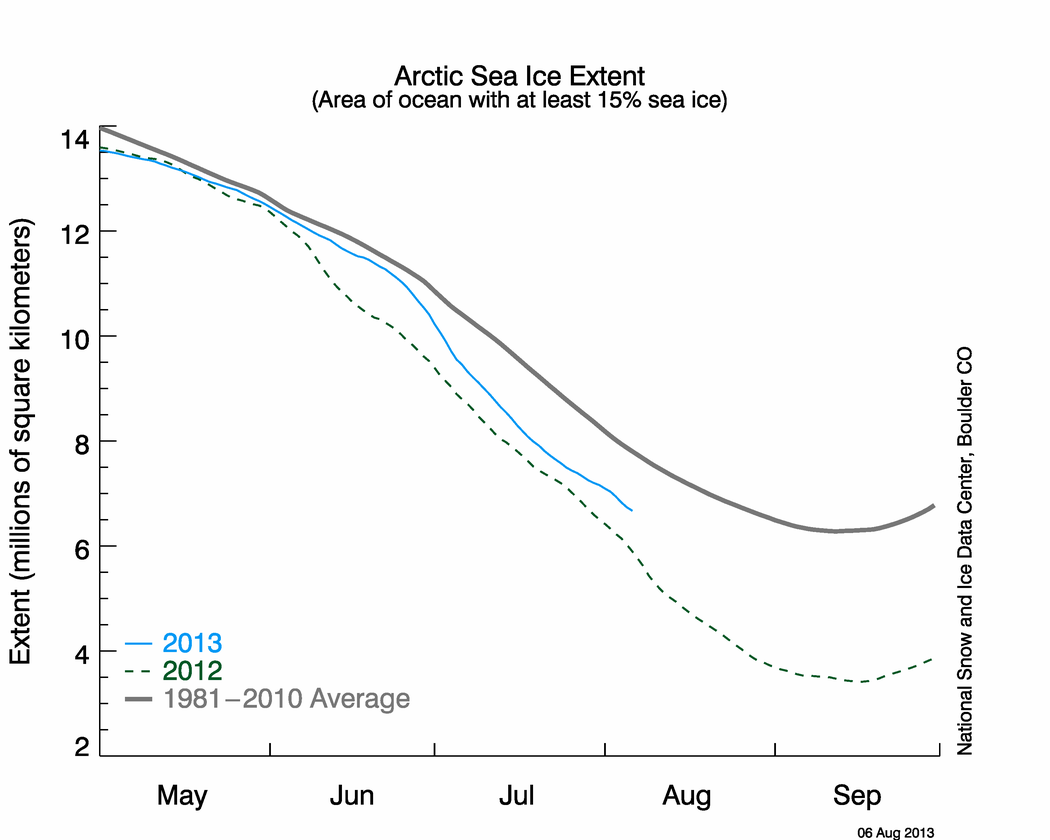
No, it is correct. October moving slowly for sea ice build up. Polar Vortex hasn’t got going yet and the cold air is over most of Europe and Russia. Someone might be better able to explain the mechanics of it, but when the Polar Vortex isn’t up and running at a good speed, cold air slips down, warm air slips up, warmer than usual arctic. It should go up after November 10th, as even without favorable conditions, it is hard for ice not to grow then.
Some of the really bad years lots of ice exited into the Atlantic. More recent years a lot of ice has piled up along the Arctic coasts of Canada and Greenland.