OAK RIDGE, Tenn.,—In a new twist to waste-to-fuel technology, scientists at the Department of Energy’s Oak Ridge National Laboratory have developed an electrochemical process that uses tiny spikes of carbon and copper to turn carbon dioxide, a greenhouse gas, into ethanol. Their finding, which involves nanofabrication and catalysis science, was serendipitous. Video follows.
“We discovered somewhat by accident that this material worked,” said ORNL’s Adam Rondinone, lead author of the team’s study published in ChemistrySelect. “We were trying to study the first step of a proposed reaction when we realized that the catalyst was doing the entire reaction on its own.”
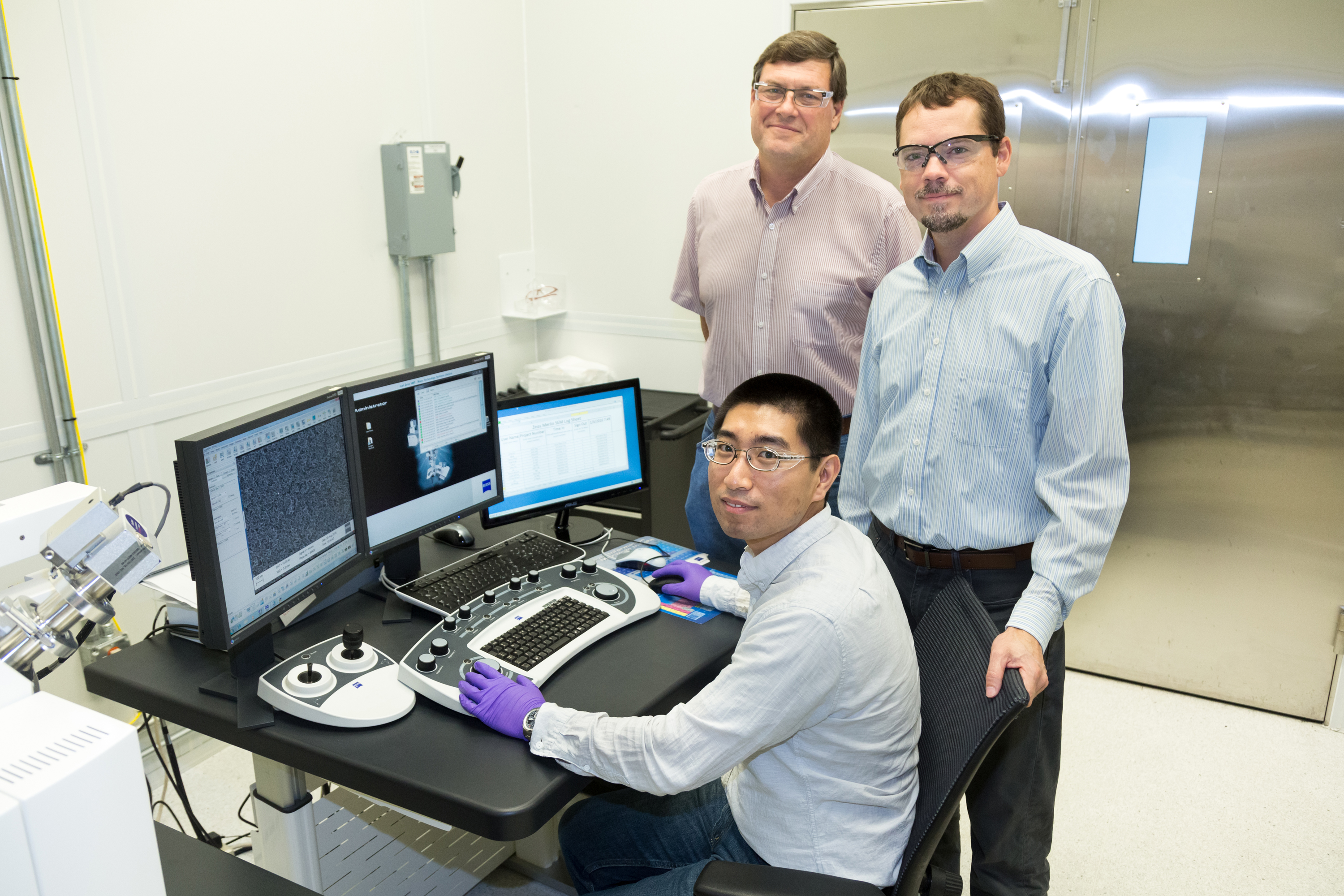
The team used a catalyst made of carbon, copper and nitrogen and applied voltage to trigger a complicated chemical reaction that essentially reverses the combustion process. With the help of the nanotechnology-based catalyst which contains multiple reaction sites, the solution of carbon dioxide dissolved in water turned into ethanol with a yield of 63 percent. Typically, this type of electrochemical reaction results in a mix of several different products in small amounts.

“We’re taking carbon dioxide, a waste product of combustion, and we’re pushing that combustion reaction backwards with very high selectivity to a useful fuel,” Rondinone said. “Ethanol was a surprise — it’s extremely difficult to go straight from carbon dioxide to ethanol with a single catalyst.”
The catalyst’s novelty lies in its nanoscale structure, consisting of copper nanoparticles embedded in carbon spikes. This nano-texturing approach avoids the use of expensive or rare metals such as platinum that limit the economic viability of many catalysts.
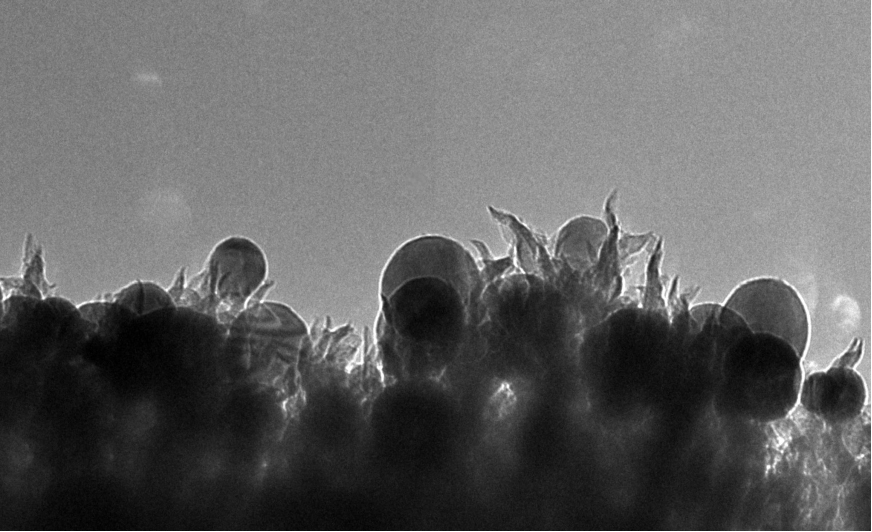
“By using common materials, but arranging them with nanotechnology, we figured out how to limit the side reactions and end up with the one thing that we want,” Rondinone said.
The researchers’ initial analysis suggests that the spiky textured surface of the catalysts provides ample reactive sites to facilitate the carbon dioxide-to-ethanol conversion.
“They are like 50-nanometer lightning rods that concentrate electrochemical reactivity at the tip of the spike,” Rondinone said.
Given the technique’s reliance on low-cost materials and an ability to operate at room temperature in water, the researchers believe the approach could be scaled up for industrially relevant applications. For instance, the process could be used to store excess electricity generated from variable power sources such as wind and solar.
“A process like this would allow you to consume extra electricity when it’s available to make and store as ethanol,” Rondinone said. “This could help to balance a grid supplied by intermittent renewable sources.”
The researchers plan to refine their approach to improve the overall production rate and further study the catalyst’s properties and behavior.
ORNL’s Yang Song, Rui Peng, Dale Hensley, Peter Bonnesen, Liangbo Liang, Zili Wu, Harry Meyer III, Miaofang Chi, Cheng Ma, Bobby Sumpter and Adam Rondinone are coauthors on the study, which is published as “High-Selectivity Electrochemical Conversion of CO2 to Ethanol using a Copper Nanoparticle/N-Doped Graphene Electrode.”
The work was supported by DOE’s Office of Science and used resources at the ORNL’s Center for Nanophase Materials Sciences, which is a DOE Office of Science User Facility.
So how much energy is lost from the system to turn CO2 into ethanol. I mean how much after you burn the ethanol as auto fuel oxygenate ??
Somewhere behind a curtain, there must be some undisclosed source of energy being surreptitiously introduced to this serendipitous chemistry.
G
They did say they were applying an electric current.
Even if there is a loss of energy in the process, it can be useful to transform energy from one form to another. A liquid is more useful to automobiles than is electricity for example.
However, you have the Carnot cycle when you run the other direction.
The article mentions that the process occurs in water, so you have to add the energy costs to distill the ethanol after it is produced.
Firstly define “yield”: are they talking about the amount of CO2 or the amount of energy ??
If it is 62% energy efficient ( which seems doubtful ) then burn it in a car or an electricity generator at around 35% and you get a 20% yield. Best case.
Sounds about as energy dumb as CCS except that you don’t need to use underground timebombs to stock the gas.
How does one produce a billion dollars worth of green energy? start with $10 billion…
That is an old saying in the wine industry ” how do you get to a million as a grape grower and a wine producer, ” answer start with 5.
MarkW – no need to remove the water, just add some OJ and ice.
If the process is cheap enough (Very big if), it might be useful as to store energy.
Is ee the EROEI concept is unfamilar to you?
That’s covered under the concept of cheap enough.
It is never cheap enough if it is a net loss of available energy. Doing nothing costs nothing, and is 100% efficient.
G
Batteries always lose energy, but for some reason people keep using them.
Perhaps that’s because creating energy is not the reason for their existence.
If it is cheap enough, there will be no net loss of energy. The question is, is the technology cheap enough or are the losses so large it will be cheaper to use another method available. I suspect, given the weasel words, that the losses are far too large for viability of this idea, but I’m only expert in recognizing BS talk.
The question that is really important is how cheap is it, not how efficient it is. If you have solar cells whose output cannot be used during the daylight hours because there is no demand for it then it is all wasted. If on the other hand you could store the excess energy that is essentially free and use it later then that energy that would have been lost is now free. An example, say a homeowner has enough solar cells to be self sufficient, but he can only harvest for 5 hours a day. He has batteries and a backup generator to cover those times when he has rain or snow or even heavy clouds. Now on the days he has more than he can use he can put the excess into a tank and run his generator when he needs it, for free. Not efficient, but free. At that point who cares about efficiency?
It’s only free if the storage system itself costs nothing.
I feel that you might have a problem funding young college students with your tax money. Wouldn’t it be better spent repealing the First and Second amendments? (Sarc)
And when ya burn that newly created ethanol ya release that CO2 back into the air to be sequestered again ….. and ya got a “perpetual motion energy reformatting mochine”.
zactly. it will absorb the energy from wind turbines and at huge expense, turn it into a fuel at such low efficiency, it will completely waste the output of acres – nay hundreds of square kilometres – of wind turbines and solar panels, this generating huge amounts of subsidy.
Of course it wont generate electricity worth a damn, but who cares?
The hydrogen comes from where? Natural gas maybe? What a crock.
usexpat
October 18, 2016 at 2:32 pm
From the water?
From their paper:
Data were not collected above −1.3 V vs. RHE because hydrogen bubbles that evolved from water reduction blocked the electrode. The decline of Faradaic efficiency for ethanol above −1.2 V vs. RHE suggests that the catalyst reached the mass-transport-limited current density for CO2 reduction, and therefore hydrogen evolved via H2O reduction at unoccupied active sites.
Good point George, It could be like manufacturing ethanol from corn, and require as much energy to produce as available in the final product.
Unfortunately according to the laws of thermodynamics and chemistry one never gets as much energy out as you need to put into the system. No conversion process has an efficiency greater than 100%, most are much lower due to losses that are inevitable. Are they using electricity produced from fossil fuels to convert the CO2?
Did they mention the energy in versus the energy out?
What knowledgeable person wants more Ethanol anyway?
Well, it might free up some corn fields for more useful production… Food.
Mark,
Surely you are joking, do you believe the ethanol from corn lobby will ever give up one drop of ethanol. They want more ethanol from corn!
Catcracking,
No they want more need for corn. Food, ethanol, feed, the corn lobby doesn’t care.
Those who continue their assault on the 2-cycle engine.
Thanks George,
The other expense/need is the fact that virtually all gas from burning fossil fuels is combined with nitrogen (and other gases) as air is burned. It is very expensive from capital cost viewpoint and energy extensive to separate the CO2 from the Nitrogen. Unfortunately one cannot just look at one step in the conversion, all the energy requirements to capture the CO2 first must be included in the energy out versus the energy in.
One of the costly obstacles in the CO2 capture (CCS) from coal plants which kills the efficiency and requires significantly burning more coal to separate the CO 2.
How do you separate the CO2 from the Nitrogen in the flue gas, normally requires energy hungry cryogenic process with compression costs ! Where do they get the CO 2?
It seems like these folks are working in a vacuum, an intelligent engineer needs to look at the entire process, not just focus on one of many steps to provide energy.
Actually I stumbled on some research on this very point. basically if you mix coal dust and rust it burns, and produces red hot iron and pure CO2.
Then you take the liquid red hot iron and blast air through it, and get iron oxide all over again..
the metal s constantly cycled, and the only time nitrogen laden air is involved is when the molten iron is oxidised.
Interesting concept, Leo. However, that would require a purge step to rid the chamber of oxygen and nitrogen (replaced with what, I don’t know), and a large amount of very active rust (meaning, no water), so it would require a large, expensive drying step for the air. All of these things just make it worse economically, and I’m probably missing a few steps.
However, Cat, the nitrogen might not be much of an issue. The N-N triple bond is a pain to break, so it’s more likely that the CO2 will react with the catalyst (I would not be surprised if the process sometimes makes amines either, but it’s not necessarily the case).
What’s with all the trolling of this discovery? I mean these guys didn’t claim to have solved the problems, they announced an interesting discovery. Maybe it will turn out to be useful on an industrial scale, maybe not. They still deserve some credit for making a useful discovery. Appreciate the science. Don’t expect them to install ethanol pumps at the lab the next day. This is the way things get done in the real world. Someone makes a discovery, people discuss what it means and how to further our knowledge, always with the idea it might be useful. Right? This seems like something to appreciate, not tear down immediately. Hammer them if they make baseless claims, sure. That’s part of the process too. But jeeze, at least let them bask in glory for a little bit, huh?
You are correct, Leo, there has been extensive research on that concept, it is called “chemical looping” and is being explored as a possible replacement for the traditional steam boiler while producing more-or-less pure CO2.
The sensible way to prove the effectiveness of the technology is to use the ethanol it produces to generate the electricity it uses. Allowance still needs to be made for any other resource it uses, of course.
So is it worth doing this test? Well, of course it isn’t. You can’t get net positive energy from a C – CO2 – C cycle. So all those catalysts are a red herring. What they are doing is converting electricity into ethanol. So they are converting an energy form that is very versatile, transportable and efficient into a fuel that is remarkably inefficient, more expensive to transport, and corrodes the engines that it is used in. Its only positive is that it can be stored more easily and cheaply. That doesn’t sound very useful to me. Surely it would be better to put their efforts into electricity storage.
exactly. as a way to store electricity it sucks. if the ethanol is burned in a steam turbine it’s unlikely to get better than 60% conversion efficiency and its probably only about 60% efficient electricity to ethanol.
that means turnaround efficiency is 36% – that’s rubbish. even pumped storage is around 75%.
So its very good engineering. Novel and innovative, but has no application vis a vs climate change or renewable energy
“But, ve get medals, Boris! Medals!” **
[** Nobel Peace Prizes]
brains356
Even the EU – and the undersigned, amongst 500,000,000 others – got a Nobble for something or other.
Fudging accounts, maybe, or bringing peace to Iraq and Syria.
Whatever.
Not sure if the delightful enlightened ‘modern man’ Putin will get one soon.
Auto
Steam cycles that produce the vast majority of electricity in the world are about 35% efficient.
If you had a magic 100% efficient way to turn CO2 back into a fuel, it still HAS to put at least as much energy back into the reaction.
Best case scenario, a CO2 utilization technology will use 1/.35 times as much energy as the steam cycle produces. Call it 3x as much.
This is limited by fundamental thermodynamics. There is no way around it.
Real conversion technologies operate well below 100% efficiency.
Plus CO2 capture energy costs and fuel processing.
It’d take 5-10 500MW nuclear plants to convert the CO2 from one 500MW coal plant. Or 15-30 500MW wind plants.
Basically, all of the wind plants in Texas combined could convert the CO2 from one coal unit into ethanol. This theoretical best possible.
CO2 utilization is a dead end.
Amen vb. I have had a number of normally intelligent people, ask me, “Why don’t we just strip off the oxygen from the CO2 and produce carbon?” My response, “Why do we burn it in the first place?”
Homer Simpson:, ” Lisa, in this house we OBEY the Laws of Thermodynamics!”
Isn’t 20% yield about the same as pumped hydro? There’s a $4 billion pumped hydro plant proposed in central Arizona on what is essentially high desert, taking water from a declining aquifer. The Dems “war on climate” could make it happen ( https://verdeviews.wordpress.com/2016/10/05/could-the-presidential-election-determine-the-fate-of-the-upper-verde-river/ ).
It this can be scaled up, it could be a huge benefit to the power grid and the US economy in a relatively short period of time! Oil industry won’t be too pleased.
What about the OZONE problem that Ethanol creates?
That depends on entirely on the energetics and productivity of the process. We have seen a number of these announcements that don’t pan out due to poor economics, purification requirements, and by products of the processes. .
Still interesting, and worth knowing more about.
Ah, no. This would take energy AWAY from the power grid. It takes energy to create the solution of dissolved carbon dioxide in water. It takes energy to make the reaction happen that converts the CO2 into ethanol.
It’s an interesting experiment, but won’t make any impact to overall energy production.
Not oil industry but corn growers, but then just raise the subsidy…At least corn fed meat prices might drop.
There is no corn subsidy. The economics stand on their own in Ethanol. There is a mandate to blenders to maintain 10% solution. Cattle prices are at 6 year lows.
Please use facts.
A mandate to buy is as much a subsidy as is a direct cash payment.
@WinnepegBOy There is an ethanol subsidy. It is called Volumetric Ethanol Excise Tax Credit, which give blenders a 45 cent credit for every gallon of ethanol mixed. And since there is a requirement to use ethanol that creates a subsidized market that immediately affects corn prices and planting schemes. So get your facts in order. Giving 45cents per gallon and requiring ethanol blending is more than an ethanol subsidy.
“””””….. There is a mandate to blenders to maintain 10% solution. …..”””””
Mandate is an anagram for subsidy.
G
@tomo_soren The Ethanol blending credit expired in 2011.
William …
It draws from the power grid, not an input. I don’t know of any electricity produced from ethanol, please explain.
Perhaps the control room operators and dispatchers still run on 3.2% ethanol (beer), but that was 3 decades ago, I doubt the company allows that anymore. 😉
@ur momisugly pop, 2:14 pm : Perhaps the control room operators and dispatchers still run on 3.2% ethanol (beer), but that was 3 decades ago, I doubt the company allows that anymore.
At one point it seemed like Chrysler was okay with it (or was that 35% ethanol ?) 🙂
POP…,
Thanks for the laugh, that was a really good one. I especially hope there is no ethanol in the Nuclear plants.
No ethanol and little oil for electricity generation. The total energy system is so complicated that the feeble minded government employees don’t have a clue, they are not qualified. Only the free market can manage the system as proven by socialist failures, the most recent in oil rich Venezuela.
I once contacted the DOE representative who was listed as the responsible person regarding a request for a research project in an area where I had some expertise. He explained that he let the contract but could not remember to whom he gave your tax payers $$$.
The oil industry has nothing to worry about, I can assure you. The laws of thermodynamics don’t need a consensus to work. The entropy of the universe is increasing everywhere and at all times. There are no perpetual motion machines. Going from low energy CO2 to high energy ethanol takes energy. However, if it could be scaled up to capture useless wind-generated electricity, that would be great.
using wind and solar power to produce it fixes the energy storage problem and the co2 problem, if there were one.
ROFLMAO!
More ‘magic thinking’
A little bit of orange flavoring to divert it from the fuel tank, perhaps?
This should be attractive to the liquor industry. Why wait and fuss with natural fermentation? Just take the watered down ethanol and flavor it. Another new market sector.
Or bottle it straight as vodka – save a potato!
It would appear that the relevant word in this process is electrochemistry–i.e. it is using electricity to produce a chemical reaction. How much power? How much relative to current batteries if one is using the ethanol as energy storage?
TH, went and read the paper. Answer in the abstract. The 63% efficiency is Faradic efficiency–‘energy’ efficiency. So 37% of the input electrical energy is lost. Now suppose the catalyzed ethanol is used to store wind energy, as ORNL posits. The electricity would presumably be regenerated from ethanol combustion by a steam turbine, preferably USC steam. The best largest units are 45% efficient. So the net electricity in to electricity out is (.63*.45) 0.28. Never going to fly. Hopelessly inefficient and uneconomic. Pumped storage is ~80% by comparison.
You still have to separate the ethanol from the water before it can be burned.
Mark. good point.
Unfortunately you also have to separate the CO 2 from the Nitrogen in the flue gas which is not cheap.
One needs to look at the entire process not just on step.
Did you read that article about a typhoon wind turbine producing 50 years worth of electricity from a single storm. Perhaps that could be combined with this.
Rudd it would be easier to decode if you wrote that formula as (.63 * .45) = 0.28.
You made me check your arithmetic … 🙂
‘Did you read that article about a typhoon wind turbine producing 50 years worth of electricity from a single storm. Perhaps that could be combined with this”.
Well, yes, maybe…
http://inhabitat.com/worlds-first-typhoon-turbine-could-power-all-of-japan-for-50-years/
Just a stronger vertical wind turbine, less efficient than propellor turbines but less likely to be damaged in strong winds.
Japan’s electrical generating capacity is around 250GW.
The largest wind turbines at the moment produce around 8MW. An onshore wind turbine can operate at 40-45% efficiency but usually operates at about an average of 25% of peak efficiency. So to produce 250GW with 8MW turbines operating at 25% efficiency Japan would need 125,000 wind turbines.
To produce 50 years worth of power [12,500 GW years] from one typhoon Japan would need rather a lot of turbines, all located conveniently in the path of the typhoon and operating at a phenomenal efficiency
Even if the vertical turbines could operate at 50% efficiency and were rated at 8MW [the largest generators currently available] 3,125,000 wind turbines would be required to produce the 50 year of power, and all of them located conveniently in the path of the typhoon which would have to blow for a year.
However typhoons/cyclones/hurricanes usually pass fairly quickly. The very strong winds rarely persist for more than a day. Let’s allow 3 days of typhoon strength winds and 3 typhoons a year…so 9 days of typhoon strength winds a year. We’ll need to increase our wind turbines to take into account the days when the wind isn’t at typhoon strength. So possibly 125,000,000 wind turbines located in the path of the typhoons to produce 50 years of power from 3 very large typhoons.
You can fiddle with efficiencies and increases in turbine capacity but I think we’re a long way Mr Shimizu’s target.
Still, you’ve got to be an optimist..
How much relative to current batteries if one is using the ethanol as energy storage?
at best one thirds as efficient at probably a far higher price..
It sounds like something for nothing. Which makes me skeptical that thus is legit.
The video said 63-70% efficient, which is high but not outrageous, but I not sure how the calculate efficiency in this case. If they use this to absorb energy peaks from wind farm, and nuclear plants when night load drops, who cares? So they have 30% loss making the fuel, then your car has a 30% loss driving, that would be 49%, it’s not a 200MPH carburetor fantasy but not too shabby either.
So we take a process (wind, solar) that are already way too expensive, and we make them more expensive by adding grid level storage.
Be still my beating heart.
See comment to TH just above.
From the paper, they state that they achieved 63% “faradaic efficiency.” That wasn’t a term I was familiar with, but there is a wikipedia article on it, which seems to agree with their description in the paper as that efficiency meaning “63 % of the electrons passing through the electrode were stored as ethanol”. It does not equal energetic efficiency, although it stands to reason that the energetic efficiency would depend on it.
J, full energetic efficiency is always equal to or less than Faradic efficiency. Less than if there are additional side processes like necessary overvoltage or leakage currents. Those don’t seem likely here, so approximately faradic equals energetic.
So at 63-70% efficient you only lose 30-37% to do exactly nothing of any use.
g
If the energy lost is less than battery storage, this could be a positive development. It would mean more oil for cars (yay!), until we get below 150 ppm in CO2 and all the plants die.
Not much oil is being used to generate electricity.
The article mentions that the process occurs in water. So the ethanol will have to be purified from the water before it can be burned.
That’s easy enough to do, but takes (ta da!) energy.
Maybe this is something. Unless it’s not. Too soon to tell right now.
Mark, you must have heard of solar stills. The ethanol can be refined with heat (sun) and a copper tube, sort of like whisky 🙂
I think the point is the process is aimed at capturing waste energy using a method that’s proposed to be cheaper than other storage tech (LiOn batteries for example). To the extent it is, it might be useful?
we already know its way more loss than a battery.
“we already know its way more loss than a battery.”
Loss is less important if the goal is to provide peak capacity to smooth out demand, where the important factors are storage capacity and power delivery per unit cost. If you can use renewable energy to produce the stored energy (fuel), so much the better. Storing additional energy in batteries is far more expensive than incrementally storing it as fuel, especially if the fuel can be safely stored in large quantities. Batteries also tend to have a relatively short lifetime when frequently charged and discharged.
If your goal is to replace internal combustion engines in automobiles, it’s not worth thinking about until we run out of oil. I even think that the best automotive solution is a smaller gas engine driven generator powering electric motor drive with an Li battery pack for increased peak power capacity and efficiency in stop and go traffic.
Very interesting, of course everything depends on this scaling up from a laboratory curiosity to industrial quantities, a lot of things look good at first blush but don’t pan out well. Still there is no obvious show-stoppers so maybe this will be the disruptive technology that’ll shut up the whiny greens without cause 5 billion people to starve.
No so fast there Bugs, “no obvious show-stoppers” is a bit strong. The catalyst is doped graphene. Making graphene is challenging, doped graphene will be more challenging. Nano scale doped graphene? We just turned the knob up to 11.
My guess is this process is quite a way from being commercial. For example, about 4 years ago a few folks at UCLA came up with a process for fabricating graphene based supercapicitors using carbon, water and a computer CD burner. I’ve yet to see Maxwell Technologies (or Tesla for that matter) putting them on the shelves down at my local NAPA Auto Parts store. There may be a lesson in there somewhere?
You beat me to it george e. smith. Until they repeal the Laws of Thermodynamics and let us build a perpetual motion machine it ain’t gonna work! I think that’s what William Yarber is saying too?!
MM
If this was scalable, it would essentially turn ethanol into a fuel cell.
Here in Alberta, where a lot of our electricity comes from coal, this could allow us to run our cars on coal power…(Coal>>electricity>>Ethanol>>car)
It is a process for converting electricity into more storable liquid fuel. If oil is banned or becomes too expensive and the e-car lovers realize their cars don’t work in cold weather and don’t have decent range, then it might have a future for transportation fuel.
Jeff,
You can already run your car on gasoline which is readily available with fossil fuels in Alberta.
What is the advantage considering higher cost for running your car on ethanol from CO 2?
Ethanol only has 2/3 the energy of gasoline, MPG terrible.
Capturing CO 2 from coal plants is very expensive and you have to separate it from the Nitrogen which is the bulk of the gas in the effluent since they burn air which is 78% Nitrogen.
BTW if you want to use coal to run your car there are much better processes to convert coal to gasoline. Why do it when Alberta is sitting on huge oil reserves?
In physics, chemistry and life—
TANSTAAFL
TANSTAAFL
Acronym, originating in the early 20th century, and popularized by Robert Heinlein’s novel, The Moon is a Harsh Mistress.
Place I worked had a free cafeteria, food wasn’t bad, but considering that you’d end up working more because you never left the building, you mostly got what you paid for.
It’s not something for nothing – as Tom Halla above points out, electricity is consumed. What is critical to the viability of this process is how much. I would imagine it is more that the ethanol produced could generate!
Calculation based on reading the paper posted above in reply to Halla.
In theory, it would help solve the problem of storeage, making renewables more grid-friendly. However, it wouldn’t solve the cost issue. And yes, a bit Rube Goldbergian. Greenies will go for it, though.
I remain skeptical. Has this been replicated? What are the energy costs for this conversion?
Anyone else remember “Cold Fusion”?
You’re out of date I’m afraid. Cold fusion/LENR has been replicated all over the world and is gaining momentum rapidly toward commercial products. Another example of main stream science and media demonstrating their closed mindedness. Check out MFMP, E-Cat world, Parkhomov, Brillioun or many others. It will quite likely make all this nonsense about CO2 just a speck in history’s rear view mirror.
Cold Fusion/LENR ?
http://www.extremetech.com/extreme/156393-cold-fusion-reactor-independently-verified-has-10000-times-the-energy-density-of-gas
Apparently it needs a secret ingredient……..”As for what the secret sauce is, no one knows — in the research paper, the independent scientists simply refer to it as “unknown additives.”
Presumably if successful the LENR secret has been purchased/stolen by oil/gas/coal/nuclear/wind/solar power companies to prevent challenges to their businesses
In the meantime..
http://www.lenr-coldfusion.com/2016/04/16/rossi-sues-ih-unable-substantiate-claims/
NASA isn’t the only group of people working on cold fusion in the US. Patent rights are certainly an issue. If you remember the litigation between Bell et. a host of other companies and Gordon Gould, or LCD watches, or that component that allows a VHS player to work. The formula for Bake lite has disappeared along with a formula that applied in a very thin sheet resists very high temperatures. … at this point almost anything from NASA is suspect. NASA has become a residential supplier of science, who’s paying us and what do they want.
I haven’t kept up with it. I thought if we could understand gravity waves, via LIGO, that we could finally torque the plasma gas in a tokamak, Russian for doughnut, to produce fusion. Frankly, I don’t care which of the processes win, as long as it comes into existence.
A few years ago, I was surprised ( really surprised) to learn that government’s ( not just the US ) are/were still working on cold fusion. At that time I think some of the experiments were blowing up, literally, and they didn’t know why. I haven’t followed it since. I see J. Harmsworth has..
Since there are no free lunches, it’s a safe bet that the process consumes more energy than is in the ethanol being generated.
Yes, that’s true. But a liquid fuel has advantages over electricity (and batteries)
There are way easier, cheaper, and more efficient ways to get liquid fuels.
I’m impressed that the article doesn’t make claims that this technology could be used by fossil fuel power plants on engines to convert their waste CO2, since that would require more energy then you’d get from burning the fuel in the first place.
As a means of storing energy from intermittent sources it has potential. But it depends on how much energy is lost in the process. Wind and solar are already more expensive then fossil fuels on a per Mw/h bases, losing half the energy produced converting it to ethanol and back won’t make it any cheaper.
maybe a better use for this technology would be a way to produce high energy fuels for transportation with Nuclear Power. Hell, it would even be ‘Green’.
Guys, you are missing the big picture – world economic meltdown!
BATF will remove the “A” from its name, Beer companies and distilleries will go bankrupt along with bars, etc. Total chaos, dogs and cats living together, Amazon delivery of DYI kits , just add water, flip the switch and the local power becomes your liqour store @ur momisugly ~$1 /gal.
The workers paradise realized. I can sleep easy now. Isn’t science wonderful?
Throwback can “I can sleep easy now.”
Yep. In my experience everything goes better with Vodka 🙂
crap. Was supposed to read “Throwback says…”
Somethings obviously don’t go better with Vodka. Typing is one.
It’s awesome. We burn more fossil fuel to make CO2 to make ethanol. Sweet. How long before lefty starts harping about “endangered copper” ? 🙂
“A process like this would allow you to consume extra electricity when it’s available to make and store as ethanol,”
The same can be said about the electrolysis of water and fuel cells, especially if the low voltage, high current DC generated by solar cells is used directly for the electrolysis. I also like the idea of using Aluminium as the storage mechanism which is also produced with low voltage, high current DC and then the energy can be released in a thermite reactor (the other ingredient, rust, is omnipresent). Aluminium is also the safest way to store and transport stored energy (until you turn it into the Aluminium dust required for the thermite reactor).
I’ve been predicting that the eventuality of CO2 to Ethanol conversion will make the generation of atmospheric CO2 the worlds top priority so that we don’t run out and crash agriculture, which will also be an issue when the next, inevitable ice age arrives.
How about this for the next gen cogen facility:
Located out in the middle of a desert, the plant will use DC solar power to directly electrolyze water, produce Aluminium and produce Ethanol from atmospheric CO2, all of which are processes that require low voltage, high current DC. The H2 and Ethanol reacts with atmospheric O2 in fuel cells to produce electricity. A thermite reactor produces heat from Al and Fe2O3 to run a turbine generator and produces molten iron and Al2O3 as its waste products. The O2 generated by the electrolysis of water is used to efficiently convert the iron back into rust to fuel the reactor along with the Al produced from solar input as the Al2O3 produced by the thermite reaction becomes the input to the Al electrolysis cells. Another low voltage, high current DC process is the production of silicon wafers which can be utilized to create the solar cells the plant uses to produce the electricity powering the electrolytic processes.
The basic idea is for a self replicating power plant that uses solar energy to produce fuel and which produces electricity from that fuel. The only inputs the plant requires is water, Al2O3 and Fe2O3,although most of the reactants are recycled through the fuel cells and thermite reactor. With a continuing supply of Fe2O3 and Al2O3, the plant can also be a net producer of Al and Fe.
To make aluminum you need a constant source of electricity. You can’t start up and shut down those cells on a whim and expect to get anything useful out.
Or a heavy electro-chemical plant producing ethanol from electric power and carbon dioxide.
MarkW,
“To make aluminum you need a constant source of electricity.”
Yes, based on current Al manufacturing methods, but it should be possible to design a throttleable Al production cell, which needs to be considered anyway since traditional AL production plants are good candidates to throttle down when the grid demand exceeds the supply as renewables flake in and out.
My real point is that using solar cell output directly for electrolysis applications is the best way to use photovoltaic electricity which avoids all the DC to AC and back conversion as well as transmission losses. Of course, you still need a supplemental source of DC to keep the cells idle at night, hence cogeneration is useful and of course there’s always the grid to supply idle power …
I support that message NotEvil. Way back in my hippy days I designed a mini-van that used solar powered electrolysis. I figured me and my buds weren’t in a hurry anyway, so whenever we needed gas for the van we’d just pull over at the nearest lake, deploy the solar array and go fish for dinner.
We imagined ourselves to be freedom loving babe magnets who just needed a van, some tents and a few fishing poles. We were 15.
Mark W,
Good point batch processes do not work well in the energy business either. Refineries and chemical plants cannot shut down every day when the sun goes down or the wind stops blowing. For large commercial plants, it often takes days to start up a plant and line it out to achieve product quality. I guess the lab folks living on subsidies don’t have a clue of the real world. They shut down every night to go home to watch TV. That is not the real world.
Catcracking,
“batch processes do not work well in the energy business either.”
Yes, energy intensive, high temperature batch processes are hard to start up, but this doesn’t mean it’s necessarily impossible or even difficult to throttle the process based on available energy without shutting it down completely. It’s like spinning reserve. If you keep the cell hot, it can be ramped up quickly. A larger number of tiny cells is another way to do this where smaller cells can ramp up more quickly. You need many cells in series anyway so the voltage drop across the cell line becomes high enough to be practical.
I’m not saying that this is a trivial undertaking, only that the solution is function of material science and process control which are well studied fields. For example, super insulating the cell with aerogel will keep it hot for a longer period of time when the cell is not active and will mean less idle power is required to keep the electrolyte molten. Materials like aerogel were not even theorized when the basic Hall–Héroult process was initially developed, so there is room to rethink the process. In the case of Al production for fuel, it’s not necessary to achieve ultra high purity which opens up other possibilities.
I think you’re missing a goldfish and a snail in there somewhere, although considering the amount of ethanol produced, maybe you need a Kennedy also.
We can replace the goldfish and snail with a single Snail Darter. Now that’s efficiency.
The headline possibilites for this story are endless.
The person interviewed in the video says that > 60% of the electricity used is converted into Ethanol by the catalyst. Unfortunately, nothing was said about total power consumption. I’m curious about the possibility of using this process to replace corn-based Ethanol production. That’s a big waste of many resources.
Alan, the energy required would be the heat of combustion of the ethanol plus an additional 10-15% or so for resistance losses, side reactions, heat losses and an unknown amount for manufacture of the catalystic electrode structure.
Stop the conversion process before all the dissolved CO2 is consumed, and hops and sell it as
Power Plant Pilsner? Market it to the ecological aware crowd.
Fossil fuel powered electrical generating plants are generally owned by utilities which have severely limited profits. This might be extremely interesting as a side revenue generator ( Ah excuse the pun)
“Market it to the ecological aware crowd.”
You mean to the starry-eyed members of the Church of Human-Induced Ecological Apocalypse? Them wankers? Think they’d appreciate the nose and finish?
+10 More Beer!
A perpetual motion machine. Finally. ……. should I put a sarc tag here?
It’s a pretty cool engineering feat, but how does this make ethanol any less destructive of the engines in which it’s used as a fuel–whether to power cars or to reconvert into electricity?
Eric Hines
It is interesting with this new developments, but why is it always packed with this:
” For instance, the process could be used to store excess electricity generated from variable power sources such as wind and solar.
“A process like this would allow you to consume extra electricity when it’s available to make and store as ethanol,” Rondinone said. “This could help to balance a grid supplied by intermittent renewable sources.”
The essential is to make ethanol from CO2 and water with electricity, all the other could be to hide a really bad effectivity by greenwashing. Tell about the power needed to make ethanol. How many kWh is needed to make 1kWh of ethanol combustion energy, then we can talk again.
I could find many uses of that excess electricity to save some gas burning in my boiler, and without making it to ethanol first. I might also use ethanol to other uses than heat, but that’s an other story.