From the “it’s a 50 year storm I tell you” department, comes this interesting find by Larry Hamlin. While apologists rush to blame “climate change enhanced severe weather” for failure of the grid in South Australia, Hamlin finds that this problem with wind turbine farms maintaining frequency and causing a blackout was foreseen and published. If only some people had the sense to pay attention.
Guest essay by Larry Hamlin.
In a 2014 report issued by the Australian Energy Market Operator Ltd (which operates the national energy market) & Electranet (which operates the national electricity transmission grid) these agencies examined the credible events that could occur in South Australia (SA) with loss of electrical system control that could lead to a state wide black out.
The report noted (https://decarbonisesa.com/2016/07/15/the-unfolding-energy-crisis-in-south-australia-was-foreseeable-and-foreseen/) that the continuing and growing use of wind turbines (which do not have synchronous generators that stabilize the electric system) to meet SA electrical load combined with a loss of interconnection would result in:

This finding clearly should have provided caution to SA government and political leaders that their head long rush to push ever greater use of wind energy in the state to reduce CO2 emissions (given that SA population is more than 20 times below that of California the CO2 emissions reduction here is absolutely trivial) was creating increased risks of electrical system price and supply upheavals.
Now that price upheavals and a state wide electrical black out have occurred SA government officials and politicians along with renewable energy media supporters are trying to conceal the clearly foreseeable and foreseen outcomes that flawed climate change energy policy have created.
These wind energy SA renewable energy use issues were also clearly identified in an article published in the Transactions of the Royal Society of South Australia where the significant electrical system reliability problems created by renewable wind energy in SA are addressed in detail.

This study specifically addressed the black out concerns noted by the Australian Energy Market as follows:

This analysis exposes the extraordinary energy market distortion that the politically mandated use of renewable energy has created.
Renewable energy cannot be reliably used without placing demands on electric system stability that can only be provided by dispatchable fossil power plants.
Yet renewable energy is given preference in use over fossil plants based on political policy mandates even though the costs associated with electric system stability must be provided by fossil plants which experience lower operating hours thus increasing fossil plant production costs.
Additionally these electric system stability costs climb as more and more renewables are placed in use. Renewables energy projects however are never held accountable for these increased electric system stability costs that occur and in fact these increased system costs are concealed from view by renewable energy advocates.
The extraordinary distortion of energy market prices created by the mandated use of renewables is further addressed in the Royal Society study as follows:

With the huge worldwide attention now focused on the state wide black out event in SA perhaps the significant reliability impediments and huge energy market distortions that use of renewables has crated for integrated electric systems can be brought into the light and finally dealt with in the open instead of being hidden from view through the deception utilized by renewable energy advocates.
It’s richly ironic that the SA push to renewables has, to practical effect, tampered with a large and surprisingly delicate electrical ecosystem, by removing stabilising elements (online synchronous generation) and colonising it with vast numbers of individual and intermittent species which are essentially alien to the original network design.
It had always been my understanding that, faced with any large, complex, interconnected ecosystem, the Greenish response was to invoke the Precautionary Principle and stop the proposal in its tracks by whatever means necessary.
It seems that the Movement has violated one of its own founding principles.
I’m Shocked, just Shocked….
Looking at the press coverage from Australia makes we wonder if the public will ever understand the factors contributing to this blackout, Certainly you can say the loss of transmission towers “caused” the blackout in terms of the event sequence. But you should expect storms to take out towers and a robust system (with good synchronous resources) will survive such scenarios better than one with a high penetration of wind. It will likely never be the intermittent by themselves that blackout a grid. The Problem is they don’t help with the normal blips and challenges every grid is exposed to.
The most troubling statement I saw was that the wind helped the situation and had they had more wind it would have been better. Think about that one. I don’t think this is unique to the press down under. Similar statements accompanied the ERCOT winter outages here a couple years back.
“It will likely never be the intermittent by themselves that blackout a grid. The Problem is they don’t help with the normal blips and challenges every grid is exposed to.”
That sounds like a good summary, and rather different from what is being claimed in these threads. It’s consistent with what AEMO said. Wind needs more effort in management, which may cost a bit. But there is the large gain on fuel costs to offset this.
ind needs more effort in management, which may cost a bit. But there is the large gain on fuel costs to offset this.
Of course, that’s why Big Wind doesn’t need subsidies or mandated feed in standards to survive and doesn’t necessarily cause the cost of electricity to skyrocket. Snort.
“doesn’t necessarily cause the cost of electricity to skyrocket”
It doesn’t. In Australia the support for renewables comes through a Renewable Energy Target, with the Abbott government’s description of how it works here. Here is their table of costs. 4.4% for SA isn’t skyrocketing.
That is the only thing that could be described as a “mandated feed”.
Maybe not skyrocket, more like a Boeing 787.
http://www.abc.net.au/news/image/5780702-3×2-940×627.jpg
Av. annual residential electricity bill A$.
“Chris Hanley October 2, 2016 at 8:30 pm”
2010, is when the “proice ohn cahbon” was introduced by someone who said she would not do that. It’s funny around about 2010 is when energy prices “necessarily skyrocketed”.
“2010, is when the “proice ohn cahbon””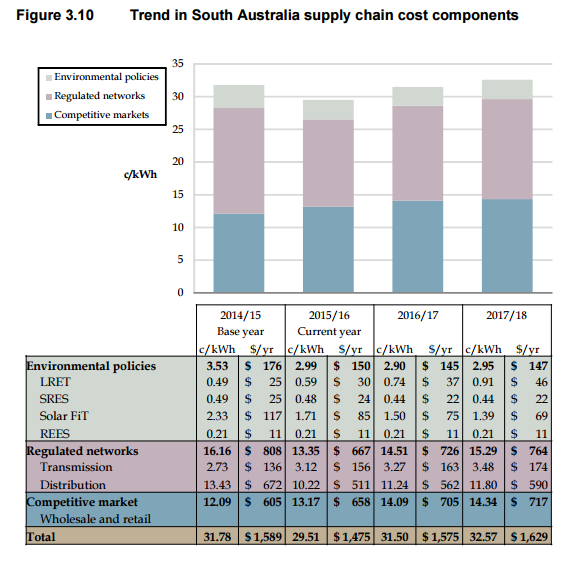
No, the carbon tax became effective on 1 July 2012. Doesn’t seem to be a huge rise following that.
Here is a detailed AEMC report on electricity pricing components. It gives a breakdown of factors for recent and near future years. Here is their table for SA:
Environmental part is small and diminishing.
“Nick Stokes October 2, 2016 at 9:37 pm”
The policy of the price on carbon was introduced in 2010, after the federal election won by Gillard with support from Brown (Greens) with implementation, as you say, July 1st 2012. But the graph shows significant increases from 2010, when the policy was introduced/announced by the Greens and denied by Gillard (Lie). Trying to hide behind smoke and mirrors again Nick. Your posts over the last few days in support of failed energy policies of the South Australian govn’t just underlines your biased opinion.
C’mon Nick, get serious.
Your first table shows only 4.4% being due to renewables, but also shows SA being the highest cost jurisdiction in Australia by quite a chunk. If the price was low, like it is in ACT, it would be 6.7%. So you’re attempting to show it is “only” 4.4% while glossing over that they have the highest rates in Australia which makes it look smaller. You follow that with another chart that purports to show no trend by starting in 2014/2015 and extending out into the future. First of all, that’s a cherry pick rivaling Michael Mann, and perhaps worse because it purports to use future estimates as data.
Oh, yeah… you believe in models.
You know, I once had a lot of respect for you Nick.
“Environmental part is small and diminishing …”.
==================================
Wind also involves additional network costs all-up adding ~40% to the wholesale price of electricity.
Whether a “carbon reduction” policy could be regarded as an ‘environmental policy’ depends on where one stands.
It certainly will not make any difference to the environment overall, except deprive the biosphere of a little additional CO2, but of course the greenies would regard it as helping to save the world.
“while glossing over that they have the highest rates in Australia which makes it look smaller”
That was discussed here. SA rates have always been high, because they don’t have resources like hydro or good easily accessed coal. Wind hasn’t changed that. Coal from Leigh Creek was a very expensive way of generating.
“You follow that with another chart that purports to show no trend”
I didn’t include it to show trend. I was showing the breakdown by components, and in particular the small component due to environmental.
“But the graph shows significant increases from 2010, when the policy was introduced/announced by the Greens and denied by Gillard (Lie).”
Yes. But it doesn’t become a cost factor until it is implemented. The rise from 2010 to 2012 was not caused by the carbon tax, which didn’t even pass parliament till end 2011.
And a massive cost in environmental degradation.
“You cannot stop the wind, but you can adjust your sails”
Here’s one from 5 years ago in Texas, USA, I think it is inevitable everywhere there is an abundance of wind power with not enough reliable backup power:
https://wattsupwiththat.com/2011/02/02/we-spent-billions-on-wind-power-and-all-i-got-was-a-rolling-blackout/
“Here’s one from 5 years ago in Texas, USA”
That, like this, is rank speculation, based on there being a power shortfall in a state with wind power, and nothing more. And of course, the real facts showed otherwise.
That’s really interesting Nick. You post a chart showing no trends in rates that somehow uses data from the future, and then chastise someone else for rank speculation.
You can’t suck and blow.
So what is the backup power when the wind turbans don’t work? Solar panels? I don’t think so.
Probably coal power, natural gas power. nuclear power, hydro power, or diesel-power.
“You post a chart showing no trends in rates”
I made no claims about trends in rates. I posted to show the cost components.
The Texas post was rank speculation. Texas had a power shortfall, Texas has some wind energy, so, said poster, the shortfall was caused by wind. No basis for that, and in fact it wasn’t true.
Nick Stokes October 3, 2016 at 12:48 am
“You post a chart showing no trends in rates”
I made no claims about trends in rates.
Fair enough. You didn’t intend to call out the rates, only the mix of components. It is still a massive cherry pick in that it doesn’t allow historical comparison and it also includes years that do not exist, they are in the future and hence modeled.
If you trust these you may. But every jurisdiction that I am familiar with has seen a massive increase in electricity prices due to wind being implemented at scale. How Australia manages to escape the economics that haunt the rest of the world is a but of a mystery. Well, you present figures from a politically motivated body on a politically charged issue…. I can’t do an audit obviously, but someone ought to. Physics and economics don’t magically change their rules once they cross into the land down under. But accounting is a practice proven malleable all over the world.
“Well, you present figures from a politically motivated body”
The AEMC is the rule-making body for the Energy Market here. It operates alongside the AEMO, which is the authority being cited in the head post. They have the facts, and no obvious political motivation, being set up by COAG, which is a council of Fed and all State govs.
and no obvious political motivation
LOL. Regulators have no obvious political motivation? Who knew?
Why are so many governments willing to dive headfirst into a lake of renewables without first testing to see how shallow the lake is? They must be overflowing with excess funds to want to break what isn’t broken.
Simple. I’s political.
Some interesting comments, thanks to all.
As a UK resident I have been aware of the risky strategy adopted by successive governments here who are in general united in their affection for saving the world. British citizens in general have shown little interest in seeing its electrical generating capacity pared below what is sensible so it will serve them right if the lights go out and stay out for some time. Of course I too will have to endure this outcome, cannot say I am happy with it but alas only such outcomes are capable of waking people up from their obsessions with the Kardashian’s (not sure about the spelling) and Coronation Street.
It is depressing to see this happening!
It was the wind that did it!
If you look at wiki, first entry for https://en.wikipedia.org/wiki/List_of_wind_farms_in_South_Australia
and look at the first entry: Canunda Wind Farm : https://en.wikipedia.org/wiki/Canunda_Wind_Farm,
and its say: “The wind farm is made up of 23 Vestas 2.0 MW wind turbines”.
Looking at http://nozebra.ipapercms.dk/Vestas/Communication/Productbrochure/2MWbrochure/2MWProductBrochure/
the data for these machines, depending on which of the 4 types have been installed in each tower,
the generator works between 4m/s and 25m/s. Below 4 it generates no electricity, above 25 it generates no electricity.
The killer figure is the “cut in” value: 23m/s.
It does not need much to imagine a gusty storm with wind speeds going through 23m/s to 25m/s frequently and rapidly. Its what happens in storms.
To put it into perspective:
23 m/s = 44.7 knots = 82.8 km/h
25 m/s = 48.6 knots = 90 km/h
A storm gust passing through a wind farm will trip *ALL* of the units, again and again, but of course if the grid goes down once, then you require a staged recovery, it is no longer one unit tripping off and on.
If the above behaviour was a design aim, then great, your system works as intended. If your design aim was to give you a reliable continuous supply of electricity, then it is madness.
“A storm gust passing through a wind farm will trip *ALL* of the units, again and again, “
Probably not – gusts are fairly local, and 82.8 km/h is getting up to the max attained at any time. And there are 16 farms on that list, at widely dispersed locations..
The SA power outage would have happened with any form of generation… renewables are not a factor in the failure:
“23 towers in five locations, affecting three major power lines, were lying on the ground, ripped out by the storm.
As Simon Emms from Electranet made clear on Thursday, when you take more than 700MW of generation out of the system in a matter of seconds, no grid that he knew of could have kept going”
http://reneweconomy.com.au/2016/uhlmanns-bizarre-prediction-of-national-blackout-if-we-pursue-wind-and-solar-39364
RenewEconomy – yeah, a site where we can expect dispassionate, objective commentary about energy.
Pull the other one, Griff.
I put it in because it directly quoted a spokesman for the network which went out.
Is he not telling the truth?
What!? Griffypoo believes an actual industry expert?
Which spokesman? Perhaps he meant the author, Giles Parkinson?
Nah, he’s another parasite feeding at the climate funding trough. Keep the money flowing double down reporting. There is very little he can’t bafflegab into appearing to support eco-lunacy.
Nah, more likely Griffpoo meant Simon Emms; but only after Griffpoo completely misinterprets Mr. Emms.
Mr. Emms is correct in that an electrical grid will likely cascade into failure when 700MW jumps up and down then punts out.
Griffpoo, is insinuating that Mr. Emms is verifying or validating the use of wind power; a complete and wilful misinterpretation on Griffpoo’s part.
Natural Gas, Coal, Nuclear power generating facilities rarely suffer such failures. Decades of power generation have proven how smoothly these facilities operate providing steady quality power.
Griffpoo claims that any kind of generating facility/electrical grid would suffer the same fate.
23 wind towers went down in normal thunderstorm winds. Some transmission wires likely went out because debris fell across the lines or were struck by lightning. Unless, hit by a tornado, I doubt any transmission towers were even damaged.
23 wind towers crashed in ordinary winds; and Griffpoo is celebrating their success. Quoting articles from some journalist that does not mind making stories up out of whole cloth.
Really!? Replace generating facilities providing hundreds of MWs to GWs?
No, There are not any battery facilities in North America replacing coal generating facilities!
• Not forgetting how stupid the premise is:
• Generate electricity,
• transmit the electricity,
• transform the electrical power from DC to AC,
• trickle charge batteries,
• draw current from the batteries in a manner to provide a steady even current draw,
• transform the electricity from DC to AC,
• supply the grid. Oh, yeah, realll smart…
Yup, Griffpoo loves to prefer lies, fabrications and fairytales.
With such an awful educational foundation and background, it must take quite a daily salary for Griffpoo to keep trolling here and embarrassing himself repeatedly. Incredibly embarrassing.
If anybody goes live off grid, it sure would be nice if they took Griffypoo. Nothing too difficult or electronic for Griffpoo. Keep him pulling the plow, cleaning the chicken house, spreading the liquid fertilizer…
Atheok
I’m saying a spokesman for the power company gave the exact and only reason for the outage.
There was no wind component in this failure.
you cannot break a power distribution system at 23 points over 3 separate lines without those breaks and only those breaks taking it down, no matter what the power source.
“With the huge worldwide attention now focused on the state wide black out event in SA”
The majority of us in the UK could be forgiven for not knowing anything about this debacle. I don’t remember seeing it mentioned in the papers, or on TV…
That’s because only climate skeptic sites are alleging renewables are involved.
(and sites reporting local politicians)
for most of the world this was a storm caused power outage – which is what the facts show.
“That’s because only climate skeptic sites are alleging renewables are involved”
Really? If you had bothered to read all of the blog linked at the start of this post, (and the comments as I did) you might have spotted this:
“Suggestions that the renewable sector is now merely a “scapegoat” for our problems are absurd, stemming from an ideology of nil criticism for some technologies”
“As you can see both we and the sources we cite were paying attention to problems in the pipeline. These problems were foreseeable and foreseen.
Maybe we just needed more pain to make us pay attention”
Well they’ve just had their “Pain” – let’s hope (for all our sakes) that they start paying more attention…
Dave, this is being dishonestly hyped by a section of the internet…
South Australia is so screwed up these days, we cannot even say “Would the last one to leave, please turn out the lights,” as there are no lights, due to the green energy fiasco.
We often used to joke about that during the times after the State Bank disaster, costing the state billions of dollars!
Griff, is it normal for a large state to be completely blacked out by a storm?
Could you not imagine, that if you had say 20 large generator facilities, that delivered a controlled amount of power might, just might, be a lot more reliable than 10 large generators and 200 very small ones, where the small ones were totally dependent upon wind speed for their electrical output.
Either too little or too much wind speed and you loose 40% of your states capacity.
Not even a little sneaking suspicion that uncontrolled – wind dependent – generators may not be as reliable as conventional generators?
How about a ‘maybe’?
Yes, it is, when you have your network hit in 23 places over 3 power lines!!!
Even with 20 generator plants.
Most of them would be cut off from the grid – which would have tripped anyway due to sudden power loss.
What might have kept some power on was part renewable microgrids, able to run locally in isolation. Research New York’s response to Sandy.
what might have restarted this even quicker – and this is the first known state wide restart in Australia and considering the scale was as quick as could be- would be grid storage, which is already in place in Germany for ‘black start’.
Bottom line is my State of South Australia has been right out there at the forefront of trying to create a reliable power system from unreliable energy sources in a rapidly changing environment-
http://www.wattclarity.com.au/2016/10/the-new-energy-ecosystem/
and there are lessons here for you all in following that path.
whiten wrote
The NEM works by a “day ahead” bidding process where generators nominate the amount of electrical power they can deliver at a price point (long with ramp rates for control requirements). Prior to renewbles, this meant that as demand increased, they price of electricity would go up and the generators would switch on as required. Thermodynamic principles and fuel costs lead to the most efficient and hence cheapest generators being slower to vary their output (termed ramping). Fast ramping generators, like big diesels and open cycle gas turbines (stationary jet engines) are much less efficient so they cost more to run.
This meant the cheapest generators would be on continually (baseload) with higher priced but more flexible generators coming online, ramping up and down and then switching off as demand varied during each day from the baseload requirement. Of course, slow ramping of baseload generators allows for the seasonal variations in the baseload power requirement.
It’s more complex due to the multiplicity of generators, reserve capacities, ancillary services etc but that is the essence of the market mechanism and how generators make money while the delivering power.
Now the renewable generators have been allowed to bypass this pricing mechanism – they can sell power into the market anytime they are producing. What’s more, they either have guaranteed pricing for their power, no matter what the current market rate is (via power purchase agreements) or else the power they generate is afforded a large premium via the renewable energy certificates which the utilities are required to purchase from them to fulfil the green regulatory requirements. This means it make sense for the renewable generators to generate power whenever they can as they have a guaranteed market with high profitability.
Domestic PV is also unregulated – they generate power when the sun shines and either flow excess in to the grid or reduce demand, totally beyond the control of the grid operators
You can then see the final result – when the wind blows (and sun shines) there is lots of electricity being generated by renewables so the demand for traditionally produced electricity falls, dropping the market price. This makes it uneconomic for most traditional generators to run since the price will fall under their bid price.
Last week, the wind was blowing hard with the stormy weather so there was a lot of wind generated power being produced, depressing the market price. The big gas generators were largely forced offline due to the low pricing leading to a grid with poor stability – only Torrens B and a few small OCGTs were online. From there, events like falling pylons and lightning strikes would cause large changes in the grid frequency which would cause the Heywood interconnector to disconnect for self protection, islanding the South Australian grid. Any other “weather induced” event (or even the consequences of the first one) would then trip the traditional generators, leading to the blackout. If there were more baseload generators online (Torrens A and Pelican Point), then the statewide blackout would not have occurred.
Again, no scheming was required on the day – the schemes to blame are set in the large renewable energy targets and the market access given to the renewables as incentives. Distortions due to poor legislation was the cause.
This is why ElectraNet and the AEMO are able to truthfully state that the renewables were not the cause of the blackout – they weren’t in a direct sense, through a semantic loophole.
The Federal Minister tilts at the windmills and naturally it’s all about climate change from the true believers-
http://www.abc.net.au/news/2016-10-03/sa-government-energy-policy-exacerbated-blackout-greg-hunt-says/7897298
When you believe in 100% renewables by whenever we can manage it and at any cost, naturally no further correspondence will be entered into, but there’s nothing like a complete blackout at the beginning of the peak hour home time to concentrate lots of minds on real physics rather than emotional wishful thinking.
The paradox for these Greens is while they’ve been big fans of lots of micro renewable power generators everywhere, they’re all scrambling now for more interconnection to no prizes for guessing. They need to look up the meaning of ‘fallacy of composition’, even if they have a cargo cult fixation on technological innovation taking care of all that pesky science of electricity generation and distribution. Perhaps some more computer modelling might help chaps?
It’s not Treasurer Tom’s problem because they were all licensed-
‘The Minister’s letter proposed a series of changes to the national electricity market rules, “to manage security challenges that may emerge as Australia’s electricity supply transitions to a carbon constrained future”.
Mr Koutsantonis told ABC local radio it is up to the AEMC to make sure the energy market runs properly.
“If someone attempts to plug in a new form of generation, and the market operator and AEMC feel that this form of generation is unsuitable, you won’t be licensed,” he said.
“Every single windfarm has been licensed.
“What we’re saying in this letter is that, as we integrate new technology into the grid, we need to manage it.”‘
http://www.abc.net.au/news/2016-10-04/sa-energy-minister-unapologetic-over-power-security/7900748
It’s moments like this many of us are reluctant to admit we’re from South Australia and wish to most humbly apologise to the memory of Edward Gibbon Wakefield and Colonel Light’s vision 🙁
Why don’t they say “another” form of generation instead of “new” form of generation? What’s “new” about windmills?
nothing.
But these are wind turbines…
That’s ‘licensed’ wind turbines to you ignoramus 😉
This is about an area of Germany with 3 times the population of SA going to 70% then 100% renewables…
http://www.altenergymag.com/story/2016/09/using-industry-40-know-how-north-german-region-is-going-100-renewable-test-run-for-the-energy-transition/24767/
Please reflect – if this area can be happy to go ahead, then why is that level of renewables a problem?
“As of 1 December 2016, an energy system of the future will be developed in Northern Germany as part of the large-scale project NEW 4.0. From 2035, around 4.5 million residents in the federal states of Hamburg and Schleswig-Holstein will be provided with power by renewable energy sources alone. Applying Industry 4.0 systems, the project will demonstrate how imbalances in production and consumption can be offset based on renewable energies. ”
That explains all the black screens then. We South Australians were clearly stuck on version NEW 1.0.1 and didn’t realize there were a number of major software updates we missed.
Here’s a list of major world power outages…
https://en.wikipedia.org/wiki/List_of_major_power_outages
I haven’t found any from renewables in a quick scan… there are plenty in Australia from storm and heatwave.
what struck me was how many of them have been from a single failure… so 23 separate fail points would seem to me to be even more likely to take a grid out?
“so 23 separate fail points would seem to me to be even more likely to take a grid out?”
err no, that was 23 transmission towers on one transmission line and the metro area was back anywhere from 3 hours to before dawn, as was most of the State while remote Coffin Bay on Eyre Peninsular took longest at 3 days and there was no way those downed transmission towers were replaced in that time. Clearly there was transmission replication but the finger is being pointed at cascading State blackout.
The AEMO report Section 3.2 details the tower outages as follows:
Davenport – Mt Lock & Davenport -Belalie: 5 (double circuit) towers
Davenport – Brinkworth – Templers West: 14 towers N of Brinkworth and 2 towers S of Brinkworth
Port Lincoln – Yadnarie: 1 tower (Lower Eyre Penisula supply).
ie 22 towers on 3 transmission lines through the Mid North.
The report estimates the earth faults on the double circuit line were about 42-43 km from Davenport, which is between Wilmington and Melrose. This is close to the location where the bent single Brinkworth line towers were reported and photographed.
‘Asked if South Australians might question that choice given the events of last week, Mr Weatherill declared: “We’ll have to wait and see.”
AEMO says it directed the owner of SA’s transmission network, Electranet, to “progressively energise” the main Victorian interconnector by starting the Torrens Island Power Station.
This provided a “basis to allow customer supply to be restored”, says its report.
AMEO says it will now investigate each component of the electricity system and provide a further update on October 19.’
http://www.adelaidenow.com.au/news/south-australia/multiple-faults-led-to-huge-south-australian-blackout-preliminary-report/news-story/f9d66b196d1756a4ed1af8a899a387df
So to reboot the system guess what was needed and the penny is dropping all over talkback radio at present and the punters aint happy at being conned with unreliables.
The AEMO report reads:
“At 17:23, AEMO directed the SA transmission network owner ElectraNet to progressively energise the
main Victorian interconnector through to Adelaide to start Torrens Island Power Station and provide a
basis to allow customer supply to be restored.”
Thus the interconnector was used to start Torrens Island PS and not the other way round,