
Guest essay by Eric Worrall
A new research paper claims that the Antarctic Ocean is staying cold, because it receives large infusions of “old water”, water which has been sitting in the freezing cold ocean depths since before the start of the machine age.
Antarctic Ocean Climate Change Mystery Could Be Explained By Deep, Old Water
A new study suggests that the Antarctic Ocean has remained unaffected by climate change and global warming due to deep, old water that is continually pulled to the surface.
A new University of Washington study reveals why the Antarctic Ocean might be one of the last places to experience the effects of global warming and human-driven climate change.
Over the years, the water surrounding Antarctica has stayed roughly the same temperature even as the rest of the planet continues to warm, a fact often pointed out by climate change deniers.
Now, a new study uses observations and climate models to suggest that the reason for this inconsistency is due to the unique currents around Antarctica that continually pull deep, old water up to the surface. This ancient water hasn’t touched the Earth’s surface since before the machine age, meaning it has been hidden from human-driven climate change.
“With rising carbon dioxide you would expect more warming at both poles, but we only see it at one of the poles, so something else must be going on,” said Kyle Armour of the University of Washington and lead author of the study. “We show that it’s for really simple reasons, and ocean currents are the hero here.”
The abstract of the study;
Southern Ocean warming delayed by circumpolar upwelling and equatorward transport
The Southern Ocean has shown little warming over recent decades, in stark contrast to the rapid warming observed in the Arctic. Along the northern flank of the Antarctic Circumpolar Current, however, the upper ocean has warmed substantially. Here we present analyses of oceanographic observations and general circulation model simulations showing that these patterns—of delayed warming south of the Antarctic Circumpolar Current and enhanced warming to the north—are fundamentally shaped by the Southern Ocean’s meridional overturning circulation: wind-driven upwelling of unmodified water from depth damps warming around Antarctica; greenhouse gas-induced surface heat uptake is largely balanced by anomalous northward heat transport associated with the equatorward flow of surface waters; and heat is preferentially stored where surface waters are subducted to the north. Further, these processes are primarily due to passive advection of the anomalous warming signal by climatological ocean currents; changes in ocean circulation are secondary. These findings suggest the Southern Ocean responds to greenhouse gas forcing on the centennial, or longer, timescale over which the deep ocean waters that are upwelled to the surface are warmed themselves. It is against this background of gradual warming that multidecadal Southern Ocean temperature trends must be understood.
Read more: http://www.nature.com/ngeo/journal/vaop/ncurrent/full/ngeo2731.html
The world’s oceans contain enough cold water to quench any imaginable anthropogenic global warming for hundreds, more likely thousands of years. If that deep water is upwelling around Antarctica, keeping the Southern Ocean cold, it is difficult to see how significant global warming can occur, or significant Antarctic contribution to sea level rise can occur, until that reservoir of freezing cold deep ocean water is finally depleted.
I guess the paper is saying, “What happens in Antarctica, stays in Antarctica”…
Like!
But the waters around Antarctica are in fact warming, Here is 0-700 m temps south of 60S:
http://climexp.knmi.nl/data/inodc_temp700_0-360E_-90–60N_n_mean12_12v_anom_30.png
Is the heat welling up from below, slightly warmer slightly saltier water..?
Well yeah….last year it was the warm water melting the ice
Now this year it’s the cold water freezing it
It’s not the Southern Ocean! It says 60N!
OR-san
I notice the sudden temp rise coincides when ARGO data went online in 2003.
Perhaps that’s the reason. Prior to ARGO, ocean area temperature coverwge was spotty.
It would also like to know how much (KARL2105) raw data adjustments have had on ocean temp records.
It would be interesting to know if those numbers are an artifact of ARGO coming online or if they have been Karlized. Not sure if anyone saved the ARGO data for that area before Karl 2015.
2 points:
1. Gotta love data wiggles that show 2 to 6 one-hundredths of a degree changes in temp. Even changes +/- a whole one tenth of a degree are hilarious when one considers the accuracy implied by that graph when no error bars are shown.
2. I would strongly suspect that a systematic measuring process changed in about 2003-2004 to cause the discontinuity and the higher amplitude swings post 2004. And the name of that systematic change in measuring methodology would be called Argo.
So O R, before you get too excited about that graph you posted, the data post-2003 cannot be stitched to the post 2004, to find some trend across the interval. Mann did that bit of dishonesty on another graph.
Errata: pre-2003.
O R, you seriously cannot call changes in hundredths of a degree “warming”!!! Get a life, mate.
Oh, but those measurements must be for “new water” only.
Argo data 0 – 2000m do not seem to show much warming in any of the polar oceans:
http://climate4you.com/images/ArgoGlobalSummaryGraph.gif
Karl-san:
Do you happen to know the extent of KARL2015 “adjustments” have had on ARGO final-temp data (0~2000 meters)?
Looks like all the warming is across the tropics over the past 2 years of El Nino conditions.
Do the probes actually measure down to a hundredth of a degree?
If not, then your chart is garbage.
How about this: ?w=470&h=262
First: This is surface down to over 2 km
Second: This is millions of sq. km all the way around the globe
Third: This is a range of .1 degree C
Lastly, and forever more: This is completely meaningless measurement
Does that graph contain the motivated ARGO adjustments of Josh Willis?
He who banished the mysterious post millennial cooling observations, with this brilliant explanation:
“First, I identified some new Argo floats that were giving bad data; they were too cool compared to other sources of data during the time period. It wasn’t a large number of floats, but the data were bad enough, so that when I tossed them, most of the cooling went away. But there was still a little bit, so I kept digging and digging.”
http://earthobservatory.nasa.gov/Features/OceanCooling/
There were basically NO temperature readings taken down there before 2003.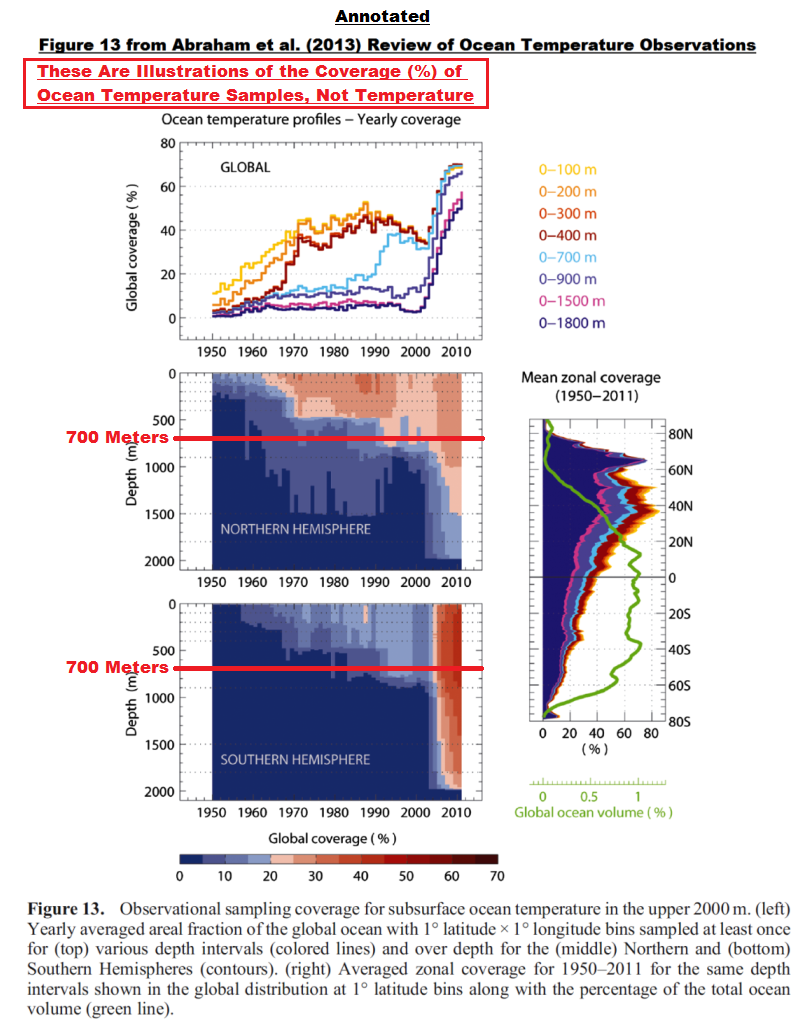
NOAA has used a “model” to invent these numbers.
There is something wrong with this graph! The Southern Ocean is cooling! Sixty degrees NORTH*! That would be Siberia!
* The graph lists 60N, which is Sixty North.
I was responding to the graph by O R above!
The maps of world thermohaline circulation show a underwater current coming south off the east coast of South America and joining the thermohaline current that circles Antarctica.
The discrete thermal haline urban legend was started by Wally Broeker. Wally invented the concept of a discrete deep water conveyor to try to explain the polar see-saw which is the name given for the fact that the Antarctic ice sheet warms slightly when the Greenland ice sheet cools and vice versa.
The idiots in pure science ignore the piles and piles of observations that disprove their pet theories. The planet warms and cools cyclically. Internal forcing functions are chaotic and affect only one hemisphere.
http://www.agu.org/pubs/crossref/2003/2003GL017115.shtml
Timing of abrupt climate change: A precise clock by Stefan Rahmstorf
Many paleoclimatic data reveal a approx. 1,500 year cyclicity of unknown origin. A crucial question is how stable and regular this cycle is. An analysis of the GISP2 ice core record from Greenland reveals that abrupt climate events appear to be paced by a 1,470-year cycle with a period that is probably stable to within a few percent; with 95% confidence the period is maintained to better than 12% over at least 23 cycles. This highly precise clock points to an origin outside the Earth system (William: Solar magnetic cycle changes cause warming and cooling); oscillatory modes within the Earth system can be expected to be far more irregular in period.
The analysis goes in circles as there are piles and piles of urban legends and zombie theories that have been thrown at the problem what causes cyclic warming and cooling and sometimes abrupt cooling of the earth.
Solar cycle changes are the cause of all of the cyclic warming and cooling in the paleo record. The planet resists rather than amplifies forcing changes (the amplifying urban legend has also started by Wally Broeker to try to explain cyclic abrupt climate change in the paleo record.) The explanation for cyclic abrupt climate change is the sun is different than the standard model and changes in a manner to cause the cyclic abrupt climate change in the paleo record.
First the following is the observation that supports the assertion that there is no discrete deep water thermal haline conveyor system to interrupt.
http://www.sciencedaily.com/releases/2009/05/090513130942.htm
Polar See-saw.
As Svensmark notes (see Svensmark’s attached paper that discusses the polar see-saw) there is no delay in the cyclic Antarctic ice sheet slight cooling and warming which correlates in time but is out of phase with the Dansgaard-Oeschger warming and cooling cycle warming of the Greenland ice sheet in the Northern hemisphere. The fact that there is no delay in the polar see-saw warming and cooling rules out ocean currents as the cause as there is a theoretical 1000 year plus delay in the ocean current change in the North hemisphere to cause a change in the southern hemisphere if there was a discrete deep water conveyor which there is not.
It is important to note the planet cyclically warms and cools (both hemispheres in sync except the Antarctic ice sheet is out of sync and cools and warms slightly). This paper notes that the Southern hemisphere cools and warms with the same periodicity as in the Northern hemisphere.
http://wattsupwiththat.files.wordpress.com/2012/09/davis-and-taylor-wuwt-submission.pdf
Greenland ice temperature, last 11,000 years determined from ice core analysis, Richard Alley’s paper. William: As this graph indicates the Greenland Ice data shows that have been 9 warming and cooling periods in the last 11,000 years.
http://www.climate4you.com/images/GISP2%20TemperatureSince10700%20BP%20with%20CO2%20from%20EPICA%20DomeC.gif
What we are currently experiencing is the end of a Dansgaard-Oeschger warming cycle. The D-O warming and cooling is caused by solar cycle modulation of high latitude cloud cover.
As the albedo of the Antarctic ice sheet is higher than cloud cover, a decrease in cloud cover over the Antarctic ice sheet
The cooling of the Antarctic ocean is due to cooling of the Antarctic ice sheet.
P.S. Observations continue to support the assertion the solar cycle has been interrupted and we are going to experience a Heinrich event.
http://arxiv.org/abs/physics/0612145v1
Thanks for that. Not just about the currents. polar see-saw; Clouds with a different effect depending on the albedo of what is beneath
I am going to read it a second time.
Old water, you have to be joking. The Surface of water does NOT obey the laws of thermodynamics because god got there first with surface tension.
The SURFACE of water will only allow radiated energy through its surface physical heat is blocked.
As the sun’s Radiated energy reaches the planet it first passes through the atmosphere heating the gases including co2.That heat is blocked only the radiated energy is allowed to pass and you can’t add to it because god got there first with Surface tension. There is NO such thing as AGW
When your practicing ‘heads you lose tails I win ‘ “science” then of course you can square the circle .
meanwhile
‘a fact often pointed out by climate change deniers.’ has no relationship at all to any science , it just throwing around a silly insult .
Well, it is after all, important to reinforce who the “enemy” is and who the “bad people” are so that the newly-enraged crowd knows who to attack for destroying the planet. Oh is it done pour encourager les autres?
It’ heavy, and it’s old, cos it’s dinosaur piss!
Yesterday a report on Yahoo had the temperature in Antarctica at -93 for some British Station. Don’t know if that included wind chill but it is very hard to conjure up “ice loss” at those kind of temperatures.
I wonder what it was before they fiddled it warmer
I’m no scientist or anything but I would think that all the water in the ocean is the exact same age.
Not all of it, no.
Right. Most water is ancient. New water is created when hydrocarbons burn. It takes work to destroy water.
Photosynthesis is a water destroying mechanism at work in the oceans.
SR
And those burning hydrocarbons were produced in the first place by photosynthesis.
SR
But can you pick out the one new water molecule in a line up of old water molecules?
The comment about the ‘old water’ is in the article, but not in the paper.
On a hot day I like a nice cold beer. Sure enough not long after I produce new water. Much warmer just like their theory predicts. The difference of course is that my new water is worth more than their theory.
Here one source of the Old Water:
http://bakerdistributing.com/wp-content/uploads/2015/07/old-milwaukee.png
+10 🙂
+100
in a list of replies that has had me rofl ,that one takes the biscuit rob 🙂
Colder, saltier water floats to the top. Who knew?
This is another example of the denial rampant among climate pseudo-scientists. There is already an easy explanation for the differences seen at the poles. The AMO drives changes in the ice in the Arctic.
As the AMO index warms, the water melts ice which allows energy to be released into the atmosphere from the water. This warms the air but eventually cools the water sufficiently that ice reforms and starts to insulate the water. The full cycle takes 60-70 years.
But hey, once the Arctic warming is shown to be natural the entire claim of dangerous warming is toast. They now have shown the Antarctic is not going to warm and to admit much if not all of the Arctic warming is natural would end the silly field of climastrology.
Most of the water in the lower portions of oceans is the old water, after all the Earth is an old planet, but by no means the oldest. According to astronomers in Lund, there is a lot to indicate that Planet 9 was captured by the young sun and has been a part of our solar system completely undetected ever since, there should be some even older water in form of a veeeeerrryyy old ice.
https://youtu.be/gVSEK9yvr3s
http://phys.org/news/2016-05-theft-planet-solar.html#nRlv
I thought it was Plan 9 that came from outer space?
No, Revolution 9 by the Beatles.
So…he doesn’t see any way a planet could form at such a great distance from our star, therefore it must have formed at the outer edge of some other star system? How does that work?
SR
In approximately six billion years, our galaxy will start to physically collide with the Andromeda Galaxy (M31) with gravitational warping beginning at four billion years.
One model I watched, estimated that from initial gravitational warping the whole collision will last for approximately three billion years.
There is a strong possibility that Andromeda’s satellite companion galaxy (M33) will join in the fun.
I’m sure there will be plenty of planetoids wandering in search of a solar system then.
That’s all it takes to free up planets is a gravitational source strong enough to kick one free. There are plenty of binary and triple star solar systems out there that kicked out planetoids in the wrong positions early on.
We better be kicked free of the sun … It will expand into a red giant and kill everyone on the planet if not transferred to (1) another solar system by gravity loops and kicks or (2) another planet (by technology and energy).
Let me put that on my calendar.
Aye RACookPE1978!
We need strip the Earth of everything usable, strip the Asteroid belt of anything that we’d need, herd all of the biological life we like into stock transports, then find a nice cozy spot to watch the galaxies merge.
When they’re mostly finished, we can look for a fresh new solar system, move an ideal planet into position, load it up with all of the goodies and move in. After we send all of the interior designers, unreformed climate team descendants and beauticians back to the old ‘newly terra-fried’ Earth.
i.e. unless mankind and critters have managed to evolve into beings of pure energy by then.
Four billion years to evolve before the merger.
Three billion years to evolve during the merger.
Old Sol will have expanded and either consumed the Earth or barbecued it thoroughly.
British Astronomer Royal Lord Rees has gone BB nuts.
Hello Vukcevic, good to see you again, always with thought-provoking ideas (seriously)
You said:
Which planet is Lund again?
does this mean we can’t hide heat in the ocean depths anymore?
Here is a transect from Antarctica to Australia sampling CFCs. Rather than cold water rising up to nefariously hide our preconceived idea of warming, that cooling around Antarctica is creating more cold water which is sinking, dragging with it absorbed CFS ( and CO2 ) to the depths:
http://mersaustrales.mnhn.fr/blog_mission/images/10%2001%202008/Image%202V.jpg
As I get older, I find that I get cold more easily.
Perhaps that’s what’s wrong with the water.
THE SCIENCE IS SETTLED DAMMIT!!!!
What, AGAIN?
My theory is that Trenberth’s “hidden” AGW heat is actually hiding much deeper… in the earth’s core! Our reckless production of CO2 is actually causing the core to melt from it’s pre-industrial solid state.
Did they forget that cold water is denser and sinks? Sure displacement by the wind can upwell some old cold water, but the wind isn’t always present, isn’t always strong enough to cause this upwelling and the S pole is a powerful source of new cold water to replace anything that upwelled to the surface. It will not take mere centuries to exhaust the cold (old or new) water, but will take until the Sun reaches its red giant phase and consumes the Earth..
This is a classic case of acknowledging only the small slice of reality that can be spun to support a cause while ignoring anything else. This is how politics works and this is how Nature reports.
My thoughts exactly. Water i(frsh or salt) s at its densest at around 4 degress C. This report suggests that denser fluids rise. On this basis the Laws of Thermodynamics and Archimedean principles are poor science and the proponents of AGW global change give us a new “science” where conjecture overrules observation and determinisatic theory.
No, saltwater has it’s maximum density at its melting/freezing point, the 4ºC maximum density only applies to freshwater.
Density depends on salinity as well as temperature. Also, much of this water is colder than 4C. Throw in surface temperature interactions and evaporation along with wind and subsurface currents and it’s obviously too complcated for your (below) average climate scientist.
Seriously. This time they’ve really got a handle on something. And, despite all the past pronouncements that predicted catastrophes that just didn’t occur, this time it’s true. We’re doomed. Once that “old water” applies for Social Security benefits it’ll bankrupt the system. The economies will collapse.
I thought of Old Water crawling out of the ocean and eating people like in the old-fashioned monster movies. Never thought of it lining up at the Social Security Office – somehow that’s much scarier.
If this has continued thousand years it can not be explanation resent cooling South waters, just eplanation of cold South as general.
But there is some faint claims that winds of the area are now more powerfull than before. Make sense if tropic is a bit warmer then there is larger thermal gratient = more energy to use.
So “missing heat” is on a way to the North Pole not to the bottom of southern seas.
And you may ask if this is negative feedback because colder sea surface means lager sea ice.
A funny thing is that the reality is in this case quite opposite to climate sciences claims about missing heat.
All deep water is cold. Around 4 degrees C. Simply because of the high pressures at that depth. Water has its highest density at 4C. Nothing to do with Old or New water.
As salt water freezes the water separates from the salt so the remaining water becomes more saline. This occurs at less than 0C. The resultant cold, extra saline water sinks through the surrounding water in columns much like cold air in thunderstorms. When Arctic or Antarctic ice forms, it creates very cold, extra saline water in proportionate amounts that sinks until it either hits bottom, finds fresher water to mix with or else finds a source of heat to warm up.
[Only in very still, undisturbed water uniform in temperature and salinity vertically from top to bottom. Add waves, under-ice currents, surface winds and mixing …It gets messy. Like thinking super-cooled liquids that freeze instantly are a common occurrence. They “can” happen, but it takes very, very unusual circumstances. .mod]
“With rising carbon dioxide you would expect more warming at both poles, but we only see it at one of the poles, so something else must be going on,”
Classic ! The author doesn’t consider even for one nanosecond that the CAGW hypothesis might be wrong & the “something else that is going on ” is that CACW isn’t what’s going on.
Many years ago on WUWT there was a beautiful essay, I think written by Willis Eschenbach, about the incredible complexity of the climate and the hubris of scientists who believe they captured its essence in a rather simplistic set of models.
Every discovery of a new factor interacting with the climate validates that essay. Wouldn’t it be nice if the climate modelers come to accept that the system is really really complicated.
“and heat is preferentially stored where surface waters are subducted to the north.”
The heat “prefers” to go north? Who knew?
Well of course. It goes north to cool off. No one likes being hot.
Duh.
that’s cause heat rises
Warm water rises to the top of the earth and cold water sinks to the bottom. Easy but /sarc off in case anyone thinks I’m really stupid.
two great minds….look up
Or is that “look down”?
Depends which way your holding the map, I suppose.
Not in climate science, no. In climate science, warm water can hide inside cold water.