Guest opinion: Dr. Tim Ball
Science is pervasive directly and indirectly in every phase of modern life. While the majority are not directly involved in science, they need to understand science and how it works. It is increasingly the underlying control of social, political, and economic decisions made by them or for them. They need to understand how it works, even if they don’t make it work. This knowledge must be a fundamental part of any school curriculum.
Climate skeptics struggle with getting the majority of people to understand the problems with the UN Intergovernmental Panel on Climate Change’s (IPCC) anthropogenic global warming (AGW) story. It was the theme of my presentation at the first Heartland Climate Conference in New York and many articles and presentations since. The problem is much wider because it relates to the lack of scientific abilities among a majority of the population. Based on teaching a science credit for science students for 25 years, giving hundreds of public presentation and involving myself in education at all levels from K-12, to graduate, and post-graduate, plus the transition to the workplace, I believe a fundamental mandatory change in thinking and curricula are required.
I believe abilities are an example of the ongoing nature/nurture argument. People can learn an ability, but can only achieve a high level of competence with an innate ability. For example, most people can learn the mechanics of teaching, but only a few are ‘gifted’ teachers. These concepts are particularly true of certain abilities, such as music, art, languages and mathematics. From my experience, I learned that most people with these gifts struggled with understanding why other people cannot do as they do. Often, they do not even see their ability as unique, and some deride those without their ability. On a larger scale than just mathematics, which philosophically is an art, is the distinction of abilities between those who are comfortable with science and those who are not.

Figure 1
Figure 1 shows the national percentage of students with High-Level Science Skills. Presumably, they are the ones who will pursue careers that require that level. Figure 2 shows the number of university graduates in science-related programs. By combining the data, it is reasonable to assume that approximately 15 percent of the population are comfortable with science.

Figure 2
Figure 3 appears to confirm that percentage as it shows the percentage of Undergraduates from the University of Michigan. Those graduating with a science degree include Engineers 3 percent, Mathematicians 5 percent, and Sciences 7 percent, for a total of 15 percent.

Figure 3
I was involved in many curricula fights, few of them ever resolved much. Ever subject area and discipline considered theirs essential to an education. They failed in achieving curricula useful to the student and society. This was because they were controlled by people ensuring what interested them or what ensured their job, rather than what the student needed to become an effective informed citizen. Students are not given the tools to avoid being exploited. Indeed, sometimes I think the system keeps them ignorant so it can exploit them as adults. Peoples of the Rainforest teach their children what they need to survive in the real and dangerous world in which they live. We don’t do this at any level. For most North American university or college students the experience is simply a socially acceptable and ridiculously expensive form of unemployment. Most of them learn more about life and themselves in part-time and summer jobs.
Michael Crichton, best known for his scientific novels like Jurassic Park, was a graduate of Harvard Medical School. He wrote an interesting novel, State of Fear, that used global warming to illustrate how environmentalists misuse science for a political agenda. This misuse works because 85 percent of society are unable to know what is happening. However, there are other ways to determine that misuse is occurring. For example, I am not a mathematician, but I do understand the scientific method. I knew from the start that the goal was to ‘prove’ the anthropogenic global warming (AGW) hypothesis, not to disprove it. Richard Lindzen’s comment very early in the debacle that the consensus was reached before the research had even begun resonated with me immediately.
It is true that the devil is in the detail. I did not have the skills to detect what Michael Mann did to create the ‘hockey sick’, but knew from knowledge of climate history and other evidence that something was wrong. To quote Popeye as my philosopher of record, “I don’t know how’s youz duz it, but youz duz it.” It took the skills of Steve McIntyre and Ross McKitrick to identify how it was done. It was the nail in the coffin, but the coffin was already under construction. Worse, the coffin is still not finished.
Crichton also gave a speech to the Commonwealth Club in San Francisco on September15, 2003. Here are his opening remarks.
I have been asked to talk about what I consider the most important challenge facing mankind, and I have a fundamental answer. The greatest challenge facing mankind is the challenge of distinguishing reality from fantasy, truth from propaganda. Perceiving the truth has always been a challenge to mankind, but in the information age (or as I think of it, the disinformation age) it takes on a special urgency and importance.
We must daily decide whether the threats we face are real, whether the solutions we are offered will do any good, whether the problems we’re told exist are in fact real problems, or non-problems. Every one of us has a sense of the world, and we all know that this sense is in part given to us by what other people and society tell us; in part generated by our emotional state, which we project outward; and in part by our genuine perceptions of reality. In short, our struggle to determine what is true is the struggle to decide which of our perceptions are genuine, and which are false because they are handed down, or sold to us, or generated by our own hopes and fears.
The main theme of his talk is the political use of environmentalism as a religion for indoctrination and control. His concluding remarks state:
Because in the end, science offers us the only way out of politics. And if we allow science to become politicized, then we are lost. We will enter the Internet version of the dark ages, an era of shifting fears and wild prejudices, transmitted to people who don’t know any better. That’s not a good future for the human race. That’s our past. So it’s time to abandon the religion of environmentalism, and return to the science of environmentalism, and base our public policy decisions firmly on that.
I agree, but how do you resolve the problem of science being the answer when 85 percent of the people don’t understand science? I agree with Crichton about Environmentalism, but it is a wider problem. Every aspect of society is a function of science and technology that is vulnerable to political manipulation.
For me, the obvious answer is to have compulsory courses in Science. They should occur in Elementary, Middle, High School and College and University. Everyone needs to know what science is, how it works, and how it evolved. If everyone knew about the scientific method the challenges I faced in my first presentation before a Canadian Parliamentary Committee would not have occurred.
The hearing involved the issue of ozone. I did not want to attend because I knew it was pure political theater designed to exploit an environmental issue. I had no choice; it was a quasi-judicial hearing with incarceration the threat for failure to appear.
I was grouped with two other science people and we had less presentation time in total than the five “Friends of the Earth.” (Think of the arrogance of that name; if you are not in our group you are not a friend of the Earth.) I expected that bias. Biases are only problems if you are not aware of them. I also realized that the politicians knew little or nothing about science. However, the presentation of one of the scientists disturbed me most. He presented data of ozone levels over Toronto for a period when I knew there were no such measures; he particularly stressed one very low reading. I realized this was computer model generated data. He did not explain this to the politicians who thought it was real data. In a break after his presentation, I asked if he knew about the scientific method and was surprised when he said no. I decided at that point to break protocol and replace my submitted presentation with an impromptu explanation of the scientific method.
This began by explaining, as a geochemist colleague put it, that people think science provides answers. It does, but only rarely. Science works by asking and vetting questions. The questions are presented as a hypothesis based on assumptions. Other scientists, acting as skeptics, challenge the hypothesis by testing the validity of the assumptions. In other words, they try to disprove the hypothesis. I told the politicians that the CFC destroying ozone hypothesis was untested.
I then explained that a scientific hypothesis was akin to speculation based on a few selected facts. That science was constantly creating hypotheses, which in this time of environmental hysteria, received media attention but also attracted people seeking research funds. I told them I could produce several hypotheses based on a few facts that presaged global disasters. I gave one example, the potential collapse of the Earth’s magnetic field and the resulting damage to plants and animals without the protection it provided. I wanted to know what my government planned to protect the citizens.
The challenge for scientifically illiterate politicians, I subsequently found out there was only one who had BSc in biology, was to decide which of these threatening speculations warranted their attention. The current response is to fund those that will advance their career. They do this partly because of the self-serving nature of people and politics, but also, because they are ill-equipped to make a better judgment. If they knew and understood science and how it works it would be different. It certainly would be different if they knew the constituents knew.
If people knew that science involves constantly asking questions and only occasionally finding answers their understanding is measurably improved. The few acceptable answers are only those that withstood challenges and eventually made accurate predictions. All skeptics would need to do is show, to an educated mostly non-scientific public, that a hypothesis failed most challenges and produced incorrect predictions without having to involve the arcane scientific complexities that baffle the 85 percent. As I explained in another article, Aaron Wildavsky understood this when he chose only non-science graduate students, members of the 85%, to investigate environmental threats already being exploited. They found none of them withstood scrutiny.
Education is actually free here in Finland and as such everyone is expected to go to university.
That plays a big part in the success.
..Nothing is FREE…Someone, somewhere, pays for it !
It is free here in Norway too. Look how much it helps.
Jan
Anything above average is considered elitism in Norway, so what’s cultivated in our schools is the mediocre.
MIT is $60k per year. But it’s the hard frost killing my newly planted apricot trees right now that makes me a skeptic.
Steinar Midtskogen
May 15, 2016 at 4:05 am
Anything above average is considered elitism in Norway, so what’s cultivated in our schools is the mediocre.
____________
Where as here in Finland, society expects you to go to Uni. If you have no job, if you want any support you gotta go to school or find work, no sitting on your behind.
Education is available to everyone here, so everyone can have an elite education, which is good.
Norway’s problem is then social. If it is free, then there is education equality, anyone can have an elite education. If they are not taking it up, that is a question for society as to why, Steinar made an interesting point.
Does the Finnish government realize that not everyone is suited for college? What happens to the inevitable ones who can’t keep up with the curriculum? Do they get “I participated!” degrees?
Steinar Midtskogen
May 15, 2016 at 4:05 am
Anything above average is considered elitism in Norway, so what’s cultivated in our schools is the mediocre.
__________
Is the Dystopian left in Norway?
Mark May 15, 2016 at 4:51 am: Is the Dystopian left in Norway?
The public school is a political tool to level out social differences, and perhaps some will see that as a sign of the dystopian left.
Nothing is FREE Mark, the citizens of Finland PAY for all that “free” education with higher income taxes and fees than the citizens of other countries pay. Finland also offers “FREE” college to citizens from other countries, as long as they pay their own living expenses while they study in Finland. I wonder how the Finnish people feel about THAT….
The problem with this whole topic is that what qualifies as “science” curriculum varies from university to university and country to country, even state to state. Progressive universities are incorporating more and more “social science” into their programs, and using less and less fundamentals like the Scientific Method, and logic.
And statistics are just tools as well….they don’t always reveal “the truth” well. Let’s examine what you call “the success”:
http://www.scientificamerican.com/article/the-worlds-best-countries-science/
For example, the OP talks about how many “science” graduates there are in Finland, and yet, if you look at linked article, the metrics of scientific advancement/success- journal publications, annual governmental spending towards R and D, and number of patents held on medical, tech, and scientific products-the US is still #1. We spend more, we publish more, we develop more advanced products in the “scientific” field, and we have more people with PhD’s than any other country.
Finland ranked #25. I wouldn’t call that much of a “success” myself.
There is no adjustment for population in the Scientific American tabulation, making direct comparison between the U.S. and Finland ridiculous!
Well “Free” education sounds like a worthy goal. But when it is free, and the student has no skin in the game, then what does it matter what (s)he chooses to study.
If you had to come up with the wherewithal to pay for your education, you might be a bit more selective in your choice of studies.
Like maybe studying something that can earn you a living, for YOU and YOUR family.
San Francisco State University has its famous Ethnic Studies School.
Yes its a school for racism, and a disproportionate number of its students, would seem to be more desirous of eliminating racism, rather than teaching it.
G
Whether simply correlated or causative , Finland has long been recognized as having perhaps the highest usage of APL per capita in the world . Google “APL idioms” and you will immediately be offered “finnish apl idioms” leading to http://aplwiki.com/FinnAplIdiomLibrary .
As Ken Iverson quoted A. N. Whitehead in his Turing Award lecture Notation as a Tool of Thought :
Works for me .
Yay! A long time since I’ve seen any reference to APL. I’ve forgotten pretty much all I used to know of it 🙁
:B-) The Florida state dept. of Educationism used to use APL for budget work, db management, tracking back-ups… But then my room-mate was eccentric that way.
In reply to Steinar, who knows about Jantelov, which is a fact of life in Scananavia (but not Finland?). I associate it with socialism, where equality means no one can be special. See also American Exceptionalism. I remember something from Victor Hugo (?) where nobody is allowed to be a hero — it makes the rest of us look bad.
https://en.m.wikipedia.org/wiki/Law_of_Jante
I disobey 8 of the 10 Jante rules. The two I obey inadvertently are: I don’t laugh at people and I doubt I could teach them anything. You can always tell a {Swede, Norwegian, etc} but you cannot tell him much.
Seems to me that this could be condensed as ” Don’t come first if you can come last, you will get more applause”
In my experience, few people value what they don’t have to work for.
This is especially true of education.
Well I would like to see a more specific break out of “Science” education, as I’m not convinced the above chart is realistic.
For starters, MATHEMATICS, and COMPUTER SCIENCE. What fraction of the result do they include, because NEITHER ONE of those subjects is SCIENCE.
They both are ARTS. Yes extremely important, and valuable, skills (marketable). But neither one involves “Observations and experiments.” So neither relates to the real universe and all that goes on within it.
Mathematics is a valuable and essential tool of scientists, and computer science is simply a mechanized implementation of some of the manipulations of mathematics.
Certainly Science, whether the physical sciences, like Physics, Chemistry, or the biological sciences would be severely constrained without mathematics, and today without the results of the computer science discipline. But they still are just tools of science; and also often the tools of mischief as well.
So I wonder where Finland and Japan figure in the statistics, if you excluded mathematics and computer science.
As for the “Social Sciences”; it seems to me they are neither social, nor scientific.
They are the idle machinations of persons who for some reason can’t bring themselves to mind their own business.
G
If it’s free, then adding say a million or two immigrants won’t cost anything.
its free in Germany too isn’t it?
Yes, but in Germany you can only go as far as your intellect and ambition take you. If you don’t make the grade in high school you don’t get to university. If you don’t make university then you might make technical school…or not if you won’t apply yourself or if you’re just not smart enough.
Sounds very practical to me Mike.
When 65% of ALL US University PhD in Physics graduates, NEVER ever find a full time permanent job working in their special field of expertise, it seems like a great waste of resources.
But the 39% in the category of “Social sciences” ; which are neither science, nor social, reported in this study, seems to be the real travesty.
I was very fortunate to attend a “Technical High School”, where I could learn the basic elements of every ordinary trade occupation, as well as pursue more academic things.
So if I needed to cut, plane, bend, machine, shape, weld, wire, build, hammer, file, weigh, whatever, I could do any and all of those things, before I ever saw the inside of any University campus building.
And all of those common trade skills were invaluable, when it came to helping a startup LED company get off the ground on a shoe string, and accomplish things with at least one order of magnitude less money involved than our principal competitors burned through.
In one instance, we added a seven dollar clock motor to an ordinary $300 off the shelf Temperature controller, to achieve what our main competitor did with a $35,000 computer system. So they figured we might have four such systems, in our factory; when in fact we had 72 of them. (and we darn near decided to build 72 more (but didn’t need to))
Higher Education may be one of the greatest money wasting enterprises of all time.
And the purveyors of it, have a vested interest in keeping their gravy train rolling on.
G
PS: NO ! It was not I who came up with the $7 gizmo. Somebody else with his feet on the ground also.
G
Will confirm ges’s statistic. Hal Salzman, Daniel Kuehn, B. Lindsay Lowell, Michael Teitelbaum and others did studies of USA STEM job markets and found we were turning out 2-3 times as many STEM grads as were landing STEM-related jobs (year after year since at least about 1999), and have testified the same to congressional committees. Statistician and CS professor Norm Matloff looked at Intel and found they employ very few STEM PhDs…nowhere near enough jobs to avoid massive waste of STEM talent.
And his other point about academic credentials being beside the point has also been confirmed by NSF. Some 20% of practicing engineers and 40%-44% of highly-skilled computer wranglers do not have university degrees, and HS students & people with music degrees can also make very good software product developers. Florman, president of one of the professional engineering societies confirmed that the split between academics and “muddy boots” engineers was about 59-50 in 1900 and remains healthy.
My “statistics” on the PhD employment success rate, was from a study done by the American Institute of Physics, and published I believe in Physics Today.
They found 30% got full time permanent jobs in their field of expertise, being paid to do what they were experts at. Another 5% got short term part time jobs in their field, but then had to basically go and find a job doing something else quite unrelated to their specialty.
The majority of the 65% ended up as permanent post doc fellows, in some institution or other.
If you do your PhD thesis on something your mentor suggests you do, because nobody else has published any papers on that subject, so you will be the first, and the most often cited.
Well you also are likelu to be the world’s leading authority on that subject, which is another way of saying you are the only person on earth with ANY interest in that.
So nobody is going to pay you to work in your specialty, unless you study how to do something useful.
G
PS I should reiterate this study was for Physics PhDs only. Can’t comment on any other disciplines.
Yes I know there are jobs out there where a PhD in the field is absolutely essential and mandatory. Don’t go getting the idea I’m down on PhDs. They are worth their weight in gold, in the right areas of expertise. I chose to go into industry and engineer, with my bachelor’s degree; but as a Physicist; not as an EE or somesuch. When push came to shove, I could go right back to the bare metal if need be.
“Ever subject area and discipline considered theirs essential to an education. ”
Should that be EVERY ???
If you can make sense of it as written then feel free to go with that.
Very relevant article.
I feel students are no longer taught to look at things from more than one viewpoint and tend to take the teachers/professors viewpoint as the only true one.
I agree, students are not taught to look at things from another viewpoint. They just parrot what their tutors tell them. And the fact that universities are accepting anyone (at least in the UK), doesn’t help. I’ve got lots of friends with science degrees, and they know f**k all about anything. One of my friends has a degree in astronomy, and she actually thinks you can see the American flag on the Moon from Earth. Her math skills are awful, and she’d never heard of a synodic period. And never mind the students, most of the tutors are crap. One well known planetary science tutor had never heard of lunar nodes! We need good science, not just statistics about which country has the most science graduates. That’s just window dressing. Call me jaded……
That means the 97% number is true.
They do believe!
The fact that so many of our students today are engaged in “Social Sciences” says it all about where all the “social justice warrior” batshit ideas are coming from–instead of an actual understanding of the natural world.
To be ‘fair’, Social Justice used to be about urban planning and community development and had little to what radicals are pushing today. It all started in the 80s as a response to decaying urban neighborhoods. Cities around the states were not much different than what Detroit or Baltimore is today. But after the work was done, many radicals of the movement created the social justice courses that we see today…They still beliveve they’re in the 80s thus all of the madness. Meanwhile, those, like my own mother who is pushing 70 years of age, have moved on to improve impoverished areas around the states while her counter parts are poisoning the minds of future generations.
Dog, the term “social justice” has been around a lot longer than just since the 1980s. It used to be about actual just societies, and it’s premises were far more pure and just than they are by those who spew the terminology today. https://en.wikipedia.org/wiki/Social_justice
@Aphran
I never said it started in the 80s and you should know better than to quote wikipedia which is known to be a hot spot for disinformation for politically and emotional hot spots. I was simply stating the flip side to it all.
i mean i do state that the results of the 80s is in part responsible for the actions of those today…[trimmed] semantics…use ur intuition.
[Better to use your editor. .mod]
Can someone explain “Feminist Glaciology” to me?
@Mod
Yeah, I should have waited to get home before posting…Never write posts on a phone! Uhg, what a mess…
“Can someone explain “Feminist Glaciology” to me?”
I’d assume it’s what happens when you drink or eat something really cold way too fast with thoughts of patriarchy?
http://brainblogger.com/2008/07/06/the-science-of-brain-freeze/
So just what the hell is “social justice” and what is fair about it ??
G
Students are now taught what to think, not how to think. They are then tested to a standardized test that is politically correct on information/thinking. This is what is done at my local community college where I no longer teach because I did not conform in my teaching methods (critical thinking and scientific methods). The US students today are like robots in their reasoning abilities.
I completely agree.
It’s as if the entire learning experience these days is compartmentalized into finite categories from which all students must follow, a narrative so to speak, in order to achieve their goals despite the fact that more often than, it’s throws them into life long debt from which they can never escape since bankruptcy laws don’t apply to higher education…It’s truly sickening.
Well Judy, they have to have a feeling of self esteem, don’t you see. So long as they follow the correct method, that is more important than getting the correct answer.
Hey ! Earth to ‘common core’ !! ; If you follow the proper method, you ALWAYS get the correct answer. In fact that is how you DEFINE what is the proper method.
Much of ‘what’ you learn in school, is obsolete or wrong, by the time you get out of school.
BUT ! , if you learned HOW TO LEARN, in school, it doesn’t even matter if the “info” is later discredited.
G
The basic philosophy of Common Core is the rejection of the teaching methods that produced moon landings, the Theory of Relativity, science, and medicine.
They presumed to produce a superior teaching method, when all they did was confuse the students (and their parents).
One of the problems is that elementary and secondary school mathematics teaching is very bad. Furthermore, administrators do their best to squash good math teaching.
One example of good math teaching that many people will be familiar with is Jaime Escalante. He was the subject of the movie Stand and Deliver. He showed that math can be taught to most students, even the disadvantaged, at a high level. You would think that the administrators would get excited and try to duplicate his success. It didn’t happen.
Another example is John Mighton. He has shown that most people can learn math at a high level with his program Jump Math.
John’s observation is that most people become bad at math the same year that they have a crappy math teacher. Since math builds on itself, they are usually done forever. An important part of John’s tutoring work is to convince the students that they are smart enough to do math. Only then will they think it is worthwhile to do the necessary work.
We have crappy math and science education because most people don’t expect better. Once we know that excellent teaching exists, we can demand it. (And, no, just mandating more testing doesn’t work.)
Excellent is available. Check out Jump Math. Check out Finland.
My dad was a math major (wound up being a lawyer), and he is very opinionated about this subject. He tutored a LOT of “mathematically challenged” students who majored in everything from music to elementary education to various sciences. In order to help these students understand the concepts, he had to come up with explanations and connections that made sense to that student, rather than regurgitating the same lesson and language that the professor and textbook provided. This meant he had to look at the math in a very different way than he naturally did.
One of the problems he has identified in math education is that the people who become (or became) math teachers were the people who understood math as it is usually taught in schools and/or had an innate mathematical talent. This is not bad in itself, but it often means that the teacher does not think about the fact that many people do not naturally think in the “normal” math language. Some teachers are able to look at math concepts from multiple sides, and translate them into language that most people can understand. The tough part about math (and science) education is finding teachers who know the subject well AND are able to communicate the material to students in a way that the students understand.
Ironically:
Finland is the country which could not afford to implement the recommendations from the OECD to reform their educational system.
Norway could afford the reformations, and reformed their educational system in 1971, 1974, 1987, 1994, 1997 og 2006.
Now Finland is on top of the scale measuring scientific skills, Norway is at the bottom.
Yet another great article from Dr. Tim Ball. Thank you Tim, and long may you keep giving us your wisdom.
Absolutely horrid article with little wisdom.
How ironic that Tim Ball uses a quote from a fictional character based on a scientific hoax. Popeye truly knows nothing as spinach is not a great source of iron. How many decades of children were tortured into eating spinach based on this scientific fallacy.
He accuses “Friends of the Earth” of being arrogant because they think everyone else is not a friend? Can Tim give us the logical fallacy in that thought? How arrogant is it to go before the Canadian Parliamentary Committee and presume it is his job to not inform or advise them, but to teach them about the scientific method?
There are lots of other problems with this article but I don’t have time.
You actually haven’t shown one problem with his article but have shown your pathetic bias.
You show up, rant about other stuff, and dont point out the parts of the essay you have problems with.
Too much emotion, come back when you have calmed down love, have a cup of tea
We should all be grateful to ‘Dan’ for taking the time (apparently his time is very valuable and he is quite busy) to stop by to give us his
informed opinionwell-reasoned thoughtsscintillating insightinformative commentsad hom.I stopped at ‘absolutely horrid.’
Clearly you’re one of those gen. Zs/sjw/special snowflakes that find anything and everything offensive.
If you’re so ‘triggered’, why not hobble over to one of your safe-space echo chambers instead of subjecting yourself to the tortures of reason?
Why are you even here to begin with if you’re not prepared to give a sound rebuttal?
Dan, Dan, Dan,
Logical fallacies are not your strong suit….or maybe they are, as you seem to commit so many in such a short time. Depends on the point of view I suppose.
The whole “spinach” and “Popeye” thing was not a scientific HOAX. But nice try. “Popeye truly knew nothing about spinach” because in 1870, the German SCIENTIST (chemist) Erich von Wolf accidentally misplaced a decimal point when transcribing the iron content in spinach-giving a 100 gm serving of spinach 35 mgs of iron, instead of 3.5 mgs. That “scientific mistake” wasn’t corrected until 1937.
Popeye was introduced into an already existing comic strip called Thimble Theater in a minor role and later became it’s star. He was not created based on a “scientific fallacy” or even eating spinach.
Also, Dr Ball says that the NAME “Friends of the Earth” is arrogant, not the actual people. And I would think it highly practical, rather than “arrogant” to inform and advise the Canadian Parliamentary Committee on the “Scientific Method” if even the other “scientists” advising and informing them didn’t even know what it was. How on earth can politicians determine what is true and what is false if they have no standard to measure information with?
It’s probably a good thing that you didn’t have more time, because if your short complaint was any example, you’d just be splattering more logically flawed rhetoric all over the place and contributing nothing in the end anyway.
“There are lots of other problems with this article but I don’t have time.”
You don’t have the scientific literacy or the knowledge either.
This is a reflection of the egos of the instructors and the inadequacies of institutional philosophical bases. Serious efforts need to be made to stop professors from indoctrinating students via one sided perspectives.
Sorry, somehow my comment above landed in the wrong place. I was ranting about the lack of rigorous discipline in maintaining scientifically unbiased perspective in universities these days.
Yeah, and Dan? It must be very dark where your head is at. As a Canadian I am very thankful for any guidance prof. Ball can provide my country’s politicians. They are much like yourself I fear and greatly in need of illumination.
Ate plenty of spinach thanks to Popeye and a mother who knew how to cook fresh spinach. But canned or frozen spinach turns most anyone off from spinach.
Good in a salad too!
Beg to differ re your opinion of spinach as a source of iron
https://en.wikipedia.org/wiki/Spinach
Perhaps spinach does not contain as much iron as Popeye thought but as a vegetable it’s not bad.
If he really wanted iron he should have chewed on a bit of raw liver but he’d have had to be careful about vitamin A poisoning
“I knew from the start that the goal was to ‘prove’ the anthropogenic global warming (AGW) hypothesis, not to disprove it.”
Indeed, United Nations climate panel, IPCC, was heavily biased from the very beginning
Report of the second session of the Intergovernmental Panel on Climate Change (IPCC) 28 June 1989 e.g.
“In welcoming the delegates to the United Nation Environment Program (UNEP) Headquarters … The Executive Director of UNEP, hailed the fruitful alliance between World Metrological Organization and UNEP. The firm commitment of prof. Obasi, the Secretary-General of WMO, coupled with the determination of UNEP leadership, has resulted in a partnership which is helping to unify the scientific and policy-making communities of the world to lay the foundation for effective, realistic and equitable action on climate change.”
Oscar Wilde
“Life imitates art far more than art imitates Life.”
My view of how science is understood is of two camps.
1. The cartoon camp.
2. The expert camp.
Most all of us are in the cartoon camp when we venture outside of our narrow field of focus.
1. The cartoon camp is myself reading an article in Science mag on Astroseismology of distant stars determining its magnetic properties, or of Climate Change prognostications for the WAIS or Greenland, as just two examples. Those graphs from those examples of much reduced and interpreted data, I have zero ability to pick apart, compare with other infield subject experts, or see the real limitations that are not explicitely laid out in the text of said article. I have to take them at face value. I have to trust the cartoon depiction from those experts, of the “goes into” and the “comes out of” arrows and lines as their best depiction of the raw data and the arcane reduction process, specific to the field, they used.
2. The expert camp: My doctorate is in molecular biology-immunology. I read, ponder, and compare those researchers’ manuscripts and published papers to my own base of supposed expert knowledge. A knowledge of others in the field, the controversies, the limits of the detection technologies, the common statistics used by my field, to form an opinion of what is sound and what is on quicksand waiting to dissapear. And even within the expert camp, there are of course subspecialties with which I am reduced again to the cartoon camp unless I want to expend considerable time to learn that field’s methods. For example, for me innate immunity is not my stdy area but related, where my focus was adaptive T cell immunity. I can learn the details, but still I can use common areas of uncertainty and statistics to form opnions of the reduced data being presented. I have no doubt an expert in solar seismology can make quick estimations of a solar wind physicist’s data presentations.
Outside one’s very focused speciality, everything else is cartoons. We can view the graphs, the data plots, but all that is derived from a raw datasets that is arcane to those not directly involved in that field.
But going back to the high school level or the freshman level of science taught in colleges, the opportunities to leave fmisleading “consensus” pseudoscience cartoon depictions in legions of college kids is possible.
So we see cartoon science now in high school science texts and freshman-sophmore college text books. There is so much vast breadthe that students of science are now expected to incorporate into their memory. Essentially those science cartoons portray a message. That message is one of “consensus,” here is the consensus science in this area. You must learn it and regurgitate it on a multiple choice exam, and then you too can get your BS degree (pun intended) to join the rest of the consensus trained undergrads. Tht is not to say one can not app,y scientific principle of uncertainty and skepticism in other fields. It is just with major additional effort that say a geologist may require indepth study of atmospheric physics to understand GHG theory the way an armospheric physicist working in the field does. The rub comes from the raw data. How do you go from a fle cabinet full of raw data to 3 or 4 graphs and charts of reduced data? That distinguishes the cartoon science from the in-field scientist.
In science, we scientists must inherently trust our colleagues are not intentionally misleading us. That is where we find ourselves today in outside scientists looking at climate scientists communicating climate alarmist messages.
Too often it appears, the out of field scientist is being taken for a ride (so to speak) by the climate scientist with an agenda, an agenda to deliver a politically convenient message.
Now clearly I have admitted I am of a cartoon science category when it comes to solar science, climate science, atmospheric science, the physical sciences in general. My training is in the biological sciences. Fortunately for myself, I have a BS in Civil Engineering so diverse, broad subject areas comes naturally. So given time and study I have invested, and an understanding of underlying statistics, the cartoon science of today’s climate science is quite profoundly lacking in “science.”
Well stated joelobryan and thanks for your article Dr Tim.
As an experienced petroleum engineer (retrained electrical engineer) I needed to self educate myself when the global warming issue became front page material and I started wondering about my ethics being employed by one if the largest oil companies. I started searching the web and spent considerable time evaluating blogs such as “De Smog Blog” and “Skeptical Science”. It was pretty obvious that these and others of that ilk were biased. (Thanks to my technical education and work experience). Stumbling onto Anthony’s blog was a revelation. Thanks Anthony and thanks to the many other authors and contributors, both skeptics and AGW supporters who give this site the balance you don’t see often on the other sites
While molecular biology requires specific training, when “climate scientists” produce statistical analyses other non Climate scientists can have more than a cartoon input if statistical analysis is their thing, a perfect example of that is Steve McIntyre.
When Marine Biologists claim man made global warming is causing mass Bleaching, a layman can dig up evidence that shows the mass bleaching has other more relevant and logically based conclusions, because blaming AGW when AGW is still a hypothesis (because all evidence has other equally and more scientifically grounded explanations) means the marine biologist claiming AGW is the cause, is not scientifically supported and they know it, which denotes a complete lack of scientific principle.
A paper can claim global warming is causing more precipitation, but a layman can look at water vapor trends and see the claim is bunk.
There are many areas of climate science a layman can look at, and research and indeed show that the paper is incorrect.
Scientific study should always be logical, the process of discovery must be logical, mathematical calculations must be logical. Laymen can spot contradictions and logical fallacies, an example is Muons, using them to “prove relativity” is indeed a logical fallacy any layman can recognise, and if the scientific argument, made with scientific findings, is a logical fallacy, then the science is not logical.
Conclusions of scientific studies also are not always supported by the data within the paper. Non scientists can look at data, some do it here all the time, and can analyse data and see the conclusions are bunk.
While specific sciences require understanding often the data does not require this understanding in order to analyse it, one just needs to understand the tools used to create the data.
Mark,
I agree the point about Steve McIntyre. But he had to devote many hundreds of hours of study and analyses to understand a field of science outside his own area of expertise to fully debunk the Mannian tree ring hockey stick. Many outside scientists do not have the time for that. We rely on the honesty of other scientists in other fields to be honest and self police their colleagues.
And where you say:
Someone had to create those water vapor trends from raw data to debunk a claim made elsewhere.
Q: What happens when the water vapor trend graph maker is in cahoots with the other pseudoscientists to sell a narrative to maintain a dogma?
A: The layman is continued to be taken by the deception. That is why what is going on in certain agencies of NOAA, NASA, and the UK Met Office will be so utterly destructive to the entirety of those organizations and science in general when nature finally reveals the hustle.
When a chemist can’t understand a chemistry paper, we have a problem.
1 – The paper’s subject will become a dead end.
2 – So few people understand it that the result is pal review.
There’s a big difference between a work of total genius, like relativity, and stuff that’s crufted up with insider jargon. The jargon problem is largely solved by working on communication skills.
I am not sure that I agree entirely with the cartoon camp. Many scientific disciplines, including physics and engineering, require a sophisticated understanding of the principles of measurement and of data analysis.
Many of us are quite capable of understanding the methodology of many climate science measurements and analysis. To say that our opinions are dienfranchised because we are not climate scientists are absurd.
What turned me against the consensus was Real Climate and the censorship practiced by “leading” Climate Scientists. It was clear they were closed to any new evidence that might upset their views on Climate.
For example, why do the ocean charts, drawn hundreds of years ago to an exacting level of detail that has never been repeated, why do these charts not have a correction for seal level rise in their datum?
It seemed to me that if sea level rise was real, the first place we would see it would be in the charts that thousands of mariners rely on every day to prevent the loss of ships and lives.
The charts are drawn to 1 foot accuracy in depth, and we are told sea level rise is more than 7 inches in the past 100 years, and the charts are older than this, so why are the chart datum not corrected for this?
But Real Climate dismissed my questions out of hand, without investigation. That is not the action of scientists, it is the action of activists in lab coats.
ferd,
Like you, Real Climate and a couple of other sites like it quickly turned me against what they were preaching. They pegged my B.S. meter. I had already heard too much about past climates (e.g, Medieval Warm, Little Ice Age, etc.) which they were heavily denigrating. So, I decided to take a look at the Vostok data myself. That did it. I knew then that they were preaching and propagandizing, not advancing the science. It didn’t take me long to find Climate Audit, which was just starting up. It eventually led me here and to Judith’s site. Can’t say I can now sleep any better at night, but at least I now know other people that verify my initial suspicions and my B.S. meter is still working.
You can teach people about the BS Meter, but some of us are born with an “innate” BS sensor that is highly developed, and we’re rather “gifted” in discerning its presence, even in small amounts. 🙂
Some examples of BS in science: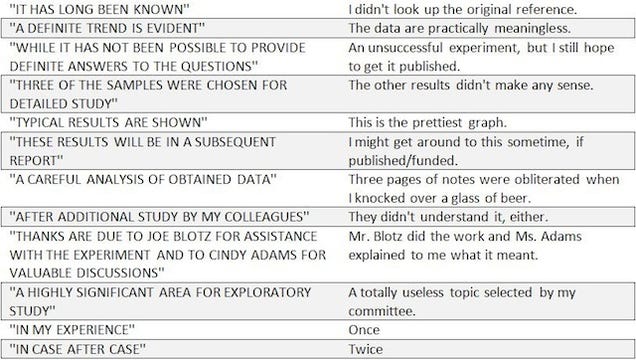
Alphan,
I was lucky, I had a manager many years ago that had the best B.S. meter I have ever seen. I had to give him several presentations for a project I was working on. He may know absolutely nothing about the subject you were presenting but within 10 minutes and a couple of questions asked he knew exactly how much you knew about your subject, and woe be unto you if you tried to B.S. him.
All it took for me was Phil Jones’s remark about his data, and trying to find something wrong with it. A real scientist would have said yes, look at my data, and see how I reached my conclusions, and marvel at my genius! Only a fraud tries to hide behind the curtain.
Sorry, but I have to disagree with you. The scientific method is the same regardless of the area of research. Any well-trained scientist can recognize when the method has been violated or misused. Case in point, when a climate scientist calls the output of a computer model ‘data’, or worse, proof. We can recognize logical fallacies, missing data, abuse of statistics, unstated confounding factors, and lack of consderation for other possible explanations and conclusions.
More than that, we know how to read the research. Sure, there may be many esoteric papers that we simple don’t know the terminology to understand the research, but we know that if a researcher touts the growing interest in his area, and justifies it with five footnoted references, that he is engaging in self-serving BS when all of those references are his own publications.
Sometimes you do not need to be an expert in cow manure to recognize it as such.
But do you have the time and background to get into the weeds of what lays between raw data and a well honed data figure for a peer-reviewed journal?
My point is that all fields of science today areadvancing so rapidly on so many fronts, that one scientist getting hit by something outside his/her field must, in most cases, take it at face value and move. It is just that climate science has such a huge social and economic cost associated with the policy prescriptives it invokes makes its critical examination by all nscientist necessary.
For me, the obvious answer is to have compulsory courses in Science. They should occur in Elementary, Middle, High School and College and University. ~ Dr. Tim Ball
Dr. Ball, there is a problem with that obvious answer. I have worked at all levels that you mention and I have seen enormous amounts of indoctrination. If we could be assured that we had good instructors teaching the young the way science is supposed to work then we are on the same page. But if we have left-wing social justice warriors teaching the middle school kids that science “must reach a consensus” (I swear I heard a woman say that to 8th graders) then more science schooling might just make things even worse.
My solution is similar to yours, but I would get government totally out of the education business and privatize all schools and training. Government can pay the bills for those who can not pay themselves, but government must be taken out of the schools and universities if you want even an outside chance at teaching truth in schools.
OK, what if that is not going to happen? Then we need a large group of scientists (real ones, no one named “Mann” need apply) to help produce a series of videos (and complete curriculum for classrooms) on how the scientific method works. How the scientific method has improved our lives — there are millions of great examples to pick from. How logic and observation meld together to answer questions that mankind has. How “what is so obvious” often is not reality after all.
Whatever group would fund such a documentary series, should make that series to reach various age groups (age-level appropriateness really is important), and should make the series available for the classroom teacher at no charge.
It is my belief that logic is mankind’s main tool for living a good life. Mathematics and science can teach logic but often we fail to do so and teach only subject matter and “hope they get it somehow”. Meanwhile they are reading all sorts of popular books that impart “magical thinking”. We are outnumbered my friends!
My God have mercy on us all.
PS: Yet another darn fine essay on a very important topic. How do you do it? You are an essay machine! Bravo. (sorry for the minor quibble)
My belief is that inductivism is at the root of much evil. If I could choose only one principle to teach our youngsters, it would be to be extremely careful with inductive reasoning.
Some of the biggest blunders in science have come about from reasoning out what sounds logical instead of getting out in the field and seeing what is actually going on.
It is logical that heavier objects fall faster than lighter objects. There are an infinite number examples that show this is true. Yet all it took was one simple experiment to show that a thousand years of scientific belief was wrong.
This is the failing in our schools. The failing of logic. Students are taught that positive examples prove things to be true, while nature shows us that it is the negative examples that separate fact from fiction.
This carries over into our scientific reporting. Positive examples are sensationalized, while negative examples rarely see the light of day. This leads to bias and over reporting of positives. And as a result we have an epidemic of false positives everywhere we look in scientific publishing.
To the point where the more sensational the scientific finding, the more likely it is to be false.
We also need to educate people that scientists are not the high priests of knowledge. That the history of science is riddled with scientist getting it completely wrong. The student needs to understand the reason for the scientific method is that scientist are human just like you and me.
The students should understand that what the instructor teaches should not be taken at face value. The student should learn what the lab part of the course is for. To independently confirm that what the instructor has taught is indeed true. It would also be useful to present to the students a hypothesis that is wrong. Attempting to verify this false hypothesis through a lab would would reinforce the importance of believing the data above believing the scientist.
Perhaps the first lesson should be, “Most of what we believe in science today will be considered wrong, or at least incomplete, tomorrow.”
Berple’s Law
The more sensational the scientific finding, the more likely it is to be false.
This has been discussed elsewhere. Unfortunately, there are rarely any volunteers. Over a year ago, myself and another individual started a web site with climate information for kids. That individual has since been unable to continuethe work, so I put up postings as often as I can. In spite of asking for contributors and input on a major blog, there have been no other volunteers.
Even assuming by some miracle such material could actually be produced, how then does one get this into the schools? I believe the Heritage Foundation in the US is trying to get a skeptical curriculum into schools without much success.
I would add that one of the first things revealed, when logic is taught, is that the laws themselves are a prior. They are antecedent of knowledge. They are not taught or learnt they are the “given” field and background of thought itself. The term “science” is overrated today for political reasons. Our natural inborn logic which is akin to sentience or consciouness itself, is more important because it comes before all disciplines or studies. Science and Mathematics begin with the formalisation of logic by philosophy which spawned all the natural sciences.
A priori!
It shits me that I don’t notice typos until I’ve posted and I’m even more ticked off that I can’t edit them!! 😉
..Me too Scott, that’s why I use Spell Check !
government must be taken out of the schools and universities if you want even an outside chance at teaching truth in schools.
I’m not sure that government is the problem. Countries [e.g. Finland, Norway, …] where education is free and the schools and universities are public score high on the science scale.
It seems to me that private schools [e.g. religious ones] are more prone to ideological distortion and bias.
Government per se is not the problem, it is usually politics and religion practiced by the governing political class that interferes to create the problem of biased science.
Here in the US, our 1st Amendment bars the government from practising religion by forbidding the passage laws based on religions. It is clear what ancient practices of faith in an unseen diety are: Christianity, Islam, Buddhism, Judaism, and so on. We know those are religions because they call themselves religions. What happens when a faith-based belief system comes along to control a society, but does not call itself a religion?
So the rub of today’s plight of Science is we have a very specific sub- field of science that offers a means to a very enriching end. What happens when a class of political actors turns the practice of a biased science field into a de facto religion for indoctrination based on consensus and faith? What we see happening now in the climate science practiced by our government institutions run by political actors is by every logical definition a religion.
And when the climate science hustle finally collapses, just like it would for a primitive society shaman who promised his people to stop a volcano if they would just deliver their wealth to him, the damage to reputation of all of science in the public view will be immense.
That education isn’t free. Someone is paying for it via taxation. Regarding your comment about religious schools being “prone to ideological distortion and bias,” well, let’s just say that “safe spaces” aren’t being implemented at Liberty University or Brigham Young University as they are at the Ivy League schools.
It is free for the student, and that is what matters.
As an economist, you leave a lot to be desired. “That is what matters,” forsooth.
As a student I would take free any time. That is what matters.
Public school teachers practice their loony left indoctrination side by side with their sheer incompetence. I’m no fan of religious schools either by we have to do better in education than bowing down to entrenched mediocrity.
No, Dr. I, the education is not free for the student either. He will be paying for it in the form of higher taxes for all of his income-producing life. ‘Buy now, pay later’ does not translate to ‘free’.
It is free when he needs it to be free [he has no money now]. With an education, he will earn the money to pay for it. This is good and better than having to take out a big loan.
Again with the faulty economics. A student loan will also be paid off after he has an education, and money to pay for it. That loan will be paid off, and it will be done. The Finnish student will be paying that student loan his entire life, and will probably pay more than a loan would be.
I do not see how your emphasis on private schools would work considering most private schools seem to be religion biased.
Why can’t we have private schools with a curriculum that is at least partly mandated by the state in exchange for certification an funding..?
John Harmsworth, in BC at least, the private schools do have to cover the basic curriculum. But they don’t have to teach it exactly the same way as it is taught in the public schools.
Monna Manhas writes: “in BC at least, the private schools do have to cover the basic curriculum. But they don’t have to teach it exactly the same way as it is taught in the public schools.”
Exactly so. My children attended a charter school where somewhat traditional methods of learning are used, plenty of “drill” (practice) and re-visit previously learned concepts. Prior to that they attended the local public school where topics were taught briefly and often only one day; if you missed that day then you missed that topic forever. Unfortunately they got a bit too much “public education” and not enough remedial charter school.
My 16 year old was faced with 9*6 (nine times six) as part of a 3 digit by 2 digit multiplication. She understand it means six 9’s. Since she cannot add more than two values together, she takes the 9’s by pairs giving three 18’s. Two of them added is 36, that is added to the remaining 18 to get 54. Write the 4, carry the 5 (but they now call it “regrouping”) and start the whole procedure over again. The test will be over before she has worked a single problem. It came as a huge shock that calculators were not permitted for that test.
The younger generation doesn’t understand or accept the value of having worked the problem by estimating in your head so that you know when you’ve made a serious mistake with the calculator. Otherwise you have no choice but to accept the calculator answer.
MarkStoval, I was hoping someone would make your point. It is quite naive to suppose that mandated courses on science, would actually teach any science.
I’ve just put my four kids through K-12, partly private and partly public, and I’m here to tell you that many “Science” teachers are environmental activists and very little else. I think the core reason for that is that environmental activism is “virtuous” and Virtue Signaling is a helluva lot easier than mastering or teaching actual science.
In fact, many teachers and administrators seem quite oblivious even to the possibility that there is a difference between environmental activism and actual science. They conflate the two ideas in essentially every class period.
Tom, I agree with your belief that the core reason for why many people are environmental activists is that environmental activism is considered to be “virtuous”. People like to feel “good about themselves;” and one way to do that is to exude an “I care about the environment” attitude. Aside from their lack of knowledge of the environmental issue at hand so that a proposed “solution” may actually be harmful to the environment, the fact that other concerns may be of a higher virtue doesn’t seem to enter their minds.
As an example. I once saw a show about a black mamba that was living on the farm of a poor rural African. Somehow a snake handler got involved. Accompanied by a film crew, the snake handler caught the black mamba and “relocated” it away from people. The intent of the show was to demonstrate the “virtue” of caring about the environment–in this case, caring about a deadly poisonous snake. As I was viewing this example of “environmental virtue”, two thoughts entered my mind. First, would the same dedication to the environment have been filmed if instead of a black mamba, the threat was say a deadly spider? Probably not. The farmer would most likely have simply killed the spider. Second, what’s more important, my kid’s safety or the environmental worth of that particular black mamba? For my kid’s safety, like a deadly spider it is obviously better to kill the threat than to wait for a “threat” handler and a cinematography crew to arrive and save the day. Now I can understand the farmer’s being reluctant to “try” to kill the snake–he might get bitten in the process. But for the life of me, I cannot see the farmer’s reluctance to having the snake killed. A dead black mamba like a dead spider will not hurt my kids, a live one might. Color me unvirtuous, but I care more about my kids than any particular black mamba’s role in the environment.
Reed Coray commented “I care more about my kids than any particular black mamba’s role in the environment.”
It helps to have kids. How many environmental activists have kids? (or have outgrown their 20’s?)
I pretty much agree with Markstovall but the beginnings of that possibility are already apparent in internet offerings like khan academy. At the first level, internet video lectures can protect younger kids from the blatant ignorance of many grade school teachers, especially in science related studies. At more advanced levels, the same delivery method protects students from indoctrination and improper use of ideas. Eventually, classroom teachers are just assistants to a comprehensive “education by experts” , with no reason to withhold access to competing ideas.
MarkStoval,
The main fear is “who is doing the teaching.” If those currently in the field bear any resemblance to those currently enrolled in college (at both the Bachelor of Ed and Masters of Ed level), the problem is there simply are too few teachers who can understand the scientific method or real history of science.
The Bachelor of Ed students are 90% those who found one of the “soft sciences” too difficult and decided the teacher’s education curriculum looked doable. There are very few who can even put a decent paragraph together in proper English, let alone evaluate a PDE with constrained boundary conditions.
The Masters of Education candidates are somewhat better because we have a dual degree BSc in a STEM field with a Masters of Ed that skews the numbers. Most of the teachers coming back for their MEd are only in it for the pay raise the school system offers for the advanced degrees. These “educators” can’t even use simple computer programs (I’m talking MS Word).
are they supposed to know anything when the College of Education professors are not a great deal better in many cases. I heard one talking about how he only needed to know how to teach – subject matter knowledge was unimportant! How one teaches something one does not oneself know is beyond my comprehension, because my first step to teaching something is to first go learn it myself.
I fear that Dr. Ball’s solution is a non-starter as there are simply too few teachers with the mental horsepower to pull it off, and a lack of institutional will in the education establishment to improve the situation.
Years ago, even amongst teachers, a BEd was considered the lowest degree to achieve. Nowadays, many people do a BEd because they don’t know what else to do.
One could make an even stronger argument that people should be compelled to learn plumbing. After all, what use is a scientist when you’re dealing with a burst pipe?
The problem is the abuse of science, and the solution to that has to come from within that fraternity itself.
https://thepointman.wordpress.com/2014/12/11/is-it-now-considered-okay-for-science-to-be-corrupt/
Pointman
Hell, plumbing is easy. As one friend told me: “There are only two things you need to know; poop flows down hill, and don’t lick your fingers.”
If plumbing is so easy why are all happy to pay one $75/hr. to come to our house and show off his butt crack?
John,
I think it has to do with the fact we all know the second truth of plumbing and really don’t want anything to do with putting our hands in that muck.
Also I don’t have a pumper truck and a long plumber snake handy in the back shed and really don’t want to dig a hole when I know the reason for truth #2 is what is waiting at the bottom of it. I don’t believe I am unique there.
Social Sciences 39% and Humanities 35% Mathematics 5% Science 7% and Engineering 3%, no wonder our universities have become liberal reeducation camps. We’ve stopped teaching our children to think, and all they know how to do is “feel” what their totalitarian instructor wants them to feel. NASA is no longer hiring rocket scientists, they are hiring Muslim outreach social workers, and collectivist “consensus” building climate “scientists.” It also destroys the myth of liberals being well educated. Those majors are usually filled by the bottom of the barrel students. Participation trophy liberals may start out in Engineering, but they quickly find themselves falling into history, education, black studies, women studies majors. No one that is truly intelligent and has anything to offer society chooses those majors. Those are simply ways for liberals to get college degrees. They are dumbed down major that allow sanctimonious elitist self absorbed egotistical liberal to feel superior. It is time for complete higher education educational reform. Our students are being forced to pay $40,000/yr or more for an education that is worthless. Much of that tuition goes to fund research that is just as worthless, like climate change research.There should be a metric that measures how much of a student’s tuition goes to fund worthless research projects. Does a student really want to spend the rest of their lives paying off student loans used to fund climate research? How much of that tuition is going to be spend building transgender restrooms? Something must be done to stop the continued decay of our Universities into reeducation camps for the Communist Left.
I’m a liberal professor, and my liberal students terrify me
http://www.vox.com/2015/6/3/8706323/college-professor-afraid
http://www.mybudget360.com/wp-content/uploads/2011/03/college-cost-inflation.gif
Quote *It also destroys the myth of liberals being well educated.* This guy married to a cousin of mine had the gall to say to my mother how he was better educated than she was. Well my mother used to be a teacher back in the 1930/40’s and laughed her head off when he left because his grammar was so appalling. Her mother had been to university back in the late 1800’s early 1900’s which was very unusual back then.
Once a teacher always a teacher as she was always correcting me through life. I do appreciate it now that she is gone.
It is a common misperception. Our knowledge base today is vastly larger than it was when our parents were our age, and their parents were their age, ad infinitum.
The problem then is too many people confuse intelligence as knowledge.
Actually Joel I would amend your comment and say that our information base is much larger than that of former generations. But information is not knowledge – you have to evaluate it, and many people either don’t know how or can’t be bothered to evaluate the information they receive. They just accept it as fact as long as it reinforces their own biases.
Your chart makes no sense! It shows the consumer price index climbing from 1982 to 2007 on an “Inflation-adjusted” scale. The consumer price index IS the adjustment for inflation. So it has to be level and unchanging, by definition, on such a scale.
You must be one of those math wizards,lol. Looked at another way, you couldn’t pass climate studies! Lol!
CO2is life
Thanks for the college cost data and explanation of how NASA is destroyed in one administration.
Knowing that College tuition costs are out of control, I am reminded that before the Feds got into loans, etc. I managed to save enough to pay my first year tuition cost in engineering school by working and saving the money from jobs while going to high school, working two nights and Saturday. I went to Drexel Institute of Technology, which was a mostly Engineering, private Co Op, 5 year program school that required industry experience/credits to get the BS Degree in Engineering that virtually had a job guarantee at graduation. .
After the first year, working 6 months per year, I was able to save enough to pay the next 6 months tuition admittedly living at home not paying .room and board. 6 months working at low pay=6 months tuition!
It is sad that today one has to take out a $200,000 loan today to accomplish what an average person could do 4 decades ago, thanks to government interference in education and corrupt colleges that are obsessed with global warming rather than the student because big brother sends them money for that waste.
Way back in my childhood when my father was involved in all this, NASA was mainly German rocket scientists. Now look at it.
Yep. ‘Muslim Outreach’.
Germans reached out to other peoples, too!
When all the high paying jobs are gone there won’t be many able to afford post-secondary education.
Student loans can’t be paid back with low wage earnings.
Tax base declines so higher education can’t be funded except in essential areas such as medical, agricultural, engineering as examples. Higher education will return to what it used to be.
Perhaps some will be able to attend night school paid for by working days.
There should be, IMO, some discussion of the word ‘professionalism’ here. It is known that many people have some inkling of some aspects of science to some level, but that does not help them much when the discussion is about a narrow, special topic. So, to progress better in Life, one can use measures of professionalism to estimate, to an extent, the value of scientific material. Particularly if the material is known to be contentious, look for fibs in the data, look for weasel words like ‘might’ rather than ‘will probably’, look out for papers with more than 20 authors unless there is a good reason for them, be a little alarmed when you see cherry picking of items like start and end dates of time series. Beware of what seem to you to be exaggerations and muse on why they might have been used. Question odd uses of general techniques like statistics and graphics and terminology, rebutting obfuscation. Why does a particular author not use normal stats as opposed to particular new methods like statistics for tree ring paleaothermometry? The old Aussie phrase is “Keep the bastards honest”.
But, above all, conduct yourself on an even higher plane. Don’t do those things that come back to sting.
The professional does not double dip on his income. Does not do overtime, is on call when help is evidently needed. Does not play underhand with rivals or public. Charges no fee if consulting to those obviously with no funds to pay. So far as is possible, treats others as equals unless/until they show they are not.
It does not matter so much if one reads a science paper that is in a different specialty. A mature author will usually welcome follow-up letters from people who do not quite comprehend the specialty.
Tim Ball makes an important point that some people excel beyond the easy comprehension of those around them. I’ve been used to regarding groups of scientists as varied as groups of golfers. There are weekend players on 15 handicaps, there are keen hard workers on 2 handicaps and now and then, an exceptional person on 2 or more below par. These exceptional people, in science, contribute a great deal, weight for weight, more than the weekenders and it is good to be able to identify them. This is often done by their past performance, just as golfers can be invited to play in the world’s top circuits.The thought – if it exists – that anyone can become a top scientist has no more validity than saying that anyone can be a top golfer. They cannot, no matter how hard they practice. However, you are not in a position to comment much on golf or science unless you know the rules and that is from education. As a minimum, re-read about the scientific method from time to time.
Only liberals would support Anti-Trust laws for industry, but oppose those principles when applied to the public school monopoly. The concepts and principles are the same, yet liberals are willing to throw our children under the bus for their own political gain.
<blockquote<The truth about Finland’s education miracle
So there you have it: Finland does school competition, which partly explains its success in PISA. Studies show unequivocally that school choice lifts countries on both PISA and TIMSS league tables. It increases the fairness of outcomes. It decreases costs. The corollary is clear: Finland would do even better if it were to instil more choice in its education system – in sharp contrast to choice critics’ arguments.
While Finland’s centralised approach to the curriculum helps its PISA ratings, but not necessarily its performance on other metrics, this success is still in no small part due to school choice and competition. The lesson for Britain is simple: choice works. The more we have, the better.
http://blogs.spectator.co.uk/2013/06/is-finland-a-choice-less-education-miracle/
Here are some real “progressive” education solutions. How un-progressive is a government monopoly? How un-progressive is socialism. How un-progressive is defending the status quo unionized educational system? Liberals are only progressive if this were 1860s Europe.
Scholar Charles Glenn noted that “governments in most Western democracies provide partial or full funding for nongovernment schools chosen by parents; the United States (apart from a few scattered and small-scale programs) is the great exception, along with Greece.”2 Or as Diane Ravitch pointed out in a 2001 article, “The proportion of students in government-funded private schools is sizable in countries such as Australia (25 percent), Belgium (58 percent), Denmark (11 percent), France (16.8 percent), South Korea (21 percent), the Netherlands (76 percent), Spain (24 percent), and the United Kingdom (30 percent).”
In Finland, the government provides funding for basic education at all levels, and instruction is free of charge.3 In Sweden, schooling is “free,” and parents are able to choose their children’s schools; funding even follows the student when they change schools.4 In Portugal, the Ministry of Education finances the public sector in its entirety, and the state subsidizes each student in private schools.5 In Germany, the Netherlands, England, Northern Ireland, and Sweden, “public funding is provided so that families can choose to send their children to schools with a religious character.”6
http://www.edchoice.org/school_choice_faqs/how-does-school-choice-work-in-other-countries/
Your typical highschool class will have a lot of students who will not even consider a science or engineering career. It will have a few with innate talent and desire. It will also have a few who will not let you stray from a rote learning approach (mechanical or simply copying explicit instructions rather than writing). This is the real problem. Experts tell you what intelligent people would do and you do the same to be intelligent. Its safer to play along when there is a 97% consensus. With 96 people around you looking sheepish, you might not be noticed. Not the case if you’re only one of three.
Rather than science, the students need to discover that its quite enjoyable to struggle through many wrong attempts until they get it right. Its a hard thing to figure out how to teach and there is usually nobody around to help you. Worse, there is a lot of grief from other teachers rather than reward when you do get it right from those who do not appreciate it and think that you are taking away a valuable control method.
Science is a good subject to discover how beneficial it is to be able to use a process of elimination to get to the right answer but science is not what they need to learn.
“a little knowledge is a dangerous thing”
Since you have admitted that it is the truly “gifted” who have provided those few answers, the argument could also be made that giving that 75% social science and humanities crowd a taste is what causes them to be so easily manipulated.
Never met a true believer who didn’t believe themselves intellectually superior to all.
I agree wholeheartedly with Dr Ball with one caveat, without classes in logic, the science still falls foul of concept building and logical fallacies.
Science requires logic, if you are versed in one and not the other, your science can and as we have seen often becomes uprooted from reality and planted in fantasy land.
Feminist glaciology is one such example of this phenomenon
But feminist glaciology is a logical solution to the problem of how to pass a b.s. class toward a b.s. degree for someone who arrives at university with no critical thinking skills and no desire to acquire them lest they lose the gigantic (glacial?) chip on their poor middle class shoulder.
“People can learn an ability, but can only achieve a high level of competence with an innate ability.”
[Grampa Simpson hat on] One problem is that software is replacing natural talent/ability, knowledge and skill and the software is necessarily written by “experts” in such a way as to make it inflexible regarding work methods. This of course results in more centralized control over the software users. But if you know how to write your own software (or have a choice of software), then it’s a very powerful and useful tool.
Nowadays almost anyone can mimic competence by using a computer whereas in the past one had to demonstrate competence by actually being able to perform tasks without “artificial assistance”. I often use drafting as an example of this. There is less actual detailed knowledge required to perform fairly high level functions, and that is attractive to certain types of people who may not really belong in the discipline.
I have always thought spell checker makes people worse spellers. In my field, IT, people are often atrocious spellers
In my case it has been quite the opposite which may be due to the way I use it. Rather than typing something out and then going back to fix all the mistakes with the spell checker I fix each mistake as they happen.
Spell checkers just demonstrate just how small is the vocabulary of Microsoft Word.
I have to turn it off or it would have a heart attack just red underlining words it doesn’t know.
And the grammar thing is even worse. It thinks that if the same word comes twice in a row, then it must be a mistake, so it wants to erase the second instance.
G
The obvious flaw in the Hockeystick was identified in the recent Climate Hustle and The Changing Climate of Global Warming. The flaw is so obvious that two independent sources immediately recognized the flaw.
https://youtu.be/QowL2BiGK7o?t=31m05s
“The key to science” ….Most have probably seen this Feynman video, but for those who haven’t:
While reading Dr. Tim Ball’s great essay this immediately came to mind.
Once again, this documentary was before its time. This clip highlights how anti-science climate “science” is.
https://youtu.be/QowL2BiGK7o?t=16m40s
The most important ability is to be able to think and reason, without fear of not being part of the group (whichever group we identify with). That takes both courage and character. I don’t know that schools can impart that, but as it stands now, they seem to be doing the opposite.
That’s a hard lesson to learn, if even possible for many people. Several times in my career I’ve been on a few development projects where apparently I was the only one that knew the project was in deep trouble, headed the wrong direction, or just plain impossible to build, and in one case recognizing that the company was headed for chapter 7/11. It gets pretty uncomfortable when you have everyone you work with telling you how wrong you are. You even start questioning your own sanity at times. Thank the Lord for single malt scotch and entertaining bars.
Just be thankful, Joe that your vision helps avoid many problems and gives an opportunity to get out the door before the roof comes down.
That’s why politicians are so insidiously evil. They are mostly people of mediocre intelligence, low character and infinite ambition seeking power in an arena where no one even acknowledges that the truth is not relative. That’s why it attracts so many lawyers. Relative truth has it’s place in social interactions but has no place in science (relativity excepted,lol)
I think most people can figure things out, if given enough information.
The problem is many people only get one side of the argument. If they got both sides of the argument, I think they could understand the issue, and come out on the correct side of it.
A majority of polled Americans still don’t think AGW is a cause for concern, and most of them are not scientists.
The explanation for this is they don’t see any of the gloom and doom predicted by the Alarmists, and so discount the claims.
It can’t be because they are getting both sides of the argument, because most of them are not. They are only getting the Alarmist side. But they have figured it out anyway.
The problem is, many don’t see enough harm done, policy-wise, to vote accordingly. There is still that disconnect.