
Guest essay by Eric Worrall
An American scientist has made a remarkable conceptual breakthrough, a design for a non nuclear relativistic launcher, capable of accelerating thousands of deep space probes per year to 0.25C; fast enough to reach the nearest stars in 15 years. The system is extremely scalable – you could start with a small, low cost proof of concept launcher, and work up to bigger devices, capable of launching substantial probes into interstellar space. The system also has a practical alternative use – the full size version is powerful enough to deflect dangerous asteroids into safer orbits. The design uses mostly off the shelf industrial laser and optical technology.
The abstract of the study;
In the nearly 60 years of spaceflight we have accomplished wonderful feats of exploration and shown the incredible spirit of the human drive to explore and understand our universe. Yet in those 60 years we have barely left our solar system with the Voyager 1 spacecraft launched in 1977 finally leaving the solar system after 37 years of flight at a speed of 17 km/s or less than 0.006% the speed of light. As remarkable as this we will never reach even the nearest stars with our current propulsion technology in even 10 millennium. We have to radically rethink our strategy or give up our dreams of reaching the stars, or wait for technology that does not exist. While we all dream of human spaceflight to the stars in a way romanticized in books and movies, it is not within our power to do so, nor it is clear that this is the path we should choose. We posit a technological path forward, that while not simple, it is within our technological reach. We propose a roadmap to a program that will lead to sending relativistic probes to the nearest stars and will open up a vast array of possibilities of flight both within our solar system and far beyond. Spacecraft from gram level complete spacecraft on a wafer (“wafersats”) that reach more than 1⁄4 c and reach the nearest star in 15 years to spacecraft with masses more than 105 kg (100 tons) that can reach speeds of greater than 1000 km/s. These systems can be propelled to speeds currently unimaginable with existing propulsion technologies. To do so requires a fundamental change in our thinking of both propulsion and in many cases what a spacecraft is. In addition to larger spacecraft, some capable of transporting humans, we consider functional spacecraft on a wafer, including integrated optical communications, optical systems and sensors combined with directed energy propulsion. Since “at home” the costs can be amortized over a very large number of missions. I n addition the same photon driver can be used for planetary defense, beamed energy for distant spacecraft as well as sending power back to Earth as needed, stand-off composition analysis, long range laser communications, SETI searches and even terra forming. The human factor of exploring the nearest stars and exo-planets would be a profound voyage for humanity, one whose non-scientific implications would be enormous. It is time to begin this inevitable journey beyond our home.
Read more: http://www.deepspace.ucsb.edu/wp-content/uploads/2015/04/A-Roadmap-to-Interstellar-Flight-15-h.pdf
NASA spends around a billion dollars per year on GIS climate research. The GIS budget was reviewed in 2011, on the grounds that they are duplicating work done by NOAA/NCDC, but the GIS budget survived the review.
A billion dollars per year would go a long way towards funding a pilot laser launcher program. Given the linear scalability of the proposed system, ongoing funding of this magnitude would allow progressive scaling of the prototype into a full size launcher.
105 kg (100 tons) ?
If you read the pdf it shows up as 10^5 kg, which is precisely 100 metric tons.
Which is what inevitably happens when 10[sup]5[/sup] loses its [sup] tags. Even 10^5 should look like 10⁵
We certainly need a new vision to get our space exploration moving ahead again and this idea has some merit…not without lots of problems though. How can these probes be slowed down at the other end to be able to go into orbit or land rather than just zipping though a solar system in a few hours after all that travel time?
Hail the driver.
I noticed immediately this adjective: …… mostly …..
Adjectives turn the ho-hum into the spectacular achievement.
Give us a shout when ALL of these technologies are available ON the shelf.
G
But while I’m not doing much of anything, I’ll get right on this project; after flipping the on switch of ITER !
Yes, that’s what I was thinking, you could deflect it on to another nearby star I suppose.
Could cause a diplomatic incident if there were something that took a dim view of unannounced relativistic ‘spy’ missiles flying by. Could be something of a misconstrued noob error.
Just what I thought. Send near light speed 100 ton objects hurtling into nearby star/planetary systems with no brakes.
Could spark an interstellar war if one of them happened to slam into a habitable planet — by accident. I know we’d take a dim view if 100 metric ton objects started taking out small sized cities
If there was a civilization orbiting the target star they’d know something was up several years before a probe arrived.
…Toss out the anchor ???
Gravity assist braking. http://solarsystem.nasa.gov/basics/grav/primer.php
Gravity sucks; NO braking aloud !
“105 kg (100 tons)” Huh?
10^5 = 10⁵ kg = 100,000 kg ≡ 100 MT
Not that the whole of NASA’s “climate budget” wouldn’t be even more beneficially treated were it left in the pockets of the private citizens – the productive sector of our society – from whom it’s presently being mulcted.
Tucci
+ loads.
A simple – yet accurate – exposition.
Auto
The paper has 3 citations, all from the same author.
It says Submitted to JBIS, which I assume is the Journal of the British Interplanetary Society, but I haven’t been able to find out if it ever passed peer-review to be able to be published.
Skimming through the paper, I see quite a few hyperbolic phrases, but I don’t have the physics background to be able to parse the content. Still, all signs point to this being a waste of time, and it’s no good to just replace funding to one area of bad science with another.
It was probably an april fools joke For a sceptic, eric is sure gullible
Pretty elaborate joke if that is what it is. Here’s a video.
https://www.facebook.com/FollowNASA360/videos/10156484765630285
The idea of directed energy propulsion has been around for a long time. I don’t know whether this paper breaks any new ground.
James Cross asks (rightly), I don’t know if it breaks new ground.
It does not.
This is a modern “hope and change” or “reach for the stars” articles. Pure compressed helium.
GoatGuy
The key to the concept is the dramatic rise in the capabilities of solid state lasers (and the reduction in price)/
http://livestream.com/viewnow/niac2015seattle
http://www.dailymail.co.uk/sciencetech/article-3466264/Forget-three-days-physicist-radical-laser-propulsion-explains-Mars-30-MINUTES.html
Wouldn’t a laser with kind of power (100MT) burn right through the receiver (unless using ablative materials for propulsion which is not apparent in the drawing), and then there is the matter of powering the laser itself. There is also the focusing requirements at long range which would be difficult even for a laser. For once I agree with Steve.
No, it’s serious – there are quite a few teams around the world working on similar concepts, including some really tiny ones, with each probe weighing just a few grams.
“there are quite a few teams around the world working on similar concepts,”
Well if the money flow works for climastrology, then why not?
I thought Mike Mann got a Nobel for this already!
That’s nothing!
The Brits have got a complete single stage to launch space plane, ready designed, and proven to work. Total cost of development – 12bn, which is peanuts. They spend this money on abortive CCS projects…..
“… but the GIS budget survived the review.”
Of course it did. Call me cynical, but I believe the point is graft, not research.
Page 6: “… this technology is NOT science fiction. Things have changed. The deployment is complex and much remains to be done but it is time to begin. Since the system is modular and scalable the costs to begin are very modest as even small systems are useful. The same system can be used for many other applications as outlined in our papers which amortizes the costs over multiple tasks. … ”
Ambitious but I’m wondering why they are not proposing a solar system scale transportation mechanism first? For we have proven we can build reliable electronics that lasts many decades in space, so we can pre place decelerator lasers around the solar system, at each planet and moon of interest, and ping-pong materials stuff around the solar system quickly. Walk before run?
Or do they want long range probes, as well, in parallel to doing that? If not science fiction, but doable, this is a pretty interesting approach.
..It is only good for 105 kgs..I think ??
No, it’s actually 100 tons.
If the distances are shorter, solar system scale, it may be possible to accelerate a much larger load to slower, more manageable interplanetary speeds. Depends how long it takes to accelerate and decelerate it. There would be a happy medium somewhere between weight and speed of transit, against cost and requirement.
Ah, there it is, as currently envisioned, it has a single use sail.
“… Laser Sail. The laser sail is both similar to and fundamentally different than a solar sail. For small sails, even with low powers the flux can easily exceed 100 MW/m2 or 105 Suns. This requires a very different approach to the sail design. Fortunately the laser line is very narrow so we can tune the laser sail reflectivity to be extremely high and the absorption to be extremely low using multi layer dielectric coatings. The relativistic aspects of the highest speed missions present another problem as the laser wavelength is shifted at the reflector. Laser coatings on glass already can achieve 99.999% reflectivity or absorption of less than 10-5. We have started working with industrial partners and have designed a “roll to roll” process that is a multi-layer dielectric on plastic that achieves 99.995% reflectivity (in design). …”
10⁵ suns, absorption < 10⁻⁵ …
The complication is the drop in frequency as it accelerates away. The absorption of the sail has to maintain that low absorption at all intervening frequencies. If they’re using coatings this implies each coating is going to be burned off to reveal the next low-absorption coating or membrane for that new lower frequency.
Thus rendering the sail a single-use item. And meaning you can’t use it for deceleration either, within the solar system, as the deceleration will occur first at a higher frequency as the sail approaches.
However, in the solar system context the velocities involved would be much lower, so frequency shifts lower than at interstellar speed. So not impossible to make a sail that could work for both acceleration and deceleration.
That’s 10,000 watts/sq.cm. In the laser weapon business, it was typical to specify an “open fire” threshold no lower than 100 watts/sq.cm. What about high reflectivity? We regarded that as merely a theoretical possibility, not an operational one. In the real world, random accumulations of “stuff” would be enough to reduce the reflectivity, even if only as a speck. The equilibrium radiant flux of molten titanium is on the order of a few tens of watts per square centimeter, so we took it for granted that the inevitable imperfections would result in surface blemishes that would grow and deteriorate the rest of surface.
Also, what total power level are we talking about? I presume any such sail might be 1 km2 in extent, which would imply a laser projecting 100 trillion watts. Even 100 million watts is a pipe dream. Any such system would be, de facto, an anti-satellite weapon par excellence. It could probably be used to write imperishable graffiti on the face of the moon! (Maybe even on Mars.) I won’t stay up late nights in expectation…
Has anyone read, “The Mote in God’s Eye,” by Niven and Pournelle?
Yes, one of my all time favourites!
..Too late, they are coming to us….and, OMG, they’re GREEN !!
http://a57.foxnews.com/images.foxnews.com/content/fox-news/science/2016/03/25/stargazers-have-chance-to-see-bright-green-comet-next-week/_jcr_content/par/featured-media/media-0.img.jpg/876/493/1458918363206.jpg?ve=1&tl=1
http://www.foxnews.com/science/2016/03/25/stargazers-have-chance-to-see-bright-green-comet-next-week.html?intcmp=hpffo&intcmp=obnetwork
America could do a whole lot of useful and worthwhile things if the government was not obsessed with wasting money on ‘Climate Change / Global warming / CAGW. One of them could be the NASA Relativistic Interstellar Laser Launcher:
NASA Marc Millis talk on interstellar space travel….
https://youtu.be/9doOLHeW8p4?list=PLP52dI6_8CQIWy87oJwSUtwg6hMSDJSSC
here are some other projects, worked on, including his at NASA
http://www.bbc.co.uk/news/magazine-35861334
Kevin Roberts March 27, 2016 at 10:48 pm said “If you read the pdf it shows up as 10^5 kg, which is precisely 100 metric tons.”
Thank you Kevin, but what a pity. It reminded me of the old saying “2 plus 2 = 5 for sufficiently large values of 2”
According to Wikipaedia:
Orwell’s protagonist, Winston Smith, uses the phrase to wonder if the State might declare “two plus two equals five” as a fact; he ponders whether, if everybody believes it, does that make it true? The Inner Party interrogator of thought-criminals, O’Brien, says of the mathematically false statement that control over physical reality is unimportant; so long as one controls one’s own perceptions to what the Party wills, then any corporeal act is possible, in accordance with the principles of doublethink (“Sometimes they are five. Sometimes they are three. Sometimes they are all of them at once”)
Reminds me of CAGW.
What a stupid idea , why would NASA want to waste money on space exploration or any space related matter when they can gouge the money and just use a crystal ball for doing earth research . Priorities please !
Hmm. I had no idea Orwell was a quantum physicist.
Like almost every thing NASA does, from climate to Mars, it serves absolutely no purpose except to create work for NASA
100 % agree.
err a no tech in that area Q…
HOW??? do they plan to power this setup?
surely its going to require some massive power supply to get tons of stuff thrown up to space?
replace fuel in rockets to???? power to run a laser
Never heard of solar cells? And you probably don’t need a whole lot to boost a few wafersats as proof of concept.
Power doesn’t come spontaneously from the wall socket? Who knew!?!?
Like Columbus setting sail, a complete waste of money and time on exploration. The Wright brothers aircraft is another example of expensive useless ventures. We were very happy with a flat earth and some of us wish we could go back to it.
Scottish Sceptic
What would you like to see NASA doing?
Empower private commercialization by providing the R&D and documentation support for legislation. The more opportunities for people to make money the more rapidly space becomes viable venue for humans. Rather than create the lift vehicles and infrastructure via NASA, help the private sector take on those roles.
I like it. Will it work? I don’t know. At least someone one is thinking, proposing and exploring.
That to me is a step forward. Without that we’d be stuck.
I like the idea!
Amazon announces plans to fire packages at peoples homes at .25C with no method for stopping them! Asking for volunteer recipients.
So which politicians would we elect to go on the first manned one?
I can think of quite a few ………. .
We need to get on this NOW so we’ll be ready for the Kzinti when they show up!
For sure, how else will we make contact with the Outsiders? 🙂
“A reaction drive’s efficiency as a weapon is in direct proportion to its efficiency as a drive.”
So we’re the Moties?
Indeed! Seems we’re going full ‘Crazy Eddie’.
Analitik asks:
Our more technologically advanced cultures seem to be suffering reduced fecundity, though it’s true that the cultures dominated by a 7th-Century barbarity (and therefore incapable of the sustained scientific advancement needed for high-tech civilization) are showing high birth rates, whereas on the gripping hand dar al-Islam sanctions such a high degree of consanguinity in their marriages that they’re manifestly breeding for imbecility….
Oops, answers to an earlier post about “The Mote in Gods’ Eye.”
oeman50 writes about
…with regard to us being the Moties, and apparently I have to clarify my response.
In Pournelle & Niven’s The Mote in God’s Eye (1974), the writers posited that the Motie civilization was biologically destined for cycles of catastrophic war because of a drive to reproduce that’s literally a matter of life or death for each individual, resulting in horrendous population pressures, and that the “natural selection” thereby imposed had resulted in advancing (specialized) intelligence and ferocity in the species.
With regard to H. sapiens terra, however, what we’re apparently seeing is that the more technologically advanced one of our societies becomes, the lower the prevailing reproduction rates. This observation seems to justify C.M. Kornbluth’s premise in “The Marching Morons” (1951; plagiarized most prominently as the premise behind 2006’s Idiocracy) that as human technological and economic advances continue, we’re breeding against intelligence.
As dar al-Islam is definitely breeding for Abdul Kallikak and Mohammed Jukes imbecility.
God another NASA money black hole.
NASA cant get satellites into low orbit without blowing up rockets, are currently too concerned to send manned flights through the VB and depend on Russia for rocket tech for missions.
Can we come back to reality, this is a concept, based off of a theory. While interesting to explore, beware of concepts, reality tends to leave the room.
The technological reality is this is currently dreaming, interesting as it is, nothing more.
It was not that many years ago that automobiles were dreaming, flight was dreaming, space flight was dreaming, Computers were dreaming, Phones that are portable, take photos and connect to the internet were dreaming Atomic Energy was dreaming, most modern medicine was dreaming.
That is what Science, Engineering and Mankind’s advance is made of, your negative attitude stinks.
What is required is Application, another space race, or leave it to the current batch of entrepreneurs who are adding to our advancement.
Exactly right. Ad astra per aspera.
/Mr Lynn
@L.E. Joiner
The motto of my Alma Mater.
Latin is a DEAD language.
Why not use Klingon sayings.
Oh, then you would not be so erudite.
Do you realize there was less time between Lindbergh crossing the Atlantic and the Moon landings then between now and the Moon landings. Is technology really progressing or have we lost all ability to do things for ourselves? Image for a second what the people at NASA 50 years ago could do with all the new systems and materials we have today, yet we can’t even match what they could then.
@ur momisugly Rob Roy: Not intending (or imitating) erudition.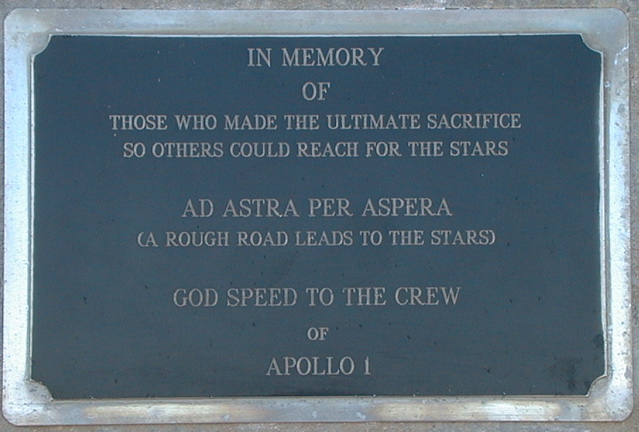
Ad Astra is the name of the National Space Society’s magazine.
Also:
/Mr Lynn
@Tucci78 March 29, 2016 at 2:30 am
Nice writing. I found a YouTube video of the song here:
/Mr Lynn
Regarding Julia Ecklar’s filksong “The Phoenix” it might be remembered that the fire which killed Grissom, White, and Chaffee (as well as the Challenger and Columbia disasters) had arguably instantiated the bureaucratic imperative at NASA in action.
Track down a copy of Victor Koman’s Kings of the High Frontier (1998) for a speculative examination of the cogent argument that NASA is principally the vehicle by which the governing class (our enemies foreign and domestic) is preventing private-sector exploitation of “the High Frontier.”
1. Billions of dollars a year will enable us to develop ANY rocketry system.
2. Laser impelled rockets are not new.
3. A lot of work needs to be done to create sensor systems that will gather information in the 1 hour it passes through the solar systems it encounters.
4. If the Keunesians cannot resist spending invented government money, then buying rocketry seems like the least bad way to do it.
At 0.25C, it’s going to take a lot longer than an hour to pass through a solar system the size even of our own. At that speed, Mars is about an hour away from Earth, depending on orbital position. The width of our solar system at light speed is 8 hours, plus or minus, based on the orbital path of the farthest planet.
What if the Centaurians back engineer it and come to get us ?!?!
The problem with such speeds is how do you stop. Let’s take a trip to the Moon. It only takes 10 hours from Earth orbit. (distance approx 250,000 miles at 25,000 mph). In order to slow down enough to enter lunar orbit you must carry the fuel to do so. That means at launch you have a heavier payload so you need a bigger rocket and more fuel to launch but then you have to calculate how much more fuel you need to launch the extra fuel but then you have to calculate THAT extra fuel and so on. Eventually you break even but for the Apollo missions it was easier and less expensive to let Earth’s gravity do the slowing work so that the spacecraft had to carry a only a small amount of braking fuel.
Oh, yes. What is the density of interstellar matter? And what happens when a dust mote at 0.25 of the speed of light impacts the spacecraft? Not to mention a baseball. We keep thinking space really has nothing in it…excepting all the stuff that actually shows up.
obviously shield technology will have to be greatly advanced
The paper made the claim of reaching mars orbit in 30 minutes. At 57.6 million km a trip of 30 minutes would require acceleration of about 3,600 g’s. Wouldn’t that be enough to squash a steel ball-bearing into a pancake?
No (stainless steel pancake). Well, not quite ‘no’ – because it depends on the size of the bearing. Volume goes up per D³ (D = dimension), so must also a solid sphere’s mass. Surface area however only goes up per D², so rises more slowly. At sufficiently large D, the force exerted by D³ overcomes the strength of the material covering D², and it deforms. But still the answer is “no” for ball bearings one might buy at the hardware store. GoatGuy
Lets try something a bit more modest, accelerate comfortably at 1g (10m/s^2) and do so for ~1 day (100,000 secs).
At the end of the day you’ll be traveling at 1,000,000 m/s (1,000 km/s), and will have travelled 100,000 km, well past Mars.
For human travel, this is the way to go. Accelerate at 1G or a shade more to half way or a shade more and then decelerate at 1 G to destination. A little harder ( 1.5G?) would be ok for a few days on the way out and on the last few days at arrival. The only way to travel.
Should be 100,000,000km.
Not really. 3600g is within the range of accelerations experienced by projectiles fired from current artillery systems. We already have projectiles with electronic fuses, GPS guidance, and flight controls that survive these accelerations, Railgun systems with significantly higher accelerations are already in development.
The idea of using laser driven space travel (using a stationary laser beamed against a vehicle with collector sail) has been around for many years. At least two science fiction books used the concept and had enough technical details to show the practical possibility. If the author claims this is his idea, he is a plagiarizer.
As an old science fiction fan, why not laser launchers to orbit, c.f. Pournelle in the 1970’s. I lack the hard science backround to judge, but Pournelle was not noted for making things up he considered implausible. However, we will not get anything of the sort without a major change in government, including the current management at NASA..
Not necessarily implausible, perhaps just very improbable:-
Infinite Improbability Drive
Scene 6. Int. Heart of Gold
‘The Hitch-Hiker’s Guide to the Galaxy’
by Douglas Adam
I retract the plagiarizer statement. I looked at the list of references, and the author has credited previous work.