From the “why worry, the 99.7% of the ice is still there” department and York University comes this climate claim that has to do with a natural event in 2012, and just doesn’t hold up as being driven by “climate change”. More details on that below.

From Eurekalert:
Climate change altering Greenland ice sheet & accelerating sea level rise, says York University prof
New research has found the Greenland ice sheet is rapidly losing the ability to buffer its contribution to rising sea levels
TORONTO, January 4, 2016 – The Greenland ice sheet has traditionally been pictured as a bit of a sponge for glacier meltwater, but new research has found it is rapidly losing the ability to buffer its contribution to rising sea levels, says a York University researcher.
York U Professor William Colgan, a co-author on the study published today in the journal Nature Climate Change, helped analyse data from three expeditions to the Greenland ice sheet in 2012, 2013 and 2015. The research was done in conjunction with lead researcher Horst Machguth of the Geological Survey of Denmark and Greenland, Mike MacFerrin of the University of Colorado at Boulder and Dirk van As of the Geological Survey of Denmark and Greenland Copenhagen, Denmark.
Colgan spent five weeks with the team in 2013 drilling firn cores in the interior of the Greenland ice sheet. Firn is multi-year compacted snow that is not as dense as glacier ice. Instead, it forms a porous near-surface layer over the ice sheet. Dropped off by a ski-equipped US Air National Guard C-130 Hercules in minus 40 degrees Celsius weather, with 6,000 kilos of supplies and equipment, the team set up several camps and drilled a series of shallow firn cores about 20 metres deep during their time on the ice sheet.
“We were interested in the thin porous near-surface firn layer, and how its physical structure is changing rapidly with climate change,” said Colgan of the Lassonde School of Engineering. “The study looked at very recent climate change on the ice sheet, how the last couple of years of melt have really altered the structure of the ice sheet firn and made it behave differently to future melt.”
The researchers also towed a radar unit behind their skidoos to gather profiles between core sites along a 100-kilometre path from the low elevation ice sheet margin into the high elevation ice sheet interior. They analysed the firn cores on the spot by cutting them into small sections to quantify their properties, such as their density, so they could compare them with samples collected the following year. “The year-on-year firn changes were quite dramatic,” said Colgan.
The team was surprised by what they found. An extreme melt that occurred in 2012 caused a layer of solid ice, several metres thick, to form on top of the porous firn in the low elevation areas of the ice sheet. “In subsequent years, meltwater couldn’t penetrate vertically through the solid ice layer, and instead drained along the ice sheet surface toward the ocean,” said Colgan. “It overturned the idea that firn can behave as a nearly bottomless sponge to absorb meltwater. Instead, we found that the meltwater storage capacity of the firn could be capped off relatively quickly.”
As Machguth said, “Basically our research shows that the firn reacts fast to a changing climate. Its ability to limit mass loss of the ice sheet by retaining meltwater could be smaller than previously assumed.”
Because the models scientists use to project Greenland’s sea level rise contribution do not presently take firn cap-off into consideration, it means that Greenland’s projected sea level rise due to meltwater runoff is likely higher than previously predicted. Getting this newly observed physical process into these models is an important next step for the team.
Using unmanned aerial vehicles, Colgan also plans to begin surveying the changes in ice sheet surface reflectance caused by the development of massive ice layers associated with firn cap-off. There are preliminary indications that firn cap-off is also occurring in the ice caps of the Canadian High Arctic.
###
It should be noted that in this WUWT story from 2012 about that “extreme melt that occurred in 2012 caused a layer of solid ice, several metres thick” shows that it is clearly a weather event, not a climate event:
…and one that happens about once every 150 years due to forest fires in Canada, according to another scientist who chooses to look beyond the climate narrative:
…widespread melt events only occurred in 1889 and 2012. In C and E, melt occurred because of the deposition of high concentrations of BC and ammonium, indicating an albedo reduction due to BC from summer forest fires.
Climate change and forest fires synergistically drive widespread melt events of the Greenland Ice Sheet
Significance:
Through an examination of shallow ice cores covering a wide area of the Greenland Ice Sheet (GIS), we show that the same mechanism drove two widespread melt events that occurred over 100 years apart, in 1889 and 2012. We found that black carbon from forest fires and rising temperatures combined to cause both of these events, and that continued climate change may result in nearly annual melting of the surface of the GIS by the year 2100. In addition, a positive feedback mechanism may be set in motion whereby melt water is retained as refrozen ice layers within the snow pack, causing lower albedo and leaving the ice sheet surface even more susceptible to future melting.
Abstract
In July 2012, over 97% of the Greenland Ice Sheet experienced surface melt, the first widespread melt during the era of satellite remote sensing. Analysis of six Greenland shallow firn cores from the dry snow region confirms that the most recent prior widespread melt occurred in 1889. A firn core from the center of the ice sheet demonstrated that exceptionally warm temperatures combined with black carbon sediments from Northern Hemisphere forest fires reduced albedo below a critical threshold in the dry snow region, and caused the melting events in both 1889 and 2012. We use these data to project the frequency of widespread melt into the year 2100. Since Arctic temperatures and the frequency of forest fires are both expected to rise with climate change, our results suggest that widespread melt events on the Greenland Ice Sheet may begin to occur almost annually by the end of century. These events are likely to alter the surface mass balance of the ice sheet, leaving the surface susceptible to further melting.
And then there’s this study:
Research from the University of Sheffield has shown that unusual changes in atmospheric jet stream circulation caused the exceptional surface melt of the Greenland Ice Sheet (GrIS) in summer 2012.
The research, published today in the International Journal of Climatology, clearly demonstrates that the record surface melting of the GrIS was mainly caused by highly unusual atmospheric circulation and jet stream changes, which were also responsible for last summer’s unusually wet weather in England.
The analysis shows that ocean temperatures and Arctic sea-ice cover were relatively unimportant factors in causing the extra Greenland melt.
Arctic is moving south, global warming has reached Poland.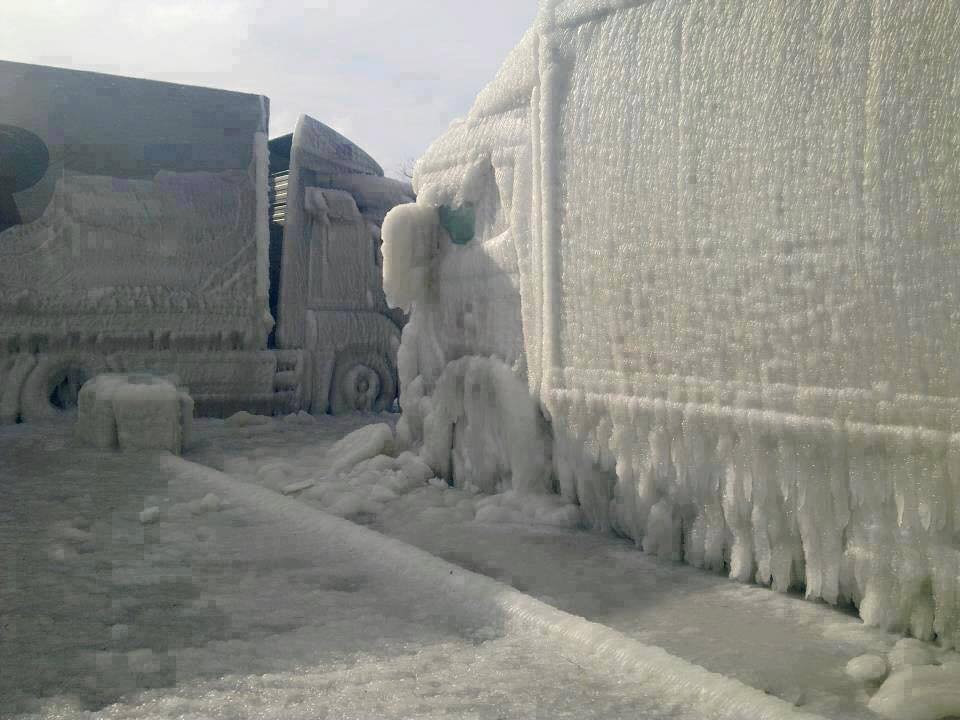
O bring back / bring back / bring back my Glazier Girl to me to me. https://www.youtube.com/watch?v=OeXy0IdCELk
Wow, that will take a little scraping in the morning …
“www.williamcolgan.net is powered by 100% renewable energy by HostPapa”
Need anyone say more?
Interestingly, nowhere on its own website does HostPapa make any mention of of the use of renewable energy but does stress it has back-up diesel generators! So ASSISTANT Professor Colgan appears to adjust the truth even in small matters.
Disregarding arbitrary time frames, all “energy” is renewable. 😉
… and it’s all free, too.
Well, so much for conducting science with an open mind.
-40°C = -40°F,
“Mean Elevation: 1,500 m (4,921 ft)”
Not much chance for melting ice here!
Oh!? “recent climate change”? Is that another description for ‘weather’?
One does wonder when ‘climate change’ means weather events?
One also notices that there is not any intention to study multiple occurrences of firn changes to establish frequency…
In other words, their wasting grant monies is advocacy and ‘so not science’.
Basically they have discovered that when exposed to several years of freeze-thaw cycles firn is converted into much denser glacial ice.
Unfortunately if they want to get another research grant in the future they have to advance the warmist agenda.
Drawing conclusions based on changes over a single season.
These guys have even stopped pretending that they are doing actual science.
Any glaciologists here?
One thing I don’t see mentioned – glacial moraine. On average what is the ratio in volume of, ice:moraine?
What is the annual contribution to sea level rise due to displacement by sediments and moraine?
This layer of ice can only prevent a few seasons meltwater. If it was not there the snow would soak up the water and when full, it could not soak up anymore, lid or not.
“The same thing happened 150 years ago, in a few decades, the firn will be back to normal until the next 150 year melt event occurs.”
150 years? From your post:
“Since Arctic temperatures and the frequency of forest fires are both expected to rise with climate change, our results suggest that widespread melt events on the Greenland Ice Sheet may begin to occur almost annually by the end of century. These events are likely to alter the surface mass balance of the ice sheet, leaving the surface susceptible to further melting.”
That’s from the Alarmist PNAS study. You want this one; http://www.foxnews.com/tech/2012/07/26/skeptics-put-freeze-on-nasa-hot-air-about-greenland-ice.html
trafamadore January 5, 2016 at 11:40 am
So much pseudo-science with so many weasel words. These folks don’t ‘expect’ any such thing or they would’ve used direct action words to describe it.
Collectively, their weasel words mean that this is an imaginary beer soaked dream scenario that they hope will lead towards more funding.
Anybody spot one of them forest fires on top of Greenland? Another fantasy.
During the MWP Greenland was covered in grass…hence the name. Every melting season we lose around 80% of the sea ice in the northern and southern hemisphere’s but do not even notice it….yet we are informed that if the remaining 20% goes we will be under 30ft of water.
Historical records of CO2 show levels of between 4,000-5,000ppm and yet the planet survived. Compared to this the current 400ppm suggests Carbon Dioxide “starvation”.
The whole nonsense is an epic logic fail…
[Well, parts of coastal Greenland were covered with grass … .mod]
Sorry. I didn’t read all the post or the comments.
Is the message that “The Missing Heat” is now hiding in the ice?
I’m afraid to admit that I had to look up the word “firn”