
From the PRINCETON UNIVERSITY and the department of 97% consensus and 911 Trutherism comes this study that I’d put zero stock in for two reasons: 1) Author William Anderegg, forerunner of the widely debunked 97% consensus meme and Pieter Tans, keeper of the official CO2 record and an avowed 911 “truther”. 2) Besides, the study itself is nothing new, as biologists, farmers, botanists, and greenhouse operators have known for decades that warmer temperatures increase plant growth. In this case, they are arguing for a positive feedback that will put leave more CO2 in the atmosphere. Given a fixed amount of biomass, that “might” be true, but satellite remoste sensing studies have shown that the planet is greening, and biomass is increasing thanks to increased CO2.
Next!
Warm nights could flood the atmosphere with carbon under climate change
The warming effects of climate change usually conjure up ideas of parched and barren landscapes broiling in a blazing sun, its heat amplified by greenhouse gases. But a study led by Princeton University researchers suggests that hotter nights may actually wield much greater influence over the planet’s atmosphere as global temperatures rise — and could eventually lead to more carbon flooding the atmosphere.
Since measurements began in 1959, nighttime temperatures in the tropics have had a strong influence over year-to-year shifts in the land’s carbon-storage capacity, or “sink,” the researchers report in the journal Proceedings of the National Academy of Sciences. Earth’s ecosystems absorb about a quarter of carbon from the atmosphere, and tropical forests account for about one-third of land-based plant productivity.
During the past 50 years, the land-based carbon sink’s “interannual variability” has grown by 50 to 100 percent, the researchers found. The researchers used climate- and satellite-imaging data to determine which of various climate factors — including rainfall, drought and daytime temperatures — had the most effect on the carbon sink’s swings. They found the strongest association with variations in tropical nighttime temperatures, which have risen by about 0.6 degrees Celsius (33 degrees Fahrenheit) since 1959.
First author William Anderegg, an associate research scholar in the Princeton Environmental Institute, explained that he and his colleagues determined that warm nighttime temperatures lead plants to put more carbon into the atmosphere through a process known as respiration.
Just as warm nights make people more active, so too does it for plants. Although plants take up carbon dioxide from the atmosphere, they also internally consume sugars to stay alive. That process, known as respiration, produces carbon dioxide, which plants step up in warm weather, Anderegg said. The researchers found that yearly variations in the carbon sink strongly correlated with variations in plant respiration.
“When you heat up a system, biological processes tend to increase,” Anderegg said. “At hotter temperatures, plant respiration rates go up and this is what’s happening during hot nights. Plants lose a lot more carbon than they would during cooler nights.”
Previous research has shown that nighttime temperatures have risen significantly faster as a result of climate change than daytime temperatures, Anderegg said. This means that in future climate scenarios respiration rates could increase to the point that the land is putting more carbon into the atmosphere than it’s taking out of it, “which would be disastrous,” he said.
Of course, plants consume carbon dioxide as a part of photosynthesis, during which they convert sunlight into energy. While photosynthesis also is sensitive to rises in temperature, it only happens during the day, whereas respiration occurs at all hours and thus is more sensitive to nighttime warming, Anderegg said.
“Nighttime temperatures have been increasing faster than daytime temperatures and will continue to rise faster,” Anderegg said. “This suggests that tropical ecosystems might be more vulnerable to climate change than previously thought, risking crossing the threshold from a carbon sink to a carbon source. But there’s certainly potential for plants to acclimate their respiration rates and that’s an area that needs future study.”
###
This research was supported by the National Science Foundation MacroSystems Biology Grant (EF-1340270), RAPID Grant (DEB-1249256) and EAGER Grant (1550932); and a National Oceanic and Atmospheric Administration (NOAA) Climate and Global Change postdoctoral fellowship administered by the University Corporation of Atmospheric Research.
William R. L. Anderegg, Ashley P. Ballantyne, W. Kolby Smith, Joseph Majkut, Sam Rabin, Claudie Beaulieu, Richard Birdsey, John P. Dunne, Richard A. Houghton, Ranga B. Myneni, Yude Pan, Jorge L. Sarmiento,? Nathan Serota, Elena Shevliakova, Pieter Tan and Stephen W. Pacala. ” Tropical nighttime warming as a dominant driver of variability in the terrestrial carbon sink.” Proceedings of the National Academy of Sciences, published online in-advance of print Dec. 7 2015. DOI: 10.1073/pnas.1521479112
Why naming Pieter Tans at the same level as William Anderegg? He was only one of the many co-authors and indeed the keeper of the Mauna Loa CO2 data, which he does as rigorous as can be. He has no problems to admit that something can go wrong, as can be seen in his reply already several years ago when the hard disk at Mauna Loa crashed:
http://wattsupwiththat.com/2008/08/06/post-mortem-on-the-mauna-loa-co2-data-eruption/
After that, he made a good overview of what is done at Mauna Loa to maintain the quality of the data:
http://www.esrl.noaa.gov/gmd/ccgg/about/co2_measurements.html
After simple request, I received several days of 10-second voltage readings from the NDIR equipment at Mauna Loa, so I could check the calculations myself…
If he is avowed 911 “truther”, I don’t know, maybe he is, but his work at Mauna Loa is impeccable…
Yeah, but you don’t need to go to the 911 truther. This report is enough to guage silliness. You all of all people should be critiquing the paper itself. Isn’t CO2 mass balance one of your specialties? You don’t accept that the atmosphere is going to be flooded because more CO2 is being produced than emitted by healthy vegetation. Let’s accept Tans may be a nice fellow.
When anyone will show images of the plane and its remnants that allegedly hit the Pentagon…
Gary,
I did comment on the paper here…
I don’t know what Pieter Tans contribution to the paper was, but as far as I know, he is an integer researcher on the main aspect of CO2: the measured rise in the atmosphere. He did some work on the influence of temperature and drought on tropical forests, see:
http://esrl.noaa.gov/gmd/co2conference/pdfs/tans.pdf
from slide 11 onwards.
That may be the base of this paper, but that doesn’t imply that he agrees with the claims made by Anderegg…
I have a friend who was driving into the Pentagon when the plane hit. As she describes it she heard it then saw it clip a light pole right near her then watched as it crashed into the side of the building she was facing.
As she described it all she could do was tighten her grip on the steering wheel and watch helpless as it happened.
Certainly no doubt in her mind that it was an airpane.
James Hein,
Thanks for that info. Was a few weeks after 911 in Washington and saw the hole in the side of the building. Either it was from an enormous inside explosion of from an outside impact. As there are many witnesses which have seen the plane crashing, that rests the case…
At the risk of kickback on 911, there are a lot of intelligent people, many of whom were there, in his corner: NYPD/NYFD personnel, pilots, engineers, architects, doctors, researchers and others. Realizing of course that a false flag operation required at this level would be very destructive to public morale and even sanity, just better to go with patriotic disbelief. A similar situation occurred with Kennedy in that the 3rd round impact acted just like a .223 frangible M-15 round (Secret Service/Mortal Error bk), but that would have again been extremely upsetting to not only the SS but the public in general. Better to go black.
It is one thing to argue that the incompetence and ill-fitted ideology of the neo-cons in the Bush Administration contributed to leaving the nation vulnerable in the face of overwhelming evidence of a pending terrorist attack. It is another thing entirely to argue that the Bush Administration was directly involved in the attacks themselves.
The former argument respects all the evidence. The latter argument ignores evidence and/or makes stuff up, depending on the amounts of Kool-Aid and tinfoil involved.
“The latter argument ignores evidence and/or makes stuff up, depending on the amounts of Kool-Aid and tinfoil involved.”
I’m sure that the numerous NYPD & NYFD professionals on site are glad to hear what you think of them…..
Nothing that I say (or that others might make up) can diminish the incredible heroism displayed by members of the NYFD and NYPD (along with others) on 9/11.
Considering that the Bush team screwed up just about everything they tried to accomplish it is nonsensical to assert that they actually could have pulled off a false flag op, even if they’d wanted to.
Maybe the Bush team (meaning Cheney/Rumsfeld) maybe not. A lead intelligence member was once asked by congress just how many (U.S.) intelligence agencies there were (most “black”) and the response was, only God really knows. Many of these are way beyond any control at prez, cabinet or secretary level and are really sub-governments (see bk Blank Check). I am only pointing out that the independent 911 websites by the professional groups listed in my opening comments bring out many, many discrepancies in the investigations.
The question to ask is why Night Time Temperatures are increasing:
http://www.climatecentral.org/blogs/record-warm-nighttime-temperatures-a-closer-look
But this is not the explanation given by those who believe adding incremental amounts of CO2 to the atmosphere causes warming of the troposphere.
They don’t talk about or model clouds.
They talk about CO2 acting as a greenhouse gas of itself, so warming the lower atmosphere, inducing more water vapour.
They don’t go to the next step and talk about convection and water vapor condensing to clouds and falling as rain or snow.
I can’t find any loss of nightly cooling in the surface station measurements since 1940
https://micro6500blog.wordpress.com/2015/11/18/evidence-against-warming-from-carbon-dioxide/
Can’t this whole CO2 issue be boiled down to a simple control experiment?
1) Daytime temperature variations are due to incoming radiation, not trapped radiation outgoing.
2) The most significant greenhouse gasses are H20 and CO2.
3) The Deserts and Antarctica have very low H2O, Rain Forest have extreme H2O levels, all have 400ppm.
If CO2 was the cause, wouldn’t you find that the difference between desert/Antarctica day and nights would be narrowing, as more CO2 traps more heat? Mars has I think 16x (adjusted for the relative density) as much CO2 as Earth’s atmosphere, and it has huge swings between day and night.
Bottom line, is there any evidence that desert/Antarctica nights are warming relative to their peak daytime temperatures?
http://image.slidesharecdn.com/a109venusmarsatmos-100311130902-phpapp02/95/a1-09-venus-mars-atmos-13-728.jpg?cb=1268313218
http://sourceforge.net/projects/gsod-rpts/files/Reports/N360Deserts.zip/download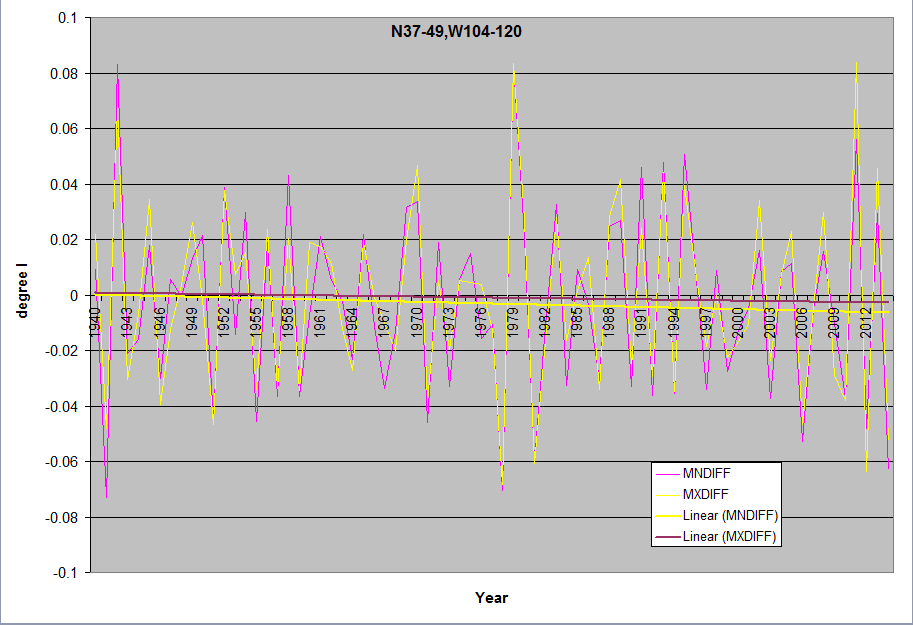

http://sourceforge.net/projects/gsod-rpts/files/Reports/N360Deserts.zip
This zip has a ton of surface station data from the US SW Deserts.
Average daily values, annual values, station info and individual station counts, slope of the seasonal change in temp, average daily rising and falling temps, there are even google maps KML files with a map pin for each station.
including the data used to make both of these charts
It’s not Co2.
Wow, great job micro6500. I am always amazed at how when you take a logical approach and look for the data, the data always confirms the hypothesis that CO2 isn’t the cause. I made that hypothesis without having any knowledge of the data sets, but for some reason the real climate “scientists” don’t seem to think in terms of using the scientific method to make their point. They simply rely on politics. The data certainly doesn’t support their conclusions, unless they can explain how increasing CO2 hasn’t warmed the deserts, the best controls we have for their CO2 theory. They also then can’t explain why other areas are warming, if the deserts aren’t.
Math = Plants grow faster absorb more CO2 = Plants release even more CO2 that they absorb.
= Failure in Grade 1
To add to the already confused state of affairs, someone should write one of those computer generated papers and tweak it a bit to set forth the discovery of transmutation of elements via cold-fusion in plants thereby internally creating more carbon than they take in from the atmosphere. The heat on those nights is explained by the cold fusion of course. …well, with enough weasel words it would probably pass peer review!
What is going to make this stop? If they haven’t given a quantitative analysis of the CO2 flows (they appear to prefer informationless prose instead of numbers). Also, it is an old chestnut that, gee if this keeps going on like this, we will flood (?) the atmosphere with CO2. Mark Twain speculated on a news story that Mississippi was shortening by a mile and a half a year (engineers were cutting off meanders to improve navigation). M.T reckoned “..And by the same token any person can see that seven hundred and forty-two years from now the lower Mississippi will be only a mile and three-quarters long. . .”
In Samuel Clemens time this was meant to be a joke!! Today, we are paying trillions for this kind of stuff.
Hey! He was paid a lot of money for his witticisms by the papers in his day. So obviously, straight line interpolation leads to pay days, just like for the climate scientists™.
Just today someone asked me for a good method for constructing simple models. The example he was looking at was CFC emissions. I pointed out that the obvious simple linear model implied that some time ago we were emitting an Earth mass of CFCs every year and in the future we’d be absorbing them, so that it made no sense to use a linear fit outside the range of the data. “Models should make sense” is, astonishingly, a difficult concept for people to grasp.
Also in PNAS …
http://phys.org/news/2015-12-co2-atmosphere-photosynthesis-20th-century.html
Very possibly, Mr Anderegg was in a muddle about respiration as distinct from photorespiration, but that doesn’t explain how he was able to have plants not merely conserve matter but create it.
One does have to admire the inventiveness of the doom-sayers; no apparent benefit of increased CO2 could ever overwhelm its malign essence. So, it seems we have reached the pinnacle of plant potential.
nighttime temperatures in the tropics…
I thought global warming was supposed to have the least effect on the tropics.
…it’s the higher latitudes that increase night time temps
Carbon change! We’re doomed! Again!
“tropical ecosystems might be more vulnerable to climate change than previously thought, risking crossing the threshold from a carbon sink to a carbon source.” Supported by NCAR. They may have built this into their climatic models.
We should award the authors a medal. The name ig-Nobel has been taken; better ideas?
The medal should be the Cookie.
A quote from a response to one of Mr Anderegg’s earlier efforts regarding that 97%… and pondering why it should have beentpublished in the Proceedings of the National Academy of Sciences …
From…http://www.pnas.org/content/107/52/E188.full
“Publication of this article as an objective scientific study does a true disservice to scientific discourse”.
Mr Watts, here is something you may want to do an article on because it undermines one of the strongest arguments the warmists have, the C12/C13 ratio. The warmists clearly blame man.
http://www.esrl.noaa.gov/gmd/outreach/isotopes/stable.html
These charts show a clear natural cause of the variation. The closer to vegetation, namely grass like vegetation, the higher the variation.
http://cdiac.ornl.gov/trends/co2/iso-sio/graphics/isobrwgr.jpg
http://cdiac.ornl.gov/trends/co2/iso-sio/graphics/isosamgr.jpg
http://cdiac.ornl.gov/trends/co2/iso-sio/graphics/isospogr.jpg
http://cdiac.ornl.gov/trends/co2/iso-sio/graphics/isoaltgr.jpg
Slight problem here, the C12/C13 ratio is not just effected by fossil fuel consumption… In fact quite of lot of existing processes (both natural and man made) also ‘interact’ with the ratio. Namely:
C4 metabolism plants absorb more C13 than do C3 metabolism plants. Basically C4 plants are grasses, and grasses grow fast and include a lot of farmed field crops (like wheat). So we grow more C4 plants, the C13 goes down and the C12/13 ratio is effected in the same way as fossil fuel….
The C12/C13 ratio varies in the fossil fuel source used (i.e coal and oil), see this paper ….
Bacteria make methane with even less C13 in it than natural gas, after oxidization. Lots of bacteria of different types around….
These are just some of the known simpler to explain ‘other things’ that effect the C12/C13 ratio. If you would like to learn more see this excellent article.
Did the smoking gun just go ‘pop’ instead of bang?
Basically I think using just C12/C13 ratio as the ‘smoking gun’ that its humans polluting with Co2 is looking at serious risk of not being sound or significant.
This deserves a lot more direct research to ascertain if it is a valid mechanism for measuring human Co2 contributions. In the meantime, take human Co2 atmospheric measurements with a healthy dose of salt.
http://www.ecowho.com/blogs/132/Atmospheric_carbon,_man_made_Co2_measurement_problems/-cdf48
excellent post co2islife……thank you!
Thanks Latitude.
There are C3 grasses as well as C4 grasses. C4 seem to be almost absent away from tropics.
http://onlinelibrary.wiley.com/doi/10.1111/nph.12942/pdf, Figure 1.
Are they green as grass?
co2islife,
That research was already done 10 years ago: the seasons in the NH show a huge up and down in CO2 and opposite δ13C variations as extra-tropical plants start to regrow in spring, where higher temperatures give show a drop of CO2 and shed their leaves in fall, releasing a lot of CO2 with colder temperatures. In the SH that is a lot less: more ocean less vegetation. Here the averaged seasonal impact for Barrow and Mauna Loa:
http://www.ferdinand-engelbeen.be/klimaat/klim_img/seasonal_CO2_d13C_MLO_BRW.jpg
The inter-annual changes where the report is talking about are different: CO2 and δ13C variations again are opposite of each other, pointing to vegetation as main cause, but CO2 goes up with temperature, not down. Temperature and drought in tropical vegetation reduce the uptake of CO2 and increase the decay of organic debris of previous years.
Does that give problems to know the cause of the δ13C decline? Not at all: there is a way out: the O2 balance. There is less O2 consumption than calculated from the burning of fossil fuels. Thus the biosphere as a whole is a net producer of O2, a net sink for CO2 and preferentially of 12CO2, thus not the cause of the δ13C decline. See:
http://www.sciencemag.org/content/287/5462/2467.short
and
http://www.bowdoin.edu/~mbattle/papers_posters_and_talks/BenderGBC2005.pdf
As there are no other known huge sources of low-13C in nature and the levels in the atmosphere are following human emissions in near perfect ratio, that points to human emissions as the main cause…
Thanks Ferdinand Engelbeen, my understanding is that C13 is essentially fixed, and it is the change in C12 that drives the ratio. The theory being that fossil fuels contain mostly C12, so when burned the C12/C13 ratio increase. Plants are supposed to have mostly C12, and the oceans have a mix of C12 to C13 similar to the atmosphere. That is the theory. The problem is there are grasses that absorb C13 preferentially, and cold water absorbs C12 more than C13, and releases C12 when warmed. That is a natural cycle explanation for the fall in the C13/C12 ratio that is used as a smoking gun for fossil fuels.
http://cdiac.ornl.gov/trends/co2/iso-sio/graphics/isokergr.jpg
Here is another issue with the C12/C13 Ratio:
https://chiefio.wordpress.com/2009/02/25/the-trouble-with-c12-c13-ratios/
thank you again!
CO2islife,
The isotopic shift between air and water and reverse is known for decades.
The water – air shift is -10 per mil
The air – water shift is -2 per mil.
For the atmosphere that means that the δ13C level is about 8 per mil below the ocean’s per mil level, as the biosphere was rather neutral in the past and even a relative source of increasing δ13C in the past decades.
The deep oceans are average around zero per mil, while the ocean surface is around +1 per mil, locally up to +5 per mil, depending of bio-life. Bio-life is very abundant at deep ocean upwelling places like before the Peruvian and Chilean coasts, except during El Niño’s. Historical δ13C levels show -6.4 +/- 0.2 per mil in ice cores over the full Holocene, decreasing to less than -8 per mil nowadays in complete lockstep with human emissions since ~1850. The same drop is seen in ocean surface waters, where the drops follow the changes in the atmosphere with 1-2 years, not reverse.
Any huge release from the (deep) oceans would INcrease the current δ13C level of the atmosphere back towards about -6.4 per mil, while we see a firm drop…
This means that in future climate scenarios respiration rates could increase to the point that the land is putting more carbon into the atmosphere than it’s taking out of it
In a follow on study by davidmhoffer, the results on longer timelines are even worse.
“We took the study’s results and extrapolated them as a linear trend. The results are alarming.” said the researcher. “Assuming a linear trend, and we have no reason not to, the world runs out of oxygen completely in less than a millions years. If we don’t act now to limit plant growth by starving it of CO2, everything on earth could be sentenced to death.”
davidmhoffer was asked for further comment, but was apparently unavailable due to having passed out from laughing too hard.
LOL……….
This was due to an imbalance in his physiological O2/CO2 ratio. However unfortunate this occurrence was, it provided dramatic proof that his theory is, in fact, correct.
it provided dramatic proof that his theory is, in fact, correct.
I’m sorry Tony, but it isn’t a theory. A linear extrapolation of a tiny segment of data is not a theory nor even a prediction. It is a projection. 97% of oxygen depletion scientists agree on this. Aw cr*p. I’m going to faint aga
“risking crossing the threshold from a carbon sink to a carbon source” and this in reference to living plants. So we shall witness, and soon, the majestic goliaths of the tropical rain forest quickly shrinking down to mere stubs scattered across the landscape. I expect a movie “Honey, I shrank the trees!”
The only thing the carbon sink is doing is expanding, and not only is it expanding, it is eating it’s way into whatever we’re producing. The rise in output of co2 vs the rise in ppm per year proves it. Thats not a conjecture, projection, or prediction it’s happening right now., and has been happening.
99 barrels of climate hypothesis on the wall…you take one down you pass it around 98 climate thesis on the wall…..
http://wrlanderegg.com/
My research focuses around two central themes:1. What is the future of forests in a changing climate? Massive mortality events of many tree species in the last decade prompt concerns that drought, insects, and wildfire may devastate forests in the coming decades. I study how drought and climate change affect forest ecosystems, including tree physiology, species interactions, carbon cycling, and biosphere-atmosphere feedbacks. This research spans a broad array of spatial scales from xylem cells to ecosystems and seeks to gain a better mechanistic understanding of how climate change will affect forests around the world.
2. How do we communicate climate science to the public and policy-makers? Communicating expert consensus and scientific understanding, even with inherent uncertainties, is critical to addressing climate change. I’ve explored the dynamics of expert agreement in communicating the state of climate science and trends in public interest and attention to climate issues.
Forests are doing much better than when they were crushed by glaciers. http://www.livescience.com/39819-ancient-forest-thaws.html
Your work is very similar to much ecology research I have seen in the past 15 or so years. Perhaps you can help me with a point I an confused on.
You study
forests in a changing climate
What changing climate? The temperatures have flatlined for nearly 20 years, and have no significant change for longer. Any metric you choose, extreme hot or cold, drought, flood, storms, no storms, snow, no snow, rain, no rain, have all been remarkably constant now for two or maybe three decades.
In biology terms, plants do not flower sooner or later, species have not changed their ranges, and the polar bears are doing just fine.
Straight Question:
What aspects of the climate are you observing to change, and how are you measuring that change?
How have you observed that change to impact the forests you study, and how did you measure it?
Haven’t we been saying all along that temperature drives CO2? Hello NPP!
“Dr. J. Leroy Hulsey, PE, SE, introduces the WTC 7 Evaluation study to the University of Alaska Fairbanks Student Chapter of the American Society of Civil Engineers, October 15, 2015.
Title: “A Presentation to the University of Alaska Fairbanks
Student Chapter of the American Society of Civil Engineers”
Project topic: World Trade Center (WTC) Building 7
World Trade Center Building 7 Evaluation is an engineering study at the University of Alaska Fairbanks (UAF) using finite element modeling to evaluate the possible causes of World Trade Center Building 7’s collapse. Dr. Hulsey is the Chair of UAF’s Civil and Environmental Engineering Department.”
They will be computer modelling (I know) building 7 based on NIST theory of the one column causing the total symmetrical destruction.
Fascinating for sure, but you are viciously off-topic. This topic, among just a few other, is forbidden here. The temptation for trolls is just too much, among other things.
Understood but since there was a ‘cheap’ shot at truthers in the lead post I felt a response was appropriate Sort of like ‘denialist’
Have they considered checking if the plant can actually put out more carbon than it absorbs if the area it’s in is extremely hot at night?
Sounds like the first step.
I’ve seen house cats age until quite old. They apparently put out more carbon than they take in. They get smaller and smaller until there is nothing left, except maybe, a grin.
If this run-away CO2 flooding has not happened at any time over the last half billion years of multicellular life – during most of which CO2 has been at above 1000 ppm – then how exactly is it going to happen now?
Yet another example of how not to do science of a complex system. These zealots again ignore climate history and assume the earth was created in 1850.
“These zealots again ignore climate history and assume the earth was created in 1850.”
… and that you and I were born yesterday.
seems china is having a bit of air quality problem. Should have had cop21 in Peking.
Oh not as much fun.
http://www.bbc.com/news/world-asia-china-35026363
michael
RAPID Grant , EAGER Grant …. wow, they don’t even hide it. What’s next years project called, EASY Grant, GRIFTER Grant , KICKBACK Grant ?
Useless Grant!
Seems that if the NSF were not within the Office of the President, and the NAS were independent of the President, and James Hansen were not a Fellow of the NAS, then perhaps something useful would be funded and published. Sadly, that will not be the case for many decades come I hazard a guess.
Ha ha
Remember when they laughed at Reagan who pointed out that by liberal standards and demands, trees were polluting?
Well…the Gipper is howling with laughter now.,
We know that total capacity of carbon sinks are increasing, year by year, since the annual increase in atmospheric CO2 is less than the annual amount of CO2 that man emits.
It seems to me that IF forest/plants truly release more CO2 than they sequester during the day and/or during the growth cycle of the plant, then total biomass carbon sinks would be reducing and not increasing. (At any rate, if one leaves plankton and the like out of the biomass equation).
The assertion in this paper makes it difficult to explain why atmospheric CO2 is not increasing year on year by more than the amount of CO2 that man emits each year.
IF forests/plants are an increasing source of CO2, what is the sink that is absorbing all of the forest/plant additional CO2, and some part of the manmade emissions of CO2?
Perhaps Ferdinand can shed some light on what this new sink is, or which sink we have previously underestimated its sequestering properties and capacity.
The authors next study will demonstrate that in the fall CO2 enhanced trees will drop more leaves, thus they will release more CO2 into the atmosphere, which will be very bad creating more terrorism in the middle east.
Yeah, but we can prevent that by raising taxes and banning fossil fuels, David A.
Indeed, but, as they are “honorable” scientists, they will leave the taxes, no doubt funding their further astute studies, up to the politicians.
This kind of reminds me of those who say they don’t want to make more money because they would have to pay more taxes. They don’t realize that they do not tax you more than 100% of what you earn, although I am sure they are trying to find a way to do so.
“… they do not tax you more than 100% of what you earn, although I am sure they are trying to find a way to do so.” –Tom in FLA
Soon, Tom. Very soon.