Guest essay by Ferdinand Engelbeen
Both Bart Bartemis and Dr. Murray Salby are confident that temperature is the only/main cause of the CO2 increase in the atmosphere. I am pretty sure that human emissions are to blame. With this contribution I hope to give a definitive answer…
1. Introduction.
Some of you may remember the lively discussions of already 5 years ago about the reasons why I am pretty sure that the CO2 increase in the atmosphere over the past 57 years (direct atmospheric measurements) and 165 years (ice cores and proxies) is manmade. That did provoke hundreds of reactions from a lot of people pro and anti.
Since then I have made a comprehensive overview of all the points made in that series of discussions at:
http://www.ferdinand-engelbeen.be/klimaat/co2_origin.html
There still is one unresolved recurring discussion between mainly Bart/Bartemis and me about one – and only one – alternative natural explanation: if the natural carbon cycle is extremely huge and the sinks are extremely fast, it is -theoretically- possible that the natural cycle dwarfs the human input. That is only possible if the natural cycle increased a fourfold in the same time frame as human emissions (for which is not the slightest indication) and it violates about all known observations. Nevertheless, Bart’s (and Dr. Salby’s) reasoning is based on a remarkable correlation between temperature variability and the CO2 rate of change variability with similar slopes:

Capture: Fig.1: Bart’s combination of T and dCO2/dt from WoodForTrees.org
Source: http://i1136.photobucket.com/albums/n488/Bartemis/temp-CO2-long.jpg_zpsszsfkb5h.png
Bart (and Dr. Salby) thinks that the match between variability and slopes (thanks to an arbitrary factor and offset) proves beyond doubt that temperature causes both the variability and slope of the CO2 rate of change. The following will show that variability and slope have nothing in common and temperature is not the cause of the slope in the CO2 rate of change.
2. The theory.
2.1 Transient response of CO2 to a step change in temperature.
To make it clear we need to show what happens with CO2 if one varies temperature in different ways. CO2 fluxes react immediately on a temperature change, but the reaction on CO2 levels needs time, no matter if that is by rotting vegetation or the ocean surfaces. Moreover, increasing CO2 levels in the atmosphere reduce the CO2 pressure difference between ocean surface and the atmosphere, thereby reducing the average in/out flux, until a certain CO2 level in the atmosphere is reached where in and out fluxes again are equal.
In algebraic form:
dCO2/dt = k2*(k*(T-T0) – ΔpCO2)
Where T0 is the temperature at the start of the change and ΔpCO2 the change in CO2 partial pressure in the atmosphere since the start of the temperature change, where pCO2(atm) was in equilibrium with pCO2(aq) at T0. The transient response in rate of change is directly proportional to the CO2 pressure difference between the pCO2 change in water (caused by a change in temperature) and the CO2 pressure in the atmosphere.
When the new equilibrium is reached, dCO2/dt = 0 and:
k*(T-T0) = ΔpCO2
Where k = ~16 ppmv/°C which is the value that Henry’s law gives for the equilibrium between seawater and the atmosphere.
In the next plot we assume the response is from vegetation, mainly in the tropics, as that is a short living response as will be clear from measurements in the real world in chapter 3:

Caption: Fig. 2: Response of bio-CO2 on a step change of temperature
Source: http://www.ferdinand-engelbeen.be/klimaat/klim_img/trans_step.jpg
As one can see, a step response in temperature gives an initial peak in dCO2/dt rate of change which goes back to zero when CO2 is again in equilibrium with temperature. That equilibrium can be static (for an open bottle of Coke) or dynamic (for the oceans). In the latter case one speaks of a “steady state” equilibrium or a “dynamic equilibrium”: still huge exchanges are going on, but the net result is that no CO2 changes are measurable in the atmosphere, as the incoming CO2 fluxes equal the outgoing CO2 fluxes.
Taking into account Henry’s law for the solubility of CO2 in seawater, any in/decrease of 1°C has the same effect if you take a closed sample of seawater and let it equilibrate with the above air (static) or have the same in/decrease in (weighted) average global ocean temperature with global air at steady state (dynamic): about 16 ppmv/°C.
2.2 Transient response of CO2 to an increasing temperature trend.
If the temperature has a slope, CO2 will follow the slope with some delay.

Caption: Fig. 3: Response of bio-CO2 on a continuous increase of temperature
Source: http://www.ferdinand-engelbeen.be/klimaat/klim_img/trans_slope.jpg
A continuous increase of temperature will induce a continuous increase of CO2 with an increasing dCO2/dt until both increases parallel each other and dCO2/dt remains constant. This ends when the “fuel” (like vegetation debris) gets exhausted or the temperature slope ends. In fact, this type of reaction is more applicable to the oceans than on vegetation, but this all is more about the form of the reaction than what causes it…
A typical example is the warming from the depth of a glacial period to an interglacial: it takes about 5,000 years to reach the new maximum temperature and CO2 lags the temperature increase with some 800 +/- 600 years.
2.3 Transient response of CO2 to a sinusoid.
Many changes in nature are random up and down, besides step changes and slopes. Let’s first see what happens if the temperature changes with a nice sinus change (a sinusoid):

Caption: Fig. 4: Response of bio-CO2 on a continuous sinusoidal change in temperature
Source: http://www.ferdinand-engelbeen.be/klimaat/klim_img/trans_sin.jpg
It can be mathematically explained that the lag of the CO2 response is maximum pi/2 or 90° after a sinusoidal temperature change [1]. Another mathematical law is that by taking the derivatives, one shifts the sinusoid forms 90° back in time. The remarkable result in that case is that changes in T synchronize with changes in dCO2/dt, that will be clear if we plot T and dCO2/dt together in next item.
2.4 Transient response of CO2 to a double sinusoid.
To make the temperature changes and their result on CO2 changes a little more realistic, we show here the result of a double sinusoid for sinusoids with different periods. After all natural changes are not that smooth…:

Caption: Fig. 5: Response of bio-CO2 on a continuous double sinusoidal change in temperature
Source: http://www.ferdinand-engelbeen.be/klimaat/klim_img/trans_2sin.jpg
As one can see, the change in CO2 still follows the same form of the double sinusoid in temperature with a lag. Plotting temperature and dCO2/dt together shows a near 100% fit without lag, which implies that T changes directly cause immediate dCO2/dt changes, but that still says nothing about any influence on a trend. In fact still T changes lead CO2 changes and dT/dt changes lead dCO2/dt changes, but that will be clear in next plot…
2.4 Transient response of CO2 to a double sinusoid plus a slope.
Now we are getting even more realistic, not only we introduced a lot of variability, we also have added a slight linear increase in temperature. The influence of the latter is not on CO2 from the biosphere (that is an increasing sink with temperature over longer term), but from the oceans with its own amplitude:

Caption: Fig. 6: Response of Natural CO2 on a continuous double sinusoidal plus slope change in temperature
Source: http://www.ferdinand-engelbeen.be/klimaat/klim_img/trans_2sin_slope.jpg
As one can see, again CO2 follows temperature as well for the sinusoids as for the slope. So does dCO2/dt with a lag after dT/dt, but with a zero slope, as the derivative of a linear trend is a flat line with only some offset from zero.
This proves that the trend in T is not the cause of any trend in dCO2/dt, as the latter is a flat line without a slope. No arbitrary factor can match these two lines, except (near) zero for the temperature trend to match the dCO2/dt trend, but then you erase the amplitudes of the variability…
Thus while the variability in temperature matches the variability in CO2 rate of change, there is no influence at all from the slope in temperature on the slope in CO2 rate of change.
Conclusion: A linear increase in temperature doesn’t introduce a slope in the CO2 rate of change at any level.
2.4 Transient response of CO2 to a double sinusoid, a slope and emissions.
All previous plots were about the effect of temperature on the CO2 levels in the atmosphere. Volcanoes and human emissions are additions which are independent of temperature and introduce an extra amount of CO2 in the atmosphere above the temperature dictated dynamic equilibrium. That has its own decay rate. If that is slow enough, CO2 builds up above the equilibrium and if the increase is slightly quadratic, as the human emissions are, that introduces a linear slope in the derivatives.

Caption: Fig. 7: Response of CO2 on a continuous double sinusoidal + slope change in temperature + emissions
Source: http://www.ferdinand-engelbeen.be/klimaat/klim_img/trans_2sin_slope_em.jpg
Several important points to be noticed:
– The variability of CO2 in the atmosphere still lags the temperature changes, no matter if taken alone or together with the result of the emissions. No distortion of amplitudes or lag times. Only simple addition of independent results of temperature and emissions.
– The slope of the natural CO2 rate of change still is zero.
– The relative amplitude of the variability is a small factor compared to the huge effect of the emissions.
– The slope and variability of temperature and CO2 rate of change is a near perfect match, despite the fact that the slope is entirely from the slightly quadratic increase of the emissions and the effect of temperature on the slope of the CO2 rate of change is zero…
Conclusion: The “match” between the slopes in temperature and CO2 rate of change is entirely spurious.
3. The real world.
3.1 The variability.
Most of the variability in CO2 rate of change is a response of (tropical) vegetation on (ocean) temperatures, mainly the Amazon. That it is from vegetation is easily distinguished from the ocean influences, as a change in CO2 releases from the oceans gives a small increase in 13C/12C ratio (δ13C) in atmospheric CO2, while a similar change of CO2 release from vegetation gives a huge, opposite change in δ13C. Here for the period 1991-2012 (regular δ13C measurements at Mauna Loa and other stations started later than CO2 measurements):

Caption: Fig. 8: 12 month averaged derivatives from temperature and CO2/ δ13C measurements at Mauna Loa [9].
Source: http://www.ferdinand-engelbeen.be/klimaat/klim_img/temp_dco2_d13C_mlo.jpg
Almost all the year by year variability in CO2 rate of change is a response of (tropical) vegetation on the variability of temperature (and rain patterns). That levels off in 1-3 years either by lack of fuel (organic debris) or by an opposite temperature/moisture change [2]. Over periods longer than 3 years, it is proven from the oxygen balance that the overall biosphere is a net, increasing sink of CO2, the earth is greening [3], [4].
Not only is the net effect of the biological CO2 rate of change completely flat as result of a linear increasing temperature, it is even slightly negative in offset…
The oceans show a CO2 increase in ratio to the temperature increase: per Henry’s law about 16 ppmv/°C. That means that the ~0.6°C increase over the past 57 years is good for ~10 ppmv CO2 increase in the atmosphere that is a flat line with an offset of 0.18 ppmv/year or 0.015 ppmv/month in the above graph.
There is a non-linear component in the ocean surface equilibrium with the atmosphere for a temperature increase, but that gives not more than a 3% error on a change of 1°C at the end of the flat trend or a maximum “trend” of 0.00045 ppmv/month after 57 years. That is the only “slope” you get from the influence of temperature on CO2 levels. Almost all of the slope in CO2 rate of change is from the emissions…
3.2 The slopes.
Human emissions show a slightly quadratic increase over the past 115 years. In the early days more guessed than calculated, in recent decades more and more accurate, based on standardized inventories of fossil fuel sales and burning efficiency. Maybe more underestimated than overestimated, because of the human nature to avoid paying taxes, but rather accurate +/- 0.5 GtC/year or +/- 0.25 ppmv/year.
The increase in the atmosphere was measured in ice cores with an accuracy of 0.12 ppmv (1 sigma) and a resolution (smoothing) of less than a decade over the period 1850-1980 (Law Dome DE-08 cores). CO2 measurements in the atmosphere are better than 0.1 ppmv since 1958 and there is a ~20 year overlap (1960 – 1980) between the ice cores and the atmospheric measurements at Mauna Loa. That gives the following graph for the temperature – emissions – increase in the atmosphere:

Caption: Fig. 9: Temperature, CO2 emissions and increase in the atmosphere [9].
Source: http://www.ferdinand-engelbeen.be/klimaat/klim_img/temp_emiss_increase.jpg
While the variability in temperature is high, that is hardly visible in the CO2 variability around the trend, as the amplitudes are not more than 4-5 ppmv/°C (maximum +/- 1 ppmv) around the trend of more than 90 ppmv. To give a better impression, here a plot of the effect of temperature on the CO2 variability in the period 1990-2002, where two large temperature and CO2 changes can be noticed: the 1991/2 Pinatubo eruption and the 1998 super El Niño:

Caption: Fig. 10: Influence of temperature variability on CO2 variability around the CO2 trend [9].
It is easy to recognize the 90° lag after temperature changes, but the influence of temperature on the variability is small, here calculated with 4 ppmv/°C. For the trend, the CO2 increase caused by the 0.2°C ocean surface temperature increase in that period is around 3 ppmv of the 17 ppmv measured…
3.3 The response to temperature variability and human emissions:
With the theoretical transient response of CO2 to temperature in mind, we can calculate the response of vegetation and oceans to the increased temperature and its variability:

Caption: Fig. 11: Transient response of bio and ocean CO2 to temperature [9][11].
Source: http://www.ferdinand-engelbeen.be/klimaat/klim_img/rss_co2_nat.jpg
The bio-response to temperature changes is very fast and zeroes out after a few years [6], the response to the temperature amplitude is about 4-5 ppmv/°C, based on the response to the 1991 Pinatubo eruption and the 1998 El Niño.
The response of the ocean surface is slower, but stronger in effect. The 16 ppmv /°C is based on the long-term response in ice cores and Henry’s law for the solubility of CO2 in ocean waters (4-17 ppmv /°C in the literature).
In reality, both oceans and the biosphere are net sinks for CO2, due to the increased CO2 pressure in the atmosphere and the biosphere also a net sink due to increased temperature on periods of more than 3 years. That is not taken into account here, but is used in the calculation of the net increase of CO2 in the atmosphere with the introduction of human emissions.
If we introduce human emissions , that gives a quite different picture of the relative dimensions involved:

Caption: Fig. 12: Human emissions + calculated and measured CO2 increase + transient response of bio and ocean CO2 to temperature [9][11].
Source: http://www.ferdinand-engelbeen.be/klimaat/klim_img/rss_co2_emiss.jpg
The influence of temperature both in variability and increase rate is minimal, compared to the effect of human emissions, based on the transient response of oceans and biosphere and the calculated decay rate of human emissions.
The long tau (e-fold decay rate) of human emissions is based on the calculated sink rate (human emissions – increase in the atmosphere) and the increased CO2 pressure in the atmosphere above dynamic equilibrium (“steady state”), which is ~290 ppmv for the current weighted average ocean surface temperature. That is thus ~110 ppmv above steady state and that gives ~2.15 ppmv net sink rate per year. For a linear response, the e-fold decay rate can be calculated:
disturbance / response = decay rate
or for 2012:
110 ppmv / 2.15 ppmv/year = 51.2 years or 614 months.
That the sink process is quite linear can be seen in the similar calculation by Peter Dietze with the figures of 27 years ago [12]:
1988: 60 ppmv, 1.13 ppmv/year, 53 years
Or from earliest accurate CO2 measurements:
1959: 25 ppmv, 0.5 ppmv/year, 50 years
Conclusion: Within the accuracy of the CO2 emission inventories and the natural variability, the decay rate of any extra CO2 above the dynamic equilibrium (whatever the cause) behaves like a linear process…
3.4 The derivatives.
What does that show in the derivatives? First the transient response of the biosphere and oceans to temperature variability:

Caption: Fig. 13: RSS temperature compared to CO2 increase and transient response of natural CO2 (biosphere+oceans) rate of change [9][11].
Source: http://www.ferdinand-engelbeen.be/klimaat/klim_img/rss_co2_nat_deriv.jpg
It seems that the amplitude of the natural variability is overblown, but for the rest both the temperature and the transient response of CO2 are equally synchronized with the observed CO2 rate of change with hardly any slope in the transient response. Thus while all the variability is from the transient response, there is hardly any contribution of oceans or biosphere to the slope in CO2 rate of change.
The overdone amplitude of the natural variability may be a matter of CO2/temperature ratio or a too short transient response time, but that is not that important. The form and timing are the important parts.
Now we can add human emissions into the rate of change:

Fig. 14: RSS temperature compared to CO2 increase and transient response of natural CO2 + emissions rate of change [9][11].
Source: http://www.ferdinand-engelbeen.be/klimaat/klim_img/rss_co2_emiss_deriv.jpg
For an exact match of the slopes of RSS temperature and CO2 rate of change one need to multiply the temperature curve with a factor and add an offset. The match of the slopes of the observed CO2 rate of change and the calculated rate of change from the emissions plus the small slope of the natural transient response needed no offset at all: it was a perfect match. Only the amplitude of the variability was reduced, but that has no effect on the small natural CO2 rate of change slope.
As can be seen in that graph, both temperature rate of change and CO2 rate of change from humans + natural transient response show the same variability in timing and form. That is clear if we enlarge the graph for the period 1987-2002, encompassing the largest temperature changes of the whole period:

Fig. 15: RSS temperature compared to CO2 increase and transient response of natural CO2 + emissions rate of change in the period 1987-2002 [9][11].
Source: http://www.ferdinand-engelbeen.be/klimaat/klim_img/rss_co2_emiss_deriv_1987-2002.jpg
As is very clear in this graph, there is an exact match in timing and form between temperature and the transient response of the CO2 rate of change, as was the case in the theoretical calculations. Where there is a discrepancy between the observed and calculated rates of change of CO2 , temperature shows the same discrepancy, like the 1991 Pinatubo eruption which increased photosynthesis by scattering incoming sunlight.
Conclusion: it is entirely possible to match the slopes and variability by temperature only or by the effect of human emissions + natural variability.
4. Conclusion.
Which of the two possible solutions is right is quite easy to know, by looking which of the two matches the observations.
The straight forward result:
– The temperature-only match violates all known observations, not at least Henry’s law for the solubility of CO2 in seawater, the oxygen balance – the greening of the earth, the 13C/12C ratio, the 14C decline,… Together with the lack of a slope in the derivatives for a transient response from oceans and vegetation to a linear increase in temperature.
– The emissions + natural variability matches all observations. See: http://www.ferdinand-engelbeen.be/klimaat/co2_origin.html
Most of the variability in the rate of change of CO2 is caused by the influence of temperature on vegetation. While the influence on the rate of change seems huge, the net effect is not more than about +/- 1.5 ppmv around the trend and zeroes out after 1-3 years.
Most of the slope in the rate of change of CO2 is caused by human emissions. That is about 110 ppmv from the 120 ppmv over the full 165 years (about 70 from the 80 ppmv over the past 57 years). The remainder is from warming oceans which changes CO2 in the atmosphere with about 16 ppmv/°C, per Henry’s law, no matter if the exchanges are static or dynamic.
Yearly human emissions quadrupled from over 1 ppmv/year in 1958 to 4.5 ppmv/year in 2013. The same quadrupling happened in the increase rate of the atmospheric CO2 (at average around 50% of human emissions) and in the difference, the net sink rate.
There is not the slightest indication in any direct measurements or proxy that the natural carbon cycle or any part thereof increased to give a similar fourfold increase in exactly the same time span, which was capable to dwarf human emissions…
Conclusion: Most of the CO2 increase is caused by human emissions. Most of the variability is natural variability. The match between temperature and CO2 rate of change is entirely spurious.
5. References.
[1] Why the CO2 increase is man made (part 1)
[2] Engelbeen on why he thinks the CO2 increase is man made (part 2)
[3] Engelbeen on why he thinks the CO2 increase is man made (part 3)
[4] Engelbeen on why he thinks the CO2 increase is man made (part 4).
[5] http://bishophill.squarespace.com/blog/2013/10/21/diary-date-murry-salby.html?currentPage=2#comments
Fourth comment by Paul_K, and further on in that discussion, gives a nice overview of the effect of a transient response of CO2 to temperature. Ignore the warning about the “dangerous” website if you open the referenced image.
[6] Lecture of Pieter Tans at the festivities of 50 years of Mauna Loa measurements, from slide 11 on:
http://esrl.noaa.gov/gmd/co2conference/pdfs/tans.pdf
[7] http://www.sciencemag.org/content/287/5462/2467.short full text free after registration.
[8] http://www.bowdoin.edu/~mbattle/papers_posters_and_talks/BenderGBC2005.pdf
[9] temperature trend of HadCRUT4 and CO2 trend and derivatives from Wood for trees.
CO2 and δ13C trends from the carbon tracker of NOAA: http://www.esrl.noaa.gov/gmd/dv/iadv/
CO2 emissions until 2008 from: http://cdiac.ornl.gov/trends/emis/tre_glob.html
CO2 emissions from 2009 on from: http://www.eia.gov/cfapps/ipdbproject/IEDIndex3.cfm?tid=90&pid=44&aid=8
[10] The spreadsheet can be downloaded from: http://www.ferdinand-engelbeen.be/klimaat/CO2_lags.xlsx
[11] The spreadsheet can be downloaded from:
http://www.ferdinand-engelbeen.be/klimaat/RSS_Had_transient_response.xlsx
[12] http://www.john-daly.com/carbon.htm
You have no idea what global temperature is doing ass your figures 14 and 15 show. You cannot draw a a straight line through these data sets. The super El Nino in the middle separates the data into two segments, differing by a step increase of a third of a degree just after its departure. Both the right side and the left side of the temperature curve are each represented by a horizontal straight line, each designating the existence of a sepasrate hiatus. You just may have heard that the existence of a hiatus nullifies the greenhouse theory of global warming. It is not for nothing that Karl thinks his paper is a “pause-buster.” That is fakery, obtained by changing temperature curves retroactively. The U.S. Congress wants to know about it but NOAA has refused to give any info. As to the slope of the carbon dioxide curve, who cares. Having a hiatus proves it does not warm. Just look around . Have you noticed that CO2 has been increasing for 18 years without causing any warming?
arnoarrak,
I did only use the trend lines to align the temperature trend (as Bartemis insists that is the only cause of the CO2 increase) with the CO2 rate of change trend. The human emissions + natural variability did fit the slope perfectly.
My only aim was to show that human emissions are the cause of the CO2 increase in the atmosphere not temperature, as many skeptics still think.
That has no effect on better arguments to counter the warmistas: that the models are way too high today in their “projections” and indeed no temperature increase for a record CO2 level…
I see this argument continuing for a very long time. Here is what is known,CO2 is increasing, CO2 can cause warming. What is not known is what are the sources and what each contribute to the additional CO2. Next how much warming will come from the additional CO2. Present projection are somewhere around 1.5 degrees which if true make the entire debate moot. I will also inject we do not at this point and time know if the warming of land base temperature, is a measurement, adjustment or siting artifact. I do know no definitive statement about anything in climate should be take seriously since it quite simply the science is to young there are too many variables to know whether the temperature is actual rising now and at what rate. The best measurement we have are satellites and their measurement period is to short to tell us anything. Argo is a bucket of spit it is so full of variables there is nothing there, on top of the their deployment is of such a short of time and trends are to short to be any value.
This leave us too reason entire climate change, CGW debate is only about one thing it control, their a group of people that think they know all the answers and want to tell the rest of us peons what to do. There is one definitive answer on that is, when the elites come down from the mountain with all the answer they are always wrong and millions will die because of it. That is not a world I want to have to live in, nor should it be for anyone else. Let us learn fine some light walk slow with the light and do not run into the darkness, because someone or some group said it was safe. For god sake let make sure their so call cliff we are trying to not drop off of is indeed cliff no a small drop that we can simple step over. After the climate debate is still has us in a deep fog uncertainty and we do not know what is in front and what was behind us since most of us did not look back at the time we traversed the climate terrain.
Cutting back on fossil fuels may be like climbing a mountain easier to climb up than it is to climb down and the worst part of that we are doing it in a fog, we don know if we are on summit, a ledge of it we are hanging off the ledge all and honest person can say is I don’t know what the best route. This best thing is to proceed with caution and try to learn the terrain as much as possible and for god sake don’t get up and run any direction because some one or some group yelled fire. Especially when it might be someone’s camp fire and they are just trying to stay warm.
AGW debate is just like the middle age debate of “How many angels can be on the point of a pin” pure sophistry , it does not matter a huge waste of time. It looking more and more AGW reality is it does not matter it is sophistry a waste of time and money. I would not bother to pay attention to it but the AGW crowd has crawled into my wallet and are causing everything I do to be more expensive from what I can see is very little evidence or reason. Climate research is not a waste of money but making grand statement from that research is sophomoric. I do believe generation to come are going to be asking who stupid where these people to believe man could greatly affect climate at the 21 century level of technology.
It can be boiled down to the lack of tropospheric hotspot which outright disproves the positive feedback hypothesis. Combined with the ERBE satellite measurements that show OLR goes up with surface warming not down and global temperatures are a third of the GCMs it shows the Climate sensitivity parameter is far less than the alarmists project, meaning there’s no crisis and no proof that a warm climate is bad at all anyway.
i challenge anyone to provide a shred of proof to the contrary.
http://papers.ssrn.com/sol3/papers.cfm?abstract_id=2642639
+10
Chaam Jamal,
Have you really read that abstract?
A statistically significant correlation between annual anthropogenic CO2 emissions and the annual rate of accumulation of CO2 in the atmosphere over a 53-year sample period from 1959-2011 is likely to be spurious because it vanishes when the two series are detrended
When you detrend the two series, you effectively remove the influence of human emissions (which are all trend and little variability) and the remainder is the variability caused by temperature (which is all variability and little trend). Quite obvious that the conclusion is that there is no correlation between CO2 emissions and detrended CO2 rate of change…
Errr, excuse me for stating the obvious, but is there not a much easier way of demonstrating and proving this??
If we look at the Ice Age record, we see that for a 10 degree warming, we get a 100 ppm CO2 increase. Or 10 ppm per degree of warming. So if we have warmed by 2 degrees in recent decades, the natural oceanic CO2 increase will be 20 ppm. And anything in excess of this must be anthropogenic.
QED. This is not exactly rocket science.
.
http://www.brighton73.freeserve.co.uk/gw/paleo/400000yearslarge.gif
“…not rocket science”
Ralfellis, no but it is climate science. (at least with a rocket you can verify if you are wrong) Ice cores are unverified. They can be smoothed or co2 can get lost in the upper parts of the core as time goes by. As well, fewer trees are around during an ice age thus less sequestration of co2. As well, what role does a longer time period play in the stabilization of co2 levels (as recent warming has been relatively fast). So the “obvious” may not be so obvious after all…
Fonzie,
Except that the 8-16 ppmv/°C is in the ballpark of Henry’s law: 4-17 ppmv/°C in the literature for the solubility of CO2 in seawater…
Ice cores are unverified? Every new technique is “unverified” as the older techniques were by far less accurate… That was the case for CO2 measurements: the NDIR method used by Keeling Sr. was “unverified”, as its accuracy is better than 0.1 ppmv, while the old chemical methods were accurate to +/- 10 ppmv…
There is an overlap of ~20 years (1960-1980) between two Law Dome ice cores and direct measurements at the South Pole, overlapping ice cores with different resolution, different temperature, different snow accumulation rate, each showing the same CO2 levels +/- 2.5 ppmv for the same averaged gas age…
Ferdinand, it’s one thing for co2 to be sitting around in ice for twenty years, quite another for it to be sitting around for thousands of years. BTW the neftel numbers at your site show 3ppm lower than MLO when overlapping. I was also wondering why they use two different cores to demonstrate the overlap at law dome. Less than a decade worth from the very upper most part of the two cores may not tell us much about smoothing/co2 loss…
Fonzie,
They drilled three cores at Law Dome, to test the influence of different drilling techniques on the CO2 record (wet and dry).That was one of the many objections the late Dr. Jaworowski had against ice cores… Two were at the summit, going back 150 years in time. The third was downslope with thinner layers, allowing a view of 1,000 years back in time…
The overlap of ~20 years shows that at the start of full closure, ice bubbles and atmosphere are equal, thus no selective discrimination for CO2…
3 ppmv may be the difference between Mauna Loa and South Pole CO2 in 1960-1980, need to check dat…
Ferdinand, i see bart has chimed in at the bottom of the page. This could get interesting (have fun…). Let me clarify; to show that ice cores match atmospheric concentrations they use both DE08 (’62-’69) and DE08-2 (’70-’78). This is good for demonstrating that the age of the air is the same as the atmosphere, but not so good if we want to see some smoothing. Using just the very top 7 or 8 years of each of the two cores is not going to show us much in that regard… Just eye balling it, it looks like SP is just 1 ppm lower than MLO. So the neftel data shows 2ppm less than SP. (But, it looks like they simply matched the top of the siple curve to the MLO data anyway at 328 ppm in ’73, no?)
One other tidbit i’d like to put out here; in the deeper cores, closing time on the bubbles is as much as 600 years (?). (it’s been said that a spike like the present one won’t even show up with averaging like that) THUS, the henry’s law ratio of co2 to temperature may be underrepresented in the deeper (low resolution) cores…
Fonzie,
The current spike of 110 ppmv in 165 years would be visible in all ice cores, be it with a lower amplitude thanks to the lower resolution…
.
Ferdinand — so what do you say to my quick and simple empirical calculation? Your complex calculations suggested 16 ppm per degree centigrade. My simple calculation based on data going back 500,000 years suggests 10 ppm per degree centigrade.
So we are in agreement, yes?
Ralph
ralfellis,
We are largely in agreement…
But there is one correction needed: the temperature proxies (dD and d18O of the ice) show the temperature changes at the place where the snow was formed, thus somewhere around Antarctica. The warming and cooling episodes are a lot larger in the polar areas than around the tropics, thus the global change is about half the polar change or a near doubling of the CO2/temperature ratio…
But don’t worry, I have used a lower ratio for years, doesn’t matter much, what matters is that there is a rather fixed ratio between temperature changes and CO2 changes and very little effect in the reverse…
Point taken.
In which case, my empirical calculation shows a 20 ppm increase per degree centigrade of warming on a worldwide basis. While your methodology shows 16 ppm per degree.
Ralph
ralfellis:
Indeed, it’s not rocket science that there’s ~10ppmv overall change in CO2 per degree Celsius evident in the Vostok record. The rub comes in the fact that these are Antarctic temperature changes compared to quasi-global concentrations of a well-mixed gas. Furthermore, that’s insufficient scientific basis for attributing causality to temperature without additional analysis.
In principle, both variables can be driven by another variable (say, global insolation) with starkly different response characteristics, resulting in concomitant behavior. Add a strong new (anthropogenic) source of CO2 in the 20th century and the highly muddled claim of causality for CO2 arises, despite cross-spectral evidence that it either lags temperature (lowest frequencies) or is incoherent with it (highest frequencies).
Ralf,
Sorry, but it is not that simple. Among other reasons, consider that there are more carbon sinks during interglacials than glacials.
Just as there is not a single equilibrium climate sensitivity to CO2, the amount of CO2 in the air is also not strictly a function of temperature, although perhaps given enough time, it might be. But there is rarely if ever enough time.
After the ice sheets melt under warmer conditions, then land plants spread, drawing down CO2. But T can remain high during deglaciation while there are as yet enough sinks to bring CO2 back into line.
But IMO, it doesn’t matter much whether the 120 ppm of CO2 allegedly added over the past 160 years is mainly man-made or not, since the increase has negligible effect on climate, but an obvious beneficial effect on vegetation.
This argument about expecting 1 degree from 10ppm comes from the hypothesis that CO2 is a driver of global temperature in the first place; ie it is a circular argument.
If the Antarctic is such a good proxy for the globe then why is it cooling and expanding now contrary to expectations? The usual answer from climate scientists to the odd cooling is that it has a unique climate system.
There are other proxies which contradict the lock-stepness of the Antarctic ice cores between CO2 and temperature – Arctic ice cores, geological data and plant stomata recons. So you have to ignore alternative data and the uniquess of the Antarctic to be able to imply that CO2 is a climate driver.
An alternative and more plausible explanation which is borne out by all other observations and the failures of the models to predict a pause is that CO2 is not a climate driver – rather just a weak feedback to rising temps that arise from another cause, ie the sun. QED. It isn’t rocket science but it isn’t about cherry-picking either.
This argument about expecting 1 degree from 10ppm comes from the hypothesis that CO2 is a driver of global temperature in the first place; ie it is a circular argument.
________________________________
All you have to do is reverse your statement. In reality 10 ppm comes from 1 degree of warming. Now everything is correct.
See my post and graph directly above.
Ralph
JasG,
Ralfellis is correct: in ice cores, CO2 follows temperature with a lag, without a sign of the opposite. Thus temperature increase causes CO2 increase.
Further, ice cores are accurate direct measurements of CO2 (and other gases) in ancient air, be it a mixture of 10-600 years, depending of the snow accumulation rate. The rest are proxies, with all the problems they have: stomata data need to be calibrated to ice core CO2 for local bias, geo data are much too coarse and ice cores from Greenland are unreliable for CO2 because of frequent deposits of highly acidic ash from Icelandic volcanoes, which react with sea carbonate deposits to form in situ CO2…
This whole discussion is spurious because the planet’s major CO2 producer has been ignored. VOLCANOES: these produce not only tonnes of CO2 but also HCl, H2S, SO2, HF,HCN into both oceans and atmosphere. Remember there are more volcanoes below the ocean’s surface than those of continental origin. Volcanogenic CO2 isotope ratio is identical to that of burning fossil fuels. So where does the CO2 originate? Certainly not humans trying to live a good life.
In addition, take earth quakes as indicator for tectonic activity
http://research.dlindquist.com/quake/historical/?mag=0&type=num&freq=year&style=raw
The number of all quake rose 6 fold from 1973 to 2008.
Looks like a Hockey Schtick by the way.
johnmarshall,
Measurments around active volcanoes (mount Etna, Sicily/Italy) show that volcanoes emit ~1% of human emissions. Undersea volcanoes emit within the huge ocean reservoir. Volcanic CO2 isotope ratio is way higher in δ13C than fossil CO2: around zero per mil for subduction volcanoes, around -6 per mil for deep magma volcanoes. Human emissions are around -24 per mil…
Thus yes, humans are the cause of most of the increase…
No one, even IPCC, knows what’s happening on the ocean floor.
Ferdinand E.:-
Total rubbish, You need to look at the data not wishful thinking. Volcanogenic CO2 has been the major input for 4.6Ga. Human input can be ignored.
Nicholas, what happens at the ocean floor largely stays in the deep oceans, except maybe in the Bermuda triangle if the stories are right…
John Marshall: besides the Decan and Siberian traps and a few large meteor impacts, the release per unit of time was minimal. Even the largest volcanic event of the past decade: the Pinatubo, larger than all eruptions of the past century together, caused a drop in the CO2 rate of change…
Ferdinand,
So you think that, without the human CO2 emissions, atmospheric CO2 would not be increasing (zero or very small trend), something like this (but at the lower “preindustrial” level of 280 ppm?):
http://www.woodfortrees.org/plot/esrl-co2/plot/esrl-co2/detrend:82
edimbukvarevic
Slightly more upward: without human emissions, CO2 levels follow the temperature trend at ~16 ppmv/°C. You can better plot the temperature anomaly with a factor 16 to see what happens with CO2 from natural sources…
Obviously, there are a number of superficially attraction to the argument that human emissions are solely or mainly responsible for the observed rise in atmospheric CO2 since the mid 19th century, not least that manmade emissions are a new source of CO2, that came into existence at around that time, and that the rise in atmospheric CO2 is coincident in time upon manmade emissions.
Obviously, it is superficially attractive to suggest that if man was not emitting any CO2, then the total sources, whatever they are (and there is significant uncertainty with respect to them), would be less such that less CO2 would be being emitted into the atmosphere, from which it should follow that the amount of atmospheric CO2 in the atmosphere similarly be would be less.
On a related argument, obviously it is superficially attractive to argue that whatever the size of the carbon sink is today and however it is constituted (the fine detail of which are not known, but do not need to be known), it is greater in size than the cumulative value of sources, whatever these be including that of human emissions (again we do not need to know the precise detail but merely the relative size of the sinks verses sources), such that if we were to reduce (or eliminate) human sourced CO2 emissions, the amount of atmospheric CO2 would fall.
But underpinning all these superficially attractive propositions are a number of assumptions, the validity of which is uncertain. I set out a few of these, but not an exhaustive list.
First, the assumption that we know sufficient about pre 1959 Mauna Loa atmospheric conditions. Ferdinand does not, in this post, deal with the Beck reconstruction. Ferdinand considers that the Beck reconstructions can be dismissed because Mauna Loa (and other observations that match it fairly well) deal with high altitude CO2 and at high altitude CO2 is a well mixed gas, whereas the Beck data pertains to ground sourced samples whereat CO2 is not well mixed and is in fact highly variable such that that data set cannot elucidate what the global high altitude CO2 composition was at the relevant time.
Now whilst the point raised by Ferdinand for dismissing the Beck data may be sound, I consider that it points to a problem, namely that the source and sink interchange is not taking place at high altitude where the Mauna Loa CO2 data is being measured but rather at the surface, where we do not know what changes if any with respect to the concentration of CO2 has taken place these past 150 or so years.
Ferdinand relies upon the fairly steady and monotonic increase in CO2 (as measured by Mauna Loa), but since the source and sink interface is essentially at ground level there may be many more complexities happening at ground level that we do not know about, and which may more accurately explain the incessant rise in CO2 at high altitude which rise is at a rate less than the anthropogenic emissions of CO2.
Second, Ferdinand relies upon Henry’s law, but there are a number of problems with this namely that the oceans are dynamic, the chemical composition of which is in flux (not simply dissolved CO2), and they are not a system in equilibrium. I consider that issues arise when one makes an assessment on the basis of average temperature when in practice the oceans extend over a vast area and have a substantially different temperature across that area ranging from around 2degC (the Polar oceans ) to 34degC (Red Sea, Gulf of Mexico, Some areas of the Indian Ocean, South China Seas etc). There is also a diurnal difference in the temperature of the oceans, more pronounced depending upon ocean basin and latitude, and prevailing currents. The outgassing and the sequestering of CO2 is different and CO2 outgassed in one area is not necessarily sequestered back in the same area, so it becomes much more difficult to apply Henry’s law.
Third, there seems strong evidence that CO2 lags temperatures by about 600 to 1000 years. The rise in CO2 that we are seeing today may simply be a response to the temperature change that took place in the MWP, and it is just coincident that today there is late 19th century and 20th century industrialisation of the planet leading to anthropogenic emissions and perhaps further coincidence that the late 20th century warming is broadly similar to that which took place in the MWP.
My view is that without getting on top of the sources and sinks, by which I mean identifying each every source and each and every sink, and precisely how much CO2 it is sourcing, or sinking, as the case may be, we do not know whether the position put forward by Ferdinand is correct. Presently, there is simply too much uncertainty surrounding sources and sinks (we keep on discovering more of them) and too much uncertainty surrounding the estimates that we have placed upon them in the carbon cycle.
I consider that this exposition by Ferdinand is useful, and helps us gain insight into the Carbon Cycle, but like too many areas in this ‘science’ there is a lack of knowledge, insufficient or poor quality data, which results in our lacking the necessary understanding of the processes involved.
Richard Verney,
It wonders me every time again, that some skeptics are rightly pointing to the lack of quality in temperature measurements, but do like the compilation of the late Ernst Beck as the truth. Beck’s data are a mix of the good, the bad and the ugliest CO2 data one can imagine. All lumped together in one compilation.
It is comparable to one year of temperature measurements in Oslo, Norway at a good situated site, followed by a year of data in Rome on an asphalted parking lot and later back to a year in Moscow. The conclusion: the middle year shows a peak in temperature…
That is the quality of Beck’s compilation. Thus sorry, that is no argument at all. See:
http://www.ferdinand-engelbeen.be/klimaat/beck_data.html
We have ice cores which show filtered values of various resolution: over the past 150 years with 10 year resolution, over the past 1,000 years with 20 years resolution. More than sufficient to see the evolution of CO2, CH4, N2O, CFC’s, 14C bomb spike,… in the atmosphere. Including a 20 year overlap (1960-1980) with direct measurements at the South Pole.
If we take the historic CO2 measurements which were taken over the oceans or coastal with wind from the sea side, the values are around the ice core levels for the same period…
CO2 levels at Mauna Loa at 3,400 m height are near identical to those taken at Cape Kumakahi at 3 masl. CO2 levels in 95% of the atmosphere from near the North Pole to the South Pole show yearly average CO2 levels differing less than 5 ppmv, mainly due to the NH-SH lag…
Ferdinand relies upon Henry’s law, but there are a number of problems with this namely that the oceans are dynamic
While there are a lot of ingoing and outgoing fluxes, they all obey Henry’s law. That makes that any increase in temperature increases the local ocean pCO2 with 16 μatm/°C. For the sources that means an increase in CO2 release. For the sinks, that means a decrease in sink flux. The net result is an increase of the CO2 level (pCO2) in the atmosphere. When that reaches ~16 ppmv/°C, the original in/out fluxes are restored.
The net result of a dynamic equilibrium for the whole ocean surface or for a static sample are exactly the same for the same change in temperature…
Third, there seems strong evidence that CO2 lags temperatures by about 600 to 1000 years.
That is for deep ocean temperature changes which need 5,000 years to warm up. The MWP-LIA cooling of ~0.8°C (depending of the reconstruction), did give a drop of ~6 ppmv with a lag of ~50 years after the temperature drop. A similar increase in temperature since the LIA thus is good for 6 ppmv?
What you miss in this debate is that more and more is known about the individual fluxes, but that the main balance is quite accurately known: human emissions, increase in the atmosphere and net sink rate. Plus a lot of other observations: 13C/12C ratio, 14C decline, oxygen balance, process characteristics,… which all point in one direction: human emissions as cause of the increase…
Ferdinand
Your answers do not seem to address the fundamentals behind the points that I raise. For example,
You state:
It wonders me every time again, that some skeptics are rightly pointing to the lack of quality in temperature measurements, but do like the compilation of the late Ernst Beck as the truth. Beck’s data are a mix of the good, the bad and the ugliest CO2 data one can imagine
Implying that I accept the Beck data as being valid, but you overlook that I specifically stated:
Now whilst the point raised by Ferdinand for dismissing the Beck data may be sound
You say:
Beck’s data are a mix of the good, the bad and the ugliest CO2 data one can imagine
And this is not because there is any problem with the equipment used for testing, nor the manner in which the tests were carried out, but rather because of the sampling itself. The sampling was from areas where CO2 varies significantly from hour to hour, from day to day etc. We have had several exchanges over the last few months on this, and you have provided independent evidence that CO2 is not a well mixed gas at low altitudes, and it this fact that causes the Beck data to be the bad and ugly.
You fail to address in your reply, the implications that follow from the fact that CO2 is not well mixed at low altitude and is extremely variable and the relevance of this fact, on the sink and source interface.
I do not consider that you have given sufficient thought to the issue regarding average ocean temperature and that CO2 outgassed in one area may be carried with winds to another area where the ocean temperature is significantly different. Those winds are never constant, and the places to where CO2 may be swept is continually changing. I consider that you need to give further consideration to the problems created by dealing with everything on an average basis when in fact it is highly variable certainly in 2 dimensions and possibly 3 dimensions. Perhaps OCO-2 will, in time, shed more light on this.
The thermohaline circulation is considered to be in the order of a 1000 years. Wikipedia states:
If it is 5,000 years, as you suggest, we are going back to the time of the Old Kingdom (In Egypt) which was another warm period. So the same problem emerges.
If there are wide estimates as to capacity of each of the individual sinks (as there is) and if there are wide estimates of the individual sources (as there is), and if we are still finding new sinks and sources (which we are), it is wishful think to conclude
The point I make is that we do not know enough about this as your own reply demonstrates.
Whilst I have not yet studied this, I presume that you have looked at (or will be looking at):-
http://wattsupwiththat.com/2015/11/26/report-global-growth-in-co2-emissions-stagnates/
There are several strange steps in the Mauna Loa data series, not simply those identified in the above article, which do not fit particularly well with your view of the Carbon Cycle and the rise in atmospheric CO2 levels.
Personally, I am not greatly concerned by all of this since the fundamental issue is not why CO2 may be rising (although if this is not because of anthropogenic actions, a policy of mitigation is worthless and will fail to curb emissions), but whether it is significant. In other words, what is Climate Sensitivity (if any at all) to CO2. This can only be answered by observational evidence, and hence I am much more concerned at getting good quality observational data that will elucidate that.
The reason behind the rise in CO2 seems very much a secondary issue especially since the globe is presently starved of CO2 so rising CO2 would appear to be a welcomed event. If it brings some warming with it, so much the better because the globe is also rather cool and in the round all life would benefit from a warmer biosphere.
Richard Verney,
The ugly data were from equipment not suitable to detect atmospheric change to any reasonable accuracy:
– That was the case in Barrow: equipment used to measure CO2 in exhaled air (20,000-40,000 ppmv!) was calibrated to outside air. If that was between 200-500 ppmv, the equipment was ready to use. Accuracy +/- 150 ppmv…
– That was the case in Antarctica: equipment accurate to +/- 200 ppmv. O2 measurements down 2% in some samples, CO2 elevated to over 1000 ppmv in some samples…
– Thousands of seawater samples at 0 m depth were catalogued as air samples, while the pH of the samples was measured…
After long discussions, Beck dropped the first two as unreliable, but never admitted his error in the last one.
Then we have the bad ones: that are all data taken on land, except in deserts or on mountain tops, far from vegetation, as that is the main cause of the variability. The variability is far less over the oceans: maximum 10 ppmv between North Pole and South Pole, including the large seasonal variability and the NH-SH lag. That is in 95% of the atmosphere…
The variability over the oceans has hardly any influence on yearly average uptake and release. The variability over land is the result of the uptake and release by the biosphere. But that all doesn’t matter: we know the net result at the end of the year, for every year of the past 55+ years with reasonable accuracy…
Further:
The THC needs ~1000 years to return from the polar waters to the equator, but the warming of the full deep oceans needed 5,000 years.
Even the 1,000 years has little effect: the MWP may have had 10 ppmv more CO2 in the atmosphere than today, that results in maximum 5 ppmv more in the current atmosphere, not 110…
Where we agree is that the increase of CO2, whatever the cause, will have little effect on temperature/climate…
November 26, 2015 at 4:53 am
I posted this above:
co2 and o2 rise and fall in step (anti phase) the yearly cycle is mainly plant respiration (O2 out in light ; co2 out in dark). If this is the case then the respiration is from land plants / sea phytoplankton outside the tropics, It is not from growth and decay since decay is too slow to give the rapid increase in co2 in NH autumn – when temperatures fall decay rate is low.
a plot of CO2 and O2 is here:
If CO2 in ocean solution was cause of dips and slopes then O2 would not be inverse.
-=-=-=-=-=-=-=-=-
Additionally.
Any CO2 eruptions from volcanic activity, or CO2 release from sea water solution would produce a rise in CO2 without a corresponding fall in O2 the plot clearly shows rise in co2 and simultaneously a fall in o2 – i.e. the carbon is being oxidised to Co2. and a fall in CO2 has a corresponding rise in O2 – i.e. the CO2 is being reduced to C + O2
http://4.bp.blogspot.com/-bCvtAJzSBMY/T9ptnRzSP9I/AAAAAAAAAYc/1NYuolWUs_w/s1600/co2+-+02+all.jpg
Thank you for this very thorough analysis Ferdinand. You cover one of the most fundamental issues in climate science and your analysis is extraordinary convincing.
Let me just add that the Vostok ice core shows that the CO2 level has not been above 300 ppm in the last 800 000 years.
http://cdiac.ornl.gov/trends/co2/ice_core_co2.html
I think this data series alone is evidence enough to conclude that the current level of 400 ppm is caused by humans.
I wonder whether those who object to that think that the current CO2 level is just natural variability, and that it is just a coincidence that it happens now, and never before in the last 800 000 years, or do they think that the Vostok ice core is bogus?
/Jan
Ice cores are the tea leaves of climate science, an entertaining parlor game, but too much uncertainty and co-confounders for scientific value.
If ice cores are tea leaves, then what are stripbark pines?
And yet temperatures have varied quite a bit during that time. Much more so than can be explained by a change of just ~30ppm of CO2. WUWT?
No Richard, they match very well with theory,
As Willis describes above, the relation between temperatures and CO2 in Vostok gives us a value of a change in CO2 due to temperature rise of ~ 16.5 ppmv/°C, in very good agreement with Henry’s Law.
This must of course not be confused with climate sensitivity, which is the opposite effect, i.e. the change in temperature caused by change in CO2. The climate sensitivity is in the range 1.5 to 4.5 °C for a doubling of CO2.
Both climate sensitivity and Henry’s law are real physical phenomenon and Henry’s law is one of the positive feedbacks to the climate sensitivity.
/Jan
Over the last 800,000 years temperatures have varied by approximately 13 to 14degC, and during the same period CO2 has varied by about 100ppm (from about 200 to ~300ppm). See, eg the right hand plot:
http://lafenergy.org/essays/gwfig1.php
It is difficult to see how that is in good agreement with Henry’s law, and it is nothing like ~ 16.5 ppmv/°C, but rather much more like ~7.5 ppmv/°C (ie., 100ppm/13degC).
Over the last 2000 years (before say 1800 AD) there has been all but no increase in CO2 and yet we have seen the Roman Warm Period, the Medieval Warm Period and the LIA.
See the top plot at:
http://cdiac.ornl.gov/images/three_gases_historical.jpg
Richard,
You cannot just take the maximum difference in CO2 and divide it by the maximum difference in temperatures, and think that you get the relation between CO2 and temperature from that.
That will only work if there is a 100% correlation between the two, but it is not.
The correct way to identify the relationship between the two is to make a scatter plot with CO2 and temperatures.
This is done in figure 1 in
S. Torn, Harte, GEOPHYSICAL RESEARCH LETTERS, VOL. 33, L10703
The relationship found is 14.6 ppm/C
/Jan
Richard Verney,
You need to take into account that the dD and d18O temperature proxies in ice are mainly from where the snow was formed, thus in near polar areas. The temperature change there is about twice that of the global temperature change. Thus you need to increase your polar ratio to have the global ratio…
Good point Ferdinand,
however, the figures I provided of 14.6 ppmv /°C was from the average Southern hemisphere, not the local Vostok temperature.
The Torn and Harte paper says:
Furthermore:
I cannot see that the paper Richard provided specify whether they use local or temperatures or not.
/Jan
Thanks Jan,
Not far off the 16 ppmv/°C that Henry’s law gives for seawater pCO2 change. I can live with that difference…
Hard to use that for the 110 ppmv CO2 increase over the past 165 years. Boiling oceans somewhere?
Boiling oceans, nobody has ever seen a storm at sea. That would have to reduce the pressure over a very wide area. I’m sure that only water vapor is the only gas that is being released as if that could happen. When I release the pressure on a bottle of soda/pop it never fizzles either. Or goes flat.
rishrac,
Have been sailor (engine room) myself some (very) long time ago, still remember a few severe storms… But was just joking about boiling oceans. With a severe storm, the mixing between oceans and atmosphere is certainly very intense and a lot of CO2 and water vapor released into the atmosphere from warm oceans. Once mixed in the bulk of the atmosphere, I don’t think that will give much difference in CO2 levels, or one should see that in temporarily higher levels after major hurricanes…
A very long analysis to state the obvious: if the atmospheric CO2 concentration rise would not be caused by the emissions from burning fossil fuels, where then would have gone the 385 Pg carbon emitted since the beginning of the industrial era, or the current 10 Pg C per year ?
It can’t jump from a flame to be immediately sequestered by biomass or the seas, it has to stay in a certain quantity in the atmosphere (in fact 50-60%) for a while.
Other point: if CO2 absorption in sea water would only be driven by Henry’s law, then only a minuscule amount would be absorbed. The actual driver is the carbonate formation, a chemical reaction between water and the weak acid CO2.
All hart analysis without stating the corresponding coefficient of correlation is as valid as stock market chart analysis. In fact no statistically valid correlation can be established between T and CO2.
See https://hal.archives-ouvertes.fr/hal-01146608v3/document
Ferdinand Engelbeen:
Thanks for the post. An interesting thread. I appreciate your effort in clearing up the comments, as well.
Ferdinand
Further to your comment Ferdinand Engelbeen November 26, 2015 at 8:27 am
Your answers do not seem to address the fundamentals behind the points that I raise. For example,
You state:
Implying that I accept the Beck data as being valid, but you overlook that I specifically stated:
You say:
And this is not because there is any problem with the equipment used for testing, nor the manner in which the tests were carried out, but rather because of the sampling itself. The sampling was from areas where CO2 varies significantly from hour to hour, from day to day etc. We have had several exchanges over the last few months on this, and you have provided independent evidence that CO2 is not a well mixed gas at low altitudes, and it this fact that causes the Beck data to be the bad and ugly. In your response to me, you do not seek to argue that CO2 is well mixed at low altitudes or that I am incorrect in pointing out that CO2 is not well mixed at low altitudes.
You fail to address in your reply, the implications that follow from the fact that CO2 is not well mixed at low altitude and is extremely variable and the relevance of this fact, on the sink and source interface.
I do not consider that you have given sufficient thought to the issue regarding average ocean temperature and that CO2 outgassed in one area may be carried with winds to another area where the ocean temperature is significantly different. Those winds are never constant, and the places to where CO2 may be swept is continually changing. I consider that you need to give further consideration to the problems created by dealing with everything on an average basis when in fact it is highly variable certainly in 2 dimensions and possibly 3 dimensions. Perhaps OCO-2 will, in time, shed more light on this.
The thermohaline circulation is considered to be in the order of a 1000 years. Wikipedia states:
If it is 5,000 years, as you suggest, we are going back to the time of the Old Kingdom (In Egypt) which was another warm period. So the same problem emerges.
If there are wide estimates as to capacity of each of the individual sinks (as there is) and if there are wide estimates of the individual sources (as there is), and if we are still finding new sinks and sources (which we are), it is wishful think to conclude
The point I make is that we do not know enough about this as your own reply demonstrates.
Whilst I have not yet studied this, I presume that you have looked at (or will be looking at):-
http://wattsupwiththat.com/2015/11/26/report-global-growth-in-co2-emissions-stagnates/
There are several strange steps in the Mauna Loa data series, not simply those identified in the above article, which do not fit particularly well with your view of the Carbon Cycle and the rise in atmospheric CO2 levels.
Personally, I am not greatly concerned by all of this since the fundamental issue is not why CO2 may be rising (although if this is not because of anthropogenic actions, a policy of mitigation is worthless and will fail to curb emissions), but whether it is significant. In other words, what is Climate Sensitivity (if any at all) to CO2. This can only be answered by observational evidence, and hence I am much more concerned at getting good quality observational data that will elucidate that.
The reason behind the rise in CO2 seems very much a secondary issue especially since the globe is presently starved of CO2 so rising CO2 would appear to be a welcomed event. If it brings some warming with it, so much the better because the globe is also rather cool and in the round all life would benefit from a warmer biosphere.
IPCC AR5 assigns an RF of 2 W/m^2 to the accumulated 112 ppm CO2 between 1750 and 2011. As with the net 4 C/CO2 balance, 2 W/m^2 is lost in the magnitude and +/- 10% uncertainties of the global heat balance, 340 W/m^2 ToA, and absorptions/reflections/fluxes on the orders of 70s, 80s, 90s. Even IPCC acknowledges the pause/hiatus/lull/stasis and laments the failure of the GCMs to model, in part because the sensitivity is a fraction of their assumption (see TS.6 Key Uncertainties).
Ferdinand’s analysis fails. He is treating natural and anthropogenic uptake as if they were independent of one another. That is not physically viable.
Here is a toy model that demonstrates equal treatment of anthropogenic and natural inputs, and shows how the dCO2/dt = k*(T – T0) relationship can arise in a realistic, physically viable way.
Let
A = atmospheric CO2 content
O = oceanic content
alpha = steady state proportionality
tau = rapid time constant to equalize proportions of oceanic and atmospheric content
H = human inputs
B = oceanic THC imbalance
dA/dt = (O – alpha*A)/tau + H
dO/dt = (alpha*A – O)/tau + B
Note that, in this model, overall net permanent sink activity is assumed negligible over the observation interval, and
d/dt(A + O) = H + B
i.e., the mass balance is obeyed.
These equations rapidly equalize atmospheric and oceanic content, subject to the proportionality factor alpha. It should be quite large, as the oceans can absorb vastly more CO2 than the atmosphere.
The solution for A as tau -> zero is
A = integral(H+B)/(1+alpha)
Since alpha is large, the first part is small, and we have
A := integral(B/(1+alpha))
the assumption being, obviously, that B is much greater than H.
Let B be temperature dependent such that B/(1+alpha) := k*(T – T0). Then
dA/dt = k*(T – T0)
Most of the H goes into the ocean O, which is approximately
O = alpha*A = (alpha/(1+alpha))*integral(H+B) := integral(H+B)
H contributes to oceanic acidification, but much less than the natural B.
This example shows how the result can be perfectly consistent with Henry’s law, one of Ferdinand’s recurring objections, as the alpha parameter would be related to this quantity.
I am not saying this is how things are. It is a toy model, just an example of why the objections do not hold any water.
dCO2/dt = k*(T – T0) is physically viable. It is, without a doubt, the governing equation for atmospheric CO2 in the modern era. The agreement with the data is impeccable:
http://i1136.photobucket.com/albums/n488/Bartemis/temp-CO2_zpsnp6z3jnq.jpg
The long term trend matches. The variability matches. You cannot get this kind of agreement using a combination of anthropogenic and natural forcing with a significant reliance on anthropogenic forcing unless you stack the deck by positing a physically impossible system which treats the inputs independently, with different dynamics, as Ferdinand has done.
Bravo, Bartemis!
Repeated for (and with) emphasis:
That is (just for other non-scientist readers — correct me, please if I’m mistaken, here),
Ferdinand Englebeen:
1. treats human CO2 differently from natural CO2
(with no evidence for this, purely arbitrary distinction, only unsupported conjecture for this treatment; see Dr. Murry Salby in Hamburg, 2013 lecture posted above re: refutation of the Carbon 13 mishandling by Mr. Englebeen); and
2. bases his equations NOT on how things are observed to behave in the real world.
Bartemis: 10 (or was this the 100th time?
Englebeen**: 0
** Mr. Englebeen, I LIKE you — please know that I’m only addressing the science, here. You, as a person, are just fine (just, imo, mistaken due to some emotionally charged-blindness connected to human emissions …. some underlying issue of great importance to you, which impairs your otherwise FINE intelligence — just here, as to CO2, not in general).
“You, as a person, are just fine…”
Janice, personally i think he’s a bit pushy…
Always love to read your comments, full of enthusiasm and rare compliments to other commentors. (rare meaning that others seldom often compliment) I guess i can forgive your compliment to ferdinand even though he IS holding us all hostage to his dumb ideas…
Just kidding, Ferdinand, just kidding… (sheesh, you euros can be so touchy)
Well, Arthur, how kind of you to say so. #(:))
(remember how “Mrs. C.” was the only one The Fonz would let call him “Arthur?”, heh)
I want to return the compliment, for I noticed that you were warmly supportive on the half-life thread and on this one (and with the obviously keen insights of a well-informed scientist/engineer, too) of “Bart,” one of WUWT’s finest science warriors for truth.
Me: You’re all right, Fonzarelli.
F: aaaaaayyyyy
🙂
Janice,
I try to be as polite as I can, as yelling doesn’t convince anyone… And I like your enthusiasm, even if we don’t agree on this item…
But here goes Bart wrong:
dCO2/dt = k*(T – T0) is physically viable
That is physically impossible because that doesn’t take into account the negative feedback from the increased pressure in the atmosphere.
When the temperature increases with 1 °C, dCO2/dt at start = k*(T – T0), where k = ~16 μatm/°C. That is because the seawater surface temperature increase does increase the partial pressure of CO2 the surface with 16 μatm.
If the ocean and the atmosphere were in dynamic equilibrium at time t0, the CO2 release does start at the above rate.
After some time the CO2 pressure in the atmosphere increased with 8 ppmv. That makes that the pressure difference between oceans and atmosphere halved and dCO2/dt then is only half the original flux. The moment that the increase in the atmosphere reaches 16 ppmv, the CO2 pressure difference between ocean surface and the atmosphere is zero. No further increase…
That is the transient response of oceans (and vegetation) to a change in temperature…
The formula which takes the pressure change in the atmosphere into account is:
dCO2/dt = k2*(k*(T-T0) – ΔpCO2)
Where k is the temperature influence per Henry’s law and k2 the speed at which the new equilibrium is reached. That is when dCO2/dt = 0
or
ΔpCO2 = k*(T-T0)
A fixed CO2 change for a fixed temperature change as can be seen in ice cores over the past 800,000 years and in the 1-3 years variability today…
[Deleted doubled italics. .mod]
Sorry Janice, something wrong with the italics closing tag…
Janice, another point:
1. treats human CO2 differently from natural CO2
Not at all, I treated different processes with different response times, as the response speed and amplitude of vegetation and oceans are quite different between each other and with their response to an increased CO2 pressure in the atmosphere. Three/four different response times for two different source/sinks of CO2.
If there is a drop in temperature (like 1998-1999), the CO2 rate of change drops with ~3 GtC within 1-2 years, due to colder ocean surface and increased uptake by plants in the tropics (after been dried out during the 1998 El Niño). That grabs any CO2 in the atmosphere, natural as good as human. Still human emissions were larger than the sink capacity: 6.5 GtC/year, ~2,5 GtC/year residual increase in the atmosphere.
Bart treats all source/sink processes as one process, which is physically impossible.
BTW, thanks Mods for the correction… lots of work these days…)
Ferdinand Engelbeen @ur momisugly November 27, 2015 at 12:31 pm
“That is physically impossible because that doesn’t take into account the negative feedback from the increased pressure in the atmosphere.”
Wrong. The equilization in proportionality between the oceans and atmosphere is explicitly stated in the model with
dA/dt = (O – alpha*A)/tau + H
dO/dt = (alpha*A – O)/tau + B
What you are doing is adding in a sink dynamic which works only on natural inputs, and not on anthropogenic inputs. That is magical thinking. This model treats them on an equal basis.
Bart,
Besides that there a few problems with your toy model, the discussion is about the term:
dCO2/dt = k*(T – T0) is physically viable
Which doesn’t take into account the CO2 increase in the atmosphere as dCO2/dt is not only a function of temperature, it is a function of the CO2 pressure difference between oceans and atmosphere. Where Henry’s law says:
ΔpCO2 = k*(T-T0) at equilibrium or ~16 ppmv/°C for the solubility of CO2 in seawater,
The current increase of CO2 in the atmosphere is over 2 ppmv/year. In 8 years the CO2 pressure in the atmosphere is over the CO2 pressure caused by a temperature increase of 1°C. In that case the net ocean-atmosphere CO2 flux reverses…
“…the discussion is about the term…”
No, Ferdinand. The discussion is about the model. The model has been shown to result in the approximate relationship dA/dt := k*(T – T0). I should have used a different “k” value, but it should not be too confusing.
CO2 is A/total_atmospheric_volume, but since total atmospheric volume is only slightly affected by A itself, we can immediately go to dCO2/dt := k’*(T – T0) where k’ := k/total_atmospheric_volume.
Bart,
See my reaction here.
Bart, I agree.
Furthermore, Ferdinand is knocking down a strawman with his change in temperature argument (dT).
dCO2/dt = k*(T – T0)
The correlation is between (annual) change in atmospheric CO2 and (annual) temperature level, NOT change. One explanation could be that the annual CO2 cycle is not net neutral (zero) and that there is a net annual change, depending on the temperature level (or something correlating with it). The annual co2 cycle is not symmetric – the rise is ~7.5 months and the fall ~4.5 months long.
http://meso.gsfc.nasa.gov/val/projects/co2/images/co2_yearly_cycle.png
That is Mauna Loa, here are the annual cycles at different latitudes:
http://2.bp.blogspot.com/-_3zQZdJHEoQ/T1-6uvB4GrI/AAAAAAAAAbQ/SyE6-Fohf4c/s1600/CO2+cycle+polarity+2.jpg
Edim,
The correlation is between (annual) change in atmospheric CO2 and (annual) temperature level, NOT change.
Quite strange, I fully agree with that statement.
Bart doesn’t: he insists that T changes are the cause of dCO2/dt changes, which is impossible as the transient response of CO2 from oceans and biosphere has zero slope in the derivatives…
Ferdinand, where is the temperature change in dCO2/dt = k*(T – T0)?
Edim:
Ferdinand, where is the temperature change in dCO2/dt = k*(T – T0)?
I thought that T-To is a temperature change, but I can be wrong…
Anyway that formula means that the CO2 increases with the difference in temperature, which is largely true, but also true if it is a transient response:
dCO2/dt = k2*(k*(T-T0) – ΔpCO2)
That gives a similar curve, where CO2 lags T with 90 degrees or about 3 months. a plot of T would make that clear…
The asymmetry can be more or less explained by
1) the slope due to continuous increase in the atmosphere
2) the uptake which peaks enormously in spring and the decay rate, which is more spread over the year with peaks in fall (fresh fallen leaves) and spring, just before spring blossoms come out with already higher temperatures.
Ferdinand, No. T is just temperature. When T = T0, dCO2 is zero, when T is greater than T0, dCO2 is positive and vice versa. Of course, we only observed positive dCO2 (growth) and the extrapolation is uncertain, but that is what the equation says.
And regarding asymmetry, my point is that it could be causing (some of) the annual change in CO2. Why would the natural annual CO2 cycle (without human CO2) be net zero?
Edim,
Sorry, but T – T0 really IS temperature change…
What Bart’s formula implies is that if the temperature jumps 1°C up, that gives a constant dCO2/dt until eternity, which is impossible. That formula does work for the seasonal changes, because temperature goes up and down, and it works as long as there are human emissions, but it ceases to work in other periods, because for every period you need another coefficient k.
Why would the natural annual CO2 cycle (without human CO2) be net zero?
Because there is already 18 years zero temperature change, thus in principle T = T0…
Ferdinand,
As I suspected, you either don’t understand the equation or don’t want to. It’s a linear relationship between annual change in CO2 and temperature. Not temperature change!
deltaCO2 = k*Ta, where Ta = T – T0.
It’s another matter whether or not the equation always holds true, but it does in the observation period (since 1959).
The formula does not work for the seasonal changes, only for the annual and longer averages.
“Because there is already 18 years zero temperature change, thus in principle T = T0…”
Again, NO! T0 is the temperature at which dCO2 is zero (when T = T0). Your 18 years zero temperature change means no (or very little) trend. That means there will be zero change in annual growth (~2 ppm). T is greater than T0. Ta = deltaCO2/k.
Edim,
What you said was rather confusing: after telling:
The correlation is between (annual) change in atmospheric CO2 and (annual) temperature level, NOT change.
You show the seasonal changes which are certainly showing a lot of temperature change…
One problem with the dCO2/dt = k*(T – T0) formula is that it doesn’t take into account that for a transient response temperature as good as the transient response in the derivatives match each other exactly in timing of the peaks and troughs, so that it can be claimed that it is a direct response of the derivative to temperature. But a slope in temperature has no slope in the derivative of the transient response, so you can never match the slopes (or the amplitudes) if there was no other cause for the slope in the derivatives: the slightly quadratic increase of human emissions.
Next problem: the formula violates Henry’s law for the solubility of seawater. If the CO2 pressure in the atmosphere increases, dCO2/dt decreases for a fixed positive temperature difference. At ~16 ppmv/°C more CO2 in the atmosphere dCO2/dt = 0 as the pCO2 in the atmosphere again equals the pCO2 in the oceans at steady state.
Ferdinand Engelbeen November 29, 2015 at 7:29 am
“Next problem: the formula violates Henry’s law for the solubility of seawater. “
Wrong. The equilization in proportionality between the oceans and atmosphere is explicitly stated in the model with
dA/dt = (O – alpha*A)/tau + H
dO/dt = (alpha*A – O)/tau + B
The parameter alpha is directly related to the Henry’s law constant. If this toy model were expressed in terms of partial differential equations, with A and O having dependency on altitude of the former and depth of the latter, alpha evaluated near the surface would be Henry’s constant. In the steady state without inputs H and B, these equations drive the oceanic content to approximately O = alpha*A.
Bart,
You have made quite a mess of your toy model. If I do understand it now, please correct me if I am wrong:
– The model is about the exchange between ocean surface and atmosphere.
– Input H is from humans in the atmosphere.
– Input B is from the deep oceans into the ocean surface.
A few problems with that: equilibrium between ocean surface and atmosphere is quite rapid (e-fold decay rate less than a year). Any surplus B can be assumed directly to the atmosphere.
Any change in the atmosphere results in only 1% change of total carbon in the ocean’s surface per Henry’s law, as free CO2 is only 1% of total carbon. Thanks to the Revelle/buffer factor, it is 10% of the change in the atmosphere after (rapid) chemical equilibrium.
Masses involved: atmosphere ~800 GtC, ocean surface layer ~1000 GtC. 30% CO2 change in the atmosphere gives 3% total carbon change in the ocean surface or 30 GtC. That is all…
The B that comes from the deep oceans is a problem, as 90% within a few years gets into the atmosphere, thus adding to the H from humans and there we go again as is observed:
H + B > H > dCO2/dt in all 57 years…
Thus B must be negative.
Only one exception: an extreme fast deep ocean – atmosphere cycle but that is in two ways measured as ~40 GtC/year, not spectacular at all with an unbalance of ~3 GtC/year more sink than source…
Thus sorry, you need to find another source (which BTW increased a fourfold in the past 57 years)…
“A few problems with that: equilibrium between ocean surface and atmosphere is quite rapid…”
The model actually requires a fairly rapid equilibrium time. See where I wrote “The solution for A as tau -> zero is…”
“H + B > H > dCO2/dt in all 57 years…”
Again, a static analysis. dCO2/dt is net. You have to subtract out the sink activity on the left side. See above for a bit of discussion on sink activity.
“You have made quite a mess of your toy model.”
Not I. You have not understood it, and are drawing incorrect conclusions. The model is fully internally consistent, and consistent with observations.
I should perhaps point out that the “sink” activity in the model is the equilibration of atmospheric CO2 with the oceans.
See below for fuller explanation of where B comes from.
WordPress reversed the last two responses, and it could cause confusion. In the expanded model below, I add in additional long term sink activity to explain where the B term comes from.
Thank you Janice, Fonzie, and Edim. You guys have been encouraging from the get-go, and it has helped me keep a positive attitude. I really just do not understand how people can not only ignore what is right in front of their eyes, but twist themselves into knots to deny it.
To clarify, on the point where I say “I am not saying this is how things are”, what I mean by that is that the actual mechanisms are much more complicated. But, they are analogous. Whatever the dynamics are, they must result in an approximate relationship dCO2/dt = k*(T – T0) over the interval of observation in which we have direct and reliable temperature and CO2 measurements.
Bart, as a first-time commenter here, allow me to add myself to the list of those who want to thank you for your posts – your debates with Ferdinand over the years have made for an excellent crash course in the subject, and you have more or less single-handedly turned me into a full-fledged AGW skeptic. I still don’t know enough of the underlying science to have formed a definite opinion, but my background is in mathematics, and it is eminently clear that on that front, you are the one who is talking sense. Great job in particular with your repeated demolitions of the manifestly idiotic “mass balance” argument.
Fair enough, but how do you explain current atmospheric CO2 being much higher than the MWP, the hollowscene thermal max, and each of the prior 4 interglacial maxima when current temperature seems lower than any of these?
Also, what’s up with second derivatives, anyway. You take a first derivative which doesn’t match worth a damn, convert ONE of the variables to a second derivative, and suddenly get an impressive match. You have done it, Murray Salby has done it, Paul Pukite has done it with QBO and ENSO. All this by dividing by time twice…
Welcome, from out of the shadows, at least, DJ.
And, keep on commenting!
Janice
DJ,
The mass balance needs to be obeyed at any moment of time. If that is sufficient in this debate to prove something, that can be debated, but anyway at every year of the past 57 years, nature was more sink than source, as human emissions were one-way additions and larger than the observed increase all the years.
Rests the problem that there is a fourfold increase in human emissions, increase in the atmosphere and thus net sink rate over these years.
Do you agree that IF a natural cause is the main cause of the increase, the natural carbon cycle (a one-way addition is not possible), must have increased a fourfold over the same time span?
DJ November 27, 2015 at 7:37 am
Wow. Now that’s a post that really warms one’s heart. I take it DJ that you are well versed in mathematics, and have been as scandalized as I at the very poor quality of mathematical reasoning evidenced in most of the warmist literature. I really have a hard time believing some of these people have PhD’s. It’s like they started giving them out in Cracker Jack boxes.
gymnosperm November 27, 2015 at 11:44 am
“Fair enough, but how do you explain current atmospheric CO2 being much higher than the MWP, the hollowscene thermal max, and each of the prior 4 interglacial maxima when current temperature seems lower than any of these?”
I do not believe it is. It is said to be so on the basis of a single proxy measurement – those of ice cores. These cannot be verified over the long term. If there is one thing we who toil in laboratories know, it is that you cannot take anything for granted until you have seen the full process unfold from start to finish within the laboratory. Nature is mischievous in the extreme. Add in the likelihood of human mischief in the evaluation of the results, and only a naif would maintain a high level of confidence in them.
But, so what anyway? Who says this complex system has to be stationary? Who says the natural world has to have the same behavior now as it did 1000, 10,000, or 100,000 years ago? We know how it has behaved since at least 1958. That is enough to establish that atmospheric CO2 is not being driven significantly by human inputs.
“All this by dividing by time twice…”
Taking differentials twice, and dividing by the time interval each time. It fits the data. What’s the problem? Newton observed that the position of an object unfolded as the second derivative of force, and the rest is history.
Ferdinand Engelbeen November 27, 2015 at 1:40 pm
“…as human emissions were one-way additions…”
They were, and are, not. Human emissions stimulate sink activity. The additional sink activity thus stimulated is, in every practical sense, artificial sink activity. It would not exist without the human inputs having stimulated it into being.
That is the nature of a dynamic system. Dynamic systems react to their inputs. You cannot analyze such systems with algebra. You need calculus.
It is not enough that nature is net negative. It is only so because of the additional artificially induced sink activity. Take it away, and nature turns net positive. With it there, it is less negative than it would have been were nature, on its own, not a net source. In a dynamic system, that is enough to propel the overall balance higher.
I’ve tried explaining this every which way I know how. It is very elementary. If you do not understand it, you should not be involved in the discussion at all. You simply are not qualified, and your reasoning on other fronts will be similarly faulty.
Bart:
They were, and are, not. Human emissions stimulate sink activity. The additional sink activity thus stimulated is, in every practical sense, artificial sink activity. It would not exist without the human inputs having stimulated it into being.
As I have repeatedly shown:
Either the increase is non-human and then near all sink activity is non-human. Which makes that only a small part of the sinks is caused by humans, which means that a large part of human emissions remains in the atmosphere, which contradicts the non-human cause of the increase.
Or most of the increase is human caused and the humans are fully responsible for the sink rate, which is only about halve the emissions, with only a small additional increase due to the increased temperature.
That is the nature of a dynamic system. Dynamic systems react to their inputs. You cannot analyze such systems with algebra. You need calculus.
In this case it is very simple: the whole process behaves as a simple linear process where a doubling of the CO2 pressure above steady state gives a doubling of net sink rate. Where the steady state changes with 16 ppmv/°C per Henry’s law for the whole dynamic of the oceans… 290 ppmv for the current average ocean surface temperature…
Ferdinand Engelbeen November 29, 2015 at 1:14 pm
“Which makes that only a small part of the sinks is caused by humans, which means that a large part of human emissions remains in the atmosphere, which contradicts the non-human cause of the increase.”
This is gibberish. The sink reaction is in proportion to the forcing. If the sink response to human forcing is small, it is only because the human forcing is, itself, small.
“Where the steady state changes with 16 ppmv/°C per Henry’s law for the whole dynamic of the oceans… 290 ppmv for the current average ocean surface temperature…”
As I showed above, the system naturally results in a sensitivity in ppmv/degC/unit-of-time. You are insisting that the system behaves as you want it to behave, not as the data actually show it behaves.
Bart,
This is gibberish. The sink reaction is in proportion to the forcing. If the sink response to human forcing is small, it is only because the human forcing is, itself, small.
Some simple calculation shows that you are wrong:
The current net sink rate is ~4.5 GtC/year, mostly in the oceans. Human emissions are ~9 GtC/year. If we may assume that the natural carbon cycle is (at least) 10 times larger than the human contribution, then the human contribution to the sink rate is ~0.45 GtC/year. Remains ~8.5 GtC of human origin in the atmosphere, but we see only an increase of 4.5 GtC in the atmosphere… Either way, (near) all increase in the atmosphere is human caused and thus (near) all sinks or the balance doesn’t fit…
the system naturally results in a sensitivity in ppmv/degC/unit-of-time. You are insisting that the system behaves as you want it to behave, not as the data actually show it behaves.
The system behaves by obeying Henry’s law, as proven by over 3 million seawater samples in all oceans of the world. Henry’s law gives ~16 ppmv/°C. no matter if that is for a closed sample (static) or for the total oceans, including all upwellings and sinks (dynamic). Your ppmv/degC/unit-of-time is maximum at the start of a temperature change and rapidly gets zero when the pressure in the atmosphere reaches the 16 ppmv/°C change and gets negative if the pressure passes that value…
“Human emissions are ~9 GtC/year.”
H = 9.0
“If we may assume that the natural carbon cycle is (at least) 10 times larger than the human contribution…”
N >= 90
“The current net sink rate is ~4.5 GtC/year…”
N+H-S = 4.5
S = SH + SN
the sink rate for human inputs versus the sink rate for natural inputs. Let us assume that N = 90. The fraction removed is
f = 94.5/99 = 0.9545
SH = 0.9545*H = 8.5905
Net human contribution is H-SH = 9 – 8.5805 = 0.4095. Net natural contribution is 90-0.9545*90 = 4.095. Natural contribution is 4.095/4.5 = 91%. Net human contribution is only 9%.
” Henry’s law gives ~16 ppmv/°C…”
Wrong again. What you are focusing on is the temperature sensitivity of the alpha term in my model. But, the B term provides a continuous temperature accumulation of CO2. This term come about because of a temperature dependent imbalance between what is flowing into the surface oceans, and what is flowing out.
Bart
You have not even read what I did…
All what I did is looking at the transient response of CO2 from the biosphere and the ocean surface to temperature changes. The latter per Henry’s law. That response will be there, no matter the presence of extra CO2 – whatever the cause – in the atmosphere above steady state. Even if there was zero human contribution, the same variability with the same amplitude would be visible, as that is temperature driven, not pressure driven.
The tau’s for bio and ocean as indicated in the graphs are transient tau’s, the speed with which a new steady state is reached after a temperature change. That are not sink tau’s for an increased pressure in the atmosphere.
What you don’t see is that a transient response ends at a new steady state: 16 ppmv/°C for the ocean surface, per Henry’s law. Even more important: a transient response to a more or less linear increase in temperature is also linear and has zero slope, even slightly negative for vegetation in the derivatives.
The increase in temperature over the past 57 years gives near zero slope in the derivatives of the CO2 rate of change for a transient response…
overall net permanent sink activity is assumed negligible over the observation interval
That is impossible:
dCO2/dt (atm) = H + B
but if B > 0:
H + B > H > dCO2/dt
where H > dCO2/dt is measured in every year of the past 57 years…
That is only possible if B is a sink:
dCO2/dt = H – B
Which nullifies the rest of the exercise…
Further: it doesn’t address another point: the increase in the atmosphere per year over the past years increased a fourfold 1958-2012. The net sink rate too increased a fourfold, which points to a linear uptake of CO2 with the increased pCO2 in the atmosphere above steady state.
If any natural source is the cause of the increase, it must have increased a fourfold over the same period, as human emissions did that too and the sinks don’t differentiate between CO2 of any origin.
There is not the slightest indication that the natural carbon cycle increased, to the contrary…
unless you stack the deck by positing a physically impossible system which treats the inputs independently, with different dynamics, as Ferdinand has done.
Bart, either you don’t understand what a transient response is, or you just dismiss anything which refutes your theory. My theory is based on the transient response of oceans and especially vegetation to temperature changes, independent of any pressure change of CO2 in the atmosphere – whatever the cause – and the related sinks. That fits all observations, yours fits none, except a nice graph, which does my theory as good:
http://www.ferdinand-engelbeen.be/klimaat/klim_img/rss_co2_emiss_deriv.jpg
The transient response of oceans and vegetation to all the temperature variability + slope is:
http://www.ferdinand-engelbeen.be/klimaat/klim_img/rss_co2_nat.jpg
5 ppmv over 35 years. That is all. In reality, thanks to increased CO2 pressure in the atmosphere, both are net sinks for together ~40 ppmv over the same period…
Ferdinand Engelbeen November 27, 2015 at 11:56 am
“The tau’s for bio and ocean as indicated in the graphs are transient tau’s, the speed with which a new steady state is reached after a temperature change. That are not sink tau’s for an increased pressure in the atmosphere.”
It does not matter, Ferdinand. Each removal mechanism reacts to both anthropogenic and natural inputs on an equal basis. If you have a time constant representing the removal of natural inputs, it also must apply in equal measure to the anthropogenic inputs. So, where you write
dCO2/dt = k2*(k*(T-T0) – ΔpCO2)
You must also include the anthropogenic inputs
dCO2/dt = k2*(k*(T-T0) + H – ΔpCO2)
and, they will be removed at the same rate.
“What you don’t see is that a transient response ends at a new steady state…”
No. That is your hypothesis. You can’t just assert it is true. You have to prove it.
As I have shown above, a physically consistent model naturally results in a sensitivity k which is in units of ppmv/degC/unit-of-time.
“That is impossible:
dCO2/dt (atm) = H + B”
That is not the model. The model is
dA/dt = (O – alpha*A)/tau + H
dO/dt = (alpha*A – O)/tau + B
“A” is your CO2(atm). This is a dynamic model. It is quite possible for A in this model to be any value at all relative to H, and still not have H be the major driver. As I have shown above.
“If any natural source is the cause of the increase, it must have increased a fourfold over the same period, as human emissions did that too and the sinks don’t differentiate between CO2 of any origin.”
I have given you a model which is consistent with Henry’s Law, and which can give the observed results, and which satisfies a true mass balance argument. Your insistence that this doesn’t matter, because you just don’t see how it can be, is not an argument at all. It is plugging your ears and shouting “Nah, Nah, Nah”.
“My theory is based on the transient response of oceans and especially vegetation to temperature changes, independent of any pressure change of CO2 in the atmosphere…”
I.e., you arbitrarily and nonphysically treat anthropogenic and natural inputs separately. You cannot. The sink activity does not differentiate between them.
Bart:
You must also include the anthropogenic inputs:
dCO2/dt = k2*(k*(T-T0) + H – ΔpCO2)
Yes, but you have the sign of H wrong:
dCO2/dt = k2*(k*(T-T0) – H – ΔpCO2)
As the transient response is towards:
k*(T-T0) = ΔpCO2 per Henry’s law. H makes that the new steady state at a positive T-T0 is reached faster and exceeded, which makes that dCO2/dt gets negative: a net sink.
As explained to Richard Courtney even every year of the past 57 years…
—————-
In your example you have as definition:
H = human inputs
B = oceanic THC imbalance
If B is the THC imbalance at the ocean side, it is positive. If it is counted at the air side, it is negative?
I used B as at the atmosphere side, thus it must be negative. But we can assume that B is at the ocean side.
d/dt(A + O) = H + B violates the mass balance:
H is the only external addition from outside A and O, thus the mass balance is only fulfilled at:
d/dt(A + O) = H
Which changes the two main equations:
dA/dt = (O – alpha*A)/tau + H
dO/dt = (alpha*A – O)/tau + B
into:
dA/dt = (O – alpha*A)/tau + H – B
dO/dt = (alpha*A – O)/tau + B
Where B is a lot smaller than H, as there still is an increase in the atmosphere. But it doesn’t make much sense to use B as the exchange/sink rate is already expressed in alpha*A. If that is large enough, it can theoretically dwarf H. But…
The increase rate in the atmosphere was a fourfold in the period 1958 – 2012: from 0.5 ppmv/year to over 2 ppmv/year:
http://www.ferdinand-engelbeen.be/klimaat/klim_img/dco2_em2.jpg
The net sink rate followed linearly also with a fourfold, as human emissions did. If the natural carbon cycle between oceans and atmosphere is the main cause of the increase in the atmosphere, it must have increased a fourfold in the same time span, or you violate the equality of the sinks for human or natural CO2…
For which is not the slightest indication…
Bart:
I.e., you arbitrarily and nonphysically treat anthropogenic and natural inputs separately.
Please will you stop with that nonsense? I do treat temperature responses and pressure responses differently, which is clearly seen in nature and I treat ocean responses and vegetation responses differently as clearly seen in in nature. That has nothing, zero, nada to do with any different response of these processes to what is grabbed out of the air…
Ferdinand Engelbeen November 29, 2015 at 12:46 pm
“H is the only external addition from outside A and O, thus the mass balance is only fulfilled at:
d/dt(A + O) = H”
Nonsense. Again, this is you arbitrarily constraining how the system behaves to suit your narrative. But, there is absolutely no requirement that it do so. The B in my equations can arise very simply from a temperature dependent, but slow, feedback which represents permanent sink activity.
“dA/dt = (O – alpha*A)/tau + H – B
dO/dt = (alpha*A – O)/tau + B”
(Facepalm) Ferdinand…
No, that is not how it works. B is a steady input to the surface oceans induced by the temperature dependent throttling of the THC flow.
Ferdinand Engelbeen November 29, 2015 at 12:53 pm
“Please will you stop with that nonsense?”
I wish I could. It is you who keeps insisting you can remove natural CO2 input in short time, while maintaining anthropogenic input for very long time intervals. It is absolutely ridiculous. Either they are both removed rapidly, or neither.
The answer is: they both are, but the natural input is so much larger that it is the driver of what we observe.
Bart:
The B in my equations can arise very simply from a temperature dependent, but slow, feedback which represents permanent sink activity.
Which is impossible as you write:
d/dt(A + O) = H + B for the mass balance, the change in total mass of atmosphere + oceans is H + B. H indeed is an external addition to A + O, but B comes out of the blue and thus is an on the spot created extra mass… There are some fusion experiments which create mass from extreme high temperatures, but I don’t think that is what you had in mind…
No, that is not how it works. B is a steady input to the surface oceans induced by the temperature dependent throttling of the THC flow.
Either it is exchange between deep oceans and ocean surface and then B = 0 for total oceans, or it is between oceans and atmosphere and then the first term dA/dt = (O – alpha*A)/tau + H gets H – B (for B positive) or H + B (for B negative)…
I wish I could. It is you who keeps insisting you can remove natural CO2 input in short time, while maintaining anthropogenic input for very long time intervals.
Sorry Bart, there is no way that the natural inputs are removed any faster than human inputs. That is your delusion. There are only different processes with different response times, whatever the origin of the inputs.
The answer is: they both are, but the natural input is so much larger that it is the driver of what we observe.
We can discuss that, as that is your theory. My theory is that most variability is caused by a fast, but limited response of vegetation to temperature changes, while most of the slope is caused by the response of oceans to an increased pressure in the atmosphere, caused by human emissions + a small part caused by the temperature increase. In the latter case, there is no increase in the natural carbon cycle at all, only an increasing net sink flux in direct ratio to the increase in the atmosphere above steady state.
Both theories fit the slope + variability of the CO2 rate of change…
“…but B comes out of the blue and thus is an on the spot created extra mass…”
B is from ocean upwelling. It is the differential between what is coming up, and what is going down. It is temperature dependent.
This is a transmission line. It represents the 1000 year trek of CO2 from the surface oceans of the past to the surface oceans of today. It is essentially independent of current surface conditions, and can be taken as an exogenous input.
In no way is it possible for B to leap up into the atmosphere and start drawing CO2 out of the atmosphere, as you have suggested.
“There are only different processes with different response times, whatever the origin of the inputs.”
If you filtered the anthropogenic inputs as you are the natural inputs, you would have a system of the form
dCO2/dt = k*(T – T0) + H – CO2/tau
That system does indeed settle out to approximately tau*k*(T-T0) for the natural term, but it also settles out to approximately tau*H for the anthropogenic term.
You don’t show that at all. You show the anthropogenic contribution as the cumulative integral of H. That is non-physical.
Bart:
He is treating natural and anthropogenic uptake as if they were independent of one another. That is not physically viable.
To be clear, as I did to Janice:
I did treat the processes which govern the uptake/release of CO2 as independent of each other, not what is taken away out or released to the atmosphere: the former is exactly the same for any increased CO2 pressure in the atmosphere, from humans and natural alike.
The influence of temperature and pressure is near fully independent and different for oceans and vegetation. Vegetation is very sensitive for temperature changes, but hardly for pressure changes. Oceans are less sensitive to temperature changes, but more to pressure changes…
By your one-process-fits-all, you ignore the differences…
Ferdinand Engelbeen @ur momisugly November 27, 2015 at 12:31 pm
“That is physically impossible because that doesn’t take into account the negative feedback from the increased pressure in the atmosphere.”
Wrong. The equalization in proportionality between the oceans and atmosphere is explicitly stated in the model with
dA/dt = (O – alpha*A)/tau + H
dO/dt = (alpha*A – O)/tau + B
What you are doing is adding in a sink dynamic which works only on natural inputs, and not on anthropogenic inputs. That is magical thinking. This model treats them on an equal basis.
Bar:
What you are doing is adding in a sink dynamic which works only on natural inputs, and not on anthropogenic inputs.
Bart which of the four process responses vegetation/oceans temperature/pressure works different for anthro and natural inputs?
Natural and anthropogenic inputs are removed by the same processes. You cannot have one linger, while the other is rapidly removed.
This is what you have done.
Bart,
Again, there are different processes at work, some pressure dependent, other temperature dependent, some in vegetation, others in the oceans. All what I have done is giving these different processes their proper ratio and rate of change constant.
In no way any of these processes reacts different on human or natural inputs.
Is that your new line of defense for your theory?
Write out your precise equations, Ferdinand. You’ve got to have the human input rate H treated exactly as the natural input k*(T – T0).
I published this paper in June 2015, based on papers we/I wrote in 2002, 2008 and 2015. Note Anthony’s disclaimer.
My question to all of you who care to comment is:
How many of you agree or disagree with points 1 through 10 below?
Please indicate those points you disagree with by number (and why you disagree) .
Regards, Allan
Presentation of Evidence Suggesting Temperature Drives Atmospheric CO2 more than CO2 Drives Temperature
http://wattsupwiththat.com/2015/06/13/presentation-of-evidence-suggesting-temperature-drives-atmospheric-co2-more-than-co2-drives-temperature/
Note: I present this for discussion, I have no opinion on its validity -Anthony Watts
Observations and Conclusions:
1. Temperature, among other factors, drives atmospheric CO2 much more than CO2 drives temperature. The rate of change dCO2/dt is closely correlated with temperature and thus atmospheric CO2 LAGS temperature by ~9 months in the modern data record
2. CO2 also lags temperature by ~~800 years in the ice core record, on a longer time scale.
3. Atmospheric CO2 lags temperature at all measured time scales.
4. CO2 is the feedstock for carbon-based life on Earth, and Earth’s atmosphere and oceans are clearly CO2-deficient. CO2 abatement and sequestration schemes are nonsense.
5. Based on the evidence, Earth’s climate is insensitive to increased atmospheric CO2 – there is no global warming crisis.
6. Recent global warming was natural and irregularly cyclical – the next climate phase following the ~20 year pause will probably be global cooling, starting by ~2020 or sooner.
7. Adaptation is clearly the best approach to deal with the moderate global warming and cooling experienced in recent centuries.
8. Cool and cold weather kills many more people than warm or hot weather, even in warm climates. There are about 100,000 Excess Winter Deaths every year in the USA and about 10,000 in Canada.
9. Green energy schemes have needlessly driven up energy costs, reduced electrical grid reliability and contributed to increased winter mortality, which especially targets the elderly and the poor.
10. Cheap, abundant, reliable energy is the lifeblood of modern society. When politicians fool with energy systems, real people suffer and die. That is the tragic legacy of false global warming alarmism.
Allan MacRae, Calgary, June 12, 2015
Nobody is arguing that. A change in T causes a change in dCO2/dt, the derivative, not directly in CO2 itself.
1old: additionally
1) your time scale is too short; and
2) you also need to factor in that CO2 level lags temperature by a quarter cycle (did you watch the above-linked video (you can find it with a quick search on youtube directly, too) of Murry Salby’s Hamburg, 2013 video? — if so, I think you need to watch it again — his teaching is quite clear to a layperson such as myself).
It’s too soon to say Bartemis and Salby are incorrect, much less, “falisified.”
Thank you Bart – 1old mis-stated point 1 and then contradicted his mis-statement.
Allan MacRae: I agree with all ten of your points and want to applaud you for your succinct, accurate, summary of the science (versus lukewarmer or AGW conjecture). Thank you for sharing your work with us. I hope it gets the attention it deserves….
+1
Allan, i’m glad you finally weighed in here… I was wondering, has a statistical analysis ever been done on bart’s graph (your theory)? What are the chances of the peaks and troughs aligning while at the same time the over all slopes match? (ANY other trend in temps won’t produce matching amplitude of peaks and troughs) What are the chances that both have step rises circa ’80 & 2000 (with matching “amplitude”) if temps aren’t driving co2? What are the chances that both trend flat at all other times? (if temps aren’t the driver, they could have been anything but they weren’t) And lastly, what are the chances that we find barts graph consistant with the (arguably) most stable period of ice cores (1800s) if we extend the temps back that far? No other current temperature trend will produce that with the extension of the temps in the graph back to 1850. (again, temps could have been ANYTHING over the last 165 years, but they weren’t…) This is what drives the layman “nutso”: When we see work that should be done (such as statistical analysis of bart’s graph) and it isn’t being done. This graph is way too important, science wise as well as policy wise, for those in a position to run with it to do otherwise. Can you clue me into what’s going on here? What will it take to get someone (ANYONE!) in the scientific community to get moving with your theory?
Fonzie,
What are the chances of the peaks and troughs aligning while at the same time the over all slopes match?
No problem at all to match slope (without arbitrary factor) and all variability (with an arbitrary factor) with an alternative theory, without violating any observation, as Bart’s theory does:
http://www.ferdinand-engelbeen.be/klimaat/klim_img/rss_co2_emiss_deriv_1987-2002.jpg
There is a 100% synchronization between a transient response of CO2 in the derivatives with temperature variability, but the slope is from human emissions, as the derivative of the transient responses has hardly any slope.
The match of the slope in temperature with the slope in dCO2/dt is entirely spurious and has no bearing in any physical process…
1oldnwise4me,
Temperature variability indeed causes a lot of variability in the CO2 rate of change, but it is not responsible for the slope in the CO2 rate of change.
The point where Bart (and Dr. Salby) got wrong is where he saw a perfect match of the variability’s and assumed that the slope was from temperature too.
The problem with that theory is that the transient response of CO2 to temperature changes lags temperature with 90 degrees for a sufficient long response time, but taking the derivatives shifts everything 90 degrees back in time, so that temperature and dCO2/dt fully synchronize in variability, but with (near) no slope in CO2/dt…
Thus while temperature and other natural causes are fully responsible for the variability, temperature is not responsible for most of the increase, human emissions are…
Ferdinand, if there was no temperature trend then, of course, the graph couldn’t be fitted at all. If the trend was only 1/4 of what it is, then the scale would have to be quadrupled (to match the slopes) and the peaks and troughs would not match. If the trend was half, then the scale must be doubled and the peaks still would not match. If it was 3/4, then the scale must be increased by 4/3 and still no match. Only the temperature trend that we actually had produces a perfect fit and no other…
BTW, you showed me bart’s graph with trend lines and those lines were a little off. I cleaned it up a bit, matching the trend lines exactly. The scale is .204, the adjusted offset .096. The major peaks are an exact fit. Hadsst3, which i did not use here, had an even better fit…
http://www.woodfortrees.org/plot/esrl-co2/from:1958/mean:24/derivative/plot/hadcrut4sh/from:1958/scale:0.204/offset:0.096/plot/esrl-co2/from:1958/derivative/trend/plot/hadcrut4sh/from:1958/scale:0.204/offset:0.096/trend
Fonzie,
In real life, a temperature change will induce a CO2 change, with a ~90 degree lag for a sufficient long response time. Everybody agrees on that.
If you take the derivatives, you shift all variability 90 degrees back in time. That is a mathematical fact.
That means that the peaks and troughs always will align, whatever the further influence of temperature on the slopes.
Because there is a slope both in T and dCO2/dt, it is easy to match both with an arbitrary factor and offset. By doing so, you attribute both variability and slope to temperature, while part of the s lope is caused by the slightly quadratic increasing human emissions. That may range from 0% to 100%, but ignoring that influence and attributing all slope + variability to temperature is circular reasoning.
What I have done is:
– Showing that you can match all of the variability by the transient response from vegetation and oceans.
– Showing that such a response has near zero slope in the derivatives, thus no match with T for variability.
– Showing that almost all variability is the response of vegetation to temperature variability.
– Showing that vegetation is not the cause of the slope.
– Showing that you can combine the slope of the residual from human emissions and natural variability which matches the observed slope of dCO2/dt without arbitrary factor and synchronizes with its peaks and troughs in exact the same way as for temperature only.
Thus, which one is true? That can be deduced from other observations. For Bart’s solution:
– mass balance (needs a fourfold increase of the natural cycle for Bart’s solution – not observed).
– 13C/12C ratio: goes wrong way for oceans as source, vegetation is a proven sink.
– 14C bomb spike: no acceleration visible in decay rate.
– Oxygen balance: shows that the biosphere is a proven, increasing sink.
—
My solution matches every observation, Bart’s solution none…
Fonzie,
Forgot to add:
I have plotted the trends to show the difference in slopes in Fig. 13, but used a factor and offset in Fig. 15 to align the slopes of RSS-T and dCO2/dt. Even without a factor and offset, the sum of human emissions caused CO2 + natural variability did match the slope of dCO2/dt. Only the amplitude of the natural variability was way too high, but that is a matter of lengthening the response time(s) of the oceans (and maybe vegetation).
I need to work out the same for HadCRUT4, but expect to see the same matches…
Allan – I agree with your points with a few comments on point number 1:
Temperature drives atmospheric CO2 only when atmospheric CO2 is low, i.e. below the equilibrium partial pressure as a result of being dissolved in water.
The compelling evidence is CO2 NEVER drives temperature.
I just tuned up the following this AM. Some of it expands a bit on your points.
The assertion 97% of scientists believe atmospheric carbon dioxide (CO2) causes global warming (aka climate change) is blatantly false. There is no excuse for anyone to be so gullible that they would make that assertion. Scientists are not that ignorant although some may have gotten mired in irrelevant minutia and/or misled by wildly speculative notions, or mesmerized by CO2 being a ‘greenhouse gas’, or even willfully blinded by the siren call of a paycheck.
Necessary knowledge to realize CO2 has no effect on climate should have been learned before the 12th grade in school. It is a basic understanding of the ramifications of photosynthesis. Google provides a good definition of photosynthesis: “the process by which green plants and some other organisms use sunlight to synthesize foods from carbon dioxide and water. Photosynthesis in plants generally involves the green pigment chlorophyll and generates oxygen as a byproduct.”
The applicable ramification of photosynthesis is that CO2 is necessary for the initial step for all life on the planet and always has been. For life on land as we know it to have evolved there had to have been substantial CO2 in the atmosphere for more than 500 million years. If CO2 made the planet warmer it would have been doing it for 500 million years. But average global temperature (AGT) has gone up and down over the eon and most of the time it has been warmer than now. The only way this could consistently result is if CO2 has no effect on temperature and temperature change is caused by something else.
The idea that a threshold level of CO2 might exist, where above the threshold CO2 warms the planet and below the threshold it does not, requires a more complex analysis but the end result is the same: CO2 has no effect on AGT.
Because CO2 is only a trace gas in the atmosphere, if CO2 change does not cause temperature change, it cannot cause climate change. Thus the CO2 change from burning fossil fuels has no effect on climate, and ‘climate sensitivity’ (the effect on AGT of doubling CO2) is zero.
The analysis at http://agwunveiled.blogspot.com expands on this and identifies the two factors that do cause reported average global temperature change for at least as long as AGT has been accurately measured world wide. An equation there using only the noted two factors calculates a 97% match to reported measured temperatures since before 1900 (after calibration to historical AGT, the only inputs to the equation are from the sunspot number data set). Everything not explicitly included (such as aerosols, volcanos, non-condensing ghg, ice changes, uncertainty in measurements, heating from the earth’s core, storing heat in ocean depths, etc.) must find room in the unexplained 3%.
I have made a somewhat similar point to Willis numerous times whenever discussions relate to radiating the oceans.
If one accepts that DWLWIR is capable of performing sensible work in the environ in which it finds itself, then there is a huge amount of energy going into the top of the ocean. We have had some 4.5 billion years of solar + DWLWIR accompanied by churning (the action of the wind, swell, waves, and ocean over-tuning and vertical currents etc) whereby this energy is sequestered to depth, and yet the ocean is so very cold. The average temperature of the ocean is only ~ 4degC, and this temperature has been aided by some 4.5 billion years of thermal heat coming up from below (even if that energy is very low over the course of some 4.5 billion years it adds up)..
Thank you Dan, Richard and all.
Dan – I like your model and agree that Climate Sensitivity to atmospheric CO2 (ECS) is so low as to be effectively zero. As we wrote in 2002: “The global warming crisis does not exist .”
Richard – I suggest the average ocean temperature must be 4C OR COLDER. I recall swimming on a summer Sunday morning at the “Forty Foot” at Dun Laoghaire, near Dublin. I only lasted a few brief minutes. The seawater was so bloody cold that the twins retreated into my body cavity and did not emerge for a week.
Best wishes to all and Happy USA Thanksgiving, Allan
“It’s too soon to say Bartemis and Salby are incorrect, much less,”falsified”.”
Janice, this is the most definitve statement that i’ve read so far… Couldn’t ferdinand at least wait til bart’s graph deviates a little? Ferdinand’s gossamer correlation (of human emissions to carbon growth rate) is falling apart as we speak. I asked him if he really thought that there would be a rise in the carbon growth rate without a corresponding rise in temperature just to keep his failing correlation alive. He dodged the question by saying that it’s nice to have (his) correlation, but we don’t really need it !
Funny you should mention “arthur”. Over at Dr Spencer’s blog i just go by “fonzarelli”. I recently tried to log onto Dr Curry’s blog, but it appears that someone else (somewhere) is using “fonzarelli”, “fonzie” & “fonz”! (i started using “afonzarelli” and it ended up changing my name here as well) So i got to thinking, wouldn’t it be fun to address Dr Curry as “Dr. C.” and sign my name “Arthur” with each comment (that i address to her)?! I’ve only tried it once as i don’t spend much time there. (plus, it’s got to be difficult to get her attention as a typical posting draws hundreds of comments) I do refer to Dr Spencer as “Dr. S.” and have noticed others starting to do the same. I also “sock puppet” as “cunningham” (and sometimes “malph”) which is alot of fun…
To: afonzarelli, re: 12:47pm today — Thank you. Your encouragement is appreciated, likely far more than you could ever know. About “Arthur,” heh, great minds, lol. If “Dr. C.” never picks up on it, it’s probably because she never watched “Happy Days.”
Re: correlation, meh, maybe, maybe not …. Wow. And I thought correlation = causation was bad.
And you, too (in addition to DJ, above), keep on posting! Your comments are well-informed and helpful.
Allen,
‘oldnwisedsocrates’ doesn’t understand the concept of lag times. He also says the ∆T is “zero”, when that is never the case. It’s the trend that is zero.
…“∆T causes ∆CO2:” ….but that statement doesn’t say anything.
That’s like a third-grader saying “MC-squared doesn’t mean anything.”
Fonzie:
Ferdinand’s gossamer correlation
There is no stringent reason to have a 50-55% increase rate from human emissions. That it is such a nice correlation is because human emissions increased quadratic over time and so did the increase in the atmosphere and the difference: the net sink rate. That gives a linear increase of dCO2/dt of emissions and atmosphere in a rather fixed ratio, together with a linear increase in sink flux.
It doesn’t matter at all that the sinks are 10% of human emissions one year, 90% next year, 40% one decade, 60% another decade: as long as it is between 0% and 100%, humans are responsible for (most of) the increase…
Ferdinand Engelbeen @ur momisugly November 28, 2015 at 1:44 am
Absolute nonsense. Ridiculous pseudo-mass balance argument.
1oldnwise4me@ur momisuglyreagan.com November 27, 2015 at 12:39 pm
“…when ΔT is zero, it doesn’t matter what dCO2/dt is, there is no proportionality constant that will make your equation work.”
Yes there is Oldie, or David Socrates, or whatever you want to call yourself now. It is right in front of you. The proportionality constant can be read directly off the graph here. It is 0.22 ppmv/degC/month. You obviously do not know what a derivative is, and you apparently have a difficult time reading a graph.
I’m still trying to figure out what happened in the twentieth century to cause a sudden and immediate change from natural climate variations … to manmade CO2 becoming “the climate controller” … with climate modelers claiming 95% confidence of that (last IPCC vote) … which is expected to increase to 105% confidence in the next IPCC vote (some scientists are so sure CO2 is evil, they are expected to vote twice, driving the confidence level above 100% for the first time in history … which will cause Al Gore to come outside of the all-you-can-eat buffet where he normally eats four meals a day, look for the nearest television camera, grab a microphone, and declare: “I told you so!”.
Climate proxy studies consistently reflect an ever changing climate, with only one suspected relationship between the very rough estimates of average temperature and CO2 levels — whatever heats the oceans causes them to release CO2 hundreds of years later.
Meanwhile, here we are in 2015: Not one “climate scientist” has made progress proving that 4.5 billion years of natural climate variations were suddenly shut down, and overwhelmed, in the last century, by that satanic gas CO2.
Climate science gives scientists a bad reputation.
Never have so many people with advanced degrees spouted their different theories … without the obvious answer ever getting any press: “We don’t know. … And our average temperature measurements are so inaccurate, and so often “adjusted”, that no one can even be sure if there was warming, cooling, or no change, in the past 20 years!”
IF humans caused most of the CO2 increase in the past 150 years, which is not certain, and IF that CO2 increase caused 100% the slight warming since then (which even the anti-CO2 biased IPCC does not claim) …
… then I’d like to thank the people on Earth for improving our planet’s climate during my lifetime:
WARMING — I love it — give me more.
MORE CO2 IN THE AIR — My plants love it — give them more.
There were many cold centuries from 1300 to 1800 — we should be happy we live in this century!
Spot on. Almost none of the data is fit fir purpose. The land based thermometer record does not even measure the right metric, and the time series anomaly set is completely meaningless, and that is before it has been bastardized by endless adjustments and station drop outs.
Why anyone is concerned about a warming globe beggars all comprehension. Man developed in a very warm climate, and modern man has been around in various guises for about 200,000 years and yet nearly all advances in civilisation have come during the Holocene, and most since the Holocene Optimum. it is only when the planet began to warm up that man began to thrive, and one can trace the rise of civilisations and the acquiring of skills (eg., bronze to iron age) by the warmth of the climate.
Both Stonehenge and the Great Pyramid were built at approximately the same time, but one is a crude structure with just a few slabs of stones resting on top of another, and the other is such a wonderous structure that we still do not know how it was built; the base of the Pyramid was carved out of the bedrock of the Giza Plateau using copper chisels and is level within about 2.5 cm over an area of more than 260 metres. Even today, we do not build with significantly better precision. But there is a reason why the Egyptians could build such monuments and the dwellers of Wiltshire could only pile a few stones on top of each other, and that is due to climate.
In Egypt the climate was benign and bountiful and people could therefore time was not spent simply surviving, seeking to survive one day to the next, and had spare time to learn language, writing and skills that could be passed from father to son. Whereas in Wiltshire it was cold, and survival was a daily chore and there was no time to learn the skills that the Egyptians learnt since all time was spent surviving from day to day in a not particularly friendly climate. the only skill set passed from father to son was survival.
You only have to look at the globe and see that least biodiversity is in cold arid climes (e., Antarctic plains, or even the Arctic), most biodiversity in warm and wet climes (particularly tropical rain forests). All the large animals that feed off land are in warm climates (polar bears could not live in the Arctic if it were not for the fact that they feed off the sea). Many animals that venture away from the mid latitudes are forced to hibernate because winter is just far too cold.
Go back in geological time and we have the dinosaurs who enjoyed a warm climate,
Bring on more warmth, that would be a godsend for all life on this planet.
Bring on more CO2 as this will aid plants and those at the base of the food chain.
I am all for burning coal cleanly and gas. What is not to like about CO2 and water, this is feedstock/fertiliser for a water world inhabited by carbon life forms.
1oldnwisedavidsocrates says: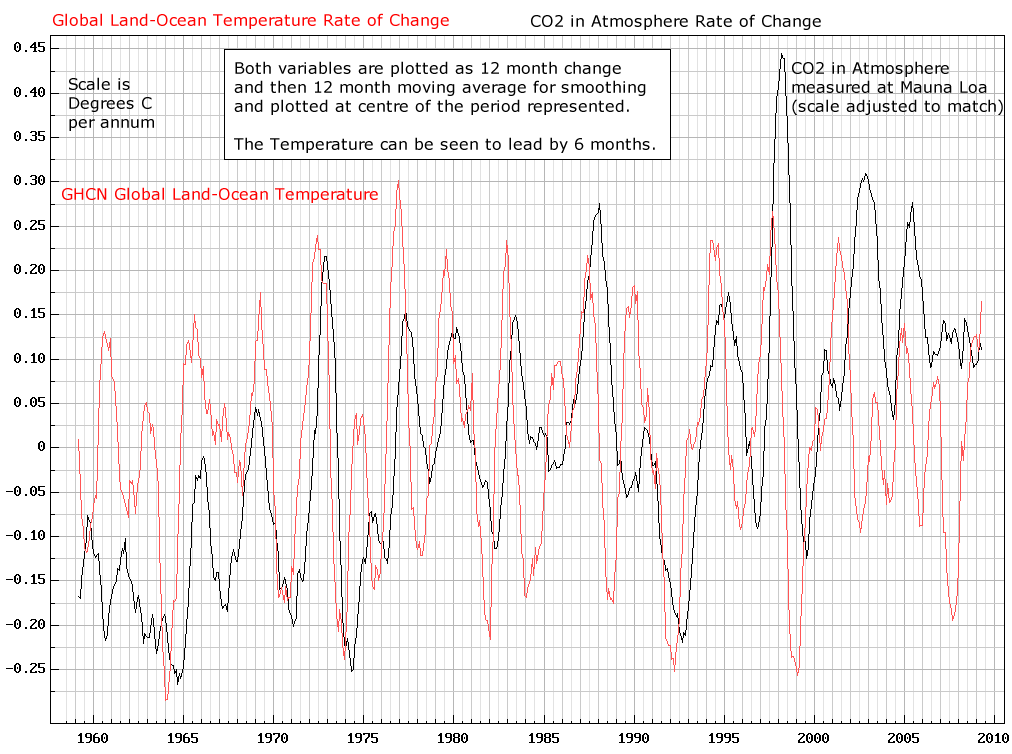

This falsifies any hypothesis that a change in T causes a change in CO2.
Wrong. On time scales from years to hundreds of millennia, the causation is clear. ∆T causes ∆CO2:
And:
[click in chart to embiggen]
(Note the NOTE in the chart.)
A fool argues with real world, empirical evidence, while honest skeptics accept what Planet Earth is saying. The planet is clearly showing that ∆CO2 is caused by ∆T.
BLAM! Way — to — go, D. Big Gun Stealey! Another Science Giant fires off a devastating artillery round. We privates down here in the infantry appreciate it!
1old,
“Per Lord Monckton”? You need to cut and paste the quote. I’m too lazy to find it, but I think Lord M was referring to the zero trend in global T for the past 18+ years.
Furthermore, what’s your point? My point is that the real world shows that CO2 does not have the global warming effect claimed.
If that is the case, then the climate alarmists’ scare is falsified.
The “dangerous AGW” alarm was all predicated on evil “carbon”. Since Planet Earth is debunking the CO2=cAGW scare, we can just forget about our ‘carbon footprint’, and all the rest of that nonsense.
They were wrong, case closed.
oldsocrates says:
My point is that when you post “∆T causes ∆CO2” you are wrong
When I post that ∆T causes ∆CO2, I am correct. See, I post corroborating links that support what I write, while you just give your opinion.
Next, when I post that global warming has stopped, that is based on the satellite measurement temperature trend; the most accurate global temperature data available. Again, when you dispute that, it is based on your opinion, nothing more.
And you are still not quoting Lord M verbatim. All you’re doing is arguing with everyone. Well, here’s a news flash: they’re right, and you’re wrong. If you don’t think so, check out the numerous links being posted. What have you got, beside your opinion?
oldsocrates:
Two “facts”? Nope. You said:
∆T for the past 17/18 years has been zero.
Wrong — as I’ve schooled you. But you don’t learn.
And the change in CO2 is just a deflection, as usual.
Since your first ‘fact’ was wrong, your premise is in big trouble. As usual.
oldie,
Either give me the temp you need for a particular year, or the trend you need for a specific time frame. I can provide either one.
…On second thought, you need to get up to speed on this subject. I suggest reading the WUWT archives for a few months. That will at least get you started. As it is right now, you’re asking 7th grade questions, and I’m not interested in holding your hand any longer.
Oldandwise- the production of CO2 from outgassing of the oceans isn’t instantaneous so the delta T that has taken place could be responsible. Certainly, temperatures turned flat after the super el nino in 1998 but, like when you strike a baseball, the ball goes for quite a ways after the impact.
old1,
Stop with your obfucating and nitpicking. Monckton was referring to the zero change in trend.
When you say:
That means ∆T = zero for 18 years and 9 months.
…are you being dense? Do you really believe there was NO change in global T during those 18 years??
If you do, we’re through here. You’re too stupid to respond to. Alzheimer’s, no doubt.
But if you’re just playing juvenile word games, then you’re being a site pest. That means you’ve got nothin’. If you had worthwhile facts, you would use them. But since you’ve got nothin’, you play your word games.
That’s about the level of the commenters here who believe in the ‘dangerous AGW’ false alarm. No facts, no evidence, and the real world is making fools of them.
So carry on.
What do I say?
I say you’re a site pest who doesn’t understand the first thing about hte subject… David.
I could post a dozen charts showing that global T is different every year. I could post charts showing the flat trend in global T. But nothing will satisfy you, because you have no interest in learning anything, you’re just running interference. Go back to hotwhopper where you belong.
Does that mean I win?
It means I’m on to you. You have no interest in learning anything; you’re just interested in arguing incessantly.
This article is about CO2, which your alarmist cult claims is the cause of global warming. Not just that, but ‘runaway global warming and climate catastrophe’.
But when that didn’t happen, it was changed to “climate change”. Because that always happens.
Now that the ultimate Authority, Planet Earth, has debunked your false alarm, you have two choices:
You can accept what reality is telling you; that there is nothing unusual happening, or…
You can obfuscate, deflect, endlessly nitpick, try to run interference, and ask interminable questions like a seven year old asking “When are we gonna get there?”
You’ve chosen the second course of actions, because some folks just can’t ever admit that their conjecture has been debunked.
Oldn: “Does that mean I win?”
LOL.
How could it? You have yet to get up out of your seat in the bleachers and down onto the playing field. D. B. (and along with others) has been engaging in excellently skillful play on the playing field. You have yet to make one genuine argument/play. No, Old, sorry, but empty comments called out at the ref or the players on the field are not “playing.”
Lol, let the poor sod think he “won,” D.B.. The rest of us can see what the deal is.
Not Altzheimer’s, perhaps, but, there is SOMETHING wrong. THAT is certain, proven by the words from Old’s own mouth.
At least, D. B. your fine play/presentation of evidence refuting AGW helped those who were genuinely interested in learning. Your efforts were not wasted, even if they were utterly wasted on Old.
1oldnwise4me@reagan.com
∆T has been near zero for the past 18 years.
Your “argument” is nothing but a distraction to the discussion of whether a decade-long change in CO2 causes a decade-level measurable change in global average temperature.
The ice core records are not sufficiently accurate in discerning individual year-to-year differences (CO2 immersion factors or CO2 equilibrium rates at that fine a time scale (10-20 years)) to determine if ever, nor if never, nor how many times ∆CO2 changed over a dozen year record to make any absolute claim. There is no indication either way.
Just as weather (individual days of temperature, humidity, rainfall, wind, or pressure) changes much more dramatically than does “climate” (now claimed to be a 30 year running average of all the above variables), the ice core records can determine hundred-year trends of CO2 and temperature reliably, but year-to-year trends (changes) with almost no reliability. It is two different cause-and-effects entirely over the short term. Jumps in temperature CANNOT immediately change CO2 since the thermal mass of the oceans and grounded CO2 take many years to warm enough ocean water to release enough CO2 to make a measurable change in global average CO2 levels.
On the other hand, the entire CO2 CAGW scare requires a near-immediate response of temperature to a change in CO2. That has been falsified the past 20 years, the past 60 years, the past 450 years, the past 1000 years, the past 3000 years.
A single “air bubble” trapped between ice layers actually crosses many years of seasonal ice layers. Diffusion limits (the number of layers of ice required to “stop” CO2 from diffusing “up” (more recent) or “down” (older) cover a short but definite period – usually accepted as 70 years.
Thus, to claim any single “year” for any single “CO2 level” is wrong. Dead wrong and misleading. Distracting. Trying to extract any year-to-year trends over any interval less than 100 years is foolish, wrong, and deliberately incites of misleading the understanding of other readers.
The temperature is no where near the projections or the 95 % certainty level. The only thing CAGW has is yelling about the warmest year ever. Which is almost laughable if this discussion weren’t so serious. No matter which way you look at it, CAGW is in huge trouble. If AGW is right, temps are falling. But doesn’t co2 control temperature? And if AGW is wrong, the temperature chart kind of looks like it does now. No relationship whatsoever. Co2 is in one direction, up, and temperature is either flat or declining. I can point to various arguments the IPCC has recently put forth to explain the pause. (excuses). Last look there were about 30.
1oldnwise4me@reagan.com
False. You are trying to distract the falsification that the ice core records show, by trying to “create” some requirement that a short change in temperature immediately changes global CO2 levels. Global CO2 levels have changed recently, and – over the same time period, global average temperatures have not changed. But that does NOT falsify the ice core records that integrate dozens of years of CO2 changes into a longer record of several tens of thousands of years when CO2 has NEVER led temperature changes.
Two different effects. Two different measurements.
Central California has had thousands of earthquakes the past 200 years, but none over magnitude 4.0
Northern CA had a massive earthquake in 1903 moving its fences and buildings 8 feet in one day.
Southern CA has not had a magnitude 7+ earthquake since statehood.
How far does an earthquake move the dirt in California?
old,
The red line shows annual temperatures. The green line is the trend:
http://realclimatescience.com/wp-content/uploads/2015/06/ScreenHunter_9549-Jun.-17-21.12.gif
Your question was a lame attempt at a “gotcha”. But you’re not smart enough to pull that off.
old1,
I’ve answered below. Now it’s your turn to do some ‘splainin’.
1oldnwise4me@reagan.com November 27, 2015 at 1:59 pm
I am going to respond to this silliness one more time. What good it will do, I do not know.
We have
dCO2/dt = k*(T – T0)
That means for small time step ∆t, we have approximately
∆CO2 = k*(T – T0)*∆t
which is to say that
1) CO2(t+∆t) = CO2(t) + k*(T – T0)*∆t
That means that, if at an additional time step ∆t, if temperature has risen ∆T, we will have
2) CO2(t+2∆t) = CO2(t+∆t) + k*(T+∆T – T0)*∆t
Thus, subtracting (2) from (1), we find
3) CO2(t+2∆t) = 2*CO2(t+∆t) – CO2(t) + k*∆T*∆t
Thus, even if ∆T = 0, we still have
4) CO2(t+2∆t) = 2*CO2(t+∆t) – CO2(t)
Suppose CO2(t) = 399 and CO2(t+∆t) = 400. Then
CO2(t+2∆t) = 401
CO2(t+3∆t) = 402
CO2(t+4∆t) = 403
CO2(t+5∆t) = 404
CO2(t+6∆t) = 405
and so on. It keeps going up linearly.
David Socrates a.k.a. 1old apparently thinks ∆T = T – T0. This is incorrect. T0 is a constant in the model, and ∆T = T(t+∆t) – T(t).
Except that Bart forgets that dCO2/dt also responds to increased pressure in the atmosphere…
The in/outflux of CO2 between oceans and atmosphere is directly proportional to the pCO2 difference between atmosphere and oceans.
Take the pCO2 at the upwelling waters near the equator: a pCO2 of ~750 μatm. Atmosphere at ~400 μatm (~ppmv). ∆pCO2 = 350 μatm. Influx (into the atmosphere): about 40 GtC/year (absolute figure not of interest here).
As the local temperature didn’t increase in the past 18.5 years, the 40 GtC/year is constant. T-T0 = 16°C
The same at the other end of the oceans, near the poles:
pCO2 of the oceans: ~150 μatm, atmosphere ~400 μatm, ∆pCO2 = 250 μatm, outflux ~40 GtC. T-T0 = -17°C
Overall balance: dCO2/dt = 0, T – T0 = 0, influx = outflux = 40 GtC/year.
Suppose that T goes up everywhere with ∆T = 1°C
At the equator, according to Henry’s law for ∆T = 1°C:
Oceans: 750 + 16 = 766 μatm. ∆pCO2 = 366 μatm. Influx 40 * 366/350 = 41.8 GtC/year. T+∆T – T0 = 17°C
At the poles, according to Henry’s law for ∆T = 1°C:
Oceans: 150 + 16 = 166 μatm. ∆pCO2 = 234 μatm. Outflux 40 * 234/250= 37.4 GtC/year. T+∆T – T0 = -16°C
Initial increase in the atmosphere: 1.8 + 2.6 = 4.4 GtC/year or ~2.1 ppmv/year.
As the CO2 levels in the atmosphere increase, the pCO2 pressure difference with the oceans increases at the upwelling side and the decreases at the uptake side. That reduces the influx and increases the outflux. At the moment that the pressure increase in the atmosphere reaches 16 ppmv, the original pressure differences are restored and thus the original equal input and output fluxes and no further CO2 increase is happening. In graph form (the real half life time may be shorter):
http://www.ferdinand-engelbeen.be/klimaat/klim_img/upwelling_temp.jpg
That is the transient response of the ocean – atmosphere system to ocean temperature changes.
“Except that Bart forgets that dCO2/dt also responds to increased pressure in the atmosphere…”
It’s in my model, Ferdinand. It’s all there. You are wrong. An accumulation of CO2 in the surface waters naturally results in an accumulation in the atmosphere. Far from being a limiting factor, Henry’s Law is what enforces the increase in the atmosphere.
No doubt, over long-enough time-scales, changes in temperature produce changes in atmospheric CO2 concentrations through oceanic solution. But that doesn’t preclude other mechanisms (organic decay, AG emissions) from contributing independently to CO2 changes. Strong correlation is insufficient, however, to distinguish between various causes. The critical question is the dynamic response characteristics of CO2 to each factor. That is best established through proper cross-spectrum analysis, which is very rarely done competently in “climate science.”
ioldwise makes a point. He is talking about a different scale than micro wiggle matching. He is asking why atmospheric dCO2 didn’t slow to match the crawl if it was all dT and none human. Pretty much like asking why atmospheric levels are so much higher today than observed during prior periods of higher temperatures. Maybe that’s the derivative thing. It increases sensitivity to micro accelerations at a scale where they matter.
Old is mixed up, O Generous Gymnosperm:
He is soundly thumped by Bartemis above:
Bartemis, here: http://wattsupwiththat.com/2015/11/25/about-spurious-correlations-and-causation-of-the-co2-increase-2/#comment-2080833
(and I pointed out the following, basic, but, that’s the level of Olds’ comments):
“1old: additionally
1) your time scale is too short; and
2) you also need to factor in that CO2 level lags temperature by a quarter cycle (did you watch the above-linked video (you can find it with a quick search on youtube directly, too) of Murry Salby’s Hamburg, 2013 video? — if so, I think you need to watch it again — his teaching is quite clear to a layperson such as myself).
It’s too soon to say Bartemis and Salby are incorrect, much less, “falisified.”
Me, here: http://wattsupwiththat.com/2015/11/25/about-spurious-correlations-and-causation-of-the-co2-increase-2/#comment-2080904 (affirmed by afonzarelli as to the emphasized clause, here: http://wattsupwiththat.com/2015/11/25/about-spurious-correlations-and-causation-of-the-co2-increase-2/#comment-2081079).
As I pointed out above, old1 conflates his terms. He’s deliberately trying to frame the question so if I say it’s the trend, he will pull a ‘gotcha!’ and talk about the change in global T year to year. But if I answer with the change in intra-annual temperatures, he will move the goal posts and pull another ‘gotcha!’, claiming that the trend shows “zero” ∆T.
But as I pointed out above, he’s just not smart enough to pull that off.
Here’ a chart showing both the change in annual temperatures, and the trend:
http://realclimatescience.com/wp-content/uploads/2015/06/ScreenHunter_9549-Jun.-17-21.12.gif
And now it’s my turn to ask a question: does the old1 think that the change is instantaneous? That there’s no lag time between CO2 and T (or T and CO2)?
So instead of his interminable ‘gotcha’ questions, how about if old1 explains exactly what he thinks the situation is? This should be good. Will he answer?
OK old1: On your mark… Ready… GO!
oldie,
I’ve answered several questions now. And I note that the alarmist contingent has one thing in common: they always want to ask the questions (which are then followed up by more questions, etc.) But they never want to answer any questions. You completely avoided my question above.
So first, old1, you answer my question. Explain what you think is happening. Give us your CO2/temperature narrative. Explain how “carbon” is gonna getcha. (And if you think CO2 isn’t a problem, then explain why you’re thread-bombing when it doesn’t matter.)
See, I don’t know for certain where you’re coming from, or what you believe.
You’ve been hiding out. Time to explain yourself.
He DID explain himself very clearly! He said:
The above two facts are all that he wants addressed. Forget ice cores; forget lag times; forget warming due to CO2. Those are NOT what he is talking about.
1oldy1,
Where are you coming from? What is your ‘carbon’ narrative? Is there anything to the CO2 scare? If so, explain what you think it is. Or are you just thread-bombing?
This is the 4th time I’ve asked you questions. I’ve answered yours, but you continue to ask more questions. Enough of that, now it’s your turn to post some answers. I’ve never gotten any answers from old1 in response to these comments:
• “…how about if old1 explains exactly what he thinks the situation is?”
• “…it’s my turn to ask a question: does the old1 think that the change is instantaneous? That there’s no lag time between CO2 and T (or T and CO2)?”
• “…I’ve answered below. Now it’s your turn to do some ‘splainin’.”
• “…old1, answer my question…”
I’ve answered several of old1’s questions, using charts, logic, and real world observations. But the old1 still hides out from answering any questions that I ask. He doesn’t understand the concept of quid-pro-quo. Now it’s his turn to answer some questions of mine.
Will old1 explain himself? Or will he skedaddle rather than answering questions?
(Werner, he is unclear. Is it temperature in a specific year, or the temperature trend? I’ve asked that, but he doesn’t answer as usual. Maybe you would like to answer, if you know what he’s asking. I don’t.)
Hi Werner B,
Here is a chart showing that T leads CO2 by six months:
That is a real world observation. The causation is crystal clear: ∆T causes ∆CO2. But oldy says T never changes!
We see the same cause and effect relationship in this WoodForTrees chart. In fact, we see the same causation on many differnt time scales:
http://theinconvenientskeptic.com/wp-content/uploads/2010/09/Vostok-CO2.png
old1 is claiming that there is zero change in T, while CO2 is rising. That makes no sense to me. Furthermore, he deflects from the question of lag time, as if it doesn’t exist.
We see in the chart above that T is never zero. Therefore, old1 is not making any sense when he claims that ∆T is zero.
I should add (before the discussion gets too far afield) that the basic alarmist premise stated that a rise in carbon dioxide would cause runaway global warming. That is the claim that started it all.
So naturally, since the alarmist crowd’s belief in CO2=cAGW has been so decisively debunked by the real world, they now want to deflect to other, extraneous arguments that try to hide the fact that they were proven to be flat wrong.
Anyway, perhaps you can understand what the old codger is saying; it’s unclear to me. If so, you can try to answer him. He is not being coherent. As Janice says, “Old is mixed up”.
Before I answer any more of his questions, oldy owes me a few answers first. I’ve already answered him several times. Now it’s his turn to answer a few questions of mine.
Maybe that’s why he seems to have skedaddled. Alarmists always want to be the ones asking all the questions, but they never answer any. It’s time for 1old1 to man up, and start explaining himself.
Yes, I know exactly where he is coming from. (But should I be wrong, he can always correct me.)
Here: http://wattsupwiththat.com/2015/11/25/about-spurious-correlations-and-causation-of-the-co2-increase-2/comment-page-1/#comment-2081114
you say: “Wrong. On time scales from years to hundreds of millennia, the causation is clear. ∆T causes ∆CO2:”
So his question is: Does this apply over the last 18 years and 9 months where RSS shows no change and CO2 is up by 30 ppm? We are NOT talking about seasonal variations nor warmer and colder years having some influence since 1997. Rather, why did the CO2 not stay more or less at its 1997 level?
Ferdinand Engelbeen has this to say:
“The point where Bart (and Dr. Salby) got wrong is where he saw a perfect match of the variability’s and assumed that the slope was from temperature too.
Thus while temperature and other natural causes are fully responsible for the variability, temperature is not responsible for most of the increase, human emissions are… “
See: http://wattsupwiththat.com/2015/11/25/about-spurious-correlations-and-causation-of-the-co2-increase-2/comment-page-1/#comment-2081102
Do you not agree with Ferdinand?
Werner Brozek (4:46am, today): Your “two facts” are not “fact” at all. The assertion you cite as Olds’ “facts” is unsupported, nonsensical (puts the effect before the cause — CO2 began to slow in increase around THE SAME TIME as temperature flatlining around 1998), sophomoric, and insincere (or crazy — take your pick), JUNK.
Why a normally fine thinker as you would defend such an empty-minded, disingenuous, troll is intriguing… .
Do you KNOW this “Old”? IS HE YOU POSING AS A SOCK PUPPET?? lol, if so, way to go, Brozek — you did a good job, oh, brother, WHAT a sock-puppet!
Huh? Here is RSS for 18 years and 9 months:
http://www.woodfortrees.org/plot/rss/from:1997.05/plot/rss/from:1997.05/trend
Both dbstealey and Lord Monckton agree with this.
Here is CO2 since 1958:
http://www.woodfortrees.org/plot/esrl-co2/from:1958
It shows an increase from about 360 to about 395 since 1997 with no decrease in rate since 1997.
Which fact is wrong?
(No, I did not pose as anyone else.)
Werner – the relationship is dCO2/dt = k*(T – T0), where T0 is an equilibrium temperature, and k is a coupling factor (remarkably, essentially constant since at least 1958).
The rate of change has leveled off since the “pause” commenced. What you are doing is akin to tracking a spent rocket in space and claiming that, since its velocity hasn’t changed while you observed it, the rocket engine isn’t responsible for its speed.
I agree with that. However it is still going up at a steady rate. In my opinion, only human emissions are responsible for that steady increase. Let us suppose this pause on RSS lasts for another hundred years and CO2 goes up steadily at the present rate to 550 ppm, what would you attribute it to?
If your answer is different from Ferdinand’s, I will apply occam’s razor and agree with Ferdinand.
“However it is still going up at a steady rate.”
Yes, and that rate is consistent with the dCO2/dt = k*(T – T0) relationship.
“Let us suppose this pause on RSS lasts for another hundred years and CO2 goes up steadily at the present rate to 550 ppm, what would you attribute it to?”
If the relationship dCO2/dt = k*(T – T0) continued, I would attribute it to temperature. If some other relationship came to the fore, I would consider that.
Obviously, dCO2/dt = k*(T – T0) with T exceeding T0 cannot last forever. This is a local model. It holds, with remarkable fidelity for constant k and T0, for the past 57 years.
Local models are used in engineering all the time. The transistors in your electronic gadgets are biased to operate in a linear range, and the gain is computed on that basis. That does not mean, however, that you can extrapolate the gain such that an input can be amplified beyond the supply voltage.
The local model is enough to tell us what has been dominating atmospheric CO2 evolution for at least the past 57 years. It is enough to tell us that natural processes are currently in the driver’s seat. To determine a global (in a mathematical sense) model, we will have to continue our observations over a long enough timeline that other dynamics become observable.
Note: when I say “observable”, I mean it in a particular technical sense.
Janice – Oldie is not Werner. He is the old “David Socrates” sock-puppet. Only he can continue droning on and on with the same baseless objection without understanding that it is been refuted over and over again. Only he can look at a plot plainly showing dCO2/dt = k*(T – T0) and claim that a lack of change in T results in a lack of change in CO2.
Bart:
The local model is enough to tell us what has been dominating atmospheric CO2 evolution for at least the past 57 years.
No, it doesn’t tell such a story, as it is not a unique solution. My solution shows the same variability an exactly the same slope without arbitrary offset and factor for the slope with human emissions plus natural variability. Without violating Henry’s law for the solubility of CO2 in seawater.
Your solution ignores the negative feedback from the increased CO2 pressure in the atmosphere: if that passes the 16ppmv/°C change, CO2 is pushed into the oceans, not reverse…
“My solution shows the same variability an exactly…”
Your solution is not physically valid. If your natural input is attenuated by a 40 year time constant, then your anthropogenic input also has to be attenuated by a 40 year time constant.
I know you didn’t do that because attenuating the input that way results in a loss of polynomial degree – the anthropogenic input does not continuously accumulate, but settles into a proportionality with the input rate of change.
Bart:
If your natural input is attenuated by a 40 year time constant, then your anthropogenic input also has to be attenuated by a 40 year time constant.
I used a 51.3 years time constant (~40 years half life) for any pressure above steady state of the oceans. That is the same for human as well as for natural causes of the extra pressure.
That is completely independent of the 12 month time constant that temperature has on (tropical) vegetation, as that releases CO2 into or takes in CO2 from the atmosphere, whatever the origin of that CO2.
Temperature is responsible for almost all the variability and a small part of the slope.
Pressure is responsible for almost all the slope…
Ferdinand, i dispute the henry’s law value of 16ppmv/1C as represented in ice cores. In much the same manner that we can say that south pole temps aren’t reflective of global temps, neither are the co2 concentrations reflective of reality. If we just look at the long closing time of the bubbles alone, all peaks and troughs are smoothed, lessened in amplitude, so that they under represent the value of henry’s law…
I don’t know what you did, Ferdinand, because you haven’t written it down. But, I know you didn’t apply a time constant parameterized low pass filter to the anthropogenic data like you did to the temperature parameterized data because of the aforementioned polynomial degree discrepancy.
I am simply an observer in this discussion. Much has been debated as to sinks and sources of the atmospheric C02 cycle. A recurring thought in my mind over several years and discussions/debates is as noted. What is the effect of falling rain with regards to CO2 levels?
I would assume that rain begins at a temp of about 0C and falls through the atmosphere where it should absorb CO2. Much of that probably falls in the oceans. I would guess that in itself would classify rain as a sink. Has there ever been any research as to the amount of CO2 that would be affected by this process? Just saying.
eyesonu,
I have calculated that some time ago: not important at all. Fresh water absorbs a few mg per liter at 0.0004 bar pressure in the atmosphere. If rain is formed, that needs about 400 m3 air to form 1 l of rain, the absorbed amount of CO2 out of 400 m3 air is undetectably low. When that falls on 1 m2 ground and all water evaporates, that increases the adjacent 1 m3 air with less than 1 ppmv if there is no wind,,,
Still huge quantities of CO2 are lifting with water vapor from the equatorial seas to where the rain falls, but back on the oceans that is just a cycle. On land it can dissolve carbonate rocks, but even that needs millions of years the form the beautiful caves…
Thank you for your reply.
Through ‘google’ search I have been able to find that rain can have a PH varying from ~4.5 to 6.5 in the USA alone. That would seem to imply that considerable CO2 was absorbed. That which falls on land and soaks into the ground would seemingly carry some amount of CO2 into the soils.
Again I thank you for your reply. The discussion on this thread has been captivating from my perspective. You have done an excellent job with regards to responding to other comments. I wish I had the knowledge to pick the scientifically correct process (if only one exists) in the discussion. But it has been a learning experience and is an excellent example of scientific discussion where differing views are debated. As I noted in an earlier comment, I hope some in the academic professions will use this thread as an example of how science should be debated and progress. You opened the door on that one.
eyesonu,
Thanks for your kind words…
You need not much CO2 to lower the pH to ~4, a few mg is sufficient as there is no buffer in fresh water. Other acids may help too: SOx, NOx,… if the air is polluted.
For the solubility of different gases in fresh water see:
http://www.engineeringtoolbox.com/gases-solubility-water-d_1148.html
That is for 1 bar pressure or 100% CO2 in the atmosphere.
At 0.0004 bar partial pressure in the atmosphere it is a few mg/l.
http://wattsupwiththat.com/2015/10/24/water-vapour-the-big-wet-elephant-in-the-room/#comment-2057601
Hi Ferdinand,
I am glad that you were respectful to Ernst Beck – many others were not.
To be clear, I regard you as one of THE experts on this topic, and enjoy your thoughtful comments.
Having said that, I am still an agnostic on your key conclusion – the “mass balance argument” (MBA) that concludes that fossil fuel combustion is the most significant driver of the observed increase in atmospheric CO2. I just want to wait and see what the new CO2 satellite data tells us.
We can afford to be patient on the MBA issue, since it is increasingly obvious that the sensitivity of global temperature to increasing atmospheric CO2 is too small to be significant.
Other issues are much more important and urgent:
IF we are correct about imminent naturally-driven global cooling, which some of us think should be apparent by 2020 or sooner, and which could be mild or severe, then we cannot wait much longer to address the potentially serious consequences of cooling on society.
As I have stated before, I hope to be wrong about cooling.
Best, Allan
Hi Allan,
The mass balance is not the only argument, human emissions as cause fit all observations…
But we agree on the part of the impact of the extra CO2…
http://wattsupwiththat.com/2015/01/30/what-are-your-fears-about-global-warming-and-climate-change/#comment-1847733
Hypothesis:
1. The next act of this farce will be characterized by global cooling starting by about 2020 or sooner, cooling that may be mild or severe. Global cooling will demonstrate that climate sensitivity to increasing atmospheric CO2 is so small as to be insignificant. The scientific credibility of the warmist gang will be shattered and some may face lawsuits and/or go to jail.
2. The scientific community will gradually accept the fact that CO2 lags temperature at all measured time scales, and that temperature (among other factors) drives atmospheric CO2 much more than CO2 drives temperature.
3. The foolish green energy schemes to “stop global warming” will be shelved and dismantled, but not before they contribute to a significant increase in Excess Winter Mortality, especially in Europe and to a lesser extent in North America, where energy costs are much lower (thanks to shale fracking).
4. The warmist thugs will still be bleating about a warmer world, wilder weather, etc., all caused by the sins of mankind, but nobody will listen.
Regards to all, Allan
with reference to Engelbeen and 10:48 am. Sorry I don’t seem to be able to reply in thread. First a general comment, it disturbs me that so many people casually dismiss the work of earlier scientists as wrong or inaccurate often on the most flimsy of evidence. In reading up on the history of science what stands out is the inordinate lengths that scientists in the past went to to achieve more and more accuracy in their measurements. There are examples of where theories were destroyed by measurement discrepancies in the 3,4 or 5th decimal place.
WRT to CO2 measurement, firstly an accuracy of +-10 ppm which you quote is adequate to determine the trends we are looking at. Secondly these people were not fools, and they did understand the impact of measuring CO2 in the middle of a town or forest. There are stories of scientists making arduous journeys to remote coastal places just to make their CO2 measurements more representative. This issue of poor measurement siting also does not explain the similarity of measurement done by different scientists at similar times. If it was all siting dependent then different scientists measuring at the same time but using different sites should get wildly different results. Scientists in the future could just as well argue that measuring CO2 on a volcano (Mauna Loa) which is spewing out CO2, as Mauna Loa does, is a really questionable approach and justifies ignoring all the data so collected.
WRT pH measurement. Your comment that glass electrodes were the earlier (relatively inaccurate) way of measuring pH since replaced by the colorimetric approach does not agree with my research. The earliest methods of measuring acidity were colorimetric ones using substance like Litmus (discovered in 1300 and used since). The glass electrode was only invented in 1909 and was far more accurate than the earlier methods (certainly not in existance for the last 165 years). True, spectroscopic methods of measuring colour change instead of relying on subjective comparisons against a printed colour chart have improved consistency but, as someone who has designed and built spectroscopic equipment for making such measurements (my job is doing research for a spectroscopy company), I can tell you the human eye is incredibly good at picking up colour differences and it is really hard to get a spectrometer to do any better. Non the less, today the most common method of measuring pH is via the glass electrode.
Michael,
I am sure that the scientists of the pre-Mauna Loa period were very good in what they did. But you need to take into account that the methods used were not even good enough to measure the seasonal changes. Even Keeling Sr. was surprised to see a clear seasonal signal after a year of data at Mauna Loa. The longer term changes also were minimal at that time, although slowly emerging out of the background noise.
Callendar was the first to use stringent a-priory criteria to sift between the noisy data, like “not from agricultural research”, which should eliminate the 1943 “peak” in Beck’s compilation as that is mainly based on two long series used for agricultural purposes… One can have objections against Callendar’s criteria (like “less than 10% deviation from the average”), but at least he had criteria and his estimates were confirmed decennia later by high-resolution ice cores…
This issue of poor measurement siting also does not explain the similarity of measurement done by different scientists at similar times.
You really should look at the data which were compiled by the late Ernst Beck: near 400 ppm at Giessen, Germany, in the same year 250 ppmv somewhere near Chicago (if I remember well). Here the minima and averages of different series taken in the same year and from different years compiled by Ernst Beck:
http://www.ferdinand-engelbeen.be/klimaat/klim_img/beck_1930_1950.jpg
The maxima were near all off-scale…
There were few ocean (ships) and coastal air CO2 measurements in the whole compilation and these are all around the ice core data…
About pH measurements: glass electrode measurements in seawater are not that easy and as you need an accuracy of better than 0.01 pH unit to see a change of 0.1 unit over a time span of 165 years, quite impossible. The only alternative is calculating the pH form other measurements (total alkalinity,…)
Spectrophotometric is better than electrochemistry. 0.0007 pH units in one method
Let’s sneak in there when noone is lookin’ and substitute true random noise for all this seemingly random data and see if we come out with the same results. If we do, let’s arrest them all and demand a full refund. Those that refuse will be turned over to the Saudis for beheading.
Source: random.org