Guest essay by David Archibald
Introduction
While Solar Cycle 24 is well into its decline in terms of F10.7 flux and sunspot number, several types of solar activity have risen dramatically over 2015. The solar wind flow pressure, for example, is now at a two decade high. That in turn means that the low in neutron count for this cycle may be more than a year out. This also means that the expected, much-awaited solar-driven cooling could be put off for at least year, with the consequence that the earthly temperature plateau will also continue for another year.
It is also possible that Solar Cycle 24 may end up having the odd combination of being both short and weak. The best analogue for Solar Cycle 24 could be the nine-year long Solar Cycle 2. Lastly, the Sun’s magnetic field strength suggests that Solar Cycle 25 will be as weak as expected.

Figure 1: Ap Index 1932 – 2015
The Ap Index is a measure of geomagnetic activity from eight stations around the planet and reflects disturbances in the horizontal component of the Earth’s magnetic field. Activity has taken off from early 2015.

Figure 2: Solar Wind Flow Pressure 1971 – 2015
Similarly, the solar wind flow pressure has also increased dramatically.

Figure 3: Interplanetary Magnetic Field 1966 – 2015
Again, the interplanetary magnetic field has now increased to levels above that of the 1970s cooling period.

Figure 4: Oulu Neutron Count 1964 – 2015
The flux of galactic cosmic rays outside the heliosphere is constant. Inside the heliosphere it is modulated by the magnetic field carried by the solar wind, which varies with the solar cycle. There is a one year delay between the strength of the interplanetary magnetic field and the galactic cosmic ray flux at the Earth’s orbit. Given the strength of the magnetic field in 2015, the low for the Oulu neutron count may not be seen until late 2016. As the neutron shower at low altitudes caused by the galactic cosmic ray flux influences cloud droplet formation, then cooling caused by increased flux as the solar cycle declines may be put off for another year or so.

Figure 4: Heliospheric Current Sheet Tilt Angle
As measured by the heliospheric tilt angle, we are now well past the Solar Cycle 24 maximum.

Figure 5: F10.7 Flux 2014 – 2015
The F10.7 flux is a measure of the Sun’s emissions at 2800 MHz (10.7 cm) and correlates with sunspot number. It is a cleaner measure than sunspot number in that it is not subject to observer bias and the record can’t be adjusted on a whim. It has a floor at 64. Based on the correlation with sea level, a F10.7 flux above 100 is warming and below that is cooling. The F10.7 flux has been in a narrow, declining band of activity over 2015, suggesting that there is some disciplined process operating at some level in the Sun. At its current rate of decline, the lower bound of activity will reach the floor at 64 in January 2016.

Figure 7: Interplanetary Magnetic Field 4000 BC – 2015 AD
This figure shows the data from Figure 3 combined with the reconstruction of the interplanetary magnetic field (IMF) for the last 6000 years by Steinhilber et al (data courtesy of Dr Gargett). This reconstruction indicates that the cause of the current, pleasant Modern Warm Period is most likely the high level of solar activity over the second half of the 20th century.

Figure 8: Solar Cycle 24 superimposed on Solar Cycle2
There are some indications that Solar Cycle 24 may be a short, relatively weak cycle of perhaps eight or nine years long. In that case, the closest analogue from the record is Solar Cycle 2. Figure 8 shows Solar Cycle 24 (in red) to date superimposed on Solar Cycle 2 (in blue).

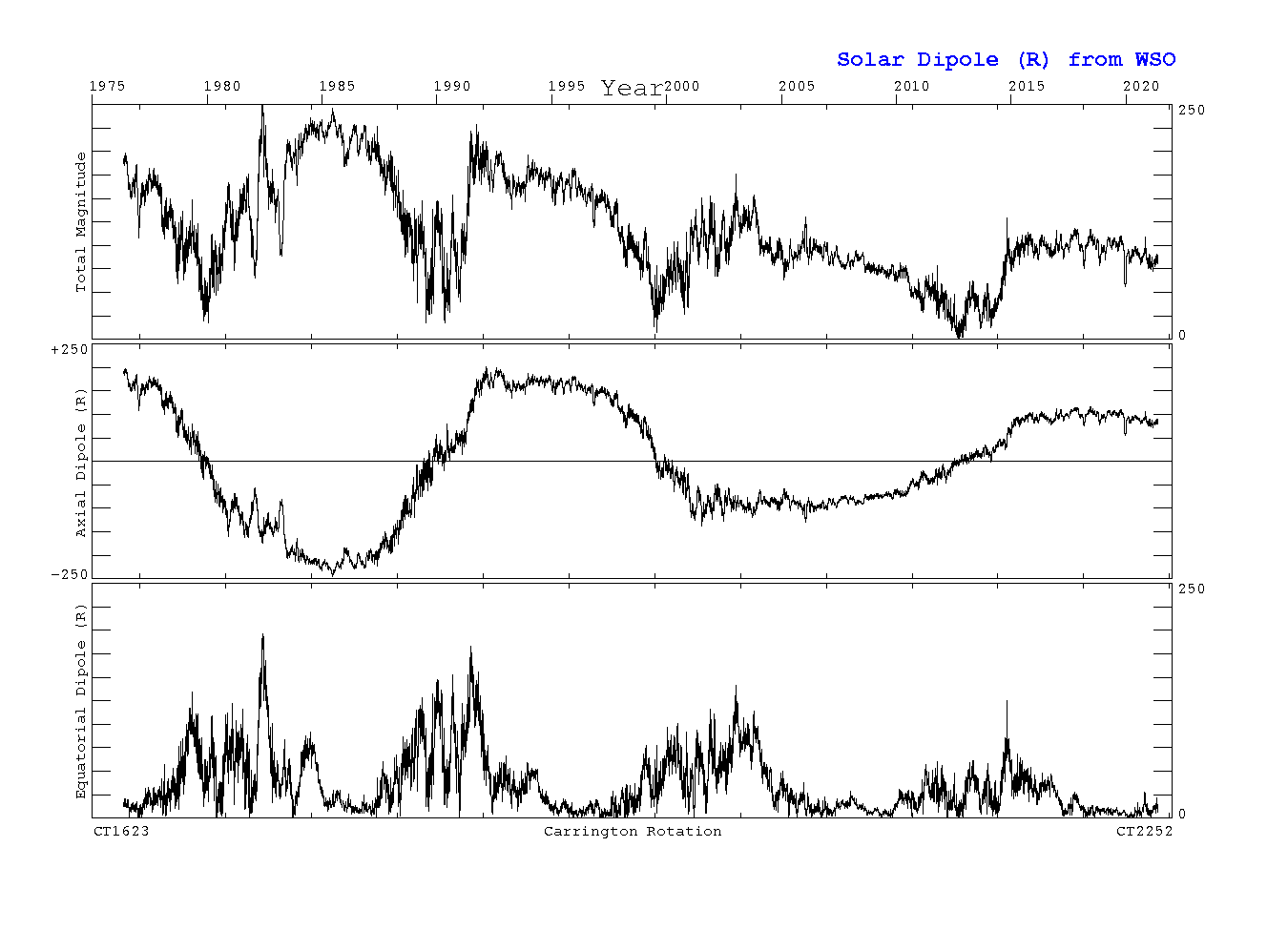
Figure 9: Solar Dipole 1976 – 2015
This figure from the Wilcox Solar Observatory shows that the polar component of the magnetic flux of the Sun has been decling for 30 years. There has been little recovery since Solar Cycle 24 maximum, suggesting that Solar Cycle 25 will be very weak.
David Archibald’s most recent book is Australia’s Defence (Connor Court 2015).
Reblogged this on Climate Collections and commented:
Interesting post and interesting discussion featuring rgb, Leif, Willis, et al.
If the suns polar field reverses and it takes 9-13 years for it to rotate around the circumference of the sun and when both polarfields interact an increase in solar activity occurs such as sunspot activity, if the suns polar field stops reversing it’s a reasonable assertion that it could be a major cause of planetary cool periods… There is controversy and debate about what drives this polar field reversal not what causes the polar field itself, personaly I’m not a fan of the self-driven dynamo, that type of thing does not occur naturally in nature and it breaks with basic principles in my opinion, the other issue is with planetary temperature whiich does not exist, the ridiculous idea of 0.bla of a degree spread accross a ton of selected instruments divided across the planet is actually very incompetent and when there’s obvious manipulation involved with the instrumental data you know that part of the equation is untouchable.. Individual records do however follow the suns activity…