Guest essay by David Archibald
Introduction
While Solar Cycle 24 is well into its decline in terms of F10.7 flux and sunspot number, several types of solar activity have risen dramatically over 2015. The solar wind flow pressure, for example, is now at a two decade high. That in turn means that the low in neutron count for this cycle may be more than a year out. This also means that the expected, much-awaited solar-driven cooling could be put off for at least year, with the consequence that the earthly temperature plateau will also continue for another year.
It is also possible that Solar Cycle 24 may end up having the odd combination of being both short and weak. The best analogue for Solar Cycle 24 could be the nine-year long Solar Cycle 2. Lastly, the Sun’s magnetic field strength suggests that Solar Cycle 25 will be as weak as expected.

Figure 1: Ap Index 1932 – 2015
The Ap Index is a measure of geomagnetic activity from eight stations around the planet and reflects disturbances in the horizontal component of the Earth’s magnetic field. Activity has taken off from early 2015.

Figure 2: Solar Wind Flow Pressure 1971 – 2015
Similarly, the solar wind flow pressure has also increased dramatically.

Figure 3: Interplanetary Magnetic Field 1966 – 2015
Again, the interplanetary magnetic field has now increased to levels above that of the 1970s cooling period.

Figure 4: Oulu Neutron Count 1964 – 2015
The flux of galactic cosmic rays outside the heliosphere is constant. Inside the heliosphere it is modulated by the magnetic field carried by the solar wind, which varies with the solar cycle. There is a one year delay between the strength of the interplanetary magnetic field and the galactic cosmic ray flux at the Earth’s orbit. Given the strength of the magnetic field in 2015, the low for the Oulu neutron count may not be seen until late 2016. As the neutron shower at low altitudes caused by the galactic cosmic ray flux influences cloud droplet formation, then cooling caused by increased flux as the solar cycle declines may be put off for another year or so.

Figure 4: Heliospheric Current Sheet Tilt Angle
As measured by the heliospheric tilt angle, we are now well past the Solar Cycle 24 maximum.

Figure 5: F10.7 Flux 2014 – 2015
The F10.7 flux is a measure of the Sun’s emissions at 2800 MHz (10.7 cm) and correlates with sunspot number. It is a cleaner measure than sunspot number in that it is not subject to observer bias and the record can’t be adjusted on a whim. It has a floor at 64. Based on the correlation with sea level, a F10.7 flux above 100 is warming and below that is cooling. The F10.7 flux has been in a narrow, declining band of activity over 2015, suggesting that there is some disciplined process operating at some level in the Sun. At its current rate of decline, the lower bound of activity will reach the floor at 64 in January 2016.

Figure 7: Interplanetary Magnetic Field 4000 BC – 2015 AD
This figure shows the data from Figure 3 combined with the reconstruction of the interplanetary magnetic field (IMF) for the last 6000 years by Steinhilber et al (data courtesy of Dr Gargett). This reconstruction indicates that the cause of the current, pleasant Modern Warm Period is most likely the high level of solar activity over the second half of the 20th century.

Figure 8: Solar Cycle 24 superimposed on Solar Cycle2
There are some indications that Solar Cycle 24 may be a short, relatively weak cycle of perhaps eight or nine years long. In that case, the closest analogue from the record is Solar Cycle 2. Figure 8 shows Solar Cycle 24 (in red) to date superimposed on Solar Cycle 2 (in blue).

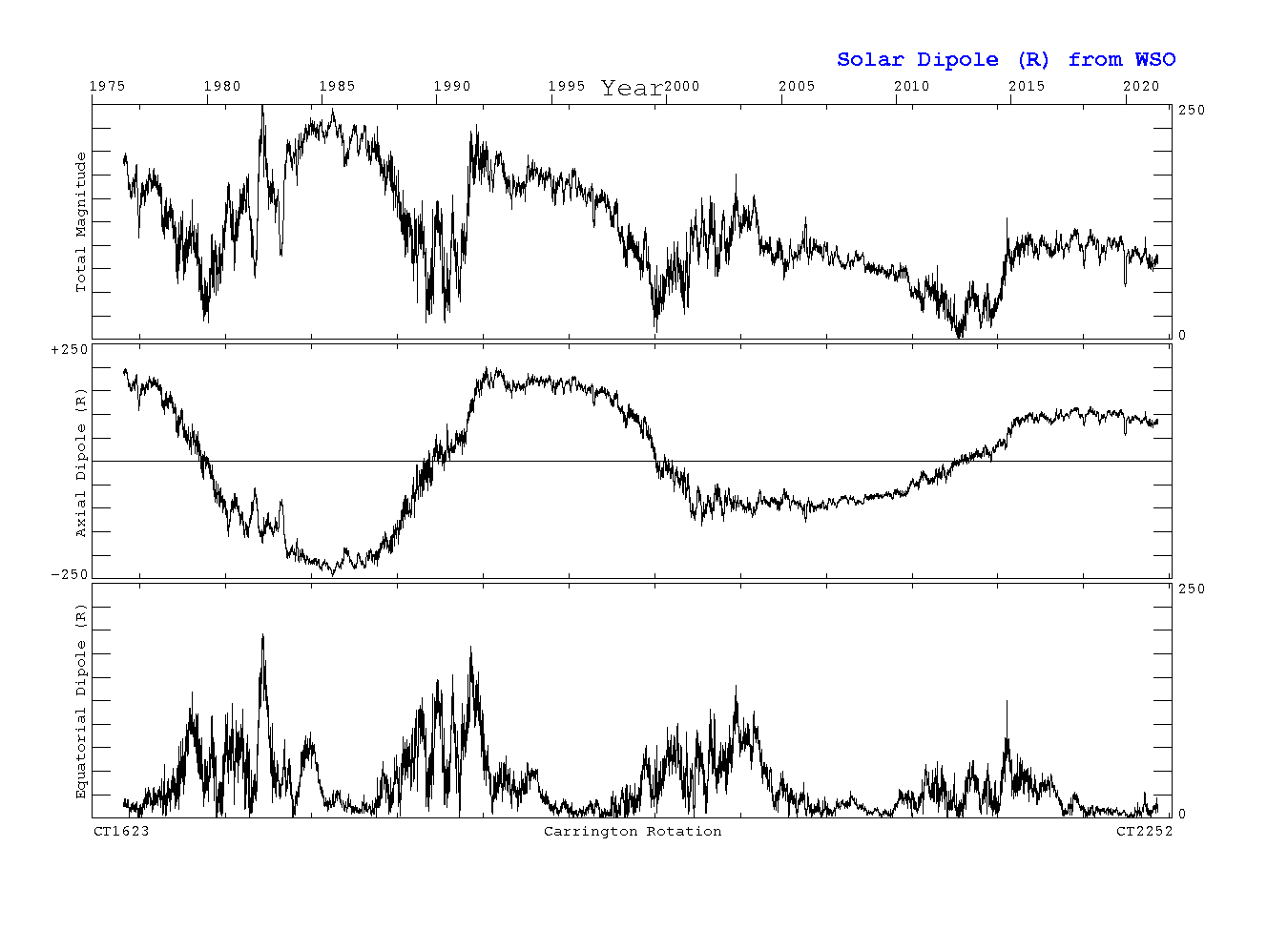
Figure 9: Solar Dipole 1976 – 2015
This figure from the Wilcox Solar Observatory shows that the polar component of the magnetic flux of the Sun has been decling for 30 years. There has been little recovery since Solar Cycle 24 maximum, suggesting that Solar Cycle 25 will be very weak.
David Archibald’s most recent book is Australia’s Defence (Connor Court 2015).
Maybe the sun doesn’t really change the overall temperature but the windflow patterns change during solar minimums. Making it colder in some regions and hotter in others. ie LIA weather in Europe and North America.
David, that’s an interesting point. Solar eclipses can create weather variations by slowing the wind down and making it change direction. This effect was demonstrated during the total eclipse in 1999. Wind speeds over the affected region reduced by 0.7 meters per second and the direction of the wind turned counterclockwise by 17 degrees.
Leif questions – when do you think solar cycle 24 will end ? Do you still have the same forecast for solar cycle 25?
I don’t ‘think’ about something like this, I prefer to let the data speak. And so far there is nothing unusual about SC24. It is too early to predict with any confidence. The best we can do is to use climatology, which says that small cycles lasts longer and are most of the time followed by another small cycle.
thanks
“The best we can do is to use climatology, which says that small cycles lasts longer..”
In fact short cycles will inevitably occur in solar minima because of the planetary periods involved in the ordering of the cycles. SC 12 is an example, there were also short ones the late 1600’s.
Dr Svalgaard
Could you please answer a question regarding the construction of your graph :
Solar activity of the past Year
http://www.leif.org/research/TSI-SORCE-Latest.png
I am not sure why the X axis is graduated as you show. I believe it is a decimal fraction of the number of days in a year, for a chosen graduation and year ? Which could convert to a month and day ?
Thanks
Yes, they are simply decimal fractions of the year, plotted 7 days apart, so the vertical lines are 7 days apart. To convert to months, multiply the fractional part by 12. To convert to days, multiply the fractional part of the months by 30.53.
thanks ! this chart provides a good compilation of solar data.
For the whole of cycle 24 see:
http://www.leif.org/research/TSI-SORCE-Cycle-24.png
It will be interesting, now that we have probes both inside and outside the heliosheath, to witness the eventual impacts the heliosheath itself. It must expand and contract in response to changes in solar flux and solar wind.
This process shields us from the stripping the solar wind creates by creating a resistance. http://newscenter.lbl.gov/2011/07/17/kamland-geoneutrinos/
“The best-studied example of a bow shock is that occurring where the Sun’s wind encounters Earth’s magnetopause, although bow shocks occur around all magnetized planets, such as Jupiter[2] or Saturn.[3] Earth’s bow shock is about 17 kilometres (11 mi) thick[4] and located about 90,000 kilometres (56,000 mi) from the planet.” https://en.wikipedia.org/wiki/Bow_shocks_in_astrophysics
[Citation needed]
“The flux of galactic cosmic rays outside the heliosphere is constant.”
Is this correct? Over what timescale?
(I think I’m remembering “The Chilling Stars” which suggested it changed according to the Solar System’s position in space, and the varying flux, modulated by the Sun, affected climate)
“The flux of galactic cosmic rays outside the heliosphere is constant.”
Is this correct? Over what timescale?
Yes, over tens of thousands of years.
“The flux of galactic cosmic rays outside the heliosphere is constant.”
“Is this correct? Over what timescale?”
“Yes, over tens of thousands of years.”
——————
Pardon my stupidity, but how can we know that? We’ve only had a sensor outside the heliosheath since August 25, 2012. I suspect it’s done with proxies. But you’ve got two (or more) unknowns: flux of GCRs at the heliopause, and moderating factors from there to your proxy sensor.
We know this because a map of cosmic rays over the sky is completely uniform with no structure at all:
http://imagine.gsfc.nasa.gov/Images/science/galaxy_cr.gif
The magnetic field of the Galaxy scrambles the cosmic rays and the amount of scrambling [and resulting uniformity] depends on the time scale over which the flux varies. Very high-energy [and thus very rare] cosmic rays are not scrambled and do show some structure, but their flux is so low that they don’t matter.
Oh My GOSH I want to be sooooo snarky here!!!!! Leif, that blank diagram is so good I now have wine spit on my computer screen! An equality calculation comes to mind.
Thank you for your explanation, but it seems to me that the uniformity is spatial, not temporal. It’s uniform, meaning we’re getting the same flux from every direction, but is the flux now the same as the flux 12kyears ago? How do we know?
How do you get spatial uniformness? By diffusion. There is a relationship between time scale of the diffusion and the length scale. All this is well known from the general theory of diffusion that we use here on Earth.
Dear David Archibald, thank you for well explained and relevant info as always!!
Frank, nothing was explained other than wriggle matching.
Yes, thanks, David. Your work is always interesting.
Daily Express strikes again:
Shock as NASA confirms asteroid TWO MILES wide will pass close to Earth in 48 HOURS
http://www.express.co.uk/news/science/610777/NASA-asteroid-warning-86666-near-miss-planet-Earth-48-hours
So, any explanation why solar activity as reconstructed from 14C and 10Be correlates quite well with global temperature variations on the millennial scale? The 2200-2500 yr Hallstatt cycle comes out in any frequency analysis of past solar activity reconstructions, and in general terms its lows are populated by minima and coincide with periods of major glacial advances and many other cooling proxies.
Perhaps it is true that small changes when accumulated over centuries cause a significant difference, or perhaps it is true that solar wind or gravitational changes affect the important “length of day” integrator as other scientists have claimed.
If we lack an explanation for the correlation between reconstructed solar activity and climatology on the millennial scale, we should either look for one or at least keep our minds open, since our knowledge is so limited as we just started looking with some detail a few decades ago.
The tiny variance in solar irradiance measured at the top of the atmosphere pales in comparison to what the Earth can do to incoming solar rays, or bits and pieces of atoms. Indeed, Earth’s highly variable surface and atmosphere affects what the Sun sends to us FAR more than the Sun’s variance affects what the Earth puts out. If you disagree, physics or chemistry, not to mention fluid dynamics and chaos theory, are areas of study beyond you.
http://www.physicalgeography.net/fundamentals/7f.html
As for CO2-believing folks, available anthropogenic column CO2 energy calculations compared to column water vapor energy calculations are apparently beyond you.
http://nov79.com/gbwm/ntyg.html
I understand that. Yet the data is obstinate. How do you explain the following evidence that has been known at least since the 60’s (J. R. BRAY. Glaciation and Solar Activity since the Fifth Century BC and the Solar Cycle. Nature 220, 672 – 674 1968):
The solar cycle activity lows on a millennial scale correlate well with cold periods according to numerous proxies.
That data still holds after 45 years. And still awaits an explanation. Fluid dynamics and chaos theory doesn’t appear to be able to explain it.
If one wishes to refer to data that has been deemed reliable, which tree ring temperature data has not been deemed, I would think one would also avoid the Beryllium 10 concentration data sets (see my first link below related to caveats about the B10 record). In your reference to Raspopov (link to his article is also below), Raspopov seems quite sure of both data sets. He is mistaken. His conclusion skates on thin ice. Literally.
http://onlinelibrary.wiley.com/doi/10.1029/97JC01282/pdf
http://elpub.wdcb.ru/journals/rjes/v09/2007ES000250/2007ES000250.pdf
You are sidetracking, Pamela. My question does not relate neither to tree-ring temperature reconstructions, nor to the 10Be dependence on climate, nor to Raspopov paper, whose figure based on other articles’ data I chose to illustrate my point, that you are carefully ignoring.
Choose your trusted/preferred solar activity proxy reconstruction for the past 8000-9000 years averaged >500 years. Compare it to a few representative climate proxies for the same time. Now observe how all the lows in the ~2,500 years periodicity correlate with significant cold periods.
[Or you can use the figure provided above and compare 14C frequency obtained by wavelet analysis with Sodium salt in GISP2 or glacier advances if you don’t want to bother].
If you don’t want to adventure an explanation for why low solar activity correlates so well with climate cooling on the millennial scale, at least you should acknowledge that such correlation exists. Logic dictates that if there is a link between solar activity and climate it is the solar activity affecting climate, and not the opposite.
Javier October 9, 2015 at 3:29 am
Say what? Your own graph shows glaciers advancing around 4000 years ago when ∂14C was falling … and it also shows advances around 2800 years ago when ∂14C was rising, and also about 5500 years ago when the ∂14C is doing nothing at all.
If you think that supports the solar hypothesis, you need to take another look at your own data.
w.
Come on, Willis,
I expected more from you than thinking that a solar hypothesis must explain every temperature change as if nothing else affected climate. If you had look at the really long solar cycles (~1000 and ~2400 years) you might have found that solar signature that you did not found with the short cycles. Then you would known that the 4200 yr BP event was not of solar origin. It was the 300 year long drought that affected Africa, Middle East and India, probably accompanied by a descent in temperatures. It was pretty important and finished the Akkadian Empire and the Harappan civilization in the Indus valley. It was of regional importance but not global since it does not register in many proxies from other places. Evidence comes from Gulf of Oman sediment cores and Kilimanjaro ice cores. See for example Cullen et al. 2000:
http://www.leilan.yale.edu/pubs/files/cullen2000.pdf
The leading hypothesis for this event is that the Indian monsoon migrated South. The ultimate causes are not known, but they don’t need to be of solar origin for the solar hypothesis to hold.
I have looked at the data with great detail. Not my data. The data obtained and published by many others. The data is obstinate. Periods of low solar activity due to clustering or unusually long grand minima correlate rather well with periods of cooling on a millennial scale over the past 9000 years. Not the other way around, as not every cooling is of solar origin. Look by yourself if you don’t trust me.
I recommend that you use the following global temperature reconstruction, which in my opinion is the best around:
Marcott et al. 2013, A Reconstruction of Regional and Global Temperature for the Past 11,300 Years.
But not the published one that is smoothed by a Montecarlo method, has an artefact due to proxy drop out at the end and has a problem with the dating of some proxies. Use the one averaged by differencing and with the published dates constructed with the same data by Grant Foster shown in the following figure in black:
Then use your favourite solar reconstruction, I used Steinhilber’s. You will be surprised. I was not convinced of a solar variation influence in the climate until I did it myself. The correlation is just too good.
Javier October 9, 2015 at 5:11 pm Edit
I expected more from you than a graph where the times of glacier advance appear to be uncorrelated with the solar cycle … that kind of handwaving from you gets short shrift from me.
w.
Why would you expect more of me if you don’t know me???
I am not handwaving. I am telling you where to look and how to look for a correlation between solar activity variation and climate at the millennial scale in case you are interested in checking by yourself. You are not interested and you have your mind made up that such a relationship doesn’t exist. Fine with me. I am not looking for converts. I was just asking if someone else has looked at this correlation and has an explanation for it. As I have told before there are articles about it since J. Bray’s paper in Nature in 1968, so a lot of people have seen it before.
You have made clear that you only looked at 11 year cycle, and are not interested in what I am saying, so you are not useful to me at this time, thank you.
Javier October 9, 2015 at 7:36 pm
Because I always expect that people making claims on WUWT will back them up with math … which you have not even tried to do, much less succeeded.
Indeed you are. You’ve put up a graph that doesn’t support your claim. You say:
Hogwash. Your own graph shows no correlation.
So now you’ve taken up mind reading along with your other skills …
As to the “correlation between solar activity variation and climate at the millennial scale”, my rule of thumb is that the further back in time someone needs to look in order to find support for their pet theory, the weaker the theory is likely to be.
You see, the problem with going back that far is that there is no way to determine just what the sun was doing then. You THINK you know, but there have been literally dozens of millennial solar reconstructions … and as you point out, they are not all the same, far from it. So you pick the one that fits your theory … handwaving.
Which correlation? The non-existent correlation in your graph? LOOK AT YOUR GRAPH! Glacier advance in your graph occurs when the ∂14C is increasing, when it is decreasing, when it is at the peak, and when it is at the trough. RUN THE NUMBERS AND CALCULATE THE ACTUAL CORRELATION BEFORE PUBLISHING YOUR FOOLISH CLAIMS! Anything else is handwaving.
A link to the actual Bray paper would be nice, because I’m sure not going to guess.
“Useful to you”? Is that how you judge the science of other people, whether they are “useful to you”?
I have no interest in being “useful to you”. I’m interested in the science.
w.
Willis Eschenbach October 10, 2015 at 4:34 pm
But I didn’t make a claim, I asked if anybody seeing a possible correlation had an explanation for it. I see it, John Bray saw it here in 1968:
http://www.nature.com/nature/journal/v220/n5168/abs/220672a0.html
“A combination of geophysical, biological and glaciological information supports the idea of a 2,600 year solar cycle.”
And dozens of people have seen it and published about it in the 47 years since. It is not as if I am claiming something new or unknown. I am asking about something already known and published and thus I don’t need to demonstrate it again.
That’s not my graph. This is my graph:
http://i1039.photobucket.com/albums/a475/Knownuthing/Solar%20cycles2_zps1va5vqbt.png
From top to bottom: Black curve represents Marcott et al. 2013 reconstruction of global temperature from 73 proxies, averaged by differencing and with original published dates as done by Grant Foster. Temperatures are extrapolated from historical measurements. Purple curve shows Earth obliquity. Black boxes represent regional glacier advances according to Mayewski et al., 2004 and references wherein. Blue curve represents solar activity as in Kern et al. 2012, based on Usoskin et al., 2004 sunspot reconstruction. Below is a fragment of this data wavelet analysis from the same reference showing the long cycles (>500 yr) only. Dark grey curve is a 2450 yr frequency sinusoidal and orange curve is a 970 yr frequency sinusoidal. The period of low ~1000 yr frequency in the wavelet analysis between 6000 and 1500 yr BP is shown by reduced amplitude in the orange curve. Grey bars labelled H-1 to H-5 mark minima in the 2450 yr Hallstatt cycle where accumulation or unusually long grand minima are observed. Orange bars mark minima in the millennial cycle for periods 11400-6000 and 1500-0 yr BP where wavelet analysis shows presence of the millennial cycle. Pink bars mark the 8.2 kyr event and the 4.2 kyr event that are proposed not t be of solar origin. The 8.2 kyr event is thought to be due to the lake Agassiz abrupt outflow, and the 4.2 kyr event is thought to be due to a 300 yr long drought in the Indian ocean monsoon area.
It is not my pet theory. I am data driven. Until I performed this analysis while writing an article about the Holocene for my blog, I was convinced that the solar theory had no basis. But seeing is believing. That is why I encourage people to do their own analysis, no need to trust me.
That is a general problem with paleoclimatology. Shouldn’t stop us from looking. I did not pick any reconstruction to fit my theory. I tried Steinhilber’s and it is there, I tried Usoskin’s and it is there. For the figure I used Usoskin’s because is 2000 years longer.
I am not making any foolish claim because I am not making any claim. This is not new and it is published, so I haven’t discovered anything, except that I found it on my own, not because I read it. I just looked for bibliography afterwards and it was there. Everywhere.
See for example:
http://geology.gsapubs.org/content/35/5/387/F4.small.gif
It is figure 4 or the following article (you can see it bigger there):
http://epic.awi.de/16850/1/Kim2007b.pdf
Guess what cycle is that? Yep, Hallstatt cycle. The 7500 yr BP Hallstatt minimum gets climatically shifted to 8200 yr BP due to the huge climate impact of the 8.2 kyr event and a solar millennial cycle minimum also there, but otherwise the minima of all these climate proxies with a 2-3 kyr cycle falls at the Hallstatt minima. So SST correlates with it, NAO-AO correlates with it, sodium in Greenland ice cores correlates with it.
The type of mathematical analysis that is required here is beyond my capabilities. You just cannot run a window through the entire series because the cycles are more intense in certain parts of the data and absent in others and you have to add the effect of two cycles at the same time, and the temperature has to be adjusted to the obliquity, not just detrended. Besides I have no interest in going through such hassle to get a number, when I am already convinced. I really don’t care that much about convincing others about something that is already published.
What science? Science is about wanting to discover and learn new things not about defending a preconceived position. I am very disappointed about my participation in WUWT in this page. I was expecting a little bit of more interest on discussing solar paleoclimatology in a solar page, and instead I am being mostly ignored, misinterpreted or just accused of making claims and handwaving. Perhaps the level in WUWT is going down, I guess I’ll try other climatology blogs to see if people are more open to talk about these questions. Any recommendation?
Javier.
Your overlay of obliquity on temperatures is astounding.
That’s the first time I’ve seen that. Do we have a return to a 41k world ? Or is it that it never really went away, other factors have led to a temporary 100k ish world. Or maybe the two coincide this time.
Perhaps we should be thankful for whatever smal warming effect co2 is having, but sooner or later temperatures will fall to rejoin the obliquity curve. We know from a comment made by rgb that during the Silurian period co2 was 10 times what it is now, yet a glaciation still took place. Given that the atmosphere was likely denser back then it seems clear that co2 won’t save us or rather future generations from the next glaciation.
J Martin, there has never been a 100k world. The time to the last interglacial is 123k which is three 41k cycles. Eccentricity plays very little role, axial tilt is paramount, precession is a secondary driver.
As the planet has cooled down and the oceans have become so incredibly cold (average temperature 3.9°C), despite being sandwiched between a 14°C atmosphere and a crust that radiates heat, the obliquity cycle is no longer capable of glacial termination as it did before mid-Pleistocene transition. Luckily every 2-3 obliquity cycles (100k average) the planet gets cold enough that the sea level gets low enough as to provide a strong positive feedback that pushes the planet briefly out of glacial conditions in the next obliquity cycle up.
The role of obliquity in glacial pacing has been modelled and studied quite convincingly by Peter Huybers. See for example:
Huybers, P. and Wunsch, C. 2005. Obliquity pacing of the late Pleistocene glacial terminations. Nature 434 491-494.
http://ocean.mit.edu/~cwunsch/papersonline/Obliquity_HuybersWunsch.pdf
http://www.nature.com/nature/journal/v434/n7032/images/nature03401-f2.2.jpg
CO2 does not protect from changes in solar irradiation distribution, it just reduces the rate of cooling (see the figure I put in a post below about historical rates of warming), as its effects are maximal in cold dry air (polar regions, high mountains and cold winter conditions). And we are going to run out of CO2 to put in the atmosphere in a few decades.
Since the ~1000 and ~2500 yr solar cycles lows, and the ~1500 non-solar cycle low all coincided between 500 and 300 yr BP (LIA), the next big cooling is not scheduled for about 500 years. Until then we should expect an end to global warming within the next decades and a moderate cooling from then on coming from the continuous reduction in obliquity. But the climate is quite unpredictable.
According to MIS19 analogy 777 kyr BP, glacial inception is scheduled in about 1500-2000 yrs from now (next low in the Hallstatt cycle). Far enough so we don’t care much.
For this you can see the work of Paul Tzedakis:
Tzedakis, P.C. et al. 2012. Determining the natural length of the current interglacial. Nature Geoscience 5 138-141.
https://courses.seas.harvard.edu/climate/seminars/pdfs/Tzedakis_etal_2012.pdf
And Katy Pol:
Pol, K. et al. 2010. New MIS 19 EPICA Dome C high resolution deuterium data: Hints for a problematic preservation of climate variability at sub-millennial scale in the “oldest ice”. Earth & Planet Sci Lett 298 95-103
http://www.researchgate.net/profile/Valerie_Masson-Delmotte2/publication/48416689_New_MIS_19_EPICA_Dome_C_high_resolution_deuterium_data_Hints_for_a_problematic_preservation_of_climate_variability_at_sub-millennial_scale_in_the_oldest_ice/links/0912f50ef2d7d14be2000000.pdf
That’s right, Pam, and the Sun revolves around the earth too…….
Your point?
Pamela, have you actually read this article? In the second paragraph, they assert that doubling CO2 concentration halves the mean free path (which they incorrectly state in the first place). At that point I’m already done. Apparently the relationship between length and volume is beyond them.
Also, if you want to understand the greenhouse effect, I’d strongly suggest reading an actual paper on it. My current favorite recommendation for people who don’t want to slog through Petty only to discover that he doesn’t really get all the way there is Wilson and Gea-Banacloche, AJP 80, p 306 (2012). This is pretty readable if you skim over the worst of the algebra.
Remember, in the end all that matters is the total incoming solar radiation (power) versus the total outgoing radiated power of all sorts, integrated over the full spectrum. An observed spectral “hole” in outgoing radiation in the CO2 band is de facto direct evidence for the GHE, quite independent of what water vapor is doing. All that is at issue is its relative, integrated strength and how it varies with concentration, which is a much more subtle and difficult questions. So I hope you don’t mean “CO2 believing folks” in the sense of suggesting that CO2 in the atmosphere has no significant effect on global temperatures, whether or not climate sensitivity now is particularly high…
rgb
I stated poorly. I do believe that CO2 contributes to the greenhouse effect and I understand how. But I don’t believe that the anthropogenic portion of total CO2 can be the cause of modern warming. Not without an amplification of some kind. Why? Not enough available energy in just that portion to explain the warming. And water vapor increase (the proposed amplification mechanism) outside of what would be expected under El Nino conditions which have been frequent during this modern warming, has not been demonstrated.
Open question to anyone. Where can I find a daily record of the 10.7cm Flux as far back to the beginning as possible? Also can anyone think of the mechanism that causes recessions to virtually never occur on the up side of a solar cycle, but always happen with in 24 months of solar max?
http://www.leif.org/research/F107-All.xls
Thank you Leif
David October 8, 2015 at 9:29 pm
You’ll have to define what exactly defines a recession “occurring” in your world before any answer would be possible.
w.
Hi Willis official starts to recessions by NBER in modern times I don’t know who was the official recession caller in the early 20th century. I am just getting into this but evidently Mental institution admissions, suicides and unemployment rates flucuate around the solar cycles. The only recession to occur in the USA during the up phase of a solar cycle was a brief recession at the end of WW2. There is always one withen 23 months of solar max. Longer lower intensity solar cycles tend to lead to manias and crashes and strong cycles have short brief recessions. If you look at the MCSI world manufacturing PMI by JP Morgan the index peaked and fell in 2012 in sync with the first peak and made a higher peak 1 month before the second peak of SC24 in 4/2014. It has steadily fallen almost in lockstep since the maximum.
David October 9, 2015 at 4:23 pm Edit
LINK! LINK TO THE DATA, PLEASE! Waving your hand and saying the magic word “NBER” is totally inadequate. I don’t go on snipe hunts looking for another man’s data.
w.
Bob Weber October 8, 2015 at 12:49 pm
Thanks, Bob. I fear that the fact that you cannot imagine another mechanism for warming does NOT mean that your mechanism is correct. That is a logical error, and I can prove it.
If you want a mechanism, the variable albedo of the earth averages about 30%. If it changes to 29% (e.g. due to changes in clouds, or wind, or ice and snow), that change would be about 3.5 W/m2.
By comparison, from peak to trough the ~ 11-year change in the TSI is on the order of 0.3 W/m2.
So there is an alternate mechanism to explain the warming, one that is much, much stronger than the change in TSI … which is also conclusive proof that the fact that you can’t think of an alternate explanation doesn’t mean your hypothesis is correct.
Finally, it’s not just you. Even if NOBODY can think of an alternate explanation, so what? The only explanation the ancients could come up with for lightning was that it was an act of the gods. Nobody had an alternate explanation … but that didn’t mean it actually was Thor’s hammerstrikes …
Like I said, the claim that ‘It’s true because I can’t think of any other explanation’ is a logical error.
w.
It would seem to me that the only heat inputs would be energy inputs from space (the Sun, plus other radiation from other sources, plus energy deposits from colliding bodies) and decay heat from the Earth’s core. Everything other variable is a variation in how much of the energy is lost to space (albedo, photosynthesis, cloud cover, GHG).
The biggest problem with the CAGW folks is they and their models treat the inputs as constants, when they truly aren’t. That, alone, skews the results.
Willis– Although I agree with you that post hoc ergo prompter hoc and argumentum ad ignorantium logical fallacies must be avoided, it seems there is sufficient empirical evidence to show a much stronger correlation exists between solar activity (TSI, CME, solar wind strength, UV flux) and global temps than CO2.
The strongest 63-yr string of solar cycles in 11,400 years occurred from 1933~1996. When these strong solar cycles ended in 1996, so did the global warming trend, despite 30% of all manmade CO2 emissions since 1750 being made over just the last 20 years:
http://www.woodfortrees.org/plot/rss/from:1996.6/plot/rss/from:1996.6/trend/plot/esrl-co2/from:1996.6/normalise/trend/plot/esrl-co2/from:1996.6/normalise
Also the Little Ice Age (1280~1850) correlates nicely with the Wolf, Sporer, Maunder and Dalton Grand Solar Minimums (GSMs). When the Wolf GSM started, global temps cooled and when the Dalton GSM ended, global temps started to recover again.
CAGW’s hypothetical projections vs. reality have exceeded 2 standard deviations for almost 20 years, which seems sufficient disparity and duration to toss CAGW in the trash. I think you share my view that further research on CO2 being the climate control knob is a complete waste of time and money.
It seems that earth’s climate is mostly influenced by: solar activity, AMO/PDO 30-yr warm/cool cycles, water vapor’s greenhouse effect, ENSO, vulcanism, the various Milankovitch cycles, earth’s albedo flux through cloud cover flux (which you have so eloquently analyzed and expounded upon) and particulates.
As the sun is entering a very weak phase, it’s important to quickly and clearly understand what effect this may have on climate.
A triage of climate is needed where the most likely variables are analyzed rather than wasting time and money on hypotheses that have already been disconfirmed. I think on that we can both agree.
The strongest 63-yr string of solar cycles in 11,400 years occurred from 1933~1996
No, there is no evidence for that. The past half+ century has not been exceptional.
SAMURAI October 8, 2015 at 11:22 pm
Gotta say, I greatly enjoy people who seriously believe they can tell us all just what the sun did for the last 11,400 years. Not 11,500 years, but 11,400.
w.
The problem Willis is those changes for us who believe in solar think those are associated secondary effects from solar changes.
Many studies have shown changes in clouds ,snow, wind ,ice are associated with long term solar changes.
Of course if you choose not to believe this ,that is fine but many of us choose otherwise.
My earlier post oct.08 at 11:04am shows the possible connections. The verdict is still out.
Savatore, I gotta say, after having read so many of your proclamations, the mere fact that you believe something is reason enough for me to doubt it seriously.
As to whether “the verdict is still out”, that’s always true in science. All we ever get are interim verdicts. And to date, my interim verdict is that after 200 years of looking, and looking hard, nobody has found any solid evidence that the sun’s tiny ~11-year cycles have any effect on the weather down here at the surface of the earth—if they had, the debate would be over.
w.
Willis I am with you with the 11 year sunspot cycles having hardly any climatic effects but differ in that I think PROLONGED periods of either minimum or maximum solar activity IF certain criteria are met as far as degree of magnitude change and duration of time will have a climatic impact.
The fact is we all agree that if the sun’s output were to change enough it would impact the climate. The disagreement is twofold which are what degree of solar variability is needed to change the climate and is this degree of solar variability needed to change the climate attained when the sun enters a period of prolonged minimum solar activity or a period of prolonged solar maximum activity.
I say yes in that the evidence suggest that when the sun is in a prolonged maximum period of activity the global temperatures have ALWAYS trended up and when the sun has entered a prolonged minimum of activity the global temperatures have always trended down.
This is without exception. If one could show data showing otherwise post it.
“I fear that the fact that you cannot imagine another mechanism for warming does NOT mean that your mechanism is correct. That is a logical error, and I can prove it………Like I said, the claim that ‘It’s true because I can’t think of any other explanation’ is a logical error.”
You are the person making the logical errors here Willis. First of all, you haven’t established any facts regarding what I can imagine or did think of or anything else regarding my work, nor have I ever said ‘I can’t think of any other explanation’. So please don’t put words in my mouth.
I’m not trying to start an argument or egg you on into another ugly confrontation either… Are you? I hope not.
Thank you for your comment. I’m very interested in your opinion about my work AFTER you’ve seen it. I did read your albedo article when you posted it and I thought it was very interesting.
My question to you is, have you determined any variability in albedo wrt to solar cycle max versus minimum for example? David Evans is leaning towards albedo but we haven’t heard everything from him on that yet.
My work involves SSN, F10.7, TSI, SST, OHC, and ENSO parameters. I am going to keep you waiting a little while longer to see that work, and I apologize for that.
When you do see it, I expect you will do your level best in analyzing it, along with everyone else.
That’s all for today because it’s movie night in 5 minutes here!
Leif,
I posted this in tips and notes. If you have already commented on this please refer me. Thanks, Jim.
The Nov. Issue of Astronomy Magazine has an interesting column on a postulated second dynamo offset from the first which is hypothesized to cause destructive interference in the normal 11 year sun spot cycle and due to cause a Maunder minimum type event in cycle 26. Would love to see Leif’s comments on the theory and, of course, all of our other solar experts as well that will undoubtedly show up on such a post. The column is called, “Sun’s activity slowing down”.
I have commented on this elsewhere. I do not consider the hypothesis credible, but people believe what they want to believe.
My grandparents parented me. Not much ruffled their feathers. Why? They had seen or heard it all before. Earth Temperature variations have come round and round, again and again. Dress for heat, pack for cold.
Where does that wisdom come from? Great-grandparent traveled on the Oregon Trail and got stuck in a great wet snow storm in the Blues rising out of Union County, so they stayed in the protected Wallowa Valley. Later, my grandparents formed the long line of travelers during the dry, snowless, cold Dust Bowl era, returning to the protected Wallowa County while the Dust Bowl/Depression eviscerated wages.
Both generations pointed to natural weather pattern variations. Today I am very much my grandmother’s child. Dress for warmth, pack for cold. The Sun is the Sun. Quite the regular chap. The Earth? Fickle and fussy, not to mention temperamental. It wobbles this way and that. Blow’s its winds here and there, or doesn’t blow at all. Do you like the weather today, this week, this year, this decade, this century? You won’t like it in your tomorrows. The Bright Regularity rises and sets paying no mind to this fickle, fussy planet. It’s the Earth wut dunnit.
Postscript: Wallowa County was formed by a great glacier advance that melted its icy fingers in place. It will happen again as our wobbly tilting planet changes its face towards the Sun. Indeed, the next door valley I now call home will likely once again be at the lapping edge of a great lake as the surrounding returned glaciers melt once again.
The CO2 vs Solar debate is much about nothing. So I am off to watch our little town’s homecoming football game. Time well spent.
Leif,
Could you please refer me to a link with your comments.
Thanks,
Jim
lsvalgaard
October 8, 2015 at 3:25 pm
“The fact is that solar activity the past three centuries has varied the same [up and down] in each century with no long term trend. Are you claiming the same for global temperatures?”
Global Temperatures have varied over the past three centuries!
But not like solar activity…
That’s true! because Global Temperatures have been manipulated to show a rise in line with CO2.
Thanks for the potted history, Pam. Football, for you, is time well spent.
After a prolonged period of reduced solar activity due to the clustering of several grand minima over a few centuries, solar activity goes back to normal in a very short time, while temperatures take about three centuries to recover to the level determined by Milankovitch variation. We have seen this in 2900-2600 yr BP, 5500-5100 yr BP, 7500-7000 yr BP, 8500-8000 yr BP, in addition to Little Ice Age.
One doesn’t need to match temperature changes to solar activity changes at a decadal scale to defend that sun variability is having an effect on climate. We are still within the temperature rebound period according to paleoclimatology, and thus our recovery can still be due with the sun going back to normal 300 years ago. The relationship between grand minima clusters and lower temperatures is pretty strong for the last 9000 years. If we prolong the Hallstatt cycle (should be called Bray cycle, perhaps you can do something about that), back, we can probably explain Younger Dryas.
It is an interesting little publicised fact that our current global warming is not due to an increase in rate of warming, and thus is compatible with the sun having normal activity, but to a significant decrease in rate of cooling. See figure: rate of cooling went from -0.4 in the 1900’s to -0.2 in the 1960’s to 0.0 now, while rate of warming has stayed between +0.2 to +0.4 all along. This figure is from UK Met through BBC. That sets a clear limit on the effect of CO2 and indicates that things are not going to get out of hand. A quieter sun in the next decades might bring back some cooling despite CO2 levels and that should be fun to watch.
http://ichef.bbci.co.uk/news/624/media/images/70025000/gif/_70025899_pause.gif
I am still waiting for data that shows the global temperature rising during a period of prolonged minimum solar activity. It will not be posted because it does not exist is as evidenced by the Dalton and Maunder solar minimums and all others that proceeded those two most recent ones.
Here’s my prediction! When the sun’s polar field stops reversing, we’ll see a dramatic drop in Global temperatures and this nonsense that the sun has no influence on planetary climates will end! 😉
The modern maximum of solar activity ended in late 2005 , and if this prolonged solar minimum meets expectations global temperatures will be on the decline just like they rose during the recent prolonged maximum.
Sun almost blank today (As far as spots):
http://www.spaceweather.com/images2015/10oct15/hmi1898.gif?PHPSESSID=68s5qr06katk93dp1g31p571c6
When we get our warmth from the sun, which part of the sun does it come from, the corona as that is the hotest part ? Dr Brown produced a global warming model with a 67 year oscillation which he hadn’t identified a source for. However, Google turned up some Russian papers showing that the suns corona has the required 67 year variation.
The decline of our happy Holocene
Our current beneficial, warm Holocene interglacial has been the enabler of mankind’s civilisation for the last 10,000+ years. The congenial climate of the Holocene spans from mankind’s earliest farming to the scientific and technological advances of the last 100 years.
Accepting that the Oxygen isotope method of paleo temperature estimation is as good representation as you can get and that the method gives a reasonable history of past climate especially for the Northern hemisphere when using Greenland ice cores.
Looking at a broader picture in Millennial steps, according to the GISP2 Ice Core data the real decline towards the next glacial age started some 3000 years ago, round about 1000BC.
The GISP2 temperature record shows a distinct ‘Tipping Point’ at 1000BC and temperatures then start their decline at a significantly increased rate. Having been roughly flat for the first 7000+ years including the Holocene Climate Optimum, the Holocene rate of temperature decline escalates from roughly 0.05°C / millennium 8000BC – 1000BC, to about 0.5 °C/ millennium, 1000BC – 2000AD.
The GISP2 ice core records matched by other ice core records from Greenland show.
1 the last millennium of our benign Holocene 1000AD – 2000AD was the coldest of the whole current Holocene interglacial.
2 each of the notable high points in Holocene temperatures, (Holocene: Climate Optimum – Minoan – Roman – Medieval – Modern), has been progressively colder than the previous high point.
3 for its first 7-8000 years the early Holocene, encompassing its high point “climate optimum” had a pretty flat temperatures on average a drop of only ~0.05 °C per millennium.
4 but the recent Holocene for the last 3000 years since 1000BC has seen a temperature diminution at at least 10 times that earlier rate.
5 our happy Holocene interglacial is about 10-11000 years old and judging by earlier Interglacials the epoch is probably drawing to its close, in this century, the next century or this millennium.
6 so any minor warming after at the end of the 20th century to the Modern high point eventually will be seen as noise in the system in the longer term progress of continuing comparatively rapid cooling over the past 3000+ years.
7 other published Greenland Ice Core records (NGRIP1, GRIP) corroborate this finding. They also exhibit the same pattern of a prolonged relatively stable early Holocene period followed by a subsequent much more rapid decline in the more recent past.
Global warming protagonists should accept that the Holocene is in long term decline and that any action taken by man-kind is unlikely to make any difference whatsoever. And were the actions by Man-kind able to avert warming would be simply reinforcing the catastrophic and eventually disastrous cooling that is bound to return in due course.
see
http://www.iceandclimate.nbi.ku.dk/data
https://edmhdotme.wordpress.com/2015/06/01/the-holocene-context-for-anthropogenic-global-warming-2/
Too much looking at a regional graph that has known problems of layer compression and altitude changes, and not enough reading makes your description of the Holocene a fairy tale with little connection with current knowledge. Some salient points:
– The deterioration of the climate starts to have a global impact around 6000 yrs ago, at the beginning of what is called the mid-Holocene transition to the neoglacial period.
– There is no “prolonged relatively stable early Holocene period.” This is a myth that breeds on ignorance. The Holocene has been characterized by a continuously changing climate punctuated by abrupt drastic climate changes like the 8.2 kyr event that was huge and lasted almost a millennium from 8.7 to 7.9 kyrs, or the end of the African Humid Period at 5 kyr ago, or the brutal arid and cold 4.2 kyr event that wiped the old Egyptian kingdom, the Akkadian empire, and the Harappan civilization of the Indus valley.
– Holocene is considered to be around 11,700 years.
– The evidence for a cooling acceleration is simply not there and contradicts evidence from previous interglacials. The cooling is progressive and irregular during the transition from interglacial to glacial.
– Nobody knows if and when glacial inception will take place. Analog comparisons with other interglacials give results that go from tens of thousands of years for the most optimistic based on 65°N insolation levels, to a minimum of 1500 years for the most pessimistic based on MIS19 analogy. Thinking that the Holocene will end within this century qualifies you to start your own doom sect.
I was trying to say:
“Noise” is not evidence.
What is signal? What is noise? – Sometimes the noise is another signal – a measure of temperature in electronic circuits. Hotter circuits are noisier – generally.
One useful addition to the above set of charts would be one on UV and EUV. Has anybody got access to up-to-date data that they could post?
Sure would like to get some reference links on the Astronomy Magazine column I noted above if everyone is done sniping and showng how smart they are.
https://www.ras.org.uk/news-and-press/2680-irregular-heartbeat-of-the-sun-driven-by-double-dynamo
“new model of the Sun’s solar cycle is producing unprecedentedly accurate predictions of irregularities within the Sun’s 11-year heartbeat. The model draws on dynamo effects in two layers of the Sun, one close to the surface and one deep within its convection zone. Predictions from the model suggest that solar activity will fall by 60 per cent during the 2030s to conditions last seen during the ‘mini ice age’ that began in 1645. Results will be presented today by Prof Valentina Zharkova at the National Astronomy Meeting in Llandudno.”
Is all my search has found of any significance. Sounds interesting. Leif says he has commented on it previously elsewhere but I have not found those comments or much else on the topic.
Jim G1
October 9, 2015 at 8:18 am
————————————-
Very interesting article, including its “Solar Cycle Prediction,” of Maunder like solar conditions by Cycle 26 (2030-2040)
They claim to be 97% accurate in their claim (model) too.
Irregular heartbeat of the Sun driven by double dynamo
https://www.ras.org.uk/news-and-press/2680-irregular-heartbeat-of-the-sun-driven-by-double-dynamo
“””….Looking ahead to the next solar cycles, the model predicts that the pair of waves become increasingly offset during Cycle 25, which peaks in 2022. During Cycle 26, which covers the decade from 2030-2040, the two waves will become exactly out of synch and this will cause a significant reduction in solar activity.
“In cycle 26, the two waves exactly mirror each other – peaking at the same time but in opposite hemispheres of the Sun. Their interaction will be disruptive, or they will nearly cancel each other. We predict that this will lead to the properties of a ‘Maunder minimum’,” said Zharkova. “Effectively, when the waves are approximately in phase, they can show strong interaction, or resonance, and we have strong solar activity. When they are out of phase, we have solar minimums. When there is full phase separation, we have the conditions last seen during the Maunder minimum, 370 years ago.”…””””
“””…Many solar physicists have put the cause of the solar cycle down to a dynamo caused by convecting fluid deep within the Sun. Now, Zharkova and her colleagues have found that adding a second dynamo, close to the surface, completes the picture with surprising accuracy.
“We found magnetic wave components appearing in pairs, originating in two different layers in the Sun’s interior. They both have a frequency of approximately 11 years, although this frequency is slightly different, and they are offset in time. Over the cycle, the waves fluctuate between the northern and southern hemispheres of the Sun. Combining both waves together and comparing to real data for the current solar cycle, we found that our predictions showed an accuracy of 97%,” said Zharkova.
Zharkova and her colleagues derived their model using a technique called ‘principal component analysis’ of the magnetic field observations from the Wilcox Solar Observatory in California. They examined three solar cycles-worth of magnetic field activity, covering the period from 1976-2008. In addition, they compared their predictions to average sunspot numbers, another strong marker of solar activity. All the predictions and observations were closely matched. …”””