Guest essay by Mike Jonas
A look at Equilibrium Climate Sensitivity from a logical perspective.
Introduction
This article is the fourth in a series of four articles.
Part 1 of the series (Part 1) is here
Part 2 of the series (Part 2) is here
Part 3 of the series (Part 3) is here
In Part 1, simple mathematical formulae were developed to emulate the carbon dioxide (CO2.) contribution to global temperature change, as represented in the computer climate models.
In Part 2, the formulae were used to have a look at the Medieval Warming Period (MWP) and Little Ice Age (LIA).
In Part 3, the formulae were used to have a look at the period used in Al Gore’s film An Inconvenient Truth.
Part 4 looks at the major components of equilibrium climate sensitivity (ECS). ECS is key to all of the findings of the IPCC and to the computer climate models.
Note : This article does not say anything new, or claim to find any new results. It has all been said many times before. But it does look at ECS from a logical perspective.
Equilibrium climate sensitivity ( ECS)
Equilibrium climate sensitivity ( ECS), is defined in the fourth IPCC report (AR4) as follows :
In IPCC reports, equilibrium climate sensitivity refers to the equilibrium change in the annual mean global surface temperature following a doubling of the atmospheric equivalent carbon dioxide concentration.
ECS is extremely important. It effectively is the one single factor that determines how much the global climate is warmed by increasing levels of carbon dioxide (CO2).
Anyone who doubts the importance of this in the climate models needs only to read the commentary about CO2 being the “control knob” of climate, see eg. [6] [7].
How ECS is estimated
The fourth IPCC report explains how ECS is estimated:
Due to computational constraints, the equilibrium climate sensitivity in a climate model is usually estimated by running an atmospheric general circulation model coupled to a mixed-layer ocean model, because equilibrium climate sensitivity is largely determined by atmospheric processes. Efficient models can be run to equilibrium with a dynamic ocean.
In other words, ECS is estimated by running climate computer models. Now of itself that isn’t as bad as it might sound to those who are already sceptical of climate scientists and the state of climate science. Obviously for complex systems some kind of computer model is needed.
Nevertheless, there is good reason to be concerned about this process. Firstly, computer models of complex systems are notorious for deviating from reality over multiple iterations, and these computer models use a very large number of iterations. Secondly, a lot of the processes cannot be modelled, either because they are not understood (eg. clouds) or are too complex (eg. biochemical processes) or both. For these, the models use parameterisations, which are basically guesses expressed as mathematical formulae. But worst of all, the IPCC reports repeatedly say that these are determined by observation:
The development of parameterisations has become very complex (e.g., (Jakob, 2010)) and is often achieved by developing conceptual models of the process of interest in isolation using observations and comprehensive process-models. [AR5 Box 9.1]
[..] methods for providing probabilistic climate change projections [include methods based on] large model ensembles that provide projections consistent with observations of climate change and their uncertainties. [..] Short-term projections are similarly constrained by observations of recent trends. [AR4 TS.5]
It is therefore common to adjust parameter values [..] in order to optimise model simulation of particular variables or to improve global heat balance. This process is often known as ‘tuning’. [AR4 8.1.3.1]
Results from forward calculations are used for formal detection and attribution analyses. In such studies, a climate model is used to calculate response patterns (‘fi ngerprints’) for individual forcings or sets of forcings, which are then combined linearly to provide the best fit to the observations. [AR4 9.1.3]
The problem here is that observations include temperature measurements and factors that relate to temperature, and many of these can only be used by assuming that they are caused directly or indirectly by CO2. So we have the absurd situation that the climate models supposedly show the 20th century warming to have been caused by CO2, but key elements in the models are themselves based on the implicit assumption that the warming was caused by CO2. In mathematics, that’s the ‘circular logic’ fallacy.
Components of ECS
Well, let’s look further into ECS and how it is arrived at. ECS has three major warming components :
- The warming generated by CO2 itself. This comes from increased downward infra-red radiation (IR) from increased quantities of CO2 in the atmosphere. This was described originally by Arrhenius [5], and is generally accepted as very solid physics by climate scientists and climate “sceptics” alike. The generally accepted value of this component is 1.2, ie. the forcing from doubled CO2 on its own would raise global temperature by 1.2 degrees.
- Water vapour feedback. The theory is primarily that the increased temperatures caused by increased levels of CO2 will increase the amount of water vapour in the atmosphere . Water vapour is itself a greenhouse gas, so this will cause further warming. (AR4 TS.2)
- Cloud feedback. The hypothesis is that as temperatures rise, clouds change in a way that further increases temperature.
The warming from these components is eventually balanced (“equilibrium”) by the increased rate of heat loss that comes from the higher temperatures.
Quantification
The IPCC report AR4 quantifies the feedbacks in para 8.6.2.3 :
Using feedback parameters from Figure 8.14, it can be estimated that in the presence of water vapour, lapse rate and surface albedo feedbacks, but in the absence of cloud feedbacks, current GCMs would predict a climate sensitivity (±1 standard deviation) of roughly 1.9°C ± 0.15°C (ignoring spread from radiative forcing differences). The mean and standard deviation of climate sensitivity estimates derived from current GCMs are larger (3.2°C ± 0.7°C) essentially because the GCMs all predict a positive cloud feedback (Figure 8.14) but strongly disagree on its magnitude.
So – if CO2 raises the temperature by 1.2 degrees, then water vapour and related changes will raise the temperature a further 0.7 degrees (1.9 – 1.2), and clouds will change in a way that raises temperature another 1.3 degrees (3.2 – 1.9).
Water Vapour Feedback
The atmosphere’s ability to hold water vapour increases with temperature increase. AR4 FAQ3.2 :
a well-established physical law (the Clausius-Clapeyron relation) determines that the water-holding capacity of the atmosphere increases by about 7% for every 1°C rise in temperature.
This leads to increased precipitation [3]:
Our 50-year observed global surface salinity changes, combined with changes from global climate models, present robust evidence of an intensified global water cycle at a rate of 8 ± 5% per degree of surface warming. This rate is double the response projected by current-generation climate models
Wentz et al 2007 [2] indicates that the water cycle increase in the climate models is even lower (1% to 3%).
So – the climate models have far too low a value for the water cycle increase. Why does this matter? An increased water cycle transfers more energy from the surface to the troposphere, thus more energy is lost to space, and hence the temperature is reduced. By placing the water cycle increase at an unrealistically low level, the climate models operate on an unrealistically high feedback, and hence on an unrealistically high ECS.
Support for this analysis also comes from Forster and Gregory [8] :
There is preliminary evidence of a neutral or even negative longwave feedback in the observations, suggesting that current climate models may not be representing some processes correctly if they give a net positive longwave feedback.
The Cloud Feedback Challenge
The challenge that the cloud feedback hypothesis has to overcome is that no-one really knows how clouds behave or what effect they have on temperature.
The IPCC has a lot to say about clouds in its AR4 report :
TS.4.5 – Cloud feedbacks (particularly from low clouds) remain the largest source of uncertainty.
Box TS.8 – parametrizations are still used to represent unresolved physical processes such as the formation of clouds and precipitation [..] Uncertainty in parametrizations is the primary reason why climate projections differ between different [climate models].
TS.6.4.2 – Large uncertainties remain about how clouds might respond to global climate change.
7.5.2 – Cloud feedbacks remain the largest source of uncertainty in climate sensitivity estimates and the relatively poor simulation of boundary layer clouds in the present climate is a reason for some concern
8 – Executive Summary – important deficiencies remain in the simulation of clouds and tropical precipitation (with their important regional and global impacts).
8.3.1.1 – Outside the polar regions, relatively large [re mean surface temperature] errors are evident in the eastern parts of the tropical ocean basins, a likely symptom of problems in the simulation of low clouds. The extent to which these systematic model errors affect a model’s response to external perturbations is unknown, but may be significant
8.3.1.1.2 – Given that clouds are responsible for about half the outgoing SW radiation, these errors are not surprising, for it is known that cloud processes are among the most difficult to simulate with models
8.6.3.2.1 – The sign of the climate change radiative feedback associated with the combined effects of dynamical and temperature changes on extratropical clouds is still unknown.
That was just a small selection of the IPCC’s statements on the knowledge of clouds – see [4] for the full set. And they don’t even know how much cloud there is:
3.4.3.2 – the effects of known and unknown artefacts on ISCCP cloud and flux data have not yet been quantified. Other satellite data sets show conflicting decadal changes in total cloud cover [..] In summary, while there is some consistency between ISCCP, ERBS, SAGE II and surface observations of a reduction in high cloud cover during the 1990s relative to the 1980s, there are substantial uncertainties in decadal trends in all data sets and at present there is no clear consensus on changes in total cloudiness over decadal time scales.
Cloud effect on radiation
Clouds affect temperature primarily by intercepting incoming and outgoing radiation. The basic mechanisms are conceptually simple :

In simple terms, there is a very neat symmetry. At Earth’s surface, for a given change in cloud cover, the percentage change in outgoing re-emitted radiation that is direct is the same as the percentage change in incoming absorbed radiation that is direct. Similarly for indirect radiation. So there is no net change.
Now that is indeed over-simplified, but the incoming vs outgoing differences are very subtle (no wonder the climate models have problems with them). The chief differences are
1. Incoming and outgoing radiation contain both shortwave (SW) and longwave or infra-red (IR), but the proportion of IR in outgoing radiation is higher. So clouds can theoretically have a net effect if they affect SW and IR differently. NASA Earth Observatory [1] gives a good explanation.
2. The distributions of incoming radiation and outgoing radiation are slightly different. They are both greatest at the tropics and least at the poles, but there is a difference. So clouds can theoretically have a net effect if their distribution changes.
Calculation of cloud feedback
From AR4 8.6.2.3 as quoted above, cloud feedback supposedly contributes 1.3°C ± 0.55°C to ECS (to 3.2°C ± 0.7°C from 1.9°C ± 0.15°C). Note that the low end of the range is strongly positive, even though they admit in AR4 8.6.3.2.1 (quoted above) that they don’t even know what sign it has!
Given how subtle the effect of clouds is, and given that there is so little known about it, how is this 1.3°C ± 0.55°C cloud feedback calculated?
The answer is given in the IPCC quotes above – they simply guess :
parametrizations are still used to represent unresolved physical processes such as the formation of clouds and precipitation [..] Uncertainty in parametrizations is the primary reason why climate projections differ between different [climate models].
Basically, there is an up-front assumption that virtually all of the 20th-century global warming was caused by CO2 (“How ECS is estimated”, above). In order to satisy that assumption (as quoted above, they call it “tuning”), they have to find about three times as much warming as they can get from CO2 itself (ECS 1.2). They speculate that water vapour contributes a further 0.7 of ECS, although, as explained above, this needs some pretty heroic assumptions about the water cycle. They then fiddle with the cloud parameters until they get the results they desire. The process is not supported by actual physics. That is why the models all differ so much in their treatment of clouds.
An additional curiosity is that an increased water cycle would suggest more clouds, not less, making a high positive cloud feedback even less likely. As NASA Earth Observatory [1] says:
The balance between the cooling and warming actions of clouds is very close although, overall, averaging the effects of all the clouds around the globe, cooling predominates.
Logically, a cloud feedback of +1.3 degrees looks like a very long stretch indeed.
Conclusion
Climate models’ estimations of ECS are implicitly based on the assumption that the 20th century warming was caused by CO2. Therefore any assertion that the models show that the 20th century warming was caused by CO2 is invalid (circular logic).
In addition, the climate modellers and the IPCC have
(a) used an unrealistically low water cycle, resulting in an unrealistically high value for CO2-driven global warming, and
(b) built on the almost complete lack of knowledge about clouds, in order to claim that clouds add a large amount to CO2-driven global warming.
The reality is that a doubling of CO2 would of itself raise the global temperature by about 1.2 degrees (this part of CO2 science is pretty solid and generally accepted), plus or minus an unknown but probably modest amount of feedback from water vapour etc, and from clouds. Knowledge in this area is so weak that even the sign of the feedback is not known.
In other words, of the mid-range claimed ECS of 3.2 degrees per doubling of CO2, nearly two-thirds is either unrealistic or sheer speculation.
Footnote
One final point; a delicious irony (mathematically speaking) :
· As shown above, there is an implied assumption in the models that CO2 is the principal driver of global temperature. That assumption is demonstrated very clearly in Part 1, where all of the post-industrial warming is assumed to be caused by CO2.
· But when the results of the models are then compared to past surface temperatures, as was done in Part 2 and Part 3, it is found that CO2 plays little part in temperature change.
So, the assumption that CO2 is the principal driver of global temperature leads to the finding that it isn’t.
Mike Jonas (MA Maths Oxford UK) retired some years ago after nearly 40 years in I.T.
References
[1] NASA Earth Observatory, Clouds and Radiation http://earthobservatory.nasa.gov/Features/Clouds/
[2] Wentz et al, How Much More Rain Will Global Warming Bring?, https://www.sciencemag.org/content/317/5835/233.abstract Science 13 July 2007: Vol. 317 no. 5835 pp. 233-235 DOI: 10.1126/science.1140746
[3] Durack et al, Ocean Salinities Reveal Strong Global Water Cycle Intensification During 1950 to 2000, http://www.sciencemag.org/content/336/6080/455 Science 27 April 2012: Vol. 336 no. 6080 pp. 455-458 DOI: 10.1126/science.1212222
[4] The full set of IPCC AR4 statements about clouds is at IPCCOnClouds (PDF)
[5] Arrhenius, S., 1896: On the influence of carbonic acid in the air upon the temperature on the ground, Philos. Mag., 41, 237–276.
[6] Lacis ert al, Atmospheric CO2: Principal Control Knob Governing Earth’s Temperature, http://www.sciencemag.org/content/330/6002/356.abstract Science 15 October 2010: Vol. 330 no. 6002 pp. 356-359 DOI: 10.1126/science.1190653
[7] R B Alley, The biggest control knob: carbon dioxide in Earth’s climate history, http://adsabs.harvard.edu/abs/2009AGUFM.A23A..01A American Geophysical Union, Fall Meeting 2009, abstract #A23A-01
[8] Piers Mde F. Forster and Jonathan M. Gregory, 2006: The Climate Sensitivity and Its Components Diagnosed from Earth Radiation Budget Data. J. Climate, 19, 39–52. doi: http://dx.doi.org/10.1175/JCLI3611.1 http://journals.ametsoc.org/doi/full/10.1175/JCLI3611.1
Abbreviations
AR4 – (Fourth IPCC report)
AR5 – (Fifth IPCC report)
CO2 – Carbon Dioxide
ECS – Equilibrium Climate Sensitivity
IPCC – Intergovernmental Panel on Climate Change
IR – Infra-red (Radiation)
SW – Short Wave (Radiation)
Mike Jonas, the work you put into this series was well worthwhile. No new theories, just an excellent summary of IPCC theory vs empirical reality.
Mike Jonas:
Your very fine essay says
Ah, clouds in climate models really, really are a problem!
Ron Miller and Gavin Schmidt, both of NASA GISS, provide an evaluation of the leading US GCM. They are U.S. climate modellers who use the NASA GISS GCM and they strongly promote the AGW hypothesis. Their paper titled ‘Ocean & Climate Modeling: Evaluating the NASA GISS GCM’ was updated on 2005-01-10 and is available at
http://icp.giss.nasa.gov/research/ppa/2001/oceans/
Its abstract says:
This abstract was written by strong proponents of AGW but admits that the NASA GISS GCM has “problems representing variables in geographic areas of sea ice, thick vegetation, low clouds and high relief.” These are severe problems. For example, clouds reflect solar heat and a mere 2% increase to cloud cover would more than compensate for the maximum possible predicted warming due to a doubling of carbon dioxide in the air.
Good records of cloud cover are very short because cloud cover is measured by satellites that were not launched until the mid 1980s. But it appears that cloudiness decreased markedly between the mid 1980s and late 1990s. Over that period, the Earth’s reflectivity decreased to the extent that if there were a constant solar irradiance then the reduced cloudiness provided an extra surface warming of 5 to 10 Watts/sq metre. This is a lot of warming. It is between two and four times the entire warming estimated to have been caused by the build-up of human-caused greenhouse gases in the atmosphere since the industrial revolution. (The UN’s Intergovernmental Panel on Climate Change says that since the industrial revolution, the build-up of human-caused greenhouse gases in the atmosphere has had a warming effect of only 2.4 W/sq metre). So, the fact that the NASA GISS GCM has problems representing clouds must call into question the entire performance of the GCM.
The abstract says; “the representation of cloud cover in the model has been brought into agreement with the satellite observations by using radiance measured at a particular wavelength instead of saturation” but this adjustment is a ‘fiddle factor’ because both the radiance and the saturation must be correct if the effect of the clouds is to be correct. There is no reason to suppose that the adjustment will not induce the model to diverge from reality if other changes – e.g. alterations to GHG concentration in the atmosphere – are introduced into the model. Indeed, this problem of erroneous representation of low level clouds could be expected to induce the model to provide incorrect indication of effects of changes to atmospheric GHGs because changes to clouds have much greater effect on climate than changes to GHGs.
Richard
Damn things won’t stay around long enough to study them! They must not like getting their temperature…taken.
we heard of the snowball earth, and now for the fireball earth
http://i.telegraph.co.uk/multimedia/archive/03394/iran-iraq-heat-DEE_3394697b.jpg
the Telegraph :Scorching ‘heat dome’ over Middle East sees temperatures soar to 165F (72C) in Iran
Ooooh!!!! Scary desert temperatures!
…wait…never mind.
vukcevic what looks to be the reason behind this heat wave is that the jet stream has been very weak over this area recently. So the air has been allowed to just sit there over the middle east for days, so allowing the heat to build up into this heat wave. By the way the max temp got up to 52c not 72c.
taxed, that is the “heat index”, a combination of temperature and humidity, (don’t ask) now being used to frighten the living daylights out of the sheeples.
The telegraph: “It is just a few degrees lower than the highest ever recorded heat index, which was 178F (81C) in Dhahran, Saudi Arabia on July 8, 2003.”
The ground temp may have been 72C; the air temp (5′ up +/-) would have been 52C.
(does the 52C air above the ground heat up the ground? if we somehow increase the specific heat capacity of the air above the ground does the dirt get warmer?; does it cool slower?; is it measurable? is it “estimatable”?; if a bird flies by an disrupts the air does it blow the potential model out the door?)
MIke: It is mathematically inappropriate to discuss feedbacks in terms of degK or degC. Feedbacks measured in terms of W/m2/K can be added and subtracted, but not once you have converted to temperature. Feedbacks are found in the denominator of calculations that produce ECS.
It is far easier to understand feedbacks and ECS (dT/dW, where dW is forcing), if you think in terms of the “climate feedback parameter, dW/dT – how much net radiation to space increases for a given increase in surface temperature. It take centuries to reach equilibrium warming when determining ECS. The surface radiative response to a change in surface temperature is instantaneous, -3.2 W/m2/K. (The negative sign is for energy being lost. -3.7 W/m2/doubling divided by a no-feedbacks climate sensitivity of 1.15 K/doubling gives -3.2 W/m2/K.) However, surface emission dramatically changes as it travels through the atmosphere on its way to space: 390 W/m2 of surface OLR becomes 240 W/m2 of TOA OLR. TOA OLR is reduced or enhanced within days to months as rapid feedbacks develop: water vapor, lapse rate, cloud, and seasonal snow cover. (Clouds and snow effect both OLR and SWR.) Those feedbacks are measured in terms of W/m^2/K where K is surface warming. For example, observations of OLR emitted from clear skies measured from space indicate that water vapor plus lapse rate feedback amount to +1 W/m2/K and climate model say this is the sum of about +2 W/m2/K from water vapor and -1 W/m2/K from changes in the lapse rate. (More warming in the upper atmosphere than at the surface means more OLR emitted per degK of surface warming). Most of the debate is about cloud feedback. To calculate climate sensitivity, one needs to add all of the feedbacks to -3.2 W/m2/K and then take the RECIPROCAL (and optionally multiply by -3.7 W/m2/doubing of CO2 if you want your answer in terms of degK/doubling). The reciprocal of a sum is not the sum of the reciprocals.
Water vapor feedback alone raises ECS from 1.2 to 3.1 K/doubling, a change of +1.9 K/doubling. Lapse rate feedback alone decreases ECS from 1.2 to 0.9 K/doubling, a change of -0.3 K/doubling. Together the raise ECS from 1.7, a change of 0.5 K/doubling. The closer total feedback gets to +3.2 W/m2/K, the bigger the change each W/m2/K makes in ECS. If total feedbacks reach +3.2 W/m2/K, then a runaway greenhouse effect exists: A rise in surface temperature causes no change in TOA OLR and there is no limit to warming.
“Water vapor feedback alone raises ECS from 1.2 to 3.1 K/doubling, a change of +1.9 K/doubling ”
As I’ve explained before that is impossible since the water vapor feedback is driven directly by TEMPERATURE, not by carbon dioxide level. Thus any feedback which directly increases its OWN forcing by a value in excess of unity will ALWAYS result in a runaway situation, no matter how small the initiating change. The ‘tipping point’ if that were the case would be ANY temperature change, even a thousandth of a degree, which would amplify itself indefinitely in a chain reaction.
The fact that this has not happened suggests that water vapor has a stabilising effect on temperature.
Frank – you say “ It is mathematically inappropriate to discuss feedbacks in terms of degK or degC.“. The degK or degC feedback reference comes from IPCC report AR4 8.6.2.3.
One doesn’t say deg. K
Kelvin is an absolute Temperature scale.
One kelvin is a fraction of the boiling point of Helium.
“7.2.1.2 Effects of Clouds on the Earth’s Radiation Budget
The effect of clouds on the Earth’s present-day top of the atmosphere (TOA) radiation budget, or cloud radiative effect (CRE), can be inferred from satellite data by comparing upwelling radiation in cloudy and non-cloudy conditions (Ramanathan et al., 1989). By enhancing the planetary albedo, cloudy conditions exert a global and annual short¬wave cloud radiative effect (SWCRE) of approximately –50 W m–2 and, by contributing to the greenhouse effect, exert a mean longwave effect (LWCRE) of approximately +30 W m–2, with a range of 10% or less between published satellite estimates (Loeb et al., 2009). Some of the apparent LWCRE comes from the enhanced water vapour coinciding with the natural cloud fluctuations used to measure the effect, so the true cloud LWCRE is about 10% smaller (Sohn et al., 2010). The net global mean CRE of approximately –20 W m–2 implies a net cooling.”
-20 W/m^2. Cooling ten times greater than CO2 warming between 1750 & 2011.
“The reality is that a doubling of CO2 would of itself raise the global temperature by about 1.2 degrees (this part of CO2 science is pretty solid and generally accepted”
No it is not “pretty solid” and 2 papers by Kimoto show why this is a result of a false assumption that GHGs are blackbodies to which the Stefan-Boltzmann law applies, and the false assumption that the effective emissivity of the atmosphere is a constant. As Kimoto shows, these false assumptions led to a basic mathematical error in calculating the Planck feedback parameter, greatly exaggerating CO2 climate sensitivity.
http://hockeyschtick.blogspot.com/2015/07/collapse-of-agw-theory-of-ipcc-most.html
I’ve started referring to Warmists as Water Vapour Convection ‘Deniers’!
Oh, that is clever.
+1
Look there is the scary ECS again. But you know what. ECS doesn’t matter as the equilibrium TIME is two to three hundres years, plenty of time to invent nuclear fusion.
http://www.ipcc.ch/ipccreports/tar/wg1/images/fig9-1s.gif
I love those wiggles and squiggles in the IPCC temperature predictions into the future, up to 500 years no less — they add a nice touch of authenticity.
They also prove that ECS is a purely academic issue, with zero importance for present day policymakers. Let that sink in.
“The warming generated by CO2 itself. This comes from increased downward infra-red radiation (IR) from increased quantities of CO2 in the atmosphere. This was described originally by Arrhenius [5], and is generally accepted as very solid physics by climate scientists and climate “sceptics” alike” How so? This has been refuted experimentally many times, from Woods onward.
However, it has to be admitted, the spectacle of a skilled mathematician destroying AGW by its own false assumptions is delightful to watch. Which was, I am sure, the whole point.
I understand that the IPCC uses HAD 4 as the data set of choice. But HAD 4 shows about 0.8 C warming since 1850 , that’s over the last 165 years.
http://www.woodfortrees.org/plot/hadcrut4gl/from:1850/offset/trend
But the Lloyd et al study found that the standard deviation over a century is about 1C. This IPCC author used the last 8,000 years of ice cores as a proxy. So how is just 0.8C warming over the last 165 years supposed to be unusual or unprecedented? And this slight warming comes at the end of a minor ice age. Here’s the Lloyd study.
http://multi-science.atypon.com/doi/abs/10.1260/0958-305X.26.3.417
It’s a truly amazing lucky coincidence that computers and computer modelling has been possible just as dangerous human-caused global warming (Climate Change™) is taking off.
Imagine, if it had not been for computers and modellers we would be blissfully unaware that we are heading for a climate catastrophe.
Thinks: I may be confusing cause and effect there.
“The warming generated by CO2 itself. This comes from increased downward infra-red radiation (IR) from increased quantities of CO2 in the atmosphere. This was described originally by Arrhenius [5], and is generally ACCEPTED AS SOLID PHYSICS (bold face added) by climate scientists and climate “sceptics” alike. The generally accepted value of this component is 1.2, ie. the forcing from doubled CO2 on its own would raise global temperature by 1.2 degrees.”
It is only accepted as solid physics by people who don’t properly understand physics, including many authors on this page. Arrhenius was falsified by experiment by Wood in 1909. These experiments have been duplicated recently by other scientists and there are numerous physicists who categorically reject the notion that molecules radiating at a lower frequency can increase the temperature of molecules radiating at a higher frequency due to basic laws of thermodynamics. Experiments with centrifuges simulating a gravitational field also verify that molecules with equal energy will form a temperature gradient in a gravitational field. This refutes the Greenhouse Effect theory absolutely.
You are channeling Doug C*tton. He’s been so roundly debunked here so many times that he’s been banned. Pay attention to rgb, ristvan, richardscourtney. Unlike Mr C*tton, when they point out an error I have made in the physics, I go and look it up and they’re right every time. Mr C*tton’s only claim to fame is his ability to dress total bull up as science and make it look credible.
With all due respect, you have no clue what you are talking about. Centrifuges and GHG effects! How about reading my response upthread to the HS gross misunderstanding (and that is charitable) of Feynman’s v1 chapter 40. Better, go read Feynman V1 c40 ourself. It is now on line, so no excuse like the bucks I paid at a Stanford book shop to biy the only copy and bring it back to the east coast. Read it for his prose, not his math (since it is evident you do not grok math).
You give us rational skeptics a bad irrational stink. Wise up or please go away in this climate change ‘war’. You are surely welcome to comment on HS blog, to join him in digging deeper delusional physics holes. BUT not here, at Judith’s, or anywhere else us rational folks frequent.
There are more than enough real issues (sensitivity, Eschenbach’s feedbacks, natural variations, policy consequences) to keep us occupied WITHOUT nonsensical distractions.
@ur momisugly wickedwenchfan August 1, 2015 at 5:59 pm
I see that you have drawn comments that you are not welcome here, and that the back-radiation issue is settled and it exists just as James Hansen claimed — no matter what Woods showed in 1909. Yes, luke-warmers claiming that the “science is settled” brings a smile to my face as the hypocrisy is overwhelming. How many times have all of us gotten indignant at the alarmists hollering “the debate is over” as the “science is settled!”.
However, the debate-killers are right in claiming that there are many “skeptical” sites where skepticism is only welcome when it agrees with the basic IPCC claims of what CO2 does. So, be careful as the easiest way to “debate” is to silence the opposition. (see Stalin of the USSR for a good example of the technique)
no matter what Woods showed in 1909
What Wood showed in 1909 is that he didn’t understand what he was investigating in the first place, and designed an experiment to prove his ignorance. Even if that were not so, his equipment was no where near precise enough to measure anything given that the experiment completely lacked the scale necessary to measure the effect with the instrumentation he had. If you want a much more precise experiment done with equipment orders of magnitude more accurate than what Wood did, I suggest you start with this one:
http://www.john-daly.com/artifact.htm
I suggest you read carefully the conclusions drawn by Hug. You will arrive no doubt at a smug self satisfied “I told you so” at the point. I then direct you to the zip file at the top of the page where you will find a very well written explanation of all the short comings of the Hug experiment, many of which apply to Wood.
All of this appears on the web site of John Daly, though long since passed, his web site is one of the great collections of SKEPTIC evidence. I don’t call for your anyone’s banishment, but on this specific issue, if you want to howl that it isn’t settled science, then have the decency to read the science that settles it instead of howling about Wood experiments so poorly thought out that they display nothing more than the ignorance of Wood and the eagerness of charlatans on both sides to seize on shoddy science to support their belief system instead of using the scientific method to modify their belief system.
I started out where you are. It didn’t take very much research on my part to make me change my mind, and when I see total crap regarding Wood and centrifuges and the like, I shudder to think there was a time when that kind of garbage might have seemed logical to me.
@ur momisugly davidmhoffer August 2, 2015 at 9:58 am
I am positive you did not “start out” where I am, and I am positive you are wrong. There is no warming of the surface of this planet due to back radiation from CO2. That is nonsense on stilts.
By the way, I have been reading on this debate since before Mr. Daly began his wonderful web site. It was one of the first I bookmarked. I doubt he would have backed up some warmist from Stanford over a properly controlled experiment as that of Professor Nahle. You? You no doubt would as luke warmers love “back radiation”. [self-snip bad words I would write here]
markstoval August 2, 2015 at 12:03 pm
@ur momisugly davidmhoffer August 2, 2015 at 9:58 am
I am positive you did not “start out” where I am, and I am positive you are wrong.
You are wrong on both counts. The Wood experiment is a joke. For anyone who has studied physics the Wood experiment is the equivalent of adding 2+2=4 and jumping up and shouting See! 7=9!
This was compelling proof that a greenhouse is heated merely by the blocking of air convection with the outside environment
Correct. Which is why the GHE is poorly named. The physical process by which it operates has nothing to do with how greenhouses operate! That’s why it is frequently referenced as “the poorly name GHE”. How greenhouses work has NOTHING to do with the poorly named atmospheric GHE which is why the Wood experiment is meaningless.
Nahle’s findings were that in the three small greenhouses having covers of different materials (glass and plastic polymers) and upon one hour of solar exposure, the temperature differences were scarcely in the range of 1° to 1.5° C
Which demonstrates the ignorance of both Wood and Nahle as to what the poorly named atmospheric GHE actually is. If either of them did, they would understand that they cannot build a small apparatus (greenhouse or otherwise” that mimics the atmospheric effect. The atmospheric effect is spread across the entire height of the atmosphere. To directly measure it in the fashion proposed by Wood and Nahle, they would have to build an appropriate apparatus (and a greenhouse isn’t appropriate since how it works has nothing to do with the atmospheric effect) and said apparatus would have to be 14 km or more in height.
Which is why both Wood and Nahle are full of bull and you would have known that had you studied the actual physics or even just read the criticisms of the Hug experiment I pointed you to
It’s great hearing just the plain truth. Thanks for the efforts –
Hans
I don’t buy that for a second, and I don’t think empirical evidence will support it. We’ve had CO2 as high as 7000 ppm and we never got above 22&Deg;C, and we fell into an ice age with CO2 at 4000 ppm. Doubling CO2 has a minimal impact on the amount of energy it absorbs, and what IR it does absorb is already absorbed by H2O. The claimed impact of CO2 is much higher than H2O, yet H2O absorbs much much much more of the spectrum.
If clouds warm by 1.3 degree, that is the warmth that CO2 is absorbing, so it isn’t CO2, it is the fact that more visible light is reaching the earth. That would also explain why the oceans are warming. We are having record high daytime temperatures. That has nothing to do with CO2, and everything to do with more visible radiation reaching earth. Once again, what is warming the oceans is warming the atmosphere and it isn’t CO2. The irradiation of earth in the daytime makes any absorbed radiation irrelevant. No one has ever fried an egg on a car roof or gotten sun burned at night. The levels of energy during the day vs the night aren’t even close. There is enough energy during the day that plants can split an H20 molecule. Photosynthesis will never occur at night.
I’m beginning to think that climate “scientists” don’t understand differential equations and the mathematics behind multi variable linear regression models.
1) The absolute value of something is irrelevant in a differential equation. What is important is its CHANGE. Delta X results in a Delta Y, cause and effect.
2) CO2 has changed from 280ppm to 400ppm.
3) That has caused the absorption band of CO2 to slightly increase from its pre-industrial band of 13µ to 18µ. The increase in energy absorption is quantifiable.
http://members.casema.nl/errenwijlens/co2/co205124.gif
4) That broadening of the IR band allows CO2 to absorb an additional 3.2 W/m2 (if CO2 reaches 560ppm)
5) The dependent variable temperature also has a change, more importantly is the change in ocean temperatures.
6) The question then becomes can an extra 3.2W/M^2 or about 11BTUs applied over 60 years 12 hrs/day warm the oceans by about 1°C. That is rather simple mathematics.
Climate “scientists” do a great job getting people to chase their tails. They can throw out an infinite number of made up theories like forcing and other nonsense, but this entire issue can be resolved by determining if the marginal increase in energy absorbed by CO2 as it has increased from 280 to 400ppm result in warming the oceans by about 1°C. That is a highly quantifiable problem, and one that determines if CO2 caused warming is a hoax or not. Can CO2’s marginal contribution to the energy balance explain a 1°C increase in the temperature of the oceans?
I should have included this graph with the previous post. It shows that the marginal increase in energy absorption by an increase in CO2 is basically nothing. Past 200 it basically flat-lines. That means a zero delta for CO2 energy absorption, and last I looked, you can’t explain a change with a constant. That is why they are called constants.
http://clivebest.com/blog/wp-content/uploads/2012/11/Figure5.png
Shouldn’t it be 24 hrs a day (not 12 hrs a day) since back radiation is a 24/7 event (albeit back radiation at night must be less than back radiation during the day since the energy radiated from the surface is less at night so there is less energy to reradiate at night)?
Conclusion
Climate models’ estimations of ECS are implicitly based on the assumption that the 20th century warming was caused by CO2. Therefore any assertion that the models show that the 20th century warming was caused by CO2 is invalid (circular logic).
In addition, the climate modellers and the IPCC have
(a) used an unrealistically low water cycle, resulting in an unrealistically high value for CO2-driven global warming, and
(b) built on the almost complete lack of knowledge about clouds, in order to claim that clouds add a large amount to CO2-driven global warming.
The reality is that a doubling of CO2 would of itself raise the global temperature by about 1.2 degrees (this part of CO2 science is pretty solid and generally accepted),
PLEASE SHOW US WHERE THIS IS PROVEN IN A RELATIVE MAGNITUDE TO WATER, WATER VAPOR AND CLOUDS. IT SEEMS THE CO2 EFFECT WOULD BE DROWNED OUT.
plus or minus an unknown but probably modest amount of feedback from water vapour etc, and from clouds. Knowledge in this area is so weak that even the sign of the feedback is not known.
In other words, of the mid-range claimed ECS of 3.2 degrees per doubling of CO2, nearly two-thirds is either unrealistic or sheer speculation.
Footnote
One final point; a delicious irony (mathematically speaking) :
· As shown above, there is an implied assumption in the models that CO2 is the principal driver of global temperature. That assumption is demonstrated very clearly in Part 1, where all of the post-industrial warming is assumed to be caused by CO2.
· But when the results of the models are then compared to past surface temperatures, as was done in Part 2 and Part 3, it is found that CO2 plays little part in temperature change.
So, the assumption that CO2 is the principal driver of global temperature leads to the finding that it isn’t.
‘that they are caused directly or indirectly by CO2. So we have the absurd situation that the climate models supposedly show the 20th century warming to have been caused by CO2, but key elements in the models are themselves based on the implicit assumption that the warming was caused by CO2. In mathematics, that’s the ‘circular logic’ fallacy.
_____
and yes, you’ve shown the ‘circular logic fallacy’:
On CO2 doubling temps, as on green doomsdays, as on MainStreamMediaExaggerating.
as on politicians MANUFACTURING next polls yields.
____
‘circular locigal fallacy’ EVER is octroyed by interrests.
____
we’re heading into interresting times.
Hans
“climate models supposedly show…….”
If computer simulations (models) are just a sophisticated, iterative calculation, programmed by a human, they can only ‘Show us what we already know.’
Yes they can be programmed to present the data in convenient ways, which helps us poor humans understand large amounts of data, but they never ‘make things up’ – do they?
” Yes they can be programmed to present the data in convenient ways, which helps us poor humans understand large amounts of data, but they never ‘make things up’ – do they?”
Of course they do, if you are convence 2+2=5 under some special circumstances you can make your program do that.
GCMs do that by allowing supersaturation of water at the surface, they allow water vapor exceed 100% rel humidity.
Models merely output the projections resultant from the assumptions upon which they are based.
Should those assumptions be wrong, inevitably the resultant output must be wrong.
If models employ circular reason (as they do in climate science), model output proves nothing (although the output could be correct since circular reasoning is not inevitably wrong).
I’ve said countless times that any 1st Year Econometrics student could identify the problems in the IPCC models. The IPCC models are very similar to the models used on Wall Street and economics, in fact my understanding is that the original climate models were simply edited financial models. They are multi-variable linear regression models that use statistical techniques to “control” for factors. These statistical factors were designed for the social sciences because you can’t put a stock market or economy in a test tube. In a lab you physically control all the factors and you physically alter the independent variable and you measure the change on the dependent variable. You can’t do that with the climate. Everyone knows the bean plant experiment you do in 2nd grade where you change the light and you measure the height of the bean plant. No light the plant dies. Y=mX+b+e, where Y is the dependent variable, m is the relationship between the dependent and independent variable, X is the independent variable, b is the Y intercept, and error is the error. The multivariable linear regression models simply take that principle and apply it across multiple independent variables simultaneously. The formulas end up looking like Y = m1X1 + m2X2…miXi + b +e, where i=number of factors. The models then figures out the impact on Y the CHANGE in Y, for a CHANGE in X1 through Xi. The important things in these differential equations is that they require a CHANGE in both the Y and the X.
The obvious problem in the climate models is that they appear to be using the absolute value of CO2 and have made it a significant variable in their models. The IPCC model must be Temperature = a function of CO2, where temperature is the change in degree K and CO2 is the change in CO2 concentration. CO2 has increased from 280 to 400, a 40% increase and temperatures have increased by 1 degree or about 1K/300K = 0.33%.
The CO2 change is huge relative to temperature’s, but the important thing isn’t the concentration of CO2, it is the change in energy absorbed my CO2 that is important.
This is the chart of the change in CO2. The slope is about 1.5ppm/yr. Note the units are ppm or parts per million. Temperature is measured in degree K, but what is really important is the energy needed to warm something, which is W/M^2.
http://www.lastwordonnothing.com/wp-content/uploads/2015/03/keeling.jpg
Here is a chart of the change in energy absorption of CO2 for a change in CO2. This is the really important factor. Note how unlike the CO2 ppm chart which is linear, the absorption chart is logarithmic, and basically flatlines after saturation near 200ppm.
http://clivebest.com/blog/wp-content/uploads/2012/11/Figure5.png
This graphic shows the marginal widening of the IR bands due to increasing CO2. The increase in area due to the widening is the increase in energy absorbed by CO2.
http://members.casema.nl/errenwijlens/co2/co205124.gif
If I treat CO2 as a linear factor and enter the ppm data, I will get the impact on temperature that a linear factor would produce. Y=mX+b. An increase in CO2 results in a linear increase in temperature (but is will have a very low R^2 if temperature isn’t linear as well). If you manipulate the temperature data to make it relatively linear, and you use CO2 in ppm, then you get a pretty good model with a high R^2…until the back tested data gets replaced with current ongoing actual data. Every firm on Wall Street has back tested models that are 100% perfect and can make you a fortune…if we repeat the past 10 or 20 years exactly. The IPCC “scientists” are learning what every financial firm on Wall Street knows, back tested models are garbage, and you get results like this.
http://www.cfact.org/wp-content/uploads/2013/07/spencer-models-epic-fail2-628×353.jpg
The problem is they modeled degree K with ppm, and there is no real relationship between degree K and ppm. What they really should be modeling is changes in energy input W/M^2 and changes in temperature. The change in energy absorbed by CO2 is the variable they should be using in their models, not the change in CO2. Changing CO2 from 280 ppm to 560 ppm results in a change in of about 3W/M^2. That change is applied 12hrs hours out of every 24hours (assuming that incoming radiation during the day makes the GHG effect irrelevant during daylight hours). The oceans have warmed about 1 degree K since 1960. The question simply boils down to can an increase in 3W/M^2 result in a 1 degree increase in the ocean temperature ceteris paribus? By doing so you are modeling W/M^2 with W/M^2, and that makes a lot more sense than W/M^2 with ppm. Basic science and econometrics 101.
There is much to ponder upon in your comments, but as some of Willis’s posts show, there is much more backradiation during the day than during the night. This is not surprising since the surface is hotter during the day and hence the energy radiated from the surface is more during the day, thus in turn leading to more energy being re-radiated during the day.
But one of the issues is how much of the back radiation is absorbed by the surface warming the surface given that about 70% of the surface is water and water is free to evaporate with resultant changes in latent energy.
Don’t forget that LWIR only penetrates a few microns in water and unless the energy absorbed within the top few microns of the oceans can be sequestered to depth at a rate faster than that energy in the top few microns would power evaporation, perhaps all that DWLWIR results in is feeding evaporation (leading to latent energy change and cooling).
In fact evaporation may be largely powered by DWLWIR since there is all but no direct solar energy in the top few microns of the ocean, in the sense that all but no incoming solar radiation (due to its wavelength) is absorbed in the top few microns. Solar energy is being absorbed at depth materially 40 cm to 6 m (and some of it is being absorbed even as deep as 100 m).
The top few microns of the oceans to the extent that they contain solar energy, this is the result of conduction/convection and ocean overturning which brings to the surface solar energy that has been absorbed at depth.
In fact the K&T energy budget cartoon does not describe where and how energy is absorbed in the system and if climate models are based on this, since that cartoon does not describe the real world, climate models could not possibly be expected to output projections which match with real world observations over the long run.
,
I’d like to note the wide range in surface temps from surface type, a 40F- 50F difference between grass and asphalt
Asphalt at this time of year still hasn’t lost all of its stored energy.
But you can see little impact to air temps.
If 40F increase for asphalt is hard to detect in air temps, there’s no way 3.7W /m^2 is detectable.
And surface temp as long as they’re not processed to show warming don’t.
That isn’t a joke. Here is the longest continual Thermometer record on earth. It shows no warming since the mid 1600’s. Ironically, this data exists, and yet the “Hockey Stick” doesn’t include thermometer data until after 1900, and even when it does, it is mixed with “proxies” until the 1980’s. Unfortunately that isn’t a joke. The temperature record used by the IPCC called the ‘Hockey Stick” doesn’t include thermometer records until after 1900.


http://a-sceptical-mind.com/wp-content/uploads/2009/12/Central-England.jpg
Note the disclaimer on the “Hockey Stick.” IMHO this is clearly premeditated statistical fraud. If this was done at a Drug Company or a Wall Street Brokerage the person producing the report would be behind bars.
http://www.sustainableoregon.com/_wp_generated/wp8a0c3263.png
Having read the article and comments, I have two observations:
1. Feedbacks have to be negative, otherwise we would already have seen runaway warming. We haven’t, and that being so (IF it exists at a level to contribute anything worthwhile at all) where is the fabled positive feedback? Surely this observation alone drives a coach and horses through ‘climate catastrophe’?
2. Huge disagreement remains between multiple highly-qualified and credible personnel. To therefore claim ‘the science is settled’ as alarmists do is exposed as the bogus sales pitch it is.
Oh, and a third observation: thanks to WUWT and Mike Jonas for this series. Very interesting, especially the cat-fights below the line!
“The warming generated by CO2 itself. This comes from increased downward infra-red radiation (IR) from increased quantities of CO2 in the atmosphere. This was described originally by Arrhenius [5], and is generally accepted as very solid physics by climate scientists and climate “sceptics” alike. The generally accepted value of this component is 1.2, ie. the forcing from doubled CO2 on its own would raise global temperature by 1.2 degrees”.
This puzzles me a little…is it a particular doubling, say from 200ppm to 400ppm ?
Or is it any doubling…..1.2 from 200ppm to 400ppm, 1.2 from 400ppm to 800ppm, 1.2 from 800 to 1600ppm etc?
Thanks for a generally illuminating series of articles.
Its complicated. It is logarithmic, not linear. These two charts demonstrate what is going on. Simply put, doubling from 10 to 20 doesn’t have the same impact as doubling from 200 to 400. It is like painting a window black. The first coat takes out 99% of the light. Each additional coat only takes out a fraction of 1%.
http://members.casema.nl/errenwijlens/co2/co205124.gif
http://clivebest.com/blog/wp-content/uploads/2012/11/Figure5.png
Clouds are the final frontier. And there is another frontier connected to the creation process of clouds, namely forests and secondary molecules. http://www.ncbi.nlm.nih.gov/pubmed/24572423
More obvious problems with the IPCC Climate models.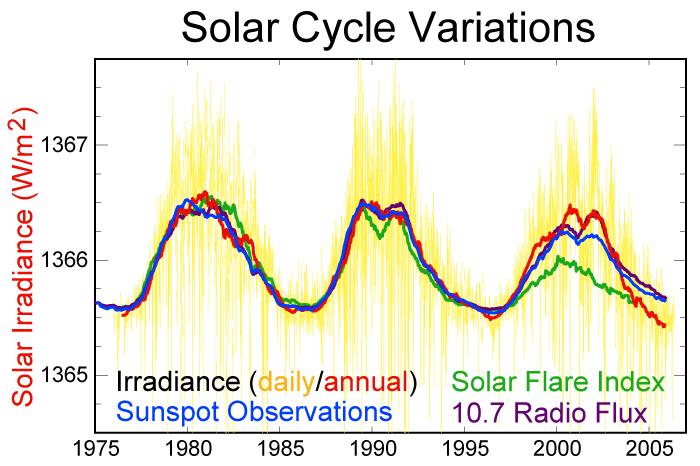 First, solar output is highly variable and it is measured by tracking sunspots. Second, solar output isn’t what is really important, solar output that reaches the oceans and surface of the Earth is what matters. You can’t warm the oceans, surface and atmosphere if you don’t reach the ocean, surface and/or atmosphere. The actual W/M^2 that reaches the earth is determined by 1) the radius from the sun to earth which alters the W/M^2 per steradian. As the earth’s orbit changes from circular to elliptical it also changes the amount of W/M^2 that reaches the earth’s surface. The same goes for the tilt and “wobble” around the earth’s axis. Another factor is if we are passing through one of the “fingers” of the galaxy. The key point is that it isn’t the solar radiance that counts, it is the solar irradiance of the earth’s surface that counts, and that is altered by the radius to the earth, the tilt and wobble of the axis, the fingers of the galaxy, cloud cover which is impacted by cosmic rays, particulate matter in the atmosphere and green house gasses like ozone, H20 and CO2.
1) The model is “mis-specified” meaning that it has reversed the independent and dependent variable. Temperature isn’t a function of CO2, CO2 is a function of temperature. This is demonstrated in every Chemistry 101 Class and is known as Henry’s Law. Simply take a Coke and warm it up and you will see Henry’s Law in action. The reason CO2 lags Temperature by 800 to 1500 years in every geologic record is because of Henry’s Law. It simply takes time to warm the Ocean coming out of an ice age to increase atmospheric CO2. The Smoking Gun regarding AGW is that there is no defined mechanism by which CO2 can lead temperature to emerge from an ice age. Temperature has to lead CO2…unless you have some huge Volcano, and then you are really opening a can of worms. Basically the current IPCC models are like a model that claims lung cancer causes smoking.
2) They appear to be deliberately under-specified, meaning they leave out highly significant variables like the sun, clouds and H20. Warmists will claim that it can’t be the sun because the sun’s output is constant, and a constant can’t cause a change. I fully agree with that statement, and that statement is far far far more applicable to CO2 energy absorption than the sun’s impact on the climate.
To put it another way it isn’t the output of W/M^2/steradian from the sun that counts, it is the W/M^2 that illuminates the earth surface that counts. If I have a fire and put insulation between me and the fire, I won’t warm much, regardless of how hot the fire is.
3)CO2 and H2O absorb the same 13µ to 18µ wavelengths, and H2O is far far far more effective at absorbing radiation. This is demonstrated by the temperature range of a dry desert being much higher than a rain forest. A desert can go from over 100°C in the day to under 0°C in the night. That is because only CO2 is present to “trap” the heat. Rain forests have the same CO2 content, but much much much more H2O, and there is very little heat lost between the day and night.
http://www.unique-southamerica-travel-experience.com/amazon-rainforest-climate.html
H20 acts as a natural regulating mechanism, and uses radiation, conduction and convection to transport heat through the atmosphere. CO2, being uniform in the atmosphere, relies mostly on radiation. The key point is H20 is a far more potent green house gas than CO2 and has a far greater concentration and absorption spectrum, and in most cases is saturates the 13µ to 18µ wavelength range making CO2 irrelevant. Rain forests would be just as hot without CO2 as with it. H2O also alters the albedo of the earth. Temperatures can vari dramatically just by having a cloud pass over head. BTW, contrails have nothing to do with CO2 and everything to do with H2O. http://www.csmonitor.com/Environment/Bright-Green/2010/0201/Airplane-contrails-and-their-effect-on-temperatures
Also, by not modeling H2O you effectively aren’t modeling the climate or atmosphere. H2O is by far the dominant influence on the climate both through ocean heat, atmospheric H2O gas and the reflectivity of clouds.
4) There is autocorrelation and most likely multicollinearity involved with the factors. The relatively linear temperature and CO2 clearly demonstrate serial correlation over the relatively short time period of the industrial age. H2O and CO2 basically are measuring the same thing when µ to 18µ wavelengths saturate the absorption.
5) The CO2 data used is linear as measured by ppm, whereas CO2’s impact on heat is logrythmic. They use linear data of ppm when they should be using the logarithmic data of CO2’s changes in W/M^2 .
6) They have manipulated the coefficients to make CO2 a significant variable when in reality it is an insignificant variable. That is why the models most likely show a high R^2 between changes in CO2 ppm and temperature, but when the real unmanipulated data is put into the models the relationship disappears. CO2 ppm has increased by about 15% over the past 20 years, yet temperatures haven’t changed at all. That is an R^2 of 0.00%. That is a problem. If however they had modeled the change in W/M^2 absorbed by CO2 as it went from 350 to 400 ppm, the change in W/M^2 absorbed by CO2 would have been basically zero, and that is consistent with a 0°C change in temperature.
7) The CO2 causes global warming is a doomsday model. CO2’s only impact on climate change is through absorbing radiation between µ to 18µ. If the relationship between CO2 ppm and temperature is truly linear, and CO2 is the main driver, there is no mechanism by which CO2 can’t result in runaway catastrophic heating. CO2 is uniform throughout the atmosphere, so more CO2 would result in simply more heat being trapped. Catastrophic warming has NEVER occurred in over 600 million years, during which CO2 reached 7000 ppm. We fell into an ice age when CO2 was 4000 ppm. Clearly there is something missing from the Temperature = Function of CO2 ppm model. 600 million years of history simply proves it wrong on a biblical scale.
http://www.geocraft.com/WVFossils/PageMill_Images/image277.gif
8) There is no mechanism by which the CO2 drives temperature model could have resulted in ice ages, or periods of stable or falling temperatures. The IPCC model is simply a dooms day model that doesn’t allow for cooling or for CO2 to ever decrease in the atmosphere. We’ve had billions of years of volcanoes producing CO2 and the net cumulative result is that CO2 has fallen from 7000 ppm to 400 ppm within the past 600 million years. Bottom line, something is seriously wrong with the IPCC’s understanding of the physics, dynamics, biology, chemistry and history of CO2 and our atmosphere.
Regarding clouds it is quite obvious what’s wrong with the CO2 theory.
Based on satellite readings can estimate the relationship between clouds and global temperatures.
http://climate4you.com/images/TotalCloudCoverVersusGlobalSurfaceAirTemperature.gif
When this linear fit is adjusted to global temperatures using changes in global low clouds, it results in this graph below.
Convincing evidence that virtually all the recent warming has been due to decreasing low levels clouds, with increased solar radiation penetrating the surface and warming the planet.
Note: a 7% change in cloud cover can erase 50% of the 1°C increase in temperatures that has occurred over the past 100 years. Now that is a significant variable to include in any model. Funny how the IPCC ignores it.
http://climate4you.com/images/TotalCloudCoverVersusGlobalSurfaceAirTemperature.gif
Ding ding ding!!!! We have a Winner!!! More solar radiation reaching the earth, the warmer it gets. Who would have thunk that? Obviously not the Einsteins in the Climate “Science” departments.” Problem is, if it is clouds and the sun, all the funding goes away and the Socialists/Marxists can’t loot the Oil, Gas and Coal industry. How will Sierra Club raise money once the big lie is exposed?