From the University of California – Santa Barbara: A cataclysmic event of a certain age
Geologist James Kennett and an international team narrow the date of an anomalous cooling event most likely triggered by a cosmic impact

This map shows the Younger Dryas Boundary locations that provided data for the analysis. Credit: UCSB
At the end of the Pleistocene period, approximately 12,800 years ago — give or take a few centuries — a cosmic impact triggered an abrupt cooling episode that earth scientists refer to as the Younger Dryas.
New research by UC Santa Barbara geologist James Kennett and an international group of investigators has narrowed the date to a 100-year range, sometime between 12,835 and 12,735 years ago. The team’s findings appear today in the Proceedings of the National Academy of Sciences.
The researchers used Bayesian statistical analyses of 354 dates taken from 30 sites on more than four continents. By using Bayesian analysis, the researchers were able to calculate more robust age models through multiple, progressive statistical iterations that consider all related age data.
“This range overlaps with that of a platinum peak recorded in the Greenland ice sheet and of the onset of the Younger Dryas climate episode in six independent key records,” explained Kennett, professor emeritus in UCSB’s Department of Earth Science. “This suggests a causal connection between the impact event and the Younger Dryas cooling.”
In a previous paper, Kennett and colleagues conclusively identified a thin layer called the Younger Dryas Boundary (YDB) that contains a rich assemblage of high-temperature spherules, melt-glass and nanodiamonds, the production of which can be explained only by cosmic impact. However, in order for the major impact theory to be possible, the YDB layer would have to be the same age globally, which is what this latest paper reports.
“We tested this to determine if the dates for the layer in all of these sites are in the same window and statistically whether they come from the same event,” Kennett said. “Our analysis shows with 95 percent probability that the dates are consistent with a single cosmic impact event.”
All together, the locations cover a huge range of distribution, reaching from northern Syria to California and from Venezuela to Canada. Two California sites are on the Channel Islands off Santa Barbara.
However, Kennett and his team didn’t rely solely on their own data, which mostly used radiocarbon dating to determine date ranges for each site. They also examined six instances of independently derived age data that used other dating methods, in most cases counting annual layers in ice and lake sediments.
Two core studies taken from the Greenland ice sheet revealed an anomalous platinum layer, a marker for the YDB. A study of tree rings in Germany also showed evidence of the YDB, as did freshwater and marine varves, the annual laminations that occur in bodies of water. Even stalagmites in China displayed signs of abrupt climate change around the time of the Younger Dryas cooling event.
“The important takeaway is that these proxy records suggest a causal connection between the YDB cosmic impact event and the Younger Dryas cooling event,” Kennett said. “In other words, the impact event triggered this abrupt cooling.
“The chronology is very important because there’s been a long history of trying to figure out what caused this anomalous and enigmatic cooling,” he added. “We suggest that this paper goes a long way to answering that question and hope that this study will inspire others to use Bayesian statistical analysis in similar kinds of studies because it’s such a powerful tool.”
###
“In a previous paper, Kennett and colleagues conclusively identified a thin layer called the Younger Dryas Boundary (YDB) that contains a rich assemblage of high-temperature spherules, melt-glass and nanodiamonds, the production of which can be explained only by cosmic impact.”
Or, and correct me if I’m wrong, by world-altering plasma electrical events, as fully scalable from laboratory bench up through to the astronomical. Some would posit thusly, it seems.
Michael S has moved on now, I believe (RIP)…a very interesting 9 minutes, with some great footage from Billy Yelverton’s lab https://www.youtube.com/watch?v=dSRLb85UAEA
Hot and humid here in Ottawa, lots of thunderstorms in the region. you can “feel the electricity in the air”.
heh.
Sorry, but electrical effects are very different from hyper-velocity impact effects.
I laid low about the electric universe idea for a few years. I had other eggs to fry. But last week I thought, well, let’s see a bit of what they’ve got. They may be saying SOMETHING useful. It was pretty sad what they are pawning off as scientific. I had to shake my head and turn the video off.
It was silly when Velikovsky came up with it, and it is silly now. I’ve got an open mind, but I also happen to know a lot of stuff that is real, and some ideas just don’t fly. . .
Hypothesis:
The megafauna evolved in the CO2-rich environment of the Eocene. The herbivores required a huge amount of plant material for food. When CO2 levels declined, the super-sized slow-moving grazers could not find enough enough to eat, and the predators evolved to prey on them suffered as a result. That ecosystem was doomed by CO2 starvation.
In other words, regardless of the ‘seemingly’ robust (tsk, tsk) results from the article…….and the many posts and replies from the scientifically learned, I contend that….
The science is not settled.
NO, you are completely correct. The science is NOT settled. And the YDB guys know that, too. Which is why they continue to work to find out if it holsd wateer or not. But, also, having DONE the lab tests on the materials, they HAVE found enough evidence to convince them that they are on the right track.
Really? They don’t KNOW where it is going to end up. They don’t have a crater, and they know it. They started with spikes of materials that USUALLY mean impacts. But others kibitzed and said, well, you can make nano diamonds by wiping an insect’s butt! (ignoring the REST of the suite of impact materials and pretending that because you COULD make nanodiamonds that way that it disproved anything. (They genuinely ha to know that they didn’t disporve anything.)
Are you aware, though, that ALL important points of contention by the skeptics was immediately rebutted in papers and letters to the science journals? That made the science not settled, but it made the supposed refutations a small pile of nothing.
But, to deal with the skeptics, the YDB guys kept doing study after study – on materials after materials. And every time, the results kept coming back: It is very VERY likely that this combination of materials could not have come from anything but an impact. And they FINALLY ran out of tests to run about the materials.
Let’s be clear about this: In science, ideas and kibitzers are a dime a dozen. It’s MEASURED empirical evidence that holds the high ground. And the most solid of all measured evidence is LABORATORY (forensic-type) evidence. (Does lab work count for anything in medicine? Of COURSE it does. Is it REAL science? Of COURSE it is. When you get lab tests, is THAT real, settled science? You damned well HOPE it is. When you send off a sample for Carbon-14 dating, is THAT settled science? Within the very small uncertainties of the lab tests, you bet your bippy it is.)
And that lab evidence – measuring the materials is the evidence that the YDB guys kept working on, to solidify their position. (It is all produced in the “Supplemental Information” parts of their papers, BTW – for the whole world to see and challenge.) Now, until some more sites show up with MORE impact materials to test, the YDB guys seem to be moving the whole thing forward, to the next step. They didn’t want to put the cart ahead of the horse, and they haven’t. Even THIS paper is is just an extension of the lab work – just working the results up in a better statistical way.
So, now they have done what they needed to do to nail down the TIME element (better now than before) , and they have lots more to go. They are tired of the sniping, (and poorly done) skepticisms. For them it is solid and settled enough to go to the next phase – but they know that somewhere they still might find another explanation for what they’ve found.
Show me anything in earth science from 125 years ago that is still as true as it was then. IN 125 years a LOT has transpired. Moving continents, mantle plumes (or NOT), undersea volcanoes, mid-ocean ridges and rifts, geomagnetic maps, all the climate stuff that we argue about, the ability to predict the weather days in advance and weeks in advance better than then – all sorts of things have changed. Nobody is going to expect that they will find out the truth and ALL of the truth in the first decade of a hypothesis this huge.
It took ten years for the Chixculub crater to be found, and it was found by an oil company geologists. If left to the academic geologists, even the K-T impact would be a big question mark still. It’s been all of 8 years for the YDIH. At 8 years, people were still asking Alvarez, “Where’s the crater. Luis?” Same old,same old.
And they are looking for a crater in a dead and gone ice sheet, for heavens’s sake! And they can’t even do that yet, because they first had to solidify their lab evidence. Anyone who hasn’t read a good portion of the lab evidence has no grounds to question this – has no standing..
The Younger Dryas (YD) may have been started by an impact but it most certainly was not ended by an impact. Look figure 5 (of eight) at the following link:
Are the Dansgaard-Oeschger (D-O) Warm Events driven by Lunar Tides?
http://astroclimateconnection.blogspot.com.au/2013/06/are-dansgaard-oeschger-d-o-warm-events.html
You will see that very rapid rise in temperatures at the end of the YD almost perfectly coincides with a Dansgaard-Oeschger (DO) event about 11,000 years BP.
I believe that the abrupt temperature changes seen in the Greenland Ice data were caused by DO event. I propose that the DO events are driven by the peak Perigean lunar tides.
It the regular DO events [roughly once every 1470 years] that are causing the temperature fluctuations that we see as the World transitioned from the Ice Age to the Holocene. It is as though the world’s mean temperature had to be jump started (by DO events) a number of times before the Holcene fired up and produced the current inter-glacial.
Here is an update of the earlier reference cited above:
DO Events Cause Rapid Warming Events in the Last Glacial Period
http://astroclimateconnection.blogspot.com.au/2014/01/do-events-cause-rapid-warming-events-in.html
Ian – Well and good, to assert that “It was a DO event”. Okay, now, other than steep slopes on graphs, what is a DO event?
The temperatures increased because of “increases in temperature”???? Defining something by what its qualities are does not define a thing. You must know that.
Physically? What physical PROCESS? Name a process. It was ice-rafted debris shutting down the oceanic conveyor? No, ice rafted debris was a lot of DUST. (And not even that much, that fast.) Look it up. It’s all little grains of dirt. Them falling off of icebergs doesn’t make the temps go up 14°C and down 13°C in a matter of a decade or two. If you think it was ice-rafted debris, that is only an effect posing as a cause.
And if not THAT then what?
What MADE the icebergs come off the Labrador coast? The ice melting? Which came first the chicken or the egg? Did the icebergs coming off the coast make the temperatures warmer? So that more icebergs could come of the coast? And all of this started WHY? And it really, really ramped up fast. Why? How?
Calling it “DO events” doesn’t answer anything. Looking at line on a graph doesn’t tell us anything. WHAT do the lines represent? Only that the temps went up – according to the proxy, oxygen-18. NOTHING you see on that graph tells you WHY – only that it did. Calling it a DO event means just absolutely nothing.
Date the death of the big elephants, in Siberia that died and were frozen with a full belly of good pasture.
From good pasture to frozen tundra in very short order, like overnight, would suggest that a catastrophe changed the world climate instantly. Cyclic changes to orbits or solar cycles can not do this, there are two possibilities, either we were hit by some big space rocks, or the gods were angry with us.
“From good pasture to frozen tundra in very short order”
Nonsense. Regardless of sudden ups and downs, there was long-term warming since the ice age maximum. How is it that the mammoths could suddenly get caught in a flash freeze that never thawed? Also, mammoth remains do not all come from the same time period. If they did we’d have no clue how long they lived in a particular area.
Consider this:
http://www.talkorigins.org/faqs/mammoths.html
The buried, frozen mammoths were well-known to native Siberians and also the Chinese, who called them tien shu, and who also relied upon them for food, believing that they were giant subterranean rats.
http://zapatopi.net/blog/?post=201301016380.burrowing_mammoths_of_siberia
Verdeviewer – “…mammoth remains do not all come from the same time period.” Of course not, they died where they lived, at the end of the time when each individual died. But look up on a map where the Siberian mammoth bones and carcasses are found. 95% of that area is now the coldest region on Earth except for Antarctica. The mammoths nor their food could survive in that region – not now they can’t. And if they can’t now, then they couldn’t then. Those flora in their digestive tracts tells it all. The place that the bones are found are not the places NOW where mammoths lived.
How to explain that? Did the dead bodies with the food inside move? Not in any way we can imagine. Did the dead bodies get up and ALL walk north to the Arctic Ocean peninsulas? Sounds like a not so scary movie these days.
verde please explain how these animals moved a thousand miles north to die with a stomach full of good pasture, they must have caught a very fast train.
“please explain how these animals moved a thousand miles north to die”
They didn’t.
Steve Garcia opines that neither “the mammoths nor their food could survive in that region.”
“Fifty-thousand years ago, the present-day arctic tundra was a vast grassland through which mammoths, woolly rhinos, reindeer and even lions roamed.”
http://www.npr.org/sections/thesalt/2014/02/05/272094425/woolly-mammoths-taste-for-flowers-may-have-been-their-undoing
“The habitat of the woolly mammoth … stretched across northern Asia, many parts of Europe, and the northern part of North America during the last ice age. It was similar to the grassy steppes of modern Russia, but the flora was more diverse, abundant, and grew faster… This habitat was not dominated by ice and snow, as is popularly believed… “
https://en.wikipedia.org/wiki/Woolly_mammoth
The woolly mammoths along the south edge of the Laurentide ice sheet were extirpated before those in eastern Siberia, and there’s evidence humans played a part. Further south, the Columbian mammoth went extinct around the same time.
verde – The NPR article got off on the wrong foot ehen they wrote:
“They were some of the largest, hairiest animals ever to walk the Earth, but new research shows a big part of the woolly mammoth’s diet was made up of tiny flowers.”
Hahaha – this isn’t new research. This has been known since the first mammoths were found a bit, because flowers were found in their mouths and guts. They didn’t mention the other stuff in the guts. Flowers makes a much better story. Ah, yes, the buttercups! Even though this article said the flowers were LIKE buttercup, buttercups is specifically what earlier reports asserted.
Buttercups [from Wiki] :
“All Ranunculus species [buttercups] are poisonous when eaten fresh by cattle, horses, and other livestock, but their acrid taste and the blistering of the mouth caused by their poison means they are usually left uneaten. Poisoning can occur where buttercups are abundant in overgrazed fields where little other edible plant growth is left, and the animals eat them out of desperation. Symptoms include bloody diarrhea, excessive salivation, colic, and severe blistering of the mouth, mucous membranes and gastrointestinal tract. When Ranunculus plants are handled, naturally occurring ranunculin is broken down to form protoanemonin, which is known to cause contact dermatitis in humans and care should therefore be exercised in extensive handling of the plants.”
There are 64 varieties of buttercups. One that is possible in the Siberia is this:
“Ranunculus lapponicus (the Lapland buttercup) is distributed all over the arctic, with the exception of northern and eastern Greenland.
It is a low, prostrate plant with a creeping, underground stem (rhizome) which sends out long stalks and shoots bearing the flowers. The leaves are deeply tripartite, forming 3 lobes which are toothed or crenated. The flowers are yellow, solitary, generally having 6 (8) petals that are distinctly longer than the sepals. After flowering, the fruit forms a globular head of carpels held above the creeping plant.
It grows in wet localities, especially in moss carpets along beaches, streams and lakes.”
So, rather than this idyllic visions of large, dancing pachyderms munching sweetly on some pretty flowers, we have a poisonous plant that is only eaten out of desperation. They didn’t happen to mention that in the article, did they? I wonder if the diarrhea was found under or on the carcasses and bones? No, there is mention of diarrhea? Only mammoth poop”? Strange. What are they not telling you?
Buttercups bloom in the spring. What do the mammoths eat the rest of the year? When the temps dive to -60°F and -80°F? You know, the 9 months of the year when northern Siberia is FROZEN? Do they do like bears and hibernate? Of course not.
Elephants need 200-600 pounds of food a day. Tiny flowers, indeed. Yes, they ate the PLANTS that were flowering – which is what the article actually says.
The article continues:
“And when the flowers disappeared after the last ice age, so too did the mammoths that ate them.”
Geez… The last ice age was the Wisconsinan in N America and the Weichselian in Eurasia. That last one was FAR from the worst of the ice ages in the Pleistocene. It was not even as bad as the Last Glacial Maximum, which ended about 22,000 years ago. Miraculously, the mammoths survived those earlier, more severe, ice ages. So why would they all die off from the littlest of the true ice ages? The article doesn’t even attempt to explain why the weakest of the ice ages should be the one that killed off the mammoths.
FUNNY, isn’t it? How the mammoths dies out “when the flowers disappeared”, but not when the flowers died for 9 months every year. Those must have been some SKINNY mammoths.
It IS true that the ice sheets did not extend into Siberia east of the Urals. It was too cold for snow. The Arctic Ocean coast was ice-free, but it was not a tundra. The nearest latitude for the flowers in the mammoths’ mouths and guts was FAR to the south.
Look up “Tundra” and specifically “Arctic tundra”. Then ask yourself if these mammoths could survive there on the food that is only available about 2-3 months out of the year.
“Buttercups?”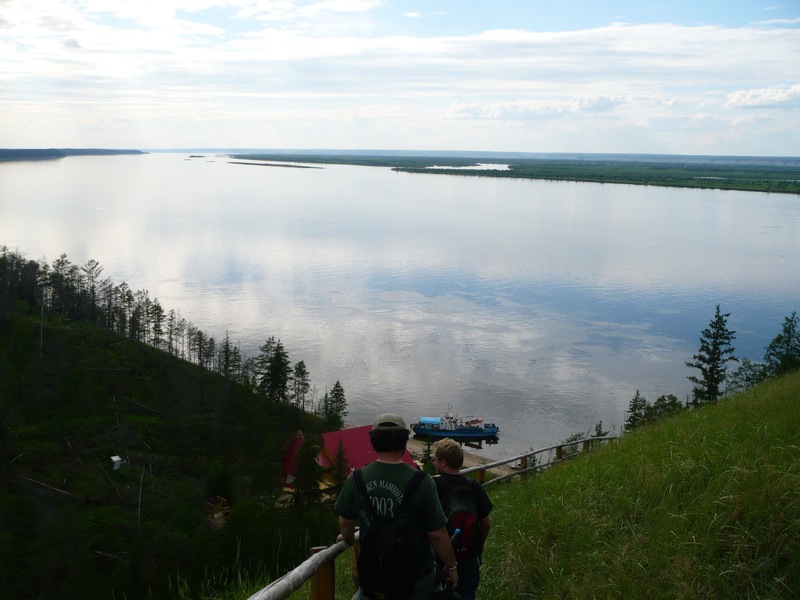
.jpg#/media/File:Lena_River_near_Yakutsk_(synchroswimr).jpg)
The flowering plants were forbs, and forbs may have died out from lack of megafauna poop.
Flowers, however, weren’t the point. Whatever they were chomping, they clearly weren’t starving.
Oh, and BTW, here’s the “barren tundra” near where the “Adams Mammoth” remains were found:
“Lena River near Yakutsk (synchroswimr)” by “synchroswimr”/Stacy, Minneapolis – flickr.com. Licensed under CC BY 2.0 via Wikimedia Commons –
More on mammoths, buttercups, and forbs…
There’s a reference to mammoths eating buttercups in “Paleoecology of Beringia”. Analysis of food in the Beresovka mammoth’s gut and mouth identified 5 grasses, 2 sedges, mint, poppies, oxytropis pods and beans, and buttercup seeds.
Oxytropis is a forb. Oxytropis didn’t “disappear”–it still grows where mammoth remains are found.
“Seeds” indicate the mammoth died in the autumn, when buttercups would not have been poisonous. But some oxytropis subspecies are known as “locoweed.” Eating too much locoweed could have resulted in herds of mammoths and rhinos staggering about, tumbling down riverbanks or falling into mudholes. Not a pretty picture.
Holy samoly, I just perused the research paper that prompted the NPR article.
There are 13 forb families listed as megafauna foods, and none of them are oxytropis.
Huh?
Poppies, however, are on the list. And that raises serious questions:
Did megafauna die out from drug addiction?
Are NPR reporters equally vulnerable?
@verdeviewer July 29, 2015 at 2:13 pm –
Hmmmm, there is apparently a good bit of contradictory reportage out there. Some say buttercup flowers, and those point to it as evidence of death in springtime. And you now present buttercup seeds, which indicate autumn. Some clearly state that grasses were NOT eaten by the mammoths, and this one of yours presents “5 grasses”.
Contradictory stuff.
Note to Steve’s brain: Don’t even TENTATIVELY conclude anything for a while… Just keep on accumulating information….
@verdeviewer July 28, 2015 at 6:02 pm –
Good photo of present day Lena River during the 3-month summer – which is like spring anywhere else. What was it like the rest of the year – and back in the ice age?
The photo says “near Yakutsk”. The Yakutsk I know of is THIS one: http://www.independent.co.uk/travel/europe/yakutsk-journey-to-the-coldest-city-on-earth-771503.html “Yakutsk: Journey to the coldest city on earth”
8 Months of the year the average daily temp is below freezing. What do the mammoths eat the other 9 months? 5 months of the year the weather is “frigid” meaning BELOW -9°C (15°F) close to 24 hours a day. If nothing else, that means nothing grows. And for 2 more months the weather is “freezing” – from 0° to -9°C. Again, meaning that nothing grows.
These are the most voracious eaters on dry land, needing 200 to 600 pounds of food a day.
C’mon, Steve G., you won’t find the answer to your question on tourist sites.
How do the local reindeer, long-horned goats, ibex, and musk deer survive Yakutsk winters?
What do elephants do when seasonal changes dry up their food and water supply?
This mammoth seems to be a relative outlier based on tummy contents:
http://www.pbs.org/wgbh/nova/nature/mammoth-dung.html
Others apparently chomped twigs and bark of alder, birch, larch, and spruce during the winter, much like reindeer (some species of which migrate 1000s of miles per year).
You noted that a lot of current arctic plants are small and poisonous. Could it possibly be that the plants evolved as a result of overgrazing? Could it not have been an evolutionary battle that required mammoths to become smaller and poison-resistant and the mammoths lost?
The following paper concludes that:
Wilson, I.R.G. Are the Strongest Lunar Perigean Spring Tides Commensurate with the Transit Cycle of Venus?, Pattern Recogn. Phys., 2, 75-93
http://www.pattern-recognition-in-physics.com/pub/prp-2-75-2014.pdf
If the mean drift of the 31/62 Perigean spring tidal cycle is corrected for the expected long-term drift between the Gregorian calendar and the tropical year, then the long-term residual drift between: a) the 243 year drift-cycle of the pentagonal pattern for the inferior conjunctions of Venus and the Earth with respect to the nodes of Venus’s orbit and b) the 243 year drift-cycle of the strongest seasonal peak tides on the Earth (i.e. the 31/62 Perigean spring tidal cycle) with respect to the tropical year is approximately equal to -7 ± 11 hours, over the 3000 year period [from 1 to 3000 A.D.].
The paper makes the following very speculative extrapoolation from these conclusions:
Finally, there is one speculative extrapolation that could encourage others to further investigate this
close synchronization on much longer time scales. If these future investigations show that the long-term residual drift rate of -7 hours over 3000 years is valid over much longer time scales, then this close synchronization may highlight a mechanism that might be responsible for the Earth’s 100,000 year
Ice-Age cycle. This comes from the fact that the strongest Perigean spring tides would be in close synchronization with (i.e. ± half a day either side of) the date of the Earth’s Solstice (on or about December 21st) for a period (24/7) × 3000 years =10,300 years. In addition, this close synchronization would
be re-established itself after the 31/62 peak tidal pattern drifted backward through the Tropical calendar by ~ 9.7 days (i.e. the average vertical spacing between sequences in figs 12 a & b) such that after ((9.7 x 24) /7) x 3000 years = 99,800 years. Hence, the close synchronization discovered in this study lasts
for ~10,000 years, with each period of close synchronization being separated from its predecessor by ~100,000 years. This is very reminiscent of the inter-glacial/glacial period that is characteristic of the Earth’s recent Ice-Age cycles.
I’m not sure why the two theories have to be mutually exclusive. An impact could have been what opened the way to let Lake Agassiz release its water.
“I’m not sure why the two theories have to be mutually exclusive.”
Me neither.
And it seems highly unlikely the hypothesized impact could have had much influence on the 8.2 ka event.
Good point…
Except it takes the cause and makes it the effect, and vice versa. That is a big difference.
My brain is tired. I meant the meltwater becomes the effect not the cause. Forget the vice versa part…
Why at this late stage in the history/evolution of the solar system would there be such a bombardment?
I would want to see evidence of recent impact bombardment on the moon and Mars before I would consider this to be anything more than speculation.
At 5 am, I misread the article. Obviously, I can accept a one off impact as a possible explanation.
Look up astronomer William Napier, about the Comet Encke and its progenitor (father). The Taurids are a stream of rocks of varying sizes that the Earth passes through twice a year. Napier has worked out that the progenitor of Encke broke up about 30,000 years ago, and that we’ve been at risk of the fragments ever since. He is not alone in thinking this. He asserts that in the early centuries after the break-up the fragments were much more plentiful than now – and that their numbers decreased over time (meaning they HIT some planet), so that now we don’t get much because they are thinned out. But he says that the stream is not evenly spaced out along its orbit. It, in fact, split into a north and south stream at some point. And we sometimes get one and sometimes the other. No one knows how many Taurids three are, and no one knows how big the other fragments are. Encke itself is like three miles across. NOT one we want hitting us – but it is out there.
This is an old story with the same old bad logic. I’ve written several articles and responses to this nonsense but it just keeps popping up–comets seem to be blamed for a many not-well-understood phenomena. Here is what I wrote about the same story in 2012.
March 12, 2012 at 8:20 am
Before jumping on this bandwagon, consider the following:
1. There may well have been a meteorite impact near the beginning of the Younger Dryas (YD), but that doesn’t prove it was the CAUSE of the YDs. It’s the same logic as saying the cause of the 1978-1998 warming coincided with rise in CO2 so the cause must be CO2. Bad logic.
2. The YD is just the most prominent of many Dansgard-Oerscher abrupt climatic events.
3. The YD ended just as abruptly as it began a little over 1000 years later.
4. The YD corresponds with changes in 10Be and 14C production rates, suggesting changes in incoming radiation and pointing toward a Svensmark type cause.
5. The problem with single event causes (e.g., volcanic eruption) is that they cannot be sustained for the length of time of the climate change. If the idea is that the cooling was caused by ejection of dust into the atmosphere, that wouldn’t last for more than 1000 years.
6. If the YD was caused by dust in the atmosphere, it should show up in the Greenland ice cores (where even very small, annual accumulations of dust from summer ablation are well preserved). There is no such evidence of dust from an impact event throughout any of the well preserved YD ice core record.
7. The list goes on and on–too many to include them all here. Perhaps a longer response later. The bottom line is that a single event, meteorite impact event doesn’t prove the origin of the YD.
Before jumping on the comet bandwagon, a number of dots need to be connected and some critical questions need to be addressed. For example, how could a single event, even with multiple projectiles, cause an ice age that lasted for more than 1,000 years? Surely not from atmospheric dust and if not that, then what? The Younger Dryas is not the only climatic event during the post glacial maximum period—there are also a number of others spanning the time from 14,500 radiocarbon years (about 17,500 calendar years) to 10,000 14C years (about 11,500 calendar years). These are well known, well dated, and well documented in ice cores and in the global glacial record. So the question is, how could an impact event cause both multiple warming and cooling events over a 3,000 year period? Doesn’t seem logical at all for either impact or volcanic events.
Some other questions pertain to the evidence for the proposed cosmic event. Geologists are used to studying micro-images of rocks and looking at the two samples shown in the paper, it is obvious that both show definite flow structures that closely resemble glass flows from volcanic lava. The statement “Morphological and geochemical evidence of the melt-glass confirms that the material is not cosmic, volcanic, or of human-made origin. “The very high temperature melt-glass appears identical to that produced in known cosmic impact events such as Meteor Crater in Arizona, and the Australasian tektite field,” is very vague. What morphological and geochemical evidence? As for these specimens being identical to trinitite from atomic blasts, there is surely no flow structure in the photos shown so how can they be identical?
The bottom line here is—a lot more dots need to be connected and these critical questions (as well as a number of others) need to be addressed before concluding that the Younger Dryas was caused by a cosmic impact.
For background on what the Younger Dryas is and isn’t, see:
http://wattsupwiththat.com/2012/06/19/the-intriguing-problem-of-the-younger-dryaswhat-does-it-mean-and-what-caused-it/
“6. If the YD was caused by dust in the atmosphere, it should show up in the Greenland ice cores (where even very small, annual accumulations of dust from summer ablation are well preserved). There is no such evidence of dust from an impact event throughout any of the well preserved YD ice core record.”
Actually you are wrong on this, to some extent. Not in an ice core. The YD scientists found a layer that dates to the YDB in the Greenland ice sheet, with nanodiamonds.
http://cosmictusk.com/new-paper-greenland-ice-sheet-shows-diamond-rich-layer-at-younger-dryas-boundary/
No, I’m not wrong–you’re missing the point here. If a comet impact put enough dust in the atmosphere for more than 1,000 years to cool the climate, that’s a lot of dust–where is all this dust in the ice core? How can this explain the many other abrupt periods of cooling at the end of the Pleistocene and the abrupt end of the YD?
Don – No, I am not missing the point. But you ignored my information.
I have the same questions you have. But I don’t jump to conclusions. These people haven’t had time to develop their entire hypothesis nor its ramifications or deal with its weak points. They haven’t had time. They’ve been doing the foundational work, lab work, to first prove one way or another that what they have is impact materials. That they have come to the end of, otherwise they wouldn’t be collating it in this Bayesian paper. Give them time. Rome wasn’t built in a day.
Do you even REMOTELY think that they haven’t thought of those questions, too? Before any of us? Do you take them for fools?
If they went off replying to everyone who had a point of contention about peripheral issues, they would be poorly organized and poorly disciplined scientists. Which they are not. One thing at a time.
You’ve asked and not gotten any answers. It all has to be done on your time schedule? Hardly.
Don, you are 100% correct.
Don,
All true, but there is much more. It has been hashed and rehashed here because our esteemed host keeps drawing attention to Kennett’s baseless, repeatedly falsified drivel.
The YD Impact fantasy has even less support than catastrophic man-made global warming hypothesis. Both fail to reject the null hypothesis, ie that the YD is no different from the thousands of other such sudden warming and cooling events during the Pleistocene.
Ah, Mister Sturgis Hooper, the man who decided before he ever read anything academic that this was wrong. What’s new?
I’ve read far more things “academic” than you have, obviously.
I’ve known this was pure bunkum from the very first paper spewing this nonsense, as has the geological community. It’s a bad joke.
This is a convenient way of ruling out or avoiding greater research into a cosmic ray event. A possible increase in cosmic rays from a super nova within 100 light years of earth could last several decades. The Be-10 in the ice cores of Greenland and Antarctica do show an increase around that time when layer thickness is also taken into account. But lets ignore cosmic rays, they can’t be taxed.
Dude, This all started out with Richard Firestone. Cosmic rays are right up his alley. He thought originally that is what it all was. So, you are completely claiming things off the top of your head, and you don’t know anything about the history of this hypothesis.
Sorry that that all was bold. Only one sentence was intended “Cosmic rays are right up his alley”
Seems there is no consensus that Lake Agassiz drained abruptly nor entirely into the North Atlantic:
http://agassiz.cs.umn.edu/agassiz_facts.html
Well, good, it is good that the UM is not giving the students out-of-date ideas. Even Wally Broecker who came up with the idea abandoned the idea when he faced the evidence that the outlet was simply not available at the YDB. Theere shouldn’t be ANY consensus AT ALL that this is what happened, because it is flat WRONG.
In fact, in response to the convincing evidence against it, some die hards thought to have the meltwater pulse go NORTH out the mouth of the MacKenzie River – about as far from the Atlantic as you can go in Canada.
It’s an accepted reality: The glacial Lake Agassiz did NOT drain abruptly out into the North Atlantic.
Veli *cough* ski
The essence of the problem has to do with geologists: for nearly 200 years they have accepted that the Earth has had all of its water since nearly its beginning. This belief follows from observations and debates in the early decades of the 1800s when geologists discerned that diluvial gravels belonged to multiple, distinct events; thus, they concluded that there was not a single worldwide flood.
During that period, The Geological Society of London’s president, the Rev. Adam Sedgwick, publicly recanted his belief in a worldwide flood. He said: “…the vast masses of diluvial gravel … do not belong to one violent and transitory period. It was indeed a most unwarranted conclusion when we assumed the contemporaneity of all the superficial gravel on the earth…. Having been myself a believer [in a worldwide flood], and, to the best of my power, a propagator of what I now regard as a philosophic heresy … I think it right thus publicly to read my recantation.”
Some geologists have argued that Sedgwick’s proclamation initiated the “no flood, ever” paradigm.
But the conclusion is incorrect. Instead, it should have been: presently exposed landscapes were not inundated by a presumed worldwide flood. This is the only conclusion that could have been drawn from the evidence, and it is wholly different from claiming that there was not a worldwide flood.
We should let that sink in: two-hundred years of geology and related fields have been affected by this fundamental error.
What brings it to our attention? Fire up Google Earth or maps (satellite view), and investigate the submerged features off Monterey, CA, or San Francisco, or the Gulf of Alaska, or the Celtic Sea, or the Mediterranean Sea, etc. All around the planet we can identify well preserved topographic features that are evidently submerged rivers and drainage systems. How could they be in such depths if there was never a worldwide flood?
One explanation holds that these features were carved by turbidity currents. For instance, one article from the literature is “Submarine canyons in the bathtub” that claims these sediment flows are rarely observed mainly for two reasons: the “difficulty in making measurements and observations on active or abandoned channels, and the probably long time scale, on the order of thousands of years, needed to develop these structures, that forbids the observation of processes on a human time scale.” As most of us know, it is impossible for focused currents in the deep ocean to persist over the distances involved (it is 200 km from the beginning of Monterey Canyon in Moss Landing, CA, to the system terminus to the southwest), so why do geologists believe such fantasy?
There are two reasons: (1) when investigations into the structures began, the full extent of the systems was unknown – they were assumed to be found only along continental shelves where gravitational gradients might support turbidity currents; (2) geologists’ early 1800s conclusion that the Earth has had its present amount of water since nearly its beginning. A consequence of (1) is that a body of published works was built upon it, and a consequence of (2) is that it has prevented the problem’s resolution. Geologists have conflated cause and effect, and they are fitting observations (submerged features) into theory (no global flood).
Now consider that there was a worldwide flood….
Then those topographic features would have been subaerially carved and then submerged quickly by a nearly unimaginable amount of water. Such a volume cannot be stored at the poles so it must have a cosmic origin. Then the object must have been much larger than a comet but similarly composed – fragile, porous, predominantly water ice, but with other minerals, too. Its high velocity impact would cause some damage to the planet, but it wouldn’t be fiery or catastrophic because of its porous nature. Impact interactions by the minerals would create the YD nanodiamonds, and its waters would flood the former abyss. Surviving humans would record the event in their oral traditions. The addition of such a volume would irrevocably change the Earth ecosystem, and humans would be ill-adapted for the post-flood Earth they now encounter.
Without giving away the impact site, it’d be interesting to learn whether WUWT readers could identify it using Google Earth or maps. Hint: it’s huge but subtle, it’s in the Southern Hemisphere, and it’s now submerged.
There was a worldwide flood. It was delivered by a cosmic impact about 13kybp, it created the YD nanodiamonds and associated ecosystem changes, it submerged the myriad drainage systems found in continental margins around the planet, and it is commemorated in ubiquitous human oral traditions.
*** HINT *** it’s location is related to a region of the Earth’s crust that is defined by a complex tectonic arrangement which appears to be circular and is close to a hotspot.
Biggest load of hogwash I ever saw. –AGF
My hypothesis is that it was caused by Stone Age Mankind having an use of stones that was no longer sustainable and addition created a cloud of stone dust that covered the whole Earth?
Yeah, cavemen probably suffered from peak-stone, too…
Maybe. But why not a slight increase in the density of the Local Fluff? (Local Interstellar Cloud)
http://science.nasa.gov/science-news/science-at-nasa/2009/23dec_voyager/
Reading this paper and the comments on this thread show in vivid relief the complete loss of integrity the field of climatology has brought upon itself.
Because of climatology’s rampant and unethical raw-data “adjustments”, continued reliance on utterly unskilled climate models, $billions of agenda-driven CAGW research grants, the politicization of the CAGW hypothesis, the antagonistic attitude towards genuine skeptics, the complete absence of constructive debate, etc. have all created an atmosphere where any new climate paper is met with contempt and cynicism rather than healthy skepticism; and rightfully so.
Because the CAGW hypothesis spills over into so many different fields of study: epidemiology, oceanography, geology, astronomy, physics, chemistry, mathematics, statistics, biology, physiology, medicine, philosophy, economics, politics, etc., all these fields are being tainted and slowly destroyed from within by a stubborn adherence to a failed hypothesis.
When “science” loses its integrity, it becomes worthless, leading to: wasted money, lost lives, bankrupt companies, poverty, wars, lowered standards of living, economic stagnation, higher unemployment, larger deficits, inefficiencies, apathy, frustration, anger and lack of human progress.
Man is the only animal whose survival is entirely dependent upon its ability to objectively use reason and logic. When logic and reason are replaced by pragmatic subjectivism, man loses his humanity…
The disconfirmation of the CAGW hypothesis can’t happen soon enough….
It might be useful for everyone to see just what is out there. This terrific video shows how many asteroids have been known, over time, and how that population has gone up a LOT with the WISE mission. https://www.youtube.com/watch?t=41&v=xJsUDcSc6hE
Earth crossers are in RED.
The superstitious ancients viewed comets as a presage of coming disaster. It would appear that we have learned nothing in the last 40,000 years and still live by superstition.
I said it to someone else: Have you ever read anything by astronomer Bill Napier? He and others like him present the case that the ancients had good reason to be sacred of comets and other things in the night sky – that Earth’s orbit was much more populated by objects at times in the last 30,000 years, and that many of them hit the earth in the time of man. Such a history, if real, would explain why they gave names to the objects and had reason to fear them. It might also explain why so many communities had large megalithic astronomical stone circles. We will be a long time understanding what the full purposes of the stone circles were. Yes, we’ve identified the sunsets and solstice sunrises and such – but it doesn’t explain why they would put so much effort in the OTHER stones. I don’t know the answers myself. Also why did they so often build so massively, in so many places around the world?
The Mayan’s Chilaam Balam at one point describes how the Milky Way (the alligator in the sky) rose up. Did they mean it figuratively? Arkies say so. WHY do over 500 ancient cultures have a destruction myth with so many features in common, almost always with a devastating flood and burning things falling out of the sky? Many of them of such objects, destroying and killing and burning, and roaring and buzzing – with “beards”, as the arkies translate it. One man’s beard on a comet is another man’s tail.
To the arkies, these are all just mumbo-jumbo tales. Did you ever wonder WHY any king would consult seriously with an “astrologer”? How DUMB can people of the past have BEEN, after all? Astronomy, whether they admit it or not anymore, grew out of astrology. But which was which, in the long distant past?
WHY would anyone consider those little points of light that hardly move from day to today (the planets) to be gods? We look up and yawn. They made them into gods and assigned them abodes and powers. WTF?? wwe all think now, right?
But is it totally impossible that we are missing something in our own past? Except for moments like Chelyabinsk in 2013, the night sky and day skies are quiescent places. And because they are in our time, we assume that they were always that way.
We now know of more than half a million asteroids, with ones the size of Tunguska that cross Earth’s orbit numbering over 1400. How much shift would it take for a few dozen of those to endanger us? Obviously, with all the craters out there on planets and moons, the solar system had a lot of things going boom in the night at one time and for a long time. We are told that that was all millions and billions of years ago. I am sure some of it was. But I’ve read enough astronomy pepers to understand how much bluff is in most of them. Assumptions piled on assumptions. And then those who know all about it all, we find out that when we send probes to Vesta and Ceres, we find out that Vesta isn’t what we thought it was – AND that some astronomers are reading the new evidence to re-think the entire history of the solar system. How much do we rally know about the solar sytem? More of it than we know is assumptions and guesses. Asssumptions with good reason, and good guesses. But they really missed on Vesta. How many other things are they guessing wrong about? Are they really s wise as we give them credit for?
This isn’t any of us being climate warming alarmists. This isn’t us being Creationists. These are scientists, doing LAB work, for Pet’s sake. They aren’t imagining the characteristics of the materials they re finding. They are REAL materials, with REAL characteristics that are normally ALWAYS interpreted as impact materials. But another group (doing sloppy replication work that was called out and showved in their faces in rebuttals) waves their arms around and asserts that the lab work is wrong. (Never once proven), and thus theis is all a bigger hubbub than it should be. These scientist are NOT going around saying we are going to get hit some day. Other people might be saying that, but this group of scientists is not. All they are saying is that there is FORENSIC-style, measured evidence that seems to say that Earth was hit a long time ago.
When someone says that tektites are impact related, do you accuse them of being warmists? When someone finds a meteorite, do you accuse them of being an alarmist? When Chelyabinsk happened, did you accuse the people there of being alarmists? But I assure you, almost everyone there was very happy that that meteor was only 17 metres and not 170. We might or might not have seen a 170 meter one coming. NO time for doing any alarm thing there, is there?
Did you run around accusing Luis Alvarez of claiming that we are going to get hit by a dinosaur killer? Ah, maybe you were. But Alvarez wasn’t saying any such thing. Neither are these scientists. If you read that into THEIR work because of what some people HERE are saying, you aren’t paying attention.
As to “superstitious ancients”, with our world divided by religious peoples at home and abroad, pointing to the ancients as if we don’t have our share, that makes little sense. I grew up near one of the hearts of evangelism; I can assure you superstition is far from dead in this modern world.
http://wattsupwiththat.com/2013/06/02/multiple-intense-abrupt-late-pleisitocene-warming-and-cooling-implications-for-understanding-the-cause-of-global-climate-change/
How do you explain all of the other abrupt climatic changes ? I doubt they were all caused by extra terrestrial impacts.
Astrology, the belief that stars control our destiny, is a relic of the belief that planets were gods and stars were demigods or angels. It’s a curious quirk of history that this superstition survived any form of monotheism, let alone Christianity and the Enlightenment. –AGF
This is as anthropologically naive as it gets–pagan creationism–Velikovsky copycats. When are these cosmic catastrophes supposed to have occurred, 10ky? And their oral histories survived, independently, all over the world? If it were possible for legends to persist so marvelously, we could not call them independent since they could have been carried across the Bering Strait or anywhere else–could even have a single source which dispersed everywhere, like the Baltic Sea flood theory.
Skies full of comets, 10ky? There ought to be some terrestrial or lunar evidence. Astrology buffs still believe the stars control human destinies. This belief is a relic of animism–everything is alive–trees, springs, rocks; especially things that move, like stars. And the planets move through the stars–they’re the bosses, the gods. Stars are demigods or angels. Monotheism didn’t make a dent in this world view, or Christianity: Christ was “the bright morning star” (the Pseudepigrapha frequently identify stars with angels). The Copernican revolution eventually did make a dent when stars were deduced to be inanimate suns, and Church and all obliviously accepted this doctrine without worrying at all whether the rug had been pulled out from under astrological superstition. Copernicus unintentionally relegated astrology to the realm of paganism, and nobody made a fuss. The astrologers remain in communion.
The meteor shower of 1833 was unprecedented, and heralded the end of the world for millions. But it led to the scientific investigation of meteors and modern theories of their origin with comets. I’ve heard of the 100my comet cycle, but nothing to explain a modern myth of numerous comets any time in recent geological history. This is a rather imaginative theory, but it explains your adherence to the ET origins of the YD–there ain’t nothing rational about it. –AGF
SDP –
Not avoiding your question, but it is SERIOUSLY premature to think that a couple of O18 graphs is the full story of the climate back then. Note that the Antarctic ice cores don’t show nearly as much change. THAT suggests two things (maybe more) – that the Greenland ice cores are showing extremes, and that O18 may not be the proxy that we think it is. After all, we here are finding out that tree rings are all over the place and must be read with care – not counting the Divergence Problem.
In addition, Greenland was directly east and downwind of the center of N American ice cap, which was situated in Labrador east of Hudson Bay (the thickest ice). What does that do to the temps, with katabatic winds blowing all around Greenland, even if not directly over the high ice. STRANGE weather exists in such places, to begin with. And certainly the center of a high ice sheet is not presently indicative of the weather patterns of the rest of the world. So, be careful with what you read into the ice cores. The apparent ups and downs – why does everyone accept those at face value? We have people worrying over 2°C possibilities, but there the O18 suggest 13-14°C and nobody bats an eye. They accept it as rock solid. I don’t understand how they can. Merely having shifting wind patterns could make the temps go up and down like that – and would be a much better explanation than the current one, which is “Well, it warmed up and cooled down”. That is not an explanation of cause, only of effect.
It’s like th guy above who claimed that the cause of the warmups and cool downs was the DO events. NO. DO events are in themselves simply the artifacts of the ice core graphs, literally described as “sudden large temperature changes.” Well, you can’t explain sudden large temperature changes by DO events when DO events themselves e “sudden temperature changes.” You can’t explain something by itself and giving it a name.
agfosterjr – Astrology and the stars. Firstly, you didn’t read Napier. Secondly, astrology is not about stars “controlling our destiny” but about planets. If you are going to diss something, you should at least get your facts straight.
Four days ago it’s abrupt warming: http://wattsupwiththat.com/2015/07/24/ship-of-fools-leader-humans-didnt-kill-the-mammoths/
Today it’s cooling (?) caused by a comet. Or dogs. Or pathogens. All of which specialize in big game extinctions.
Well we know that humans liked to hunt big game–one kill feeds the clan–a whole lot easier than killing a few hundred rabbits. And we know that climate has been oscillating for millions of years. And that everywhere humans go they wipe out the big game fast, rain or shine. But the debate rages on. –AGF
agfosterjr
We know absolutely (from Lewis and Clark’s walk across America from Washington DC to the Oregon coast and back to Washignton DC that a group of people can cross the north American continent twice in less than 4 years. Now, these were not a tribe of “first-time-ever” stone age Indians/cavemen/Mongols (who conquered central Europe from China’s Mongonlian plains only a few centuries later in one generation), but the “it must have taken hundreds/thousands of years to populate North America/hunt North America/influence North America” is dead wrong.
Meat goes bad in 3-4 days. A tribe must continue to kill the easiest, largest, most productive, least dangerous target it can every day of the year. OR – and this is important – it’s “protectors” (the hunters) MUST deliberately seek out, target and then go out after and kill the most dangerous enemy in the nearby area to protect its own weak and susceptible targets (women and children) or there will be no second, third, or fourth generations. Thus, cave bears and saber tooth tigers disappeared soon after women and children came into the cave bear’s territory because they were a threat to the tribe. Large ground sloths and mammoths and the like disappeared because they were food.
Why did horses (a valuable asset) disappear? Don’t know.
Horses were just another source of meat until domesticated.
Even during the advanced Solutrean culture, they were driven off the rock from which that distinctive phase of European development during the LGM takes its name.
http://www.oldstoneage.com/montetwhite/solutre.shtml
North American Clovis culture is similar.
Short-faced bears, sabertooth tigers, North American lions, North American cheetahs, and dire wolves were extirpated, while gray wolves, brown bears, cougars, and jaguars were not. Maybe the gone carnivores were vying with the humans for the gone herbivores.
DNA on stone butchering tools shows that Clovis people ate horses, camels, sheep, and bear.
http://www.horsetalk.co.nz/news/2009/02/132.shtml
Finds of their blades show they killed mammoths.
Why did the megafauna of Caribbean islands survive while those on the mainland of North America died out?
“Meat goes bad in 3-4 days”
Not if it is smoked or otherwise processed. I recently posted about the Inoca and their buffalo hunts:
http://wattsupwiththat.com/2015/07/24/ship-of-fools-leader-humans-didnt-kill-the-mammoths/#comment-1992701
According to most accounts, there were vast herds of Buffalo across N. America at the time of first contact. Any argument claiming that humans were the agent of the demise of the megafauna reaches an insurrmountable obstacle, in my view, at the presence of the huge buffalo herds in the historical record.
Although many native American tribes were at peace with each other via the ceremony of the calumet, others were keeping each other’s populations in check by constant warfare with their neighbors. These skirmishes were more on the order of blood feuds, but captives were taken, either to be slaves, or to be tortured, burned, and sometimes consumed.
Sturgis Hooper: “…they were driven off the rock…”
Thanks for the link. What I found especially interesting is that the article refutes that claim:
True that the Solutreans used other techniques, too.
They employed similar strategies against reindeer and other game.
But some of the horses do show evidence of being driven off the cliff.
“Why did the megafauna of Caribbean islands survive…”
Pygmy giant sloths on Cuba? Once humans arrived, they were goners.
Verde,
My point exactly.
The island megafauna were killed off by people much later, not by the YD, whatever its cause.
Here is a much better analysis of the effects of human hunting v. climate change in megafaunal extinctions than that committed by the Ship of Fools skipper.
http://dujs.dartmouth.edu/spring-2009/humans-and-the-extinction-of-megafauna-in-the-americas#.Vbeua_lsYZ8
But, until horses (Spanish invasion species, by the way) and the bridles and saddles and horse-training needed to use them were imported, the vast buffalo herds were simply too large – too many millions – to harvest successfully by people limited to walking speeds against a migrating herd. Killing one or two? certainly.
But it took technology and steel and gunpowder to remove them.
Lewis and Clark’s journey took place 10,000 years after the large North American megafauna went extinct. The most accurate Pre-Columbian estimates are 2 million inhabitants for both Americas. ‘Pre-Columbian’ still implies 9,500 years after the extinction! So, it begs the question … how many humans existed on the North American continent, all 9.54 million square miles of it, 10,000 years ago, during the time of the extinction of the mammoths? Until you can answer that question, speculating about human hunting being the cause, with the air of certainty you give it, falls flat.
As to “from Washington DC” – sorry but no. Lewis and Clark left from the Mississippi River at St Louis and just south of the mouth of the Missouri River. Yes, they went to DC to talk to Jefferson, but they had all the time in the world to get from there to St Louis. THEN they stayed all winter.
As to them, remember that they had BIG rafts and stayed to the Missouri River, and that it took an entire winter to provision them. I KNOW: Over that winter, they provisioned themselves in my home town, across from St Louis. I seriously doubt that Clovis hunters took entire winters to provision themselves.
Recall, too, that they were specifically TASKED with discovering what was out there in the Louisiana Purchase that Jefferson had bought from France. Thus, they made a beeline to the coast. Nomads don’t do that.
And no, meat does not necessarily go bad in 3-4 days. Not even.
Just one hit on a Google search of “aged beef” – from http://www.theguardian.com/lifeandstyle/2015/mar/11/extreme-aged-steak-meat-with-mould-on-gourmet and your point is shot down in the first sentence.
Aging meat was VERY common before refrigerators, and in all sorts of cultures.
verde – Yep. The meme that they ate only mammoth was one of the stupidest cases EVER of scientist’s jumping to conclusions.
There is plenty of literature out there describing that they also ate smaller game. SOME researchers actually questioned their orthodoxy and went out looking.
One telling piece of evidence is that the great majority of Clovis sites (1 or more Clovis tools) aren’t even out west. Most of them are in the US Southeast, where – interestingly – NO mammoth kill sites have been found. They had to eat SOMETHING, and it wasn’t mammoths. Not that shows up in the record in the sites in the SE.
It is amazing how much attention the put on the SW and W sites, for the public.
verde – “Pygmy giant sloths on Cuba? Once humans arrived, they were goners.”
— Read up on extinctions and the mechanisms behind them. Island fauna are the majority of victims of extinctions – specifically because they can’t get away. This has been know for many years.
And be aware that a major portion of the extinctions were not done by hunting the animals. It was the ignorant importing of alien fauna, which then in a new environment fund a niche which the indigenous fauna could not do anything about: The new ones ate up the old ones. Blame humans for ignorance, but then also admit that there was no intent.
YES, there were pests and predators, which WERE targeted – by farmers in times befoe the world realized the damage that was being done. When the world woke up to the extinctions, the world’s nations and groups of nations did a LOT to stop all of this. It isn’t QUITE fully stopped – rhinos killed for their honrs, etc. – and to HELL with the poachers who have done and are doing it. But don’t blame the entire human race cor soe criminals and their actions. WE – THE VAST MAJORITY OF HUMANKIND – have no part in those rinal acts, and aer doing all we can to stop it.
NOW, go to any list of extinct animals and COUNT them in that history, over time. You will find that extinctions are getting MUCH less common (in spite of the arm waving by greens).
So, what is real here is that animal lovers LONG AGO alerted the world to our responsibility to prevent extinctions. And LONG AGO all but a few of the billions of humans took it to heart and slowed the extinctions almost to a stop. No, the stop is not complete yet. Are we to be blamed FOREVER for things that happened around the world somewhere, in times before we were born, and suffer INDIVIDUAL guilt pangs forever because of what happened long ago or in some remote corner of the world? Someone made Julius Caesar extinct 2000 years ago. Should we cry about that, too?
The rending of cloth and the beating of our breasts has to stop somewhere. You and I aren’t to blame for any of it, and if you want to cry about what you aren’t doing anything to change, that ain’t my problem.
Ockham – Quite true. Good and valid points.
It is a historical fact that animals on islands are MUCH MORE at risk of extinction than animals on continents, where they can just keep running away, to a large extent. Animals on islands simply run out of running away space.
Not true at all on N America. I’ve said since first hearing of the STUPID overkill theory of Paul Martin back in the 1970s or whenever, that it was an impossibility to prevent mammoths or dire wolves or any of the megafauna from escaping out into the vast expanses of the continent. 9.5 MILLION square miles and maybe 1.5 million humans in the northern part of the Americas, of whom 50% were women and perhaps 1/3 of the males were children. Leaving about half a million total humans.
Now, consider THIS – something most people don’t know anything about:
MOST Clovis sites are nowhere near the mammoth kill sites in the west and SW. Clovis primarily lived in the SE USA. Check with archaeologist Dennis Stanford about that one! And HOW MANY mammoth kills sites or mammoth bones have been found in the SE? Virtually NONE.
If you thought Clovis lived out west, think again.
And this “blitzkrieg” of Paul Martin’s?
If 3/4 of the Clovis men of hunting age lived in the SE, then you are down to about 125,000 Clovis hunters to cover all the western states and up into Michigan, where mammoths seemed to like living, and a bit beyond in the Midwest and NE. If one only talks about the USA, about 70% is in the regions where mammoths have been found. 3 million square miles, take 70%, and that makes about 2.1 million square miles. Round down to 2 million to be conservative. That is about 1 Clovis hunter per 16 square miles – a square 4 miles on a side or a circle about 5 miles in diameter. Standing on a flat plain, that is about as far as one can see, to the horizon in all directions. Hunting in packs of 4, let’s say, that is 64 square miles in which the animals have 360° of escape routes. Martin’s blitzkrieg is supposed to work with those numbers?
And WHY OR WHY if Clovis people lived in the SE, why would their hunters be 1,500 mile away, hunting elephant sized animals weighing 12,000 pounds? How much could 4 take back to Alabama or Tennessee from New Mexico? 100 pounds? In 4 travoises (sp?) maybe they could take 500 pounds each. Leaving 10,000 pounds lost t the vultures. No wonder that arkies think ancient men were stupid – the arkies project MONUMENTALLY stupid things on the ancient people and then sit back and feel superior.
At 30 miles a day, 1500 miles takes 50 days. With full a travois, cut that 30 down to 15. 100 days to get back. No one in their right minds would travel 1500 miles for 500 pounds of meat to feed their family – when they get back 150 days later. not when there is deer and boar and bear and rabbit and all sorts of other animals like half a mile away.
Paul Martin’s idea is DUMB.
verde – I’d left this point behind and was on to other things when I ran across the following in a paper:
That is from Grayson and Meltzer 2003 “A requiem for North American overkill“. http://faculty.washington.edu/grayson/jas30req.pdf (FULL TEXT)
Meltzer and Grayson are two biggies in this field, and seem to have probably been a thorn in the side of Martin, though Martin, I’ve heard, invited all side to the issue. So in that regard I respect him a lot.
@Sturgis Hooper: “Why did the megafauna of Caribbean islands survive while those on the mainland of North America died out?”
I suppose you ask rhetorically, but here are the obvious guesses:
1) Humans did not arrive till 5ky.
2) Cuban sloths were small for ‘megafauna’ (200kg).
3) First arrivals had no experience hunting them.
They lasted a thousand years after human arrival. The first arrivals were obviously boaters, and fishers. Sloths took a while to get on the menu. –AGF
It was rhetorical.
Caribbean ground sloths survived their kin on the mainland by 6000 years or more, and present a clear case of human predation to extinction.
IMO they qualify as megafauna, not just because they were large for their environment and related to species on the mainlands of the Americas, but since one threshold for mega status is 100 pounds and the other is 100 kg.
As to that “hunt big game” thing, there is a side to that that Clovis killed off the mammoths story that almost no one knows:
All the mammoth “kill sites” only number about 12 of them are unmistakably Clovis AND mammoth, and all of them are west of the Mississippi River, and north of the Ohio, in spite of the fact that the vast majority of Clovis “sites” are in the US Southeast. (A site is Clovis site if ONE Clovis artifact is found there.)
The same is true of mammoths in general – you can’t find mammoths in the Southeast, hardly at all. And if your brain suggests that the climate/environment decayed the mammoths fast in the SE, be aware that a good number of the mastodon finds are in Florida.
In other words, Clovis artifacts are found where the mammoth ain’t, and the mammoths are found where Clovis ain’t.
There are more than 12 sites claimed by someone to be a Clovis mammoth kill site, but one of the main experts on Clovis wrote a paper looking at them with a critical eye and had to toss most of those out, because of how the sites’ evidence was laid out.
With only 12 confirmed Clovis mammoth kill sites in a continent of 6 million square miles, the paper asked if 12 kill sites was enough for an overkill idea to be true.
You could not possibly be more wrong.
What compels you to comment out of complete ignorance, when it takes just seconds to educate yourself?
http://news.discovery.com/human/evolution/early-man-florida-120509.htm
http://www.npr.org/2011/07/25/137549198/florida-fossil-hunter-gets-credit-for-big-find
http://www.livescience.com/20088-early-floridians-mingled-mammoths-mastodons.html
Also, mammoths survived in North America long after the YD, indeed as recently as 7600 years ago in the then relatively human-free refuge of central Alaska.
http://www.livescience.com/9771-mammoths-alive-thought.html
Sturgis Hooper – Yeah, you caught me. I said there were 12 confirmable Clovis-Mammoth kill sites. There are 14. I remembered the number wrong.
See Grayson and Meltzer 2003 “A requiem for North American overkill”
“Martin” is none other than Paul S. Martin, the father of the Overkill theory.
http://faculty.washington.edu/grayson/jas30req.pdf (FULL TEXT)
And I DO stand corrected in one respect. Thanks for that. Yes, there were some mammoths in Florida.
I can’t find the papers that discusses specifically why each excluded Clovis-mammoth kill site was excluded, but I cannot recall one of the 14 being in Florida.
Sturgis Hooper –
You’ve gotta be kidding. Your “mammoths lasted until 7600 years ago” article is crap science. Utter crap.
Hahahaha – SO what these guys are doing is scraping dirt samples ON THE SURFACE ABOVE THE PERMAFROST (which “can preserve small fragments of animal and plant DNA exceptionally well) that have had mammoth DNA on them FOR GOD KNOWS HOW LONG.
And THEN, do they date the DNA samples? NO! They date the dirt! THE DIRT! Those mammoth DNA samples might have been three for 7,000 years, with the permafrost “preserving” it “EXCEPTIONALLY WELL”.
Total crap science and assumptions about what it is their methodology is measuring.
And for DNA testing, why do they need to go to all that trouble to date the SOIL? WHY are they not just getting mammoth tusks from Alaska like everyone ELSE is doing? The things can be bought over the counter. And there is a good supply. My friend bought one up there a few years ago.
If they want good provenance, they can get one of the tusk finders and get him to take them to an in situ tusk. Not all tusks are “physically degraded”. That is total hogwash. They are mostly all intact, and MANY, MANY have been carbon dated. If they can’t do it on one tusk, go grab another one.
In fact, tusks are still used to make billiard balls and piano keys.
The lesson of Chelyabinsk is that meteors – even large ones – do not necessarily create craters. Cratering depends largely on the structural cohesiveness of the meteor. A loose aggregation of ice and/or stone and/or metal fragments could dump tremendous amounts of energy and debris into the atmosphere without cratering. OTOH, a *single* body large enough could create a crater without a noticeable wide-spread effect.
Basically, those are very solid observations. Yes, that was also to me the lesson of Chelyabinsk. With the loose aggregation ones, atmospheric entry and passage through the atmosphere will cause so much ablation that it never makes it to the ground, like Chelyabinsk failed to do. Ablation is the melting and vaporization that creates the fiery tail. Ablation happens on the front face of the meteor and doesn’t melt in very far at all – only a few millimeters at a time. The apparent size of the “fireball” is the expansion due to the vaporization. The thing that does it is, of course, the resistance of the air trapped in front, like a returning Space Shuttle. But the Space Shuttle is coming at much less speed (4 km/sec) than a meteor (usually about 15-30 km/sec).
Small, relatively solid ones – like Chelyabinsk – also can’t make it to the ground. By the time of the breakup – the big BOOM – over 90% of the Chelyabinsk meteor was already melted away. When it got smaller, it got more fragile, and the pressure on the front face eventually was too much for the amount of solid body that was left.
Your OTOH is correct, too. The Barringer Crater – “Meteor Crater” – hit only 50,000 years ago, in the very late Pleistocene, and made a a crater a mile across, meaning that the meteor was about 260 feet across – about 80 meters. And so far as we know, no wide-spread effect happened.
From both of these we can get an idea of how big a meteor has to be to cause wide-spread damage or have climatic effects. Tunguska was about 100 meters across, and it never made it to the ground. Possibly a steeper path allowed Meteor crater to make it all the way down. But none of these three was sufficient to be a Doomsday meteor.
All of that is good news. And it should, IMHO, suggest that if we ever DO find one with our name on it, that we DO have the option of nuking it and that breaking it up into a lot of smaller pieces doesn’t magnify the danger, but diminish it a LOT. We could take a few thousand Chelyabinsk meteors breaking up in the atmosphere and all we’d have is a lot of glass broken and a lot of people hurt. Even if all in one region (a possibility) that area would sustain a lot of damage, but still have a very good chance of making it through. But civilization would not be threatened with extinction. It’s the one BIG one that could really hurt.
And if Shoemaker-Levy 9 tells us anything, it is that if comet breaks up before arriving, it will string out so that the fragments arrive hours apart. So, even though the fragments are in basically a straight line, the time element means that they would hit different locations on a rotating planet. That is good, because it spreads out the risk.
How about ones that enter the atmosphere and THEN break up, so that they all arrive at the same time? An early breakup would first of all suggest a “friable” body – one that doesn’t have much “structuralk cohesiveness”. It would mean that we’d have a lot of Chelyabinsks (or less intact), and that there would likely be a lot of airbursts. But if less intact, they would break up even HIGHER in the atmosphere.
Chelyabinsk convinced me that airbursts are not serious risks to humankind. Big bangs, lots of noise. Big freaking deal? No. Something to tell the grandkids.
Any comet or asteroid impact would not be able to keep dust in the atmosphere long enough for cooling to occur over thousands of years. It is extremely unlikely that they also would occur as often as number of events identified in the past. If the Platinum spike was from one then it was only coincidence not the cause.
http://oceanservice.noaa.gov/education/pd/tidescurrents/media/effect_influences_3.gif
One thing I found interesting was that it appears sea levels continued to rise rapidly through the Younger Dryas cooling period. Which is a bit counter intuitive for a major cooling event.
Sea levels were rising more rapidly prior to the YD event from the end of the last ice age and this cooling period slowed it down.
http://heliocenter.files.wordpress.com/2012/08/post-glacial_sea_level.png
hell –
Good observation But be aware that whether it was an impact or some other, as yet unknown, trigger, the YD DID begin VERY rapidly. Over a few years up to maybe 5-8 years ago, they kept finding that the suddenness was shorter and shorter, quicker and quicker – until they talked of it happening in like 20 years, and then perhaps even ONE year. Seriously, that was not what they expected nor what they could fit into their orthodoxy worth a damn. They admitted it was over their heads.
But just because the trigger was sudden does not mean that everywhere the ice masses could react/change as quickly. Even the whole length of the YD – 1300 or so years – is sudden in terms of ice ages coming and going. Ice neither advances suddenly over long distances nor retreats suddenly. The post-Wisconsinan period after 18,000 years ago was still warming up all the way up to the YD blipped and went cold 5,000 years later (with one short reversal in the middle – the FIRST Dryas, the OLDER Dryas).
Matt G –
Yeah, that is a great graph of the sea level rise. Note the discrepancy between this and the same period on the Greenland ice core graph above.
On the ice core graph, there is a dive to almost as low as the YD, at about 16,000. That time on the sea level graph doesn’t show a flattening out.
This comment is not to disparage either graph, but to point out that the sea level graph has the line. If you look at the data points (the small black crosses) over various time intervals, you will see more variance in the data points than the line admits.
A better resolution graph is at
In particular, the straight line slope at the “Meltwater Pulse 1A”, there are LOT of data points around the lower end of the slope, and then a gap, and then only a couple of data points at about the upper end of it – and no data points in between. Al’s the pity there, because that gap allows ANY ONE of several lines in the Meltwater Pulse 1A time period. That approximately 70° slope could just as easily be near vertical, given how the large group of data points trend at the bottom (early part). Looked at blown up, that large lower group all seem to point damn near straight up. But the author of the graph chose to connect the slope almost directly to the first data point after the gap. The lower end of that slope aims almost directly at the data point BEFORE the large group. In effect, the large data group (about 13 points as I can count them) seems to be given no weight whatsoever; the line would be essentially the same without them even BEING there.
On THAT point I WILL disparage the sea level graph. A close examination of those 13 data points shows that their trend is very much nearly vertical. I’d guess an angle of about 85°. That SHORTENS the duration of the Meltwater Pulse 1A by about half. Even the BOTTOM end of that slope should be moved to LATER, IMHO. Those 13 data points should DOMINATE this period, and this graph shows no such dominance.
Can I accuse the authors of intruding gradualism onto an obviously sudden (catastrophic) meltwater pulse? LOL
Sometimes the devil IS in the details.
Matt G – First of all, thank you for posting that graph. I’ve tried to post images here and always fail.
You’ve hit the nail on the head. YES, the YDB people have to some day explain all of that. Give them time. They’ve just spent 8 years just doing the lab tests on materials found that make them think they’ve got an impact. One step at a time. Had they gone off in any other direction it would have been premature. If they don’t even know – and can’t prove – that an impact is the almost certain event, then any other work would be putting the cart in front of the horse.
Where their investigation goes from here, I don’t know. Yes, some day they will need to answer the questions you ask. I assure you that they have the same questions. And the answers aren’t just lying there on the ground for anyone to pick up and shout “Eureka!” Give them time.
Finding a crate would be nice, too.
Platinum? If it was only platinum, I doubt anyone would be even studying it. It is all of the spikes, taken together. THAT is a big part of the reason for this paper.
As to why it lasted so long, no one else has any guesses, except for – as someone above did – blame it on DO events – Dansgaard-Oeschger events. But DO events are defined as “the sudden change in temperature”. You can’t explain a sudden rise in temperature by “a sudden rise in temperature”. It’s circular reasoning to begin with. Something can’t be caused by its effects. The effects come LAST.
“It just happened” seems to be the explanation of the climate guys – somehow, internal effects ran up against some tipping point – the magical mystery “tipping point!”. That doesn’t explain the start, the end, or the duration at all. If we go in that direction, the next thing we know we will be crossing ourselves at the religious altar of climate warming.
With both the start AND END of the YD being in less than 20 years – and some think in less than ONE year – the YD is not your garden variety cool down or warm up. The end came on faster than the onset, which in itself was faster than fast.
As to the Greenland ice core graph, be aware that that graph is at ONE point on the Earth. The other Greenland ice cores are similar, but outside the central Greenland plateau we don’t know. The only OTHER source we have for that is the Antarctica ice cores, and they show much less degree of change and more slowly. This one seems to show an extreme. It is also downwind of where the main ice cap was then. Did that have a bearing on the readings? The location is NOT just “somewhere on Earth”, but right next to and downwind of the biggest chunk of ice on the planet – about the same size as Antarctica is now, BTW. Maybe nominally larger.
Katabatic winds? Wind shifts? Those are questions I’d ask. When we are concerned about 1 or 2°C rise, we should see those 13-14° jumps and first of all ask if they might be proxy artifacts – Are they real? But for some reason nobody DOES.
The fact that the DO events (themselves only artifacts of the graph itself!) coincide with ice-rafted debris should give us pause. Why? Because the ice-rafted debris behind the Bond events is said to have come from icebergs that calved off the eastern shore of Labrador – right next to Greenland and directly upwind. Was it overall climate? Or was it more a regional thing, like a negative version of El Niño? One that at its source was extreme and/or cyclical wind patterns?
Both DO events and the Holocene’s Bond events have a pattern of 1470 years+/- a few hundred years. Nothing in nature has a cycle of that length. This tells us that it is something we don’t know enough about yet. Some people argue that if it can’t be tied to internal Earth system causes, that it might then be ET. Maybe, and maybe not.
We’ve got a lot to learn, and this one graph is only a starting point.
No one is really sure how sudden warming/cooling occurs in say just decades, but the best educated scientific guesses so far are sudden changes in ocean circulation. Already mentioned how El Nino’s can affect global temperatures & weather and these are tiny to what changes has been found in the North Atlantic ocean for example. If polar waters can reach Spain then it doesn’t need too much imagination how a large drop in temperatures around Greenland could occur suddenly. (10 c+)
I have also linked another chart later showing the YD event had many peak and troughs during it. The temperatures recovered numerous times and dropped suddenly again. One impact would not cause them, but ocean circulation at a tipping point and swinging between both modes over thousand years would.
The seas quit rising because the northern ice caps finished melting. –AGF
The ice sheets didn’t largely melt until about 3000 years later and still haven’t completely.
http://www.researchgate.net/publication/222671086_Reduced_solar_activity_as_a_trigger_for_the_start_of_the_Younger_Dryas
I concur with this study.
Like all such fantasies, the goal posts keep shifting, every time real scientists score again against the phony “evidence” conjured up to support the false on its face “hypothesis”. The tenured proponents and perpetrators of this zombie scenario are too invested in it now to admit defeat, and in any case find rehashing already falsified “supports”, refilling new bottles with old vinegar, easier than doing new, actual science.
http://www.sciencedirect.com/science/article/pii/S0012825211000262
Abstract
The Younger Dryas (YD) impact hypothesis is a recent theory that suggests that a cometary or meteoritic body or bodies hit and/or exploded over North America 12,900 years ago, causing the YD climate episode, extinction of Pleistocene megafauna, demise of the Clovis archeological culture, and a range of other effects. Since gaining widespread attention in 2007, substantial research has focused on testing the 12 main signatures presented as evidence of a catastrophic extraterrestrial event 12,900 years ago. Here we present a review of the impact hypothesis, including its evolution and current variants, and of efforts to test and corroborate the hypothesis.
The physical evidence interpreted as signatures of an impact event can be separated into two groups. The first group consists of evidence that has been largely rejected by the scientific community and is no longer in widespread discussion, including: particle tracks in archeological chert; magnetic nodules in Pleistocene bones; impact origin of the Carolina Bays; and elevated concentrations of radioactivity, iridium, and fullerenes enriched in 3He. The second group consists of evidence that has been active in recent research and discussions: carbon spheres and elongates, magnetic grains and magnetic spherules, byproducts of catastrophic wildfire, and nanodiamonds. Over time, however, these signatures have also seen contrary evidence rather than support. Recent studies have shown that carbon spheres and elongates do not represent extraterrestrial carbon nor impact-induced megafires, but are indistinguishable from fungal sclerotia and arthropod fecal material that are a small but common component of many terrestrial deposits. Magnetic grains and spherules are heterogeneously distributed in sediments, but reported measurements of unique peaks in concentrations at the YD onset have yet to be reproduced. The magnetic grains are certainly just iron-rich detrital grains, whereas reported YD magnetic spherules are consistent with the diffuse, non-catastrophic input of micrometeorite ablation fallout, probably augmented by anthropogenic and other terrestrial spherular grains. Results here also show considerable subjectivity in the reported sampling methods that may explain the purported YD spherule concentration peaks. Fire is a pervasive earth-surface process, and reanalyses of the original YD sites and of coeval records show episodic fire on the landscape through the latest Pleistocene, with no unique fire event at the onset of the YD. Lastly, with YD impact proponents increasingly retreating to nanodiamonds (cubic, hexagonal [lonsdaleite], and the proposed n-diamond) as evidence of impact, those data have been called into question. The presence of lonsdaleite was reported as proof of impact-related shock processes, but the evidence presented was inconsistent with lonsdaleite and consistent instead with polycrystalline aggregates of graphene and graphane mixtures that are ubiquitous in carbon forms isolated from sediments ranging from modern to pre-YD age. Important questions remain regarding the origins and distribution of other diamond forms (e.g., cubic nanodiamonds).
In summary, none of the original YD impact signatures have been subsequently corroborated by independent tests. Of the 12 original lines of evidence, seven have so far proven to be non-reproducible. The remaining signatures instead seem to represent either (1) non-catastrophic mechanisms, and/or (2) terrestrial rather than extraterrestrial or impact-related sources. In all of these cases, sparse but ubiquitous materials seem to have been misreported and misinterpreted as singular peaks at the onset of the YD. Throughout the arc of this hypothesis, recognized and expected impact markers were not found, leading to proposed YD impactors and impact processes that were novel, self-contradictory, rapidly changing, and sometimes defying the laws of physics. The YD impact hypothesis provides a cautionary tale for researchers, the scientific community, the press, and the broader public.
An ad hominem attack, and generalities.
And hahahahaha – you pull up PINTER’S 2011 paper?
The one that was fully rebutted WAY BACK in 2011?
HAHAHAHAHAHAHA
If you imagine that Pinter’s paper has been shown false, please provide some evidence.
Not a single one of the supposed impact-caused materials has been shown to be from such an event. They all occur naturally from terrestrial processes.
It’s Kennett who keeps repeating the same repeatedly falsified, baseless assertions.
You are capable of finding what you choose to find, In fact, all you DO find is what agrees with you.
Broaden your mind and go find the rebuttals. They exist. It is not my job to do your research.
I posted this a long while back on a similar themed thread:
https://cometstorm.wordpress.com/
I highly recommend this guy’s analysis. He did a yeoman’s job of fleshing out the theory. I think he is on to something. However, I have doubt regarding his hypothesis for the formation of the Carolina bays.
The now abandoned Carolina Bays conjecture is an instance of the shifting goalposts.
Bill is exactly correct Don Easterbrook has brought out this same conclusion. The YD is NOT a one time event.
Bill Illis
July 27, 2015 at 4:49 pm
I count 26 events in the Greenland ice cores that are more significant cooling events than the younger dryas (noting of course, there was an older dryas and a youngest dryas and a bunch of other events).
So 26 even bigger comet impacts then?
Wrong. They Carlina bays you bring up AVERY TIME Anthony posts something about this subject, and you make that SAME, LAME accusation. The Carolina bays were abandoned a LONG time ago, fairly shortly after the YDIH was first brought out. Ther is no NOW abandoned” It is a LONG AGO abandoned part of the original. What? They had to get it all correct, on the first go? Or suffer YOUR attacks until the end of time? I promise you, they don’t give a damn what you spiel out.
And abandoning something that has been found not to fit is good science, not “moving the goalposts”. When the tests fail to support one line of evidence, what are they supposed to do? Keep on testing the ones that they KNOW don’t fit? Geez, wake up and get real.
Moving the goalposts means changing the target. Nobody moved any target. The target for the YDIH researchers has been – for about 7 years now – to ascertain the makeup of the materials found, via lab testing and lab identification. Almost every paper since the original overall presentation has been regarding forensic-type evidence, measurable and microscopic, mostly. This present paper is a consolidation paper.
You keep on bringing in ancient papers (2009, 2010) of the skeptics, and yet you have never shown ONE bit of evidence that you’ve ever read ANY Of the original YDIH papers. You don’t put anything up hear about those with any comments about why they might be wrong. You paste in links (only to the skeptics papers) – which no one goes to read – and you think you are being a good servant of the skeptics.
Your generalities are not arguments. Go refute the nanodiamonds (including the YDIH teams’ REBUTTALS. Explain why the evidence isn’t the evidence. Do something other than being an attack dog for once. You act as if every one of the YDIH scientist has never done ONE correct thing in this entire 8 years.
That is some serious disrespect, dude.
And you don’t acknowledge when the skeptics criticisms are shown to be sloppy or wrong. Shame on your sorry anal fissure.
SDP –
Actually, the YD is CERTAINLY a one-time event.
It isn’t a one-timer if you are only looking at that one graph and leaving out the most fundamental aspect of the entire YD.
Of ALL those spikey thingies on the ice core graph, the YD stands out.
WHY? Because it is the only one that shows up in the biological record as having a change of flora.
You need to read up on the history of the Younger Dryas. Like I’ve said here earlier, these impact researchers didn’t make the YD up. Someone long ago found out that SOMETHING CHANGED. Climate-wise.
Show me another of those spikes tied to a change, other than the end of the YD – which I will grant you.
All those earlier ones align to the ice-rafted debris record in the N Atlantic. But they don’t align with observed climate shifts.
The YD is DIFFERENT, BECAUSE it has a climate shift big enough to make many places have different plants (and animals, too) – as discovered by biologists maybe all over the world.
You can’t cherry pick which evidence you are going to look at, and then conclude anything useful, based on leaving some very pertinent evidence OUT.
Not good.
Steve Garcia
July 29, 2015 at 1:29 am
Completely untrue, as always.
You ought to study paleontology and geology before presuming to comment on them.
Other abrupt changes before and after the YD also brought profound biological changes, because they are associated with human entry into new regions. Lower sea level made Australia accessible to humans during the interval roughly 60 to 30 Ka, when its megafauna were wiped out, for instance.
Nor did the American megafauna all die out out during the YD. As I’ve repeatedly shown, they were killed off by people at different times in different places. The YD cold snap was no different from the thousands before it and the milder ones after it. Swings during warm interglacials are less drastic than during cold glacials, ie D-O cycles have about an order of magnitude greater amplitude than Bond Cycles, but their durations on average are roughly the same, averaging 1470 years. The YD, which was the last Heinrich Event of the past glaciation, is a good example.
Steve Garcia
July 29, 2015 at 1:20 am
I reply to Carolina Bays assertions when they are made. Why shouldn’t I?
Please support your false assertion that I mention them in every one of our host’s posts on this born thoroughly discredited, evidence’free conjecture.
From 2012, supporting Pinter, et al, and the geological community, while further showing false Kennett’s repeated assertions.
http://www.ncbi.nlm.nih.gov/pmc/articles/PMC3427052/
Suspect cubic diamond “impact” proxy and a suspect lonsdaleite identification
Tyrone L. Daulton
Department of Physics and Center for Materials Innovation,
Washington University in St. Louis, St. Louis, MO, 63130
The presence of nanometer-sized diamonds in purported Younger Dryas (YD) boundary-dated sediments, carbon spherules, and Greenland ice was cited as evidence of a YD impact event (1). Although cubic and hexagonal (lonsdaleite) diamond have been found in shocked metamorphosed meteorites and are associated with terrestrial impact structures, cubic diamonds are well known to occur in terrestrial deposits that have no associations with impact processes. For example, submicron and smaller cubic diamond crystals have been found recently in carbonaceous spherules isolated in upper soils from various German and Belgian sites (2). Lacking links to impact structures, these diamonds are evidently not products of impact processes. Therefore, the value of cubic diamonds as impact markers is suspect. Israde-Alcántara et al. (1) quoted Tian et al. (3) as independent confirmation of nanodiamonds in YD boundary sediments; however, they failed to mention that sediment horizons above and below the Belgian YD boundary were not studied and, given the presence of diamonds in upper soils, that cubic nanodiamonds may be distributed throughout the Belgian sediments.
Lonsdaleite, on the other hand, is often associated with shock pressures related to impacts where it has been found to occur naturally. However, lonsdaleite has been reported occurring within metamorphosed and metasomatically modified rocks of the Kumdykol diamond deposit, as well as in Yakutite-carbonados; Ukrainian shield titanium placers; Yakutiya diamond placers; and eclogites in Sal’niye Tundra, Kola Peninsula, and the Urals (2). Therefore, its presence in sediments can suggest (but not necessarily prove) shock processing of materials.
What is relevant to the impact hypothesis is whether lonsdaleite is present in YD-aged materials while also being absent in younger and older associated strata. A study of YD boundary sediments sampled from the same collection sites as in Kennett et al. (4) demonstrated that Kennett et al. (4) misidentified graphene/graphane aggregates as lonsdaleite (2). Tian et al. (3) also found no evidence of lonsdaleite in Belgian YD boundary sediments. The high-resolution (HR) lattice image of a nanocrystal from residues of Greenland ice, exhibiting a 1.93-Å lattice spacing and identified as lonsdaleite (5), is clearly crystallographically inconsistent with lonsdaleite (cubic diamond, graphite, and graphene) and must be a nondiamond (and likely noncarbon) mineral (2). No crystallographic direction of lonsdaleite exists that can display two different sets of 2.06-Å spaced {002} planes, as shown in figure 6 of Kurbatov et al. (5). Israde-Alcántara et al. (1), sharing many of the coauthors of Kennett et al. (4) and Kurvatov et al. (5), also reported lonsdaleite in purported YD-aged lake sediments in Mexico. This identification is problematic, being based on a fast Fourier transform (FFT) of an HR-lattice image of a nanocrystal that is not imaged along a high-symmetry zone axis. Only one set of lattice planes is discernible in the HR lattice image [figure 8 of Israde-Alcántara et al. (1)]. Provided the weak ∼2.16-Å peak in the FFT is not an artifact, the FFT is consistent with the lonsdaleite structure. However, it is also consistent with other materials oriented along various zone axes (2).
Bogus example. Nobody out there has ever asserted that Australia became isolated because of sudden climate change and sudden sea level rise, as rapidly as any of those spikes in the graph show.
As to “Nor did the American megafauna all die out out during the YD.”, here is one paper that one of YOUR boys wrote, that completely disagrees with your statement here:
“Synchronous extinction of North America’s Pleistocene mammals” – J. Tyler Faith and Todd A. Surovell 2009 http://www.pnas.org/content/106/49/20641.full
That one I happened to have at hand, so consider it my educational gift to you.
Enjoy reading that even one of YOUR guys thinks he PROVED that the extinctions WERE “synchronous”. His word, not mine.
Hahahahahahahahahaha – He kept saying between 12,000 and 10,000 radiocarbon years ago instead of 11,000 radiocarbon years ago. He presented no real evidence in the paper for this wide of a window. Had he stated 11,000, he would have been AT EXACTLY THE SAME TIME AS KENNETT’S PAPER.
But I HAVE to quote the last lines from his Abstract for you:
Read it and weep.
And then he goes on to say,
…which he then goes on to lay out for everyone.
Having written this paper after dealing with reading the YDB Team’s papers in and before 2009, it is quite clear that they had an effect on his thinking. “Synchronous event“, INDEED! “In a geologic instant“, INDEED! ! ! !
BUSTED. You and Surovell. The skeptic Surovell re-frames the YDB Team’s work, puts his own numbers to it, and VOILA!
* * *
Let’s now address your claim that “They didn’t go extinct” yaddah yadda yaddah…
At the very LEAST the mammoth population ran into an almost total BOTTLENECK, and one they never recovered from. Yes, in remote locations – two island groups Wrangle Island above NE Siberia and Santa Rosa in the Channel Islands off California – a handful of mammoths hung on for a while. WHOOP DE DOO.
But the thing that took out the vast majority of mammoths – and put those small groups on the road to oblivion – occurred right at the YDB. Do you argue THAT? You can’t.
Whatever the cause may have been, the “extinction mechanism” (Surovell’s words) happened at the YDB. Plus or minus his 1,000 years? It is known that the VAST MAJORITY of mammoths lived up to that time on the continent and did not live past it – 11,000 radiocarbon years ago – Kennett’s exact time of 12,735-12,735 years ago Calibrated IntCal13.
Playing games talking about a remote handful who hung on is pretty lame. Tell us where the mainland ones went to.
* * *
Clovis Man was only around for a very few hundred years, and that time was synchronous with the demise of the mammoths. THAT is why they were blamed in Paul S. Martin’s Overkill Theory (c.~1975) with killing the mammoths all off. Even the Overkill Theory guys say that the mammoths died off then. THEN. Not later. Not earlier.
If you want to argue about those isolated and doomed small populations, take it up with your boy Surovell.
Steve,
No one is one of my boys. You seem to imagine that there are two camps among scientists on the YD impact conjecture. There aren’t. There are the few on Kennett’s bandwagon, feeding at the same trough, and there is everyone else.
As I’ve showed you over and over again, the Pleistocene megafauna did not all go extinct at the same time. Ground sloths lived in the Caribbean until wiped out by humans after they got to those islands some 5000 years ago. The DNA of mammoths and horses has been found in Alaska from well into the Holocene. The megafauna went extinct at different times in different places, not all at once.
But at least I managed to educate you about mammoths in Florida. I’ve asked you repeatedly to explain why ground sloths would go extinct in Florida but not at the same time in Cuba, if an impact were the cause.
Yes, Sturgis Hooper, there are two sides. You are either a self-appointed attack dog or someone’s lackey.
You INSULT the scientists, even admitting that the first time you hear it you reacted in disgust. That is taking sides. TELLING people about your disgust in a public forum is taking sides. Making ad hominem attacks is taking sides. Insulting people who don’t agree with you about it is taking sides.
Your behavior here has been to be a rude, uncivilized, insulting know-it-all, and shoving your opinion down everyone’s throat.
There are 26 scientists who put much work into this study, from about 11 or more fields of science – enough to put their names to it and connect them and their careers to it – evidently in the face of what you think is “everyone else”. What kind of person denies that there are sides, and then before the next breath proves that there are sides by saying, “There aren’t any sides, just them and everyone else who isn’t stupid”?
Really, the two sides are the MUCH SMALLER GROUP OF SKEPTICS, with you and one or two other attack dogs here – your little group of kibitzers – versus the people who have put time and expert knowledge and education and methodologies into this. Field people, lab people. How many of their samples have you even READ about? How many have you measured or weighed or looked at under a scanning electron microscope? I seriously doubt you’ve read one word past any of the Abstracts – if you’ve even done THAT. You certainly haven’t read any of the rebuttals. Otherwise you wouldn’t have had to ask me to point you to them.
Hahaha You don’t even KNOW how sloppy Pinter is, or Surovell. Daulton has done well with what crap stuff they’ve given him to work with. Holiday is a minor leaguer. Their field work you could put onto the back and front of one index card. Pinter, from Southern Illinois, the party college, put himself up against a team from Harvard about a year or two ago. Pinter’s previous work was on levees and river abatement. Yeah, a real expert on comet impacts.
This is a major league YDB team versus a pickup team. You don’t even know you are on the losing side.
You keep lying about me.
Show where I ever said I reacted with disgust. As soon as I looked at the supposed evidence, I did laugh out loud.
I don-t insult the supposed scientists, but merely showed you how academia works.
Clearly shown from about 2 years ago from this site, the YD was certainly not just one event.
http://wattsupwiththat.files.wordpress.com/2013/06/clip_image006_thumb.jpg?w=352&h=413
Yup. It had centennial-scale fluctuations, just like the Holocene, other interglacials and glacials.
Clearly, there is no need to invoke an impact to explain the YD and no valid evidence to support such a baseless assertion.
This is OT since it is not about comet impacts or craters, I hope it is allowed. I occasionally spend a bit of time looking at various Sahara desert features. This time I came across this image:
http://www.vukcevic.talktalk.net/S1.jpg
It doesn’t look much as a dried river bed, small 90 degree sections aren’t usual natural sand features, on the other hand, the distance of about 6 km between two far end ones would make it too large to be remnants of some long gone civilisation’s project.
Number of geologist commented in the above discussion, any opinions?
What are the coordinates?