Guest Post by Willis Eschenbach
I’ve been thinking about the idea of the urban heat island (UHI) as a result of my post on the bogus temperature “record” at Heathrow. The “urban heat island” refers to the fact that cities generally run warmer than the surrounding countryside. This is from some combination of the direct heat generated by fuel use, and the land surface change (more buildings, more asphalt, less grass and trees). In this regard, I ran across a very interesting interactive map today from a professor named Modi. It shows the energy used by buildings in New York, block by block. It was run on ZDNet under the subhead of “Midtown Manhattan uses more energy than Kenya”, which is an interesting statistic in itself. Here is a view of the map:
 Figure 1. Energy use in downtown Manhattan, along with some of the boroughs. Click for a larger version.
This is just one view of an interactive map of NYC energy use by buildings, produced at Columbia University. So why was this map interesting to me? Well, it’s because of the values in the legend. Let me translate them into units that we are more familiar with, watts per square metre (W/m2) of land area …
 Figure 2. Energy use in downtown Manhattan, along with some of the boroughs, expressed in W/m2. Click for a larger version.
Dang … just … dang.
Finally, please note that authors point out that this is NOT the total block-by-block energy consumption in NYC. It is only the energy used in buildings for heating, cooling electricity, and hot water. It does NOT include such things as fuel for the vehicles used in the areas, nor electricity to run the subway system, the street lighting, the traffic signals, or the pumps to supply water to the buildings and take away the sewage. The article says:
Still, Modi [the developer of the map] said he hoped city residents would see his map as a call to cool their behavior at home. Across the city, 75% of all energy comes from buildings, according to the study, whereas nationwide buildings only account for 40%. (The main reason for the difference: fewer New Yorkers drive.)
So for the full energy use in Manhattan, you could jack all of those energy use numbers up by about 1/3 …
Finally, are Dr. Modi’s numbers right? I have no idea … but if they are, then UHI is no mystery …
w.
[UPDATE] WUWT reader usurbrain commented below:
And do not forget to add the human heat load, ~100 watts per hour emitted by each human working in the building. …
To which I replied as follows:
Human heat load … good thought, usurbrain. For the population I get the following:
<blockquote>… approximately 4 million people on a typical weekday, 2.9 million on a weekend day, and a weekday night population of 2.05 million.</blockquote>
Assuming I’ve not made some arithmetical error, this gives a weighted 24/7 average of 3E+6 humans on the island. Manhattan is 87.5 square km, or 8.7E+7 square metres. In other words, we have 0.03 humanoids per square metre.
I fear, however, that you’ve underestimated the energy production of your average American heat generating unit, we’re world champion caliber in that regard. The average American heat generating unit has a fuel consumption given by the USDA as 2,640 calories for men and 1,785 for women, an average of 2212 calories of fuel per generating unit. And since in the longer term humans are 100% efficient at turning fuel into heat, that converts to about 107 watts continuous.
Put that together and we get 0.03 heat producing units per square metre times 107 watts per unit gives us just over 3 W/m2 of extra ground-level energy to add to the UHI mix …
Not insignificant, to be sure.
So where there are high rise towers on a site there is greater energy use per square metre (foot) of land surface. How about normalising the data by population density then see what happens.
More trivialisation of ‘science’ by someone who wants to get some sort of netgonition it seems to me. A scientific selfie.
I agree that it would be interesting to see these stats per capita also, but is that really relevant to the topic of urban heat islands?
Are you suggesting that the degree of heating in urban settings is a function of population, independent of energy usage? All those bodies radiating heat?
No. I was just commenting on Professor Modi’s comments about Manhattan energy usage etc. In that context per capita ‘UHI’ effect would seem more relevant. As Willis points out there are other components to the UHI that the maps reproduced reflect and for a proper analysis they need to be accounted for.
That said it may well be that population density is a material parameter but it might be that high population density has a lower per capita energy footprint than low density, eg suburbia with all its car use. I don’t know the numbers but I bet they can be improved by better building design etc.
I believe that has been shown to be the case . Certainly urban heating is more efficient because living and work surface area per capita is much less . Transportation tends to be more efficient too , despite the summer hell of the subway whose tubes add the heat of each train’s AC to the already insufferable street .
Thanks, M, but I’m not sure what your point is. I’m trying to estimate the energy used in Manhattan, in W/m2, in order to see what kind of effect that has on local temperature measurements. Why would you want to divide that by the population?
As to your accusation that this is a “trivialization of science”, my suggestion would be to emulate the rooster, and wait until it’s actually sunrise before you start preening, strutting, and crowing …
w.
Willis: You are too kind to an ass. He probably considers himself a climate “scientist”.
Sorry folks, I just thought it was a rather pointless exercise to map the energy use of high rise buildings. What would you expect other than the big buildings are big users? It may well be that tall apartments are the least energy intensive per capita, i.e efficient per capita, yet the original paper apparently talks about getting people to moderate their energy usage. I wasn’t having a go at Willis’s article but at the mapped data and comments like the one about more energy used than Kenya. Manhattan is a global city, one of the great metropolis’s and densely populated, why wouldn’t it have a high energy density and a stinking hot UHI effect? It may well be that energy efficiency is to be found in concentrated urban environments which maximise public transport and minimise car usage etc. Again, going back to the original paper referred to the author of that seems to imply something different.
As for UHI, apart from it contaminating the surface temperature record and giving an excuse for all those ‘adjustments’ what else do you expect to happen in such an environment.?
Methinks some of you are all a bit prickly. Go bite your bums.
And JF I am about as skeptical as they come.
M Seward July 21, 2015 at 6:57 am
Seriously? You accuse me of “trivialization of science”, you say I only want “netgonition”, you call my post a “scientific selfie” … and now you want to whine that in response I am “prickly”?
Really?
Here’s a secret for you, M—”prickly” is what you get back when you act like a pri … never mind, it’ll just get beeped out by the censor, but you know what I mean. If this seems complex to you, let me put it more simply:
“Karma” is like hitting a golf ball in a tiled bathroom …
To your more substantive issue. You seem to think that mapping the total energy usage of New York is “pointless”. Why? Because high rise buildings …
In that regard you say:
You do understand that some folks claim that there is no discernible UHI effect in the data? You do know that some folks think that the UHI is trivial, a few W/m2? You do recall that the size and nature of the UHI is a matter of debate and discussion?
Finally, you may not realize it, but there is a huge difference between M Simon waving his hands and saying that Manhattan has a “stinking hot UHI effect”, and a scientist who actually measures the size of the effect. What is “pointless” is you waving your hands. In my experience, accurate measurements of significant physical phenomena are rarely pointless.
M, I can do the research for you, but I can’t do the thinking for you. If you find something pointless, my advice would be to ask what the point is before slipping into attack mode and telling people to bite their bums … it’s free advice and you are free to ignore it, it’s just that I can’t see you driving your reputation off of a cliff without saying something.
Best regards,
w.
PS—Somewhere in head post I figured out the population density of New York, which is 0.03 people/m2. We know the energy used. I leave it as an exercise for you to figure out what you seem to think is so important, which you claim is the per capita energy usage. For comparison, average energy usage per capita in the US is about 9.3 kilowatts on a 24/7 basis …
I understood M Seward’s disparagement to be directed at Professor Modi.
Not that I agree it is an appropriate criticism of the Professor’s work. That has provided us all with seriously more information than we had before. But if I understood correctly, it’s fair for M Seward to observe that we’re prickly if we take his criticism of the Professor as being a shot at you, Willis. Especially since he later explicitly said he wasn’t taking a shot at Willis’s article.
Can someone who knows the answer, tell me how figures like this affected by the fact the energy is released to the outside world, where heat rises, rather than inside a greenhouse or indoors? (Yes, some of it’s in a building, but the building is not in a dome… I hope people can infer my meaning because I’m not expressing it well.)
Now I’ve been troubled recently myself by the whole issue of UHI. Here on WUWT recently I addressed a standard explanation of it to a defender of the orthodoxy. This was in response to his assertion that ‘(UHI) has little effect on the temperature of the Globe, and is often near airports where it’s cooler than in the city’, or words to that effect. I later saw that Richard Muller had used almost exactly the same words when describing BEST’s consideration of UHI. I inferred him to mean that the changes (increases) in anomalies of cities and urban areas are barely distinguishable. On the other hand, there’s this work of yours Willis, and I’ve seen a chart Anthony posted showing distinctly different large trends between city and country. Indeed, what you’re reporting here seems to me to be a quantitative assessment of a paradigm my common sense already assumed.
So I have conflicting claims as to what the data actually says. I’ll go off and do my own reading, but it’s possible some informed reader can already clarify the discrepancy.
Help would be much appreciated.
Leo Morgan July 21, 2015 at 10:41 am
I see that you are right about M Simon, Leo, and this is precise why I insist that people quote what they object to. What M Seward said was:
Now, obviously M Simon is addressing me directly with that statement. He is not talking to the mapmakers.
The other half of his comment was:
Since the first half of his comment was directed to me, I assumed (incorrectly as it turns out) that he was continuing to address me. But you gotta admit, that’s the logical assumption. Please, folks, let us know who you are talking about.
However, his assigning his comment to the people who made the map is even more strange. I could kinda understand him busting me, I get that all the time. But to me, the makers of that map have worked long and hard to produce hard estimates of actual energy use, and have mapped it in a form that is valuable to our understanding of the UHI, as well as being both clear and strikingly presented.
For me, to characterize the making of that most fascinating map as “trivialization of science” and “a scientific selfie” is truly strange, and it’s one of the reasons I assumed he was talking about me.
But perhaps he meant something different entirely … don’t know.
It’s a question I’ve been giving some thought to since I came across the map. Energy consumption in the heart of Manhattan is on the order of half a kilowatt per square metre. This is about the same as the total downwelling radiation at the surface (longwave plus shortwave). Part of the answer is that a good chunk of the heat is released at the tops of the buildings. It’s unclear what effect that might have, when combined with street-level releases. Certainly to some extent releasing heat at the tops of buildings will cause rising air and cooler air will be drawn in.
On the other hand, with any kind of wind some of the heat will assuredly be mixed downwards to street level, where it will join the heat radiating up from the streets and the steam grates and the like.
What the net effect of all of it will be is an unanswered question.
My main reason for posting this was that I was quite surprised by the size of the heat flux, of over half a kilowatt per square metre.
w.
Willis Eschenbach July 21, 2015 at 5:40 pm
I am sorry you took it that way but as I read the map the units were W/sq m and I assume they are the units used by Professor Modi not you. You quote Professor Modi as commenting about more energy than Kenya which is a per capita reference by implication and then referring to how residents ( of Manhattan) should “cool their behaviour”, again a per capita reference by implication.
I was not saying anything about your narrative or about what interested you in Professor Modi’s work, I get what your interest is and have no issue with it. I ONLY commented on some matters where you quoted Professor Modi.
I suggest you go read my post again. I could perhaps have been more explicit in my turn of phrase but there you go, it was late (AEST) and I commented on my initial takeout from your post. The thing that first struck me which was the map, the units and the quotes in italics, i.e. the things that the eye is drawn to in a graphical sense when you first view the post.
Sorry Willis but you and some others seem to have jumped to an incorrect conclusion and gosh haven’t you arced up at length. Loosen up, do some yoga perhaps, and if you are still feeling ‘prickly’ then you will be able to bite your bum with ease. I hope it is therapeutic because Houston YOU seem to have a problem.
The topic is heat island affect. Such the only figure that matters is energy per unit area.
One would think that someone such as your self that sets himself up as a critic of others, would bother to get something that basic correct.
Sorry Mark but Professor Modi’s comments were what I took issue with.
They seemed like the usual warmist thumbprint on what was at its core solid science. Why mention more energy than Kenya or that residents should cool it re their UHI effect. Yes the gross UHI effect is made up of the sum of the local energy per unit area but so what? On what basis does he make such unscientific comments about Manhattan? He may be right or he may be wrong but to be right he would at least need to look at the per capita numbers. Besides are the resideents of Manhattan responsible for the UHI of all the office space? Although the data ( map) presented was in energy per unit area units, Modi seemed to be making some sort of energy profligacy per capita point which I thought was crap.
Yes, where’s there’s lots of energy use, energy usage is high. Well done. And you have claim Willis is trivialising science?
Read the follow up comment, he was referring to the original paper that Willis was quoting, which does boil down to a complexity barely over “water is wet”
Normalising the data by population density??? What a joke. Can’t believe how stupid some of the paid shills are.
Read Modi’s quoted comments, Tim. He is making calls that relate to per capita energy use that are at best
simplistic extrapolations of the basic per unit area data. Others seem to get what I am getting at but hey maybe we are all stupid.
Just for the record, by happenstance I was the first to post on Willis’s article so seem to have got some extra attention.
As I opened the post my eye was drawn to the maps and it did not even register who had written the post. I was referring to Professor Modi’s comments about ‘more energy than Kenya’ and the implication that Manhattan people should be shamed by the UHI effect of the city. That was the trivialisation of science I was referring to, not Willi’s article. I get it that Willis was interested in the data. Willis loves data as we all know and just loves graphing it to all our benefits.
I apologise for the unintended perceived slight.
Leo Morgan seems to have got it but some of you probably needed another coffee before posting. Willis, no need to be so territorial. You did what you and others accused me of doing.
Thanks, M, for the apology. I regret my misunderstanding and my harsh words.
I was misled by the fact that your first paragraph was obviously addressed to me, viz …
From my reading of that, you were asking me that question, not the map-makers. And so I responded to that question.
Since your first paragraph was addressed to me, when you went from the previous quote directly to …
… perhaps I can be forgiven for assuming that you were still talking to me.
All the best, no hard feelings, no harm, no foul, play on …
w.
Willis Eschenbach
July 21, 2015 at 6:59 pm
Sorry Willis, it was my rushed post that set this off but I though I was just being succint at the time. I had no issue with the map maker’s efforts rather the comments by Professor Modi you quote which placed some apparent moral/ethical construction on the numbers.
Re quantifying UHI, I get your interest, but UHI per se is not evidence of energy profligacy as Professor Modi’s comments might suggest. 5 million neanderthals living in caves and piles of rocks would produce a significant UHI effect but we would hardly accuse them of contributing to ‘destroying the planet’. Actually we might suggest they stop cutting down trees for firewood and switch to coal.
PS I am not a rooster. I am more of a bear.
The area of Kenya is 582,650 m^2: the area of Manhattan is 87.46 km^2 – so the energy use per m^2 is over 6,660 times as great. The per capita comparison is irrelevant in this context (there are many rather more dramatic comparisons that could be made on that basis), although perhaps it might be fairer to compare with Nairobi and Mombasa, rather than the whole of Kenya. Of course, these numbers don’t reflect energy used by Con Ed in providing electricity to Manhattan, whereas the comparison is with Kenya’s primary energy consumption.
Have I missed something here? 500 watts per metre sq PER YEAR is trivial surely?
500Kw, not 500w. Read twice, reply once
Apologies, Heading is in Kw, side bar is W, confusing to say the least
Yeah,you missed something. Units are 5000 kWh per year.
Got your units screwed up. Watt is a unit of power – energy per unit of time. If you put a PER YEAR on it, it would be Energy per unit of time squared per square meter and I don’t know what that would be.
5000 KWh is 570 Watts per sq M continuously all year. That is more than solar insolation. Some escapes as light. The rest is heat.
5000 x 1000 x 3600 / 365.25 days / 86,400 seconds = 570 Watts
Thank you Willis. I had often wondered how much of UHI was due to energy use, petrol, electricity, and how much due to just concrete and bitumen. This has gone some way to informing that curiosity.
There is a ton of literature on this that is happily being ignored.
but to get an idea you can look at the weekend effect in Tokyo.
thankfully the world isnt NYC.
Thankfully.
Ecomods I assume would like all people to form new-york-sized cities. I don’t.
About the literature. Yes, maybe, but newspapers a la ordinary theguardian do not really like to bring this kind of stuff to the knowledge of the wide public.
Mosher, I have read some of the UHI literature and it seems pretty straightforward. The bigger picture however is something I find fascinating and sorely lacking in published research (at least recently).
Gavin S. says to divided total energy consumption (15TW back then – its probably 18.5 now) by the earths surface area (510mm km2) to give the relative value of direct energy on global warming – a small 0.03W/m2. And so its been generally ignored. But I’ve always thought thats too simple – cities are basically point energy sources that emit steadily and are concentrated in the northern hemisphere. 92% of the worlds energy is consumed in the northern hemisphere (which has about 17% of the earths land area). Just that simple math and accounting for higher energy consumption bumps that to a non trivial 0.2 W/m2 . Remove land north of 65degrees latitude where few people live, 0.35 to 0.4 W/m2 comes into play. In another 30 years these numbers will be on the same order of magnitude as theoretical feedback global warming in the northern hemisphere.
There always seems to be an assumption that this heat diffuses via the heat equation equally globally which makes little sense. Indicatively global warming is much stronger in the northern hemisphere, with the southern hemisphere barely warming in 35 years. Global energy consumptions has roughly doubled since 1980 which coincides well with satellite era measurements. With the notable exception of the arctic, warming is concentrated on land and at latitudes where the most energy is consumed. This is never explained well and is appears to be more than coincidence. Both the arctic and antarctic are areas I generally dislike with any levels of accuracy because of ice, general volatility, bad measurements spatially/quality (which is much worse with time).
Basically I have always wondered why no research has been done into a “latitude” or “hemispheric” heat island effect, especially from a modeling perspective. There would have to be some constraints on heat distribution to make it meaningful. Is heat produced partially reflected back created a non CO2 feedback effect? Is heat being stored and released slowly so net heat is being added to the system? Does wind or coriolis effect constrained heat flow across the equator?
I would appreciate any research you could direct my way on the subject. I think its meaningful but as a semi-retired mathematician I need to read a little more…
Steven Mosher July 20, 2015 at 9:25 pm
Mosh, I can’t tell you how much I dislike this kind of vague drive-by mudslinging that you seem to alternate with your thoughtful, insightful comments.
You have not identified anything that I or anyone else has said that you disagree with, or anything that I have done wrong. You have not said what it is that you think I am ignoring that is covered by the literature. You have not given a link to a single piece of the ignored literature and explained how it is so important.
Finally, you don’t seem to understand that simply because a man doesn’t mention or discuss what you think is important, it doesn’t mean he is “ignoring” it … he may simply be writing about something else.
For example, the interactive map I was discussing only covers New York City … does that mean that the authors of the map were “ignoring” Los Angeles? No, it just means that they made a map of New York.
Similarly, when I discuss the map of New York, it doesn’t mean that I am “ignoring” Tokyo. It just means I’m discussing the map of New York.
Sorry, I don’t go on a snipe hunt for any man. If there is something about the weekends in Tokyo that you think is important, spit it out, give us a link, divulge the details, show us the data. This hand-waving is garbage … and the most frustrating part is, there is likely something interesting about weekends in Tokyo, but I can’t waste time looking for it.
Did I say the world was NYC? I don’t recall saying that … did anyone say the world is NYC?
Steven, if you can find something actually wrong with my analysis, please quote what I said that you think is wrong and tell us all what is wrong with it. I’m happy to discuss most anything, and I do value your insights.
And if you think that I’ve omitted something important, please have the common courtesy to identify it and tell us why it is important, and we can discuss that as well.
But if you don’t have specific issues, let me invite you to forego these comments full of vague allegations of unspecified errors and omissions. Such mud-slinging makes it look like you are out of ammunition. I doubt greatly that you are … but it sure makes you appear that way.
w.
Willis, I couldn’t respond to your comment below. There is nothing wrong with your analysis; as usual its quite entertaining and thoughtful. I think Mosher is referring to a bunch of papers on anthropogenic heat flux (AHF), and there are tons of them that go about attempting quantify UHI using various measurements. Some even go so far to look at potential regional effects in dense areas (Europe, China, US East Coast) which are pretty dramatic. This effect is not modelled in GCM’s though there are some new attempts to add it.
I think there might be some secondary effects of AHF to consider that contribute warming in the northern hemisphere on land and its been mistaken for positive feedback CO2. Very little, if any, research beyond UHI on cities has been done – its simply dismissed as too small.
ToA is 340 W/m^2. CO2 RF between 1750 & 2011 = 2.0 W/m^2. Cloud feedback = – 20 W/m^2. Just a few perspective values.
Impossible, don’t you know the UHI doesn’t exist? They proved it using Chinese data, but, er, the dog ate the list of stations and data so you’ll just have to take CRUs word for it.
No worries, all the heat is hiding in the Deep Hudson.
Hilarious …
w.
And do not forget to add the human heat load, ~100 watts per hour emitted by each human working in the building. That is 800 watts per day X 200 days or 160 kW per year per person. That heat plus all of the heat generated in the building from electrical equipment is pumped out the evaporative heat exchangers on the roofs of those buildings (or dumped into whatever heat sink the HVAC uses as some might use river water. Many buildings are now making ice at night, as the electricity is cheaper, and then using that ice to help cool in the day. This goes on winter and summer. How many people are working each day in each block.
Human heat load … good thought, usurbrain. For the population I get the following:
Assuming I’ve not made some arithmetical error, this gives a weighted 24/7 average of 3E+6 humans on the island. Manhattan is 87.5 square km, or 8.7E+7 square metres. In other words, we have 0.03 humanoids per square metre.
I fear, however, that you’ve underestimated the energy production of your average American heat generating unit, we’re world champion caliber in that regard. The average American heat generating unit has a fuel consumption given by the USDA as 2,640 calories for men and 1,785 for women, an average of 2212 calories of fuel per generating unit. And since humans are 100% efficient at turning fuel into heat, that converts to about 107 watts continuous.
Put that together and we get 0.03 heat producing units per square metre times 107 watts per unit gives us just over 3 W/m2 of extra ground-level energy to add to the UHI mix …
Not insignificant, to be sure. I’ll add this to the head post.
w.
That’s, what, 5 times greater than the estimated TOA radiative imbalance? Anthropogenic global warming, indeed.
” since humans are 100% efficient at turning fuel into heat”???
Surely some of that fuel energy is converted to mechanical energy, like pumping blood, breathing, evapo/transporation, walking, lifting, etc., whereas the heat loss is only the residual that remains after all useful work is accounted for.
Willis,
A friend of mine corrected me when I used food calories to make similar calculations years ago. As I recall a calorie in the medical world is not the same as the engineering calorie by some order of magniude. Did you consider the difference or was my friend wrong?
I know you are sharp and apologize for bringing it up if you were aware of that.
http://www.physlink.com/Education/AskExperts/ae195.cfm
Willis check this out for the difference between a calorie in food versus the Engineering calorie. During one of my assignments in Mexico I was climbing a 200 foot high tower 2 x per day and wondering why I was not loosing weight. My friend pointed out the difference is 1000 between the 2.
Catcracking,
You are correct: a food calorie is actually 1000 calories (or a kilocalorie), being the amount of energy needed to raise the temperature of 1 kilogram of water by 1°C.
It appears that Willis factored that in, multiplying the food calorie by 1000 to get 107 watts (per hour):
https://www.unitjuggler.com/convert-energy-from-cal-to-Wh.html?val=92300
“Surely some of that fuel energy is converted to mechanical energy”
We can safely assume almost all the mechanical energy quickly converts to heat. Very few of us are pushing rocks or books uphill manually and leaving them there. There is an error there, but it is insignificant compared to other sources of error in that calculation.
Some of the energy escapes as radiation, some as latent heat of sweat. But it is of little meaning here.
Mm. not so sure that we are in fact 100% efficient in turning food fuel into heat.
Like any heat engine, a proportion of the energy emerges from the rear end of the system…
“Surely some of that fuel energy is converted to mechanical energy, like pumping blood, breathing, evapo/transporation, walking, lifting, etc., whereas the heat loss is only the residual that remains after all useful work is accounted for.”
The only case of those you mention where the mechanical energy is not lost as heat locally and quickly is evapo/transpiration, where the water vapor is moved upwards by convection and converted to heat as the water vapor condenses at altritude.
“Like any heat engine, a proportion of the energy emerges from the rear end of the system…”
And is soon converted to heat by busy little bacteria at a sewage plant a few miles away. Which is why it isn’t a good idea to put weather stations at sewage plants, as is often done.
pete j
July 20, 2015 at 10:29 pm
” since humans are 100% efficient at turning fuel into heat”???
Surely some of that fuel energy is converted to mechanical energy, like pumping blood, breathing, evapo/transporation, walking, lifting, etc., whereas the heat loss is only the residual that remains after all useful work is accounted for
=====================================
Just as some of the DLWIR is used to accelerate the hydrological cycle..
160 kilowatthours.
100 joules/second x 1600 hours x 3600 seconds/hours = 576 megajoules
576 megajoules divided by 3.6 kWh per megajoule equals 160
Impossible both the heat and oodles of taxpayer moneys are being sucked into the vacuum at the UN headquarters.
Willis, just one curiosity which I found some time ago. Average energy produced by human body by basic metabolism is 200W. How many people are living on Manhattan? I found around 1,6 million. What is area of Manhattan? 87,5km2. So that means there is 320 million Watts on 87,5 million square meters. This is 3,65W/m2 of heat produced just by human body heat. Human body is able to produce another 200W more during exercise, so real human heat is somewhere between 3,65W/m2 and 7,3W/m2
Average basal metabolism is 100 watts for an adult male, thats no activity, sleeping. Walking briskly maybe 200 watts. A biker or very fit athlete can sustain about 500 watts for an hour.
Mountain climbers know that 8 hours of climbing increases their dietary calorie intake by a factor of 4 or 5 over their regular intake.
Many ore people work in Manhattan than live there. And more still are visiting at any given time.
Yikes! > 570 w/m2 due to energy use. That is greater than both the average solar radiation and the average back radiation. Please explain how the sun and back radiation heat the city, but energy use does not? It seem clear that UHI is vastly under reported.
The reason New York City is still livable even in summer (well, more or less) is that surface heat, contrary to the party line is not removed mostly by IR-radiation, but rather by convection. All that energy use will cause a plume of hot moist air to rise over the city and draw in colder and drier air from the sides.
right, pass the thorium, please
I read years ago, that an average sized adult male puts out about 75W worth of heat. That’s going to add something to the total heat output.
Well, since it was the Manhattan Project which produced the Hiroshima bomb, it would be appropriate I think, to put the UHI value in Hiroshimas, and then figure out how many Manhattan-sized glaciers that would melt.
Cooking In New York … in multiple forms.
http://s9.postimg.org/fnyp84san/nyc.jpg
Ha!
http://www.film.com/wp-content/uploads/2012/09/ShawarmaGrill-250.jpg
I don’t know what Tom cooks, but schawarma is real food with its own UHI.
Plus the “cooking” that goes on in Jim Hansen’s apartment!
NYC is very much a water town, the water moderating temperatures year round.
Air conditioning that is not water cooled is prevalent and pumping heat to the outside air.
The Hudson River is a tidal estuary up to about Albany.
It does not do much moderating when it freezes over, like it did this past winter.
The ocean and bays do. And Long Island Sound.
I’ve seen the lower Hudson freeze. Interesting considering the salt content.
It’s all radiated by the middle of winter, there’s no sign of it year to year, but it likely increases the peak temp during the day, in fact it’s probably gone long before fall.
Remember the length of night increases and the day shortens after the end of June.
Since I Did this today thought it applicable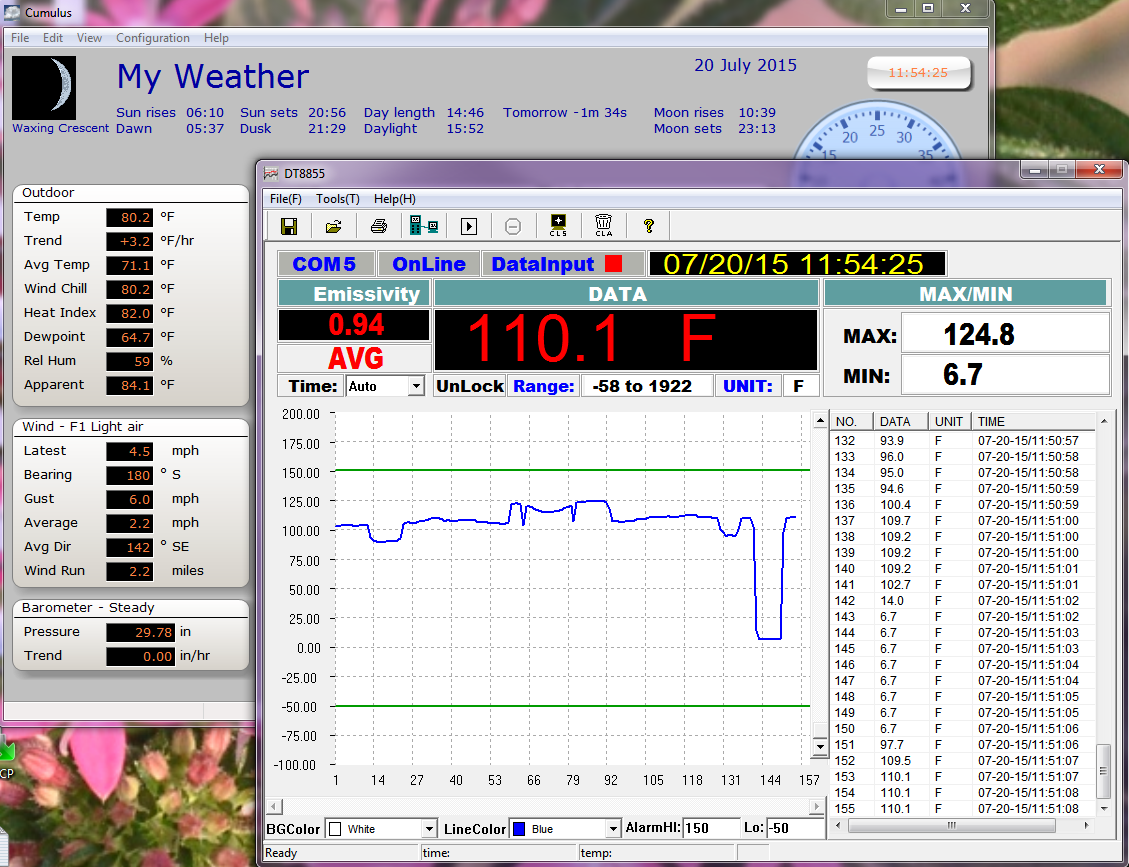
Air temp was 80F
These were taken in my easterly facing front yard at about 11:45AM on a clear sky morning.
Grass = 94F
Concrete = 110F
Asphalt = 125F
I live aways from significant human structures, and my backyard abuts a 300,000 (?) acre National Park.
51sq mile, 20,000 Sq acres
Square acres? Is that a unit of four dimensional volume?
🙂
You ever see 3d chess? This has one more dimension than that!!!!!
You should see the monster deer.
There’s also another 21,000 acres in the Cleveland Metro park district that’s adjacent to the National Park system.
Square acre can be used for renting a four-space. Each nanosecond of renting time corresponds to one foot. So if you want to rent, say a 1000 cubic feet room for 10 ns, you’d rent a 10,000 ft⁴ sized four-space.
I thought people in Manhattan were cool…?
Steam isn’t mentioned – I believe NYC, particularly Manhattan, has a huge underground distribution network of steam to most buildings from huge centralized boilers. In that case, the energy for steam generation isn’t consumed in the buildings and not counted? But the heat is released throughout, contributing to UHI, and I would assume it is not insignificant. In any event, I think steam should be mentioned somewhere as counted or not counted.
Back in 2010, I posted the following analysis on New York City power usage as it related to UHI. One big factor Willis seems to have missed is the ‘Mandated In-City Power Generation’ factor.
DD More February 26, 2010 at 7:22 am
I could never understand how UHI was minimized. If you look at New York City as an example.
Area, including water 468.9 sq mi ( 2,590,000 sq m)
Power used (2008) 54,869 GW-hr
(http://www.nyc.gov/html/planyc2030/downloads/pdf/progress_2008_energy.pdf)
Watts/sq m = 2,416 total. The Mayor says 80 percent is used by buildings and therefore 100 percent ends up as heat loss. So the forcing is 1,933 W/Sq M
The file also remarks that the city has seen a 23 percent increase in the last 10 years, which is close to the increase showing up in the charts.
http://wattsupwiththat.com/2010/02/26/a-new-paper-comparing-ncdc-rural-and-urban-us-surface-temperature-data/#comment-329553
Well it should be updated a little. Clarifying the 80 percent used by buildings was for lighting and heat, so by next day at the same temperature it was all turned to waste heat. I heard later that Reliability concerns require that 80% of the City’s peak load be met with in-City resources under a mandate from the New York State Reliability Council and the New York Independent System Operator.
The original calculation would now be 54,869 GW-hr / year * 1.0 x 1.00E+09 W/GW x 8760 hr/yr = 6,263,600,000 W-hr / hr. that divided by 2,590,000 m^2 = 2418 W / m^2 each hour. But if you take at least 60 percent of power generated in the city generates 40 percent excess waste heat to convert to electrical power = 2418 x (1+ .24) = 3000 W / m^2 of extra energy being dumped in the air of New York City. And that is from electrical power alone, doesn’t include all the vehicle waste heat.
So does 3,000 w / m^2 raise the temperature more than 100 ppm CO2?
The average day to day change in Min temp for the Northern Hemisphere (1940 to 2013) is -0.004297849F , the 1×1 degree cell that is NYC, which has a number of weather stations is 0.000786342F
Here’s the annual temperature data from 1940 to 2013
https://micro6500blog.files.wordpress.com/2015/07/y_n41w73.xls
Something I never expected when I moved there is that NYC is a geothermal area with fumaroles randomly erupting and capped with a ready inventory of orange and white striped chimney funnels , and steam explosions closing entire blocks every few years .
Of course one of the things that contributes to its per-capita energy efficiency is a substatial use of waste steam for building heating .
Wilis, I think the “calories” in our diet are actually kilo-calories, or 1000X a physics ‘calorie’.
that is correct = Kcals
Large C…Calories, not calories.
Hmm… Since AGW is for many the goose that laid the golden egg, with a little bit of focus 570 watts is just about enough to cook that egg!
It should be noted that much of this heat/energy is released far above ground level. So the impact on official temperature measurements would be some fraction of the total.
Thank you.. The issue is power / area x duration. But the are isn’t just the ground area. There are many floors to a skyscraper.
Not that I doubt the existence of HI (despite the Chinese records that were sadly lost when the dog ate the homework). But this is too simplistic.
And it misses the point:
“Midtown Manhattan uses more energy than Kenya” SO Kenya needs more energy – not Manhattan needs less.
all depends which way the wind blows.
When talking about surface area, is that just the surface area of the land occupied or the surface area of all the buildings as well as the exposed land surface area?
I feel the mass of all the structures that act as heat sinks should have a place in any formulas used in calculating UHI.
Here is a paper from Rice Univ. on the subject of UHI. Stored heat in the physical infrastructure is factored in.
http://www.ruf.rice.edu/~sass/UHI.html
Hot night summer in the city – Urban Island heat effect is not so silly!
“Midtown Manhattan uses more energy than Kenya”
…but does it use more energy than Al Gore’s empire?
Seriously, though, that should be enough reason to build coal-fired power plants to raise the Kenyans’ well-being.
My Kenyan friend was car-jacked recently and lost friends in the terrorist attacks a while back. She’s not too worried about where her power comes from.
No, no coal! We must end it!
Didn’t anyone tell you that burning fossil fuels hurts the poor the most?
/sarc off
“And since humans are 100% efficient at turning fuel into heat,”
Not really, or we would have taken over the galaxy and be expanding outward at the speed of light. Every conversion of energy comes at a cost. So far biological ones are far more efficient than the best our engineering. Consider also the human battery. How many W/M2 is the, shall we say, plumping effect?
Well, provide us an estimate how much of the traditional calory content of food eaten by Willis has converted to heat so far, and how much remains in other forms – like stored fat. Lets assume Willis is an 80kg male doing paperwork.
Way over my pay grade (and interest level). I’m sticking with the human=100w light bulb.
“Every conversion of energy comes at a cost”
Not in terms of energy it doesn’t!
According to classical physics, energy cannot be created nor destroyed. This Law is known as ‘The Conservation of Energy’ or, more formally, the 1st Law of Thermodynamics.
What you end up with, is what you started with.
Maybe that’s why we haven’t taken over the galaxy.
‘The Conservation of Energy’ or, more formally, the 1st Law of Thermodynamics.
That’s one of the Laws that should be repealed and replaced with a ‘fairer’ more ‘Democratic’ one. That way everyone could have it all! Sorry, I couldn’t resist.
Not a loss of energy. A cost in efficiency. Fossil fuel to electricity efficiency around 40%. The other 60% is conserved, but it will not run your toaster.