Retreating sea ice linked to changes in ocean circulation, could affect European climate
From the UNIVERSITY OF TORONTO

Retreating sea ice in the Iceland and Greenland Seas may be changing the circulation of warm and cold water in the Atlantic Ocean, and could ultimately impact the climate in Europe, says a new study by an atmospheric physicist from the University of Toronto Mississauga (UTM) and his colleagues in Great Britain, Norway and the United States.
“A warm western Europe requires a cold North Atlantic Ocean, and the warming that the North Atlantic is now experiencing has the potential to result in a cooling over western Europe,” says professor G.W.K. Moore of UTM’s Department of Chemical & Physical Sciences.
As global warming affects the earth and ocean, the retreat of the sea ice means there won’t be as much cold, dense water, generated through a process known as oceanic convection, created to flow south and feed the Gulf Stream. If convection decreases, says Moore, the Gulf Stream may weaken, thereby reducing the warming of the atmosphere, in comparison to today.
Their research, published in Nature Climate Change on June 29, is the first attempt to examine and document these changes in the air-sea heat exchange in the region — brought about by global warming — and to consider its possible impact on oceanic circulation, including the climatologically important Atlantic Meridional Overturning Circulation.
Previous studies have focused instead on the changing salinity of the northern seas and its effects on ocean circulation.
Moore and his fellow researchers based their findings on wintertime data from 1958 to 2014 that was provided by the European Centre for Medium-Range Weather Forecasts and model simulations.
Traditionally, the Gulf Stream moves warm water north toward western Europe, says Moore, where it loses heat and moisture to the atmosphere, acting to moderate the climate in this region. The resulting colder, denser water sinks and returns south at a great depth eventually rising to the surface in the tropics, where the cycle, known as the Atlantic Meridional Ocean Circulation, begins all over again.
The Iceland and Greenland Seas are among the only places worldwide where conditions are right and this heat exchange is able to change the ocean’s density enough to cause the surface waters to sink. The largest air-sea heat exchange in these seas occurs at the edge of the sea ice.
In the past, this region of maximum heat exchange has coincided with the location where oceanic conditions are optimal for convection to occur. However, in recent years, the sea ice has retreated and with it the region of maximum heat exchange. As a result, there has been a reduction in the heat exchange over the locations where sinking occurs in the ocean. This has the potential to weaken oceanic convection in the Greenland and Iceland Seas.
“The heat exchange is weaker — it’s like turning the stove down 20 percent,” says Moore. “We believe the weakening will continue and eventually cause changes in the Atlantic Meridional Overturning Circulation and the Gulf Stream, which can impact the climate of Europe.”
The paper’s other authors are Kjetil V?ge from the University of Bergen, Robert Pickart from Woods Hole Oceanographic Institution and Ian Renfrew from the University of East Anglia.
###
Update: The original headline was unintentionally misleading, a product of travel pressures today back from the Kennedy Space Center where I witnessed the SpaceX launch and explosion yesterday. Thanks to free WiFi at Dallas Love Field, he headline has been corrected to accurately reflect the article. My apologies to readers for the error. – Anthony
But I thought Britain was going to get a Mediterranean Climate. I wish these “science is settled” chaps would make their minds up.
travel….. back from the Kennedy Space Center where I witnessed the SpaceX launch and explosion yesterday.
Anthony, I watched it online, it must have been awesome in person. It’ll be even more spectacular when Musk gets all the pieces in the right place at the right time. I’ll bet those guys up on the ISS will be wondering what happened to their pizza order that they placed a while back.
Bar a blip in March, when all the cold air slipped down over Canada and the northeastern US to cause the unusually long, cold winter, Arctic sea ice is recovering impressively
http://ocean.dmi.dk/arctic/plots/icecover/icecover_current_new.png
Arctic temperatures are currently running below normal
http://ocean.dmi.dk/arctic/meant80n.uk.php
Where do these stories about Arctic warming and vanishing sea ice come from?
Look it’s quite simple – because you are looking at weather. Climate has to be measured on a decadal scale.
The Arctic has “weather”. It has warmer than ave and colder than ave season. The NSIDC forecast some time ago that the Arctic melt this year would not be a record low, as the spring melt-pond was cold.
Cold is weather, Warm is climate change, got it.
I appreciate that the March blip was just localized weather. My first point was that he climate alarmists didn’t recognize that, or at least they didn’t present it that way. My second point was that the trend in Arctic sea ice coverage has been upwards for the past two years. Currently it’s the best it’s been for a decade. That looks like climate, not weather.
funding
Most folk saying that the AMO is moving into its cold mode without bothering to look what it was doing through the Gleissberg solar minimum in the late 1800’s. It stayed largely in its warm mode, it didn’t cool well until solar activity picked up again.
Agree. The AMO is not the only factor, atmospheric pressure in the sub Arctic is also a critical factor. As far as the 19th century is concerned the AMO (aka 60 year quasi-periodic) as reconstructed HERE see the lower graph,
from 1810 to 1895, out of 85 the AMO was negative for only 25 years, and even so only up to half or less of the depth of the two recent lows.
AMO variability is wind driven by NAO/AO variability.
Intensity of the westerlies is directly related to the atmospheric pressure around Iceland (northern leg of the NAO). They strip warm saline North Atlantic Drift current of up to 2kW/m2 of heat.
Deprived of its warmth buoyancy, the salty water then sinks to depths of at least a mile (AMOC). Current turns southwards creating the return part of the ‘oceanic conveyor belt’.
The North Atlantic ‘Achilles Heel’ just south of Greenland is the key overturning region. I doubt that the low AMOC events that occur during negative NAO episodes are purely density driven.
Oh dear, so global warming causes regional cooling in one the main regions where the warming is happening. Sound like a dangerouly heretical negative feedback process.
The corrolary is that perhaps they have not yet understood the process at all and it is changes in atlantic overturn currents that are the reason of the main 1997-2007 loss of ice and warming in Europe.
Thank goodness, all those kids in England no longer have to worry about never seeing snow again as previously predicted.
I don’t know how they are going to model ocean circulation properly when they don’t even understand how the AMOC works and where the Arctic bottom (sinking) water originates from.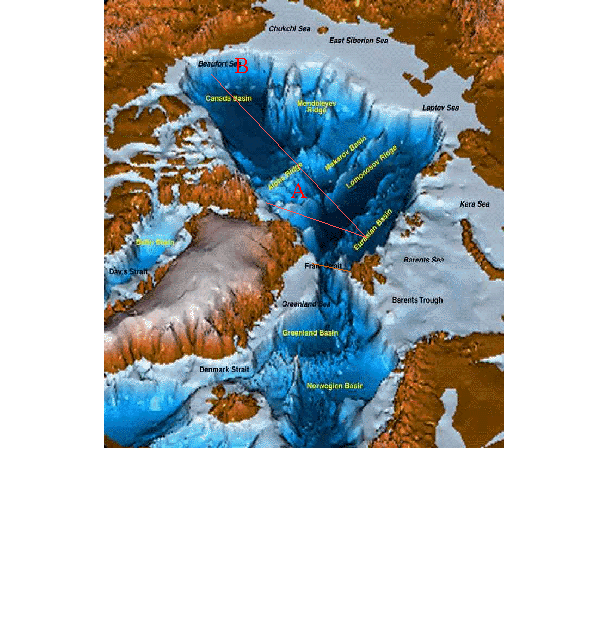
It comes from the entire Arctic ocean under the sea ice (not from the Greenland and Iceland seas next to the sea ice as they promote).
Not surprising I guess since this myth is wide-spread in the climate science community given that they don’t care about facts but more about whatever fits their global warming conviction.
The AMOC bottom water flow comes out of the entire Arctic ocean basin and, technically, overflows from the basin at these choke-point canyons. The Denmark Strait, for example, is the largest waterfall on the planet where cold Arctic water at -0.5C overflows the chokepoint and falls 4,000 metres to form one of the 3 sources of the Atlantic bottom water (the others being the Faroe Bank Channel overflow and the Davis Strait on the other side of Greenland coming from the Arctic peninsula channels). The Arctic bottom water continues flowing south from here until it starts to override the Antarctic bottom water at 20S.
Not to mention splitting of the ocean floor, oozing magma, number of sub-marine volcanoes and thousands of the ocean floor vents pumping boiling hot water
http://news.ucsc.edu/2015/06/images/circulating-seamounts-400.jpg
A ‘hydrothermal siphon’ drives water circulation through the seafloor
New study by scientists at UC Santa Cruz explains previous observations of ocean water flowing through the seafloor from one seamount to another.
http://www.nature.com/ncomms/2015/150626/ncomms8567/full/ncomms8567.html
Awesome comment.
Using an extended time-series of the NAO index as a proxy for the zonality of atmospheric
circulation in the northern midlatitudes, we find that the long-term correlation between solar
activity and atmospheric circulation changes in consecutive secular solar cycles and depends on
the north-south asymmetry of solar activity: when the northern solar hemisphere is more active,
increasing solar activity in the secular (Gleissberg) cycle leads to decreasing prevalence of zonal
forms of circulation, while increasing solar activity in secular solar cycles when more active is the
southern solar hemisphere leads to increasing zonality of atmospheric circulation.
Little can be said about the century-scale variations in the solar open magnetic field and hence
of the number and intensity of high speed solar wind streams, but we can suppose that increasing
solar open flux would lead to enhanced zonality of the circulation. The decreasing correlation
between the long-term variations in sunspot and geomagnetic activity and the recent increase in
geomagnetic activity point at the increasing importance of solar open flux. This increase in
geomagnetic activity not related to increasing sunspot activity coincides with the gradual change
over the past 4 decades of the NAO pattern from the most extreme and persistent negative phase
in the 1960’s to the most extreme positive phase during the late 1980’s and early 1990’s – a fact
which supports the role of the solar open flux in enhancing the zonality of the circulation.
http://arxiv.org/ftp/physics/papers/0702/0702057.pdf
So they say in this article which is bunk. The AMOC is showing no signs of any significant slow down while Arctic Ice is within it’s normal range of variability over the last 150 years.
Add to this that Arctic Sea Ice will be on the rise.
This article has nothing to offer other then more AGW bunk.
This has the potential to weaken oceanic convection in the Greenland and Iceland Seas.
“The heat exchange is weaker — it’s like turning the stove down 20 percent,” says Moore. “We believe the weakening will continue and eventually cause changes in the Atlantic Meridional Overturning Circulation and the Gulf Stream, which can impact the climate of Europe.”
T
I think heading forward cooler temperatures for the globe are looking more likely. The geo -magnetic field will have a bigger role then what many think because it enhances the effects of solar activity when weakening or when weak.
I do expect sea surface temperatures to decline in response to prolonged solar minimum activity and I think unlike some others that a -NAO will equate to a -AMO phase and more Arctic Sea Ice when Solar Minimum conditions are PROLONGED, and reach certain criteria in regards to duration of time and degree of magnitude change, which results in a much different climate outcome then when the sun is in a more or less 11 year rhythmic solar cycle mode of activity where solar minimum conditions under that scenario may for example go along the lines of what Ulric, has been suggesting and has some support from past data of his assertions.
I think under the scenario of prolonged minimum solar conditions however , that Sea Ice may start to form in the NORDIC SEA which could impact the AMOC and slow it down if enough fresh water via the Sea Ice got incorporated into the mix. This would have cooling implications for Europe, and Eastern North America.
The Arctic itself may not be all that cold under this scenario due to the Meridional Atmospheric Circulation but cold in the Arctic is relative and cold in the Arctic is much more meaningful during the summer season then the winter season, when temperatures in the Arctic are well below freezing regardless if the Arctic temperatures are above normal or not.
Inhibition of circulation weakens the force of the wind on the ocean. This means less water vapor in the atmosphere and global temperature drop.
-NAO will never equate to a -AMO. You have only managed to confuse what I have said with the paragraph long sentence.
I tend to disagree I do not think one should expect the same climatic results from solar minimum that are prolonged in nature, and reach certain criteria.
Time will tell.
In addition the folks at Weatherbell Inc. are of the strong opinion the AMO will be in a negative phase from this point in time going forward.
http://snag.gy/hjc6M.jpg
You may be correct. We will have to see how it plays out. Collecting the data not manipulated is what I am trying to do.
And a renewed +AMO means less sea ice again.
As of 6/29/2015 http://nsidc.org/arcticseaicenews/
I find it a little odd, that they look at winter time ice cover. The Arctic ocean is mostly surrounded by land, meaning that winter time ice cover has very little variation. http://ocean.dmi.dk/arctic/icecover.php
Did they at all looked at ice cover? “Moore and his fellow researchers based their findings on wintertime data from 1958 to 2014 that was provided by the European Centre for Medium-Range Weather Forecasts and model simulations”.
Waldmeier (1957) suggested the following relation between the north-south asymmetry of
solar activity and the secular solar cycle: solar activity dominates in the northern solar hemisphere
during the ascending part of the secular solar cycle, in the southern one during the descending
part, and in epochs of secular minima and maxima the asymmetry is small. However, there wеre
at least two episodes when this rule did not hold: the secular maximum of the 20th century around
1950 when the asymmetry had a maximum rather than a minimum (See Fig.2), and the end of the
Maunder minimum when the activity was clearly increasing while all sunspots were concentrated
in the southern solar hemisphere. From the supposed dependence of the correlation between solar
activity and temperature on solar asymmetry (Georgieva, 1998), we can hypothesize that solar
asymmetry changes sign in consecutive secular cycles, being positive in “even” cycles (if we
denote the 20th century secular cycle as even) and negative in odd ones; it has maximum positive
or negative values coinciding with the maximum of solar activity in the odd and even secular
cycles, respectively, and changes sign around secular solar minimum. Therefore, we can speak
about a “double secular” solar cycle consisting of two secular, or “Gleissberg” (Gleissberg, 1958)
cycles – one in which more active is the southern solar hemisphere, and a second one in which
more active is the northern hemisphere, much like the 22-year magnetic solar cycle consisting of
two 11-year cycles with opposite polarities, which leaves no “anomalies” in the available data
(Georgieva and Kirov, 2000). This double secular cycle, inferred from climatic data, was
independently determined by Mursula and Zieger (2001) in geomagnetic data: they found that the
streamer asymmetry, as determined from seasonal geomagnetic activity, changes its orientation
from being shifted towards the southern magnetic heliosphere in the 19th century to being shifted
towards the northern magnetic hemisphere in the 20th century.
http://www.sidc.be/images/wnosuf.png
It is obvious that the main reaction is observed at high latitudes, as should be expected taking
into account that the effect of magnetic clouds is strongest at high latitudes. The pressure at low
latitudes practically doesn’t react to magnetic clouds. Consequently, the changes in NAO index
are determined by the high latitude processes. NAO has a prolonged deep minimum starting two
days after the magnetic cloud encounter, and reaching its lowest values five days later. A more
careful inspection reveals that on the day of the encounter of a magnetic cloud and shortly prior to
it NAO index has a maximum, and the pressure in Iceland has a minimum. This maximum in
NAO and the minimum in Iceland pressure vanish if we exclude the fast magnetic clouds with
preceding shocks. Obviously, the shock itself, irrespective of its causes, always leads to a decrease
in the pressure at high latitudes. It should be noted here that according to the criteria which we
have adopted, the beginning of the magnetic cloud is considered the beginning of the magnetic
field rotation, while normally the shock precedes it by a few hours to a day or two.
http://arxiv.org/ftp/physics/papers/0702/0702057.pdf
https://en.wikipedia.org/wiki/Magnetic_cloud
Ren that approach is making matters to complicated and not straight forward which leads into problems when trying to claim a solar/climate connection.
The standardized seasonal mean NAO index during cold season (blue line) is constructed by averaging the monthly NAO index for January, February and March for each year. The black line denotes the standardized five-year running mean of the index. Both curves are standardized using 1950-2000 base period statistics.
http://www.cpc.ncep.noaa.gov/products/precip/CWlink/pna/season.JFM.nao.gif
The negative NAO (JFM) corresponds to a decrease AMO.
http://www.woodfortrees.org/graph/esrl-amo/from:1950
I show the impact of solar activity on the pressure changes at high latitudes.
Visible is the impact of solar activity on the changes in pressure in the stratosphere.
http://www.cpc.ncep.noaa.gov/products/stratosphere/strat-trop/gif_files/time_pres_HGT_ANOM_ALL_NH_2015.gif
“A warm western Europe requires a cold North Atlantic Ocean, and the warming that the North Atlantic is now experiencing has the potential to result in a cooling over western Europe.
Oh please just stop printing this BS
Let’s see what is responsible for the heat in Europe. What will happen in the winter?
http://earth.nullschool.net/#current/wind/isobaric/250hPa/equirectangular
Off topic but I got to this post from Yahoo news feed. That is the first time I have seen a WUWT post in my yahoo news. The title must have done it 🙂
“Retreating sea ice in the Iceland and Greenland Seas may be changing the circulation of warm and cold water in the Atlantic Ocean, and could ultimately impact the climate in Europe”, says a new study.
May be … could???
No disrespect but it is this kind of weak scientific language that is rendering science useless.
It should be obligatory for scientists to not use cheap words like “may be” or “could” and instead quantify what they are saying by using mathematically backed-up expressions such as “a X% risk” or “Y% probability”.
So, imagine how more scientifically meaningful the statement would have been had it stated something like the following:
“Retreating sea ice in the Iceland and Greenland Seas has a 5% risk of changing the circulation of warm and cold water in the Atlantic Ocean, with a 2% probability of ultimately impacting the climate in Europe”.
Instead, the original statement in the study simply renders the study as meaningless, and of no beneficial use.
Late in the day with this comment however….
“Traditionally, the Gulf Stream moves warm water north toward western Europe, says Moore”…..
No, no, no, no, no…..and no again
Maybe usually or normally but not traditionally.
Tradition is a human custom.
Strange clothes regularly worn are a tradition. An annual music festival might be a tradition.
The Gulf Stream has no traditions.
Apparently in the 12 years prior to 2005 the Gulf Stream had weakened 30%
http://www.theguardian.com/environment/2005/dec/01/science.climatechange
All of NW Europe was about to plunge into an ice age as a result
And in 2013 the Gulf Stream was the weakest it had been in 5 years
http://notrickszone.com/2013/10/23/meteorologist-gulf-stream-weakens-to-lowest-level-in-five-years-may-bode-ill-for-europes-winter/#sthash.GJYNV6aR.dpbs
And then Michael Mann checks his proxies and confirms NW Europe is set to freeze.
http://www.resilience.org/stories/2015-03-26/deep-concerns-as-climate-impacts-on-gulf-stream-flow#
Oh that old Gulf Stream
I shouldn’t but…http://www.dailymail.co.uk/news/article-191830/Sizzling-UK-records-hottest-day-ever.html