Limiting temperature rise by 2100 to less than 1.5°C is feasible, at least from a purely technological standpoint, according to the study published in the journal Nature Climate Change by researchers at the International Institute for Applied Systems Analysis (IIASA), the Potsdam Institute for Climate Impact Research (PIK), and others. The new study examines scenarios for the energy, economy, and environment that are consistent with limiting climate change to 1.5°C above pre-industrial levels, and compares them to scenarios for limiting climate change to 2°C.
“Actions for returning global warming to below 1.5°C by 2100 are in many ways similar to those limiting warming to below 2°C,” says IIASA researcher Joeri Rogelj, one of the lead authors of the study. “However, the more ambitious 1.5°C goal leaves no space to further delay global mitigation action and emission reductions need to scale up swiftly in the next decades.”
The authors note, however, that the economic, political, and technological requirements to meet even the 2°C target are substantial. In the run-up to climate negotiations in December 2015, such information is important for policymakers considering long-term goals and steps to achieve these goals.
Key elements: accelerated energy efficiency gains and CO2 removal
The study identifies key elements that would need to be in place in order to reach the 1.5°C target by 2100. One fundamental feature is the tight constraint on future carbon emissions.
“In 1.5°C scenarios, the remaining carbon budget for the 21st century is reduced to almost half compared to 2°C scenarios,” explains PIK researcher Gunnar Luderer, who co-led the study. “As a consequence, deeper emissions cuts are required from all sectors, and global carbon neutrality would need to be reached 10-20 years earlier than projected for 2°C scenarios.”
Faster improvements in energy efficiency also emerge as a key enabling factor for the 1.5°C target. In addition, all the scenarios show that at some point in this century, carbon emissions would have to become negative at a global scale. That means that significant amounts of CO2 would need to be actively removed from the atmosphere. This could occur through technological solutions such as bioenergy use combined with carbon capture and storage–a technology that remains untested on a large scale, increases the pressure on food supply systems and in some cases lacks social acceptance–or through efforts to grow more forests, sequestering carbon in tree trunks and branches. Afforestation, however, just like bioenergy plantations, would have to be carefully balanced against other land use requirements, most notably food production.
Overshooting the limit–and declining to 2100
In contrast to many scenarios examined in recent research, which set 2°C as the absolute limit and do not allow temperature to overshoot the target, the current set of scenarios looks at a long term goal, and what would need to happen to get temperature back down to that level by 2100.
“Basically all our 1.5°C scenarios first exceed the 1.5°C temperature threshold somewhere in mid-century,” explains Rogelj, “before declining to 2100 and beyond as more and more carbon dioxide is actively removed from the atmosphere by specialized technologies”.
The recent IPCC fifth assessment report did not describe in detail the critical needs for how to limit warming to below 1.5°C as the scenarios available to them did not allow for an in-depth analysis. Yet over 100 countries worldwide–over half of the countries in the United Nations Framework Convention on Climate Change (UNFCCC), including the Alliance of Small Island States (AOSIS) and the Least-Developed Countries (LDCs)–have declared their support for a 1.5°C target on climate change. The target itself is also up for debate at the upcoming climate negotiations. This new study fills this gap.
The authors make clear that an increase of international efforts to curb greenhouse gases is imperative to keep the 1.5°C target achievable.
“The 1.5°C target leaves very little leeway,” says Luderer. “Any imperfections – be it a further delay of meaningful policy action, or a failure to achieve negative emissions at large scale – will make the 1.5°C target unattainable during this century.”
What do you mean by “scenario?”
Scenarios, like the ones described in this study, are not predictions or forecast, but rather, stories about potential ways that the future might develop, with specific quantitative elements and details about how sectors such as the economy, climate, and energy sector interact. By looking at scenarios, researchers look for insight into the paths and circumstances that might lead us to specific objectives.
###
Reference: Rogelj J, Luderer G, Pietzcker RC, Kriegler E, Schaeffer M, Krey V, Riahi K. (2015). Energy system transformations for limiting end-of-century warming to below 1.5°C. Nature Climate Change. 21 May 2015. DOI: 10.1038/NCLIMATE2572
This is a joint press release from the International Institute for Applied Systems Analysis (IIASA) and the Potsdam Institute for Climate Impacts Research (PIK).
“What would it take ,,,”?
Nothing, absolutely nothing.
Carbondioxide is not the primery climate driver, not by a long way. Doubling CO2 would cause an increase in temperature measured in fractions of a degree. No way that magical 1.5 degree would be reached. It is an illusion.
Irrespective of what may be the amount of anthropogenic greenhouse gases released in to the atmosphere, the global warming component may not cross 0.2 oC by 2100. However, the changes associated with ecological changes [such as urban-heat-island effect, deforestation, mining, etc] may present rise in global temperature [but not contributing to global warming] by about 0.5 oC by 2100 at local level — at hotspot they may present still higher. Governments and UN must stop worrying on anthropogenic greenhouse gases and instead put more thrust in controlling pollution — air, water, soil and food — and thus protecting the people from health disasters. UN and many other international bodies are diverting the attention of the governments by declaring that such health hazards are due to global warning, a falsified alarm to garner billions of dollars, an easy way to become rich overnight. Also UN must encourage building greenery all over the world. In the States of Telangana and Andhra Pradesh in India, though the summer temperature extremes are not crossing the 1931-60 normals published by IMD [Red Book], people are dying due to heat stroke though were rare during 60s, basically because butchered greenery in the forests, in urban areas, along the roads [though Kings developed such system].
Dr. S. Jeevananda Reddy
Meanwhile, in many areas, the village population are inefficiently burning wood for cooking in open cooking pits and in rudimentary open mud-stoves. And in the process they are exposing themselves to lifelong smoke inhalation.
The result, is waste of this resources and manpower, fuel shortage, damage to health, discomfort, deforestation and the furtherance of poverty.
The widespread introduction of and funding of sealed metal stoves and solar cookers would change the lives of such people and significantly benefit their environment.
Such low-tech and cheap solutions are now being overlooked by policy makers and NGO’s who have become monomaniacally preoccupied with only one imaginary crisis and their preferred ludicrously ineffective and expensive solution to their imaginary crisis.
That’s the real global warming disaster.
We could be building a better world for all.
Instead we are spending hundreds of billions on putting windmills in the middle of the sea.
If taxing a trace gas in the atmosphere would be such a good idea, the taxation of that other, rather more abundant substance, oxygen, can’t be far away.
Preventing warming may not be worth it, but it might not be very long before we start asking the other side of the question. Is there anything we can do to stop it from cooling? Maybe by pumping huge amounts of CO2 into the air?
The hot air from warrenlb alone may be sufficient to raise the global temp by at least 0.1 degC/ comment. I believe in free speech, but his comments are not worthy of replies, or even publishing.
Totally devoid of substance.
+1
The assumed linearity between global warming and CO2 emissions dT=m[CO2] +c favoured by Obama warmists infers that as CO2 becomes negative dT reduces to c, 0 and then becomes negative +/- 0.2 also. However the exponential correlation dT = e^[CO2] +c, favoured by Mann, Gore et al, means that dT cannot fall below c +/- 0.2 no matter how negative the emissions become. The current pause or hiatus reality clearly infers that dT=0 +/-0.2
@Chemengrls
“The Assumed linearity between global warming and CO2 emissions…”
NO! The relationship is NOT between warming and emissions, and it’s NOT linear! There is a logarithmic relationship between RADIATIVE FORCING (which is directly proportional to the change in surface temperature at equilibrium) and the ATMOSPHERIC CO2 INCREASE.
Note that we are not currently at equilibrium as there is a planetary energy imbalance, and thus further warming is ‘in the pipeline’ from the carbon already emitted. Therefore, estimates of the rate of warming due to CO2 thus far will be underestimated, unless accounting for this ‘warming in the pipeline’.
..
warrenlb commented on
LMAO
First the planet is never in equilibrium, the axial tilt, the unequal land/ocean distribution, and ocean cycles pretty much demands it.
But, this is why you are clueless, it’s a decreasing log function, not an increasing log function, the increase is less than linear, linear over estimate warming.
@micro6500.
You say its a ‘decreasing log function’? Really? You say temperature DECREASES as the log of CO2 ppmv INCREASES? Really?? It seems you earned the clueless appellation with that statement!
Never passed a math class did you?
The rate of temperature increase for an increase of Co2 is a decreasing log function.
NO! The relationship is NOT between warming and emissions, and it’s NOT linear! There is a logarithmic relationship between RADIATIVE FORCING (which is directly proportional to the change in surface temperature at equilibrium) and the ATMOSPHERIC CO2 INCREASE.
Can you express this relationship in a mathematical form ie as a differential equation?
@Robert Stevenson
dF = 5.35 ln(C/Co) for CO2. The value of the constant (for CO2, 5.35) varies with specific Greenhouse Gas.
Where ‘dF’ is the radiative forcing (change in the amount of energy reaching the Earth’s surface) in Watts per square meter, ‘C’ is the concentration of atmospheric CO2, and ‘Co’ is a reference CO2 concentration. Normally the value of Co is chosen at a pre-industrial reference concentration of 280 ppmv.
Then dT = λ*dF where lambda is equilibrium climate sensitivity in either degrees Kelvin or Celsius per watts per square meter, and T is surface temperature.
So for the year 2010, dT = λ*dF = λ * 5.35 * ln(390/280) = 1.8 * λ (390 ppmv was the CO2 concentration for the year 2010.)
No negative signs anywhere.
Using the 2007 IPCC estimates for Climate Sensitivity (a doubling of CO2 ppmv) of 2 to 4.5 (you may use the more recent IPCC values of 1.5 to 4.5, or your own numbers –the math is still the same)
λ = dT/dF = dT/(5.35 * ln[2])= [2 to 4.5°C]/3.7 = 0.54 to 1.2°C/(W/m2) for a doubling of CO2 ppmv.
Plugging in this range of climate sensitivity values and solving for dT:
dT = 1.8* [0.54 — 1.2] or about 1–2.2°C of global warming since the beginning of the industrial age, with a most likely value of 1.4°C.
However, this tells us the equilibrium temperature. In reality it takes a long time to heat up the oceans due to their thermal inertia. For this reason the surface has only warmed about 0.8°C. In other words, even if we were to immediately stop adding CO2 to the atmosphere, the planet would warm another ~0.6°C until it reached this new equilibrium state.
Some skeptics have suggested the actual climate sensitivity could be closer to 1°C for a doubling of CO2, or 0.27°C/(W/m2). Although numerous studies have ruled out climate sensitivity values this low, it’s worth calculating how much of a temperature change this unrealistically low value would generate. Using the same formulas as above,
dT = 1.8 * λ = 1.8 * 0.27 = 0.5°C.
Therefore, even under this ultra-conservative unrealistic low climate sensitivity scenario, the increase in atmospheric CO2 over the past 150 years would account for over half of the observed 0.8°C increase in surface temperature.
Still no negative signs appearing. Increasing CO2 ppmv means increasing T. And no ‘saturation’ appearing in the math (or in the physics).
warrenlb
May 25, 2015 at 11:30 am
@Robert Stevenson
dF = 5.35 ln(C/Co) for CO2. The value of the constant (for CO2, 5.35) varies with specific Greenhouse Gas.
Where ‘dF’ is the radiative forcing (change in the amount of energy reaching the Earth’s surface) in Watts per square meter, ‘C’ is the concentration of atmospheric CO2, and ‘Co’ is a reference CO2 concentration. Normally the value of Co is chosen at a pre-industrial reference concentration of 280 ppmv.
Then dT = λ*dF where lambda is equilibrium climate sensitivity
How was this relationship derived?
Then dT = λ*dF where lambda is equilibrium climate sensitivity
How was this relationship derived? The present 18 year pause in global warming is a waveform and would best be described by a Fourier series.
The formula you cite is not derived — it’s the definition of equilibrium climate sensitivity.
warrenlb
May 26, 2015 at 8:35 am
The formula you cite is not derived — it’s the definition of equilibrium climate sensitivity.
The relationship you cite dF = 5.35 ln(C/Co) for CO2 is the exponential correlation dT = e^[CO2] +c, favoured by Mann, Gore et al, giving the hockey stick graph featured in IPCC reports which has long since lost any credibility.
Oh Really. In which Science journal has this relationship ‘lost credibility’? Could it be the same journal in which F=ma lost credibility? Or e = mc^2? Or in which the greenhouse effect suddenly disappeared? Or in which DNA, Evolution, and Plate Tectonics are all consequences of massive fraud and conspiracy among the worlds institutions of science?
I’ve heard so much cr**p from the no-nothings on this forum who reject Western 6th Grade Science, I guess I shouldn’t be surpised to hear more of the same on this thread.
I’ve heard so much cr**p from the no-nothings [sic] on this forum…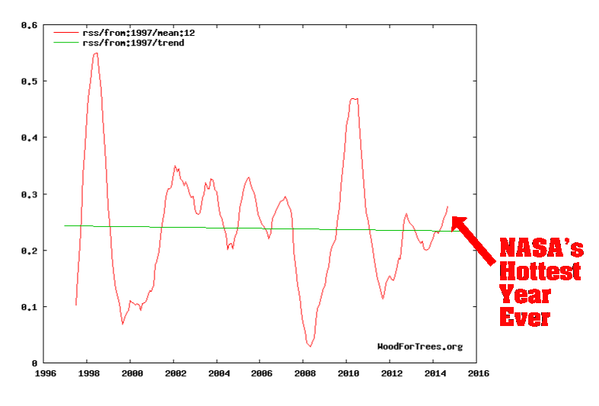
And yet, Planet Earth continues to debunk what warrenlb is trying to sell:
Yes, warrenlb is completely clueless. He believes in the big warmy-warmy “hot heat in the pipeline”, without any evidence. He believes in “dangerous man-made global warming” without a single corroborating measurement. warrenlb believes. That’s enough for warrenlb. No data required.
I’ve heard so much cr**p from the no-nothings on this forum who reject Western 6th Grade Science, I guess I shouldn’t be surpised to hear more of the same on this thread.
Ranking some half baked hockey stick equation, which has no basis in reality, alongside those of Newton, Einstein, Planck and other great physicists is really crass warren and you should apologise – unless of course you have proof of its validity.