From the United States Geological Survey and the department of omnivorous dining comes this:

Polar bears unlikely to thrive on land-based foods
ANCHORAGE, Alaska — A team of scientists led by the U.S. Geological Survey found that polar bears, increasingly forced on shore due to sea ice loss, may be eating terrestrial foods including berries, birds and eggs, but any nutritional gains are limited to a few individuals and likely cannot compensate for lost opportunities to consume their traditional, lipid-rich prey — ice seals.
“Although some polar bears may eat terrestrial foods, there is no evidence the behavior is widespread,” said Dr. Karyn Rode, lead author of the study and scientist with the USGS. “In the regions where terrestrial feeding by polar bears has been documented, polar bear body condition and survival rates have declined.”
The authors detail their findings in a review article in Frontiers in Ecology and the Environment. The scientists noted that over much of the polar bear’s range, terrestrial habitats are already occupied by grizzly bears. Those grizzly bears occur at low densities and are some of the smallest of their species due to low food quality and availability. Further, they are a potential competitor as polar bears displaced from their sea ice habitats increasingly use the same land habitats as grizzly bears.
“The smaller size and low population density of grizzly bears in the Arctic provides a clear indication of the nutritional limitations of onshore habitats for supporting large bodied polar bears in meaningful numbers,” said Rode. “Grizzly bears and polar bears are likely to increasingly interact and potentially compete for terrestrial resources.”
The study found that fewer than 30 individual polar bears have been observed consuming bird eggs from any one population, which typically range from 900 to 2000 individuals. “There has been a fair bit of publicity about polar bears consuming bird eggs. However, this behavior is not yet common, and is unlikely to have population-level impacts on trends in body condition and survival,” said Rode.
Few foods are as energetically dense as marine prey. Studies suggest that polar bears consume the highest lipid diet of any species, which provides all essential nutrients and is ideal for maximizing fat deposition and minimizing energetic requirements. Potential foods found in the terrestrial environment are dominated by high-protein, low-fat animals and vegetation. Polar bears are not physiologically suited to digest plants, and it would be difficult for them to ingest the volumes that would be required to support their large body size.
“The reports of terrestrial feeding by polar bears provide important insights into the ecology of bears on land,” said Rode. “In this paper, we tried to put those observations into a broader context. Focused research will help us determine whether terrestrial foods could contribute to polar bear nutrition despite the physiological and nutritional limitations and the low availability of most terrestrial food resources. However, the evidence thus far suggests that increased consumption of terrestrial foods by polar bears is unlikely to offset declines in body condition and survival resulting from sea ice loss.”
###
The review article was developed by researchers at the USGS, Washington State University, and Polar Bears International.
The USGS is leading studies of polar bear response to sea ice loss through its Changing Arctic Ecosystems Initiative. Current studies include examination of polar bear nutritional and behavioral ecology, linked to population-level consequences.
Gotta be a corrupt hard drive
/sarc off
Susan Crockford at Polar Bear Science has a post on exactly this article.
She points out the serious disconnect, that polar bear critical feeding time is Spring whereas the sea-ice loss is in Summer. So, the entire thesis of Dr. Karyn Rode and the USGS is falsified by facts that any expert of polar bears should know.
As Dr. Crockford says, “Don’t forget that the sea ice models these biologists use do not predict a decline in winter ice (Dec-March) and project only slight declines in spring ice (April-June) by mid-century.”
So, the very models relied upon by Dr. Rode and the USGS say that there is no sea-ice threat to polar bears during their critical feeding time. Dr. Rode’s article skews the conclusions to fit the AGW prejudice rather than the facts — exactly what we’ve seen over and over again in climate scare political (not)science.
Dr. Crockford has a follow-up article here, pointing out that polar bear feeding is under no global loss-of-sea-ice threat.
Dr. Rode has some explaining to do.
Just ask Binky.
http://en.wikipedia.org/wiki/Binky_%28polar_bear%29
Hope the hyperlink thingy works.
Bird’s eggs? For a carnivore that large?
Berries?
That’s risible.
If it’s got feet and moves, they can eat it.
If necessary, they even eat each other.
The “vegan diet” sounds like wishful thinking. I remember seeing some of a documentary many years ago of a juvenile bear being killed and eaten by an older and bigger bear in the Hudson Bay area. When they’re hungry, they don’t seem to be fussy eaters.
That is all true about bears eating bears. One of the major causes of death for young polar bears is older polar bears, especially males. In theory the population could double every year but in practice it is every 20. The main reason it is not faster is adult male polar bears.
The paper attempts to ‘hide the increase’.
Maybe they could simple re-Darwin themselves back to the land bears they evolved from and eat all those other bears. No one’s ever shown Darwin couldn’t work in a circle.
All bear species eat berries. For some species e. g. Brown Bear Ursus arctos it is an important food in autumn. And, yes, polar bears do eat bird’s eggs and young birds. It is a well-known phenomenon in e. g. Svalbard.
If Dr Rode observed me for 1 year he would observe that my main protein intake came from meat and eggs and I rarely ate berries. If he started observing after 9:00am he would categorically state that I never ate eggs. If he observed me only in winter he could say I never ate berries. There are 900-2000 bears in one population, did he have an observer for each bear 24 hours every day?
Like humans, all bears are omnivores.
The big Alaskan brown bears ( http://www.adfg.alaska.gov/index.cfm?adfg=brownbear.main ) are close to the same size as polar bears.
I’ve been too Lake Clark National Park (on the Alaska coast on the north side of Cook inlet west of Anchorage) to view and photograph the Alaskan browns that exist in relatively large numbers in the tidal grass lands along the shore of the inlet.
Their diet is mostly berries, grasses, sedges, cow parsnip, ground squirrels, and roots, supplemented by large amounts of salmon during the Salmon runs.
Yes, these bears are capable of hunting moose and other large animals, but in those areas where the Alaskan browns exist in significant numbers, all other mega fauna stays away for obvious reasons and opportunities for hunting large prey are exceedingly rare.
PS.
Yes, the diet of the Alaskan Brown Bears in the tidal grass lands is much lower in energy than the seal heavy diet of the polar bears. However, grazing doesn’t consume a lot of energy.
If you really think polar bears subsist entirely on seals you need to watch the polar bears around Churchill sizing up the humans who pay big bucks to watch them onshore. Those looks say that they are thinking “Spam in a can.”
I am wondering how did polar bears become so loveable and adorable while seals became so hated. It used to be the environmental cause of the day to hate furriers for killing seals, now the big problem is polar bears having enough seals to kill.
I bet polar bears can thrive on funding-fattened Greens 🙂
Question: how did the bears survive for eons without busybodies micro-managing the Entire Universe?
Doesn’t their very existence lay waste to the claim that polar bears can’t subsist on anything but seals? Surely there have been crashes in seal populations in the past, as there are with all living populations over time.
Max Photon,
http://wattsupwiththat.com/2015/04/03/and-here-we-have-been-told-its-climate-disruption-causing-local-weather-changes-when-its-actually-deforestation/#comment-1897168
Arguably true, but where exactly was that claim made?
brand on gates,
where
exactly get You’re claims
made true?
‘Arguably true, but where
exactly’.
Astonishing question. Exactly.
Old news. Read Susan Crockford blog dated 1 April. No joke.
http://polarbearscience.com/2015/04/01/polar-bear-consumption-of-terrestrial-foods-new-paper-misses-the-point/
With all due respect to the author, the paper did not miss the point. Because the actual point of the paper was to miss the real point.
Thanks Joe,
Just out of bed here on the Canadian west coast, on an overcast Saturday. Let me see if I can catch up.
Here are some excerpts from my post:
“Whatever food polar bears consume in the summer – whether they are on land or on the ice – doesn’t really matter. What matters is how many fat-rich seals they can consume between March and June each year.
The fat put on in late winter/spring from gorging on baby seals carries polar bears over the summer, no matter where they spend it. [see this post http://polarbearscience.com/2015/02/09/polar-bears-out-on-the-sea-ice-eat-few-seals-in-summer-and-early-fall/ ]
USGS polar bear biologist Karyn Rode and colleagues (press release here) have tried to frame this issue as one about future survival of polar bears in the face of declining sea ice.
However, the fact that polar bears in the Chukchi Sea and Southern Davis Strait are thriving despite dramatic declines in summer sea ice (aka an extended open-water season), proves my point and disproves their premise. Bears in these regions are doing extremely well – contrary to all predictions – because they have had abundant baby seals to eat during the spring (see here and here).
Don’t forget that the sea ice models these biologists use do not predict a decline in winter ice (Dec-March) and project only slight declines in spring ice (April-June) by mid-century (Amstrup et al. 2007; Durner et al. 2009; Oakley et al. 2012; Wang et al. 2012).
Polar bear biologists emphasize the generic phrase “sea ice” whenever possible (as in this paper, “Warming-induced loss of sea ice remains the primary threat faced by polar bears.”) but if you look at the predictive ice modeling papers they use, it is clear they really mean summer sea ice:
“…all GCMs project extensive winter sea ice through the end of the 21st century in most ecoregions (Durner et al. 2009).” (Amstrup et al. 2007:9)
In other words, their models show no reason to worry about the state of the critical spring feeding period between now and the middle of this century.”
thanks Susan!
because they have had abundant baby seals to eat during the spring ….
========
you know, maybe I’m missing something here…..but I don’t think seals and bears wear wrist watches
They are trying to frame this like it’s a certain time……if there’s less ice in the “spring”…that just means it melted sooner…..which just means it got warmer sooner….which just means bears and seals will do the same thing…sooner on our calendar….they won’t even know the difference
I mean it’s not like the bears and seals will wake up one day and go…..my God, spring is 3 weeks early this year
Latitude is right. My crocuses don’t have a calendar but they always know just when it’s the right time to show off.
Bear with food problems in my neighborhood last Sept.
http://bc.ctvnews.ca/large-black-bear-forces-lockdown-at-port-coquitlam-school-1.2024759
What a co-ink-a-dink.
http://www.columbian.com/news/2012/oct/04/school-suspends-round-lake-activities/
It invites speculation about bear re-introduction programs.
I laughed when it was mentioned in the article that a different species of bear (the arctic gizzly) was so small in comparison to other grizzly bears. My understanding is they are different species and size isn’t directly related to diet or we would assume all small animals are under fed. :):)
Grizzlies and Polar bears are only semi- distinct species, with the great whites having diverged only (we think) around 100K yrs ago and do interbreed at times, with hybrids of the two occasionally spotted.
chris moffatt posted an article further down the page which debunks the 100K year time span. http://wattsupwiththat.com/2015/04/03/claim-polar-bears-cant-subsist-on-anything-but-seals/#comment-1897415
How can I tap some of this grant money gravy train? Is it like do a study of anything anywhere sound the alarm cash a check?
Write a paper abut global warming, say we are doomed and don’t forget to mention that more studies will be needed. The money will flow in.
got to love the picture while studies are being done in Alaska. Our tax dollar$ at work!
Nahh, There was a seal under all of that garbage trying to change it’s own “nutritional” habits ( and eat berries ).
If the grizzlies are that small, no doubt the polar bears will eat them.
For info on bear food, see:
http://forum.lakelavonfishing.com/index.php?topic=4330.0;wap2
which may be informative!
What they seem to forget is that seals and walrus come ashore w/o ice. YouTube is packed with polar bears attacking them where there is no ice. And don’t forget the dead whales that wash ashore.
One more thing – just a rhetorical question – you never hear of environmentalists decrying how many resources the polar bears use, or the possibility of dwindling numbers of seals with increased polar bear numbers – or how many fish all those seals and walrus eat. Or how much blubber is on a whale, seal, walrus, or bear. Why is it they’re consumed with how many resources we use, but never any other creature?
From Climate Change Dispatch :
http://www.climatechangedispatch.com/despite-misleading-study-polar-bears-aren-t-starving-or-dwindling.html
The USGS has to keep the scam going or be cut back … imagine, no polar bear problems no gravy for USGS … they know that!
The image above creates the impression to be photoshopped to me, or?
Lots of sharp edges…
Peter, I think you are correct. Check out the base of the right rear leg on the nearest polar bear. Doesn’t look right at all vis-a-vis the rubbish around it. Who’s creating this picture and what’s the purpose of it?
Jeah, and look at the crates in front of the right bear, and particularly the background scenery compared to the trash dump in the front.
Also note, that no crate is broken, even when those ponderous bears plough through them.
I do not know how much you know about photo programs, such as Photoshop, first it was shot at f/4.5 which means that it has a shallow depth of field so only a small area in front of the focus point and a slightly area behind that focus point will be in acceptable sharpness. As the image would have had a original resoluation of 300dpi and has been stripped down to 72ppi on an 11″ x7.6″ image that is a lot. If you have ever tried to do a selection of soft hair or fur you will know how hard it is to do right it so a select and paste is not very likely. As for the sharpness if it has been sharpen at full size than stripped down for web than it often appears very sharp. Now this was taken with a Canon 40D (2007) it was 10MP the image on the was is 207 KB so if viewed enlarged it may appear to those that do not know what to look for as an image that has been composed or put together.
Good observation. Appears to be a mound of crates (unbroken) piled high. Did someone climb high upon a heap of trash to dispose of the crates? Not likely. In a region of scarce resources (wood, lumber, etc) would the crates be tossed into the trash heap. Photoshop seems likely.
I agree w/Allan S. I don’t think it was ‘shopped’. Apart from his observations, the black line/box on the back right foot could be anything. I’ve been using Photoshop since about v.1 (89/90) but back then we used it primarily to take photos down to 256 colours (or less, depending on how many colours were needed for on screen text). If this was Photoshopped, it was done by a master. Also, almost everything consumed in the north is shipped there. Wooden crates would be useful, at best, for kindling. You would have to be very desperate to scavenge wood (for kindling) where polar bears frequent.
Bears are bears and dumps are dumps. Anywhere both can be found means both will be found in the same place.
However, I stand to be corrected and will be ever so impressed by whoever created that image.
So how does this work?
““Although some polar bears may eat terrestrial foods, there is no evidence the behavior is widespread,” said Dr. Karyn Rode”
What planet does Dr Rode live on?
I take it she is saying that as the Arctic warms up there will be fewer seals and the polar bears will starve, right? So is it the seals or the polar bears that will go extinct first? Does the US Geological Survey know that seals are able to survive in warmer seas filled with thriving fish populations by….let me get this right…eating them?
Seals are a land-based food too. Are they aware of that? When they poke a hole in the ice and jump out for a rest, they are on ‘land’. If they want to cry ‘Alarum!’ they should have said that all the seals will drown because when the ice is gone they will have nothing to ‘land on’.
I wonder if polar bears might be able to eat any other type of land-occurring food?
http://ichef.bbci.co.uk/images/ic/640×360/p02bgtjt.jpg
I guess not. It’s seals or nothing and there is simply nothing for a giant, vicious, carnivore to eat on land.
“Although Churchill’s polar bear migration is part of an age-old pattern, climate change has caused Hudson Bay to melt earlier each summer and to freeze later, shortening the hunting season for these bears and straining the limit of their fat reserves. As a result, their numbers have dropped by 22% over the past 30 years.”
That is from http://www.polarbearsinternational.org/about-polar-bears/churchills-polar-bear-migration
Then why has the polar bear population exploded in my lifetime? Why is it that only in areas where there are a lot of people with guns that the population has declined? Has it really declined? Is there a correlation? What is the correlation coefficient between a polar bear being shot by a high powered rifle and dying?
People are complaining like hell about the increasing number of polar bears:
http://www.nunatsiaqonline.ca/stories/article/65674arviat_steps_up_efforts_to_keep_polar_bears_out_of_town/
Here is the opinion of locals: “Noting the large number coming through Arviat each year, Savikataaq wants to see the [kill] quota bumped from 24 polar bears to 45.”
Do people know that the polar bear capital of Canada is not Baffin Island – where it is too frigging cold to thrive – it is Manitoba!
http://o.canada.com/travel/manitoba-eyes-lifting-moratorium-on-tundra-buggy-permits-in-new-polar-bear-park
Ron Thiessen also has concerns. The executive director of Manitoba’s Canadian Parks and Wilderness Society said…[a]ny increase in the number of [tundra buggy] permits issued must be based on “sound science” and input from local people, he suggested.
Sound science. Sounds good. The locals say there are too frigging many bears killing their dogs and tearing up their meat caches and invading their towns as the population continues to explode and they want permission to shoot more of them so they don’t have to mount, for the first time, a 24-hour guard.
What is the correlation coefficient between the US Geological Survey’s latest brainwave and reality?
Your photo was taken from the BBC clip below. In the course of three minutes the large adult male bear attacked four different walruses, failing in every attempt.
Polar bear walrus hunt
It took two years and three shoots to bag new perspectives on the obviously high-risk hunting strategies of polar bears. The effort paid off when this desperately hungry male polar bear, followed on his epic swim in search of food, was observed trying to predate fully grown adult walruses. Usually they would go after cubs, but increasingly desperate polar conditions are pushing them to ever more ambitious attacks.
Release date: 29 May 2009
http://www.bbc.co.uk/programmes/p0038xmr
Hey, looks like I’m not blocked anymore! Off the blacklist!! Welcomed back with joy… or is that going too far?
[Reply: If you don’t use one, and only one screen name, you will not be allowed to post. Last warning. ~mod.]
@mod: as noted, I was surprised to see my original one unblocked.
I read your comment Magma – you are back. Try not to violate policies – they are not hard to comply with.
The emotionally-laden BBC commentary is anthropomorphism ‘personified’. What a crock. Being a Polar Bear is a tough game. Many young polar bears are killed and eat by other polar bears because adults are lean, mean killing machines. What are these ‘increasingly desperate polar conditions’? What a crock, again. The ‘increasingly desperate’ conditions occur each and every year. It is called life in the wild. Come to Africa. You can see mean, lean killing machines take down a buffalo or zebra.
A polar bear can kill a walrus – even ones with 3 foot tusks and a body weight of 2 tons. The claim that polar bears eat only seals is fatuous. Polar bears hunt on land all the time – when there is no ice.
In climate cooling conditions when the ice expands and threatens to turn into year-round ice the polar bear population dies off for lack of food which is why most of them live in sunny, warm Manitoba where the temperature only drops to -55 C.
Here are polar bears eating walruses:
http://static.panoramio.com/photos/large/4079923.jpg
http://product-images.highwire.com/2351370/1091-005.jpg
Apologies – that didn’t work out. Where is the end of a walrus.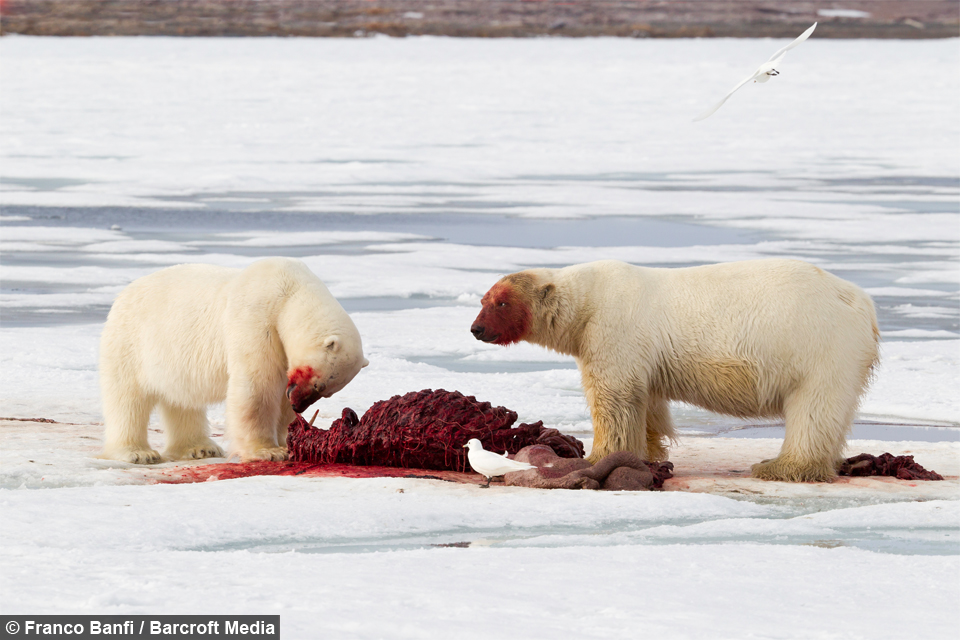
Often the success of the hunt is the resulting injuries caused to a walrus in the panic, as they attempt to escape to sea. This leaves a more vulnerable and easier target for a hungry bear to finish off. Experimenting with ever more ambitious attacks, is how nature learns. It’s why you don’t see Polar bears sitting around waiting for Mc Donalds to open a branch nearby.
Eamon.
@ur momisugly Crispin in Waterloo:
Helpful advice, no doubt. By the way, Jean-Marc Perreault, who took that photo in northern Hudson Bay in 2007, put this caption on it:
“Polar bear with cub on Walrus Island, eating Walrus killed by hunters for it’s ivory tusks”
http://www.panoramio.com/photo/4079923
Furthermore, the Hudson Bay is NOT melting earlier and freezing later. It is the exact opposite and it is totally frozen right now in April as were all the lakes in my region of NY until yesterday! This is one of the latest springs I have seen in my entire life.
Your photo was taken from the BBC clip below. In the course of three minutes the large adult male bear attacked four different walruses, failing in every attempt.
Polar bear walrus hunt
It took two years and three shoots to bag new perspectives on the obviously high-risk hunting strategies of polar bears. The effort paid off when this desperately hungry male polar bear, followed on his epic swim in search of food, was observed trying to predate fully grown adult walruses. Usually they would go after cubs, but increasingly desperate polar conditions are pushing them to ever more ambitious attacks.
Release date: 29 May 2009
http://www.bbc.co.uk/programmes/p0038xmr
Magma and CWG clearly are on the same page and they both seem to take every word from David Attenborough as the condensate of Truth; I think the splendidly dramatic background music would sway the most hesitant viewer.
Strangely enough, the BBC clip doesn’t seem to be the final word on the predilection of polar bear for walrus blubber and video abounds on youtube. The music might be not as appealing or may be totally absent in some instances.
Indeed, a lioness might lose her teeth to a well-planted zebra hoof, but lions don’t restrict their diet to critters that don’t resist.
I would speculate that Magma and CWG are the same poster, as their comments are identical, word for word.
lol. Good news for seals, then.
But good news for seals, is bad news for fish.
Etcetera.
Nice photo.
A picture of Earth’s biggest land carnivores dining in Novaya Zemlya, Russia? In the biggest outdoor nuclear bomb detonation site ever? That’s where they hide thermocalypse?
”Claim: polar bears can’t subsist on anything but seals”
Utterly ridiculous. The bears can survive quite well on the succulent corpses of Obamabalese supporters. No seals need be harmed.
Certainly I have no intention of eating any seals out. Hot huskies? Well that is an entirely different question….
Yes, yes, I’m a very bad person. But I have the advanced FEA dead man codes under butterfly wing encryption. 72 hours. I’m still smiling, what’s your issue?
Yes Anthony, I am a foul mouthed and utterly evil bastard. What of it? Black or white, right or wrong? It doesn’t matter who was “nice”, all that matters is who was right..
Was Legion right, or do you want to go with Dr. S, Willis and Dr. Brown? What? You already chose?
You chose Anthony.
You chose.
Poorly.
Hmmm…. as the pretty picture above shows, polar bears are white and seals are dark coloured. Might be a racist problem here.
Polar bear skin is black.
Slywolfe
Perfect! Yes, and their hair is hollow so they float. The idea that polar bears are struggling to swim is based on the idea that people find it hard to swim. The Latin name for ‘polar bear’ says it all.
Here is another fang through the heart of the idea that polar bears can’t eat walruses:
http://4.bp.blogspot.com/-bLBUNO5C5W4/UBFuNOECAmI/AAAAAAAAKzc/ea-AUzp-wPU/s1600/IMG_7599.jpg
Crispin, people find it hard to swim for a variety of silly reasons I believe. If a human just lays on their back in the water, even fresh water, they float. Just ask a SCUBA diver how difficult it is to descend.
Very sad!
USGS, a primarily geology and geographic science oriented agency that used to be known for quality research.
Now it employs armchair scientists that write assumptions to fit assigned titles. So very much like writing torrid romance novels without any real experience or knowledge.
“…
Although some polar bears may eat terrestrial foods, there is no evidence the behavior is widespread,”
said Dr. Karyn Rode, lead author of the study and scientist with the USGS…”
Dr. Karyn Rode displays her lack of observational skills along with her lack of analytical skill.
Polar bear are efficient and very effective omnivores; i.e. they eat what they find where they find it. Dr. Karyn Rode’s inability to understand a polar bear’s effectiveness at predation and consumer in their top of the food chain position. Polar bears may prefer consuming marine animals, but that is a terrible excuse for failing to understand that polar bears are not choosy when they are hungry or even when just partly full.
Polar bears have survived far worse ‘warm Arctic conditions’ and not only survived, but thrived.
“…“In the regions where terrestrial feeding by polar bears has been documented, polar bear body condition and survival rates have declined.”
And this part of the study involved capturing and measuring how many bears? Bears that not only represented land dwelling bears, but also included near ice dwellers and a scientifically valid control groups?
Sadly, no.
Instead, dear Dr. Rode ran her computer ice models and then surmised physical effects on summer polar bears looking for food not very long after the Arctic winter drifted into summer. Bears that were not quick enough to avoid researchers looking to drug and weigh bears.
“…Potential foods found in the terrestrial environment are dominated by high-protein, low-fat animals and vegetation. Polar bears are not physiologically suited to digest plants, …”
Polar bears are not ‘physiologically suited’ to digest plants? Polar bears have not changed much from their grizzly forebears. Polar bears may prefer meat, but their digestive tracts are still fully omnivorous. Again, polar bears have survived past Arctic ice out events.
Dr. Susan Crockford posted her review about USGS’s pitiful idea of polar bear science.
Dr. Crockford also has a post up about the current state of Arctic ice and the excellent conditions for polar bears and other Arctic marine mammals.
It seems that polar bears may have been around a lot longer than previously thought:
http://nothinginbiology.org/2012/05/09/on-molecular-genetics-and-the-origin-of-the-polar-bear/
If true they have survived much warmer, wetter, colder and drier conditions than the goldilocks climate of today.
Even if they were only 100,000 years old, so missed the hot Eemian interglacial, polar bears had no trouble surviving the long, warm Holocene optimum, with much less sea ice than now.
” A team of scientists led by the U.S. Geological Survey found that polar bears, increasingly forced on shore due to sea ice loss, may be eating terrestrial foods including berries, birds and eggs”. Maybe their concerns are a bit premature. A couple of bloggers have been raising awareness of the potential development of a new “pause” in Arctic sea ice. Looking at this graph http://arctic.atmos.uiuc.edu/cryosphere/IMAGES/seaice.anomaly.arctic.png
it would appear that we now have more or less a ten year “pause” in the decline of Arctic sea ice. So we now have an atmospheric temperature pause approaching 20 years on top of Arctic sea ice. Who knows what will happen next?
Since no polar bear has ever in recorded history been observed eating berries on an ice floe, they (the berries that aren’t on the ice floes) must not be able to sustain them. Simple logic – yes? /sarc
You forget that modern polar bears normally get their berries shipped to them via Amazon.com. (they also eat UPS drivers I hear, but no studies on that yet)
Thank goodness for drones.
What a load of claptrap. I suggest (after using my model), that Dr.Rode has never been north of the Can/US border. As pointed out above, she doesn’t even know where the biggest population is. Was she involved in that same survey years ago that said tens of thousands of caribou had died, only to find they just migrated east, like the natives said they did every now and then? And BTW, the polar bear is the largest land carnivore currently alive, and will and does track down anything moving, including man. Did she get the “Dr.” from a Cracker Jacks box?
I suspect that seal population always varies, with good years and bad.
I would expect polar bear population to also vary, sometimes in response to seal availability.
I have read nothing indicating that polar bear predation significantly impacts seal populations.
It is articles like this one that continues to inform me that most of the academics are total idiots. If all government funding was removed from education (from primary school up) then the average IQ of the nation rise dramatically.