Guest Post by Willis Eschenbach
Inspired by a random comment by Steve McIntyre over at his marvelous blog Climate Audit, I got to thinking about the ice ages. I’ve long heard that the ice ages are caused by the changes in summer insolation in the northern hemisphere. As the story goes, the Milankovitch cycles of variations in the earths orbit make it so that there is a variation in how strong the summer sun is in the northern hemisphere. When the summer sun is weaker, the ice sheets advance, and eventually the buildup of ice reflects enough solar energy to spiral us into the icebox. Then about every hundred thousand years, the sun gets stronger again, and melts away the ice, and within a few thousand years the great ice sheets melt away and we’re out of the icebox.
So of course, once I’ve had that thought, I was doomed, and so I had to take a look. I got the data, and here is the variation in average northern hemisphere insolation for the months of June, July, and August.
 Figure 1. Average insolation during the summer months (J-J-A) at 40° north latitude. DATA SOURCE: NOAA
Now, I found that surprising. I hadn’t realized the size of the swings. The cycles are about 21,000 years long and the swings are quite large, up to 100 W/m2 from trough to peak. So IF the temperature is following the forcing as the current hypothesis claims, a swing of 100 W/m2 is certainly large enough to cause a very large swing in temperatures. The current hypothesis is that at equilibrium we should see a swing of ~3°C for each additional 3.7W/m2 of forcing. However, we’re talking annual swings. Transient climate sensitivity is about 70% of equilibrium sensitivity, so I’ll use 50% to give some cushion. So according to the current thinking, a swing of an additional 100 W/m2 which is maintained for a thousand years should result in an increased annual temperature swing of about 40°C (73°F) … and we don’t see anything in the geological records even half that size.
I also didn’t realize that there is an underlying ~400,000 year cycle, which leads to the larger peaks at about 200,000 and 600,000 years before present (BP), and also leads to the very, very small peak at about 400,000 years BP.
But obviously we don’t see such a swing in geological temperatures. In fact, we don’t see anything even near that. So, scratching my head, I went and got the longest temperature record we have. This is the record from the ice cores at the EPICA dome in Antarctica. Figure 2 shows that record:
 Figure 2. Antarctic temperature variations estimated from deuterium data. DATA SOURCE: NOAA
Here, we can see the ~ 100,000 year cyclical nature of the emergence from the ice ages. The swing is generally on the order of about 12°C, and the usual estimate is that because the poles swing more than the tropics, the global swing is half the Antarctic swing, or about 6°C. We can also see that the current interglacial period, the “Holocene”, has lasted quite a while compared to the other interglacials.
Note also the very large and roughly symmetrical peak at about 400,000 years.
So … how does this relate to the Milankovitch cycles? Figure 3 shows the temperature overlaid over the Milankovitch cycles.
 Figure 3. Antarctic temperature variations estimated from deuterium data, overlaid on the Milankovitch insolation cycles.
I gotta say I’m just not seeing it. The biggest oddity is that around 400,000 years, the very small insolation peak is correlated with a very large temperature peak. In addition, in general there seems to be very little correlation between the swings in insolation and the swings in temperature. Finally, the most interesting thing is the total lack of any 21,000 year cycle in the temperature.
Now, some authorities say that the crucial factor is not the insolation at 40°N, but the insolation at 60°N. So I checked that … but the difference in the pattern is only trivial. It mainly just affects the size of the swings, which are somewhat smaller at 60°N, but the pattern of large and small swings is essentially unchanged.
Now as might be imagined, I’m not the first one to be puzzled by this. It’s widespread enough that there’s a Wikipedia page entitled “The 100,000-year problem”, which points out that:
The 100,000 year problem is a discrepancy between past temperatures and the amount of incoming solar radiation, or insolation. The latter rises and falls according to the strength of radiation given off by the sun, the distance from the earth to the sun, and the tilt of the Earth’s axis of rotation. However, the recent change between glacial and inter-glacial states that occurs on a circa 100,000 year (100 ka) timescale, does not correlate well with these factors.
Due to variations in the Earth’s orbit, the amount of insolation varies with periods of around 21,000, 40,000, 100,000, and 400,000 years. Variations in the amount of incident solar energy drive changes in the climate of the Earth, and are recognised as a key factor in the timing of initiation and termination of glaciations. Isotope analysis shows the dominant periodicity of the climate response to be around 100,000 years, but the orbital forcing at this period is small.
However, my perplexity seems to be for a different reason than the other folks discussing this, which is that the really large insolation swings occur on a 21,000 year cycle, and there’s no trace of that in the EPICA data. I’m not so much interested in the existence of the 100,000-year cycles in the temperatures, as I am by the lack of any temperature response to the ~100 W/m2 swing in the insolation. Yes, I know that overall for the globe as a whole the swing is small because the hemispheric changes oppose each other, but for each hemisphere the changes are very large. Why do we see no trace of those very large swings?
Anyhow, all comments welcome.
Best wishes to all. It’s one AM, there was a new moon earlier tonight, I’m going outside for some stargazing, and I wish the same level of joy and awe to all of you.
w.
As is my custom, I ask that if you disagree with someone, please QUOTE THE EXACT WORDS YOU DISAGREE WITH so that we can all understand the exact nature of your objection.
AAAAHHHHH,
Willis , please it is Friday, I prefer a story about some of your travels with the beautiful “Ex-Fiancee” thanks.
Tom in Florida
January 23, 2015 at 8:12 pm
Forgot to mention obliquity with also has to be at maximum. So max obliquity, low eccentricity, NH summer solstice at perihelion. All three must come together, not just two. Happens roughly ever 100K years. Lasts until obliquity lowers to 23 degrees, summer solstice moves away from perihelion and eccentricity rises.
Reply The problem is the glacial /inter-glacial cycles were not 100k until very recently (the last 800000 years) prior to this glacial/inter-glacial cycles seem to correspond to obliquity.
In addition the globe as a whole tends to cool or warm, in other words the N.H. and S.H. are in sync.
The underlying issue is about this interglacial and how it compares to the most recent ones. If the cycles of the last 800,000 years continue as they have need not concern ourselves with what happened prior to that. Now I am sure someone will want to address what would happen if these current cycles change. If they do, there is nothing we can do about it. The same goes for any major changes in solar output. We cannot influence that so there is no need to worry about it.
…… I just had an interesting thought while composing this reply. The evolution of humans began in earnest around the time of the current time periods of glacial – interglacial changes. I wonder if there is a connection.
There seems to be more of an issue with the “standard” approaches to comparing correlations. Precessional is the big dog but 65N is pretty limited for the general “climate” thing. Ocean insolation is the ticket.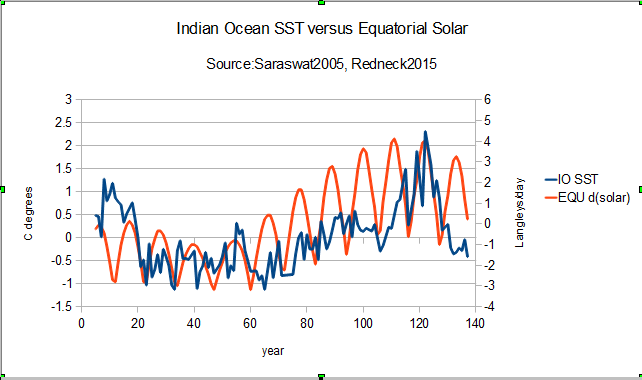
That is about a 50% correlation between equatorial solar variation and Indian Ocean SST as reconstructed by Sasaswat et al. Try using all the latitude bands and compare to your favorite reconstruction. I use Peak insulation not average, because that is the way I think is best.
Thanks, Cap’n. I gotta say, I greatly dislike graphs without links to the data. Your data claims a variation of about 3 langleys/day in 15 years, which is about 1.5 W/m2 variation. Where on earth does that large, rapid change come from?
I also distrust claims about SST without error bars or provenance …
w.
Well Willis, I guess you will just have to blow it off, but saraswat 2005 is just a google away and the equatorial solar would require a visit to my blog to get all the details.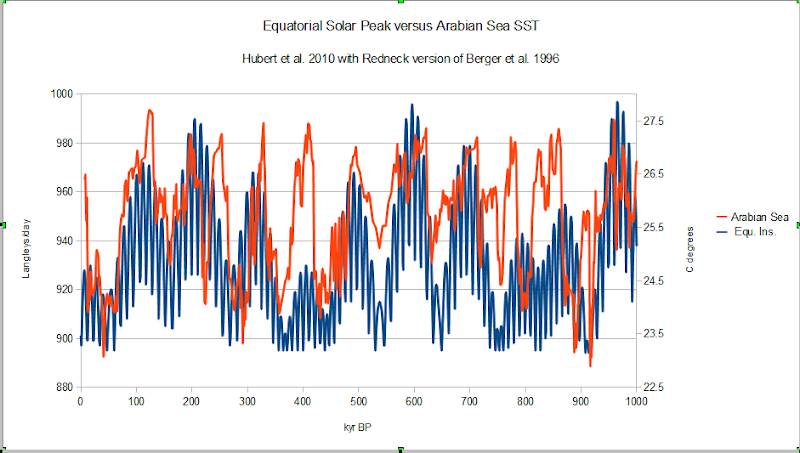
http://redneckphysics.blogspot.com/2015/01/the-solar-precessional-cycle-and-ocean.html
Try this, Herbert 2010 Arabian Sea would likely be at NCDC paleo and Berger et al 1996 should sound familiar. Now remember that ocean core paleo has some issues with dating, they can be off by a few thousand years. However, if you compare the correlation of tropical solar forcing variation with any quality paleo reconstruction of “Global” or tropical temperatures you have a fair correlation. Compare 65N insolation and you have not as good of a correlation. The oceans would appear to be doing the wagging.
captdallas2 0.8 +/- 0.2 January 24, 2015 at 2:21 pm
Sorry, Cap’n, but I’m not going to “try this”.
I don’t go on a snipe hunt for any man. Here’s why. Far too often in the past I used to try looking for what I thought someone was talking about. So I go, and I think I found it … but after sometimes hours of looking and finding and analyzing what they were referring to, I bring my results back, and the person says “Oh, no, that’s not what I was talking about all”, often accompanied by unfavorable comments on my intelligence and my antecedents.
So I gave it up. If you want me to look at something, then give me a link. And in this case, you’re right … I will just “blow it off”. If you can’t be bothered to properly cite your own graph and link to your own data, I can’t be bothered to discuss it.
w.
Willis, “I also distrust claims about SST without error bars or provenance …”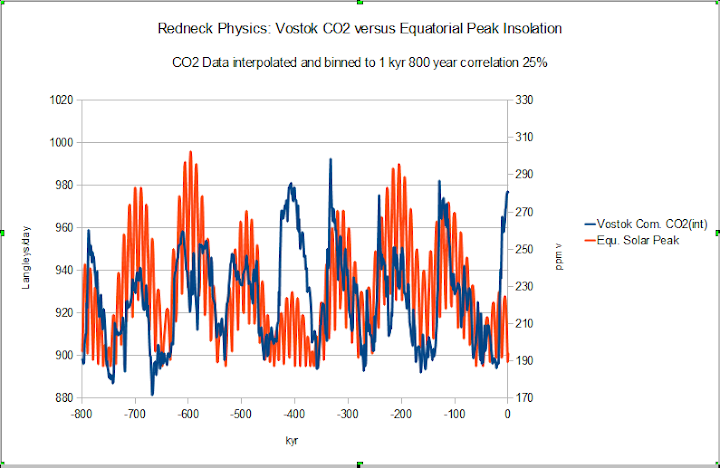
I can see that. Personally I would rather not see error bars than erroneous error bars.
“If you can’t be bothered to properly cite your own graph and link to your own data”
Since the chart is my own, I didn’t cite myself, that would be the reason that the quickly produced chart has an error in the “year” which should be kyear. The Saraswat et al, Indian ocean sst reconstruction is about 130 thousand years long. I do apologize for attempting to steer you in a different direction with regard to comparing Milankovitch Cycle insolation change to similar time frame climate reconstructions.
This also completely inadequately cited chart that I composed compares the Vostok Composite CO2 reconstruction to Equatorial solar variation estimated by Berger.
For the 800 ka length there is only a 25% correlation between the two, but for 800,000 years of “modeled” versus “reconstructed” data, that ain’t bad . If you compare this with the Herbert 2010 chart I posted earlier there is a fairly large “distraction” at ~400ka. Other than that I can find no reason for your statement, “I’m not so much interested in the existence of the 100,000-year cycles in the temperatures, as I am by the lack of any temperature response to the ~100 W/m2 swing in the insolation.”
Since the Solar Precessional data seems to agree fairly well with both temperature reconstruction and CO2 reconstructions, I found it a touch odd. The prompted my suggestion that perhaps you might want to look at the data from a more productive perspective.
Thank you Willis.
A very good post of yours, and especially when referring also to Steve McIntyre marvelous blog Climate Audit which seems to be a very good and significant challenge to the M. cycles hypothesis as an explanation of the glacial periods or put another way, the cause of a 100K year runaway cooling.
I have read most of the comments in this blog of yours, and as been one that is not convinced at all about the above explanation for the glacial periods, I will try to expand a little bit further my point of doubt, in hope that if I am not wrong, there will probably be some little more help in these kind of matter.
To start with, I have to say that in it’s bulk that hypothesis has merit and it is a “beautiful” one to start with, but that does not make it necessary by default as a highly probable or unquestionable one. It has to stand to the test of time and be proven and supported by the facts and evidence as the time passes, so to speak.
And as far as I can tell there is where it fails.
The evidence amounting against it out weights what supposes to support it.
At the time this theory was born, if I am not wrong (please some one correct me if that the case), it was considered as an explanation for the climate change mechanism, meaning that the M. cycles was the main force of climate change.
Even these days, from many, that is still considered as such, as shown in many comments in this blog.
But as far as I can tell, according to the latest day climatology, the M. cycles are not considered any more as the main climate changing force or mechanism.
Actually if looking carefully it can be seen that actually it is considered as only partially responsible for climate change, only for the cooling of climate, due to the triggering of ice built-up which leads to a long period of runaway climatic cooling……..a 100K years long period.
In climatology it is clearly explained that the warming, the abrupt one is not due to the M. cycles, as that warming caused by the warming oceans (regardless of what the unknown mechanism related to).
That is not a theory….it is based on evidence and facts from paleo climate data that the triggering of the end of the last glaciation periods was due to the warming of the oceans.
The warming started first, because of the warming of oceans, and then the Ice started to melt away, the contrary of as it should have been in the case of M. cycles impact or influence.
At this point is where the “marriage” of M. cycles and the Greenhouse effect (CO2 forcing ) is made.
The warming that triggers the end of the Ice Age (the last glacial period) is shown to be amplified from the greenhouse effect (increase of CO2 emissions) to a point that it gets climate out of the Ice Age and towards a further warming to the point of Holocene Maximum.
So according to climatology, the “abrupt” warming that ends the Ice Age and continues to the top of Holocene maximum is due to other causes than M. cycles.
That is how in modern time climatology the furore of AGW starts.
While the naturally slow emission of CO2 (the amplifying of warming) could not lead or cause a runway global warming, the anthropogenic rapid emissions of CO2 (the cause of warming) could very well do that.
So as in the case of M. cycles, where the build up of ice causes and leads to runway global cooling, the melting of ice due to anthropogenic forcing could very well lead to runaway global warming, as climate shown to be subject to it as in the case of runaway global cooling due to M. cycles.
Problem with that is that climate fails to cooperate at that point.
It clearly shows that is no subject to it, to a runaway global warming.
Most probably same holds true in the case of M. cycles.
Before going any further with evidence against the M. cycles as a cause of glacial periods, lets see what actually supports it.
The only one thing that supports it, as far as I can tell, is the interpretation of the ice core data.
Only one possible interpretation, not every possible interpretation.
Now from my point of view that interpretation suffers from what may be called a circular reasoning.
The supposed build up of ice through and during the 100K years of the supposed glacial period (the Ice Age) is estimated in the bases of temp ice core records explained due to the M. cycles.
So the temp records through the M. cycles theory establish the pattern of ice build up that than supports back the theory of M. cycles as a cause of such a pattern of build up, because the build up must be that way as the climate (globally) supposed to be cooling due to M. cycles triggering the cooling.
To put it another way…..the polar regions temp pattern is considered as exactly the global temp pattern as explained trough the M. cycles theory and therefor the same pattern of the ice build up is considered, which at that point is used to support and prove the M. cycles cooling impact.
So an ice build up estimation (the glacial period) is achieved due to that theory and than that same ice build up is used to prove that theory….funny is it not !
Further more it gets to a point that build up of ice (the glacial period) is indirectly measured in degrees C or degrees F of polar regions and not as actual measurements of weight, mass, volume or surface expansion, or any other indirect means, as far as I can tell. (If I am wrong at this, please some one correct me).
So apart from this and the “beauty” of the theory there is no much else to support the M.cycles as a cause or the triggering of glacial periods.
The main problem of that theory starts at the point that it claims and stands in a particular explanation.
The growth building up of ice causes or leads to cooling, not the other way around.
That is why the abrupt warming (that ends the Ice Age) has nothing to do with that theory, as that warming presides the melting of the ice and leads or actually causes it.
Further more, which is a much stronger case against the cooling due to M.cycles, is the climatic pattern through the Interglacial.
There is clearly shown significant climatic changes that have nothing to do or could be explained by that theory, but in contrary contradict it.
The two main ones are the Transient climatic periods that happen during the climatic trend change in climate. There is two significant trends observed during the last 18K years, that of warming (A 10K years long) starting at the very triggering of the Ice Age termination up to the very triggering of Holocene optimum termination,…..and there also is the ~ 7K years cooling trend from the very top of Holocene optimum to present. In both cases nothing to do with M. cycles.
Also there is other significant transient climatic periods (anomalies), like LIA or Y.D etc. that also have nothing to do with M.cycles.
The problem with many is the assumption of considering the Interglacial as a warm period, contrary of what it is, a warming and a cooling period. So far the Interglacial is a period of ~7K years warming followed by ~7K years of cooling.
In the mid of it, yes there is a warm period, the Holocene optimum, the end of which is triggered and the start of the cooling also by other means or causes than M. cycles.
So there is climate clearly showing a significant global cooling starting before the build up of ice which very possibly in continuation will lead and cause ice growth. No connection there to be found with M.cycles, but actually the contrary.
So whatever has being cooling for the last ~7K years the climate in continuation will cause it to enter an “Ice Age”.
As this has already come to a very long comment, I will simply leave it at this point by saying…yes the theory argued is in essential rational, intelligent and rational (beautiful, so to say), but when it comes to validate it and prove it as a correct one, there is not such thing as rational, but in contrary only paradoxes and contradictions with reality keep surfacing, same way as in the case of AGW.
That M. theory, as far as I can tell, creates more problems than solving any in regard to our better further understanding of climate and climate change.
Anyway, anyone that finds errors or faults with my above comment, as there probably could be many faults and errors,………. please do correct me……looking forward to better my understanding in this matter………..and also with my English too..
cheers
James Croll, a Scottish “scientist” – who started off as a janitor – wrote a theory about ice ages and orbit changes in 1875.
http://en.wikipedia.org/wiki/James_Croll
Decent discussion of the history of this here.
http://www.aip.org/history/climate/cycles.htm
Lots of discussion as to why the main cycle found appears to be 100 000 when this is associated with smaller calculated changes than other cycles such as 21 000
whiten says below and I am with you are several fronts, but questions remain.
My reply and questions
Question one what started the oceans to warm in the first place and hence the climate to change?
Question two which ties into question one is one would think with all other things being equal that a significant ice build up such as what occurred with the YD or any other major glaciation would feed upon itself due to the positive feedback of more ice/snow cover a higher albedo, colder temperatures but this does not happen since all glaciations come to an end sooner or later.
My candidates to explain the question I presented are
Internal solar variations with associated primary /secondary effects.
Earth Magnetic Field Changes such as excursions.
Random terrestrial or extra terrestrial events but the problem I see with this even though I listed it is there are to many abrupt climatic changes for that factor to be the reason.
Initial State of Climate- when it is near the threshold of glacial/inter-glacial conditions but then the question is what brought the climate to that threshold in the first place.
My conclusion thus far is I think it is a combination of all that is being discussed that somehow results in given forcing having a general influence on the climate but because the climate system is non linear ,random and chaotic and constantly in a different Initial State that given forcing is not going to result in a given climate result and thus allows counter trends to occur within a broad underlying trend.
In summary I think nothing can be eliminated when it comes to why the climate does what it does , rather I think every item that is being discussed has some role to one degree or another. Even Milankovitch Cycles despite short comings.
Below are some of Whiten’s commentary
The growth building up of ice causes or leads to cooling, not the other way around.
That is why the abrupt warming (that ends the Ice Age) has nothing to do with that theory, as that warming presides the melting of the ice and leads or actually causes it
In climatology it is clearly explained that the warming, the abrupt one is not due to the M. cycles, as that warming caused by the warming oceans (regardless of what the unknown mechanism related to).
That is not a theory….it is based on evidence and facts from paleo climate data that the triggering of the end of the last glaciation periods was due to the warming of the oceans.
The warming started first, because of the warming of oceans, and then the Ice started to melt away.
Hello Salvatore.
First thank you for your reply. Appreciated.
Now, in answering your first question:
The warming of the Oceans was served as it is considered by climatology, an evidence not a hypothesis.
There could be many ways to try and come with what could have being the reason for it, but as far as I can tell the way it stands is possible to be whatever a reason but not the M. cycles effect.
Lack of having a proper explanation for such as, does not necessary mean that it should (or must) be explained somehow by the M.cycles effect.
I could give you one reason I may think of but that will get us out of the subject, and will be far longer and tiresome, most probably wrong too.
The main point is that a better understanding of climate will help a lot with that, and the inability to think out of M. Cycles box makes it even much more harder than supposes to be.
If 100K years of the glacial periods length happens to be a figment of a “scientific” imagination only then it will be very hard to understand why and how climate changes.
As per the Question two:
Simple, no matter what, I do not think you seriously are saying that Y.D was caused or triggered by M. cycles.
Then, influence is another thing. I my self, still do not doubt of a potential influence of M. cycles, but the degree of it I consider it to be of very little significance to climate change. As I have mention it before on my previous comments, it could be only significantly enough in regional impact, that of polar regions by defining their extremity in respect to the climatic period, which is completely independent of M. cycles effect.
The orbital forcing is an “inherited” planetary process expected to influence the earth system , but is also feasible enough to think of the atmosphere, another such a planetary process, as able enough through its existence and evolution to have become resilient enough to absorb and stabilize such an effect to the min possible.
Any way in the end my point in the comment you replied to is simple:
In the last 400 K years there is not even a single climatic event that could be explained by the M. cycles, but in contrary there is many significant ones that could be explained any other way but not through the M. cycles effect.
So if you say that M. cycles effect has amplified some of the glacial periods, or even most of them, but actually not triggering them, I will not complain..:-). But that will be another different story and theory than the one argued here.:-)
In my opinion that theory, which seems to be the main climatic explanation of the longer periods during the last 400K years, is the one that seems pretty much a potent candidate to be eliminated from the very short list of one(s) with a significant effect in climate.
Some time progress and evolution comes through elimination of what not useful anymore.
Please do find me one single significant climatic event that can be explained as triggered or caused by M. Cycles effect. 🙂
It shouldn’t be hard, I guess..:-)
cheers
For question one, might the answer be that the lowered surface area of the oceans produced fewer clouds and more of the sun’s energy entered the ocean?
==============
In reverse at times of accelerated warming like the Paleocene /Eocene thermal maximum again why did not an increase in CO2 /warmer temperatures create a positive feedback that would go on for eternity?
In conclusion there is something that is always bringing the climate back to it’s mean state no matter how far the climate may drift away from that mean state.
The question is what are the reasons?
.
@ur momisugly brokenyogi
January 24, 2015 at 6:50 am
“There was some interbreeding with Neanderthals and Devonians, but over time all rival sub-species were wiped out”..
My great aunt was a Devonian – she came from Torquay, and spoke with that wonderful, slow, drawling West-country accent. And there was definitely considerable interbreeding with other members of the human race.
But perhaps you meant Denisovans?
With regards,
LK
A change of 40C is 40*1.8 or 72F. This is minor but over an analysis this can be significant.
The analysis does not seem very surprising.
Exactly.
Willis says
I gotta say I’m just not seeing it. The biggest oddity is that around 400,000 years, the very small insolation peak is correlated with a very large temperature peak. In addition, in general there seems to be very little correlation between the swings in insolation and the swings in temperature. Finally, the most interesting thing is the total lack of any 21,000 year cycle in the temperature.
Enjoyed the post. I gotta say nonlinear, multivariate and somewhat chaotic in nature with M cycles playing a role as an answer to your comment above. And I know these echo some of the comments above. Sorry no qotation marks as I have yet to find them on this new android.
Willis
Just a suggestion. Plot insolation at the summer solstice at the tropic of cancer (which moves from 21.4 to 24.5 degrees north) against the eccentricity cycle. You also have to include the fact that because of precession of the equinox the date of the Earth’s aphelion shifts quite rapidly, on the 21,000 year cycle. Today the Earth is at aphelion early in July, I think around the second or third. In 11,000 years that reverses and we will be near perihelion then. (northern hemisphere)
Help,
I do like, using a favorite saying of mine, to go have a little ‘look see’. i.e. download the data and play around in a spreadsheet. I’ve done that with the data outlined in the article. Added June, July and August. Dived by 3 for an average. Multiplied by 0.4843 (as per instructions in the read-me) to convert to w-2.
Trouble is – I come out with a graph that looks like yours but has and average insolation of 484 whilst yours is about 590 w-2. My peak figure is 537 m-2 whilst yours is about the 650 mark.
What idiocy am I perpetrating?
Help!
Derek