It was a tenth of that, 100,000 tons, that caused the Lake Nyos disaster

Guest essay by Eric Worrall
7000 ft below the city of Decatur, Illinois, population 74,710 people, is a high pressure reservoir which contains 1 million tons of CO2.
From the press release:
One of the largest carbon sequestration projects in the U.S., the Illinois Basin – Decatur Project (IBDP) has reached its goal of capturing 1 million metric tons of carbon dioxide and injecting it deep underground in the Mount Simon Sandstone formation beneath Decatur, Illinois. The project is designed to demonstrate the feasibility of carbon capture and storage. IBDP director Robert Finley talked about the million-ton milestone with News Bureau physical sciences editor Liz Ahlberg. Finley is director of the Advanced Energy Technology Institute at the Illinois State Geological Survey, part of the Prairie Research Institute at the University of Illinois.
The reservoir has been created to demonstrate the viability of carbon sequestration – capturing large quantities on carbon, to prevent the CO2 from being emitted into the atmosphere.
The University of Illinois scientists responsible for this demonstration project assure us that the reservoir does not pose a safety threat. According to a University of Illinois press release;
“Extensive monitoring takes place during and after injection to be sure the stored CO2 stays in place. Monitoring techniques include using geophysical technology to confirm the position of the CO2 underground and wells to monitor groundwater and soils.
No out-of-bounds health, safety or environmental risks were observed from this properly designed and managed storage site. Appropriate risk mitigation and management plans were an integral part of the overall project planning. Extensive monitoring took place before, during and now after the injection to be sure the CO2 stays in place. The first line of monitoring begins deep below the ground, so we know if any leakage occurs long before any CO2 might reach the surface.”
They’re probably right – when you create a demonstration project, a showpiece for what you hope will become a lucrative business, you want to make sure nothing goes wrong. I’m sure that elaborate precautions have been taken to prevent any possibility of adverse news, in the hope that this reservoir will be the first of many.
However, as the scientists responsible for the project admit, a serious carbon sequestration effort will need to store a lot more than a million tons of CO2. “… One million tons is scalable in its behavior to the 3 million tons that would be emitted annually from a typical medium-sized, coal-fired power plant. …”
If just one of those proposed sequestration projects suffers a major containment breach, say if an earthquake cracks the geological structure, or if a mistake or greed leads to the reservoir being overloaded, the result could be a disaster.
In Africa, in 1986, an abrupt release of an estimated 100,000 – 300,000 tons of CO2 killed 2,500 people up to 25km (15.5 miles) from the source of the release.
http://en.wikipedia.org/wiki/Lake_Nyos#1986_disaster
A similar release near a major city would kill a sizeable fraction of the city’s population. The region of devestation was comparable to the loss of life which would be caused by a large nuclear explosion – the only reason a lot more people didn’t die, was Lake Nyos is a sparsely inhabited rural region.
The Lake Nyos CO2 release was so deadly, because CO2 is heavier than air – when the huge CO2 cloud boiled out of lake Nyos, it hugged the ground, displacing all breathable air to an elevation 10s of ft above ground level, suffocating almost everyone in its path.
Its not just people and animals which would be affected – car engines would also stall, as the blanket of CO2 choked off the supply of oxygen.
If carbon sequestration becomes commonplace, sooner or later someone will get greedy and careless, and will be careless in their choice of geological reservoir, and / or will overload their geological reservoir to boost their bottom line. And that carelessness will, in my opinion, almost inevitably lead to a catastrophic loss of life.
Why would anyone in their right mind want to store all that Oxygen below ground when we need O2 to breathe?
if it were molecular O2 stored cryogenically underground, it would be quite dangerous.
Fascinating how people could agree to such storage of an inherently volatile and in large quantities deadly material underground where they have major problems with the same kind of storage for nuclear waste even if it is turned into non-volatile, insoluble matter in safe containers.
I wish I’d be able to see in what state even this particular storage will be in a hundred years.
Didn’t nature long ago figure out a way to “sequester” CO2? I believe it is called biochemistry. Plants dine on it, as do cold ocean waters absorb it. When the planet warms up, the oceans also warm, releasing CO2 for the plants who like warm weather also. By some amazing stroke of luck, it works.
And Decatur has a big lake almost right in the middle of town, too. But it’s a lot flatter there than it is at Lake Nyos, so the released CO2 should dissipate faster. Pray that it’s windy on the day of the big ‘quake!
http://www.sealevel.info/decatur.jpg
“Pray that it’s windy on the day of the big ‘quake!”
Yea fine, unless you live downwind.
This article makes the case against any underground injection project, enhanced oil recover using CO2, fracking and leaving methane underground because it is high pressure. Seems to be a bit of fear mongering. No mention of the high pressure pipeline getting it there, which could rupture.
What about the costs, energy requirements and other technical merits?
I cant see how you get that from the article.
The problem with CO2 is that it is heavier than air so if it escapes it will displace all the oxygen at ground level and thus suffocate anybody in the area. It will, of course, dissipate over time so people can come back and bury the dead.
Gases that are lighter than air (such as methane) do not pose the same risk as they will dissipate vertically instead of horizontally.
Using CO2 to extract oil doesn’t leave vast quantities of CO2 at high pressure underground.
I’m well aware of gas MW and density. The lateral spread is going to depend on a number of factors. I doubt either methane or CO2 will be dispersed through an orifice. Tell me how close you’d like to be to a methane release.
Also, EOR projects can go with higher pressures (2,400 psi) and injection rates around a billion cubic feet per day, depending on the volume of oil recovered. I’d guess it isn’t all at atmospheric pressure underground. What if some of the 3,500 miles of 1,400 psi CO2 pipeline in Texas were to rupture?
The CO2 might be injected at high pressure for EOR, but it mostly comes back out with the oil. CO2 is used because it mixes with the oil and lowers its viscosity.
As for the pipeline rupturing, the largest pipe in the network is the 30 inch Cortez Pipeline which was completed in 1983. A mile of this pipeline at 1400psi will only contain about 600 tonnes of CO2. What sort of accident would it take for a whole mile of pipeline to discharge its contents without any of the safety features cutting in?
Given the age of the pipeline (some of was built in the 1970s) and the length I doubt if it hasn’t been ruptured at some point in the past.
Finally, an actual example of a mesoscale CO2 environmental threat, created by mankind.
New terror target. Loading up the nation with WMDs just waiting to be set off by anyone with a well placed truck-bomb.
If you ever try to explain on an eco web-site that CO2 is not dangerous snarkers will chime in: “Oh yeah? Let’s put you in a room full of CO2 then.” Now I can just say: “You mean like if a carbon sequestration site loses containment?”
The advantage is that we now have the next generation of oil reservoirs. Add water and energy and out comes oil. What is there not to like?
Sure, until it is turned into oil one lives near a poison pit but once it is oil it will provide jobs and energy again. What do certain groups call that again: renewable energy.
CO2 sequestration underground and under pressure is brought to you by those fine folks who oppose fracking.
Just bringing natural gas to the surface in many fields presents similar hazards. In Wyoming some very productive fields have a lot of H2S, but this is captured and becomes a separate co-product (sulfur) with a concurrent economic incentive to prevent leaks. With regard to sequestration, the CO2 might eventually combine with reservoir materials into some form in which a catastrophic release is not possible, but nonetheless, in addition to the suffocation hazard associated with CO2, one puts work (P-V work) into the sequestration that might equal several Hiroshima bombs. Also, the troublesome releases of CO2 are likely to occur suddenly so that there isn’t much advance warning of trouble, independently of monitoring, or not enough advance warning for any useful mitigation.
Using old natural gas reservoirs for sequestration has the safety advantage that these reservoirs are mechanically stable most likely or gas wouldn’t have accumulated in them and remained for a long time. But the list of things that can go wrong is pretty long, and I’m surprised, in a way, that these demonstration projects aren’t confined to the relatively unpopulated areas of the West. On the other hand, I’m not surprised at the location, because everyone wanted some of this Federal pork. It presents an incentive to do occasionally destructive things.
Cryoseisms are confined above the frost depth.
Why are we holding CO2 hostage? It reminds me of my neighbor who scolded me when I was empty water jugs on the lawn after a camping trip. You shouldn’t waste water, they said. I am not wasting it, I am putting it back into use, was my reply.
We aren’t going to make it. We are smart enough to destroy ourselves and to stupid not to.
if an earthquake cracks the geological structure, or if a mistake or greed leads to the reservoir being overloaded, the result could be a disaster.
It is not a matter of ‘if’, it is a matter of ‘when’.
Only 210 miles to Cairo, IL, which just happens to be the top of the New Madrid Earthquake fault line.
The Illinois State Geological Survey has this to say about that.
In the following 5 weeks, 602 aftershocks were felt in Louisville, an average of 1 shake every 1½ hours with 6 of these estimated with magnitudes in the 6s. The second New Madrid fault released in the mid 7s magnitude on January 23, 1812 with 300 aftershocks in the following 2 weeks and the third New Madrid fault released the greatest amount of energy on February 7, 1812 with 970 aftershocks the following 6 weeks.
Researchers find evidence that major earthquakes occurred on the New Madrid faults not only 200 years ago, but also about 550, 1100 and 1700 years ago and there is some evidence for an even older event 2600 years ago. Historic damaging (low- to mid-6 magnitude) events have also occurred in the New Madrid seismic zone (NMSZ) in 1843 at the southern end and 1895 at the northern end just west of Cairo. There are about 100 to 200 earthquakes per year in the NMSZ that are mostly only detected by seismographic recording stations in the area.
https://www.isgs.illinois.edu/1811-1812-new-madrid-earthquakes
But I am sure they have and AP for that now.
We will all die not from too much C02 but for the lack of it.
It is a real possibility that happened on Mars.
Let’s hypothesize for a moment.
Say Mars was once covered in forests and oceans teaming with oxygen producing plankton.
Unlike Earth, Mars being smaller lost its carbon recycling tectonic plate movement.
Volcanos died out and no more life giving C02 reentered the atmosphere.
At some point there was not enough C02 to support plant life.
In addition the lack of tectonic plate movement and the declining magnetic field the atmosphere was stripped away from the planet.
The lighter gases first then finally the heavy C02 was all that remained.
Just a fraction of what it had once been.
Agriculture cannot be sustained under 200 ppm C02.
The Earth had at one time 75 percent C02 now just .0004 percent.
It is amazing that’s plants are living with this tiny amount.
Someday in the future C02 will be a precious commodity.
Sequestering C02 is just plain stupid.
But what do you expect from a bunch of left wing idiots, oh I mean intellectuals.
400 ppm = 0.000400 = 0.04%
Right. Or four cents out of a hundred bucks. (correct me if I’m wrong)
This article is alarmist and full of incorrect statements. First, the incident at Lake Nyos was due to an inversion which can only occur in a water body. An inversion cannot occur within a geologic formation.
Second, once CO2 is injected into a suitable geologic formation, it is VERY difficult to get it back out. The CO2 becomes physically and chemically trapped.
Third, EPA has a robust Underground Injection Control (UIC) permitting process for geologic sequestration demonstrations such as the one in IL and for future large-scale (i.e., 3 million tons/year) projects. Part of the criteria for obtaining a federal UIC permit for CO2 injection into permanent storage requires a complete and very robust evaluation of the geology, including potential seismic activity.
Fourth, very little anthropogenic CO2 is used for enhanced oil recovery at this time. Most EOR operators use naturally-occurring CO2. In EOR, the CO2 is injected into an oil-bearing formation that can no longer produce oil due to decreased pressure. The CO2 mixes with the oil and allows the oil to be pumped to the surface. About 50% of the CO2 injected becomes trapped in the formation and the remainder is stripped from the oil and reinjected. While anthropogenic CO2 could certainly be used, the price of anthropogenic CO2, current and pending regulations and pipeline infrastructure make this beneficial reuse a challenge.
Fifth, why are such projects occurring? Based on the mainstream science used to support current climate policies, the CO2 emitted from anthropogenic sources – combustion of fossil fuels (coal, natural gas, oil) used to generate electricity and power transportation – needs to be reduced significantly to mitigate or minimize future adverse impacts. Capturing the CO2 before it is emitted to the atmosphere and store it in geologic formations or use in a beneficial use requires carbon capture, utilization and storage (CCS or CCUS). CCS at this scale has neither been adequately demonstrated nor is it economic feasible. As renewable energy cannot replace fossil-fuel power generation on a one-to-one MWh-basis, CCS is the only potential technology on the horizon that will allow the continued use of fossil fuels to power our life in the USA as well as the rest of the world. These large-scale projects are critical to enhance our understanding of the technology. Please see the websites for the Edison Electric Institute, the Department of Energy or EPA for factual information on CCS.
1 question you must honestly answer: Would you want you and your family living on top of a large CCS project?
Fine with me! The criteria for obtaining a permit to inject CO2 for permanent storage is more stringent than a permit to inject hazardous substances, in terms of monitoring and well construction. CO2 is neither explosive nor flammable and due to the physical trapping of the CO2 within the formation, no large quantities of CO2 will be released.
Bhopal comes to mind. As there is of course surface CO2 pumping, storage, and injection machinery. What could go wrong?
In the aftermath, at the oversight hearings, the phrase, “At this point, what difference does it make?” also comes to mind.
stringent criteria for a permit… another layer of government control, bureaucracy, and costs.
For a highly questionable utility, or cost-benefit. The benefit side is only based on one still questionable assumption, that is, anthropogenic CO2 release has a high enough harm to outweigh the huge costs of CCS.
No doubt the CCS cost (aside from a release) can be engineered and calculated, and driven down with scale and new tech.
Have you seen the initial OCO-2 data? Compare that to what NASA simulations thought the picture would be.
That should challenge all prior assumptions on anthropogenic CO2 relevance in the global carbon cycle.
OCO-2 data has the real potential to do to anthropogenic CO2 climate change theory, what the telescope did for a geocentric solar system theory. Or what the microscope in the hands of Pasteur and Koch did for miasma disease theory.
I’d live there with family no problem.
It is not easy to leak CO2 from deep underground fast, gas fields usually have fair amount of CO2 naturally. Sequestering might be an inefficient and useless exercise, though.
“Fourth, very little anthropogenic CO2 is used for enhanced oil recovery at this time. Most EOR operators use naturally-occurring CO2.”
Dr Obenshein, where do “most” of the EOR folks get the “naturally-occurring CO2”? How do they segregate it from the anthropogenically-produced CO2?
Dr Obenshein – Dr Bob answered my question below.
RE, just to add to Dr. Bob’s response. There are several sources of naturally-occurring CO2 in the USA. One of the largest is the Jackson Dome in MS. Some EOR operators do use CO2 from natural gas processing units – the CO2 is stripped from the natural gas as part of the cleanup process. The CO2 is usually released to the atmosphere but in some cases, the CO2 is captured and sent to an oil field that is using CO2. The CO2 pipeline would co-mingle the anthropogenic CO2 with the naturally-occurring CO2 and it would be very difficult to tell the difference. The anthro CO2 has to be cleaned up to meet the same pipeline specifications as the naturally-occurring CO2 (i.e., certain % of water, H2S, etc.).
“Based on the mainstream science used to support current climate policies, the CO2 emitted from anthropogenic sources … needs to be reduced significantly to mitigate or minimize future adverse impacts.”
BWAHAHAHA! Good one! A real knee-slapper!
Wait, you’re serious?
Gary, I work for the Edison Electric Institute, the trade association of the investor-owned electric utilities. Debating the climate science is not in our wheelhouse. We are busy advocating for supportive, reasonable and achievable policies and regulations that impact our member companies.
kobenshein:
“Debating the climate science is not in our wheelhouse. We are busy advocating for supportive, reasonable and achievable policies and regulations that impact our member companies.”
————————
I understand. You are only following orders.
kobenshain
January 14, 2015 at 11:07 am
I understand — certainly priests over the ages have worked unquestioningly and diligently over how many angels can dance on a pinhead.
“We are busy advocating for supportive, reasonable and achievable policies and regulations…”
Which pretty much leaves out CCS, doesn’t it?
Dr. Karen Obenshain,
Myself, I do not need any website to teach me the absurd impracticality of CCS, thank you.
Is it not obvious?
While I agree that this article is unjustified alarmism I don’t agree with your 5th paragraph. Your 5th paragraph is far more alarmist than the article. Do you really believe that we needed saved from the CO2 boogeyman?
I’ve got a better idea. Use the money to build non-CO2 based energy generation. CCS is, frankly, foolish.
This technology is the same used in Natural Gas fracking and extraction. And the end result, megatons of CO2 stored under high pressure, is potentially extremely dangerous though the odds of a disaster are slim.
And yet, many of the same greens that are pushing this ‘Solution’ are the same ones who oppose Fracking and push for it to be banned. They even push such discredit me mes as fracking causing earthquakes.
Injection of CO2 into a geologic formation for permanent storage is NOT the same as hydraulic fracturing for natural gas. “Fracking” injects water mixed with sand and other components to creates fractures in the formation to release the natural gas. Injection of CO2 for permanent storage is done in such a way as to avoid fracturing the formation. Fractures would undermine the integrity f the formation.
If you are injecting CO2 as a liquid, you are essentially doing the same a s injecting water-both are incompressible.
North American tectonic stresses are clearly realigning, as Oklahoma is now experiencing more Mag. 2.5+ earthquakes than California. Underground high- pressure CO2 sequestration near population centers, seems to be a very bad idea.
Alan, the seismic activity seen in Oklahoma appears to be related to the injection of waste water from fracking operations. Fracking is not causing earthquakes. You can bet the farm that the siting of waste water wells is undergoing review by the state agencies that have primacy over this type of well.
That’s a highly speculative statement, at this point. Many of these earthquakes are at depths from 20-30,000 ft, while most quakes associated with drilling/disposal activity are at much shallower depths. The majority of the quakes in Oklahoma are not taking place in the areas with highest drilling activity.
One disposal well in Love Co. was shutdown in 2013, after being linked to a series of nearby earthquakes.
Some have speculated that recent earthquakes are a result of disposal well activity which happened decades ago, yet many areas of the state are unaffected, including the vaunted Burbank field in Osage Co., which had hundreds of high- pressure salt water injection wells, since at least, the 1960’s.
Michael Teague, Oklahoma’s energy and environment secretary and head of the state’s new Coordinating Council on Seismic Activity, recently said: “We’ve seen correlations with injection wells in Ohio and Arkansas, but we haven’t seen that tight correlation in Oklahoma.”
Not long ago, Oklahoma Geological Society seismologist Austin Holland said. “We’re continuing to see a high rate, but it looks like a steady rate at this point.” That assessment seems to have gone out the window, as we’ve gone from a rate of slightly less than 2 quakes per day, to experiencing over 10 quakes/day, on at least 3 says of the past week.
While Oklahoma is assumed to be volcanically inactive, with the state’s magnificent Black Mesa covered in basaltic lava flows from an ancient volcano in neighboring New Mexico, I have found a vein of erosion- exposed lava in Kay County (much closer to the area with greatest number of quakes.) and have found some number of pieces of lava in nearby river and stream beds. Volcanoes- that’s just what we need, to go along with our tornadoes and earthquakes…
Something other than oil/gas activity is at play, here.
It’s less than speculative, it’s wrong.
Besides what Alan wrote: Something like 85% of anywhere you go in Oklahoma is within 15 miles of an injection well, which is the new supposed distance that these wells can cause an earthquake, revised after earthquakes started to occur outside the previous conclusions of the Cornell researcher.
The empirical evidence for these being a natural seismic event is that the energy released from the quakes over the past five years cannot be explained by the energy put onto faults by any human activity. The energy released by the 5.0 2009 quake alone is more than the potential energy added by all Oklahoma injection wells over the past two decades. The cumulative energy of the seismicity over the past 5 years is staggering and direct evidence that stresses were very high prior to the uptick in activity. So unless you believe that a piece of straw really can break a camel’s back, these events appear to be the result of natural stresses in the crust.
“…appears to be related to the injection of waste water from fracking operations…”
In other words you really don’t know the cause.
Curiously, the Greens who are most in favour of pumping millions of tons of CO2 into the ground are the same individuals who get over-excited over the prospect of fracking…
It’s comforting to know that things are being monitored; that way people will know what’s about to kill them when the catastrophe begins. Even NASA screws up from time to time. Nothing is foolproof.
If CO2 is so dangerous why doesn’t my champagne uncorking on New Years kill my family?
In thousands of bio-research labs around the world, CO2 asphyxiation is the preferred method to euthanize rodents under study.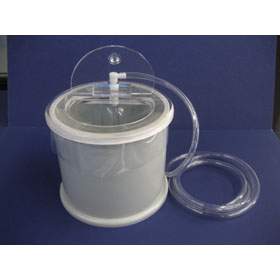
One commercial chamber.
Lab Mice have high metabolic respiratory rates, and high surface/mass ratios, so that the CO2 rapidily saturates the blood and into tissues. CNS and heart stop working in about 15 seconds, and the animal is effectively dead in less than a minute.
Public animal shelters use the same approach for cats and dogs, as the CO2 euthanasia is cheap and clean.
Accidental human CO2 deaths.
2011:
http://www.cnn.com/2011/CRIME/09/14/georgia.mcdonalds.death/
2005:
http://articles.orlandosentinel.com/2005-02-12/news/0502120303_1_carbon-dioxide-central-florida-sanford
Quantity and concentration.
I hope the above post was sarcasm.
It starts getting lethal at 8%
http://www.ivhhn.org/index.php?option=com_content&view=article&id=84
OSHA has more CO@ur momisugly asphyxiation incidents on its website,
Because they all get too engrossed in inhaling the alcohol, to be bothered snorting the CO2.
Let’s see: the Econauts say that they can store an immediately perilous substance (CO2) underground, near ground water and seismic rifts, but don’t worry, we’ve got monitoring.
Now, take out the CO2 and replace it with high level nuclear waste, and suddenly it’s not safe enough. All that the NucWaste can do is migrate–there’s no intrinsic pressure trying to force it out of containment.
Now, that’s cognitive dissonance for you.
From what I can tell, the New Madrid Earthquake Seismic Fault Zone is some 220-230 miles from Decatur. The 1895 New Madrid quake that measured 6.0 on the Richter Scale appears to have been strong enough to not only have been felt in Decatur, but might have done some damage there as well:
http://www.bing.com/images/search?q=mississippi+river+fault+line&qpvt=mississippi+river+fault+line&FORM=IGRE#view=detail&id=B290FE11CEFD8B699B0AA053D9B0399C62EC2288&selectedIndex=2.
Is this CO2 reservoir strong enough to withstand another 6.0 earthquake along this fault line with no damage that would otherwise trigger a release of CO2? Methinks I see a potential disaster here waiting to happen, and all in an effort to deal with a nonexistent problem. And doing something like this in California of all places truly is bordering on the insane.
I guess this is what happens though when we humans begin to abandon rational, level-headed scientific thought and replace it with fear and irrational behavior.
….and then there is also the Wabash Valley Seismic Fault Zone which is even closer to Decatur and to the southeast of the city. Back in 2002, a 5.0 quake was felt in the Wabash Valley fault line area…..
://www.cusec.org/earthquake-information/wabash-valley-seismic-zone.html. Total lunacy.
http://www.cusec.org/earthquake-information/wabash-valley-seismic-zone.html
Sounds like a fabulous idea. We can convert all of Decatur, IL into research labs and housing for climate scientists, as I’m sure they all want to live as they preach to others. Toss in some solar and wind power, and we could host the next IPCC meeting there. Hell, we could house them and all the green NGOs there permanently. All using only clean, renewable power to sequester nasty GHG which will otherwise push the whole planet over the tipping point to Thermageddon. And knowing they are helping save the planet might just reduce their symptoms from Climate Anxiety Disorder.
(/sarc, for the humor-impaired)
I like the proposal, Alan! Suggest we co-locate a ‘sanctuary for rescued and endangered’ polar bears there also. In the off chance that a New Madrid or Wabash fault earthquake proves insufficient to release the ‘sequestered’ CO2, it may still be sufficient to breach the polar bear facility allowing the cuddly polly bears to resume their free range, organic, environmentally conscious and sustainable feeding habits locally.
Leak? can’t happen…..granted this was flammable propane, but it still replicates the heavier-than-air problem. And it was in a relatively unpopulated area.
http://www.nytimes.com/1992/04/08/us/gas-explosion-tears-through-texas-pastures.html
When this blew, I felt it 80 miles away. CO2 may have been worse as it would just creep along the ground sliently killing anything in its path.
Why am I so suddenly overwhelmed with a flashback memory of the movie _Ghostbusters_ ?
“Yes, it’s true; this man has no …..”