“…startling data omission that he told me: “eclipses even the so-called climategate event.””
Willis Eschenbach tips me to a story by Marita Noon, titled:
What if Obama’s climate change policies are based on pHraud?
I’ve reproduced portions of it here, with a link to the full article. The graph with ALL the data is compelling.
“Ocean acidification” (OA) is receiving growing attention. While someone who doesn’t follow climate change science might think OA is a stomach condition resulting from eating bad seafood, OA is claimed to be a phenomenon that will destroy ocean life—all due to mankind’s use of fossil fuels. It is a foundational theory upon which the global warming/climate change narrative is built.
The science and engineering website Quest, recently posted: “Since the Industrial Revolution in the late 1700s, we have been mining and burning coal, oil and natural gas for energy and transportation. These processes release carbon dioxide (CO2) into the atmosphere. It is well established that the rising level of CO2 in our atmosphere is a major cause of global warming. However, the increase in CO2 is also causing changes to the chemistry of the ocean. The ocean absorbs some of the excess atmospheric CO2, which causes what scientists call ocean acidification. And ocean acidification could have major impacts on marine life.”
Within the Quest text is a link to a chart by Dr. Richard A. Feely, who is a senior scientist with the Pacific Marine Environmental Laboratory (PMEL)—which is part of the National Oceanic and Atmospheric Administration (NOAA). Feely’s climate-crisis views are widely used to support the narrative.

Feely’s four-page report: Carbon Dioxide and Our Ocean Legacy, offered on the NOAA website, contains a similar chart. This chart, titled “Historical & Projected pH & Dissolved Co2,” begins at 1850. Feely testified before Congress in 2010—using the same data that shows a decline in seawater pH (making it more acidic) that appears to coincide with increasing atmospheric carbon dioxide.
…
The December edition of the scientific journal Nature Climate Change features commentary titled: “Lessons learned from ocean acidification research.”
However, an inquisitive graduate student presented me with a very different “lesson” on OA research.
Mike Wallace is a hydrologist with nearly 30 years’ experience, who is now working on his Ph.D. in nanogeosciences at the University of New Mexico. In the course of his studies, he uncovered a startling data omission that he told me: “eclipses even the so-called climategate event.” Feely’s work is based on computer models that don’t line up with real-world data—which Feely acknowledged in email communications with Wallace (which I have read). And, as Wallace determined, there is real world data. Feely, and his coauthor Dr. Christopher L. Sabine, PMEL Director, omitted 80 years of data, which incorporate more than 2 million records of ocean pH levels.
Feely’s chart, first mentioned, begins in 1988—which is surprising as instrumental ocean pH data has been measured for more than 100 years since the invention of the glass electrode pH (GEPH) meter. As a hydrologist, Wallace was aware of GEPH’s history and found it odd that the Feely/Sabine work omitted it. He went to the source. The NOAA paper with the chart beginning in 1850 lists Dave Bard, with Pew Charitable Trust, as the contact.
Wallace sent Bard an email: “I’m looking in fact for the source references for the red curve in their plot which was labeled ‘Historical & Projected pH & Dissolved Co2.’ This plot is at the top of the second page. It covers the period of my interest.” Bard responded and suggested that Wallace communicate with Feely and Sabine—which he did over a period of several months. Wallace asked again for the “time series data (NOT MODELING) of ocean pH for 20th century.” Sabine responded by saying that it was inappropriate for Wallace to question their “motives or quality of our science,” adding that if he continued in this manner, “you will not last long in your career.” He then included a few links to websites that Wallace, after spending hours reviewing them, called “blind alleys.” Sabine concludes the email with: “I hope you will refrain from contacting me again.” But communications did continue for several more exchanges.
In an effort to obtain access to the records Feely/Sabine didn’t want to provide, Wallace filed a Freedom of Information Act (FOIA) request.
In a May 25, 2013 email, Wallace offers some statements, which he asks Feely/Sabine to confirm:
“…it is possible that Dr. Sabine WAS partially responsive to my request. That could only be possible however, if only data from 1989 and later was used to develop the 20th century portion of the subject curve.”
“…it’s possible that Dr. Feely also WAS partially responsive to my request. Yet again, this could not be possible unless the measurement data used to define 20th century ocean pH for their curve, came exclusively from 1989 and later (thereby omitting 80 previous years of ocean pH 20th century measurement data, which is the very data I’m hoping to find).”
Sabine writes: “Your statements in italics are essentially correct.” He adds: “The rest of the curve you are trying to reproduce is from a modeling study that Dr. Feely has already provided and referenced in the publication.”
In his last email exchange, Wallace offers to close out the FOIA because the email string “clarified that your subject paper (and especially the ‘History’ segment of the associated time series pH curve) did not rely upon either data or other contemporary representations for global ocean pH over the period of time between the first decade of 1900 (when the pH metric was first devised, and ocean pH values likely were first instrumentally measured and recorded) through and up to just before 1988.” Wallace received no reply, but the FOIA was closed in July 2013 with a “no document found” response.
Interestingly, in this same general timeframe, NOAA reissued its World Ocean Database. Wallace was then able to extract the instrumental records he sought and turned the GEPH data into a meaningful time series chart, which reveals that the oceans are not acidifying. (For another day, Wallace found that the levels coincide with the Pacific Decadal Oscillation.) As Wallace emphasized: “there is no global acidification trend.”
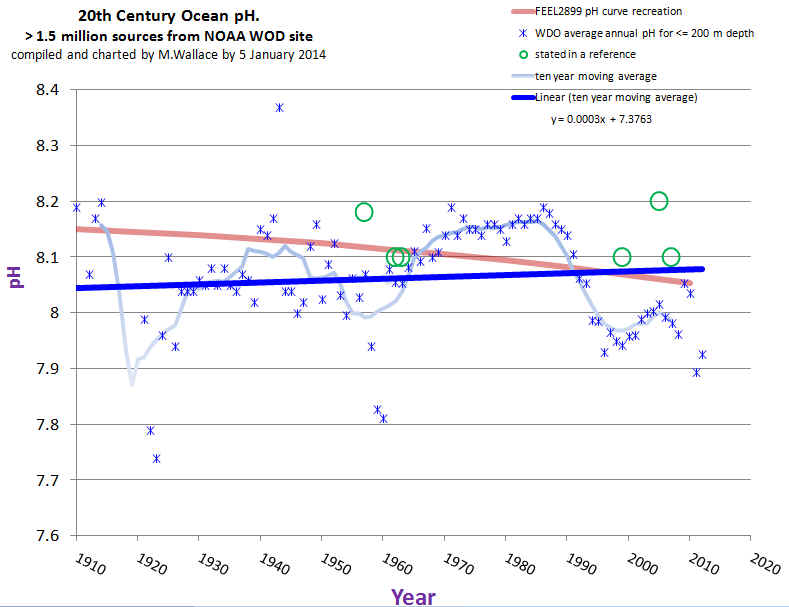

Regarding the chart in question, Wallace concludes: “Ocean acidification may seem like a minor issue to some, but besides being wrong, it is a crucial leg to the entire narrative of ‘human-influenced climate change.’ By urging our leaders in science and policy to finally disclose and correct these omissions, you will be helping to bring honesty, transparency, and accountability back where it is most sorely needed.”
“In whose professional world,” Wallace asks, “is it acceptable to omit the majority of the data and also to not disclose the omission to any other soul or Congressional body?”
Full story here: http://www.cfact.org/2014/12/22/what-if-obamas-climate-change-policies-are-based-on-phraud/
There’s a petition: http://www.ipetitions.com/petition/restore-the-worlds-ocean-ph-measurements
Rain, is often slightly acidic
Rivers are often quite acidic (below pH6)
Over millions of years rain and rivers have flowed into the ocean,
Yet the ocean is still around pH8.
That pH8 is the balanced value with the rocks that surround and are below the oceans (limestone, basalt) and the huge deposits of carbonates. This balance would have to be overcome for any pH change to take place..
and no tiny change in atmospheric CO2 is going to do that.
The oceans already contain 98% of the world’s CO2. You could put all the atmospheric CO2 into the ocean, and the pH would not move one iota.
Hardly in the deep oceans, but the surface layer is only ~1000 GtC, while the atmosphere is ~800 GtC. Both do exchange CO2 at a very high rate. The exchange with the deep oceans is much slower…
Rain is always acidic, and always has been (pH c. 5.7-6.0) since there is CO2 in the atmosphere which is dissolved in the (unbuffered) rainwater. And, yes, freshwater lakes and rivers are naturally usually somewhat acidic. Salt lakes on the other hand are alkaline, sometimes violently so, since they contain salts in different proportions to the sea (Mono Lake has pH = 10, i. e. equivalent to fairly strong lye).
Well, not always. I have measured (with my trusty Hatch) 7.2 before. It was the first rain of the start of the SW Monsoon in 1988. I was in Mesa Arizona. The rain had started just after a major dust storm. Later that night, it was at a normal 6.5.
Reblogged this on the WeatherAction News Blog and commented:
Fishy
‘Sabine responded by saying that it was inappropriate for Wallace to question their “motives or quality of our science,” adding that if he continued in this manner, “you will not last long in your career.”’
Well, yeah, Wallace pursues scientific method all the way.
Nice little career you got there, be a shame if anything happened to it…..
The oceans are not acidic. Their pH is about 8.
Water with pH below 7.0 is termed “acidic” and water with pH above 7.0 is termed “basic” or “alkaline”; pH 7.0 is “neutral”. pH measures the concentration of H+ and hydroxide (OH-) ions which make up water.
The U.S. E.P.A. considers lakes with pH less than 5 “acidified.” Tomato juice (pH 4) is ten times more acidic than black coffee (pH 5).
The pH scale is logarithmic and as a result, each whole pH value below 7 is ten times more acidic than the next higher value. The same holds true for pH values above 7, each of which is ten times more alkaline (another way to say basic) than the next lower whole value.
From Wiki: Ocean acidification is the ongoing decrease in the pH of the Earth’s oceans, caused by the uptake of carbon dioxide (CO2) from the atmosphere.
So get current.
trafamadore,
Ocean ‘acidification’ is not the ongoing decrease in ocean pH. At most, you [and Wiki] can only say honestly that a decrease in ocean pH is approaching neutral — but it will never get to 7.0.
Both you and Wiki are deliberately misrepresenting the situation, for your own political agenda.
So get current.
You forgot most of the world’s scientists. But why don’t you come up with your own word for an adjective that explains becoming less alkali. Neutralification? Not so catchy.
Cite the publications where “most of the world’s scientists” echoed Wiki or you.
Until then, false claims of authority are merely embellished fabrications.
Not so “catchy”??
It’s far more honest than your misinformation.
But then, if you had to be honest the debate would have been over years ago.
And BTW, you don’t speak for all scientists, most scientists, or even a few scientists. You speak only for yourself, and I for one would appreciate some honesty for a change. The ocenas are not ‘acidifying’. In fact, within error bars there is no change in pH at all.
When you lower the pH of any solution you have “acidified” it
…
The process is then refereed to as “acidification”
..
So, Mr dbstealey, you need to learn the use of English words.
It works just like the term “alkalinisation”
False. You do not make some less dead if you remove the bullet from the corpse.
YOu are nuccitelli.
Socrates, get with the program. db doesn’t warm up his coffee in the morning, he makes it less cool. So as not to panic himself, you see. Plus, coffee isn’t hot until it’s hot. Don’t you know nuffin’?
I’m a professional chemist, David. Lowering solution pH from 8.2 to 8.0 is not an acidification.
Pat….if you acidify a solution, are you not lowering it’s pH?
YOu are taking it from pH 7 to a lower number. However if you are NOT at 7, then all you can (at best) claim is you are neutralizing it.
Again, science 101.
David, if you lower the pH of a solution below 7, you’re acidifying it. But even pH 6 is near neutral. I wouldn’t really consider a solution functionally acidic unless it was below pH 5. Atmospheric CO2 produces rain with a pH of about 5.6. That’s considered mildly acidic.
Part of my professional research is on the blood cells of northern hemisphere sea squirts. Certain of these cells (signet ring cells) include a large vacuole with an acidic interior — pH 0 to pH 3. Now that’s acidic.
There really is no common usage term for reducing pH from, e.g., 8.2 to 8.0, or from pH 10 to pH 9. De-alkalinizing describes the process, or more conventionally, reducing pH or reducing alkalinity. But acidification? Nope.
Oops! sorry for not reading your response before posting mine. Yous is an excellent one, BTW
Pat….if you use the term “De-alkalinizing” what would you think “De-acidifying” is?
De-acidifying means to remove acid, David. In an aqueous solution process, that would mean raising the pH from below 7 to above 7.
What’s your point?
The prior point remains — the one you haven’t admitted — that “ocean acidification” is a specious label for the process of reducing pH 8.2 alkalinity by a couple of tenths of a pH unit.
SocksrAts argues pH with a chemist. Oh boy.
Get a reliable source first. Wiki is not one, and even grade school kids can tell you that.
Terminology.
Reducing the alkalinity of a basic (alkaline) solution of a basic and making it nearer pure (neutral, pH=7) water = neutralisation.
Similarly reducing the acidity of an acid solution and making it nearer pure (neutral, pH=7) water = neutralisation.
This entirely accurate and satisfactory term has been in use for a very long time.
I will leave it to others to speculate as to why the proponents of ‘OA’ didn’t choose to use the term ‘ocean neutralisation’ to describe their activities. Perhaps they felt ‘acidification’ – though technically incorrect – would get more traction among the chemically naive? Perish the thought!
“Wallace found that the levels coincide with the Pacific Decadal Oscillation”…of course it does
On the one hand they are trying claim that deep upwellings are killing oysters…
…but La Ninas do not effect pH
http://cses.washington.edu/cig/figures/pdoindex_big.gif
Thanks for providing plots with this story that make sense. CFACT reported this story along with a plot that made no sense to me at all.
Nick Stokes is a well-known apologist/defender/outright liar in the defence of AGW.
Ignore everything this jizzweasel says.
Nick is a well known apologist/defender of the AGW story, but I haven’t seen one lie of him. Do you have an example?
Ferdinand:
See exchanges at Climate Audit where Stokes is perpetually fabricating and being accused of such by many, including the blog host.
[facepalm]
Any who are interested in an meticulous analysis of paleoclimate proxies and reconstructions should see the archives at climate Audit.The work done there is of the highest quality.
The blog host, Steve McIntyre, is a recognized authority on such proxy reconstructions (tree ring, varves, corals, alkenones, etc.)
He has also thoroughly documented the fabrications in this field and the dishonesty of Michael Mann, Phil Jones, Keith Briffa, and many more such types. The archives are a “must reaf” for any who would wish to educate themselves in this field. McIntyre is one who has made a difference.
In a liberal professional world, liberal prioritizes professional. Every Time.
I’m wary of rushing to judgment here.
As Ferdinand Engelbeen points out, it matters a lot to have a consistent dataset, using the same methods at the same place for a long period. We’re used to this in evaluating atmospheric CO2 measurements. We know that they vary by place and by season, and we also know that some historical measurements of atmospheric CO2 gave absurd (and clearly wrong) results, which could even be misused to suggest that atmospheric CO2 fell sharply at times. We’re glad to have the gold-standard Mauna Loa estimates.
Perhaps Mike Wallace or someone can bring some order to the broader historical data, to demonstrate (if possible) that some subset of these data are sufficiently comparable in measurement methodology and circumstances to be suitable as a long time series. Until and unless someone actually does the legwork on this, I think we would be naive to treat the data as comparable.
I have to wonder whether Professor Feely may have had proper concerns like this in mind when he warned Wallace not to discount his own research or rush to make use of the broader data. I obviously don’t know one way or the other, but I can’t accept Wallace’s characterization of the communication between them without knowing more. Nullius in verba!
As we learned from Feynman, the easiest person to fool is yourself. We too are subject to confirmation bias. Wouldn’t we love to see another Climategate that destroys a pillar of the catastrophist narrative?
I don’t assume away the possibility of bad behavior here, but I don’t think we’ve seen enough information to conclude that it happened — or that it matters.
“I’m wary of rushing to judgment here.”
Indeed so. Wallace has some hangup on GEPH measurement. That was long known to be less reliable for measuring seawater pH. Most reliable historic data is of Total Alkalinity and Dissolved Inorganic Carbon. These are stable measurands, far more abundant than H+, and the equilibria connecting them to pH is well established. Feely is certainly not the first to prefer them.
That doesn’t explain the mafia-style utterances of Feely. Are warmist scientist all unhinged psychopaths?
If so, should we trust them with anything? Rethorical question.
DirkH, I haven’t seen the full correspondence between Wallace and Feely/Sabine. In many cases it depends of how you ask for data that triggers how the answer is formulated…
Anyway, it looks like very premature to accuse them of hiding the data, if the error bars of the historical measurements are larger than the trend you are looking for…
Repeat after me: Less alkaline, less alkaline, less alkaline.
No.. repeat after me..
no measureable change, no measurable change. !!
Just saw this on Google News:
http://www.capitalotc.com/global-warming-may-trigger-the-worst-coral-bleaching-in-16-years/26861/
“NOAA scientists suggested that global warming and increased acidity of oceanic water could put in great danger coral reefs across the planet.” Got both bad guys in the same sentence.
I guess I can imagine why people choose to read the fear, why it is “newsworthy” = reason to pour some of the good stuff. But, how do they make sense of – “Marine experts say that corals can survive several bleaching events, but they often die in the process.”?? Pour some more. Are we going to die or survive, or both? Need ice with that?
I’m encouraged that all the comments, so far, are thoroughly skeptical.
Sabine saying, in response to questioning of their “motives or quality of our science,” and adding that if he continued in this manner, “you will not last long in your career.” is a clear act of intimidation, argumentum ad hominem, and factual evasion of the question. This sort of thing is common in all science which has been reduced to the mere servant of political motives. Consensus science, argumentum ad hominem, projection of guilty motives and sponsorship, fraudulent data, models as data, and hiding of facts are all cornerstones of CAGW propaganda practice.
Freshman geology teaches students that CO2 solubility in water to create carbonic acid, a major process in dissolution of calcareous material, is strongly tied to temperature. At lower temperatures, typically during the winter months, more CO2 is dissolved in water thus raising it;s acidity. During warmer summer months, CO2 exssolves from water because higher CO2 is less stable in warmer water, and goes back into the atmosphere.
I wonder is such a process also relates to warming and cooling oceans?
A truth about oceanic geology is that in very deep water (along the oceanic floor) at cooler temperatures (~4 deg C) CaCO3 is not stable due to the higher acidity and higher concentrations of CO2. Whereas, in shallower-warmer water CO2 concentrations are less, the acidity is less, and carbonates are more stable.
I suspect that the higher concentrations of CO2 in the oceans (higher acidity) is more a a function of water temperature than atmospheric CO2 concentration.
Upwelling of deep oceanic waters along continental margins release large concentrations of CO2, as the rising water warms and CO2 stability in water diminishes releasing the gas back into the atmosphere.
Upwelling waters are also rich in phosphates, which along with the available CO2, causes large algal blooms to form along these margins. (see: the anchovy industry in Peru)
From the sun’s pov it’s always summer.
And 12 noon.
If one ocean is outgassing the other should be absorbing, eh?
No net seasonal change in CO2 or ocean ph.
“Exsolves.” One thing about WUWT, you are constantly coming across new words.
“Exsolve” is a mineralogic term having to do with the behavior of ions in the crystal lattice.
“In who’s professional world…”
Money, money, money.
Remember reading a paper about the chemistry of a river flowing out out of the Alps. The diurnal temperature changes led to changes in CO2 and therefore pH. Temperature increase and lower atmospheric pressure will lead to lower CO2 concentrations and hence pH. Acid rainfall on Calcium feldspars will lead to Ca2+ ions entering the oceans. Any increase the acid of rainfall is only likely to increase dissolution of salts from the land surface. In may parts of the tropics the seas are supersaturated with calcium carbonate leading to whitings. Any increase in acid entering the oceans is likely to lead to an increase in dissolution of calcium carbonate from the sea floor.
Any measurement of pH of the oceans to a greater accuracy of 0.1 before electric methods appears wishful thinking. Bearing mind that during the Cretaceous when vast amounts of calcium carbonate was deposited in the oceans and CO2 concentrations in the atmosphere were in the high 100s/1000s ppm , i have serious doubts about the data and the risk of any problems.
Reblogged this on Public Secrets and commented:
If true, this could be the “Climategate” moment for ocean acidification. The level of “noble cause corruption” in the climate alarmist camp is scary.
For 100’s of million years, atmospheric CO2 levels ranged between 2.000~8,000ppm and oceans were not “acidic” (average of around 7.6 pH) and teamed with life– including shellfish.
There are currently about 38,500 gigatons of carbon dissolved in the oceans as carbonic acid and about 770 gigatons of carbon as CO2 in the air. Given Henry’s gas law (50:1 ratio of ocean/air CO2 concentrations), when atmospheric CO2 levels were 2,000ppm, there were roughly 192,500 gigatons of CO2 dissolved in the oceans or 154,000 GTs more than now and the oceans were still alkaline (around 7.6 pH) and teaming with life.
Since 1750, man has emitted roughly 1,500 gigatons of carbon, which is more than 100 times less than the 154,000 GT dissolved in ancient oceans, and they were still alkaline…
It’s absurd to think man’s insignificant 1,500 GT of added carbon to the oceans since 1750 can significantly change ocean pH and make oceans uninhabitable for sea life….
Sabine is an early 21st century scientist currently officially associated with an official US government scientific organization ***. As a member of an official government scientific organization, Sabine is threatening someone outside of his organization to not look at the quality of his and his coauthor’s scientific work (paper). That is an unveiled threat to freedom and science. Where the multiple outcries of the climate focused scientific community against that behavior by Sabine and by implication the behavior of his coauthor Wallace? Shameful.
*** specifically [per Marita Noon’s articale] Dr. Christopher L. Sabine is a Director at the Pacific Marine Environmental Laboratory (PMEL)—which is part of the National Oceanic and Atmospheric Administration (NOAA). Sabine’s coauther Feely is a senior scientist with the same organization.
John
Premature termination, eh? The Nobel Prize for this should go to Al Gore’s 2006 film showing Michael Mann’s graph – which ends just short of AD2000, as global temperatures started to plateau.
“Plateau?” Then why are they saying 2014 is on track to be the warmest on record?
Who are “they”? The same “they” as in “they say”?
Yes. Must be, because you’re quoting them.
Quote someone who’s not promoting the alarmist Narrative, and you will get a different answer — an honest answer: 2014 is far from being the warmest year on record.
Good luck trying to combat reality
Yea, you do not seem to be a doing a very good job of it.
PS…..Mr dbstealey
…
Read this
http://link.springer.com/article/10.1007%2Fs00382-013-1958-7
…
Then explain to all of us why UAH and RSS don’t agree.
What record is that? The Earth is billions of years old. We have global (satellite) temperature data only since 1979. Before that there is no global temperature data.
To answer your question:”They” say that to incite fear from low information (Gruber) voters and push their political propaganda to forward their agenda.
Even if what they say is true, so what. What harm did this cause? What damage was done? 2014 saw record crop yields. How is that a bad thing?
The instrumental record.
…
But then, if you want to include proxy data, that’s another story……
SO tell us DS, where is the anus that the thermometer was inserted into the planet to take its temperature?
Or are you referring to a bunch of homogenized, averaged, and excluded readings used to create the “instrumental record”? Really? What instrument does the homogenization. Which ones does the averaging? And what instrument excludes readings?
“The instrumental record.”
Ah , that little pinprick of time.
Seriously ?
And as for the “warmest ever.” LOL..give Gavin et al enough matches, they will manage anything !!
The “pin prick” of time is enough to compare to the past 10,000 years via proxy.
…
I’m sure you can tell us all when in the past 10,000 years there has been a 0.7 degree rise in a 100 year interval.
Ah so! It is NOT the instrumental record, but an extended hokey stick that does not exist? So what other fabrications are you trying to pass off as actual data?
Socrates says 2014 is the ‘hottest year evah!!’
No, it isn’t. Far from it. Not even close. And note that I just posted a link to UAH, which also shows that 2014 is far from being the warmest year.
Therefore, reality trumps Socrates’ delusion. As usual.
OK, so you trust RSS and UAH. ???
Both use the same source data
Neither agree with one another.
..
Did you know they take the raw data from the satellite and process it using a model?
…
You trust their models?
..
Tell us why you trust atmospheric models from RSS and UAH better than thermometer data?
The instrumental record.
…
But then, if you want to include proxy data, that’s another story……
——
What global instrumental record are you referring to? And what time period?
And all of the published land surface temperature include not only proxy data, but also homogenization, TOA and various other adjustments that are basically done arbitrarily, on a whim, and without justification and proper documentation.
” that are basically done arbitrarily,”
…
Not really, they usually have a good reason for any change they make, and they publish it too
@socrates:
Satellite data is not a computer model output. It is a measurement, and it is by far the most accurate global temperature measurement.
Next, you say:
I’m sure you can tell us all when in the past 10,000 years there has been a 0.7 degree rise in a 100 year interval.
Aside from your cherry-picking of ‘10,000’ years, here is just one example of abrupt climate change, in which temperatures fluctuated by TENS of degrees, within only a decade or two.
Aside from the fact that that completely destroys your cAGW scare… how was the play, Mrs Lincoln?
dbstealey
…
The data that RSS and UAH use are from the AMSU’s on board several different satellites.
…
They measure microwave energy, not temperature.
Both RSS and UAH use atmospheric models to convert the microwave brightness readings into temperature data.
“One of our greatest assets is Remote Sensing Systems’ atmospheric radiative transfer model (RTM) for the ocean surface and intervening atmosphere.”
…
reference: http://www.remss.com/about/who-we-are
Ah! So you merely fabricated again. They are not from the same “source”. One has to wonder if you are capable of discerning reality.
It is bad when you call yourself a liar.
dbstealey
..
Your “abrupt change” is for a measurement on the Greenland ice sheet.
..
There is no corresponding change in the ice core record for Antarctica, therefore that “abrupt change” was not global
@d. socrates:
By your failed argument we can discount GRACE, and plenty of other satellite measurements — not to mention the wildly inaccurate ocean pH measurements that the lunatics are now trying to hang their collective hats on.
And I notice you never respond when your very weak arguments are thoroughly annihilated, which happens regularly. In fact, that just happened again, with your bogus, cherry-picked claim that the extremely *tiny* 0.7ºC fluctuation in global T over the past 150 years is, like, scary. That claim has been completely debunked by the real world. Score another win for skeptics. One of these years the alarmist cult might win an argument. But they haven’t yet.
Only in the crazed mind of a climate alarmist is a 0.7º blip over a century and a half something to be scared of. Rational folks larf at claims like that. But since you want to believe that tiny fluctuation is a problem, have at it. That’s just your confirmation bias at work. The rest of us know better.
socrates says:
“abrupt change” was not global
And how would you know that??
You wouldn’t, and you don’t. You have zero understanding of thermodynamics, if you believe that a giant-sized part of the planet changed T by twenty degrees centigrade (20ºC), but the rest of the planet remained unchanged at the same T.
Better go back to school, ‘socrates’. Start at the 5th grade. They already know more than you.
” that are basically done arbitrarily,”
…
Not really, they usually have a good reason for any change they make, and they publish it too.
————
Really? That’s news to me.
Please provide links to the original (unaltered) HadCRUT and GISS data and the documentation for all of the revisions that have been done over the years?
You can’t, because this information does not exist. Phil Jones publicly admitted this.
GRACE isn’t measuring microwave emissions.
There is no current satellite measurement of pH of the oceans.
…
If you think that 0.7 degrees is an “extremely *tiny* ” ” fluctuation ….I would ask you to show us when in the past 10,000 years we have had a 0.7 degree global temperature change. I will emphasize “global” because your single point data of the Greenland ice cap doesn’t represent global temperature.
…
Please note that 100 years for a 0.7 degree change over the course of 10,000 years represents a time interval of 1% meaning the other 99% didn’t have a change…..or in other words withing about 3-sigma variance.
.7 degrees in a year is not “tiny”. .7 degrees in 150 years is as it is below the accuracy of the current instruments to measure on an annual basis.
Science 101
Reg….. using the word “arbitrary” is your call, I don’t need to provide you with any evidence, you need to do so if you wish to use that word.
socrates says:
If you think that 0.7 degrees is an “extremely *tiny* ” ” fluctuation… &etc.
It is extremely tiny, and you are just deflecting again. I have easily destroyed every argument you’ve made here. All you do is deflect with something different. Face reality: the planet itself is busy debunking your nonsense.
Look at this chart, and you will see plenty of times within the past 10K years that global T has changed by far more than 0.7º.
It is just amazing how completely deluded you are. Are you posting from an asylum somewhere?
Again Mr dbstealey…..
…
You continue to use the ice cap on Greenland as a proxy for the entire global temperature.
…
That’s not too smart.
..
Besides, the Antarctic ice cores don’t correlate.
Tell us why you trust atmospheric models from RSS and UAH better than thermometer data?
___________
Surface temperature data has never been global. Land comprises about a third of the Earth’s surface, and the distribution of surface stations is not uniform, accurate, pristine or comprehensive — even today.
If you distrust satellite data, you are basically admitting we have no global temperature data of any worth, and you may be right. But If that’s the case, AGW, Climate Change, Extreme Weather, Climate Disruption, or however you want to brand it, has no basis in reality or science.
Reg….there are a lot of buoys out there measuring temperature…so, your “one third” argument doesn’t hold
The buoys have been in place for less than 10 years. So now you are reducing the age of the planet to less than 10 years. I guess once you restrict the age down to a year, you can honestly claim that year is the hottest on record! Amazing how Alarmism work. They are more fundamental than the fundamentalists claiming the earth is only 6000 years old!
Reg Nelson,
Trying to explain this subject to ‘socrates’ is like trying to teach a dog algebra. It just doesn’t work.
Socks says:
You continue to use the ice cap on Greenland as a proxy for the entire global temperature.
See what I mean? If thermodynamics worked like ‘socrates’ believes, we could keep a bowl of ice cubes on the kitchen table and they would never melt.
Socrates asked for an example of global change in T that was larger than the current *very* mild 0.7ºC. I provided it. But as usual, he nitpicks everything because his Belief requires him to.
Really, socrates’ lack of understanding is epic. If one very large part of the globe [Greenland] is twenty degrees centigrade colder or warmer than the rest of the globe, temperatures will even out over time. The laws of thermodynamics require it. You cannot have one continent-sized area be 20ºC warmer than another, and remain that way.
David, the accuracy of the instrumental record almost certainly isn’t better than (+/-)0.5 C (869 kb pdf). The entire field systematically neglects systematic measurement error. They assume it’s random. It’s a huge mistake, and that’s being charitable.
With that level of uncertainty, how is it possible to assign hotter or cooler years?
Reg….. using the word “arbitrary” is your call, I don’t need to provide you with any evidence, you need to do so if you wish to use that word.
—-
You claimed the adjustments were well documented. I know for a fact they are not. I challenged you to provide proof of this, which you haven’t, and cannot.
Many, if not most, of these adjustments were done by computer algorithms, which are by design, are arbitrary.
“See what I mean? ”
…
All you need to do Mr dbstealey is show the correlation between the Greenland ice core data with the Antarctic ice core data.
..
The problem is that the drastic changes you point to in Greenland did not happen in Antarctica.
..
Therefore, your single geographic point data does not represent global phenomena
Pat…. ” were done by computer algorithms, which are by design, are arbitrary..”
…
Citation?
David Socrates December 23, 2014 at 8:28 pm
Reg….there are a lot of buoys out there measuring temperature…so, your “one third” argument doesn’t hold.
——-
ARGO has only been around since 2005, and only includes 3,750 floats, which are not fixed in position, which means comparative data doesn’t exist.
Not talking about ARGO
…
Buoys
…
http://www.ndbc.noaa.gov/
David Socrates December 23, 2014 at 8:41 pm
” were done by computer algorithms, which are by design, are arbitrary..”
…
Citation?
From the NASA GISS site: http://data.giss.nasa.gov/gistemp/FAQ.html
Here you go:
“Originally, only documented cases were adjusted, however the current procedure used by NOAA/NCDC applies an automated system that uses systematic comparisons with neighboring stations to deal with undocumented instances of artificial changes.”
Automated systems = computer algorithms = arbitrary adjustments.
You seem very uninformed or misinformed. Stick around, you might learn something.
D. Socrates says:
All you need to do Mr dbstealey is show the correlation between the Greenland ice core data with the Antarctic ice core data.
And if I do, will you finally go away?
You are cluttering up this thread with your lack of knowledge. I would not bother trying to educate you, because it would be like trying to teach a dog trigonometry. But for new readers who might be misdirected by your SkS talking points, I feel I must correct your misinformation — which I have done constantly, and so have several others here.
So, if I post solid evidence showing the temperature corellation between hemispheres, including Greenland and the poles, will you finally get lost? Because I can do it, no problem. You’re not the first to ask, and I have a folder of charts showing a conclusive corellation.
Deal?
David, “were done by computer algorithms, which are by design, are arbitrary,” not my comment.
Sock rat is not here to learn. It is doubtful that he can. Instead, he comes to cut and paste from SKS, HotWhoppers, etc. That is his notion of science.
D. Socrates asks:
‘I would ask you to show us when in the past 10,000 years we have had a 0.7 degree global temperature change’
Maybe never. So what? It is still a tiny change, Unusual does not necessarily mean significant.
And a change from 287.1K to 287.8K over a century is pretty insignificant, even if unusual.
IN which satellite record?
The oceans have immense buffering capability. Imagine what it would actually take to demonstrably lower the pH.
Pipette soda water (know CO2 concentration) into a container of a known specific volume of sea water until the pH meter falls. Try various temperatures from sea to shining sea. Good high school quantitative chemistry lab project. (add some qualitative rules) Cheers!
Right, you are talking a 500ml beaker, I am talking about something a bit more voluminous.
…simple algebra. Cheers!
The ocean stores 50 times more carbon dioxide than contained in the present atmosphere. So, increase the concentration of H2CO3 into your beaker of fresh sea water by 1/50th using a graduated pipette . Keep doing that until the pH decreases outside the current fluctuations or variations of sea water pH. That will indicate how many total atmospheres of CO2 (~3 x 10^12 tons) the oceans could absorb without affecting the pH. Every one knows that … 🙂 Cheers!
You need to make a differentiation between the ocean surface layer and the deep oceans. The surface layer is only ~1000 GtC, the atmosphere ~800 GtC. Exchanges are fast (1-3 years half life) and the surface layer follows the changes in the atmosphere at 10% of the change (Revelle or buffer factor).
Exchanges with the deep oceans are much slower (…
Readers who are not quite experienced in the measurement of pH should be very careful about commenting here.
There are many issues with measurement of pH in ocean waters, some physical, like depth and area coverage, some chemical like what pH is, some a mixture like whether dead/live biota should be considered, or filtered out with how fine a filter.
Briefly, there are so many known unknowns on the measurement of ocean pH, especially those from years ago, that the error limits are quite wide. They are much wider than the alleged change of pH due to CO2 dissolution.
Those who has extensive experience with glass electrodes in solutions of high ionic strength will know that reproducibility of readings from day to day was poor. It was hard to get a tenth of a pH unit to reproduce, let alone to know if it was free from bias. Therefore, there is a good argument to discard all glass electrode ocean measurements when used to show change in time series.
Many current authors do not even describe the proper definition of pH. It is not related in the first instance to the concentration of hydrogen ions (as is commonly stated) but to the activity of the hydrogen ions. The activity is related to the concentration through quite difficult relationships such as the Debye-Huckel equations (Google it). If activity is not used, there is a bias.
These days there is a tendency to estimate pH through models related to the abundance of other dissolved species, measured chemically. This also has large error margins,
In the present context of this blog, one might simply say that if we cannot understand how to sense pH adequately – and we can not – then neither can the organisms that are alleged to be threatened with the apocalypse.
@GS
I agree that in a chemically complex solution like sea water, measuring pH activity is difficult and even depends on the concentration of other ions.
How shelled marine organisms adapt to changing pH is a current topic of study. The explanation may include greater use of the bicarbonate ion or controlling pH at the organism surface.
Really excellent points, Geoff.
Right on.
There is more danger in the American diet toward self inflicted low pH (acidosis) than so called danger of anthropogenic ocean pH apocalypse. The junk medications CAGW crowd are hooked on are predominantly HCl. I suppose the act of ” dropping acid” has it’s consequence : junk science + junk chemistry. Cheers!
I would never claim to know the PH of any of my Aquarii to within 0.05 accuracy and I have spent most of the 30 years of my professional life in one area or another of Test and Measurement. I am such a test instrument geek that my step dad ( a hydrologist) bought me a Hatch PH meter for Christmas one year.
BTW, there are those who are successfully breeding Angelfish and Discus, without getting all elaborate with RO systems in the Phoenix metro area. Phoenix water has a natural PH around 8.0 to 8.5. Good management, without RO can result in an aquarium with 6.8, but 7.5 is more likely. This is far higher then the waters Discus come from! So much for organisms being particularly sensitive to minor changes in PH.
thx mod. No offent ment.
I know mine’s on the brink:
a lot of ways when compared to mainstream.
But then – truth is truth AND no one guaranties truth’s niceness’.
better with uncomfortable, shabby truth.
then with sweet, prolonged lasting lies.
Thanks WUWT, an unsinkable platform of freedom of speech + freedom of listening / learning.
Hans
Geoff Sherrington,
Thank you. They cannot measure pH accurately enough to know if there has been any long term change. All they are doing is speculating.
Geoff , you have given all of us wise advice. I often wonder what scientists in 2200 will think about the inadequacies in the current understanding of mother earth. Until they pass judgment, the sound advice for this generation is to tread lightly and accept we probably know a lot less than we think we know.
A very detailed review paper on ocean acidification over the past 300 million years as obtained from proxy data was recently published . The reference is:
The Geological Record of Ocean Acidification, B. Hönisch & many others, SCIENCE 335, p. 1058 (March 2, 2012).
Over this period, atmospheric CO2 was commonly above 500 ppm and often as high as 1500 ppm.
Ocean pH varied between 7.5 and 8.1, but was never more basic than recently. The most acidic times were ~110 and ~190 million years ago.
Although there was a general relation between pH and atmospheric CO2, the data do not permit more details.
Carbonate-shelled organisms flourished during this time. Those die-offs that occurred were usually associated with extreme events, e.g. the PETM, the KT asteroid impact, the end Triassic and end Permian mass extinctions.
The Anthropogenic Center Of The Universe IS the LAW OF THE USA.
IRS feverishly spinning the TAX wheel for 2014.
Mr. Obama calls Dr. Lizardo, “Dr. Lirzardo, Please connect the dots!”
Ha ha
I should mention, the pH of surface ocean water today exhibits a range over about 7.5 to 8.4, with an average of about 8.1.