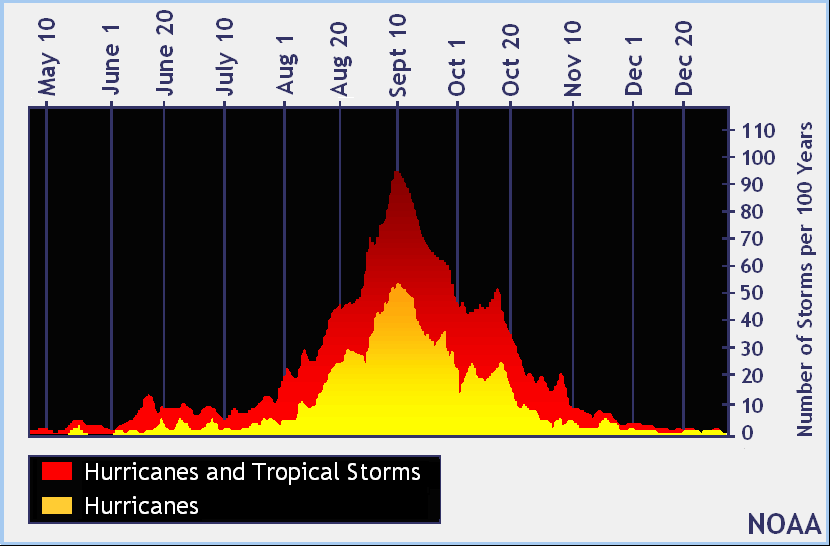
So far, four storms have gotten names in the Atlantic this year. In records going back to 1851, Sept. 10 is the day when the odds are greatest there will be at least one tropical storm or hurricane somewhere in the Atlantic.

From Bloomberg:
The statistical peak of the Atlantic hurricane season has arrived and for the first time since 1992 there isn’t a named storm in the basin.
While forecasters are watching a pair of potential systems, neither is likely to grow into a tropical storm by the end of today. So far, four storms have gotten names in the Atlantic this year.
In records going back to 1851, Sept. 10 is the day when the odds are greatest there will be at least one tropical storm or hurricane somewhere in the Atlantic.
Still, it would be a mistake for everyone to let their guard down, said Gerry Bell, lead hurricane forecaster for the U.S. Climate Prediction Center in College Park, Maryland.
“The season isn’t over and it is not shut down,” Bell said by telephone. “While it is weaker than average we already had one hurricane strike North Carolina this year. We need people to stay prepared.”
It is also too early to tell if there is a larger shift under way in the Atlantic that could herald in an era of fewer storms, he said.
Since 1995, the basin has been in the midst of what is called the warm phase of the Atlantic Multi-decadal Oscillation. This means it has been warmer than normal and the chances for weaker storms to grow stronger are enhanced, according to the National Oceanic and Atmospheric Administration.
It has also marked an era where more storms have formed. For example, 21 storms got names from 1992 to 1994 and then in 1995, 19 systems reached that threshold.
Full story here
” said Gerry Bell, lead hurricane forecaster for the U.S. Climate Prediction Center in College Park, Maryland.”
————————————————————————————————————————————————
That should give the hurricane specialists at NHC conniptions. Gerry Bell is not a hurricane forecaster, lead or otherwise. He heads up the hurricane seasonal forecast but does not do any real-time hurricane forecasting. But why should we expect accuracy from the Press? Whatever makes your ‘talking head’ sound more important and the story more sexy.
As for the African Easterly Wave train, it is keeping disturbances coming of the continent on a regular basis. However, once they reach the ocean they encounter hostile conditions their potential for development goes way down. AL91 probably has the best chance of any Cape Verde system so far this year, but it is forecast to recurve far out to sea and not affect anyone but the fishes. What we should be on the alert for is late season systems which form in the western Caribbean and are spun up from dying cold fronts that intrude upon the area in October-November. This is the sort of season where most of the activity is hybrid storms becoming tropical rather than those forming in the MDR.
Yes, they encountered much hostile dust until recently. Here is today’s Saharan Dust Layer image:
http://static.baynews9.com/images/wx/bn9/60min/SAL.jpg
A blast from the recent past:
“Tenfold increase in hurricane frequency this century, research predicts.”
Mar 18, 2013
http://phys.org/news/2013-03-tenfold-hurricane-frequency-century.html
“We find that 0.4 degrees Celcius warming of the climate corresponds to a doubling of the frequency of extreme storm surges like the one following Hurricane Katrina. With the global warming we have had during the 20th century, we have already crossed the threshold where more than half of all ‘Katrinas’ are due to global warming,” explains Aslak Grinsted.
1992 was a real doozy! Andrew was no joke.
1992 was a terrible year and the worst disaster I had ever experienced-I hope this year is nothing like 1992.
CAGS= Catastrophic Anthropogenic Global Stasis…
The new hypothesis that projects we’re all going to die of climatic boredom….
We’re doomed..
Yawn…climate change? what climate change…
http://www.bear.org/website/images/stories/images/HWB_800x600/HWB_Slide61_FS_800.jpg