James McCown writes:
A number of climatologists and economists have run statistical tests of the annual time series of greenhouse gas (GHG) concentrations and global average temperatures in order to determine if there is a relation between the variables. This is done in order to confirm or discredit the anthropogenic global warming (AGW) theory that burning of fossil fuels is raising global temperatures and causing severe weather and rises in the sea level. Many economists have become involved in this research because of the use of statistical tests for unit roots and cointegration, that were developed by economists in order to discern relations between macroeconomic variables. The list of economists who have become involved includes James Stock of Harvard, one of the foremost experts at time series statistics.
With a couple of notable exceptions, the conclusions of nearly all the studies are similar to the conclusion reached by Liu and Rodriguez (2005), from their abstract:
Using econometric tools for selecting I(1) and I(2) trends, we found the existence of static long-run steady-state and dynamic long-run steady-state relations between temperature and radiative forcing of solar irradiance and a set of three greenhouse gases series.
Many of the readers of WUWT will be familiar with the issues I raise about the pre-1958 CO2 data. The purpose of this essay is to explain how the data problems invalidate much of the statistical research that has been done on the relation between the atmospheric CO2 concentrations and global average temperatures. I suspect that many of the economists involved in this line of research do not fully realize the nature of the data they have been dealing with.
The usual sources of atmospheric CO2 concentration data, beginning with 1958, are flask measurements from the Scripps Institute of Oceanography and the National Oceanic and Atmospheric Administration, from observatories at Mauna Loa, Antarctica, and elsewhere. These have been sampled on a monthly basis, and sometimes more frequently, and thus provide a good level of temporal accuracy for use in comparing annual average CO2 concentrations with annual global average temperatures.
Unfortunately, there were only sporadic direct measurements of atmospheric CO2 concentrations prior to 1958. The late Ernst-Georg Beck collected much of the pre-1958 data and published on his website here: http://www.biomind.de/realCO2/realCO2-1.htm.
![CO2-MBL1826-2008-2n-SST-3k[1]](https://wattsupwiththat.files.wordpress.com/2014/08/co2-mbl1826-2008-2n-sst-3k1.jpg?quality=83)
Most researchers who have examined pre-1958 relations between GHGs and temperature have used Antarctic ice core data provided by Etheridge et al (1996) (henceforth Etheridge). Etheridge measured the CO2 concentration of air trapped in the ice on Antarctica at the Law Dome, using three cores that varied from 200 to 1200 meters deep.
There have been several published papers by various groups of researchers that have used the pre-1958 CO2 concentrations from Etheridge. Recent statistical studies that utilize Etheridge’s data include Liu & Rodriguez (2005), Kaufmann, Kauppi & Stock (2006a), Kaufman, Kauppi, & Stock (2006b), Kaufmann, Kauppi, & Stock (2010), Beenstock, Reingewertz, & Paldor (2012), Kaufmann, Kauppi, Mann, & Stock (2013), and Pretis & Hendry (2013). Every one of these studies treat the Etheridge pre-1958 CO2 data as though it were annual samples of the atmospheric concentration of CO2.
Examination of Etheridge’s paper reveals the data comprise only 26 air samples taken at various times during the relevant period from 1850 to 1957. Furthermore, Etheridge state clearly in their paper that the air samples from the ice cores have an age spread of at least 10 – 15 years. They have further widened the temporal spread by fitting a “smoothing spline” with a 20 year window, to the data from two of the cores to compute annual estimates of the atmospheric CO2. These annual estimates, which form the basis for the 1850 – 1957 data on the GISS website, may have been suitable for whatever purpose Etheridge were using them, but are totally inappropriate for the statistical time series tests performed in the research papers mentioned above. The results from the tests of the pre-1958 data are almost certainly spurious.
Details of the Etheridge et al (1996) Ice Core Data
Etheridge drilled three ice cores at the Law Dome in East Antarctica between 1987 and 1993. The cores were labeled DE08 (drilled to 234 meters deep), DE08-2 (243 meters), and DSS (1200 meters). They then sampled the air bubbles that were trapped in the ice at various depths in order to determine how much CO2 was in the earth’s atmosphere at various points in the past. They determined the age of the ice and then the air of the air bubbles trapped in the ice. According to Etheridge:
The air enclosed by the ice has an age spread caused by diffusive mixing and gradual bubble closure…The majority of bubble closure occurs at greater densities and depths than those for sealing. Schwander and Stauffer [1984] found about 80% of bubble closure occurs mainly between firn densities of 795 and 830 kg m-3. Porosity measurements at DE08-2 give the range as 790 to 825 kg m-3 (J.M. Barnola, unpublished results, 1995), which corresponds to a duration of 8 years for DE08 and DE08-2 and about 21 years for DSS. If there is no air mixing past the sealing depth, the air age spread will originate mainly from diffusion, estimated from the firn diffusion models to be 10-15 years. If there is a small amount of mixing past the sealing depth, then the bubble closure duration would play a greater role in broadening the age spread. It is seen below that a wider air age spread than expected for diffusion alone is required to explain the observed CO2 differences between the ice cores.
In other words, Etheridge are not sure about the exact timing of the air samples they have retrieved from the bubbles in the ice cores. Gradual bubble closure has caused an air age spread of 8 years for the DE08 and DE08-2 cores, and diffusion has caused a spread of 10 – 15 years. Etheridge’s results for the DE08 and DE08-2 cores are shown below (from their Table 4):
Etheridge Table 4: Core DE08
| Mean Air Age, Year AD | CO2 Mixing Ratio, ppm | Mean Air Age, Year AD | CO2 Mixing Ratio, ppm | |
| 1840 | 283 | 1932 | 307.8 | |
| 1850 | 285.2 | 1938 | 310.5 | |
| 1854 | 284.9 | 1939 | 311 | |
| 1861 | 286.6 | 1944 | 309.7 | |
| 1869 | 287.4 | 1953 | 311.9 | |
| 1877 | 288.8 | 1953 | 311 | |
| 1882 | 291.9 | 1953 | 312.7 | |
| 1886 | 293.7 | 1962 | 318.7 | |
| 1892 | 294.6 | 1962 | 317 | |
| 1898 | 294.7 | 1962 | 319.4 | |
| 1905 | 296.9 | 1962 | 317 | |
| 1905 | 298.5 | 1963 | 318.2 | |
| 1912 | 300.7 | 1965 | 319.5 | |
| 1915 | 301.3 | 1965 | 318.8 | |
| 1924 | 304.8 | 1968 | 323.7 | |
| 1924 | 304.1 | 1969 | 323.2 |
Core DE08-2
| Mean Air Age, Year AD | CO2 Mixing Ratio, ppm | Mean Air Age, Year AD | CO2 Mixing Ratio, ppm | |
| 1832 | 284.5 | 1971 | 324.1 | |
| 1934 | 309.2 | 1973 | 328.1 | |
| 1940 | 310.5 | 1975 | 331.2 | |
| 1948 | 309.9 | 1978 | 335.2 | |
| 1970 | 325.2 | 1978 | 332 | |
| 1970 | 324.7 |
Due to the issues of diffusive mixing and gradual bubble closure, each of these figures give us only an estimate of the average CO2 concentration over a period that may be 15 years or more. If the distribution of the air age is symmetric about these mean air ages, the estimate of 310.5 ppm from the DE08 core for 1938 could include air from as early as 1930 and as late as 1946.
Etheridge combined the estimates from the DE08 and DE08-2 cores and fit a 20-year smoothing spline to the data, in order to obtain annual estimates of the CO2 concentrations. These can be seen here: http://cdiac.ornl.gov/ftp/trends/co2/lawdome.smoothed.yr20. These annual estimates, which are actually 20 year or more moving averages, were used by Dr. Makiko Sato, who was then affiliated with NASA-GISS, in order to compile an annual time series of CO2 concentrations for the period from 1850 to 1957. Dr. Sato used direct measurements of CO2 from Mauna Loa and elsewhere for 1958 to the present. He references the ice core data from Etheridge on that web page, and adds that it is “Adjusted for Global Mean”. Some of the papers reference the data from the website of NASA’s Goddard Institute for Space Science (GISS) here: http://data.giss.nasa.gov/modelforce/ghgases/Fig1A.ext.txt.
I emailed Dr. Sato (who is now at Columbia University) to ask if he had used the numbers from Etheridge’s 20-year smoothing spline and what exactly he had done to adjust for a global mean. He replied that he could not recall what he had done, but he is now displaying the same pre-1958 data on Columbia’s website here: http://www.columbia.edu/~mhs119/GHG_Forcing/CO2.1850-2013.txt.
I believe Sato’s data are derived from the numbers obtained from Etheridge’s 20-year smoothing spline. For every year from 1850 to 1957, they are less than 1 ppm apart. Because of the wide temporal inaccuracy of the CO2 estimates of the air trapped in the ice, exacerbated by the use of the 20-year smoothing spline, we have only rough moving average estimates of the CO2 concentration in the air for each year, not precise annual estimates. The estimate of 311.3 ppm for 1950 that is shown on the GISS and Columbia websites, for example, could include air from as early as 1922 and as late as 1978. Fitting the smoothing spline to the data may have been perfectly acceptable for Etheridge’s purposes, but as we shall see, it is completely inappropriate for use in the time series statistical tests previously mentioned.
Empirical Studies that Utilize Etheridge’s Pre-1958 Ice Core Data
As explained in the introduction, there are a number of statistical studies that attempt to discern a relation between GHGs and global average temperatures. These researchers have included climatologists, economists, and often a mixture of the two groups.
Liu and Rodriguez (2005), Beenstock et al (2012) and Pretis & Hendry (2013) use the annual Etheridge spline fit data for the 1850 – 1957 period, from the GISS website, as adjusted by Sato for the global mean.
Kaufmann, Kauppi, & Stock (2006a), (2006b), and (2010), and Kaufmann, Kauppi, Mann, & Stock (2013) also use the pre-1958 Etheridge (1996) data, and their own interpolation method. Their data source for CO2 is described in the appendix to Stern & Kaufmann (2000):
Prior to 1958, we used data from the Law Dome DE08 and DE08-2 ice cores (Etheridge et al., 1996). We interpolated the missing years using a natural cubic spline and two years of the Mauna Loa data (Keeling and Whorf, 1994) to provide the endpoint.
The research of Liu and Rodriguez (2005), Beenstock et al (2012), Pretis & Hendry (2013), and the four Kaufmann et al papers use a pair of common statistical techniques developed by economists. Their first step is to test the time series of the GHGs, including CO2, for stationarity. This is also called testing for a unit root, and there are a number of tests devised for this purpose. The mathematical expression for a time series with a unit root is, from Kaufmann et al (2006a):
(1) 
Where ɛ is a random error term that represents shocks or innovations to the variable Y. The parameter λ is equal to one if the time series has a unit root. In such a case, any shock to Y will remain in perpetuity, and Y will have a nonstationary distribution. If λ is less than one, the ɛ shocks will eventually die out and Y will have a stationary distribution that reverts to a given mean, variance, and other moments. The statistical test used by Kaufmann et al (2006a) is the augmented Dickey-Fuller (ADF) test devised by Dickey and Fuller (1979) in which they run the following regression of the annual time series data of CO2, other GHGs, and temperatures:
(2) 
Where ∆ is the first difference operator, t is a linear time trend, ɛ is a random error term, and
γ = λ – 1. The ADF test is for the null hypothesis that γ = 0, therefore λ = 1 and Y is a nonstationary variable with a unit root, also referred to as I(1).
There are several other tests for unit roots used by the various researchers, including Phillips & Perron (1988), Kwiatkowski, Phillips, Schmidt, & Shin (1992) , and Elliott, Rothenberg, & Stock (1996). The one thing they have in common is some form of regression of the time series variable on lagged values of itself as in equation (2).
Conducting a regression such as (2) can only be conducted properly on non-overlapping data. As explained previously, the pre-1958 Etheridge data from the ice cores may include air from 20 or more years before or after the given date. This problem is further complicated by the fact that Etheridge are not certain of the amount of diffusion, nor do we know the distribution of how much air from each year is in each sample. Thus, instead of regressing annual CO2 concentrations on past values (such as 1935 on 1934, 1934 on 1933, etc), these researchers are regressing some average of 1915 to 1955 on an average from 1914 to 1954, and then 1914 to 1954 on 1913 to 1953, and so forth. This can only lead to spurious results, because the test mostly consists of regressing the CO2 data for some period on itself.
The second statistical method used by the researchers is to test for cointegration of the GHGs (converted to radiative forcing) and the temperature data. This is done in order to determine if there is an equilibrium relation between the GHGs and temperature. The concept of cointegration was first introduced by Engle & Granger (1987), in order to combat the problem of discerning a relation between nonstationary variables. Traditional ordinary least squares regressions of nonstationary time series variables often lead to spurious results. Cointegration tests were first applied to macroeconomic time series data such as gross domestic product, money supply, and interest rates.
In most of the papers the radiative forcings from the various GHGs are added up and combined with estimates of solar irradiance. Aerosols and sulfur are also considered in some of the papers. Then a test is run of these measures to determine if they are cointegrated with annual temperature data (usually utilizing the annual averages of the GISS temperature series). The cointegration test involves finding a linear vector such that a combination of the nonstationary variables using that vector is itself stationary.
A cointegration test can only be valid if the data series have a high degree of temporal accuracy and are matched up properly. The temperature data likely have good temporal accuracy but the pre- 1958 Etheridge CO2 concentration data, from which part of the radiative forcing data are derived, are 20 year or greater moving averages, of unknown length and distribution. They cannot be properly tested for cointegration with annual temperature data without achieving spurious results. For example, instead of comparing the CO2 concentration for 1935 with the temperature of 1935, the cointegration test would be comparing some average of CO2 concentration for 1915 to 1955 with the temperature for 1935.
In defense of Beenstock et al (2012), the primary purpose of their paper was to show that the CO2 data, which they and the other researchers found to be I(2) (two unit roots), cannot be cointegrated with the I(1) temperature data unless it is polynomially cointegrated. They do not claim to find a relation between the pre-1958 CO2 data and the temperature series.
The conclusion of Kaufmann, Kauppi, & Stock (2006a), from their abstract:
Regression results provide direct evidence for a statistically meaningful relation
between radiative forcing and global surface temperature. A simple model based on these results indicates that greenhouse gases and anthropogenic sulfur emissions are largely responsible for the change in temperature over the last 130 years.
The other papers cited in this essay, except Beenstock et al (2012), come to similar conclusions. Due to the low level of temporal accuracy of the CO2 data pre-1958, their results for that period cannot be valid. The only proper way to use such data would be if an upper limit to the time spread caused by the length of bubble closure and diffusion of gases through the ice could be determined. For example, if an upper limit of 20 years could be established, then the researchers could then determine an average CO2 concentration for non-overlapping 20 year periods, and then perform the unit root and cointegration tests. Unfortunately, for the period from 1850 to 1957 that would include only five complete 20 year periods. Such a small sample is not useful. Unless and until a source of pre-1958 CO2 concentration data is found that has better temporal accuracy, there is no point in conducting cointegration tests with temperature data for that period.
References
Beenstock, M., Y. Reingewertz, and N. Paldor (2012). Polynomial cointegration tests of anthropogenic impact on global warming. Earth Syst. Dynam., 3, 173–188.
Dickey, D. A. and Fuller, W. A.: 1979, ‘Distribution of the estimators for autoregressive time series with a unit root’, J. Am. Stat. Assoc. 74, 427–431.
Elliott, G., Rothenberg, T. J., and Stock, J. H.: Efficient tests for an autoregressive unit root, Econometrica, 64, 813–836, 1996.
Engle, R. F. and Granger, C. W. J.: Co-integration and error correction: representation, estimation and testing, Econometrica, 55, 251–276, 1987.
Etheridge, D. M., Steele, L. P., Langenfelds, L. P., and Francey, R. J.: 1996, ‘Natural and anthropogenic changes in atmospheric CO2 over the last 1000 years from air in Antarctic ice and firn’, J. Geophys. Res. 101, 4115–4128.
Kaufmann, R. K., Kauppi, H., Mann, M. L., and Stock, J. H.: Does temperature contain a stochastic trend: linking statistical results to physical mechanisms, Climatic Change, 118, 729–743, 2013.
Kaufmann, R., Kauppi, H., and Stock, J. H.: Emissions, concentrations and temperature: a time series analysis, Climatic Change, 77, 248–278, 2006a.
Kaufmann, R., Kauppi, H., and Stock J. H.: The relationship between radiative forcing and temperature: what do statistical analyses of the instrumental temperature record measure?, Climatic Change, 77, 279–289, 2006b.
Kaufmann, R., H. Kauppi, and J. H. Stock, (2010) Does temperature contain a
stochastic trend? Evaluating Conflicting Statistical Results, Climatic Change, 101, 395-405.
Kwiatkowski, D., Phillips, P. C. B., Schmidt, P., and Shin, Y.: Testing the null hypothesis of stationarity against the alternative of a unit root, J. Economet., 54, 159–178, 1992.
Liu, H. and G. Rodriguez (2006), Human activities and global warming: a cointegration analysis. Environmental Modelling & Software 20: 761 – 773.
Phillips, P. C. B. and Perron, P.: Testing for a unit root in time series regression, Biometrika, 75, 335–346, 1988.
Pretis, F. and D. F. Hendry (2013). Comment on “Polynomial cointegration tests of anthropogenic impact on global warming” by Beenstock et al. (2012) – some hazards in econometric modelling of climate change. Earth Syst. Dynam., 4, 375–384.
Stern, D. I., and R. K. Kaufmann, Detecting a global warming signal in hemispheric temperature series: A structural time series analysis, Clim. Change, 47, 411 –438, 2000.
James, thank you
CO2 levels are the root of the entire global warming hoodoo…and people have been completely fooled into believing it
CO2 history has been almost completely ignored…and it’s the biggest h o a x of them all
All based on the wrong assumption that CO2 levels are the same the world over.
Many of the recent papers are based on the Callendar (1948) paper that ignored all CO2 levels OVER 285ppmv. During the mid to late 1800’s hundreds of CO2 level readings were measured around Europe with the highest being near 600ppmv. These were measured by the same methods used today, ie. a chemical method. The IR method, used today, is not actually preferred by the WMO who prefer the older chemical method.
yup
Yup what, Mosher? Or is that just another arrogant brain fart we’ve come to expect?
It should be noted that Pierre Perron also contributed to this literature:
http://www.plosone.org/article/info%3Adoi%2F10.1371%2Fjournal.pone.0060017
http://www.nature.com/ngeo/journal/v6/n12/full/ngeo1999.html
The Etheridge1996 Law Dome data are at odds with EGB data. Curious but not unexplainable if the EGB samples were not carefully drawn.
http://www.biomind.de/realCO2/bilder/CO2back1826-1960eorevk.jpg
makiko is a she
Thanks George. My apologies to Dr. Sato.
I have seen several postings and/or papers discrediting Ernst-Georg Beck but I had not realised that the pre 1958 data was so sparse. If that is the best data available it is very difficult to see that any supposed correlation between CO2 and temperature prior to 1958 can be anything but an act of faith.
I would only disagree with one word in James McCowan’s essay. In the sentence “The results from the tests of the pre-1958 data are almost certainly spurious” I think that he has shown that the words “almost” is not necessary.
EGB’s data would need to be attacked as that 60ppm spike centered on 1940 ± 10years is quite inconvenient to any narrative on anthropogenic warming from steadily rising CO2.
Joel, Beck’s compilation should be attacked because many of the historical data are taken on unreliable places: diurnal changes of 200 ppmv and more in forests. His 80 ppmv spike around 1942 is the equivalent of burning 1/3rd of all land vegetation and restoring it each in about 7 years.
Not seen in any other direct measurement (ice cores) or proxy (stomata data, coralline sponges).
Beck just complied research work from around the world. The spike around 1941 came from several independent researchers who were not aware of each others work. The test results of W Kreutz was published in a Botany journal and was not known until it was highlighted by Beck. Kreutz made 3 daily measurements with a highly accurate instrument (more accurate than instrument & analysis at the Hawaii volcano since 1960) over a period of 1.5 years but also made measurements as short as every 20 minutes over periods of one week.
FE (below ) has been criticised for his fixation of CO2 emissions from the burning of fuels. He does not accept that CO2 can vary by much larger amounts naturally. Much of the variation can come from changed absorption and release of CO2 from oceans. Beck found papers concerning measurements made by low flying planes in long passes over the south Atlantic ocean. World land and sea temperatures were very high in the late 1930’s and early 1940’s and that can be seen in the graph from Beck in the article.
I believe that Beck was a very sincere and honest scientist. I personally have measured CO2 and know the need for accuracy and calibration. I also know from my experience that many of the assumptions of so-called climate scientists and their fellow travelers are wrong.
cementafriend, as mentioned later in this discussion, the problems were not the with the accuracy of the historical measurements (with several exceptions), but where was measured. Of the Kreutz measurements of three times a day two were at the flanks of huge diurnal changes if under inversion. No matter how accurate the method was, or how good the skill of the researchers was, that gives already a bias of about +40 ppmv.
The variability of the Kreutz measurements at Giessen was 68 ppmv – 1 sigma. The variability at Mauna Loa is 4 ppmv – 1 sigma, including volcanic vents, depleted upwind from the valleys and seasonal changes. That shows the problem with many of the historical measurements…
I had years of discussions with the late Ernst Beck, but couldn’t convince him that such a series are of no value to know the real background CO2 levels of that time.
It must be a miracle that the “high” variability of CO2 levels before 1958 (where one was not even aware of the huge seasonal variability in the NH) suddenly stopped when the far more accurate measurements at the South Pole and Mauna Loa started…
McKibben will have to rename his band of tools & toons as 350±20.com. 🙂
OK, +1 for that!
This is where a ‘like’ button would make things easier.
LIKE!
Great post.
There is one phenomenon of measurement in this entire analysis that is worth pointing out: the range of man-made atmospheric influences, the man-made greenhouse gasses. Across this time span, many of the potential predictors of global temps have continued on within their normal range of variance. However, the man-made influences have ONLY trended in one way: up, and in a definitive way, from zero at baseline t1 to their max at the end of the time series.
We know temps overall have had a gradual but steady rise over these long time spans, as we escape the most recent ice age and the most recent little ice age.
ANY coincident variable that dramatically goes from zero at baseline to its highest values at the end of the time span will have relatively powerful mathematical relation with temp.
We could plug in the human population, or the number of computers, etc., and would get a similar result.
–This is similar to a problem in a lot of health/biomedical research: if two suspected predictors each have the same mathematical relation with some outcomes (possibly, inactivity and poor diet upon heart attack risk, where either could be causal or could merely be a proxy for time, as our health habits get lousier as we get older), then the variable that has the most valid measure will, mathematically, be assigned the greater weight, and have relatively less variance.
This is an artifact of the nature of the measurements.
There are many other human-activity-related measures that wold show up as significantly predictive. They only have to have their lower value at the beginning of the timeline, and highest value at the end.
If we go into another little ice age, and survive long enough, we will have a global temp measure that goes both up and down enough to test trends.
I have the Yaffee text on time trend analysis, and I have been trying to figure out, intuitively, how these trend analyses work. I think my criticism, there being very little down-trend in global temp, is a limiting factor.
I would appreciate hearing thoughts on this from others.
[noted – but off topic and better discussed here http://wattsupwiththat.com/2014/08/27/status-report-on-changes-to-wuwt-with-user-poll/ -mod]
@thelast democrat
good point. any activity that went from a zero baseline, to a peak, then a haitus would fit the bill.
so that rules out pirates and CO2. It also rules out everton football club, because they had a good season last year.
my guess would be a medley of different frequency natural events rather than a single linear effect that was suppressed by some sort of fluke
Is it really sensible to carry out linear projections and tests for linear effects, based on the short term behavior of a chaotic system of chaotic subsystems?
of course not
No.
Theory?
Not by empirical standards.
The Magic Gas Meme is either not falsifiable or it is long dead.
As temperature records from 1970 alone destroy it.
But then facts never did matter in the Great Cause, ™ Team IPCC.
So far all we have is weak speculation, that an increase in atmospheric concentrations of CO2 will cause a warmer planet.
Right now, in the incredibly short time we have data for, looks like CO2 = Cooler .
But we do not have sufficient data to say any more than; “Could be, couldn’t say for sure”.
I believe I can make a better case, that hysterical humans produce garage in the place of science.
In the comments on the last post Greg noted from Jimbo’s chart that the stomata data don’t agree with the ice-core data.
Especially with respect to the magnitude of the CO2 changes.
M Courtney, stomata data are calibrated by direct measurements and ice core data over the previous century.
The main problem is that they reflect local CO2 data over land where the plants grow, which in general gives already a positive bias compared to “background” and larger fluctuations, depending of main wind direction and changes in land use/plant growth in the main wind direction over the previous centuries.
Thus while the bias over the past century is calibrated away, there is no guarantee that the local bias didn’t change over the previous centuries. Neither that the local fluctuations by far exceed the averaged fluctuations when they reach the South Pole…
Stomata data to be taken with more grains of salt (for height and variability) than ice core data (for resolution)…
Thanks for the reply. I see the point you make… both data sets are flawed in their own way. We are used to the problems with bristlecones (which must apply to other plants too) and know that ice doesn’t permanently seal anything reliably.
So caution is required.
But that’s all I’m saying on this thread. If you’re here then Bart and my father will be along in a bit and jumping into that…
Well, I don’t comment on a Leif, Vukcevic thread either.
My understanding is that Mauna Loa data, while it certainly must be considered accurate in the here and now, actually is mirrored in ice core data from 83 years prior. I would suspect the ice core data is certainly subject to its own contaminations which might override its utility.
Tom J, the 83 years is an error: that is the difference between the age of the ice itself that contains the air bubbles, while the age of the bubbles is much younger: for a long time the pores in snow/firn remain open and thus there is a lot of exchange with the atmosphere.
If you compare the average gas age in the bubbles with atmospheric levels (there is a ~20 years overlap between Law Dome ice cores and the South Pole data), the atmospheric data are within the accuracy of the ice core data (+/- 1.2 ppmv – 1 sigma)…
M Courtney
You say to Ferdinand
Yes, and I have not “jumped in” to this debate because your point which I quote is what I say on the matter.
Stomata data and ice core data each have uses but neither is a direct measurement. Unfortunately, some people champion one over the other, and Ferdinand champions ice core data: he goes so far as to claim that the ice acts like “a sample bottle” but in reality it does not.
The stomata data and the ice core data are each proxy indications with unique properties.
Richard
Good point. Hendry and Pretis do comment on the regime shift in CO2 data at 1958, which shows up very clearly in their figure 2 (in an otherwise peculiar paper).
Since the Etheridge drillings several other ice cores were drilled with a variation in resolution. These give similar results as the three Law Dome series:
http://www.ferdinand-engelbeen.be/klimaat/klim_img/antarctic_cores_000_3kyr.jpg
data downloaded from http://www.ncdc.noaa.gov/paleo/icecore/current.html
I do count at least 40 data points since 1850, but I doubt if that makes the results more “robust”.
One remark about the “They have further widened the temporal spread by fitting a “smoothing spline” with a 20 year window”, The work of Etheridge only speaks of spline smoothing the South Pole atmospheric data in his comparison with the ice core data. His tables contain the direct measurements for the different cores, thus with a resolution of ~10 years for the two high resolution cores and ~20 years for the DSS core which was taken more downslope.
But I see that the data which are at the NCDC include a 20-year smoothed version of the combined three cores. Are these the data which were used by the statisticians?
Further, Beck’s historical compilation is completely unreliable, not because of the measurements themselves (with several exceptions), but for the places where was measured: in the middle of towns, forests, valleys,… The equivalent of measuring temperature on an asphalted parking lot. See:
http://www.ferdinand-engelbeen.be/klimaat/beck_data.html
But anyway, I agree that it is simply impossible to deduce from these few data points that humans are responsible for the warming in the period 1850-1958.
Some addition: the gas age distribution in ice cores is not symmetric, it is heavily weighted to more recent years with a long tail over the previous years, due to the period that the pores still were open to the atmosphere. See Fig. 11 in:
http://courses.washington.edu/proxies/GHG.pdf
@FerdinandEngelbeen I see. No matter what the distribution of the gas ages in the bubbles in the ice cores, they are not valid for use as annual data.
Agreed!
The DSS core goes back to 1006 A.D. Take a look at the related graph at Etheridge 1996 (and Etheridge 1998). Do its curves look familiar? Also note the Etheridge 1996 graph grafts a form of instrumental record to its plotting. Not instrumental temperature (direct heat sensing) readings, but modern South Pole CO2 concentration observations made by, well, instruments. Nothing necessarily wrong with that, but this could be the precedent for the idea of adding a modern “instrumental record,” presumably temperature (or…??), to subsequent multi-proxy spaghetti graph creations made by others.
“it is simply impossible to deduce from these few data points that humans are responsible for the warming in the period 1850-1958.” Ice core CO2 address part of the question, namely, “did atmospheric CO2 rise from 1850 to 1958.”
One question at a time. 1) Did CO2 rise from 1850 to 1958?
2) Are humans responsible for the warming over the same period. Different question.
Let’s take the first one for now.
To address one of the comments above, the validity of ice-core -based CO2 histories and air sampling programs carried out since the 1950’s (esp. Moana Loa), the analyses are done both by infrared analysis and direct (chemical) measurement. For the highest-resolution ice-cores CO2 records, Law Dome and WAIS, CO2 analysis was carried out by gas chromatography (MacFarling-Meure et al., 2006; Ahn et al. 2012). That is one way in which the ice core records constitute robust estimation of CO2. The Law Dome record confirms direct atmospheric CO2 records (Cape Grim Tasmania in this case) where the two overlap in time. (See fig. 1 in MacFarling-Meure et al 2006).

It’s also important to note that IR analyses are calibrated by analysis of samples with known CO2 concentrations (see Keeling and Whorf, 2005, for references to the methodologies of CO2 analysis). The same decadal trends (though not the same concentrations – there are hemispheric gradients) in CO2 are measured in the atmosphere all over the globe – Alaska, the South Pole, Cape Grim, and many places in between.
Ahn, J., E. J. Brook, L. Mitchell, J. Rosen, J. R. McConnell, K. Taylor, D. Etheridge, and M. Rubino (2012), Atmospheric CO2 over the last 1000 years: A high-resolution record from the West Antarctic Ice Sheet (WAIS) Divide ice core, Global Biogeochem. Cycles, 26(2), GB2027, doi:10.1029/2011GB004247.
Keeling, C. D., 1993, Global observations of atmospheric CO2, in Heimann, M., ed., The Global Carbon Cycle, New York, Springer-Verlag, p. 1-31.
Keeling, C. D., and Whorf, T. P., 2005, Atmospheric CO2 records from sites in the SIO air sampling network, Trends: A Compendium of Data on Global Change, Oak Ridge, TN, Carbon Dioxide Information Analysis Center, Oak Ridge National Laboratory.
MacFarling Meure, C., Etheridge, D., Trudinger, C., Steele, P., Langenfelds, R., van Ommen, T., Smith, A., and Elkins, J., 2006, Law Dome CO2, CH4 and N2O ice core records extended to 2000 years BP: Geophysical Research Letters, v. 33, p. L14810.
@wrhoward The point of my article is that you cannot do cointegration analysis with CO2 data like this in conjunction with annual temperature data. Perhaps there is some other way to deduce a causal relation between the pre-1958 GHG concentrations and temperatures. But the methodology used in the papers I cite is clearly inappropriate and the results are almost certainly spurious.
The “circular” ring of CAGW “junk science” dominoes are in “freefall” mode.
@FerdinandEngelbeen
But I see that the data which are at the NCDC include a 20-year smoothed version of the combined three cores. Are these the data which were used by the statisticians?
Yes I believe this 20 year smoothed data was used by three of the papers I cite. They likely Dr Sato’s data on the NASA-GISS site that includes her adjustment for ‘global mean’ to the Etheridge data.
The Kaufmann et al papers that I cite used the Etheridge data with their own smoothing spline to ontain annual figures.
The 26 data points of Etheridge I refer to are counting from 1850 to 1957. Post-1957, all the papers I have seen use the direct flask measurements of CO2 from Mauna Loa and elsewhere.
I, for one, would like to know how well the post-1958 ice core data compares with the instrumental data to test the validity/accuracy of the method.
@PeteLJ have a look at the Etheridge et al (1996) paper. They compare their ice core results from post-1957 bubbles with the direct flask measurements. They claim their method matches up well with the direct measurements, and I have no reason to doubt them. But that does not mitigate the problems I identify in my post.
There is an overlap of ~20 years between the Law Dome average CO2 levels and the direct measurements at the South Pole (which don’t differ from the CO2 levels more to the Antarctic coast where Law Dome is situated): From Etheridge e,a, (1996):
http://www.ferdinand-engelbeen.be/klimaat/klim_img/law_dome_sp_co2.jpg
Oo-eer. After two “corrections” and a smoothing they seem to line up fairly well, with south pole CO2.
Now how about MLO that seems to be the post-58 data in question.
Greg, the corrections are in the order of 0.5-1 ppmv, mainly because in stagnant air the heavier molecules and isotopes tend to increase to the bottom of the column over the 40 and more long period before bubble sealing. The corrections are based on the enrichment of 15N compared to 14N over the same column and time frame taking into account the difference in molecular weight of CO2.
The seasonal variation at the South Pole is in the order of 1 ppmv, no big deal…
MLO leads the South Pole data with ~1 year due to the mixing speed between NH and SH (which is only 10% per year in air mass) and shows a seasonal variation of +/- 4 ppmv. If they want to match the data, they need to correct for the lead time and use yearly averages.
But even so, I doubt that the ice core data can be used as surrogate yearly data in statistics…
Thanks for the detail on the adjustments. If it’s that small it’s not really an issue. I’m just _very_ mistrusting at this stage, there seems to be barely any datasets remaining that have not been “corrected” to fit expectations.
I am surprised that these papers got past peer review. The issue of applying sophisticated econometric time series techniques to data that are NOT times series is a gaffe that would have flunked you out of econometrics 101 even back when I took it and some of these methods had not yet been invented. A hammering screws level of incompetence.
And it obviously not the case that the Etheridge data is poorly discribed so somebody got confused. There really is no good excuse for such poor climate ‘nonscience’. Pun intended.
Bwa ha ha ha ha… those are mainstream climate science papers which support the CAGW meme. Sadly the norm appears to be that if it supports exactly what the peers believe it will pass most reviewers.
Technical error: “Where ∆ is the first difference operator, t is a linear time trend”
t is the time variable , beta is the linear trend. Suggest correcting the text.
Good article.
“… but the pre- 1958 Etheridge CO2 concentration data, from which part of the radiative forcing data are derived, are 20 year or greater moving averages, of unknown length and distribution. ”
This claim of “moving averages” is used several times and its inaccurate. A spline is not a moving average. It would be better to say that the interpolated data points are not statistically independent measurements. This is also true of a moving average or any low-pass filter or interpolation but it does not make them the same thing.
In terms of doing statistical tests it is the number of “degrees of freedom” that is greatly reduced in the earlier sparse and interpolated data. That totally changes the relation with nominally independent monthly temperature data and equally means that the results are spurious.
Equally any results from post 1958 data will be incompatible with the ( spurious ) results of the earlier data and should not be presented or plotted together.
Even some glaciologists working in Antarctica cannot reconcile historic emissions with CO2 from ice cores (see appendix): paper and data presented by Jeffrey P. Severinghaus & Mark O. Battle, EPSL 2006: South Pole 2001 and Siple Dome 1996 firn air experiments.
In order for ice cores to be of any use, they must preserve the mix gases in the air and the correct chronology must be applied to the depth-based samples. Are either or both of these criteria achievable? Data from the above mentioned paper assessed in an attempt to answer this question: http://www.scribd.com/doc/147447107/Breaking-Ice-Hockey-Sticks-Can-Ice-Be-Trusted
“I emailed Dr. Sato (who is now at Columbia University) to ask if he had used the numbers from Etheridge’s 20-year smoothing spline and what exactly he had done to adjust for a global mean. He replied that he could not recall what he had done”
It is quite amazing the flippant way these professional scientists can admit that they “can’t remember” how they produced a result but carry on presenting it as science.
Do they just do this stuff on the back of a napkin and the cleaning lady throws it out?
I seem to recall that there is a significant disconnection between ice core records and direct MLO data and some rather heavy, arbitrary fudging of dates and/or CO2 concentrations is needed to align the two datasets.
Clearly pre-58 and post-58 are totally incompatible datasets and simply cannot be presented or analysed together. This is just like Mann grafting thermometer data onto tree-ring proxies. No go.
The “arbitrary fudging” is on the account of the late Dr. Jaworowski, who used the column of the ice layer age from the Neftel Siple Dome ice core to compare with the Mauna Loa data instead of the adjacent average gas age column in the same table.
When I emailed him about that point, his answer was that the ice layer age is right as there shouldn’t be a difference between ice layer age and gas age, as the pores are immediately sealed from the atmosphere by remelt layers (there was one at 68 m depth as was commented by Neftel). Seems a quite remarkable answer for a former ice core specialist…
See further:
http://www.ferdinand-engelbeen.be/klimaat/jaworowski.html
Also Etheridge makes no attempt to estimate the loss of CO2 from the ice as the core decompresses, and before it is sampled. There is no way to know what the actual air concentration was from the ice cores. Beck had several locations that probably gave good measurements (it is a long time since I analyzed his work) and his peak in the 1940s can be explained as a ridge of high atmospheric CO2 resulting from WWII that gradually smoothed out with mixing before the reaching Antarctica. A flat or plateau is visible in the ice core data that corresponds well in time with Becks mainly European peak. Etheridges results are probably not indicative of actual atmospheric concentrations, and Beck’s data is probably not so bad.
Murray, the only good places where there might have good data are the same places as today: all over the oceans, as far from vegetation and other (human) disturbances as possible. Even near volcanoes (like on Mauna Loa), if you are out of the wind from the volcanic vents. The historical data taken over the oceans shows levels around the ice core data. Unfortunately the equipment used at the two most interesting historical (and current) places: Barrow and coastal Antarctica was too coarse (accuracy +/-300 ppmv and +/- 150 ppmv resp.) to be of any use.
The two main series which make his 1942 “peak” are completely worthless: one was in Poonah (India) taking CO2 levels under, between and above leaves of growing crops. The other taken in Giessen (Germany) shows a variability of 68 ppmv (1 sigma) from 3 samples a day. The modern station at near the same spot shows a diurnal change of hundreds of ppmv under inversion with the flanks at exactly the period where 2 of the samples were taken…
Thus forget the 1942 peak. It doesn’t exist in any other proxy, even not in beloved (by some skeptics) stomata data or coralline sponges (which show nothing special in δ13C which should be if there was a substantial release from oceans or vegetation). See further:
http://www.ferdinand-engelbeen.be/klimaat/beck_data.html
You keep on telling us about all the various data that is either wrong or unreliable and why.
Please tell us what in your view does constitute reliable data. Quite apart from Mr Istvan’s astute observation, this would be most useful in terms of getting to the bottom of the argument.
tetris, the main CO2 stations nowadays are either on islands in the Pacific, on high mountain ranges or coastal where the wind is mostly from the seaside. Including regular flights measuring CO2 on different heights. That shows that CO2 levels all over the oceans and above a few hundred meters over land gives not more variability than 2% of full scale and the same trend. That includes the seasonal variations and the NH-SH lag. That is for 95% of the atmospheric mass.
There is only a lot of variation in the first few hundred meters over land, where plants show a huge diurnal release/uptake and other natural and human emissions are not readily mixed in.
See further: http://www.ferdinand-engelbeen.be/klimaat/co2_measurements.html
And of course that is where the immediate radiative feedback occurs, as well. The in-band LWIR photons from ground/cooling emissions are absorbed within a few meters of the ground and thermalized almost immediately afterwards. The downwelling photons from the warmed air all originate within the same few meters. This in turn suggests that a large part of anthropogenic (or not) CO_2-driven warming variation should be highly localized around places like airports, farm fields, highways, power plants, and gas or oil heated urbs and suburbs where both CO_2 and H_2O concentrations are unusually high due to human activity.
This is also where weather stations tend to be located — airports, cities, towns — not so much out in the middle of untouched rural forestland or even historically stable rural farmlands. I suspect a rather significant fraction of what is passed off as global warming in the various temperature series is really local urban and semi-urban warming (and not just from the increased GHG concentration near the ground in those locations, also from things like pavement, buildings, channelling away of groundwater, loss of trees and other vegetation, and the substantial utilization of energy that all eventually becomes waste heat) projected onto the surrounding rural countryside rather than the other way around — rural temperatures used to smooth over hopelessly corrupted urban data.
It is very, very difficult to separate this UHI effect out from “global” warming natural and anthropogenic. After all, UHI is anthropogenic warming — just not global warming. Properly speaking, it should be averaged in only for the (still) comparatively small fraction of the land area that is urbanized, but even farmland is not going to have the same temperature as the forestland that once grew there fifty or a hundred or a hundred and fifty years ago. And warming due to conversion of forest to farm is also anthropogenic warming — just not global warming and not necessarily due to CO_2.
Humans have affected the ecology, and quite likely the weather and even perhaps the climate, in many ways. The Sahara’s original desertification may have been caused or hastened by the human introduction of goat husbandry (goats that quickly ate and destroyed the water-conserving vegetation) to feed and help clothe a burgeoning human population after the beginning of the Holocene. If one flies over places like Europe or the United States, one looks down at a near-infinity of farmed fields, neatly channelled rivers, roads, cities, towns, power distribution networks, human built reservoirs. If one flies at night, the ground glows as a direct measure of human occupancy, where land that was virgin forest 200 years ago or 300 years ago is utterly changed. Land use change and water management has very likely had an even broader impact on local temperatures than UHI, and some of it is broad enough to almost be considered global — to affect a significant fraction of the land surface area.
rgb
Jonathan, from the work you cited, the last-minute fractionation is for the smallest effective radius molecules like Ne, Ar and O2, not for CO2:
http://icebubbles.ucsd.edu/Publications/closeoff_EPSL.pdf
From Table 1:
These limits indicate that close-off fractionation is not significant for the (large) atmospheric variations in CO2 and CH4.We cannot rule out the possibility of smaller effects of order 1‰ based on present data.
Ferdinand, take a look at the data: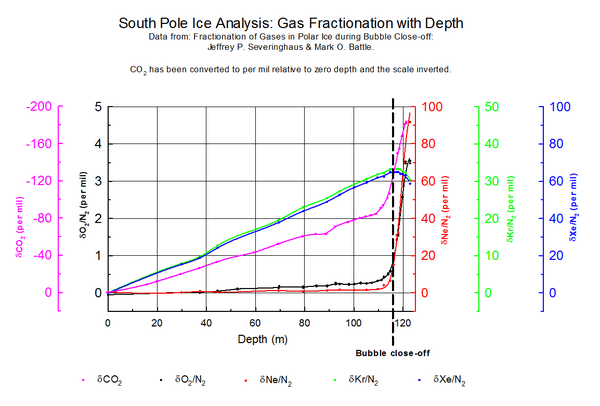 :large
South Pole ice core data shows similar gas composition trends with depth including change in fractionation rate around close-off where the fractionation rate increases.
Furthermore, as my document highlights:
“the authors demonstrate that they cannot reconcile the O2/N2 with the assumed correct CO2 record from ice cores. They find that the O2/N2 data shows fractionation that is about a factor of 4 greater than ‘expected’.”
Thus the ice core dO2/N2 record diverges from the purported CO2 history. http://www.scribd.com/doc/147447107/Breaking-Ice-Hockey-Sticks-Can-Ice-Be-Trusted
Jonathan, the problem is the O2 fractionation, not the CO2 fractionation, which is anyway small and, if present at all, in the order of 0.2-0.4 ppmv.
Did you take into account the change of CO2 in the atmosphere which goes on with depth, which doesn’t exist for other gases?
Latitude
August 29, 2014 at 10:21 am
James, thank you
CO2 levels are the root of the entire global warming hoodoo
Wouldn’t woodoo be a better word?
OK, statistical tests of the annual time series of greenhouse gas (GHG) concentrations and global average temperatures in order to determine if there is a relation between the variables finds that there is one. Huh?
I used the Historical CO2 record derived from a spline fit (20 year cutoff) of the Law Dome DE08
and DE08-2 ice cores for CO2 and my memory for the global temp changes-
The 35 years from 1910 to 1945, CO2 increased from about 300 to 310 ppm (10 ppm) about 3% and temperatures increased about 0.45 degrees C
The 33 years from 1945 to 1978, CO2 increased from about 310 to 333 ppm (23 ppm) about 7% and temperatures fell about 0.1 degrees C
The 36 years from 1978 to 2014, CO2 increased from about 333 ppm to 400 ppm (67 ppm) about 20% and temperatures increased about 0.45 degrees C.
From 1832 to 2014 CO2 increased from about 284 ppm to 400 ppm (116 ppm) about 40% and there was about 0.85 C global warming.
Before I apply any statistical tests, I want to eyeball the data and see if there appears to be a correlation. I suppose statistics is like gerrymandering. By choosing boundaries, you can get the results you’re looking for! The boundaries I choose above show no indication of correlation except the most general. Both CO2 ppm and global temperatures increased over the 1832 to 2014 time period, but not in any consistent way.
For extra credit- what is the inferred climate sensitivity from each of the above data sets?
How about the data set from 1978 to 1998 when CO2 increased from 333- 363 ppm (30 ppm) about 9%, and temperatures increased 0.45 degrees C. Aha, we found one that agrees with the IPCC climate models!
Now we’re cooking!