Allan MacRae says: Thanks to Alberta Jacobs
2
1
vote
Article Rating
Ulric Lyons “I would be pleased to demonstrate these findings to Ant*ony Watts when he is in the UK in September if he is interested. ”
I’m sure he will be very flattered. Is there any reason you don’t demonstrate that here? Sounds like important stuff. If it’s a secret, no point in posting about it , just keep quite about it and hide you results in a safe place.
Leif Svalgaard says:
August 11, 2014 at 5:15 pm
” In addition to the tiny, tiny magnetic changes, TSI changes some 70 W/m2 through the year due to the changing distance to the Sun”
————————————————————————————————————————–
My understanding is that the TSI you are referring to here is TOA. However, I believe too many people do not understand that and believe the actual output of the Sun changes by that amount. Is there a better way to refer to TSI so the meaning is clear to all, or is the TSI always TOA by definition?
A glorious sunrise is developing in Calgary today. The sun is coming up, and I predict with some confidence that the day will be warmer than the night (who knew?). I suspect a correlation, but cannot be sure… 🙂
We have been enjoying a wonderful summer, after a long cold winter – but central and eastern North America had it even colder and longer – record ice on the Great Lakes, and Chicago (among many other locations) had the coldest four winter months on record.
I’m guessing that the Sun has something to do with the climate, although I have not studied the matter in detail – those who do have many different opinions, and clarity seems to be a distant hope.
Here is a compilation of predictions for SC24. As you can see, there are 45 of them, more than enough to fill a roulette wheel, and they are “all over the map” ranging from a low of 42 to a high of 169, so somebody had to be close. Not sure that this supports any conclusion, except fundamental concepts of probability. 🙂
http://users.telenet.be/j.janssens/SC24.html
SC25 is just around the corner and predictions can start soon – Ladies and Gentlemen, faites vos jeux!
God, I hope to be wrong about imminent global cooling – I’m getting old and hate the cold.
Regards to all, Allan
Skill Testing Question:
How many people predicted imminent global cooling more than a decade ago?
Answer:
A very few people predicted global cooling more than a decade ago, but most “coolists” were stoned or burned at the stake by warmist zealots. Since then, “the pause” has caused global warming fanaticism to be debunked, and former warmist fanatics have covertly formed a new group, reportedly called ISIS.
re Vuk’s graph.
The roughly 80y period I picked out by eye ( since you refuse to provide a clear explanation for a reproducing your results ) gives the following estimated average cycles: 80/11=7.2 , 80/8.5=9.4
Within the accuracy of my eyeballed “8.5” cycles, I would guess that latter in 9.3*8.6=80
The former may be 7.5*10.7=80 , note how Hadley adjustments to SST severely attenuate the circa 9y periodicity and accentuate 7.5y.
http://climategrog.files.wordpress.com/2013/03/icoad_v_hadsst3_ddt_n_pac_chirp.png
I’m guessing your AMO is derived from Kaplan et al which adopts most of the Hadley “corrections”.
So I was incorrect in thinking that your graph was showing the same lunar cycle this I had identified but it does show the same kind of phase drift which disputes your claimed linkage.
It may be interesting to plot your geo index against ICOADS and see how well the phase lines up.
9.3 is suggestive of 18.6/2 : lunar declination Perhaps E-M-S alignments is a key factor in determining the variation in your ‘geo’ index.
wayne Job
http://wattsupwiththat.com/2014/08/11/a-gleissberg-solar-minimum/#comment-1707464
henry says
there is so much fiddling with the data that one has wonder……Better to rather establish your own data sets. My data set says we are currently cooling at a rate of -0.015K/annum since 2000 but it appears we are still accelerating further downwards. Up to now, that is 14 x -0.015 = -0.2 K
The other 4 major data sets that I quoted earlier say it is around -0.1K but none of those data sets are properly balanced NH / SH
I have a [simple] theory as to why we are cooling, and why it will continue to cool…
We know that there is not much variation in the total solar irradiation (TSI) measured at the TOA. However, there is some variation within TSI, mainly to do with the more energetic particles coming from the sun. It appears (to me) that as the solar polar fields are weakening,
http://ice-period.com/wp-content/uploads/2013/03/sun2013.png
more of these particles are able to escape from the sun to form more ozone, peroxides and nitrogenous oxides at the TOA. In turn, these substances deflect more sunlight to space when there is more of it. So, ironically, when the sun is brighter, earth will get cooler. This is a defense system that earth has in place to protect us from harmful UV (C).
That ozone is increasing, is easily proven. About the others, I don’t know [if we can measure them]
In any case, you can see that the acceleration of the cooling can be correlated with the decreasing solar polar field strengths.
Most likely there is some gravitational- and/or electromagnetic force that gets switched every 44 year, affecting the sun’s output.
{that 2 x 44 years brings the total actual Gleissberg cycle at around 87 or 88 years}
We are now waiting for the switch on the sun, where we cycle back to increasing polar field strengths again, which I predict must happen around 2016.
henry said
The other 4 major data sets that I quoted earlier say it is around -0.1K but none of those data sets are properly balanced NH / SH
henry says
The other 4 major data sets that I quoted earlier say it is around -0.1K but [ I think] none of those data sets are properly balanced NH / SH
It seems to me that a buried [insert favorite driver] signal in noisy temperature data kinda closes the case re: [repeat name of favorite driver]. Most solar proponents stipulate that there are any number of Earthly bottom up confounding/amplifying factors, ergo case closed in my opinion. CO2 modelers stipulate that there are any number of natural confounding/amplifying factors, ergo case closed in my opinion.
I’m all for looking for a needle in a haystack, but it has to be a pretty goddamn big one. So far the only big one I have seen is over on Bob Tisdale’s site related to El Nino correlated step-rises in sea surface temperature. Each one of those steps indicates warm water evaporating off the surface into the air, adding heat to the atmosphere from the ocean’s gas tank. Now that’s a pretty goddamn big needle.
Pamela Gray
Each one of those steps indicates warm water evaporating off the surface into the air, adding heat to the atmosphere from the ocean’s gas tank. Now that’s a pretty goddamn big needle.
Henry says
What you say is true. In fact that is the reason we are cooling. The reason why we are cooling is that there is less [UV] radiation coming into the oceans.
This can be easily understood from this graphic presentation:
http://blogs.24.com/henryp/files/2011/08/Atmospheric_Transmission.png
If ozone is getting more, there is less UV coming through which is a big chunk [look at the chi square distribution]
Obviously this graphic presentation was before we realised that besides ozone, peroxides and nitrogenous oxides are also formed by the most energetic particles coming from the sun {Trenberth’s missing energy}
and just ignore the fact that Sun incoming- and earth outgoing radiation it is completely out of proportion…..
UV into the oceans must eventually convert to heat, even if it is only at higher depths.So if UV is getting less, there is your explanation as to why earth is cooling.
There is no “other” way around this. I hope you understand.
Greg Goodman says:
……………..
Hi Greg
GeoSolar cycle is derived directly from geomagnetic field response to the solar activity.
Its spectrum’s principal components are 9.1 and 64.5 years, which is more or less the AMO’s spectral composition.
If you count from 1882 to 2010, there are 14 GS cycles, giving ~ 9.14 years period, while the 60’s periodicity (GS back extrapolated to 1700, varies between 58 and 67) isn’t as obvious. Neither the GS or the AMO cycles are of equal length or shape, one is affected by irregularities in the solar activity and geomagnetic shocks, http://www.geomag.bgs.ac.uk/images/image018.jpg, the other by occasional volcanic eruptions.
How does it work ?
Solar input is totally independent variable.
Terrestrial part of the equation has a degree of positive feedback, i.e. the geomagnetic input contributes to temperature changes (Svensmark, stratosphere etc), the equatorial temperature changes (mainly ENSO and monsoon strengths) move the geomagnetic field by altering the rate of rotation i.e. LOD..
Thus, I would suspect that the + or – 0.1C change, that can be without any doubt directly attributed to the solar cycles (via TSI, even Dr. S admits to that) is enhanced (~ doubled) by this positive feedback, but as every feedback introduces a phase shift (due to delay in the FB loop), so does the above, result decadal/multi-decadal ‘oscillations’.
This does not explain or says anything about the long up/down trends as experienced during the MWP, the LIA or ‘modern epoch’ warming. I attribute those to tectonics, but that is an even more controversial idea.
I do not expect or ask for any support of these ideas, universal rejection is the most likely outcome, just making my views (right or wrong) publicly known.
***
Leif Svalgaard says:
August 11, 2014 at 5:15 pm
In addition to the tiny, tiny magnetic changes, TSI changes some 70 W/m2 through the year due to the changing distance to the Sun. Here is an illustration of the changes: http://www.leif.org/research/TSI-through-a-year.png
***
When I look at this 70W/m2 annual TSI variance and knowing that global avg annual temps actually defy this trend somewhat (I know, land vs ocean in SH vs NH), then I see all kinds of posters linking the tiny 1.5W/m2 solar-cycle variance to significant climate changes, I have to shake my head in wonder….
vukcevic says:
August 12, 2014 at 2:29 am
indeed, it can not be both, but as has been demonstrated on more than one occasion your FFT spectrum analysis lacks good resolution.
The problem is not FFT, but the data themselves that are too noisy. The garbage part is your nonsense about the geomagnetic connection. Noisy data has all kinds of spurious peaks. Garbage in, garbage out. As usual, you have no idea what you talking about.
vukcevic says:
August 12, 2014 at 3:52 am
Then NASA adds their recent discovery:
Solar coronal mass ejections CMEs in the even-numbered solar cycles tend to hit Earth with a leading edge that is magnetized north.
This is simply not so. If it were, geomagnetic activity would show a 22-yr variation in phase with the sunspot Hale cycle from minimum to minimum, contrary to observations since the 1840s which show that the variation follows the polar fields, i.e goes from maximum to maximum. All this has been well-understood and observed for decades.
Tom in Florida says:
August 12, 2014 at 5:27 am
Leif Svalgaard says:
My understanding is that the TSI you are referring to here is TOA.
For the climate, TOA at the Earth is the proper measure. For stidy of the Sun, TSI at 1 AU is the proper measure. What is not to understand?
Thompson & Solomon 2009:
http://www.atmos.colostate.edu/ao/ThompsonPapers/ThompsonSolomon2_JClimate2009.pdf
figure 2 from above showing temp drop in TLS and the drop in ozone following each event.
http://climategrog.wordpress.com/?attachment_id=1002
changes in TLS compared to changes in SH SST.
http://climategrog.wordpress.com/?attachment_id=988
@Greg
for example:
https://sp.yimg.com/ib/th?id=HN.608056146891899248&pid=15.1&w=162&h=126&p=0
Ozone has been increasing since 1995.
CFC scare was a red herring as well. Complete nonsense,
[and to think that I worked on projects getting rid of CFC’s]
I have a complete set of data from 1927 from a station on the swiss alps showing that ozone is decreasing since 1951 and has started increasing again from 1995
exactly 44 years difference
is that not curious?
As I said, it is either warming or it is cooling. There no such thing as a pause.
HP: “I have a complete set of data from 1927 from a station on the swiss alps showing that ozone is decreasing since 1951 and has started increasing again from 1995”
Can we see it. Where’s the data ? ( BTW that graph is illegible.)
Ozone is not uniformly mixed, hence ozone hole etc.
The paper I linked above concludes a very small rise since 1995. NCAR and IPCC say essentially no significant change in TLS since 1995.. Surface temps say: pause. Ozone seems to be a key player.
Less ozone , less scatter back into space. Also less opacity in stratosphere means this gets down into lower climate system.
Following each eruption 0.5 drop in TLS and 0.1 rise SH SST.
The famous “ozone layer” you were trying to save is in the lower stratosphere. You may have helped stop global warming ! Well done.
Leif Svalgaard says:
August 12, 2014 at 6:55 am
The garbage part is your nonsense about the geomagnetic connection. Noisy data has all kinds of spurious peaks. Garbage in, garbage out. As usual, you have no idea what you talking about.
Now we blame data, if it is ‘garbage in’ why do you use it to justify spurious LP effect?
Are you now claiming that changes in the Earth’s magnetic (geo-magnetic) field do not affect 10Be deposition rate?
Despite the great experience and knowledge, when you put in the service of obscurantism, rather than the advance of science, it will not serve well to your legacy.
I have learned a great deal from many of your comments, but I do not read everything anyone says through the rose tinted spectacles, there are plenty of others who do that, one less shouldn’t be a distraction to the intended endeavour. Even a blindfold has its uses.
Near 22 year cycle is observable in:
– Heliospheric current sheet (yes I know ….) inclination, the Earth transverses through it frequently.
– Neutron count (difference between odd and even cycles)
– Global and hemispheric land and ocean temperature records.
Its presence may be ignored but not credibly denied.
Greg Goodman says: August 12, 2014 at 7:52 am
Where’s the data ?
ftp://iaclin2.ethz.ch/pub_read/maeder/totozone_arosa_monthly
Steven Mosher says:
“post your code and data.. saves on the air faire.. and more eyes on the problem.. always a good thing.”
It requires demonstration on a solar system model, and I have not yet produced a narrated animation. But I can give very simple instructions to anyone who has a copy of the TheSky or Alcyone astronomy programs on how to track the progression. As well as identifying when solar grand minima occur, it also shows where the sunspot maximum of most cycles occur, typically within less than a year.
Ulric would you be able and willing to give instructions here that illustrate your point using this easy to use program http://www.solarsystemscope.com/ ?
@Bob Weber
No that is not suitable at all, user defined step time periods are required.


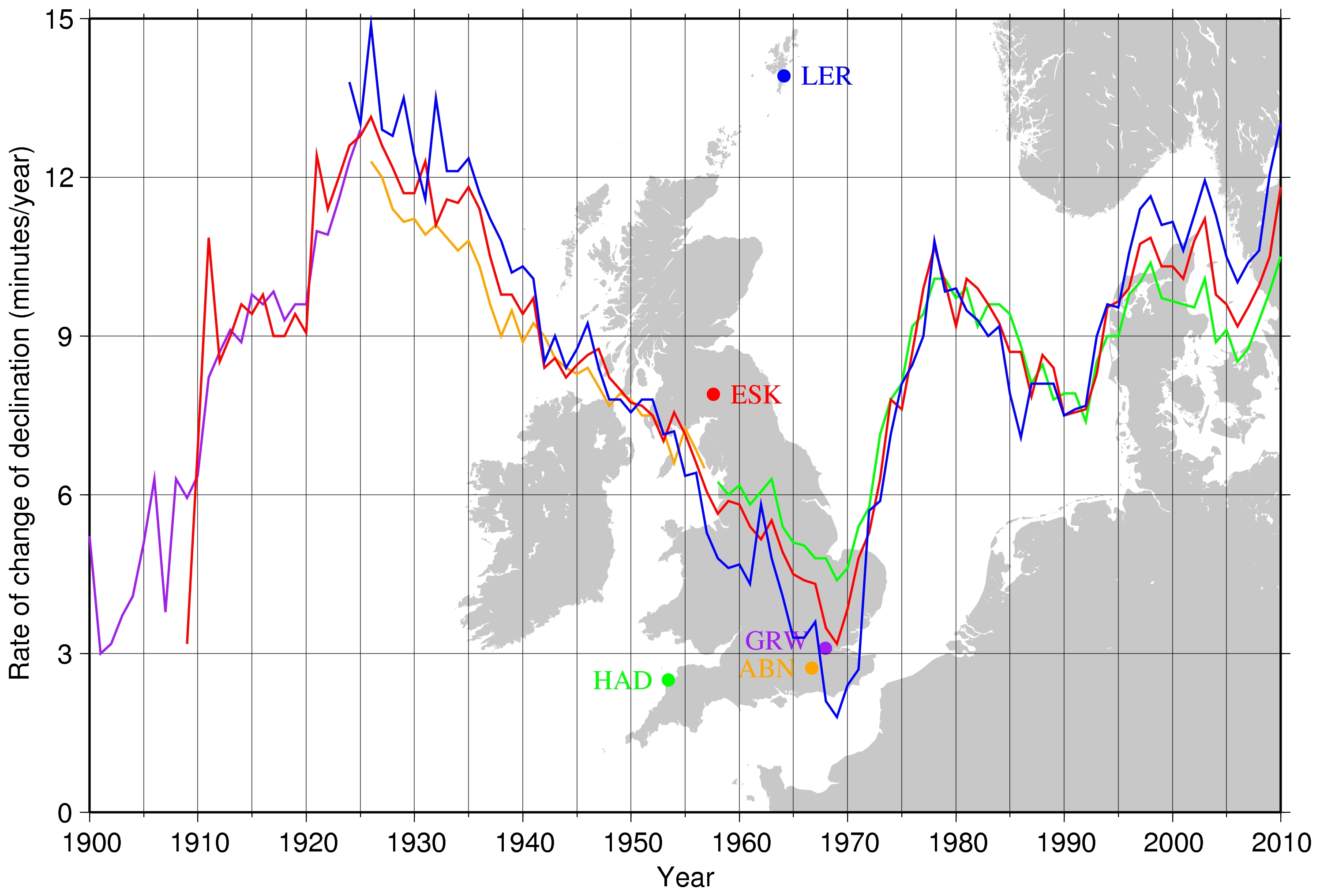

In a recent paper “The Centennial Gleissberg Cycle and its Association with Extended Minima”, to be soon published in JGR/Space, Feynman and Ruzmaikin discuss how the recent extended minimum of solar and geomagnetic variability (XSM) mirrors the XSMs in the 19th and 20th centuries: 1810–1830 and 1900–1910.
Edited abstract:
Such extended minima also were evident in aurorae reported from 450 AD to 1450 AD. The paper argues that these minima are consistent with minima of the Centennial Gleissberg Cycles (CGC), a 90–100 year variation observed on the Sun, in the solar wind, at the Earth and throughout the Heliosphere. The occurrence of the recent XSM is consistent with the existence of the CGC as a quasi-periodic variation of the solar dynamo. Evidence of CGC’s is provided by the multi-century sunspot record, by the almost 150-year record of indexes of geomagnetic activity (1868-present), by 1,000 years of observations of aurorae (from 450 to 1450 AD) and millennial records of radionuclides in ice cores.
The “aa” index of geomagnetic activity carries information about the two components of the solar magnetic field (toroidal and poloidal), one driven by flares and CMEs (related to the toroidal field), the other driven by co-rotating interaction regions in the solar wind (related to the poloidal field). These two components systematically vary in their intensity and relative phase giving us information about centennial changes of the sources of solar dynamo during the recent CGC over the last century. The dipole and quadrupole modes of the solar magnetic field changed in relative amplitude and phase; the quadrupole mode became more important as the XSM was approached. Some implications for the solar dynamo theory are discussed.
* Says The Hockey Schtick: If it is true that the current lull in solar activity is “consistent with minima of the Centennial Gleissberg Cycles,” and the Gleissberg Cycle is a real solar cycle, the current Gleissberg minimum could last a few decades before solar activity begins to rise again.
* Solar physicist Habibullo Abdussamatov predicts the current lull in solar activity will continue until about the middle of the 21st century and lead to a new Little Ice Age within the next 30 years.