EPA document supports ~3% of atmospheric carbon dioxide is attributable to human sources

NOTE: this post has an error, see update below. – Anthony

From a Wry Heat reprinted with permission of Jonathan DuHamel

A new post on The Hockey Schtick reviews a new paper “that finds only about 3.75% [15 ppm] of the CO2 in the lower atmosphere is man-made from the burning of fossil fuels, and thus, the vast remainder of the 400 ppm atmospheric CO2 is from land-use changes and natural sources such as ocean outgassing and plant respiration.”

This new work supports an old table from the Energy Information Administration which shows the same thing: only about 3% of atmospheric carbon dioxide is attributable to human sources.  The numbers are from IPCC data. 

Look at the table and do the arithmetic: 23,100/793,100 = 0.029.

URL for table: http://www.eia.doe.gov/oiaf/1605/archive/gg04rpt/pdf/tbl3.pdf

EPA_Table3pct

If one wanted to make fun of the alleged consensus of “climate scientists”, one could say that 97% of carbon dioxide molecules agree that global warming results from natural causes.

===============================================================

UPDATE:

Thanks to everyone who pointed out the difference in the chart and the issues.

I was offered this post by the author in WUWT Tips and Notes, here: http://wattsupwiththat.com/tips-and-notes/#comment-1696307 and reproduced below.

The chart refers to the annual increase in CO2, not the total amount. So it is misleading.

Since the original author had worked for the Tucson Citizen I made the mistake of assuming it was properly vetted.

The fault is mine for not checking further. But as “pokerguy” notes, it won’t disappear. Mistakes are just as valuable for learning. – Anthony Watts

wryheat2 says:

July 28, 2014 at 12:28 pm

Mr. Watts,

John Droz suggested I contact you.

On my blog, I commented on the reasearch by Denica Bozhinova on CO2 content due to fossil fuel burining. She apparently scared The Hockey Schtick into taking down his post on the matter. However, there is an older table from EIA which I reproduce on my post.

Denica Bozhinova has commented extensively, and frankly, I can’t understand her position since she seems to contradict what she wrote in the abstract to “Simulating the integrated summertime Ä14CO2 signature from anthropogenic emissions over Western Europe”

See my post here (you may reprint it if you wish):

http://wryheat.wordpress.com/2014/07/19/only-about-3-of-co2-in-atmosphere-due-to-burning-fossil-fuels/

Jonathan DuHamel

Tucson, AZ

The climate data they don't want you to find — free, to your inbox.
Join readers who get 5–8 new articles daily — no algorithms, no shadow bans.
2 4 votes
Article Rating
311 Comments
Inline Feedbacks
View all comments
July 30, 2014 3:15 am

EricS says:
July 29, 2014 at 6:06 pm
So, *nothing* else is changing in the carbon balance: no volcanoes erupting, no algae blooms blooming, etc.? Gaia is running a controlled experiment I guess? Including any sources/sinks that we have yet to characterize?
The 1992 Pinatubo eruption didn’t even increase the CO2 rate of change of that year: the rate of change dropped more due to extra uptake (more diffuse light – more photosynthesis) than the extra CO2 supply. Volcanic release are estimated at ~1% of human emissions.
There is no reason to believe that any natural flux suddenly increased at the exact rate and time as humans did at twice the measured increase in the atmosphere. Even with a lot of unknowns in individual sinks and sources, the net result of all natural fluxes is more sink than source for the past 55 years…
The biosphere is a proven sink for CO2
The oceans are proven sinks for CO2
Warming land absorbs more CO2
Warming oceans release more CO2 until a new equilibrium is reached at ~17 ppmv/°C
The combination of warming land and oceans gives a historical 8 ppmv/°C
Thus maximum 8 ppmv/°C for the warming since the LIA. Not 120 ppmv…
Do we even know if we’re in a regime where the D.E.s can be treated as approximately linear?
The temperature/CO2 ratio over the past 420,000 years at Vostok (800,000 years at Dome C) is remarkably linear, despite that a lot of underlying reactions are highly non-linear:
http://www.ferdinand-engelbeen.be/klimaat/klim_img/Vostok_trends.gif
The historical rate of change was 8 ppmv/°C

richardscourtney
July 30, 2014 3:31 am

Pete Mack:
Your post at July 30, 2014 at 1:46 am says in total

This number shows emissions and absorptions. In an equilibrium model, emissions and absorption would be equal. They are not. The difference (and a bit more) is due to extra CO2 from fossil fuel and land-use change. On this, at least, I’m glad to see you on the same side as the climate-change people.

Your propaganda contains much falsehood, and in particular makes the untrue assertion that “In an equilibrium model, emissions and absorption would be equal.”.
No! If you hadf read the thread then you would know your assertion is wrong.
For a rational and correct explanation of the matter please read my post at July 29, 2014 at 9:43 am which is here.
Richard

richardscourtney
July 30, 2014 3:37 am

cesium62:
You begin your post at July 30, 2014 at 3:01 am saying

You really ought to pay attention to more of your mistakes.

Say what!?
cesium62, you have been snowing WUWT threads with your mistakes this morning. Your mistakes are so many and so varied that I suspect they are a deliberate campaign intended as disruption of rational discourse.
Richard

richardscourtney
July 30, 2014 3:50 am

Ferdinand,
I write to proffer a warning. At July 30, 2014 at 3:15 am you write

There is no reason to believe that any natural flux suddenly increased at the exact rate and time as humans did at twice the measured increase in the atmosphere.

Absence of evidence is not evidence of absence.
So, using “We don’t know” as evidence is both a logical error and a hostage to fortune.
Also, whilst writing, I add that your post fails to address the point which EricS was making; viz. you claim the natural system was invariate but EricS points to natural sources of variation, and your comment about relative magnitudes of anthropogenic and natural variations does not counter his point.
Richard

Samuel C Cogar
July 30, 2014 6:02 am

Bernard Lodge says:
July 29, 2014 at 10:50 am
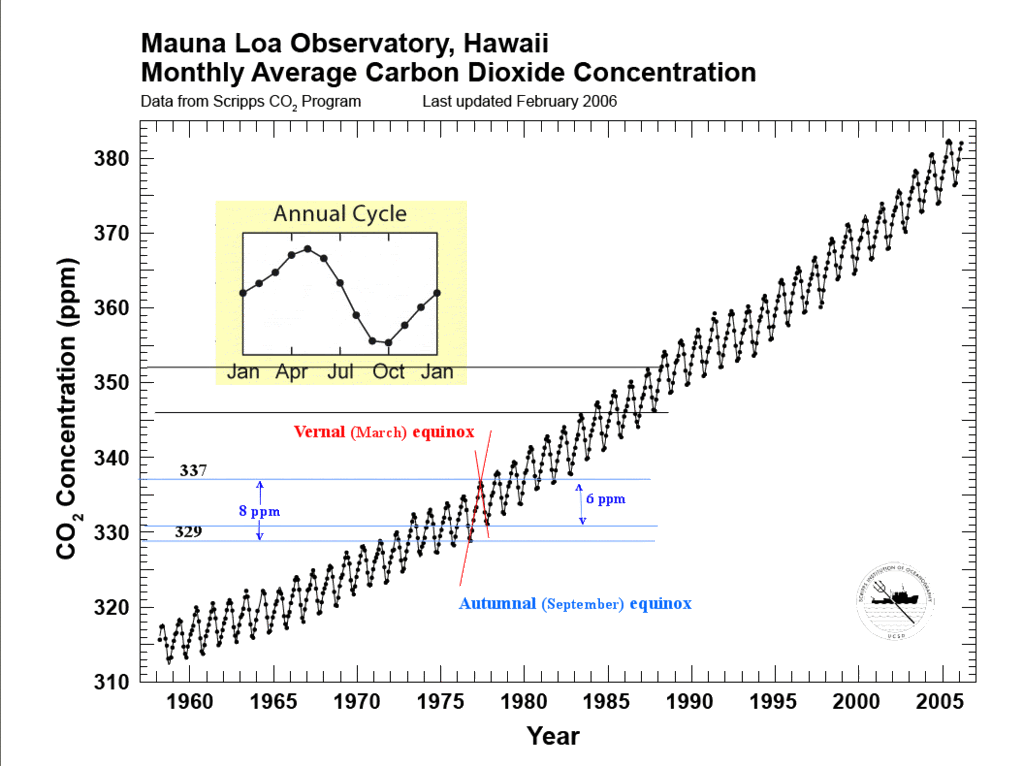
To be clearer, the levels of CO2 at Mauna Loa drop 7 ppm in March/April every year then jump by 9 ppm in Sept/Oct each year. The cause of these changes in is believed to be growth in vegetation in the ‘warming’ hemisphere (northern summer) sucking up CO2 due to increased photosynthesis combined with the cooling southern hemisphere (southern winter) causing increased absorption of CO2 into the oceans – both affects happening at the same time. In Sept/Oct, the process reverses as vegetation growth slows down in the north while ocean temperatures rise in the south, both causing global CO2 levels to rise. Don’t forget that the northern hemisphere has most of the land and the southern hemisphere has most of the oceans so the effects don’t cancel out.
Clearly, CO2 levels are driven by seasonal temperature changes every year yet we are told that changes in CO2 cause changes in temperature! This is not a trick question, I really want to know what is the explanation of this?
————————-
To better understand your stated per se “CO2 global phenomenon” you will first have to rid your thinking of a few “junk science” claims, two (2) of which I “highlighted” in your above commentary.
I agree with you that “CO2 levels are driven by seasonal temperature changes” but not via the reasons you are thinking, …. except for one that you noted, which is, in my learned opinion, the “primary” driver of both the bi-yearly (seasonal) cycling and yearly average increases in atmospheric CO2 ppm.
Now if you look at this modified Keeling Curve Graph … http://i1019.photobucket.com/albums/af315/SamC_40/keelingcurve.gif …. and/or the actual Mauna Loa CO2 data that is the source of the above graphical data ….. ftp://aftp.cmdl.noaa.gov/products/trends/co2/co2_mm_mlo.txt …. one can clearly see that there has been a “steady and consistent” clock-work pattern of increases and decreases in atmospheric CO2, each and every year …. for the past 55 years.
The yearly maximum CO2 ppm always occurs in mid-May (month 5)of each year following the Vernal equinox and the yearly minimum CO2 ppm always occurs around the 1st of October (month 9/10) of each year following the Autumnal equinox.
The growth in vegetation in the Northern Hemisphere has nothing whatsoever to do with the average 6 ppm decrease in CO2 ppm during the Spring and Summer months simply because the emissions of CO2 via the rotting and decaying of dead biomass, … due to the increase in moisture and warm temperatures, …… will “off-set” and/or negate any “sucking up” of CO2 due to increased photosynthesis.
And the rotting and decaying of dead biomass in the Northern Hemisphere has nothing whatsoever to do with the average 6 ppm increase (average 8 ppm in total) in CO2 ppm during the Fall and Winter months simply because the bacteria, fungi, etc. responsible for said “rotting n’ decaying” adhere to the Refrigerator/Freezer Law which retards and/or diminishes their “activity” when temperatures drop below 60F and/or when the biomass is “too dry” due to lack of moisture. The Fall and Winter months are always either too dry or too cold.
Now the above stated “average 8 ppm in total” includes an average 1-2 ppm yearly increase in CO2 ppm which has also been a “steady and consistent” clock-work pattern of increases in atmospheric CO2, each and every year …. for the past 55 years which is the result of a “steady and consistent” warming of the ocean waters … which are recovering from their Little Ice Age cooling.
Cheers

Samuel C Cogar
July 30, 2014 7:56 am

Ferdinand Engelbeen says:
July 29, 2014 at 4:05 pm
But there isn’t the slightest sign that the natural carbon cycle even increased over the past 55 years:
—————–
To support and/or justify your above “statement of fact” ….. you will have to provide factual scientific evidence that the anthropogenic CO2 emissions …. or lack thereof, …. have been “steady and consistent” ….. month after month and year after year ….. for the past 55 consecutive years ….. as is portrayed/recorded via the Keeling Curve Graph and the Mauna Loa Record.
So best you “think up” something that humanity has been doing in a “steady and consistent” manner for the past 55 consecutive years.
=================
Ferdinand Engelbeen says:
July 29, 2014 at 4:12 pm
Simply add some vinegar to a solution of (baking) soda and weigh both containers before and after the mixing…
————-
Iffen you are trying to simulate actual ocean activity ……….
Why not simply “shake-up” a can of cold beer and then “pop-the-top” and weigh the can both before and after the “pop-topping”.

Alan Robertson
July 30, 2014 8:00 am

Samuel C Cogar says:
July 30, 2014 at 6:02 am
“The growth in vegetation in the Northern Hemisphere has nothing whatsoever to do with the average 6 ppm decrease in CO2 ppm during the Spring and Summer months simply because the emissions of CO2 via the rotting and decaying of dead biomass, … due to the increase in moisture and warm temperatures, …… will “off-set” and/or negate any “sucking up” of CO2 due to increased photosynthesis.”
____________________
That’s a bold statement and doesn’t make sense, to me and here’s why: we know that each year, the biosphere is greening and there is a net gain in biomass, which indicates that annual CO2 bio- uptake outpaces CO2 release from the biosphere. Even the Mauna Loa/Keeling data apparently shows that annual CO2 sequestration is increasing, because the annual difference between high/low CO2 is increasing. Maybe I’m looking at this wrong. Otherwise, I think that your statements about the timing of decay are correct.
————————-
“Now the above stated “average 8 ppm in total” includes an average 1-2 ppm yearly increase in CO2 ppm which has also been a “steady and consistent” clock-work pattern of increases in atmospheric CO2, each and every year …. for the past 55 years which is the result of a “steady and consistent” warming of the ocean waters … which are recovering from their Little Ice Age cooling.”
_____________________
Has there been a steady and consistent warming of ocean waters for 55 years?

July 30, 2014 8:08 am

Hockey Schtick says:
July 29, 2014 at 6:13 pm
Your declining “sink rate” makes the convenient assumption that 100% of the CO2 increase is man-made, that none of the increase is a secondary effect of temperature, ocean outgassing, etc., thus it is a circular argument that proves nothing.
The sink rate is not declining, it is increasing in ratio to the extra pressure of CO2 in the atmosphere.
Temperature only gives a small change in input and output fluxes: 17 μatm extra pressure difference for 1°C warming of at the upwelling near the equator and 17 μatm less pressure difference for the intake at the polar sink places. That increases the inflow and decreases the outflow of CO2, such that the CO2 level in the atmosphere will increase. That goes on until the increase of CO2 in the atmosphere is 17 μatm (~17 ppmv). Then the previous in/out fluxes of CO2 between atmosphere and oceans are restored:
http://www.ferdinand-engelbeen.be/klimaat/klim_img/upwelling_temp.jpg
Thus the equilibrium “setpoint” of CO2 from the oceans changes 17 ppmv with temperature. That is all. Not 120 ppmv…
Extra upwelling from the oceans, be it from temperature, increased concentration, more upwelling or pH changes also would increase the δ13C level of the atmosphere, or at least reduce the reduction rate of the human supply of low-13C CO2.
The problem with all the “alternative” CO2 sources is that they all fail one or more observations. Only human emissions fit all observations…

Samuel C Cogar
July 30, 2014 8:18 am

Paul Jackson says:
July 29, 2014 at 5:22 pm
———————
Thank you Paul J, well stated.
If only more people actually knew and understood the “biology of the natural world” …. then they wouldn’t be mimicking so many half-truths and/or “junk science” claims in support of their miseducated beliefs.

July 30, 2014 8:21 am

Samuel C Cogar says:
July 30, 2014 at 7:56 am
To support and/or justify your above “statement of fact” ….. you will have to provide factual scientific evidence that the anthropogenic CO2 emissions …. or lack thereof, …. have been “steady and consistent”
See:
http://www.ferdinand-engelbeen.be/klimaat/klim_img/temp_co2_acc_1960_cur.jpg
and even in the year by year emissions, there is little variation (less than the detection limit of Mauna Loa):
http://www.ferdinand-engelbeen.be/klimaat/klim_img/dco2_em2.jpg
Iffen you are trying to simulate actual ocean activity
All what I tried to show is that a reduction of pH in the oceans from volcanoes would lower DIC, while more CO2 pressure in the atmosphere will increase DIC and lower the pH.
BTW, try to shake a Coke bottle in a 7 bar CO2 atmosphere: it will take up more CO2…

July 30, 2014 8:53 am

DesertYote says:
July 29, 2014 at 11:25 pm
The rate at which CO2 is “sequestered” is directly related to the concentration of CO2.
AND temperature, but to a lesser extent at current CO2 levels.
The rate at which CO2 is released is directly related to temperature
AND pressure. Temperature is good for 17 ppmv/K increase and decrease (oceans) and more uptake / decay for plants. Average 8 ppmv/K over the past 800,000 years. That shows a reaction of a quite simple linear first order process, no matter the underlying lots of processes involved.
Current 120 ppmv above (dynamic) equilibrium gives not more than 2 ppmv (4.5 GtC) extra uptake. Thus pressure wins by far from temperature, the more that there is no temperature increase in the past 1.5 decade.
The overestimated rate of anthropogenic CO2 production is well within the measurement uncertainty of vastly underestimated rate of “natural” CO2, and much smaller then the natural variability.
Please look at the data. CO2 production is quiet well known. the natural variability is only halve the human emissions and the uncertainty of the natural cycle fluxes is of not the slightest interest, as the net result of that cycle is known with the same accuracy as human emissions: the difference between measured increase and human emissions, thus negative over the past 55 years.
What we have here is a naturally stabilizing system with a great deal of negative feed back that totally swamps out mans insignificant contributions.
Of course nature tries to accommodate with human emissions, but it certainly doesn’t swamp out the human emissions. Currently only halve of them. If you like linear equations, the e-decay rate of the extra CO2 is over 50 years. Too slow to accommodate for all human emissions, but by far fast enough to accommodate for glacials and interglacials:
http://www.john-daly.com/carbon.htm

July 30, 2014 9:33 am

Ferdinand’s point on Oxygen balance should be taken far more seriously. Oxygen has a 300 Gt annual cycle and thus is cycling 30% faster than C (if you step back and think about it the speed of these cycles is astonishing). Respiration cannot take place without consuming O2 in six molecule increments. If we will argue that plankton are producing far more CO2 than we think, The O2 must be accounted for.
As usual there are vast uncertainties. Anaerobic metabolism produces CO2 from Oxygen that is not free in the atmosphere but is already bound in nitrates, phosphates, and sulfates. Its extent is unknown. And this raises the issue of chemical weathering which is more important (approaching a Gt) in the Oxygen than the Carbon cycle. Photochemical oxidation is thought to be about 6Gt …

July 30, 2014 9:53 am

Ferdinand says “CO2 production is quiet well known. the natural variability is only halve the human emissions and the uncertainty of the natural cycle fluxes is of not the slightest interest, as the net result of that cycle is known with the same accuracy as human emissions: the difference between measured increase and human emissions, thus negative over the past 55 years.”
The only thing that is “well known” is fossil fuel emissions. There are large error bars on natural sources & sinks, and on man-made land use changes [some positive and some negative], and it is a dynamic, not static, system. For examples of recent papers showing natural sources that were previously believed to be sinks but have recently been found to be sources instead see several posts including
http://hockeyschtick.blogspot.com/2014/05/settled-science-new-paper-challenges.html
http://hockeyschtick.blogspot.com/2014/05/new-paper-finds-large-erroneous.html
http://hockeyschtick.blogspot.com/2014/02/new-paper-finds-amazon-can-be-net.html
Ferdinand says above “Thus again, that humans emit only 4% of the natural emissions is of no interest at all, as nature captures 102% of the natural emissions back each year…”
And Bart replies: “Once again, a complete detachment from the way feedback systems work.”
Summing up Ferdinand’s hypothesis in his own words:
“that humans emit only 4% of the natural emissions is of no interest at all” and
“the uncertainty of the natural cycle fluxes is of not the slightest interest” as well as non-linear dynamic system responses.
Thus, apparently the only thing “of interest at all” to Ferdinand is his unjustified assumption that 100% of the increase in CO2 levels is man-made

Samuel C Cogar
July 30, 2014 9:53 am

Alan Robertson says:
July 30, 2014 at 8:00 am
That’s a bold statement and doesn’t make sense, to me and here’s why: we know that each year, the biosphere is greening and there is a net gain in biomass, which indicates that annual CO2 bio- uptake outpaces CO2 release from the biosphere.
————-
Said “indicates” is what you have been nurtured to believe, ….. but in fact, … IS NOT SO.
The FACT is that the natural biological emissions of CO2 actually begins before the biosphere photosynthetic “greening” begins. For the following reasons, to wit:
1. the initial biosphere “greening” requires a “warming” in the day-time surface temperatures …. as well as a minimum number of day-light hours. Said day-light hours is the primary “trigger” that initiates said “greening” … as well as the “shut-down” process in late summer and fall.
2. the initial biosphere “greening” DOES NOT require any CO2 absorption because it is produced by the stored sugars in the root system.
3. biological emissions of CO2 via rotting and decaying begins just as soon as the surface temperature “warm up”. Ref: my Refrigerator/Freezer Law http://www.fsis.usda.gov/wps/wcm/connect/934c2c81-2a3d-4d59-b6ce-c238fdd45582/Refrigeration_and_Food_Safety.pdf?MOD=AJPERES
4. both biosphere “greening” and biological emissions of CO2 ….. BEGINS around the 1st of February in the southern latitudes of the Northern Hemisphere …. and progresses slowly northward to the northern latitudes until the Summer solstice occurs in June. (That is why the far northern latitudes have a “short” CO2-emitting growing season)
Reference: USDA Planting Zone Map .. http://www.plant-power.com/images/zone_map.jpg
5. both biosphere “greening” and biological emissions of CO2 are neither steady nor consistent each and every year over the entire expanse of the above cited USDA Planting Zone Map therefore it is a figment of one’s imagination to assume that mid-May always reflects the “mid-point” of biosphere photosynthetic activity in the Northern Hemisphere.

Samuel C Cogar
July 30, 2014 10:14 am

Ferdinand Engelbeen says:
July 30, 2014 at 8:21 am
See:
and even in the year by year emissions, there is little variation (less than the detection limit of Mauna Loa):
——————–
Don’t be “talking trash” to me ….. by first claiming that atmospheric CO2 has generally been increasing since the Industrial Age and specifically increasing since 1958 ….. and then claiming those increases are undetectable even in the Mauna Loa record.

Samuel C Cogar
July 30, 2014 10:57 am

Hockey Schtick says:
July 30, 2014 at 9:53 am
The only thing that is “well known” is fossil fuel emissions.
—————-
I have to disagree with the above statement in you post.
Me thinks it would have been more appropriate to have stated “well believed”….. because there is no way in ell that CO2 emissions from burning fossil fuels is well known by anyone.
“Tracking” fossil fuel sales is almost akin to “tracking” marijuana sales or the number of illegal immigrants in the US. Unless, like a few other things, +-40% is considered a “scientific fact”.
“HA”, like the State DNR does in their “tracking” of Whitetail deer populations. They drive along the roadways …. counting the # of deer they see out in the fields ….. and then multiply that # by ten (10) to account for the # of deer that are surely “hiding” in woods.

Alan Robertson
July 30, 2014 11:42 am

Samuel C Cogar says:
July 30, 2014 at 9:53 am
Alan Robertson says:
July 30, 2014 at 8:00 am
“That’s a bold statement and doesn’t make sense, to me and here’s why: we know that each year, the biosphere is greening and there is a net gain in biomass, which indicates that annual CO2 bio- uptake outpaces CO2 release from the biosphere.”
————-
Said “indicates” is what you have been nurtured to believe, ….. but in fact, … IS NOT SO.”
____________________
Hello Mr. Cogar,
I made a statement to you in response to your assertion that the annual return of CO2 from decay, etc. negates any annual increase within the biosphere.
You just responded and said that my statement, which you quoted, is wrong and that I have been nurtured into a belief system…
Yet, with your response, you didn’t say one single thing to contradict my statement that the planet’s biosphere is greening and biomass increasing.
Satellite data (along with other data,) reveals that globally, net plant productivity is increasing and sequestering C at rate faster than the biosphere is releasing C due to decay/respiration.This process is well- known and is due to enhanced available CO2 to plants and increased temperatures, leading to extended growing seasons. Even NASA, which seems to be operating in support of a political agenda, can’t help but confirm that Earth’s biosphere is increasing in extent and vigor, even in such places as the Sahel and that the carbon sequester/loss ratio is increasing.

July 30, 2014 11:53 am

richardscourtney says:
July 30, 2014 at 12:01 am
Phil:
I write as a courtesy to say that I have read – and laughed at – your post at July 29, 2014 at 2:44 pm. As is typical of your comments, it is good on untrue abuse from behind the coward’s shield of anonymity, but it is poor on factual content.

Really, factual evidence such as “a change in pH of 0.1 is a change in the H+ ion concentration of ~26%, hardly ‘minute’,” and “your hypothesis about sulphate is unsupported by the data, sulphate is conserved in seawater at ~8%”. You’re too much of a coward to face up to the fact that you’re completely wrong on those points and avoid facing up to your errors and instead make pathetic excuses for not doing so.
I will discuss any flaw in my comments from rational humans and – as always – express gratitude when I am shown to be wrong. But only my disdain is obtained for untrue and irrational twaddle from anonymous internet trolls such as you.
You’ve been shown to be wrong on the above points, there’re no untruths and no irrationality, where’s your ‘gratitude’?

richardscourtney
July 30, 2014 12:33 pm

Phil.:
I see that you again demonstrate your self delusion with your post at July 30, 2014 at 11:53 am.
I have NOT been “shown to be wrong” and I would be grateful if I were.
I am content to discuss matters with knowledgeable and honourable people who disagree with me such as Ferdinand.
There is no way I will lower myself to engage with you. I have made that mistake before when I have always discovered the truth of the old maxim, “Never wrestle with a greasy pig: you can’t win and the pig likes it”.
Richard

DesertYote
July 30, 2014 12:44 pm

Ferdinand Engelbeen says:
July 30, 2014 at 8:53 am
CO2 production is quiet well known. the natural variability is only halve the human emissions and the uncertainty of the natural cycle fluxes is of not the slightest interest, as the net result of that cycle is known with the same accuracy as human emissions:
###
And Spock has a beard.

July 30, 2014 12:45 pm

Bart says:
July 30, 2014 at 12:07 am
After 34 years of practical work with feedback systems, I have some knowledge how they work. Not the big theories, which I have forgotten after decades of none-use.
This let’s see how the earth’s CO2 cycle reacts on the extra CO2 supply from humans.
– There is a lot of variability in the CO2 levels over seasons, year by year up to multi-millennia.
That is mainly caused by temperature variability. The reaction of CO2 on temperature is quite modest: 5 ppmv/°C seasonal, 4-5 ppmv/°C year by year (opposite to seasonal variations) and up to 8 ppmv/°C for decades to multi-millennia.
– For whatever reason the CO2 levels increased some 120 ppmv over the past 160 years, of which 80 ppmv since Mauna Loa and South Pole started measuring CO2.
– In the same time frame, humans emitted over 200 ppmv.
– The 100+ ppmv CO2 increase induced a net sink rate in nature of over 2 GtC/year. That is a direct feedback of the whole carbon cycle to the increased CO2 pressure in the atmosphere. Which leads to an e-fold decay rate of ~52 years or a half life time of ~40 years.
That is too slow to remove the extra CO2 out of the atmosphere in a short time frame. But by far fast enough to do that over time frames of centuries to multi-millennia.
It is very obvious that nature is in control of the atmospheric CO2 balance on this planet.
As said last time, but you didn’t react: that plot shows that fast variations of temperature (in fact the derivative) induce fast variations in the CO2 rate of change. That process is caused by the direct influence of temperature (and precipitation) changes on CO2 emissions from (tropical) vegetation. That can be derived from the simultaneous changes in CO2 and δ13C rate of change:
http://www.ferdinand-engelbeen.be/klimaat/klim_img/temp_dco2_d13C_mlo.jpg
CO2 and δ13C data from Mauna Loa and temperature data from HadCRU4_SH.
But as the biosphere is a net increasing sink for CO2, temperature is not responsible for the increase in the CO2 rate of change or the decrease in δ13C rate of change via the biosphere.
That means that the short term variability and the long term increase of the CO2 rate of change are completely disconnected and the first can’t be used as proof that the second also is caused by temperature. The matching of slopes between T and dCO2/dt is simple curve fitting and has no bearing in any known physical process. Moreover, it influences the amplitude of the first (biological) process variations which have nothing to do with the increase of the CO2 rate of change…
Thus while the short term variability of CO2 is largely caused by temperature variability, there is not the slightest reason to assume that the current 100+ ppmv CO2 increase is caused by temperature…

July 30, 2014 12:52 pm

DesertYote says:
July 30, 2014 at 12:44 pm
And Spock has a beard.
Some very smart people have problems with simple math like:
increase in the atmosphere = human emissions + natural emissions – natural sinks
2 ppmv = 4 ppmv + X – Y
X-Y = -2 ppmv
Where the variability of X-Y = +/- 1 ppmv, which is halve the human emissions, without any sign of increased variability over time:
http://www.ferdinand-engelbeen.be/klimaat/klim_img/dco2_em2.jpg.

July 30, 2014 1:08 pm

Ferdinand says “X-Y = -2”
Single equation, two unknowns, no unique solution
Some very smart people have problems with simple math like this

July 30, 2014 1:17 pm

richardscourtney says:
July 30, 2014 at 12:17 am
And nobody can weigh the oceans.
Indeed quite difficult, but one can measure what is in the oceans: all measurements taken at ships tracks and fixed stations show that the pH is decreasing and DIC is increasing over time. Which proves that the pH decrease is not caused by an addition of some acidic components but from increased CO2 input into the oceans…

July 30, 2014 1:34 pm

Hockey Schtick says:
July 30, 2014 at 1:08 pm
Ferdinand says “X-Y = -2″
Single equation, two unknowns, no unique solution
Some very smart people have problems with simple math like this

I have no problems with the unknowns, because the only solution needed is -2, which is all what counts for the increase or decrease of CO2 in the atmosphere.
No matter if X = 150 and Y = 152
or X = 300 and Y = 302
or (some part of) X and Y doubled or halved since last year
or some part of X suddenly got a part of Y
or that many individual fluxes of X and Y are not known to any accuracy
or…
You are looking for the unknowns in the carbon cycle, I am looking for the quite well known gain (or loss in this case) after a full cycle…

1 5 6 7 8 9 13