Guest Post by Willis Eschenbach
Recently there have been a number of accusations and bad blood involving myself, David Evans, Joanne Nova, Lord Christopher Monckton, and Leif Svalgaard. Now, I cannot speak for any of them, but on my part, my own blood ended up mightily angrified, and I fear I waxed wroth.
However, I see no point in rehashing the past. What I want to do is to return to the underlying scientific questions. In that spirit, I apologize sincerely and completely for wherever I put in “something extra” in the previous discussion. In Buddhism, there’s a concept called “something extra”, and one is enjoined to avoid putting in “something extra”.
It is explained in the following way:
If I say “I am angry” that is simply a true statement.
But if I say “You made me angry”, that is something extra.
So I ask any and all of you to please accept my sincere apologies for whatever what I said that was something extra, so that we can move past this difficult time and get back to discussing the science. Both sides have legitimate grievances, and I am happy to make the first move to get past all of them by apologizing to all of you for whatever my part was in the bad blood. I hope that the other participants accept my apology in the spirit of reconciliation in which it is offered, and that we can move forwards without rancor or recriminations.
Regarding the science, let me go back to the original question, and see what I can do in the way of making my claims in a more Canadian manner. I’ll start by looking at the recent record of the “TSI”, the total solar irradiance:
 Figure 1. Monthly total solar irradiance as measured by the CERES satellite. Vertical blue line shows mid-2004.
Now, if you don’t like the data from the CERES satellite, here’s the SORCE satellite data:
 Figure 2. Daily total solar irradiance as measured by the SORCE satellite. Vertical red line indicates mid-2004. SOURCE
Note what is happening in both graphs after mid-2004 (vertical lines in both plots). As in every solar cycle, the TSI declines somewhat, and bottoms out. Then, it starts to rise again. And by the end of the datasets, in both cases the TSI is higher that it was in 2004.
So what was the scientific dispute all about, the discussion that underlies all of the bad feelings?
It revolved around the following graph from David Evans, referenced by both Leif Svalgaard and Lord Monckton, showing the basis of his predicted upcoming global cooling :
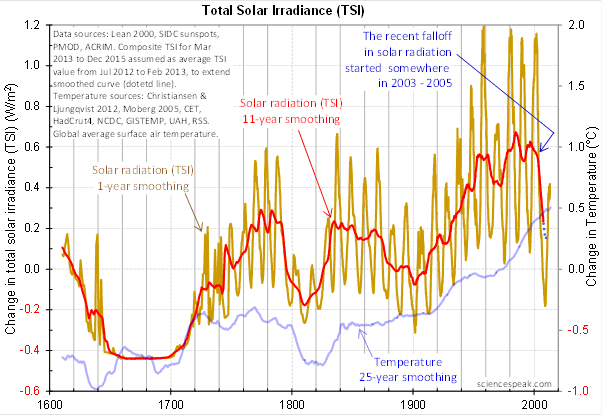
 Figure 3. David Evan’s graph of TSI (gold line), along with a centered 11-year moving average of the TSI data (red, with dotted blue extension), and a 25 year unspecified smooth of temperature, presumably a trailing average (blue line). (Click to enlarge)
Now, as you can see, the bright red line basically falls off the edge of the earth around 2004. The note says “The recent falloff in solar radiation started somewhere in 2003-2005″.
However, a look at both the SORCE and the CERES data shows no such “falloff in solar radiation”, neither precipitous nor otherwise. In fact, both datasets agree that by 2013 the TSI was well above the level in mid-2004.
Since there is no fall in the underlying data of any kind, why does the red 11-year average line show abrupt cooling starting around 2004?
The answer lies in the various problems with the graph.
• The TSI data is a splice of three datasets, with two of them showing the post-2000 period. This is a huge source of potential error in itself. However, it gets worse.
• One of the spliced datasets is the Lean TSI reconstruction, an outdated dataset that the authors of the reconstruction themselves admit is inaccurate.
• Another is the PMOD dataset. It is known to be reading low by 0.2 W/ms at the solar minimum, introducing a spurious apparently strong recent “cooling” where none exists.
• The 11-year centered average is an extremely bad choice for a filter for sunspot/TSI data. Because the solar cycle varies both longer and shorter than 11 years, at times the 11-year average actually reverses the sense of the data, converting peaks into valleys and valleys into peaks. Look at the period from 1760-1800 in Figure 3, for example. What is happening is that the frequency data is getting strongly aliased into the amplitude data. As a result, the average can end up far from the reality, particularly at the ends of the dataset.
For another example, look at the period just after 1740 in Figure 3. The 11-year average takes a huge vertical jump … but meanwhile back in the real word, the TSI itself is not rising at all. It is falling. Clearly, the large vertical jump in the red line is totally spurious.
• The TSI data has had about 900 days of “data” added to it using an arbitrarily chosen value. This is shown by the blue dots which indicate a continuing drop in the temperature.
So regarding the question of why the red line is acting so strangely, the answer is that we have a perfect storm of spliced data, bad data, arbitrary “data” added to the spliced bad data, and an extremely poor filter choice.
And as a result, the red line doesn’t represent reality in any shape or form. There is no precipitous drop in TSI starting around 2004. It doesn’t exist. Sure, the 11-year average says clearly that there is a huge drop starting around that time … but the actual data says something entirely different, as shown in Figures 1 and 2.
Now, in the heat of the moment Leif described the red line as being “almost fraudulent”. I think this was an over-reaction, but perhaps an understandable one. After all, if the red line were flipped over vertically it would make a lovely hockeystick, and if someone claimed warming was coming based on that hockeystick, people would call them alarmists … and calling someone an alarmist is certainly a close relative of calling them “almost fraudulent”.
However, my guideline is, never ascribe to malice what is adequately explained by error and misunderstanding. So I do not call their red line fraudulent, nor did I do so in the original discussion. Instead, I say that it is an error resulting from a misunderstanding. In any case, let me suggest that we leave out all ascription of motive and intent, that goes nowhere, and that we return to the science.
A more scientifically neutral description of the red line is that it is highly inaccurate and potentially misleading, because the apparent drop starting in 2003-2005 is simply an artifact of a combination of bad data and bad filtering.
Finally, to the degree that David Evans’ model predicts future cooling based on the red line, it is already falsified.
That is what I was trying to say, and I believe (subject to correction) that was what Leif was pointing out as well.
In closing, I will endeavor in this thread to keep my comments on as scientific a basis as possible, to avoid any personal references, and to not ascribe motive or intent. I request that everyone do the same. Many toes have already been stepped on in this discussion. Let’s see if we can simply discuss the science.
My best to all,
w.
VERY IMPORTANT: It is important in general, and in this discussion in particular, that you QUOTE THE EXACT WORDS THAT YOU DISAGREE WITH. Note that this doesn’t mean just referencing their entire comment. Quote the exact words of their comment that you think are in error, and tell us why you think those words are wrong. If you do not quote the exact words that you disagree with, none of us will know what you are referring to … and out of such misunderstandings grows animosity and misunderstanding.
Finally, please don’t delve into the rights and wrongs of what has happened in the previous discussions. I am not interested in the slightest in ascribing blame or responsibility. I have accepted my own responsibility for my own actions and apologized for wherever I was over the line. What I or the others did in the past is a blind alley, so please confine your comments to the science, and as the saying goes, “Let the dead past bury its dead”.
lsvalgaard says:
ren says:
Chart neutrons indicates that UV radiation
The Neutron Monitor counts have nothing to do with UV radiation as such. You might get by by saying that solar activity in 2009 was lower than most solar minima, but that we knew already as the sunspot number is a good indicator of that.
You’re wrong UV corresponds very well to the GCR and Ap, because depend on the activity of the solar magnetic field.
http://oi60.tinypic.com/28svb74.jpg
HenryP says: July 19, 2014 at 8:40 am
………
On wings of light a friend becometh a foe, the wise becometh the insane.
ren says:
July 19, 2014 at 9:20 am
You’re wrong UV corresponds very well to the GCR and Ap, because depend on the activity of the solar magnetic field.
As we have very good indicators for the solar magnetic field, it is not of any use to drag in the GCR modulation which also respond to factors other than the strength of the magnetic field, e.g. to the sign of the solar polar fields. Every 22 years [and in particular in 2009] the GCR count is higher than at the intervening minima. So, again, the GCRs do not regulate UV and are a poor proxy for solar activity, and AP is also a poor proxy. We have much better ones, e.g. the SSN.
Avery Harden says:
July 19, 2014 at 9:23 am
but is your premise that any warming trend, or cooling as some here seem to presume, is solely dictated by the sun. Do you rule out increasing greenhouse gases as having an effect on temperatures?
There is no evidence that the sun is the sole cause. And increasing GHG do have an effect. The question is ‘how large’ or ‘how small’ depending on your view. In my view, I’d ask ‘how small’.
But why so much focus on TSI? It has been neutral or trailed down, yet the long term temperature trend has stayed up.
Avery Harden says:
July 19, 2014 at 9:41 am
But why so much focus on TSI? It has been neutral or trailed down, yet the long term temperature trend has stayed up.
Bingo! There is no evidence that the sun is the sole cause.
Many would say any changes to the TSI recently have not been a factor at all for the long term temperature trend staying up.
Willis Eschenbach says:
July 18, 2014 at 11:49 pm
Agnostic says:
July 18, 2014 at 10:01 am
@Willis
Yes I know you remarked on it here, but given the large number of comments both here and at Jo’s, and considering it clearly vexes you in that you feel it is needed to validate the model, don’t you think it worth sending a private email to Dr Evans to ask him where you might find it within the material already released, or if it has not been released to send it you?
Many thanks for the suggestions, Agnostic. I asked for the out-of-sample tests on Jo Nova’s blog back around post two of eleven, from memory. I was told that they had already done the tests, and that they would release them at some point.
I asked again when Joanne was participating in the “Solar Notch Model Released” thread here. I was roundly ignored.
I’ve asked again here on this thread for both the code setting the arbitrary parameters and their own out-of-sample tests several times on this thread. Again, no reply.
I’m done with these folks. The idea that I should crawl on my knees to them to ask pretty please will they release their hidden information to me personally is laughable.
===========
Directly asking someone rather than *Hoping* they read your angry diatribe in a long thread of angry diatribes is hardly “crawling on your knees” nor is a an unreasonable burden or suggestion. Just as you find it so easy to ignore posts from people in threads for spurious reasons such as they don’t use their “real name”, it’s easy enough for others to ignore your “requests” because they are make in the middle of blog posts rather than directly to the people that you are requesting from. You keep talking about others losing credibility, well every time you say “they haven’t provided the data I asked for” and follow up with words to the effect of “I refuse to crawl on my knees and directly ask them for it” *you* are the one that loses credibility. You want something, go to the source, don’t wait for the source to come to you because you’ll likely have a long wait that way.
Steve from Rockwood
The second thread supporting Evans’ theory is the extreme non-linear behavior between TSI and temperature that would have to exist in order for such small changes in TSI to have such large changes in global temperatures. I can’t accept his theory for that reason. If the earth was that sensitive to small TSI changes I doubt we would exist.
Henry says
It is really very simple. Study this graph [ of TSI].
http://en.wikipedia.org/wiki/File:Solar_Spectrum.png
Let us assume that that graph is in fact an accurate average presentation of the 11 year Schwabe cycle or over the whole 22 year Hale solar cycle, whatever you prefer,
My data suggests that the top of that [average] chi square distribution moves a bit, ca. 44 years to the right and then 44 years to the left, like an a-c wave.
If it is moving left [as it is doing now/ quiet sun = brighter sun] you get [somewhat] more ultra short wave radiation (USW)
The atmosphere protects us from that type of harmful radiation by reactions:
O2 + USW = >.O3
H20 + O2 + USW = > HxOx
N2 + O2 + USW = > NxOx
etc. (there are more reactions)
Relatively more of these compounds TOA means that there is more back radiation [to space], i.e. the yellow area to the left is getting bigger. [note that Trenberth only reported O3, it seems he did not know about the many other substances that I am reporting as well]
As we are in fact looking at a deviation at the highest area under chi square curve this does have an effect on global temperatures, namely,
more back radiation by more ozone & others means less [normal] UV in the oceans, that means less energy in the oceans. Hence it is [currently] cooling.
Just remember: this cannot be seen so easily from the straight data from the sun, because we are looking at an a c wave playing out within the normal cycles of increasing and decreasing USW within the normal cycles….
To see this you have to study the rate of change in temperature on earth, choosing reliable sources of data, which, when properly done, clearly suggest that an a c wave does exist.
for example, see the graph below the minima table:
http://blogs.24.com/henryp/files/2013/02/henryspooltableNEWa.pdf
[at the very bottom of all the tables]
Steven Mosher says:
July 19, 2014 at 8:55 am
Kip draws from the bag of objections that Steve Mcintyre had to deal with.
Remember upthread where I said that WE HEARD THIS ALL BEFORE
what did mcintyre have to deal with
‘ he didnt ask in the right way’
=====
There’s nothing burdsome or unusual in asking someone directly and nothing at all like the objectsions to Steve McIntyre. McIntyre *did* ask the people directly, something you and Willis seem to be at pains *not* to do. why is that? Hoping that someone response to you when you don’t ask them directly is a fools hope.
Avery Harden says:
July 19, 2014 at 9:48 am
Many would say any changes to the TSI recently have not been a factor at all for the long term temperature trend staying up.
and they would be quite right. Here is the temperature chart for Planet Earth the past 500+ million years http://www.leif.org/research/Temp-of-Planet-Earth.png
During all that time the Sun’s output [TSI] has increased 5% [about 50 times the increase from solar min to solar max], yet the temperature has gone down.
Willis Eschenbach says:
July 19, 2014 at 8:57 am
Agnostic says:
July 19, 2014 at 5:28 am
@Willis and Steven Mosher
Right, so you think it sufficient to make your requests for important information on a blog rather than a direct email? Even though you emailed Phil Jones?
Since this is the 21st century, since they are obviously reading the blog posts, since “on a blog” is where they themselves have published their “important information”, since I’ve made the same request both on this thread, on the previous thread, on the thread before that, and on the same blog where they published their information, and since Joanne has responded directly to my comments requesting the information … yes, I absolutely think that is more than sufficient.
============================
I haven’t seen one single post from Dr Evans in this thread. AS such there is not one single shread of evidence that Dr Evans has read a single word in this thread. Given that, If I had a question for Dr Evans, I would appear pretty damn stupid to expect an answer if I only asked it in this thread of when he has yet to appear. Whereas If I were to ask him directly, I’d atleast be certain he’d have heard my question. Seems to me if you have a question for Dr Evans the place to take it is *directly* to Dr Evans, not to some blog post that there’s no evidence he’s ever read it, or depending on other people to convey that question to him.
Willis Eschenbach wrote: if you think that science is not a “blood sport”, consider what it means to a scientist who has spent his (her) whole life and staked his name and his job and his career on some theory, only to watch as some other scientist then falsifies that theory completely, and he sees his whole scientific career go up in smoke …
This would seem to describe the climate alarmists’ situation rather well. For in their case it’s indeed their names and their jobs and their careers that are on the line.
But to the best of my knowledge, this doesn’t describe the climate sceptics’ situation. Most of them aren’t being paid to peddle scepticism. Many of them are retired physicists and engineers. I know nothing at all about you (except that you write a lot on WUWT), but to the best of my knowledge, Leif Svalgaard is a well-respected solar physicist, currently employed at Stanford University. And he generally intervenes on these threads when someone starts writing about the Sun’s behaviour. But to the best of my knowledge this is a personal interest of his, and not something demanded by his job (studying the Sun). So I can’t really see why he’s been such a ferocious critic of Evans/Nova. What’s a stake for him? Or for you, for that matter?
I should remark in passing that I have zero name/job/career at stake. I’m just interested in ideas (I have had quite a few of my own stupid ones), and I’m always pleased when people have a ideas, and take the time to develop them a bit. Which is why I was delighted to see Evans/Nova having an idea and developing it a bit. I think that’s where science begins: with people having ideas and fooling around with them and then saying “Hey, guys! Here’s my idea! It’s probably all wrong, but maybe it’s worth a spin on the roulette table.” If everyone just gets crushed every time they open their mouths, they’re just going to keep their thoughts to themselves, and nobody’s ever going to say a word anything. Down that path lies the death of science.
No question it’s a bad idea to not publish your code and your out of sample tests on a sceptical scientific blog like WUWT. However, I take some hope away that, given the stagnant state of much of mainstream climate science as the team hunkers down behind their carbon wall, that the sceptical side will more and more shift into the breech created by falsified science and take over development of real climate theory. Mincing mainstream science is necessary and even personally rewarding, but at some point when there is a stand-off, someone has to take over the task of replacing hypotheses.
From John Endicott on July 19, 2014 at 9:45 am:
Evans is asking for credibility, for his model. Not publicly releasing the data and code, as we have long been accustomed to with Jones, Hansen, and Mann, is not getting him credibility. Having to ask Evans is allowing Evans to be a gatekeeper, letting him decide who is worthy of receiving it or if a request is spurious and may be ignored.
If Evans is an honest researcher who will have no problem releasing the info to whomever will ask, then why accept the bother of gatekeeping at all? Post the code and data where anyone can freely access it.
Frank Davis says:
July 19, 2014 at 10:06 am
But to the best of my knowledge this is a personal interest of his, and not something demanded by his job (studying the Sun). So I can’t really see why he’s been such a ferocious critic of Evans/Nova. What’s a stake for him?
I am not a ‘ferocious’ critic of anybody. I am interested in conveying the science as correctly as we know it, and I critique bad science, pseudo-science, nonsense, etc when I see it [and there is a lot of it here]. I am always willing to explain in detail where the problems are, but in most cases that is a wasted effort [like trying to tell your children what to do]. We do at Stanford have a program of Public Outreach [although my blogging is not directly related to that], so we care about communicating science to the general public.
kadaka (KD Knoebel) says:
July 19, 2014 at 10:11 am
Evans is asking for credibility, for his model. Not publicly releasing the data and code, as we have long been accustomed to with Jones, Hansen, and Mann, is not getting him credibility. Having to ask Evans is allowing Evans to be a gatekeeper, letting him decide who is worthy of receiving it or if a request is spurious and may be ignored.
If Evans is an honest researcher who will have no problem releasing the info to whomever will ask, then why accept the bother of gatekeeping at all? Post the code and data where anyone can freely access it.
==================
Idealy he should, and given time, perhaps he will. It’s only been a matter of weeks since this subject has come up, not the years that Mann, et al have been “gatekeepers”. Given that it has been such a short time, if he’s not moving “fast enough” for you in releasing his data, the place to take that is *directly to him*, like it or not.
Avery Harden says
Many would say any changes to the TSI recently have not been a factor at all for the long term temperature trend staying up.
Henry says
You sound exactly like the good dr. here
but in case you are not leif and if you are interested in the truth\
I recommend you do some work for yourself
like this
http://blogs.24.com/henryp/2013/02/21/henrys-pool-tables-on-global-warmingcooling/
Leif, where and when did David Evans say this, what where his EXACT words, please:
lsvalgaard says:
july 18, 2014 at 6:26 pm
“Central to Evans’ claim of the sharp drop in temperature [0.5C] is his contention that from the 2003-2005 timeframe until today, TSI has decreased substantially.”
and again
lsvalgaard says:
july 18, 2014 at 7:01 pm
“Fact is that Evans claims a much larger decrease than there really is. Plus that he claims that TSI decreased sharply from 2003-2005 until now, while in reality TSI increased.”
Breaking it down:
“Fact is that Evans claims a much larger decrease than there really is”
How do you know what TSI is for SURE when all TSI datasets are different, and the value of TSI is still being questioned, per
lsvalgaard says:
July 18, 2014 at 9:55 am
Salvatore Del Prete says:
July 18, 2014 at 9:45 am
If I were a betting man I bet the TSI data for the past 10 years – present will be revised.
“It most certainly will http://www.leif.org/research/DudokdeWit_announcements.pdf and probably upwards a bit [taking ACRIM into account]”
Where and when did David Evans say ” TSI decreased sharply from 2003-2005 until now” especially that “UNTIL NOW” or “UNTIL TODAY” part. If you can’t qoute him directly saying that “UNTIL NOW” or “UNTIL TODAY” part, your argument with him then reduces down to the reduction in TSI that actually started in 2002, not 2003.
TSI (daily) taken from http://ceres.larc.nasa.gov/data/CERES_EBAF_Ed2.8_DailyTSI.txt ,
2000 03 01 1360.2324 (start of record)
2000 12 04 1362.4636
2001 12 09 1362.3284
2001 12 31 1362.7272
2002 01 01 1362.6575
2003 01 01 1361.8378
2004 01 01 1361.1197
2005 01 01 1361.1265
2006 01 01 1360.8255
2007 01 01 1360.7327
2008 01 01 1360.5891
2009 01 01 1360.5222
2010 01 01 1360.4849
2011 01 01 1360.9074
2012 01 01 1361.3176
2013 01 01 1361.1569
2014 01 01 1361.2120
2014 03 31 1361.6971 (end of record)
2014 07 12 1361.5552*
* (from http://lasp.colorado.edu/data/sorce/tsi_data/daily/sorce_tsi_L3_c24h_latest.txt)
CLEARLY, TSI started dropping off day one in 2002, and the TSI overall drop-off persisted through the solar minimum into the start of 2010.
lsvalgaard says:
July 18, 2014 at 12:08 am
“As solar activity can’t be less than nothing, TSI can’t be less than when we had no solar activity, e.g. in 2009”
The issue with that statement is we have no idea how low TSI can go because we weren’t there to measure it during the MM. Just because sunspot numbers drop to zero doesn’t mean that solar irradiance has bottomed out necessarily. F10.7 during cycles 19-24 ranged from 63-66 sfu. The fact is we don’t know how low the sun’s output can go as registered in it’s magnetic state, in F10.7 or TSI, during a PROLONGED zero sunspot state period. We have never measured a zero-sunspot state that lasted long enough to find out!
I hope for your sake Leif you can find a direct quote. For David Evans sake I hope you can’t.
Either way, TSI dropped from 2002 to at least the beginning of 2010. TSI dropped from the SC23 max of 1,362.7272 on 12/31/01 to the SC24 maximum measurement of 1362.0669 on 4/6/14.
It would be good to hear more detail about how you go from LEIF2007 down almost 5W/m2 to today’s TSI. How does anyone know whether TSI really measured an actual 5W/m2 change that people aren’t recognizing? Maybe it was 5W higher through the peak of SC23 and those who changed it may have “THOUGHT” it was too high and endeavored to scale it down when MAYBE it was right as mesured… the problem we all have is there are so many TSI datasets that have too many overlapping scaling issues. Where are the step-by-step negotiations for the TSI reconstruction laid-out so we can all see and understand it?
F10.7 is so much easier – no trauma, no drama.
“Just because sunspot numbers drop to zero doesn’t mean that solar irradiance has bottomed out necessarily. F10.7 during cycles 19-24 ranged from 63-66 sfu.”
Today: SSN=0, F10.7=89. 2008-09, when SSN=0, F10.7=65 min. Two dates with the same SSN giving DIFFERENT solar activity levels, as registered in F10.7cm flux. The other solar indices including Bt also are different wrt SSN=0, so we can’t use SSN=0 as a baseline for all solar indices.
Bob Weber says:
July 19, 2014 at 10:28 am
where and when did David Evans say this, what where his EXACT words, please:
Are you too lazy to look for yourself?
“The reason for the cooling is the dramatic fall in solar radiation that started around 2004. [ http://joannenova.com.au/page/2/ ]”
How do you know what TSI is for SURE when all TSI datasets are different, and the value of TSI is still being questioned
The most reliable source is SORCE/TIM from LASP which is not in question for the period 2003-today..
Either way, TSI dropped from 2002 to at least the beginning of 2010. TSI dropped from the SC23 max of 1,362.7272 on 12/31/01 to the SC24 maximum measurement of 1362.0669 on 4/6/14.
Quoting daily values is meaningless, as you can see here: http://www.leif.org/research/TSI-SORCE-Cycle-24.png
You can, of course, plot all the observations [for every day] as here:
http://www.leif.org/research/TSI-since-2003.png
It would be good to hear more detail about how you go from LEIF2007 down almost 5W/m2 to today’s TSI. How does anyone know whether TSI really measured an actual 5W/m2 change that people aren’t recognizing?
http://www.leif.org/EOS/2010GL045777.pdf
“[1] The most accurate value of total solar irradiance during the 2008 solar minimum period is 1360.8 ± 0.5 W m−2 according to measurements from the Total Irradiance Monitor (TIM) on NASA’s Solar Radiation and Climate Experiment (SORCE) and a series of new radiometric laboratory tests. This value is significantly lower than the canonical value of 1365.4 ± 1.3 W m−2 established in the 1990s, which energy balance calculations and climate models currently use. Scattered light is a primary cause of the higher irradiance values measured by the earlier generation of solar radiometers in which the precision aperture defining the measured solar beam is located behind a larger, view‐limiting aperture”
My reconstruction was normalized to the ‘canonical’ value en vogue in 2007.
F10.7 is so much easier – no trauma, no drama.
F10.7 does not show any dramatic drop from one minimum to the next:
Slide 6 of http://www.leif.org/research/SHINE-2010-Microwave-Flux.pdf
so I’m fine with F10.7 as an indicator of solar activity.
Bob Weber says:
July 19, 2014 at 10:39 am
Today: SSN=0, F10.7=89. 2008-09, when SSN=0, F10.7=65 min. Two dates with the same SSN giving DIFFERENT solar activity levels
Comparing daily values is meaningless.
A cowboy just looking for a fight, might add an addendum to their treatise saying something along the lines of:
“VERY IMPORTANT: It is important in general, and in this discussion in particular, that you QUOTE THE EXACT WORDS THAT YOU DISAGREE WITH……..”
===============
It tries to set down the rules of the fight that is sure to follow, almost as if the fight was the true end game ? (or nearly so).
This is strange. Why is the following happening?
WoodForTrees’ Help page says of the “Isolate” function: “Does the same running mean as ‘mean’, but then subtracts this from the raw data to leave the ‘noise'”.
Using an 11 year mean:
http://woodfortrees.org/plot/pmod/from:1978.8/to:2011.8/offset:-1366/plot/pmod/from:1978.8/to:2011.8/isolate:132/
The signal is the noise plus a 1366 W/m^2 offset, up to about 2004 (or perhaps 2003?) when they noticeably diverge as the noise shoots upward.
http://woodfortrees.org/plot/pmod/from:1978.8/to:2011.8/offset:-1366/plot/pmod/from:1978.8/to:2011.8/isolate:66/
With 5.5 year mean there’s greater differentiation, and you can see better that something did go haywire on the noise around 2004.
Why is the signal actually the noise plus the offset?
From “Raw Data” link, first graph.
PMOD – 1366: “#Mean: -0.0986646”
PMOD Isolate:132: “#Mean: -0.00520949”
Alignment by means over entire record:
PMOD – 1366 + 0.0986646 = 0 = PMOD Isolate:132 + 0.00520949
PMOD = PMOD Isolate:132 + 1365.906545
Offset ~= 1365.9
http://woodfortrees.org/plot/pmod/from:1978.8/to:2011.8/offset:-1365.9/plot/pmod/from:1978.8/to:2011.8/isolate:132/
Wow, that is strange how “noise” and signal can match up indistinguishably so often. Don’t know what it means, but that’s good enough evidence for a Goodman Proof.
Leif Svalgaard wrote: I am not a ‘ferocious’ critic of anybody.
In the body of the post above, Willis Eschenbach wrote: Now, in the heat of the moment Leif described the red line as being “almost fraudulent.”. What is that if it’s not ferocious?! And,correct me if I’m wrong, but it was almost your first response to the Evans/Nova hypothesis
We do at Stanford have a program of Public Outreach [although my blogging is not directly related to that], so we care about communicating science to the general public..
And I’m sure you do it very well. But in the present matter we are concerned with something that lies beyond the borders of established science. Because nobody really yet knows what controls terrestrial temperatures. So when it comes to new ideas (like the Evans/Nova notch filter), there isn’t any established science to communicate or defend. Which is why new ideas ought (in my view) to be welcomed at the outset, even if they fairly soon prove to be fatally flawed in one way or other.
Which is why I applaud Evans/Nova for having an idea, and pursuing it, even if it may one day prove to be as unhelpful as any of the other ideas that anyone has had.
TSI data is not reliable and let us see how many times values over the past 10 years get revised or worse how many different sets of data we wind up with.
Terry Oldberg wrote: Frank Davis: You’ve used the term “science” in reference to Dr. Evans’s model.
I think it’s a scientific hypothesis. It is, after all. hardly established science.
The claims that are made by Dr. Evans’s model do not appear to me to be falsifiable.
As best I understand it, his model predicts global cooling in a few years time. That is an eminently falsifiable prediction, because events will reveal the truth of the matter.
Frank David:
Thanks for giving me the opportunity to clarify. A scientific model is a generalization from observed events to events not yet observed. The various events belong to a set that is an example of a statistical population. For falsifiability, this population must be described in detail for it is from this population that observed events are drawn in testing the model. Based upon the somewhat sketchy description at the Evans model’s Web site, my guess is that this population does not exist for Evans’s model.