On ‘denying’ Hockey Sticks, USHCN data, and all that – part 2

In part one of this essay which you can see here, I got quite a lot of feedback on both sides of the climate debate. Some people thought that I was spot on with criticisms while others thought I had sold my soul to the devil of climate change. It is an interesting life when I am accused of being in cahoots with both “big oil” and “big climate” at the same time. That aside, in this part of the essay I am going to focus on areas of agreement and disagreement and propose a solution.

In part one of the essay we focus on the methodology that was used that created a hockey stick style graph illustrating missing data. Due to the missing data causing a faulty spike at the end, Steve McIntyre commented, suggesting that it was more like the Marcott hockey stick than it was like Mann’s:

Steve McIntyre says:

Anthony, it looks to me like Goddard’s artifact is almost exactly equivalent in methodology to Marcott’s artifact spike – this is a much more exact comparison than Mann. Marcott’s artifact also arose from data drop-out.

However, rather than conceding the criticism, Marcott et al have failed to issue a corrigendum and their result has been widely cited.

In retrospect, I believe McIntyre is right in making that comparison. Data dropout is the central issue here and when it occurs it can create all sorts of statistical abnormalities.

Despite some spirited claims in comments in part one about how I’m “ignoring the central issue”, I don’t dispute that data is missing from many stations, I never have.

It is something that has been known about for years and is actually expected in the messy data gathering process of volunteer observers, electronic systems that don’t always report, and equipment and or sensor failures. In fact there is likely no weather network in existence that has perfect data without some being missing. Even the new U.S. Climate Reference Network, designed to be state-of-the-art and as perfect as possible has a small amount of missing data due to failures of uplinks or other electronic issues, seen in red:

CRN_missing_data

Source: http://www.ncdc.noaa.gov/crn/newdaychecklist?yyyymmdd=20140101&tref=LST&format=web&sort_by=slv

What is in dispute is the methodology, and the methodology, as McIntyre observed, created a false “hockey stick” shape much like we saw in the Marcott affair:

marcott-A-1000[1]

After McIntyre corrected the methodology used by Marcott, dealing with faulty and missing data, the result looked like this:


alkenone-comparison

McIntyre points out this in comments in part 1:

In Marcott’s case, because he took anomalies at 6000BP and there were only a few modern series, his results were an artifact – a phenomenon that is all too common in Team climate science.

So, clearly, the correction McIntyre applied to Marcott’s data made the result better, i.e. more representative of reality.

That’s the same sort of issue that we saw in Goddard’s plot; data was thinning near the endpoint of the present.

Goddard_screenhunter_236-jun-01-15-54

[ Zeke has more on that here: http://rankexploits.com/musings/2014/how-not-to-calculate-temperatures-part-3/ ]

While I would like nothing better than to be able to use raw surface temperature data in its unadulterated “pure” form to derive a national temperature and to chart the climate history of the United States, (and the world) the fact is that because the national USHCN/co-op network and GHCN is in such bad shape and has become largely heterogeneous that is no longer possible with the raw data set as a whole.

These surface networks have had so many changes over time that the number of stations that have been moved, had their time of observation changed, had equipment changes, maintenance issues,or have been encroached upon by micro site biases and/or UHI using the raw data for all stations on a national scale or even a global scale gives you a result that is no longer representative of the actual measurements, there is simply too much polluted data.

A good example of polluted data can be found in Las Vegas Nevada USHCN station:

LasVegas_average_temps

Here, growth of the city and the population has resulted in a clear and undeniable UHI signal at night gaining 10°F since measurements began. It is studied and acknowledged by the “sustainability” department of the city of Las Vegas, as seen in this document. Dr. Roy Spencer in his blog post called it “the poster child for UHI” and wonders why NOAA’s adjustments haven’t removed this problem. It is a valid and compelling question. But at the same time, if we were to use the raw data from Las Vegas we would know it would have been polluted by the UHI signal, so is it representative in a national or global climate presentation?

LasVegas_lows

The same trend is not visible in the daytime Tmax temperature, in fact it appears there has been a slight downward trend since the late 1930′s and early 1940′s:

LasVegas_highs

Source for data: NOAA/NWS Las Vegas, from

http://www.wrh.noaa.gov/vef/climate/LasVegasClimateBook/index.php

The question then becomes: Would it be okay to use this raw temperature data from Las Vegas without any adjustments to correct for the obvious pollution by UHI?

From my perspective the thermometer at Las Vegas has done its job faithfully. It has recorded what actually occurred as the city has grown. It has no inherent bias, the change in surroundings have biased it. The issue however is when you start using stations like this to search for the posited climate signal from global warming. Since the nighttime temperature increase at Las Vegas is almost an order of magnitude larger than the signal posited to exist from carbon dioxide forcing, that AGW signal would clearly be swamped by the UHI signal. How would you find it? If I were searching for a climate signal and was doing it by examining stations rather than throwing out blind automated adjustments I would most certainly remove Las Vegas from the mix as its raw data is unreliable because it has been badly and likely irreparably polluted by UHI.

Now before you get upset and claim that I don’t want to use raw data or as some call it “untampered” or unadjusted data, let me say nothing could be further from the truth. The raw data represents the actual measurements; anything else that has been adjusted is not fully representative of the measurement reality no matter how well-intentioned, accurate, or detailed those adjustments are.

But, at the same time, how do you separate all the other biases that have not been dealt with (like Las Vegas) so you don’t end up creating national temperature averages with imperfect raw data?

That my friends, is the $64,000 question.

To answer that question, we have a demonstration. Over at the blackboard blog, Zeke has plotted something that I believe demonstrates the problem.

Zeke writes:

There is a very simple way to show that Goddard’s approach can produce bogus outcomes. Lets apply it to the entire world’s land area, instead of just the U.S. using GHCN monthly:

Averaged Absolutes

Egads! It appears that the world’s land has warmed 2C over the past century! Its worse than we thought!

Or we could use spatial weighting and anomalies:


Gridded Anomalies

Now, I wonder which of these is correct? Goddard keeps insisting that its the first, and evil anomalies just serve to manipulate the data to show warming. But so it goes.

Zeke wonders which is “correct”. Is it Goddard’s method of plotting all the “pure” raw data, or is it Zeke’s method of using gridded anomalies?

My answer is: neither of them are absolutely correct.

Why, you ask?

It is because both contain stations like Las Vegas that have been compromised by changes in their environment, that station itself, the sensors, the maintenance, time of observation changes, data loss, etc. In both cases we are plotting data which is a huge mishmash of station biases that have not been dealt with.

NOAA tries to deal with these issues, but their effort falls short. Part of the reason it falls short is that they are trying to keep every bit of data and adjust it in an attempt to make it useful, and to me that is misguided, as some data is just beyond salvage.

In most cases, the cure from NOAA is worse than the disease, which is why we see things like the past being cooled.

Here is another plot from Zeke just for the USHCN, which shows Goddard’s method “Averaged Absolutes” and the NOAA method of “Gridded Anomalies”:

Goddard and NCDC methods 1895-2013

[note: the Excel code I posted was incorrect for this graph, and was for another graph Zeke produced, so it was removed, apologies – Anthony]

Many people claim that the “Gridded Anomalies” method cools the past, and increases the trend, and in this case they’d be right. There is no denying that.

At the same time, there is no denying that the entire CONUS USHCN raw data set contains all sorts of imperfections, biases, UHI, data dropouts and a whole host of problems that remain uncorrected. It is a Catch-22; on one hand the raw data has issues, on the other, at the bare minimum some sort of infilling and gridding is needed to produce a representative signal for the CONUS, but in producing that, new biases and uncertainty is introduced.

There is no magic bullet that always hits the bullseye.

I’ve known and studied this for years, it isn’t a new revelation. The key point here is that both Goddard and Zeke (and by extension BEST and NOAA) are trying to use the ENTIRE USHCN dataset, warts and all, to derive a national average temperature. Neither method produces a totally accurate representation of national temperature average. Keep that thought.

While both methods have flaws, the issue that Goddard raised has one good point, and an important one; the rate of data dropout in USHCN is increasing.

When data gets lost, they infill with other nearby data, and that’s an acceptable procedure, up to a point. The question is, have we reached a point of no confidence in the data because too much has been lost?

John Goetz asked the same question as Goddard in 2008 at Climate Audit:

How much Estimation is too much Estimation?

It is still an open question, and without a good answer yet.

But at the same time we are seeing more and more data loss, Goddard is claiming “fabrication” of lost temperature data in the final product and at the same advocating using the raw surface temperature data for a national average. From my perspective, you can’t argue for both. If the raw data is becoming less reliable due to data loss, how can we use it by itself to reliably produce a national temperature average?

Clearly with the mess the USHCN and GHCN are in, raw data won’t accurately produce a representative result of the true climate change signal of the nation because the raw data is so horribly polluted with so many other biases. There are easily hundreds of stations in the USHCN that have been compromised like Las Vegas has been, making the raw data, as a whole, mostly useless.

So in summary:

Goddard is right to point out that there is increasing data loss in USHCN and it is being increasingly infilled with data from surrounding stations. While this is not a new finding, it is important to keep tabs on. He’s brought it to the forefront again, and for that I thank him.

Goddard is wrong to say we can use all the raw data to reliably produce a national average temperature because the same data is increasingly lossy and is also full of other biases that are not dealt with. [ added: His method allows for biases to enter that are mostly about station composition, and less about infilling see this post from Zeke]

As a side note, claiming “fabrication” in a nefarious way doesn’t help, and generally turns people off to open debate on the issue because the process of infilling missing data wasn’t designed at the beginning to be have any nefarious motive; it was designed to make the monthly data usable when small data dropouts are seen, like we discussed in part 1 and showed the B-91 form with missing data from volunteer data. By claiming “fabrication”, all it does is put up walls, and frankly if we are going to enact any change to how things get done in climate data, new walls won’t help us.

Biases are common in the U.S. surface temperature network

This is why NOAA/NCDC spends so much time applying infills and adjustments; the surface temperature record is a heterogeneous mess. But in my view, this process of trying to save messed up data is misguided, counter-productive, and causes heated arguments (like the one we are experiencing now) over the validity of such infills and adjustments, especially when many of them seem to operate counter-intuitively.

As seen in the map below, there are thousands of temperature stations in the US co-op and USHCN network in the USA, by our surface stations survey, at least 80% of the USHCN is compromised by micro-site issues in some way, and by extension, that large sample size of the USHCN subset of the co-op network we did should translate to the larger network.

USHCN_COOP_Map

When data drops out of USHCN stations, data from nearby neighbor stations is infilled to make up the missing data, but when 80% or more of your network is compromised by micro-site issues, chances are all you are doing is infilling missing data with compromised data. I explained this problem years ago using a water bowl analogy, showing how the true temperature signal gets “muddy” when data from surrounding stations is used to infill missing data:

bowls-USmap

The real problem is the increasing amount of data dropout in USHCN (and in Co-op and GHCN) may be reaching a point where it is adding a majority of biased signal from nearby problematic stations. Imagine a well sited long period station near Las Vegas out in a rural area that has its missing data infilled using Las Vegas data, you know it will be warmer when that happens.

So, what is the solution?

How do we get an accurate surface temperature for the United States (and the world) when the raw data is full of uncorrected biases and the adjusted data does little more than smear those station biases around when infilling occurs? Some of our friends say a barrage of  statistical fixes are all that is needed, but there is also another, simpler, way.

Dr. Eric Steig, at “Real Climate”, in a response to a comment about Zeke Hausfather’s 2013 paper on UHI shows us a way.

Real Climate comment from Eric Steig (response at bottom)

We did something similar (but even simpler) when it was being insinuated that the temperature trends were suspect, back when all those UEA emails were stolen. One only needs about 30 records, globally spaced, to get the global temperature history. This is because there is a spatial scale (roughly a Rossby radius) over which temperatures are going to be highly correlated for fundamental reasons of atmospheric dynamics.

For those who don’t know what the Rossby radius is, see this definition.

Steig claims 30 station records are all that are needed globally. In a comment some years ago (now probably lost in the vastness of the Internet) we heard Dr. Gavin Schmidt said something similar, saying that about “50 stations” would be all that is needed.

[UPDATE: Commenter Johan finds what may be the quote:

I did find this Gavin Schmidt quote:

“Global weather services gather far more data than we need. To get the structure of the monthly or yearly anomalies over the United States, for example, you’d just need a handful of stations, but there are actually some 1,100 of them. You could throw out 50 percent of the station data or more, and you’d get basically the same answers”

http://earthobservatory.nasa.gov/Features/Interviews/schmidt_20100122.php ]

So if that is the case, and one of the most prominent climate researchers on the planet (and his associate) says we need only somewhere between 30-50 stations globally…why is NOAA spending all this time trying to salvage bad data from hundreds if not thousands of stations in the USHCN, and also in the GHCN?

It is a question nobody at NOAA has ever really been able to answer for me. While it is certainly important to keep these records from all these stations for local climate purposes, but why try to keep them in the national and global dataset when Real Climate Scientists say that just a few dozen good stations will do just fine?

There is precedence for this, the U.S. Climate Reference Network, which has just a fraction of the stations in USHCN and the co-op network:

crn_map

NOAA/NCDC is able to derive a national temperature average from these few stations just fine, and without the need for any adjustments whatsoever. In fact they are already publishing it:

USCRN_avg_temp_Jan2004-April2014

If it were me, I’d throw out most of the the USHCN and co-op stations with problematic records rather than try to salvage them with statistical fixes, and instead, try to locate the best stations with long records, no moves, and minimal site biases and use those as the basis for tracking the climate signal. By doing so not only do we eliminate a whole bunch of make work with questionable/uncertain results, and we end all the complaints data falsification and quibbling over whose method really does find the “holy grail of the climate signal” in the US surface temperature record.

Now you know what Evan Jones and I have been painstakingly doing for the last two years since our preliminary siting paper was published here at WUWT and we took heavy criticism for it. We’ve embraced those criticisms and made the paper even better. We learned back then that adjustments account for about half of the surface temperature trend:

We are in the process of bringing our newest findings to publication. Some people might complain we have taken too long. I say we have one chance to get it right, so we’ve been taking extra care to effectively deal with all criticisms from then, and criticisms we have from within our own team. Of course if I had funding like some people get, we could hire people to help move it along faster instead of relying on free time where we can get it.

The way forward:

It is within our grasp to locate and collate stations in the USA and in the world that have as long of an uninterrupted record and freedom from bias as possible and to make that a new climate data subset. I’d propose calling it the the Un-Biased Global Historical Climate Network or UBGHCN. That may or may not be a good name, but you get the idea.

We’ve found at least this many good stations in the USA that meet the criteria of being reliable and without any need for major adjustments of any kind, including the time-of-observation change (TOB), but some do require the cooling bias correction for MMTS conversion, but that is well known and a static value that doesn’t change with time. Chances are, a similar set of 50 stations could be located in the world. The challenge is metadata, some of which is non-existent publicly, but with crowd sourcing such a project might be do-able, and then we could fulfill Gavin Schmidt and Eric Steig’s vision of a much simpler set of climate stations.

Wouldn’t it be great to have a simpler and known reliable set of stations rather than this mishmash which goes through the statistical blender every month? NOAA could take the lead on this, chances are they won’t. I believe it is possible to do independent of them, and it is a place where climate skeptics can make a powerful contribution which would be far more productive than the arguments over adjustments and data dropout.

 

5 1 vote
Article Rating

Discover more from Watts Up With That?

Subscribe to get the latest posts sent to your email.

274 Comments
Inline Feedbacks
View all comments
Nick Stokes
June 26, 2014 7:25 pm

richard verney says:
June 26, 2014 at 6:30 pm
“The data is the data. It should never be adjusted. The only interpretation that needs to be made is to assess the errors, and assess the relevance.”

No, that is a fundamental fallacy. Take the min-max data. What do we know? An observer has, at a stated time, noted the position of the markers in a min/max thermometer, and reset them. So what does that mean?
The observer didn’t observe the max for Tuesday. He observed the position of the markers on Monday and Tuesday. If you want to convert that to data about Tuesday, you have to make assumptions. An assumption that it is the Tuesday max may be justified if, say, he read at midnight. But if he read at 5pm Tue, you don’t know. It might have been Monday.
Ultimately, you are going to average over a month, and then over a larger scale. So it doesn’t matter to get it exactly right for each case. What is imnportant is to avoid bias.
Leaving the data unadjusted is just one of many assumptions you could make. It is testable (with modern hourly data), and if the reading time was 5pm, it will fail the test.

June 26, 2014 7:26 pm

Nick Stokes,
Despite all your disclaimers, the fact is that about 99% of all ‘adjustments’ are in the direction of making a more alarming chart.
That cannot be just a coincidence.

Jimmy Finley
June 26, 2014 7:26 pm

Anthony: That is a very good article, and one I can agree with and support in my inimitable way. 😉 Quit messing with the mess; the various measurements are possibly useful locally and if people want to pay for them, let them continue, but nationally they are dreck. NOAA isn’t about to “discover” this; there are lots of 25-year and 30-year careers of going to work on a very relaxed schedule, drinking coffee, surfing the ‘Net and porn, then off to a nice retirement involved in messing with those data. Dispense with NOAA and let Joe Bastardi do it for a fee. Fire him if he can’t do the job, and get somebody else. Similarly, if NASA doesn’t have a manned mission to someplace, then we don’t need NASA in any way. When the time comes, it can be reconstituted, if there are any people left in America that can successfully add two plus two.
Get it down to the nitty-gritty, with sites that are few enough to examine closely to see if there are issues. Give the data collection to someone who gets paid for it (with the now-dismissed NOAA/NASA funds in hand, one can pay an attractive amount to someone) and fired if it gets screwed up. Get rid of government hacks that are either slugs, or appointee activists willing to cheat to serve a political mean. Get some solid, useful data, so that we know if good times keep on rolling, on the Great White Blanket is about to descend on us.
Now that we’ve solved those problems, what to do about “paid for and bought” science?
Jim Finley

mark
June 26, 2014 7:29 pm

norah4you says:
June 26, 2014 at 7:19 pm
Alarmists better read: Huff’s How to lie with statistic today and yesterday they used almost all of the non scientific methods Huff warned could be used.
Seems they have read it.

milodonharlani
June 26, 2014 7:31 pm

Correct me if wrong, but are the major data set keepers/adjusters not down to about 3000 locations? That would be one for every 170,000 sq km of earth’s surface, ie a little less than one per area the size of the state of Washington, with of course coverage worse over the oceans.
And armed with these “peer-reviewed data”, Hansen et al have gotten rich jetting around the globe spewing polluting garbage with a carbon footprint large as all outdoors? This racket puts all of organized crime, to include drug smuggling, human trafficking, illegal gambling, murder for hire & every other racket to shame.

bw
June 26, 2014 7:37 pm

1. Bad data must be tossed out. That’s fundamental. You can’t “save” corrupted data because the errors can’t be quantified.
IF the data had been collected with good planning and methodology in the first place, you would not need all this wasted effort.
The effort to recover corrupted data is wasted, you will never recover good data from bad.
That’s why the USCRN was created.
IF the USCRN had been established 100 years ago, we would not be having any AGW discussion.
2. There is no point in “averaging” widely different climates. Seattle has a different climate than North Dakota. What’s the point of averaging those two. San Francisco has a different climate than Las Vegas, what’s the point of averaging those with any others?? That’s the point of averaging Texas and Alaska?? or Florida and Maine?? There is no “average” between tropical and polar, it’s nonsense.
3. There are a few individual stations with long term data in rural locations. Some in the US, some in western europe, and the four in Antarctica. Just look at the data from those stations and you will see that there is no global warming on any time scale. The good data from 1958 at the Antarctica stations of Amundsen-Scott, Vostok, Halley and Davis proves that without doubt.

milodonharlani
June 26, 2014 7:37 pm

dbstealey says:
June 26, 2014 at 7:26 pm
As Lenin said, “It is no accident”. Maybe if after November the US Senate joins the House in having more rational, pro-science, anti-CACA rather than emotional, anti-science, pro-CACA, anti-human members, then America can side with Canada & Australia against the CACA Mafia.

milodonharlani
June 26, 2014 7:40 pm

bw says:
June 26, 2014 at 7:37 pm
There is definitely no warming in Antarctica since the geophysical year of 1958. There may or might not be some regional warming someplace else. But even if the whole globe could be shown to have warmed a fractional degree since 1945, so what? It has little if nothing to do with CO2, & in any case is a good thing.

Björn
June 26, 2014 7:42 pm

Quted from AW’s posting
“…
The key point here is that both Goddard and Zeke (and by extension BEST and NOAA) are trying to use the ENTIRE USHCN dataset, warts and all, to derive a national average temperature. Neither method produces a totally accurate representation of national temperature average. Keep that thought.
…..”
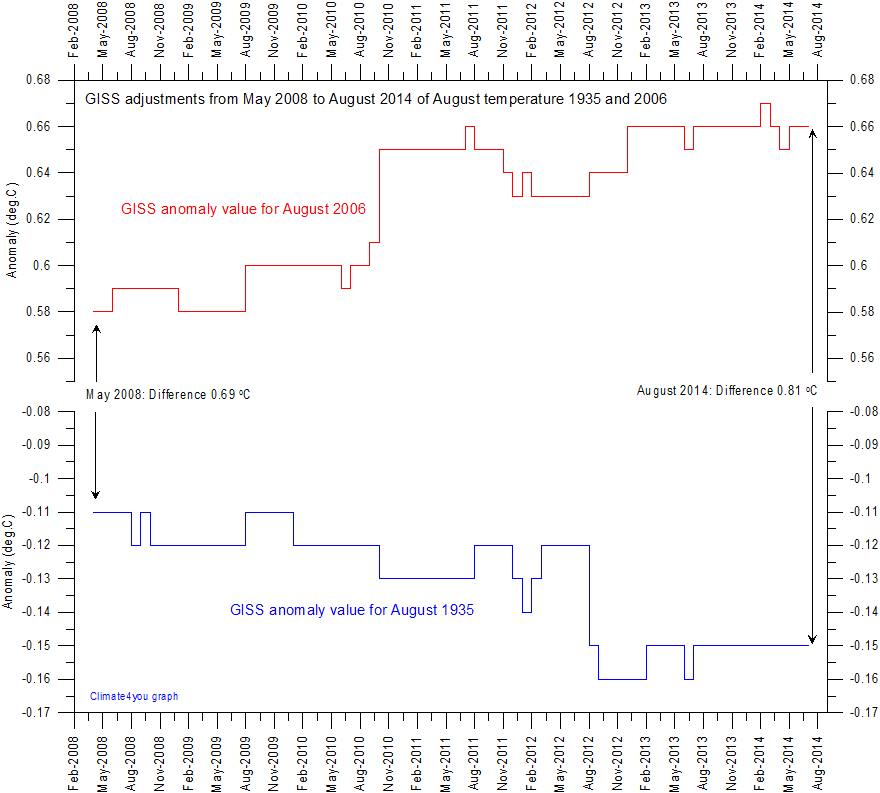
And the trouble NOAA seems have in predicting an accurate recent past is well examplified in Ole Humlums in one of the graphs on his Climate4You website , the one he calls ” the GiSS maturity graph” (link below) :
http://www.climate4you.com/images/GISS%20Aug1935%20and%20Aug2006.gif
so it’s not only Goddard ( though he shouts more and louder about it ) that is critical of
the slowly but unidirectionally widening gap between the past and present, as for example like in this day instance of the diffrence between the anomalies of the two values for the same day of the month 70 years apart , as the more resent days value heads for heavenly heigth’s , while the older anomaly is clearly speeding down the higway to underworld inferno.
It’s hard avoid the thought that there isn’t something amiss here , because of how univerasally one directional this process seems to be with all the adjustment that are being made to the data, one intuitionally would expect a a bit more randomness in the signs of adjustments.
And I cannot help it but my brain sometimes inadvertly conjures up flashes of “Comical Ali” ( Saddam Hussenin’s PR man in the early days of the first Iraq mess , who I at that time nicknamed “the green man” as it was the color of the uniform he most commonly wore in his TV apperance , no eco-green connection there ), when mr. Stokes ride in to defend the saying that there is no diffrence between the raw and adjusted anomalies at those moments he takes on some kind of ” the green man” , cause if they make no diffrence the why bother why expand a lot of effort to with no effect. ??

June 26, 2014 8:17 pm

The event times are not near long enough.
Busy work not much else.

Nick Stokes
June 26, 2014 8:22 pm

Matthew R Marler says: June 26, 2014 at 7:08 pm
“I doubt you could show that. It sounds like an unverifiable assumption — maybe reasonable, maybe not, but hardly trustworthy.”

No, it’s verifiable – one of the things Hansen did early on. You can see it here. It’s a shaded plot of raw GHCN/ERSST temperatures for a chosen month. You can choose to show the stations. The shading is such that it is exact for each station location, otherwise interpolated. You’ll see that mostly stations are shaded with their neighbours.
There are exceptions, of course. But again, it’s all about calculating an average. That’s what people hear about. If you’re averaging 4000 or so stations, that will damp a lot of noise.
Incidentally, quite a few of the exceptions are glitches in raw GHCN that I have been blogging about recently.

milodonharlani
June 26, 2014 8:44 pm

Nick Stokes says:
June 26, 2014 at 8:22 pm
Thanks, Nick. Wasn’t sure of the current number of stations. So one for every 127,500 sq km of the earth’s surface. Assume maybe half of them are good enough, & you get one per 250,000 sq km, or ~100,000 sq miles. That’s as if life & death public policy were based upon one reading for an area the size of my state of Oregon.
IOW, YHGTBSM.

Richard Ilfeld
June 26, 2014 8:51 pm

The Notion of one station being sufficient for a very long time series in interesting. One of the MWP pro arguments has always been that grapes for wine were grown in England then, but not when it was cooler. Now, I know proxies are always a bit dicey, but a data set that might be interesting is: date of last frost-date of first frost / by year. Surely there is a monastary somewhere in Britain with a 1000 year or more record. I wouldn’t have a clue how to find such a thing, but it might be interesting and a very long series of measured data points — about all one could measure and record before thermometers.

Reg Nelson
June 26, 2014 8:53 pm

Nick Stokes says:
Adjustments have a specific purpose – to reduce bias preparatory to calculating a space average. They are statistical; not intended to repair individual readings.
TOBS, for example, would not affect a record max. That temperature is as recorded. The problem is that if you reset the instrument at 5pm, that makes the next day max hot, even if the actual day was quite cool. That is a statistical bias, for which it is appropriate to correct a monthly average.
***
The problem is you (or anyone) has no idea what the time of observance adjustment should actually be — unless you have the ability to to time travel and conduct experiments\observations.
And trying to estimate it based on current observations is ridiculous, if your premise is that climate has changed dramatically because of CO2.
More importantly, where are UHI adjustments? Where are the station relocation adjustments?
You state “Adjustments have a specific purpose”. Where are these other adjustments?
I ask because i don’t know. Do you?

JoshC
June 26, 2014 8:59 pm

First: Thank you for the work Anthony, I have had a good chunk of social media this year. It is a wall of work, and mine was not as technical as yours. I really appreciate it.
Normally I don’t comment, since most of the things I would have suggested are better fleshed out by others. This time I didn’t see something I expected so:
Why not find a set of site records that correlate well with the RISS/UAH/weatherballon datasets and use those records?
I know, there is a lot most everybodies plate, but if people are interested in finding the best stations, the ones that match UAH could be better choices than some of the other ways suggested I would think.
Just a humble thought that seemed missed in the discussion. 🙂

Patrick B
June 26, 2014 9:12 pm

@PeteJ
“…then averages all the averages together you kind of lose all frame of reference and the margin of error explodes exponentially, even more so if you insist on using anomalies.”
Exactly. If climate “scientists” who did infilling, gridding etc. to fill in data then applied the proper margin of error analysis, they would quickly find the margin of error is so large as to render the results useless. Instead they pretend to know global temperatures to tenths and hundredths of a degree. I was taught that if your data was so poor that your margin of error overwhelmed your theory, you went back, re-designed your experiment and started over. The fact that in climate “science” we wish we had good data, but do not, should not change that approach.

June 26, 2014 9:41 pm

Thank you a fine explanation.
Highlighting that Climatology is more theology than science.
Right now we lack data of quality and duration.
Funny how the possibility of man caused global warming, was sufficient to demand world domination by the concerned ones.Their risk being the end of mankind.
Yet right from the start the data was foggy and there has been very little done to improve our understanding of weather past.
So while Steve Goddard is using immoderate language and flourishing a digital paintbrush to highlight his anger, is he wrong?
I remain deeply offended by the behaviour of our government people in this business.
What is the “official Global Average Temperature?
What error bars?
Then the temperature measurement accuracy and error bar.
The world proclaimed warming signal, Team IPCC ™ , is noise.
Sad that this nonsense can be called science and depressing that it ever progressed to the massive devourer of public wealth and energy that CAGW is.

June 26, 2014 9:54 pm

I can’t speak to the issue of the missing station data, but I’ve archived as many versions as I can find of the NASA GISS “Fig.D” Averaged U.S. 48-State Surface Air Temperature Anomaly files, and put them in a chronological table, here:
http://sealevel.info/GISS_FigD/
The revisions are very striking. They drastically cooled the older temperatures (esp. the 1930s) and warmed the more recent temperatures.
In the earliest (mid-1999) version†, 1998 is 0.54°C cooler than 1934.
In the 6/2000 version, 1998 is 0.25°C cooler than 1934.
In the 2001, 2003 & 2004 versions, 1998 is only 0.04°C cooler than 1934.
In the 2005 version, 1998 is only 0.01°C cooler than 1934.
In the 1/2005 version, 1998 and 1934 were tied, as equally warm.
In the 6/2006 version, 1998 is again 0.01°C cooler than 1934.
In the late Feb. 2007 version, for the first time they showed 1998 as 0.01°C warmer than 1934.
In an early 8/2007 version, they’re tied again, as equally warm.
In a later 8/2007 version, 1998 is again 0.02°C cooler than 1934.
In the 1/2008 and 1/2009 versions, they’re tied again, as equally warm.
In the 11/2009 version, 1998 is 0.03°C warmer than 1934.
In the 1/2010 version, 1998 is 0.09°C warmer than 1934.
In the 2/2010 version, 1998 is 0.12°C warmer than 1934.
In the 2/2011 version, 1998 is 0.122°C warmer than 1934.
In the 3/2011 through 7/2011 versions, 1998 is 0.123°C warmer than 1934.
In the 8/2011 version, 1998 is 0.122°C warmer than 1934.
In the 1/2012 version, 1998 is 0.121°C warmer than 1934.
In the 4/2012 version, 1998 is 0.071°C warmer than 1934.
In the 7/2/2012 version, 1998 is 0.089°C warmer than 1934.
In the 7/13/2012 version, 1998 is 0.083°C warmer than 1934.
In the 8/2012 version, 1998 is 0.082°C warmer than 1934.
In the 10/2012 version, 1998 is 0.112°C warmer than 1934.
In the 12/2013 version, 1998 is 0.1054°C warmer than 1934.
In the 1/2014 version, 1998 is 0.1057°C warmer than 1934.
In the 3/2014 version, 1998 is 0.1088°C warmer than 1934.
In the latest version, 1998 is 0.0935°C warmer than 1934.
Comparing the current version to 15 years ago, NCDC has added 0.6335°C of warming to the temperature record, when 1998 is compared to 1934.
† Caveat: the 1999 version was reconstructed by digitizing a graph.

June 26, 2014 9:58 pm

Minor correction to my previous msg: “In the 1/2005 version” should read “In the 1/2006 version”

June 26, 2014 10:09 pm

@Willis Eschenbach
“His regular promotion of a brain washing gun control conspiracy theory complete with Holocaust photos loses him the entire Internet culture debate for *all* of us skeptics because he has the second highest traffic skeptical site.”
I’m inclined to agree with you on this. Goddard as far as I can recall (and I am a regular although skeptical reader of his blog) when using Holocaust imagery is making certain general or philosophical points. One, for example, concerned the evil of the eugenics movement. Another is a reminder of why the “right to keep and bear arms” was added to the US constitution. Most Westerners have governments that are relatively corruption free, so tend to have lazy thinking on such issues. There are no specific conspiracy theories here that I can recall, which is what Nick is accusing Goddard of. And in fact, you’ll find him most of the time mocking conspiracy theories rather than promoting them.
I do recall he has posted at least once, perhaps several times, links to mind control/brain washing conspiracy involving the government. I couldn’t find the links to these as he may have taken them down or I failed to look for them in the right places.
Having said all that, Goddard can be a bit of a knuckle head at times, although he is certainly nobody’s fool. Originally I was inclined to assume that Goddard was controversial because controversy is an effective means of getting his points across and to drive traffic to his blog. I’m more inclined these days to view Goddard as someone who just has a controversial personality.

Eugene WR Gallun
June 26, 2014 10:59 pm

This is a better version.
PROFESSOR PHIL JONES
The English Prometheus
To tell the tale as it began —
An ego yearned
Ambition burned
Inside a quiet little man
No one had heard of Phillip Jones
Obscure to fame
(And likewise blame)
The creep of time upon his bones
Men self-deceive when fame is sought
Their fingers fold
Their ego told
That fire is what their fist has caught!
So self-deceived, with empty hand
Jones made it plain
That Hell would reign
In England’s green and pleasant land!
Believe! Believe! In burning heat!
In mental fight
To get it right
I’ve raised some temps and some delete!
And with his arrows of desire
He pierced the backs
Of any hacks
That asked the question — where’s the fire?
East Anglia supports him still
The truth abused
Whitewash was used
Within that dark Satanic mill
The evil that this wimp began
Soon none will doubt
The truth will out
Prometheus soon wicker man

June 26, 2014 11:10 pm

Eugene WR Gallun,
You da Man!!
.
Kudos, dude. Truly. You are good.

AW35
June 26, 2014 11:23 pm

I’d like to thank Steve and Anthony for at least making me realise how things work with these stations and potential problems for a person who didn’t really have any interest before this difference of opinion.
Originally I was confused because the mainstream media has picked up about the change in temps between 1930′s and today claim by Goddard, then this fabrication claim, two different points.
It does show though how many things have changed and problems with the whole system. Not only changes in environment, infilling of data but it seems time the measurements were taken all changing. That’s an awful lot of things to factor in. Considering how careful scientists are when moving simply from one satellite sensor to a new better one to make sure the record is not skewed I can see trying to get a nice accurate trend over many years is definitely a non trivial problem!
I think my main beef with Steve Goddard is the terminology used in graphs, headlines etc etc. Even since when he was on here, the headlines didn’t actually match what he was trying to say, due to trying to give too much shock and awe; most infamous being the CO2 freezing out when actually all he was saying really it was cold in Antartica. Well, that’s what it seemed to me he was saying, he was right too, it was cold at that point. But CO2 was not freezing out. He still claims this. No flip flopping….. 🙂
I think the problem is also he does too much stuff so quality control falters. I visit his site to look at the Arctic side, although I am not a skeptic I do find it interesting and he does post on it. One post he did he mentioned how little time the melt season has, and did a graph split with the months above 0c shown. Problem is sea ice does not melt at 0c. I mentioned this to him and although he did not admit his mistake ( he never does ) he did remove that line in the graph. So as i say, he produces a lot per day and does not really check into it. He needs a Chief Editor to check it over.
He does post some interesting stuff though on the Arctic, and always good to have a different viewpoint rather than just visiting sites which confirms your own view.
Once again thanks for the info on your network over there. You should use the British stations, Mary Poppins once described them as being more than practically perfect I believe.

angech
June 26, 2014 11:44 pm

.Zeke (Comment #130058 June 7th, 2014 at 11:45 am How not to calculate temperature 5 June, 2014 says the past station temperatures will be raised or lowered by the size of the breakpoint.
Nick Stokes says: June 26, 2014 at 5:04 pm WUWT
I doubt that anyone uses adjusted temperatures when talking of exceptional temperatures. They shouldn’t.
Adjustments have a specific purpose – to reduce bias preparatory to calculating a space average. They are statistical; not intended to repair individual readings.
TOBS, for example, would not affect a record max. That temperature is as recorded. The problem is that if you reset the instrument at 5pm, that makes the next day max hot, even if the actual day was quite cool. That is a statistical bias, for which it is appropriate to correct a monthly average.
So which is it Nick? I can say that you cannot have an unadjusted TOBS maximum and an adjusted monthly average, that is what used to be called keeping double books and Zeke notes that all temperatures are adjusted down [or up on very odd occasions].

1 4 5 6 7 8 11
Verified by MonsterInsights