This post updates the data for the three primary suppliers of global land+ocean surface temperature data—GISS through May 2014 and HADCRUT4 and NCDC through April 2014—and of the two suppliers of satellite-based global lower troposphere temperature data (RSS and UAH) through May 2014.
Initial Notes: To make this post as timely as possible, only GISS LOTI and the two lower troposphere temperature datasets are for the most current month. The NCDC and HADCRUT4 data lag one month.
This post contains graphs of running trends in global surface temperature anomalies for periods of 13+ and 17 years using GISS global (land+ocean) surface temperature data. They indicate that we have not seen a warming halt (based on 13 years+ trends) this long since the mid-1970s or a warming slowdown (based on 17-years trends) since about 1980. I used to rotate the data suppliers for this portion of the update, also using NCDC and HADCRUT. With the data from those two suppliers lagging by a month in the updates, I’ve standardized on GISS for this portion.
Much of the following text is boilerplate. It is intended for those new to the presentation of global surface temperature anomaly data.
Most of the update graphs in the following start in 1979. That’s a commonly used start year for global temperature products because many of the satellite-based temperature datasets start then.
We discussed why the three suppliers of surface temperature data use different base years for anomalies in the post Why Aren’t Global Surface Temperature Data Produced in Absolute Form?
GISS LAND OCEAN TEMPERATURE INDEX (LOTI)
Introduction: The GISS Land Ocean Temperature Index (LOTI) data is a product of the Goddard Institute for Space Studies. Starting with their January 2013 update, GISS LOTI uses NCDC ERSST.v3b sea surface temperature data. The impact of the recent change in sea surface temperature datasets is discussed here. GISS adjusts GHCN and other land surface temperature data via a number of methods and infills missing data using 1200km smoothing. Refer to the GISS description here. Unlike the UK Met Office and NCDC products, GISS masks sea surface temperature data at the poles where seasonal sea ice exists, and they extend land surface temperature data out over the oceans in those locations. Refer to the discussions here and here. GISS uses the base years of 1951-1980 as the reference period for anomalies. The data source is here.
Update: The May 2014 GISS global temperature anomaly is +0.76 deg C. It warmed slightly (an increase of about 0.03 deg C) since April 2014.

Figure 1 – GISS Land-Ocean Temperature Index
NCDC GLOBAL SURFACE TEMPERATURE ANOMALIES (LAGS ONE MONTH)
Introduction: The NOAA Global (Land and Ocean) Surface Temperature Anomaly dataset is a product of the National Climatic Data Center (NCDC). NCDC merges their Extended Reconstructed Sea Surface Temperature version 3b (ERSST.v3b) with the Global Historical Climatology Network-Monthly (GHCN-M) version 3.2.0 for land surface air temperatures. NOAA infills missing data for both land and sea surface temperature datasets using methods presented in Smith et al (2008). Keep in mind, when reading Smith et al (2008), that the NCDC removed the satellite-based sea surface temperature data because it changed the annual global temperature rankings. Since most of Smith et al (2008) was about the satellite-based data and the benefits of incorporating it into the reconstruction, one might consider that the NCDC temperature product is no longer supported by a peer-reviewed paper.
The NCDC data source is usually here. NCDC uses 1901 to 2000 for the base years for anomalies. (Note: the NCDC has been slow with updating the normal data source webpage, so I’ve been using the values available through their Global Surface Temperature Anomalies webpage. Click on the link to Anomalies and Index Data.)
Update (Lags One Month): The April 2014 NCDC global land plus sea surface temperature anomaly was +0.72 deg C. See Figure 2. It showed a rise (an increase of +0.05 deg C) since March 2014.

Figure 2 – NCDC Global (Land and Ocean) Surface Temperature Anomalies
UK MET OFFICE HADCRUT4 (LAGS ONE MONTH)
Introduction: The UK Met Office HADCRUT4 dataset merges CRUTEM4 land-surface air temperature dataset and the HadSST3 sea-surface temperature (SST) dataset. CRUTEM4 is the product of the combined efforts of the Met Office Hadley Centre and the Climatic Research Unit at the University of East Anglia. And HadSST3 is a product of the Hadley Centre. Unlike the GISS and NCDC products, missing data is not infilled in the HADCRUT4 product. That is, if a 5-deg latitude by 5-deg longitude grid does not have a temperature anomaly value in a given month, it is not included in the global average value of HADCRUT4. The HADCRUT4 dataset is described in the Morice et al (2012) paper here. The CRUTEM4 data is described in Jones et al (2012) here. And the HadSST3 data is presented in the 2-part Kennedy et al (2012) paper here and here. The UKMO uses the base years of 1961-1990 for anomalies. The data source is here.
Update (Lags One Month): The April 2013 HADCRUT4 global temperature anomaly is +0.64 deg C. See Figure 3. It increased (about +0.10 deg C) since March 2014.

Figure 3 – HADCRUT4
UAH Lower Troposphere Temperature (TLT) Anomaly Data
Special sensors (microwave sounding units) aboard satellites have orbited the Earth since the late 1970s, allowing scientists to calculate the temperatures of the atmosphere at various heights above sea level. The level nearest to the surface of the Earth is the lower troposphere. The lower troposphere temperature data include the altitudes of zero to about 12,500 meters, but are most heavily weighted to the altitudes of less than 3000 meters. See the left-hand cell of the illustration here. The lower troposphere temperature data are calculated from a series of satellites with overlapping operation periods, not from a single satellite. The monthly UAH lower troposphere temperature data is the product of the Earth System Science Center of the University of Alabama in Huntsville (UAH). UAH provides the data broken down into numerous subsets. See the webpage here. The UAH lower troposphere temperature data are supported by Christy et al. (2000) MSU Tropospheric Temperatures: Dataset Construction and Radiosonde Comparisons. Additionally, Dr. Roy Spencer of UAH presents at his blog the monthly UAH TLT data updates a few days before the release at the UAH website. Those posts are also cross posted at WattsUpWithThat. UAH uses the base years of 1981-2010 for anomalies. The UAH lower troposphere temperature data are for the latitudes of 85S to 85N, which represent more than 99% of the surface of the globe.
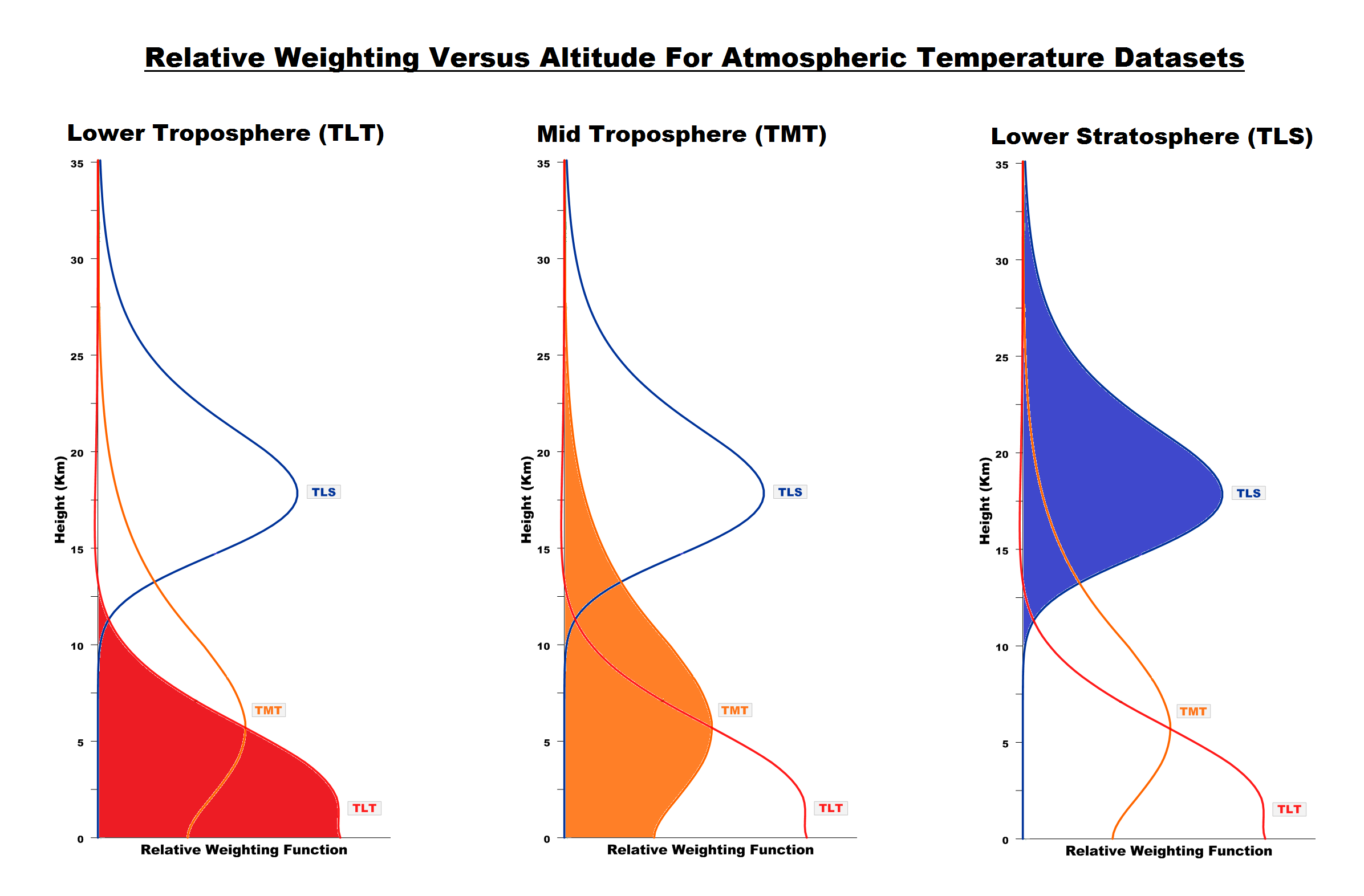
Update: The May 2014 UAH lower troposphere temperature anomaly is +0.33 deg C. It is rose sharply (an increase of about +0.14 deg C) since April 2014.

Figure 4 – UAH Lower Troposphere Temperature (TLT) Anomaly Data
RSS Lower Troposphere Temperature (TLT) Anomaly Data
Like the UAH lower troposphere temperature data, Remote Sensing Systems (RSS) calculates lower troposphere temperature anomalies from microwave sounding units aboard a series of NOAA satellites. RSS describes their data at the Upper Air Temperature webpage. The RSS data are supported by Mears and Wentz (2009) Construction of the Remote Sensing Systems V3.2 Atmospheric Temperature Records from the MSU and AMSU Microwave Sounders. RSS also presents their lower troposphere temperature data in various subsets. The land+ocean TLT data are here. Curiously, on that webpage, RSS lists the data as extending from 82.5S to 82.5N, while on their Upper Air Temperature webpage linked above, they state:
We do not provide monthly means poleward of 82.5 degrees (or south of 70S for TLT) due to difficulties in merging measurements in these regions.
Also see the RSS MSU & AMSU Time Series Trend Browse Tool. RSS uses the base years of 1979 to 1998 for anomalies.
Update: The May 2014 RSS lower troposphere temperature anomaly is +0.29 deg C. It rose (an increase of about +0.04 deg C) since April 2014.

Figure 5 – RSS Lower Troposphere Temperature (TLT) Anomaly Data
A Quick Note about the Difference between RSS and UAH TLT data
There is a noticeable difference between the RSS and UAH lower troposphere temperature anomaly data. Dr. Roy Spencer discussed this in his July 2011 blog post On the Divergence Between the UAH and RSS Global Temperature Records. In summary, John Christy and Roy Spencer believe the divergence is caused by the use of data from different satellites. UAH has used the NASA Aqua AMSU satellite in recent years, while as Dr. Spencer writes:
…RSS is still using the old NOAA-15 satellite which has a decaying orbit, to which they are then applying a diurnal cycle drift correction based upon a climate model, which does not quite match reality.
I updated the graphs in Roy Spencer’s post in On the Differences and Similarities between Global Surface Temperature and Lower Troposphere Temperature Anomaly Datasets.
While the two lower troposphere temperature datasets are different in recent years, UAH believes their data are correct, and, likewise, RSS believes their TLT data are correct. Does the UAH data have a warming bias in recent years or does the RSS data have cooling bias? Until the two suppliers can account for and agree on the differences, both are available for presentation.
In a more recent blog post, Roy Spencer has advised that the UAH lower troposphere Version 6 will be released soon and that it will reduce the difference between the UAH and RSS data.
13-YEAR+ (161-MONTH) RUNNING TRENDS
As noted in my post Open Letter to the Royal Meteorological Society Regarding Dr. Trenberth’s Article “Has Global Warming Stalled?”, Kevin Trenberth of NCAR presented 10-year period-averaged temperatures in his article for the Royal Meteorological Society. He was attempting to show that the recent halt in global warming since 2001 was not unusual. Kevin Trenberth conveniently overlooked the fact that, based on his selected start year of 2001, the halt at that time had lasted 12+ years, not 10.
The period from January 2001 to April 2014 is now 161-months long—more than 13 years. Refer to the following graph of running 161-month trends from January 1880 to April 2014, using the GISS LOTI global temperature anomaly product.
An explanation of what’s being presented in Figure 6: The last data point in the graph is the linear trend (in deg C per decade) from January 2001 to May 2014. It is basically zero (about 0.02 deg C/Decade). That, of course, indicates global surface temperatures have not warmed to any great extent during the most recent 160-month period. Working back in time, the data point immediately before the last one represents the linear trend for the 161-month period of December 2000 to April 2014, and the data point before it shows the trend in deg C per decade for November 2000 to March 2014, and so on.

Figure 6 – 161-Month Linear Trends
The highest recent rate of warming based on its linear trend occurred during the 160-month period that ended about 2004, but warming trends have dropped drastically since then. There was a similar drop in the 1940s, and as you’ll recall, global surface temperatures remained relatively flat from the mid-1940s to the mid-1970s. Also note that the mid-1970s was the last time there had been a 161-month period without global warming—before recently.
17-YEAR (204-Month) RUNNING TRENDS
In his RMS article, Kevin Trenberth also conveniently overlooked the fact that the discussions about the warming halt are now for a time period of about 16 years, not 10 years—ever since David Rose’s DailyMail article titled “Global warming stopped 16 years ago, reveals Met Office report quietly released… and here is the chart to prove it”. In my response to Trenberth’s article, I updated David Rose’s graph, noting that surface temperatures in April 2013 were basically the same as they were in June 1997. We’ll use June 1997 as the start month for the running 17-year trends. The period is now 204-months long. The following graph is similar to the one above, except that it’s presenting running trends for 204-month periods.
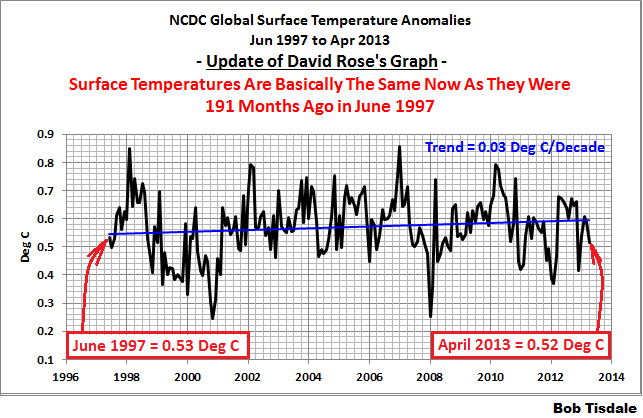

Figure 7 – 204-Month Linear Trends
The last time global surface temperatures warmed at this low a rate for a 204-month period was the late 1970s, or about 1980. Also note that the sharp decline is similar to the drop in the 1940s, and, again, as you’ll recall, global surface temperatures remained relatively flat from the mid-1940s to the mid-1970s.
The most widely used metric of global warming—global surface temperatures—indicates that the rate of global warming has slowed drastically and that the duration of the halt in global warming is unusual during a period when global surface temperatures are allegedly being warmed from the hypothetical impacts of manmade greenhouse gases.
A NOTE ABOUT THE RUNNING-TREND GRAPHS
There is very little difference in the end point trends of 13+ year and 16+ year running trends if HADCRUT4 or NCDC or GISS data are used. The major difference in the graphs is with the HADCRUT4 data and it can be seen in a graph of the 13+ year trends. I suspect this is caused by the updates to the HADSST3 data that have not been applied to the ERSST.v3b sea surface temperature data used by GISS and NCDC.
COMPARISONS
The GISS, HADCRUT4 and NCDC global surface temperature anomalies and the RSS and UAH lower troposphere temperature anomalies are compared in the next three time-series graphs. Figure 8 compares the five global temperature anomaly products starting in 1979. Again, due to the timing of this post, the HADCRUT4 and NCDC data lag the UAH, RSS and GISS products by a month. The graph also includes the linear trends. Because the three surface temperature datasets share common source data, (GISS and NCDC also use the same sea surface temperature data) it should come as no surprise that they are so similar. For those wanting a closer look at the more recent wiggles and trends, Figure 9 starts in 1998, which was the start year used by von Storch et al (2013) Can climate models explain the recent stagnation in global warming? They, of course found that the CMIP3 (IPCC AR4) and CMIP5 (IPCC AR5) models could NOT explain the recent halt in warming.
Figure 10 starts in 2001, which was the year Kevin Trenberth chose for the start of the warming halt in his RMS article Has Global Warming Stalled?
Because the suppliers all use different base years for calculating anomalies, I’ve referenced them to a common 30-year period: 1981 to 2010. Referring to their discussion under FAQ 9 here, according to NOAA:
This period is used in order to comply with a recommended World Meteorological Organization (WMO) Policy, which suggests using the latest decade for the 30-year average.

Figure 8 – Comparison Starting in 1979
###########

Figure 9 – Comparison Starting in 1998
###########

Figure 10 – Comparison Starting in 2001
AVERAGE
Figure 11 presents the average of the GISS, HADCRUT and NCDC land plus sea surface temperature anomaly products and the average of the RSS and UAH lower troposphere temperature data. Again because the HADCRUT4 and NCDC data lag one month in this update, the most current average only includes the GISS products.

Figure 11 – Average of Global Land+Sea Surface Temperature Anomaly Products
The flatness of the data since 2001 is very obvious, as is the fact that surface temperatures have rarely risen above those created by the 1997/98 El Niño in the surface temperature data. There is a very simple reason for this: the 1997/98 El Niño released enough sunlight-created warm water from beneath the surface of the tropical Pacific to permanently raise the temperature of about 66% of the surface of the global oceans by almost 0.2 deg C. Sea surface temperatures for that portion of the global oceans remained relatively flat until the El Niño of 2009/10, when the surface temperatures of the portion of the global oceans shifted slightly higher again. Prior to that, it was the 1986/87/88 El Niño that caused surface temperatures to shift upwards. If these naturally occurring upward shifts in surface temperatures are new to you, please see the illustrated essay “The Manmade Global Warming Challenge” (42mb) for an introduction.
MONTHLY SEA SURFACE TEMPERATURE UPDATE
The most recent sea surface temperature update can be found here. The satellite-enhanced sea surface temperature data (Reynolds OI.2) are presented in global, hemispheric and ocean-basin bases.
TABLE OF CONTENTS OF UPCOMING BOOK
I linked a copy to the post here of the Table of Contents for my upcoming book about global warming, climate change and skepticism. Please take a look to see if there are topics I’ve missed that you believe should be covered. I’ve already removed the introductory chapters for climate models from Section 1, and provided a separate section for those model discussions. Section 1 now only includes the chapters that introduce global warming and climate change topics. (Thanks, Gary.) Please also post any comments you have on that thread at my blog. Otherwise, I might miss them.
Thanks
Bob Tisdale
Simon says:
June 21, 2014 at 5:38 pm
None taken. Any more than I would take offense at what your run of the mill Hare Krishna thought of my statements. Life’s too short to worry about what every yahoo thinks about you.
Bart
That is all sorted then. Have a nice day.
Simon says:
I see you have only mentioned sea ice.
Reading comprehension, Simon me boi. You needs it. I’ve commented on sea ice, sea level rise, CO2, global warming, short term and long term trends, GISS, the tropospheric hot spot, stratospheric cooling, etc., etc. And that is just in this thread alone.
So now you have moved the goal posts to “net ice”, but I covered that too, in my ‘global ice’ link. If it were not for moving the goal posts, Simon, you would have even less of your already pathetic argument.
Yes, sea levels are rising, as they have naturally, since the end of the last great stadial. The simple fact that sea levels are not accelerating makes your Belief in manmade global warming ridiculous indeed.
You wrongly assert:
Now here is the (clincher) thing. The level is not going down, so if it is going up…. there must be more ice melting than freezing.
You certainly are amusing, Simon. I had you smoked out from your very first comment, when you pretended to be Mr. Middle-Of-The-Road. But I knew then that you were a religious True Believer. That’s why it was easy to smoke you out after your very first comment.
In your amusing “clincher thing” assertion [is ‘clincher thing’ a scientific term?] you say:
The [sea] level is not going down, so if it is going up…. there must be more ice melting than freezing.
Logic isn’t your strong suit. One possible factor is melting ice. But as I showed above, since global ice is above its 30-year average, we can discard that factor. And since Greenland ice is in a bowl, you need not worry your crazy Believer head that the ice is going to spill out and raise sea levels.
Finally, Antarctic ice is in the midst of a multiyear increase. Since the Antarctic contains 10X more ice than the Arctic, and since Antarctic ice is increasing, your Belief that sea level rise will accelerate due to melting ice is complete nonsense.
Once again, my question: where do you get your misinformation? And why do you take it as Gospel, while rejecting all the factual evidence posted here? Enviro-religion has a choke hold on you Simon, me boi. Your mind is closed tighter than a submarine hatch. I doubt you will ever have the scales fall from your eyes, and see the truth. Sad, really.
dbstealey
Ill keep it simple.
Sea ice in Antartica = increase
Sea ice in Arctic = decrease
Land ice Antartica = decrease
Glaciers worldwide = decrease
Total ice volume = decrease
Simon, you keep avoiding my question: where do you get your misinformation?
Here is Antarctica. It is a land continent. Note the cooling vs the warming areas. Further, the WAIS is warming because of volcanic activity, not due to CO2. You moved the goal posts to land because of a small part of the continent that is warming, versus the 90% that is cooling. That argument is one big FAIL.
Antarctic ice is expanding overall, as I linked in my last post. Are you that deluded that you reject everything that debunks your CAGW nonsense?
The Antarctic continues to gain ice. This has been going on for many years. And global ice is now above its long term average.
Face it, Simon, you lost the argument way upthread. You don’t have credible facts. Also, I would like to know why polar ice seems so important to you, that you have to lie about it? Polar ice is cyclical, and those cycles are natural. There is no measurable, testable evidence showing that human activity has anything to do with it. It has all happened before, and to a much greater degree. The Arctic was ice-free a few thousand years ago, during our present Holocene. Only a religious True Believer would assume that this time it must be the fault of humans:
That’s you, Simon. Exactly.
dbstealey
You will find all you need here.
http://www.bbc.com/news/science-environment-27465050
Seems the ice over most of the continent is melting at a faster pace than was expected.
Can I make one request from here on though. I’d like to think we can disagree without this chat descending to personal insults. If you really think I am deluded, then it is best we finish it now. Besides, I can’t see why you would waste your time talking to someone with a deluded mind? I for one appreciate your replies and I’d like to think as gentleman we can disagree politely.
Simon,
You are extremely frustrating. You cherry pick whatever you believe will support you, you have excessive confirmation bias, and you never answer questions. I guess we can’t expect anything more from a religious True Believer. Honest scientists try to answer questions. But your notions are pre-conceved. Your mind is made up, and you are looking for anything that confirms your belief.
Did you even read the article in your link? It says:
…six huge glaciers are currently undergoing a rapid retreat – all of them being eroded by the influx of warm ocean waters that scientists say are being drawn towards the continent by stronger winds whipped up by a changing climate. About 90% of the mass loss from the West Antarctic Ice Sheet is going from just these few ice streams.
So human activity has nothing to do with it. And of course, climate is always changing. Only Michael Mann and his followers deny that fact.
All the charts I linked to above were done to help you understand that Antarctica, with 90% of all polar ice, is gaining ice. Those measurements are more credible than the ESA’s ‘adjusted’ measurements. But even so, AGW has nothing to do with polar ice cover.
The only reason that polar ice is argued anyway is because of all the endless predictions made by the alarmist cult, every one of them has failed. But like a drowning man grasping a stick, you folks hold on to Arctic ice because it is your forlorn hope that it will disappear — validating the only prediction that has any hope of coming true.
But it very likely will fail just like all the other failed alarmist predictions, because it was always about Arctic ice. So ice is a big deal to you. Not to sceptics, though, because there is zero evidence that human-emitted CO2 has anything to do with cyclical polar ice cover — the basic belief in the “carbon” scare.
I have been responding to every move of the goal posts you make. It is tedious and frustrating. You obviously don’t have a background in the hard sciences. So, your turn now. Re-read my questions and answer them, please, if you can. Since ice is so important to you, you can start by explaining why the Arctic had less ice before industrial activity than now, in the context of the climate Null Hypothesis. That should keep you busy running back to SS for their version of reality.
@Simon
Those still pointing to melting arctic ice and NH glaciers, as “proof” that it is (still) warming, and not cooling, should remember that there is a long lag from energy-in and energy-out. Counting back 88 years i.e. 2013-88= we are in 1925.
Now look at some eye witness reports of the ice back then?
http://wattsupwiththat.com/2008/03/16/you-ask-i-provide-november-2nd-1922-arctic-ocean-getting-warm-seals-vanish-and-icebergs-melt/
Sounds familiar? Back then, in 1922, they had seen that the arctic ice melt was due to the warmer Gulf Stream waters. However, by 1950 all that same ‘lost” ice had frozen back. I therefore predict that all lost arctic ice will also come back, from 2020-2035 as also happened from 1935-1950. Antarctic ice is already increasing.
I already showed you that my own results for the drop in global minimum temperatures suggest a perfectly natural relationship between the speed of warming/cooling in K/annum when set against time. The curve is like someone throwing a ball: perfectly natural. If there were any AGW, more especially of the type caused by more CO2 or other GHG, we would see some chaos, exhibited by a correlation coefficient of less than 1, especially on minima. (1=100% correlation for the binomial curve)
http://wattsupwiththat.com/2014/06/18/may-2014-global-surface-landocean-and-lower-troposphere-temperature-anomaly-update/#comment-1666344
To those actively involved in trying to suppress the temperature results as they are available on-line from official sources, I say: Let fools stay fools if they want to be. Fiddling with the data they can, to save their jobs, but people still having to shove snow in late spring, will soon begin to doubt the data…Check the worry in my eyes when they censor me. Under normal circumstances I would have let things rest there and just be happy to know the truth for myself. Indeed, I let things lie a bit. However, chances are that humanity will fall in the pit of global cooling and later me blaming myself for not having done enough to try to safeguard food production for 7 billion people and counting.
It really was very cold in 1940′s….The Dust Bowl drought 1932-1939 was one of the worst environmental disasters of the Twentieth Century anywhere in the world. Three million people left their farms on the Great Plains during the drought and half a million migrated to other states, almost all to the West. http://www.ldeo.columbia.edu/res/div/ocp/drought/dust_storms.shtml
I find that as we are moving back, up, from the deep end of the 88 year sine wave, there will be standstill in the change of the speed of cooling, neither accelerating nor decelerating, on the bottom of the wave; therefore naturally, there will also be a lull in pressure difference at that > [40 latitude], where the Dust Bowl drought took place, meaning: less weather (read: rain). However, one would apparently note this from an earlier change in direction of wind, as was the case in Joseph’s time. According to my calculations, this will start around 2020 or 2021…..i.e. 1927=2016 (projected, by myself and the planets…)> add 5 years and we are in 2021.
Danger from global cooling is documented and provable. It looks we have only ca. 7 “fat” years left……
WHAT MUST WE DO?
We urgently need to develop and encourage more agriculture at lower latitudes, like in Africa and/or South America. This is where we can expect to find warmth and more rain during a global cooling period.
We need to warn the farmers living at the higher latitudes (>40) who already suffered poor crops due to the droughts that things are not going to get better there for the next few decades. It will only get worse as time goes by.
We also have to provide more protection against more precipitation at certain places of lower latitudes (FLOODS!), <[30] latitude, especially around the equator.
Simon:
Your silly post at June 21, 2014 at 3:05 pm again changes the subject in response to my having shown another of your fallacious assertions is plain wrong. And it ends saying to me
I said nothing about “longer term graphs”.
I will consider the effect of any El Nino if it occurs. Please report back with an apology for wasting space on this thread if an El Nino does not break new records this year.
Richard
richardscourtney
I will consider the effect of any El Nino if it occurs. Please report back with an apology for wasting space on this thread if an El Nino does not break new records this year.
—————————————–
Why do you feel the need to tell people they are silly and that they need to apologise for having a specific point of view? Frankly I find your comments rather condescending and see no possible reason for it. I know you and I disagree, but I am not a child to be scolded. Either show a little more respect or don’t waste your time on me. Make up your mind.
Simon:
Your silly post at June 22, 2014 at 12:20 pm yet again avoids the issues put to you, and it says this in total to me
I take your word that you are “not a child” but your behaviour in this thread has been very childish. You have repeatedly made untrue assertions which when called on them you have not withdrawn but – instead – you have changed the subject.
I respect people who debate a different point of view from my own. I learn from them.
You have clearly demonstrated that you do NOT have “a specific point of view”: you have an irrational belief. And you do not debate: you make asserts and you ignore all evidence which refutes your assertions.
My comments reflect my disdain for your anti-science belief and your irrational assertions. Disdain is not condescension. You need to improve your behaviour a lot before I can gain sufficient respect for my attitude to you to be merely condescending.
I have – and am – spending my time to expose the nature of true believers in AGW which you represent. I made up my mind to do that when you began by providing your duplicitous pretense that global warming has not stopped.
Richard
I note that Simon still refuses to answer questions. I can understand why: if he started down that road, he would run smack into cognitive dissonance, and his head might explode.
Last chance, Simon. I’ve answered your questions and concerns; it’s your turn now. I’ll ask once more. Try to answer this:
Since ice is so important to you, you can start by explaining why the Arctic had less ice before industrial activity than now, in the context of the climate Null Hypothesis.
Do your best. You might even convince me! Stranger things have happened, such as the inexplicable popularity of the Kardashians.
dbsteatley
It is true, it is possible the arctic was ice free about 8000 years ago, although recently moss was uncovered that had been buried under ice for probably 70,000 and maybe and many as 150,000.
But even if you are right (and we don’t know for sure on this one), it is the speed of decline that has those who study this stuff concerned. I would be grateful if you could tell me what caused the decline last time. Given we know what has caused it this time it would be interesting to compare.
You conveniently omitted the Null Hypothesis, which was the central point.
You like to quote Dr. Roy Sperncer, who wrote: “The Null Hypothesis has never been falsified.”
Have at it.
dbstealey says:
June 22, 2014 at 5:00 pm
You conveniently omitted the Null Hypothesis, which was the central point.
You like to quote Dr. Roy Sperncer, who wrote: “The Null Hypothesis has never been falsified.”
Have at it.
———————————————-
Please explain the NH and I would like to read any docs you have stating we have been ice free recently. Post a link and I will read.
Simon,
I see you’re asking questions again, instead of answering.
We are currently in the Holocene. The Arctic was likely ice free during the Holocene. The Arctic is not ice free now. Therefore, the Null Hypothesis applies. The Null Hypothesis is a corollary of the Scientific Method.
The Null Hypothesis of climate science is that climate is always changing in a log-log fractal manner due to normal chaotic-nonlinear oscillation. CAGW not only fails to nullify this Null Hypothesis – its believers fail to understand what a Null Hypothesis is.
The Null Hypothesis is the statistical hypothesis that states that there are no differences between observed and expected data. That is the definition, although you will probably have to give it some thought before you begin to understand what that means.
In order to falsify the Null Hypothesis, current climate parameters [temperature, extreme weather events, etc.] must exceed past parameters. That has not happened. The Null Hypothesis has never been falsified.
Kevin Trenberth is so confounded by the Null Hypothesis that he has demanded that it should be reversed, and therefore that skeptics should, in effect, have to prove a negative. That is how important the Null Hypothesis is in the climate debate.
The basic claim is that a rise in CO2 will cause runaway global warming. If that happened, the Null Hypothesis would be falsified. But that has not happened. In fact, global warming has stopped. Therefore, the CAGW conjecture fails. There is nothing either unusual, or unprecedented happening with the climate. Everything observed now has happened in the past, repeatedly, and to a greater degree.
The alarmist crowd does not like to discuss the Null Hypothesis, for the obvious reason that it deconstructs their “climate change” hoax. But if you want to discuss science, you must accept the Scientific Method and its corollary, the Null Hypothesis.
I read your link and it is clear that ice was reduced 6-7000 years ago. but as the article says…
“However, the scientists are very careful about drawing parallels with the present-day trend in the Arctic Ocean where the cover of sea ice seems to be decreasing.
“Changes that took place 6000-7000 years ago were controlled by other climatic forces than those which seem to dominate today,”
In other words today’s reduction is a different story to back then. And we all know what the scientists say is the problem now.
Re your null hypothesis…”The Null Hypothesis is the statistical hypothesis that states that there are no differences between observed and expected data.”
The decline in the arctic is worse at this point than the models forecast. I’m not sure where that leaves us in relation to NH. Worse off I would say.
Here is the overriding difference between you and I. I don’t believe on any level that AGW is a hoax made up by those greedy scientists of tax grabbing politicians. I have a friend who is a climate scientist and you would not meet a more sincere dedicated person. A hoax he is most definitely not. However clearly you don’t have the same faith in these people. I guess we will just have to agree to disagree.
richardscourtney says:
June 21, 2014 at 5:57 am
PS I would be interested to know if you are having a competition with Phil. to see which of you can make the most ridiculous post on WUWT.
No contest, you’re the champion in that competition.
richardscourtney says:
June 20, 2014 at 12:22 pm
Phil.
I write to say that I have read, noted and laughed at the desperate attempts to justify your errors with your posts at June 20, 2014 at 12:14 pm and June 20, 2014 at 12:17 pm.
As usual you fail to identify any of those ‘errors’, classic trolling.
And I am only providing this acknowledgement because those temper tantrums are directed at me.
Just amusement old boy, nothing more.
@Simon
face the facts Simon
if that is your name
(we know where you come from)
: the earth is cooling, as it has been cooling before,
http://wattsupwiththat.com/2009/12/09/hockey-stick-observed-in-noaa-ice-core-data/
Why don’t you show us some of your own results, if any,
that convinces that earth is warming and not cooling?
Pity your job depends on this carbon scare,
I will pray for you that you will be freed from the sin of lies.
HenryP
Is that a serious post? You know where I come from? You mean you are watching me? Tell you what I will do if you can guess the country I come from I will be utterly impressed. Seriously have a guess.
The earth is cooling…. well that’s all sorted then.
My job depends on the carbon scare? Really? Mmmm I don’t think so.
Please don’t pray for me… I’m not a religious man. Prefer to rely on facts.
@Simon
You complain that we do not take you seriously
Yet…., you have no results of your own…..none whatsoever?
Never looked at any temp. results or rainfall results?
That makes you look quite silly, really,
So this is how we know exactly where you come from.
You believe anything you read in the newspaper and on the news.
So, I say you are a clown living in a circus, somewhere in Disneyland.
Seriously, am I right or am I wrong?
Simon:
At June 22, 2014 at 6:53 pm you write to dbstealey
Oh dear! You get everything the wrong way round as usual.
I took the trouble to explain the Null Hypothesis for you earlier in this thread. The explanation was at June 19, 2014 at 2:14 pm and is here.
That explanation begins saying
Your comment to dbstealey which I have quoted says you failed to understand that. The facts are
1.
The models having “forecast” more ice decline in the arctic than is empirically observed is evidence that understandings used to construct the models are wrong.
And
2.
The Null Hypothesis decrees that greater Arctic ice loss in the past indicates no discernible change to the system which governs Arctic ice loss.
I suspect your failure to understand is because the Null Hypothesis is a scientific principle and you prefer your superstitious belief in AGW to science. However, your failure could be feigned and be an attempt to outdo Phil. in your competition to see which of the two of you can make the most ridiculous post on WUWT. If the latter then you have failed because your proclaimed inability to read an explanation is not as daft as Phil.’s recent attempt to redefine “sequestration”.
Richard
Troll posting as Phil.:
I see that at June 22, 2014 at 8:27 pm you adopt your common practice of attempting to justify your lies by adding another lie.
In response to my having written saying to you at June 20, 2014 at 12:22 pm
You have replied
No. I had identified your errors. I do not intend to list them all as one example will suffice.
At June 20, 2014 at 1:25 am I wrote
That one post alone provides corrections to three of your errors; i.e.
1.
Refutation of your attempt at disingenuous distraction.
2.
Refutation of your stupid assertion that information previously existing in literature demonstrates that the information was not used as a “fallback”.
3.
Statement that your so-called evidence shows the opposite of what you (and Simon) claimed.
I dislike the competition between you and Simon to determine which of you two trolls can make the silliest post on WUWT.
Richard
HenryP says:
June 23, 2014 at 1:48 am
@Simon
You complain that we do not take you seriously
Yet…., you have no results of your own…..none whatsoever?
Never looked at any temp. results or rainfall results?
That makes you look quite silly, really,
So this is how we know exactly where you come from.
You believe anything you read in the newspaper and on the news.
So, I say you are a clown living in a circus, somewhere in Disneyland.
Seriously, am I right or am I wrong?
————————————————————————
Um….. I’m not sure.
I never said I wasn’t taken seriously.
Why would I have results… I’m not a scientist.
So you are saying you know what I am thinking. Fair enough. You will be disappointed then.
I believe what the scientists say for the main part, particularly those who make sense to me.
You got your guess wrong… I don’t live in Disneyland, although I have been there.
Sadly you are wrong on almost everything here…. but as a consolation I can say you spelt Disneyland right.