 WUWT reader Tom O’Hara writes in a question that seemed worthwhile to discuss. Paleo specialists can weigh in on this. It seems to me that he has a point, but like him, I don’t know all the nuances of calibrating a proxy. (Graphic at right by Willis Eschenbach, from another discussion.)
O’Hara writes:
[This] is a puzzle to me.
Everything we know about past climate is based on “proxies.” As I understand the concept, science looks at “stuff” and finds something that tends to mirror the changes in temperature, or whatever, and uses that as a means to determine what the likely temperature would have been at an earlier time. This is, I am sure, an oversimplified explanation.
So what we have, in essence, is a 150 year or so record of temperature readings to use to determine our proxy’s hopeful accuracy.
Now my question would be, if we are continuously adjusting the “readings” of that record, how does that affect the usefulness of the proxy information?
If I have correlated my proxy to a moving target, doesn’t that effect the likelihood that the proxy will yield useful information?
It would seem to me that this constant massaging of the database used to define and tune my proxy, would, in the end, destroy the utility of my proxy to deliver useful information. Or have I got it all wrong?
A few primers for discussion:
1.Detecting instabilities in tree-ring proxy calibration
Abstract. Evidence has been found for reduced sensitivity of tree growth to temperature in a number of forests at high northern latitudes and alpine locations. Furthermore, at some of these sites, emergent subpopulations of trees show negative growth trends with rising temperature. These findings are typically referred to as the “Divergence Problem” (DP). Given the high relevance of paleoclimatic reconstructions for policy-related studies, it is important for dendrochronologists to address this issue of potential model uncertainties associated with the DP. Here we address this issue by proposing a calibration technique, termed “stochastic response function” (SRF), which allows the presence or absence of any instabilities in growth response of trees (or any other climate proxy) to their calibration target to be visualized and detected. Since this framework estimates confidence limits and subsequently provides statistical significance tests, the approach is also very well suited for proxy screening prior to the generation of a climate-reconstruction network.
Two examples of tree growth/climate relationships are provided, one from the North American Arctic treeline and the other from the upper treeline in the European Alps. Instabilities were found to be present where stabilities were reported in the literature, and vice versa, stabilities were found where instabilities were reported. We advise to apply SRFs in future proxy-screening schemes, next to the use of correlations and RE/CE statistics. It will improve the strength of reconstruction hindcasts.
Citation: Visser, H., Büntgen, U., D’Arrigo, R., and Petersen, A. C.: Detecting instabilities in tree-ring proxy calibration, Clim. Past, 6, 367-377, doi:10.5194/cp-6-367-2010, 2010.
2.
From WUWT August 16, 2013 A new paper now in open review in the journal Climate of the Past suggests that “modern sample bias “has “seriously compromised” tree-ring temperature reconstructions, producing an “artificial positive signal [e.g. ‘hockey stick’] in the final chronology.”
Basically, older trees grow slower, and that mimics the temperature signal paleo researchers like Mann look for. Unless you correct for this issue, you end up with a false temperature signal, like a hockey stick in modern times. Separating a valid temperature signal from the natural growth pattern of the tree becomes a larger challenge with this correction. More here
3.
Calibration trails using very long instrumental and proxy data
Esper et al. 2008
Introduction
The European Alps are one of the few places that allow comparisons of natural climate proxies, such as tree-rings, with instrumental and documentary data over multiple centuries. Evidence from local and regional tree-ring analyses in the Alps clearly showed that tree-ring width (TRW) data from high elevation, near treeline environments contain substantial temperature signals (e.g., Büntgen et al. 2005, 2006, Carrer et al. 2007, Frank and Esper 2005a, 2005b, Frank et al. 2005). This sensitivity can be evaluated over longer timescales by comparison with instrumental temperature data recorded in higher elevation (>1,500 m asl) environments back to the early 19th century, and, due to the spatially homogenous temperature field, back to the mid 18th century using observational data from stations surrounding the Alps (Auer et al. 2007, Böhm et al. 2001, Casty et al. 2005, Frank et al. 2007a, Luterbacher et al. 2004). Further, the combination of such instrumental data with even older documentary evidence (Pfister 1999, Brázdil et al. 2005) allows an assessment of temporal coherence changes between tree-rings and combined instrumental and documentary data back to AD 1660. Such analyses are outlined here using TRW data from a set of Pinus cembra L. sampling sites from the Swiss Engadin, and calibrating these data against a gridded surface air temperature reconstruction integrating long-term instrumental and multi-proxy data (Luterbacher et al. 2004).
paper here: Esper_et_al_TraceVol_6 (PDF)
Well there is always this paper to study:-
Libby, L. M. & L. J. Pandolfi. (1974) Temperature Dependence of Isotope Ratios in Tree Rings Proc. Nat. Acad. Sci. USA Vol. 71, No. 6, pp. 2482-2486.
Do you core a tree from the left side or the right side or the north side.
Look at Michael Mann holding the tree cross-section above. It completely depends on what location you drill the core from. It probably changes from foot to foot high and angle to angle across the whole tree from top to bottom.
Secondly, Bristle Cone pine trees, which Mann relied on in his hockey stick. You cannot get a reliable core from these trees if you life depended on it. Only 10% of the tree is alive at any one time and any core of the tree just gives a non-sensical result.
Then one gets into age, precipitation versus temperature, nutrients, nearby trees blocking or not blocking the Sun etc. tre rings do not depend on temperature.
I have no rational for why the tree ring width methodology has been used at all,
I can be convinced that C14 isotope dating data (to give an age of the ring) or O18 isotope temperature calibration (providing some measure of the temperature when the ring was formed) could provide some useful information. But ring-width and ring density is just faking up numbers.
This is a field of science that would be described as moribund.
I hate proxy ‘evidence’ At best a proxy can be used as a rough and ready indicator, but no proxy should vbe compared to another, let alone an attempt be made to cut and splice..
As regards the tree rings, I cannot recall the precise facts but seem to recall that Mann tuned the tree ring data to the thermometer temperature record between the early 1900s and about 1960, or the late 1800s and about 1960. One thing I do recall is that he found a divergence between tree rings and post 1960s temperatures. The tree rings suggesting that temperature was falling.
If one looks at this another way, the post 1960s thermometer record suggested that temps were rising faster than one would expect from tree rings. Perhaps that is not surprising if the thermometer temperature record became polluted by UHI (and/or possible station drop outs and/or other inappropriate homegenisation adjustments).
Perhaps the trees are telling us something of importance, namely that the temperature record post 1960 is suspect.
One thing is clear, Mann was well aware from the divergence problem that one could not cut and splice the two proxy chains together (tree rings and thermometers). He knew from this that either the tree proxy was wrong, or the thermometer record was wrong, or both were erroneous and unreliable.
Mann had found something of interest (subject to the other issue regarding sampling integrity), it is a pity that he did not more honestly share his findings with then world. An honest scientist would have pointed out that one conclusion from his study was that perhaps the thermometer record post the 1960s is suspect and perhaps it shows too much warming (an inference supported by the satellite temperature record).
Mosher,
If that did not sting, then you do not actually read the comment here directed to you, which would explain a lot!
Decepticon…
Michael Moon says:
June 13, 2014 at 10:33 pm
Michael, I have absolutely no idea what you are talking about. You have not identified whatever you are calling “that”, as in “that did not sting”. You have not identified whatever it was that Mosher said that has your knickers in such a twist.
As a result, your comment is both totally incoherent, and nothing but mudslinging.
If you object to something Mosher said, QUOTE IT so we all can see what you are on about.
w.
Esper et al. 2008
Introduction
The European Alps are one of the few places that allow comparisons of natural climate proxies, such as tree-rings, with instrumental and documentary data over multiple centuries.
…
References
Auer, I., and 31 Co-authors (2007): HISTALP – Historical instrumental climatological surface time
series of the Greater Alpine Region. International Journal of Climatology 27: 17-46.
Böhm, R., Auer, I., Brunetti, M., Maugeri, M., Nanni, T., Schöner, W. (2001): Regional temperature
variability in the European Alps: 1760-1998 from homogenized instrumental time series.
International Journal of Climatology 21: 1779-1801.
====
“one of the few places…” While this appears to be the case, the temperature data they are using is HISTALP series. The centennial variability in these data are _almost totally_ the result of “corrections”. Specifically the “homogenisation” efforts of Bohm et al.
Before “correction” they snow very little increase over 250 years.
Worse both the austrian and swiss met. services are very possessive with their “unhomogenised” data and only make the manipulated temperature records publicly available, without a considerable payment ( contrary to WMO rules ) and signature of non-disclosure agreement
This means that Bohm et al’s adjustments are neither verifiable nor falsifiable. The non-disclosure agreement would also prevent any work contradicting or modifying their adjustments from being published in a verifiable way.
This underlines the point O’Hara is making. Adding the opacity of those jealously controlling the original data renders studies based on them , like Esper et al. 2008, equally unverifiable and sadly worthless scientifically.
====================================================================
You might try here.
http://web.archive.org/web/20051214033741/http://data.giss.nasa.gov/gistemp/station_data/
Further up the thread phi posted link for Swiss data.
Data’s spectral response should cheer-up Svensmark’s devotees.
http://www.vukcevic.talktalk.net/SwissData.htm
Kurt says:
June 13, 2014 at 5:20 pm
“My understanding (which may be wrong) is that the proxy data is initially calibrated or trained against a first subset of the instrumental record and then tested against a second, different subset of the instrumental record as a verification step.”
——————-
That is a misunderstanding on your part, …. except maybe for proxy data pertaining to the past 50 years. Most all proxy data pre-dates all the thermometer based instrument records.
Anyway, it is of my learned opinion that:
Proxy records, thermometer based instrument records and sports statistic records are like three (3) peas in a pod ….. except that the sports statistic records are the only ones that are highly accurate and believable. But, the only real value for all three (3) record types are for “reference” data of past events …… and “heated” discussions of what “cudda” been, “shudda” been, “woudda” been or ”mighta” been.
Sports statistics that are less than ten (10) months old are useful in “making a bet” on “who” will likely be the “winner” of the next event, ….. but none of the three (3) aforementioned “records” are worth a damn for making accurate predictions of future events.
If anyone think otherwise, ….. then “bet-your-farm” today, ….. on which NFL team will win the next Super Bowl game (Jan 2015).
Don’t be making bets on repeated “emergent phenomenon” occurring, …. the “deck” is stacked against you winning.
Willis, well, clearly I was referring to Mosher’s claim that Global Dimming explains the Divergence Problem. This is ludicrous, absurd, sense-free: Global Dimming from aerosols could not explain rising temps and thinning tree-rings. Try to keep up.
Samuel C Cogar says:
“That is a misunderstanding on your part, …. except maybe for proxy data pertaining to the past 50 years. Most all proxy data pre-dates all the thermometer based instrument records.”
Tree ring and other proxy data may begin long before the instrumental record begins, but the data ends at the date you take the sample, which means there should always be a period of overlap to calibrate the proxy data to the instrumental record. A tree ring for a 400 year old tree for example will always have tree rings corresponding to the instrumental record and some rings going back before that.
“Anyone have any guesses about why this might be? The authors show data from ~1960 for their stations. I can’t find it.”
Sta Maria is in the Swiss part of HISTALP.
They are even more secretive with their temperature records than they are with identity of their numbered bank accounts.
You probably need a personal recommendation for Dr. “poor Phil” Jones to get the data and a signed letter from you mum saying you won’t let anyone else see it.
Michael Moon says:
June 14, 2014 at 1:15 pm
No, Michael, without a quote or a citation that was not clear in the slightest.
Given our current state of understanding of the climate, and particularly the poor understanding of the indirect effects of aerosols, I’d be cautious about claims that you can tell us what aerosols can and can’t do …
Michael, when you don’t cite, quote, or in any way indicate which of the hundreds of comments you are talking about, the subject may be perfectly clear to you. Your assumption that it is equally clear out here is a joke. It’s not all about you. We don’t follow your comments with bated breath, and many of us may not have even seen the comment you are referring to.
As a result, your nasty parting shot is unpleasant, unnecessary, and untrue. The person who isn’t keeping up their end is you, my friend. If you don’t clearly identify what you’re talking about, that’s your fault, not mine.
w.
phi says:
June 13, 2014 at 3:04 pm
Thanks, phi. Unfortunately, the Swiss only make data from 14 stations available for free.
Also, I looked at HISTALP as someone suggested … it covers everywhere but Switzerland.
Gotta love a nation of bankers …
Net result? Since Esper et al. haven’t archived their data and the Swiss want money for their data, it’s just advertisement and not science.
w.
Tom O’Hara’s question is a reasonable one, but I would partially agree with Steve McIntyre’s June 13, 2014 at 12:25 pm comment:
I partially agree for several reasons:
1. The net effect of most of the current adjustments (e.g., NOAA NCDC, NASA GISS) to regional/global trends is quite modest (~0.1°C/century).
2. The “calibration procedure” used for most of the global temperature proxy reconstructions is quite crude. For example, with the “Composite-plus-scale” (CPS) approach, proxy series are simply re-scaled to have the same mean (“average”) value and variance (“range”) as the instrumental record over the calibration period. The instrumental adjustments used by NOAA NCDC, NASA GISS etc. don’t majorly change these two particular values.
So, a proxy series calibrated to unadjusted data will be fairly similar to one calibrated to data “homogenized” using the NCDC/GISS adjustments.
At any rate, the differences between an “unadjusted data” calibration versus an “adjusted data” calibration would often be smaller than the differences between different proxy series!
3. Rescaling a proxy series in this way doesn’t alter the relative “warmth”/”coolness” of different periods, i.e., the Medieval Warm Period/Little Ice Age/Current Warm Period (MWP/LIA/CWP) ratios will be the same regardless of what mean/variance you rescale to.
4. As it is, the proxy reconstructions aren’t particularly great at reproducing the instrumental record. For instance, many reconstructions are plagued by the so-called “divergence problem” and also the “convergence problem”, as we discuss in Section 2 of our “Global temperatures of the last millennium” paper, which we have submitted for open peer review to our OPRJ website: http://oprj.net/articles/climate-science/16
By the way, Steve, have you had a chance to read our paper yet? We reference your work quite extensively there, so would particularly welcome your feedback (whether positive or negative).
—-
Having said that, I do not think that simply “rescaling” a proxy series and treating it as a perfect “thermometer” is a good idea! While many paleoclimatologists are careful to stress that their proxies are not to be treated as exact “thermometer records”, this is effectively what happens when people start treating global temperature proxy reconstructions, such as the “hockey stick graphs” as reliable replacements for instrumental data.
Also, as I have written elsewhere, I do not think the current NCDC/GISS adjustments are adequate.
In particular, we have found that:
1.) The NCDC homogenization algorithm (i.e., Menne & Williams, 2009) is very poor at removing urbanization bias or the siting biases that Anthony and the Surfacestations crew have identified.
2.) There are serious flaws in the GISS urbanization bias adjustment algorithm, and the adjustments are often inadequate, inappropriate or just plain wrong.
Kurt says:
June 14, 2014 at 3:10 pm
“A tree ring for a 400 year old tree for example will always have tree rings corresponding to the instrumental (temperature) record, and some rings going back before that.”
—————-
That is true, Kurt, …… but only iffen your “instrument” is a tape-measure or ruler. And Kurt,
figuring that you will also disagree and/or discredit any further commentary of mine, ….. I therefore offer the following excerpted commentary for you to ponder the scientific value of … and in which I have denoted important segments via “bold-face” type.
And ps, Kurt, as you are pondering the following commentary please keep-in-mind the FACT that ….. tree rings are only capable of POTENTIALLY corresponding to the instrumental (temperature) record for four (4) months out of each year (April thru July). Thus, guesstimated surface temperatures for four (4) months out of twelve (12) [1/3 year] is absolutely inadequate even for ESTIMATING …… Yearly Average Surface Temperatures. (I’ll explain my accusation if you wish.)
—————–
TREES AND THEIR TYPICAL AGES AND GROWTH RATES
By: Thomas 0. Perry, professor of tree physiology, School of Forest Resources, North Carolina State University, Raleigh, North Carolina
”How long do trees typically live and how rapidly do they grow? The following is a summary of data that may answer these questions.
DATA FROM FORESTS
Foresters tabulate the numbers of trees, their ages, and sizes for typical stands of many species. A review of these yield table data shows that Darwin’s laws of geometric ratio of the increase and survival of the fittest hold. Competition in the young forest stand is intense with tens of thousands of seedlings per acre struggling to survive and dominate the main canopy. A typical hardwood forest will contain 25,000 or more stems per acre at year l; 10,000 stems per acre at year 5; 1,500 stems per acre at year 20 and fewer than 200 stems per acre at year 100. Thus, less than one tree per hundred will live a hundred years.
Visits to virgin forests like those in the Olympic National Park in Washington reveal a similar pattern of mortality. Only the rarest trees in the park may be 1900 years old. The typical maximum age of trees in this virgin forest is between 200 and 600 years old and these trees are confined to narrow bands along the streams. Most of the dominant trees of this forest are less than 250 years old and are, as with typical forests, the product of a self-thinning process that eliminated the vast majority of trees before they were 20 years old
The situation is no different in the Joyce Kilmer Memorial Forest in the Southern Appalachians. The big trees there are confined to a few sheltered coves that occupy fewer than 100 of the 3,000 acres in the forest. New trees die there every year and there is more dead wood on the ground than in the main canopy. The highest number of growth rings I have ever counted among the many trees that have fallen across the trails is 320. The size an age of the trees decreases rapidly as one leaves the moist streams and sheltered coves and goes upslope to where fires and wind play an active role in addition to the normal processes of competition. The oldest trees on the ridge tops are much twisted and penetrated by rots that developed after historic fires. The average maximum age of trees on the ridge tops is between 100 and 220 years. Again the typical tree in this virgin forest dies before it has lived 20 years.
Rates of growth are highly variable in a crowded forest, and size bears little relationship to age. Trees growing without competition commonly attain diameters of 30 inches (76.2 cm.) or more by age 50 years while the same trees would attain diameters of only 3 inches (7.62 cm.) when growing in a crowded forest. Rates of growth vary radically with the depth of the soil and availability of moisture and oxygen for a given site. The size a tree achieves at a given age is made even more unpredictable when these environmental variables are combined with the variable effects of crowding. Knowledge of the tremendous variation involved makes foresters fall into embarrassed silence when challenged with the question “how old is that tree?”
Competition, fires, wind, insects, rot, and other agents, but particularly competition of other trees combine to make life harsh and short for most trees of the forest.”
The above excerpted from: http://www.ces.ncsu.edu/fletcher/programs/nursery/metria/metria01/m11.pdf
Ronan, I quickly read your able and interesting article on proxy reconstructions. It’s gratifying that you’ve so clearly understood so many issues, particularly when so much commentary )on both sides of the aisle) has misunderstood the critique. I don’t know whether I have time or energy to comment on details.
I urge readers interested in the topic to look at Ronan’s article and will try to cover it at some point at CA as well.
rgbatduke says:
June 13, 2014 at 8:25 am
……. Then there is the infamous remark ON the record about the need to pick cherries to make cherry pie — to the US Congress!……
======
It is appropriate in this case that in Cockney Rhyming Slang – “Cherry Pie” is the slang for “Lie“
In the given Abstract, as I read the context, the use of the term “dendrochologists” should instead be “dendroclimatologists.” Dendrochrologists study AGE, not “sensitivity of tree growth to temperature “, and they do it by counting the tree rings.
If I am correct, it give me doubts that people with such a careless error are doing good and solid work. I tend to AGREE with their premise, but I wonder how many more slip-ups they have in the work.
Ian W:
At June 15, 2014 at 11:00 am you assert
Sorry, but No.
In Cockney Rhyming Slang – “Pork Pie” is the slang for “Lie“.
Hence, in England the phrase ‘telling porkies’ means telling lies; it is an abbreviation of “telling porky pies”.
Richard
Samuel C Cogar says:
June 15, 2014 at 10:16 am
“That is true, Kurt, …… but only iffen your “instrument” is a tape-measure or ruler. And Kurt,
figuring that you will also disagree and/or discredit any further commentary of mine, ….. I therefore offer the following excerpted commentary for you to ponder the scientific value of … and in which I have denoted important segments via “bold-face” type.”
It looks like you have completely misunderstood my original post, and nothing you have presented has any relevance to the actual procedures used to associate width of tree rings to temperature. My information comes from “The Hockey Stick Illusion” which describes that procedure as one where the portion of the tree rings corresponding to the instrumental temperature record (meaning thermometers) is divided into a calibration period and a verification period. The calibration period tree rings are used to determine a mathematical relationship between ring width and average temperature. The verification period rings are used to test that mathematically derived association. Assuming that the verification step is satisfied, then the mathematical relationship is used to reconstruct temperatures prior to the instrumental record.
The two points of my original post were (1) to express skepticism that this procedure accurately associates tree ring width to temperatures given that the boundary between the calibration period and the verification period seems to be an arbitrary one, so you can simply find the boundary that gives you the best match to the verification period and use that; and (2) to indicate that, assuming that this procedure were being used, and the instrumental record was subject to later change, then the accuracy of the whole reconstruction is questionable.
Your first response to my post alleged that I was “misinformed” and substantiated that allegation with the cursory assertion that nearly all proxy data represented time periods prior to the instrumental record. If you meant that only a small portion of the time series for any given proxy record overlapped with the instrumental record, your observation would be irrelevant as my post dealt with the procedures that used the period of overlap which did exist. If, on the other hand, you meant that most proxy data began and ended before the instrumental record, that would simply be wrong. In either circumstance, I don’t see how you had shown me to be “misinformed.”
Your second response cites an article that is again irrelevant as it simply calls into question the assumption that tree ring width can be accurately correlated to temperature – an argument that in no way conflicts with what I have been saying. I happen to agree with the points in that article, and more generally in the idea that proxy data is unreliable or at least unverifiable. Maybe before you get snarky with someone, you should first take the time to understand what they are saying.
Ronan Connolly says:
June 15, 2014 at 5:45 am
Thanks for that, Ronan. The US has one of the better temperature datasets … here are the adjustments to that record ..
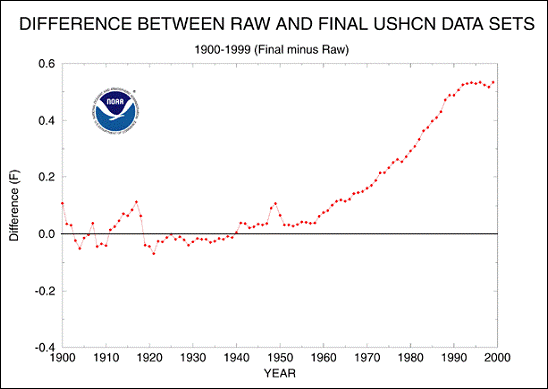
The trend due solely to adjustments is about
0.5°C0.3°C per century …Also, while the regional/global adjustments may be smaller, a common procedure is to compare the proxy to the nearest station or stations … and their amount and and even sign of adjustment could be anywhere on the map.
Actually, what the CPS procedure does on average is to adjust the trend of the proxy during the calibration period to agree with the trend of the instrumental record over that period. As a result, a change in the instrumental record trend from some adjustment will be matched by an equal change in the proxy trend.
However, there is a problem with this, which is the length of the reconstruction. The procedure you describe “pins” the recent end of the proxy reconstruction to the mean of the instrumental record, with the overall trend of the proxy adjusted so that the proxy trend during the calibration period matches the trend of the instrumental data.
Now, let’s say we have a thousand-year proxy. Consider an adjustment in the instrumental trend of let’s say 0.2°C/century, a mid-range kind of number. It’s pinned at the near end and we’re adjusting the overall trend of the proxy. By the time we’ve gone back 10 centuries, the adjustment of 0.2°C/century in the instrumental data is reflected as a full 2°C of change in the temperature a millennium ago.
This is one of the reasons that I just laugh when I see the claimed uncertainty ranges for such reconstructions …
Generally, I agree with Steve McIntyre that the adjustments aren’t much of an issue in proxy reconstructions. However, the only way to really find out would be to run the analysis both ways and measure the difference … I’ll leave that for someone else, in general proxy reconstructions are a dry hole for me.
Best regards,
w.
Willis Eschenbach says: June 16, 2014 at 2:02 am
“The trend due solely to adjustments is 0.5°C per century “
Yet another misreading of the y-axis on that plot.
Nick Stokes says:
June 16, 2014 at 2:53 am
First time I’ve misread it, so your claim of “another” isn’t clear … in any case, thanks, fixed.
w.
Steve,
Thank you for your kind words & encouraging reply! 🙂
Willis,
Thanks for your reply!
I agree that the net USHCN adjustments are quite substantial. Greater than +0.3°C/century in fact! Specifically, Time of OBservation (TOB) adjustments ≈ +0.19°C/century; Step-change adjustments ≈ +0.16°C/century [FILNET “infilling” apparently also introduces a slight warming trend]. However, for the non-USHCN component of the GHCN, the net adjustments are much less.
Speaking of which, have you had the chance to read our “Urbanization bias III” paper yet? It’s another paper which we have submitted for open peer review at our OPRJ website: http://oprj.net/articles/climate-science/34. In Section 4, we assess the various adjustments applied to both the USHCN and the GHCN. In Figures 19 & 21, we provide a breakdown of the net gridded mean adjustments and in Figure 21, we split the figure you show into the TOB/step-change components.
The description of the actual reconstruction method is unhelpfully obtuse/terse in many publications, so you may well be right that some studies use the trend as their fitting parameter. But, as far as I know, the usual CPS method involves simply scaling the mean and variance of the proxy to match that of the instrumental record for the calibration period.
Having said that, if you increase/decrease the variance and/or flip the sign of a proxy, this would usually alter the slope, i.e., the trend. So, what you’re saying about the trend of the instrumental record influencing the trend of the “calibrated” proxy is, in principle, correct.
However:
1. This does not alter the relative MWP:LIA:CWP ratios of a proxy (for instance).
Admittedly, if you combine a short, high-variance proxy series with a long, low-variance series, this can alter the ratios – as Steve has illustrated for the Jones et al., 1998 NH estimate: http://climateaudit.org/2006/06/04/making-hockey-sticks-the-jones-way/. But, if all series have a similar variance, then the ratios should remain the same.
2. On average, the current adjustments mainly alter year-to-year values, and don’t majorly alter the variance of the record. CPS simply rescales the proxies to match the overall mean & variance over the entire calibration period, so it’s mostly the average variance over the calibration period that counts…
—
For the record, I think that the CPS approach is an inadequate “calibration” method for the proxies used in these reconstructions, and I think that the NCDC/GISS/Berkeley/etc. adjustments are inadequate (as we discuss in our 4 papers on the instrumental thermometer datasets). However, I agree with Steve that, as it stands, the current reconstructions shouldn’t be majorly influenced by the differences between the current adjusted instrumental records and the unadjusted instrumental records – the “calibration process” is too crude & the current adjustments are too small on average.
—
By the way, thanks for your positive comment on our paper at OPRJ! I agree with your suggestions, and we had alluded to some of them, e.g., we provide a brief (albeit indirect) reference to Ababneh’s findings (p15, Ref B57). But, we will try and incorporate a more detailed discussion of your suggestions into version 0.2 of our paper.
Your “cluster analysis” could be a useful technique for future reconstructions, and I’ll try to mention it. Perhaps in Section 3.4 where we discuss the lack of consistency between proxies (as cluster analysis should help identify similarities/differences between proxies)?