 From the University of Utah, an argument that makes you wonder “what started it 4000 years ago”? Looking at another similar study, Joltin Joe Romm called that study Bombshell: Study Ties Epic California Drought, ‘Frigid East’ To Manmade Climate Change
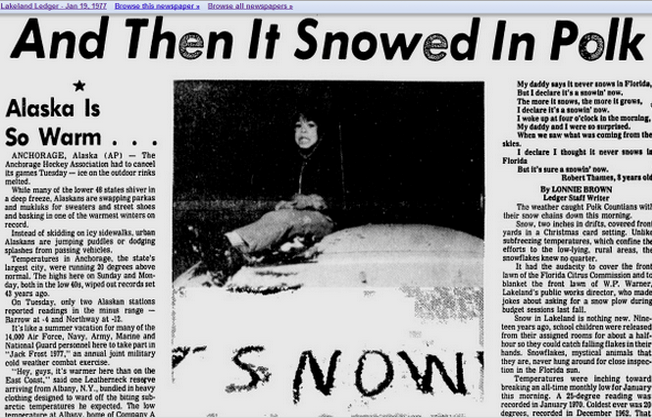
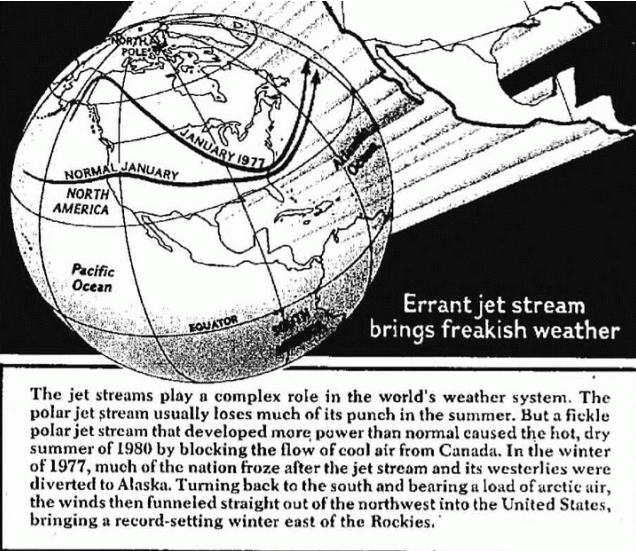
While they focus on the recent winter as being an example of this errant jet stream pattern and persistent ridges, they completely ignore an almost identical pattern in the winters of 1977/78 before global warming was even a funding twinkle in James Hansen’s eye.
In 1977, a nearly identical pattern set up with warmth in Alaska, drought in California, and cold in Florida. Arctic sea ice was near a peak at the time. (h/t Steve Goddard)
Warm US West, cold East: A 4,000-year pattern
Global warming may bring more curvy jet streams during winter
SALT LAKE CITY, April 16, 2014 – Last winter’s curvy jet stream pattern brought mild temperatures to western North America and harsh cold to the East. A University of Utah-led study shows that pattern became more pronounced 4,000 years ago, and suggests it may worsen as Earth’s climate warms.
“If this trend continues, it could contribute to more extreme winter weather events in North America, as experienced this year with warm conditions in California and Alaska and intrusion of cold Arctic air across the eastern USA,” says geochemist Gabe Bowen, senior author of the study.
The study was published online April 16 by the journal Nature Communications.
“A sinuous or curvy winter jet stream means unusual warmth in the West, drought conditions in part of the West, and abnormally cold winters in the East and Southeast,” adds Bowen, an associate professor of geology and geophysics at the University of Utah. “We saw a good example of extreme wintertime climate that largely fit that pattern this past winter,” although in the typical pattern California often is wetter.
It is not new for scientists to forecast that the current warming of Earth’s climate due to carbon dioxide, methane and other “greenhouse” gases already has led to increased weather extremes and will continue to do so.
The new study shows the jet stream pattern that brings North American wintertime weather extremes is millennia old – “a longstanding and persistent pattern of climate variability,” Bowen says. Yet it also suggests global warming may enhance the pattern so there will be more frequent or more severe winter weather extremes or both.
“This is one more reason why we may have more winter extremes in North America, as well as something of a model for what those extremes may look like,” Bowen says. Human-caused climate change is reducing equator-to-pole temperature differences; the atmosphere is warming more at the poles than at the equator. Based on what happened in past millennia, that could make a curvy jet stream even more frequent and-or intense than it is now, he says.
Bowen and his co-authors analyzed previously published data on oxygen isotope ratios in lake sediment cores and cave deposits from sites in the eastern and western United States and Canada. Those isotopes were deposited in ancient rainfall and incorporated into calcium carbonate. They reveal jet stream directions during the past 8,000 years, a geological time known as middle and late stages of the Holocene Epoch.
Next, the researchers did computer modeling or simulations of jet stream patterns – both curvy and more direct west to east – to show how changes in those patterns can explain changes in the isotope ratios left by rainfall in the old lake and cave deposits.
They found that the jet stream pattern – known technically as the Pacific North American teleconnection – shifted to a generally more “positive phase” – meaning a curvy jet stream – over a 500-year period starting about 4,000 years ago. In addition to this millennial-scale change in jet stream patterns, they also noted a cycle in which increases in the sun’s intensity every 200 years make the jet stream flatter.
Bowen conducted the study with Zhongfang Liu of Tianjin Normal University in China, Kei Yoshimura of the University of Tokyo, Nikolaus Buenning of the University of Southern California, Camille Risi of the French National Center for Scientific Research, Jeffrey Welker of the University of Alaska at Anchorage, and Fasong Yuan of Cleveland State University.
The study was funded by the National Science Foundation, National Natural Science Foundation of China, Japan Society for the Promotion of Science and a joint program by the society and Japan’s Ministry of Education, Culture, Sports, Science and Technology: the Program for Risk Information on Climate Change.
 |
||||
 |
 |
|
 |
|
|
 |
  IMAGE: These maps show winter temperature patterns (top) and winter precipitation patterns (bottom) associated with a curvy jet stream (not shown) that moves north from the Pacific to the Yukon and…Click here for more information. IMAGE: These maps show winter temperature patterns (top) and winter precipitation patterns (bottom) associated with a curvy jet stream (not shown) that moves north from the Pacific to the Yukon and…Click here for more information. |
|
|
|
 |
|
 |
|
|
||||
Sinuous Jet Stream Brings Winter Weather Extremes
The Pacific North American teleconnection, or PNA, “is a pattern of climate variability” with positive and negative phases, Bowen says.
“In periods of positive PNA, the jet stream is very sinuous. As it comes in from Hawaii and the Pacific, it tends to rocket up past British Columbia to the Yukon and Alaska, and then it plunges down over the Canadian plains and into the eastern United States. The main effect in terms of weather is that we tend to have cold winter weather throughout most of the eastern U.S. You have a freight car of arctic air that pushes down there.”
Bowen says that when the jet stream is curvy, “the West tends to have mild, relatively warm winters, and Pacific storms tend to occur farther north. So in Northern California, the Pacific Northwest and parts of western interior, it tends to be relatively dry, but tends to be quite wet and unusually warm in northwest Canada and Alaska.”
This past winter, there were times of a strongly curving jet stream, and times when the Pacific North American teleconnection was in its negative phase, which means “the jet stream is flat, mostly west-to-east oriented,” and sometimes split, Bowen says. In years when the jet stream pattern is more flat than curvy, “we tend to have strong storms in Northern California and Oregon. That moisture makes it into the western interior. The eastern U.S. is not affected by arctic air, so it tends to have milder winter temperatures.”
The jet stream pattern – whether curvy or flat – has its greatest effects in winter and less impact on summer weather, Bowen says. The curvy pattern is enhanced by another climate phenomenon, the El Nino-Southern Oscillation, which sends a pool of warm water eastward to the eastern Pacific and affects climate worldwide.
Traces of Ancient Rains Reveal Which Way the Wind Blew
Over the millennia, oxygen in ancient rain water was incorporated into calcium carbonate deposited in cave and lake sediments. The ratio of rare, heavy oxygen-18 to the common isotope oxygen-16 in the calcium carbonate tells geochemists whether clouds that carried the rain were moving generally north or south during a given time.
Previous research determined the dates and oxygen isotope ratios for sediments in the new study, allowing Bowen and colleagues to use the ratios to tell if the jet stream was curvy or flat at various times during the past 8,000 years.
Bowen says air flowing over the Pacific picks up water from the ocean. As a curvy jet stream carries clouds north toward Alaska, the air cools and some of the water falls out as rain, with greater proportions of heavier oxygen-18 falling, thus raising the oxygen-18-to-16 ratio in rain and certain sediments in western North America. Then the jet stream curves south over the middle of the continent, and the water vapor, already depleted in oxygen-18, falls in the East as rain with lower oxygen-18-to-16 ratios.
When the jet stream is flat and moving east-to-west, oxygen-18 in rain is still elevated in the West and depleted in the East, but the difference is much less than when the jet stream is curvy.
By examining oxygen isotope ratios in lake and cave sediments in the West and East, Bowen and colleagues showed that a flatter jet stream pattern prevailed from about 8,000 to 4,000 years ago in North America, but then, over only 500 years, the pattern shifted so that curvy jet streams became more frequent or severe or both. The method can’t distinguish frequency from severity.
The new study is based mainly on isotope ratios at Buckeye Creek Cave, W. Va.; Lake Grinell, N.J.; Oregon Caves National Monument; and Lake Jellybean, Yukon.
Additional data supporting increasing curviness of the jet stream over recent millennia came from seven other sites: Crawford Lake, Ontario; Castor Lake, Wash.; Little Salt Spring, Fla.; Estancia Lake, N.M.; Crevice Lake, Mont.; and Dog and Felker lakes, British Columbia. Some sites provided oxygen isotope data; others showed changes in weather patterns based on tree ring growth or spring deposits.
Simulating the Jet Stream
As a test of what the cave and lake sediments revealed, Bowen’s team did computer simulations of climate using software that takes isotopes into account.
Simulations of climate and oxygen isotope changes in the Middle Holocene and today resemble, respectively, today’s flat and curvy jet stream patterns, supporting the switch toward increasing jet stream sinuosity 4,000 years ago.
Why did the trend start then?
“It was a when seasonality becomes weaker,” Bowen says. The Northern Hemisphere was closer to the sun during the summer 8,000 years ago than it was 4,000 years ago or is now due to a 20,000-year cycle in Earth’s orbit. He envisions a tipping point 4,000 years ago when weakening summer sunlight reduced the equator-to-pole temperature difference and, along with an intensifying El Nino climate pattern, pushed the jet stream toward greater curviness.
Sorry to inform you that even if a new glaciation started they would still blame
global warmingclimate change caused by man. They will not allow themselves to be won over no matter what happens. You are dealing with a New Age religion. They used to blame warm winters on global warming. Now they blame cold winters on global warming. Next they will blame average winters on…………………………………………………global warming.Given the benefit of the doubt, if it (the “polar vortex”) would have centered itself over the northern pacific ocean, instead of the central U.S., would we even be having this discussion.
Yep, the U.S. is only 3% of the earths surface.
Now tell me, the (world) percentage of science grants its citizens pay for.
We have to fight for the data of the research ?
When the children’s lives hang in the balance ?
[The mods will not tolerate any additional descriptive comments about Jimbo’s newly hippy curves. 8<) Mod]
==================
Define "descriptive comments".
On second thought, don't 🙂
Yet it also suggests global warming may enhance the pattern so there will be more frequent or more severe winter weather extremes or both. UGH………
Madame Zenda’s Astrology, Phrenology, Tarot Card and Crystal Ball Readings may provide more accurate predictions than this ‘suggestive’ pile of AGW speculation. This non-science speculation, offered for its fear mongering and rent seeking value, is revolting to a rational mind. A decent body of field work, detailed lab analyses, and compiled results are substantially discounted as a result of that stupid, baseless speculation.
We have little idea how the weather patterns over the North American continent vary across the span of an interglacial period or why. We have little idea if this interglacial period will ‘last’ 100 more years…. or 6000 more years before glaciation begins anew. We have little idea why an interglacial ends and a glaciation period restarts, other than ‘it became colder again’. We have little idea of how violent or quiescent the weather patterns may be as we approach the glacial re-entry point. Add in some seemingly random events, such as major vulcanism or a significant meteor strike on the planet, to our incredible lack of interglacial/glacial period knowledge and any and all such ‘suggestive predictions’ become just talking rancid fear mongering from your nether orifice.
‘Yet it also suggests global warming may enhance the pattern ‘
The jet stream is getting old and needs such enhancements.
I sense a Josh cartoon of Abby Normal weather…
Well at least they have curvy models. This one less so:
California Drought/Polar Vortex Jet Stream Pattern Linked to Global Warmin
Summarized very nicely here:
http://www.wunderground.com/blog/JeffMasters/comment.html?entrynum=2665
Here is the original paper (paywalled)
http://onlinelibrary.wiley.com/doi/10.1002/2014GL059748/abstract
The 2013-14 California drought was accompanied by an anomalous high-amplitude ridge system. The anomalous ridge was investigated using reanalysis data and the Community Earth System Model (CESM). It was found that the ridge emerged from continual sources of Rossby wave energy in the western North Pacific starting in late summer, and subsequently intensified into winter. The ridge generated a surge of wave energy downwind and deepened further the trough over the northeast U.S., forming a dipole. The dipole and associated circulation pattern is not linked directly with either ENSO or Pacific Decadal Oscillation; instead it is correlated with a type of ENSO precursor. The connection between the dipole and ENSO precursor has become stronger since the 1970s, and this is attributed to increased GHG loading as simulated by the CESM. Therefore, there is a traceable anthropogenic warming footprint in the enormous intensity of the anomalous ridge during winter 2013-14, the associated drought and its intensity.
Copied from a comment on Zerohedge here:
http://www.zerohedge.com/news/2014-04-16/103-mentions-weather-it-time-rename-beige-book-weather-book
This image shows the well the importance of growth of cosmic rays in the situation of weakening the magnetic field of the Sun.
http://oi58.tinypic.com/15nvayd.jpg
From
Galway’s drowned forest shows climate change is nothing new
by Lorna Siggins
April 17 2004
http://www.irishtimes.com/news/science/galway-s-drowned-forest-shows-climate-change-is-nothing-new-1.1764077?page=1
“Prof Michael Williams of NUI Galway discovered evidence of a 7,500-year-old drowned forest on the northern shores of Galway Bay,..he says” if we examine past climates which have existed on Earth, we see that at present the Earth is cooler, sea levels are lower and atmospheric levels of carbon dioxide are less than they have been for most of Earth history, …“
“So we can expect sea levels to rise another 10m-20m, over the next few tens of thousands of years… ..”
“the isotopic composition of carbon-dioxide relates to volcanic emissions and fossil fuels, he notes, and one is “indistinguishable” from the other.”
“Rapid climate changes occurred, some by as much as 16 degrees, in time frames as short as decades,” he says, and we are living in one such interglacial stage now. “Even if industrial development had not occurred, the Earth would still have warmed since the last ice retreat 11,000 years ago.” .
.
Inclination shows the areas of greatest concentration of cosmic rays.
http://www.geomag.nrcan.gc.ca/images/field/incnordipole.gif
And this comment to the previous link.
http://vortex.accuweather.com/adc2004/pub/includes/columns/alertengine/2014/590x455_04161324_20140414180000_cvchdctgl_0007617826.jpg
Is there a correlation between rising temperatures and curvy models? IF so, we could have some important decisions to make. Paracetamol or Viagra?
Mac the Knife says: @ur momisugly April 16, 2014 at 5:35 pm
…Madame Zenda’s Astrology, Phrenology, Tarot Card and Crystal Ball Readings may provide more accurate predictions than this ‘suggestive’ pile of AGW speculation.
>>>>>>>>>>
Since Madame Zenda has to be a very good observer, her livelihood depends on it, her predictions ARE going to hit more often then the Climastrologists who are paid to ignore the observable evidence.
I bet there is a scientific paper in that….
Not a comment on the blog, but on a common misconception, here regarding Jim Hansen.
http://en.wikipedia.org/wiki/James_Hansen
Hansen worked for the Goddard Institute for Space studies from the late 60’s until last year. He is a PhD physicist at a governmental agency, he did not first have to make up a myth to justify his position. If you follow the process, his background was in remote sensing, planetary studies, atmospheric physics, especially Venus and its runaway greenhouse. It follows that he would connect the dots when increased global temperatures were seen in the 90’s and 2000’s. No conspiracy is required. None is even required to explain the global consensus, because the temperatures did go up. Nothing, even science, takes place without some personal, inadvertent bias. But, try not to be disingenuous.