Initial Notes: This post contains graphs of running trends in global surface temperature anomalies for periods of 13+ and 16+ years using GISS global (land+ocean) surface temperature data. They indicate that we have not seen a warming halt and slowdown this long since the early-1970s (13-year+ trends) or late-1970s (16-years+ trends).
Much of the following text is boilerplate. It is intended for those new to the presentation of global surface temperature anomaly data.
Most of the update graphs in the following start in 1979. That’s a commonly used start year for global temperature products because many of the satellite-based temperature datasets start then.
We discussed why the three suppliers use different base years for anomalies in the post Why Aren’t Global Surface Temperature Data Produced in Absolute Form?
GISS LAND OCEAN TEMPERATURE INDEX (LOTI)
Introduction: The GISS Land Ocean Temperature Index (LOTI) data is a product of the Goddard Institute for Space Studies. Starting with their January 2013 update, it uses NCDC ERSST.v3b sea surface temperature data. The impact of the recent change in sea surface temperature datasets is discussed here. GISS adjusts GHCN and other land surface temperature data via a number of methods and infills missing data using 1200km smoothing. Refer to the GISS description here. Unlike the UK Met Office and NCDC products, GISS masks sea surface temperature data at the poles where seasonal sea ice exists, and they extend land surface temperature data out over the oceans in those locations. Refer to the discussions here and here. GISS uses the base years of 1951-1980 as the reference period for anomalies. The data source is here.
Update: The January 2014 GISS global temperature anomaly is +0.70 deg C. It warmed (an increase of about 0.1 deg C) since December 2013.

GISS LOTI
NCDC GLOBAL SURFACE TEMPERATURE ANOMALIES
Introduction: The NOAA Global (Land and Ocean) Surface Temperature Anomaly dataset is a product of the National Climatic Data Center (NCDC). NCDC merges their Extended Reconstructed Sea Surface Temperature version 3b (ERSST.v3b) with the Global Historical Climatology Network-Monthly (GHCN-M) version 3.2.0 for land surface air temperatures. NOAA infills missing data for both land and sea surface temperature datasets using methods presented in Smith et al (2008). Keep in mind, when reading Smith et al (2008), that the NCDC removed the satellite-based sea surface temperature data because it changed the annual global temperature rankings. Since most of Smith et al (2008) was about the satellite-based data and the benefits of incorporating it into the reconstruction, one might consider that the NCDC temperature product is no longer supported by a peer-reviewed paper.
The NCDC data source is usually here. NCDC uses 1901 to 2000 for the base years for anomalies. (Note: the NCDC has been slow with updating the normal data source webpage, so I’ve used the value listed on their State of the Climate Report for January 2014.)
Update: The January 2014 NCDC global land plus sea surface temperature anomaly was +0.65 deg C. It remained about the same (an increase of 0.01 deg C) since December 2013.

NCDC Global (Land and Ocean) Surface Temperature Anomalies
UK MET OFFICE HADCRUT4 (LAGS ONE MONTH)
Introduction: The UK Met Office HADCRUT4 dataset merges CRUTEM4 land-surface air temperature dataset and the HadSST3 sea-surface temperature (SST) dataset. CRUTEM4 is the product of the combined efforts of the Met Office Hadley Centre and the Climatic Research Unit at the University of East Anglia. And HadSST3 is a product of the Hadley Centre. Unlike the GISS and NCDC products, missing data is not infilled in the HADCRUT4 product. That is, if a 5-deg latitude by 5-deg longitude grid does not have a temperature anomaly value in a given month, it is not included in the global average value of HADCRUT4. The HADCRUT4 dataset is described in the Morice et al (2012) paper here. The CRUTEM4 data is described in Jones et al (2012) here. And the HadSST3 data is presented in the 2-part Kennedy et al (2012) paper here and here. The UKMO uses the base years of 1961-1990 for anomalies. The data source is here.
Update (Lags One Month): The December 2013 HADCRUT4 global temperature anomaly is +0.49 deg C. It decreased (about -0.1 deg C) since November 2013.

HADCRUT4
RUNNING TRENDS FOR 13+ YEARS
As noted in my post Open Letter to the Royal Meteorological Society Regarding Dr. Trenberth’s Article “Has Global Warming Stalled?”, Kevin Trenberth of NCAR presented 10-year period-averaged temperatures in his article for the Royal Meteorological Society. He was attempting to show that the recent halt in global warming since 2001 was not unusual. Kevin Trenberth conveniently overlooked the fact that, based on his selected start year of 2001, the halt at that time had lasted 12+ years, not 10.
The period from January 2001 to January 2014 is now 157-months long— a little more than 13 years. Refer to the following graph of running 157-month trends from January 1880 to January 2014, using the GISS LOTI global temperature anomaly product. The last data point in the graph is the linear trend (in deg C per decade) from January 2001 to the current month. It is basically zero. That, of course, indicates global surface temperatures have not warmed during the most recent 157-month period. Working back in time, the data point immediately before the last one represents the linear trend for the 157-month period of December 2000 to December 2013, and the data point before it shows the trend in deg C per decade for November 2000 to November 2013, and so on.

157-Month (13+ Years) Linear Trends
The highest recent rate of warming based on its linear trend occurred during the 157-month period that ended about 2004, but warming trends have dropped drastically since then. There was a similar drop in the 1940s, and as you’ll recall, global surface temperatures remained relatively flat from the mid-1940s to the mid-1970s. Also note that the early-1970s was the last time there had been a 157-month period without global warming—before recently.
RUNNING TRENDS FOR 16+ YEARS
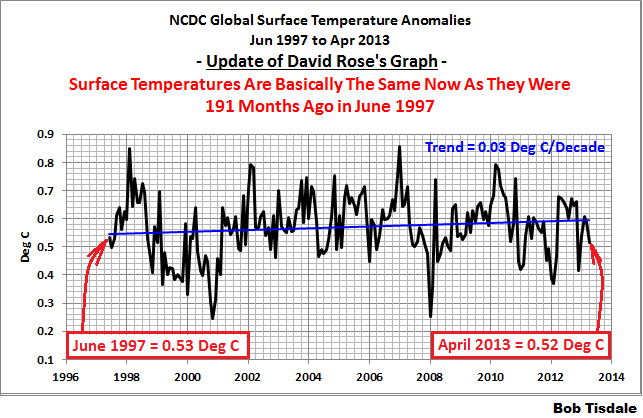
In his RMS article, Kevin Trenberth also conveniently overlooked the fact that the discussions about the warming halt are now for a time period of about 16 years, not 10 years—ever since David Rose’s DailyMail article titled “Global warming stopped 16 years ago, reveals Met Office report quietly released… and here is the chart to prove it”. In my response to Trenberth’s article, I updated David Rose’s graph, noting that surface temperatures in April 2013 were basically the same as they were in June 1997. We’ll use June 1997 as the start month for the running 16-year+ trends. The period is now 200-months long. The following graph is similar to the one above, except that it’s presenting running trends for 200-month periods.

200-Month (16+ Years) Linear Trends
The last time global surface temperatures warmed at this low a rate for a 198-month period was the late 1970s. Also note that the sharp decline is similar to the drop in the 1940s, and, again, as you’ll recall, global surface temperatures remained relatively flat from the mid-1940s to the mid-1970s.
The most widely used metric of global warming—global surface temperatures—indicates that the rate of global warming has slowed drastically and that the duration of the halt in global warming is unusual during a period when global surface temperatures are allegedly being warmed from the hypothetical impacts of manmade greenhouse gases.
A NOTE ABOUT THE RUNNING-TREND GRAPHS
There is very little difference in the end point trends of 13+ year and 16+ year running trends if HADCRUT4 or NCDC or GISS data are used. The major difference in the graphs is with the HADCRUT4 data and it can be seen in a graph of the 13+ year trends. I suspect this is caused by the updates to the HADSST3 data that have not been applied to the ERSST.v3b sea surface temperature data used by GISS and NCDC.
COMPARISON
The GISS, HADCRUT4 and NCDC global surface temperature anomalies are compared in the next three time-series graphs. The first graph compares the three global surface temperature anomaly products starting in 1979. Again, due to the timing of this post, the HADCRUT4 data lags the GISS and NCDC products by a month. The graph also includes the linear trends. Because the three datasets share common source data, (GISS and NCDC also use the same sea surface temperature data) it should come as no surprise that they are so similar. For those wanting a closer look at the more recent wiggles and trends, the second graph starts in 1998, which was the start year used by von Storch et al (2013) Can climate models explain the recent stagnation in global warming? They, of course found that the CMIP3 (IPCC AR4) and CMIP5 (IPCC AR5) models could NOT explain the recent halt.
The third comparison graph starts with Kevin Trenberth’s chosen year of 2001. All three of those comparison graphs present the anomalies using the base years of 1981 to 2010. Referring to their discussion under FAQ 9 here, according to NOAA:
This period is used in order to comply with a recommended World Meteorological Organization (WMO) Policy, which suggests using the latest decade for the 30-year average.

Comparison Starting in 1979
###########

Comparison Starting in 1998
###########

Comparison Starting in 2001
AVERAGE
The last graph presents the average of the GISS, HADCRUT and NCDC land plus sea surface temperature anomaly products. Again because the HADCRUT4 data lags one month in this update, the most current average only includes the GISS and NCDC products.

Average of Global Land+Sea Surface Temperature Anomaly Products
The flatness of the data since 2001 is very obvious, as is the fact that surface temperatures have rarely risen above those created by the 1997/98 El Niño. There is a very simple reason for this: the 1997/98 El Niño released enough sunlight-created warm water from beneath the surface of the tropical Pacific to permanently raise the temperature of about 66% of the surface of the global oceans by almost 0.2 deg C. Sea surface temperatures for that portion of the global oceans remained relatively flat until the El Niño of 2009/10, when the surface temperatures of the portion of the global oceans shifted slightly higher again. Prior to that, it was the 1986/87/88 El Niño that caused surface temperatures to shift upwards. If these naturally occurring upward shifts in surface temperatures are new to you, please see the illustrated essay “The Manmade Global Warming Challenge” (42mb) for an introduction.
MONTHLY SEA SURFACE TEMPERATURE UPDATE
The most recent sea surface temperature update can be found here. The satellite-enhanced sea surface temperature data (Reynolds OI.2) are presented in global, hemispheric and ocean-basin bases.
There’s a lot of subsurface cold water at the east equatorial Pacific
http://www.bom.gov.au/climate/enso/sub_surf_mon.gif
and a nice gradient with the warmer west Pacific to stoke up the trades so I’m still holding out for a La Nina.
If the trend doesn’t show any sign of increasing, I’m sure a new version of the record will come along that cools the past a bit more.
I hate these running averages…very deceptive…also these ‘global’ averages are a nonsense concept
given the ipcc remit is only to look at man made change then MetO and others cannot include in their models unco2weighted natural processes otherwise they become useless to the ipcc who is ONLY looking at man made change ie a very narrow section of process. . The climate models cannot be improved by removing the heavy co2 bias and include other natural processes because then they would no longer be about ‘man made change’ and be useless for ipcc. So its Catch 22
and no wants to be outside the IPCC magic cirlce ie denierland.
Bob,
It seems natural to expect that if the warming trend slowed since 1998 then most of the observed warming since 1979 must have occurred up to the end of 1997.
Looking at your figures (average of the three surface sets), the trend since Jan 1998 is 0.05 deg C/dec. Using the same data, I calculate that the trend between Jan 1979 and Dec 1997 is 0.13 deg C/dec; nearly three times faster than the more recent period. So that seems to be as expected.
However, as your chart shows, the overall trend in the same data between Jan 1979 and the present is 0.15 deg C per decade. That’s even faster than the rate of increase observed between 1979 and 1997, before the ‘slowdown’ started.
If we take the multi-decade period since 1979 as a whole, rather than dividing it up into two shorter periods of less than two decades each, there is no slowdown.
Tamino isn’t going to like this! Hey, Grant Foster, lookie over here, this is what truth looks like!
I’m interested in seeing what record snow cover and cold does to the land temperatures in the US, particularly around the urban heat islands. I’ve always felt the removal of snow in urban areas due to salting and plowing (I even hear in some cities they use machines that heat and melt snow and send into the storm drains rather than trucking it out) is a manmade temperature-forcing variable beyond the regular urban heat sources that is not properly accounted for in the long term record. After all, we’ve all seen old postcards of the big city snows in the past and they basically had to live with that snow until it melted on its own.
Both graphs 4 and 5 are labeled linear trends yet you refer to the second one as running. Would it be possible to begin numbering your graphs? Much easier to refer back to them with a labeled number already there.
Also, graph 4 is labeled as linear and you refer to it as linear. Yet I don’t understand how the graph can be depicting linear trends. Is it an extrapolation of the linear slope of the 13 year period you are using and then graphing that?
I would need to ask a statistician, but graphing running 13 year linear slope data with error bars (helps when depicting spread from the trend) would be an interesting way of finding 13 year trends. According to the “theory” we should always be heading up so graphing the running 13, 14, 15, 16, etc linear trend would get rid of the short term variations they so love to bring up.
Scott,
You make an interesting point.
So, how were temperatures distorted by the big high pressure ridge parked over Alaska and the Pacific NW?
Heres some examples of city snow melters in action, I did a quick check and some advertise themselves as 30 million btu/hr melters, they melt snow as fast as they can dump it in, when it goes down sewer there goes 30 million btu/hr that won’t be cooling the city air, not to mention the double whammy of exposing dark pavement.
http://blogs.howstuffworks.com/brainstuff/how-the-snow-dragon-works-a-machine-for-digesting-huge-amounts-of-snow-in-urban-areas/
Fascinating Scott. I would also imagine that sensors (particularly the older ones) get snow shoveled all the time so that people can walk out there and check things. I would also imagine that snow gets piled up on the newer sensors that you don’t have to shovel a pathway to and possibly insulates them.
Bob:
This treatment of the same longer GISS data says that this all has some periodicity built into it (and there may well be nothing to worry about in the near future either)..
http://climatedatablog.files.wordpress.com/2014/02/giss-monthly-anomalies-with-full-kernel-gaussian-low-pass-filters-of-annual-15-and-75-years-with-15-year-savitzky-golay-extension.png
That’s temperature anomalies, right?
I have a question.
In the past I’ve commented on how past record high and low temperatures for my area have been changed. (IE Between 2002 and 2007, the 2007 list of records from the NWS has no new records set. In the 2009 list of record temps there were over 10 records temps set between 2002 and 2007.)
My question is, are the temps for a given year, say 1981, the same as they were stated in, say 1990, as they are stated today?
(I hope I stated my question clearly.)
These results are still very disappointing for the Warmistas. There will have to be some seriously concerted effort from the ‘Adjustments’ Department’ in all the major Climatological Institutes to ensure that the correct message is delivered to the Public.
Bob – You show excellent reproductions of GISS LOTI, NCDC, and HADCRUT4 temperature sets in the time slot corresponding to the satellite era.Looking at them I notice that all three are still riddled with noise from secret computer processing they were jointly subjected to. This noise manifests itself as high spikes, mostly at the beginnings of years. Here is a list of years in which the more prominent of these noise spikes occur:
1980
1981
1983
1990
1995
1998 (on top of super El Nino, extends it)
2002
2007
2008 (in the middle of La Nina valley)
They are all noise and very visible. They should be removed. You will also note that they are in exactly the same places in all three data sets. The owners of the data are oblivious to the fact that their little computer game of fixing the temperature has left a footprint behind. I suggest they explain how it was done and why. Arno
ntesdorf says:
February 21, 2014 at 2:43 pm
These results are still very disappointing for the Warmistas
Not really. If I were hoping it was going to get warmer, I’d be quite pleased that the year had started off with an anomaly of 0.70 degrees – the 4th warmest January, warmer than all but 14 of the 120 months in the last decade, and higher than any annual anomaly.
Here’s hoping some of that February cold in the USA finds its way into the Global figure next month.
DavidR, if there is no slowdown, then the climate science community is wasting a lot of time and money trying to explain it.
I suspect, in 50 years, when they look back at the halt in global warming, the breakpoint will be somewhere between 2001 and 2005, not 1998 as is commonly used now.
Regards
Pamela Gray, the graphs you’re discussing are running trends, based on linear trends. I’ll try to clarify that next month. I left myself a note.
Thanks.
Arno Arrak says: “Looking at them I notice that all three are still riddled with noise from secret computer processing…”
Secret computer processing? You’re sounding like a conspiracy theorist, Arno.
I think 2010 was the last high point, but what do I know. 1878 – 1911 – 1944 – 1977 – 2010
Richard Barraclough says:
February 21, 2014 at 3:09 pm
I’d be quite pleased that the year had started off with an anomaly of 0.70 degrees – the 4th warmest January
If other data sets agreed with this, that would be one thing. However for RSS, January 2014 is only the 9th warmest and for Hadsst3, it is only the 8th warmest.