Climate Dialogue about the (missing) hot spot
by Marcel Crok
Over at the Climate Dialogue website we start with what could become a very interesting discussion about the so-called tropical hot spot. Climate models show amplified warming high in the tropical troposphere due to greenhouse forcing. However data from satellites and weather balloons don’t show much amplification. What to make of this? Have the models been ‘falsified’ as critics say or are the errors in the data so large that we cannot conclude much at all? And does it matter if there is no hot spot?
The (missing) tropical hot spot is one of the long-standing controversies in climate science. In 2008 two papers were published, one by a few scientists critical of the IPCC view (Douglass, Christy, Pearson and Singer) and one by Ben Santer and sixteen other scientists. We have participants from both papers. John Christy is the ‘representative’ from the first paper and Steven Sherwood and Carl Mears are ‘representatives’ of the second paper.
Below I repost the introduction that we – the editors of Climate Dialogue – prepared as the basis for the discussion.
The (missing) hot spot in the tropics
Based on theoretical considerations and simulations with General Circulation Models (GCMs), it is expected that any warming at the surface will be amplified in the upper troposphere. The reason for this is quite simple.
More warming at the surface means more evaporation and more convection. Higher in the troposphere the (extra) water vapour condenses and heat is released. Calculations with GCMs show that the lower troposphere warms about 1.2 times faster than the surface. For the tropics, where most of the moist is, the amplification is larger, about 1.4.
This change in thermal structure of the troposphere is known as the lapse rate feedback. It is a negative feedback, i.e. attenuating the surface temperature response due to whatever cause, since the additional condensation heat in the upper air results in more radiative heat loss.
IPCC published the following figure in its latest report (AR4) in 2007:

Source: http://www.ipcc.ch/publications_and_data/ar4/wg1/en/figure-9-1.html (based on Santer 2003)
The figure shows the response of the atmosphere to different forcings in a GCM. As one can see, over the past century, the greenhouse forcing was expected to dominate all other forcings. The expected warming is highest in the tropical troposphere, dubbed the tropical hot spot.
The discrepancy between the strength of the hot spot in the models and the observations has been a controversial topic in climate science for almost 25 years. The controversy [i] goes all the way back to the first paper of Roy Spencer and John Christy [ii] about their UAH tropospheric temperature dataset in the early nineties. At the time their data didn’t show warming of the troposphere. Later a second group (Carl Mears and Frank Wentz of RSS) joined in, using the same satellite data to convert them into a time series of the tropospheric temperature. Several corrections, e.g. for the orbital changes of the satellite, were made in the course of years with a warming trend as a result. However the controversy remains because the tropical troposphere is still showing a smaller amplification of the surface warming which is contrary to expectations.
Positions
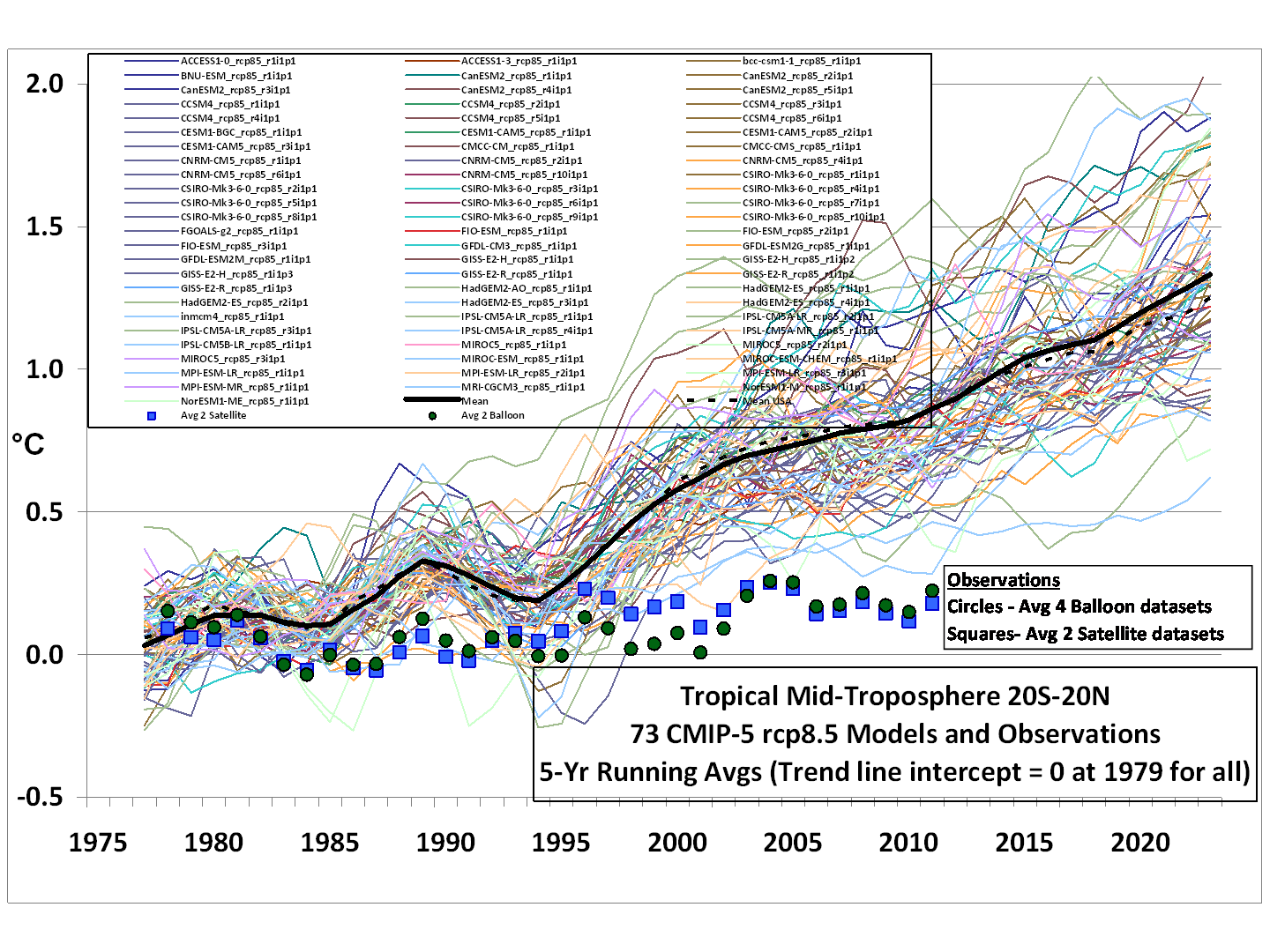
Some researchers claim that observations don’t show the tropical hot spot and that the differences between models and observations are statistically significant [iii]. On top of that they note that the warming trend itself is much larger in the models than in the observations (see figure 2 below and also ref. [iv]). Other researchers conclude that the differences between the trends of tropical tropospheric temperatures in observations and models are statistically not inconsistent with each other [v]. They note that some radiosonde and satellite datasets (RSS) do show warming trends comparable with the models (see figure 3 below).
The debate is complex because there are several observational datasets, based on satellite (UAH and RSS) but also on radiosonde measurements (weather balloons). Which of the dataset is “best” and how does one determine the uncertainty in both datasets and model simulations?
The controversy flared up in 2007/2008 with the publications of two papers [vi][vii] of the opposing groups. Key graphs in both papers are the best way to give an impression of the debate. First Douglass et al. came up with the following graph showing the disagreement between models and observations:

Figure 2. Temperature trends for the satellite era. Plot of temperature trend (°C/decade) against pressure (altitude). The HadCRUT2v surface trend value is a large blue circle. The GHCN and the GISS surface values are the open rectangle and diamond. The four radiosonde results (IGRA, RATPAC, HadAT2, and RAOBCORE) are shown in blue, light blue, green, and purple respectively. The two UAH MSU data points are shown as gold-filled diamonds and the RSS MSU data points as gold-filled squares. The 22-model ensemble average is a solid red line. The 22-model average ±2σSE are shown as lighter red lines. MSU values of T2LT and T2 are shown in the panel to the right. UAH values are yellow-filled diamonds, RSS are yellow-filled squares, and UMD is a yellow-filled circle. Synthetic model values are shown as white-filled circles, with 2σSE uncertainty limits as error bars. Source: Douglass et al. 2008
Santer et al. criticized Douglass et al. for underestimating the uncertainties in both model output and observations and also for not showing all radiosonde datasets. They came up with the following graph:

Figure 3. Vertical profiles of trends in atmospheric temperature (panel A) and in actual and synthetic MSU temperatures (panel B). All trends were calculated using monthly-mean anomaly data, spatially averaged over 20 °N–20 °S. Results in panel A are from seven radiosonde datasets (RATPAC-A, RICH, HadAT2, IUK, and three versions of RAOBCORE; see Section 2.1.2) and 19 different climate models. The grey-shaded envelope is the 2σ standard deviation of the ensemble-mean trends at discrete pressure levels. The yellow envelope represents 2σSE, DCPS07’s estimate of uncertainty in the mean trend. The analysis period is January 1979 through December 1999, the period of maximum overlap between the observations and most of the model 20CEN simulations. Note that DCPS07 used the same analysis period for model data, but calculated all observed trends over 1979–2004. Source: Santer (2008)
The grey-shaded envelope is the 2σ standard deviation of the ensemble-mean trends of Santer et al. while the yellow band is the estimated uncertainty of Douglass et al. Some radiosonde series in the Santer graph (like the Raobcore 1.4 dataset) show even more warming higher up in the troposphere than the model mean.
Updates
Not surprisingly the debate didn’t end there. In 2010 McKitrick et al. [viii] updated the results of Santer (2008), who limited the comparison between models and observations to the period 1979-1999, to 2009. They concluded that over the interval 1979–2009, model projected temperature trends are two to four times larger than observed trends in both the lower troposphere and the mid troposphere and the differences are statistically significant at the 99% level.
Christy (2010)[ix] analysed the different datasets used and concluded that some should be discarded in the tropics:

Figure 4. Temperature trends in the lower tropical troposphere for different datasets and for slightly differing periods (79-05 = 1979-2005). UAH and RSS are the estimates based on satellite measurements. HadAt, Ratpac, RC1.4 and Rich are based on radiosonde measurements. C10 and AS08 [x] are based on thermal wind data. The other three datasets give trends at the surface (ERSST being for the oceans only while the other two combine land and ocean data). Source: Christy (2010)
Christy (2010) concluded that part of the tropical warming in the RSS series is spurious. They also discarded the indirect estimates that are based on thermal wind. Not surprisingly Mears (2012) disagreed with Christy’s conclusion about the RSS trend being spurious writing that “trying to determine which MSU [satellite] data set is “better” based on short-time period comparisons with radiosonde data sets alone cannot lead to robust conclusions”.[xi]
Scaling ratio
Christy (2010) also introduced what they called the “scaling ratio”, the ratio of tropospheric to surface trends and concluded that these scaling ratios clearly differ between models and observations. Models show a ratio of 1.4 in the tropics (meaning troposphere warming 1.4 times faster than the surface), while the observations have a ratio of 0.8 (meaning surface warming faster than the troposphere). Christy speculated that an alternate reason for the discrepancy could be that the reported trends in temperatures at the surface are spatially inaccurate and are actually less positive. A similar hypothesis was tested by Klotzbach (2009).[xii]
In an extensive review article about the controversy published in early 2011 Thorne et al. ended with the conclusion that “there is no reasonable evidence of a fundamental disagreement between tropospheric temperature trends from models and observations when uncertainties in both are treated comprehensively”. However in the same year Fu et al.[xiii] concluded that while “satellite MSU/AMSU observations generally support GCM results with tropical deep‐layer tropospheric warming faster than surface, it is evident that the AR4 GCMs exaggerate the increase in static stability between tropical middle and upper troposphere during the last three decades”. More papers then started to acknowledge that the consistency of tropical tropospheric temperature trends with climate model expectations remains contentious.[xiv][xv][xvi][xvii]
Climate Dialogue
We will focus the discussion on the tropics as the hot spot is most pronounced there in the models. Core questions are of course whether we can detect/have detected a hot spot in the observations and if not what are the implications for the reliability of GCMs and our understanding of the climate?
Specific questions
1) Do the discussants agree that amplified warming in the tropical troposphere is expected?
2) Can the hot spot in the tropics be regarded as a fingerprint of greenhouse warming?
3) Is there a significant difference between modelled and observed amplification of surface trends in the tropical troposphere (as diagnosed by e.g. the scaling ratio)?
4) What could explain the relatively large difference in tropical trends between the UAH and the RSS dataset?
5) What explanation(s) do you favour regarding the apparent discrepancy surrounding the tropical hot spot? A few options come to mind: a) satellite data show too little warming b) surface data show too much warming c) within the uncertainties of both there is no significant discrepancy d) the theory (of moist convection leading to more tropospheric than surface warming) overestimates the magnitude of the hotspot
6) What consequences, if any, would your explanation have for our estimate of the lapse rate feedback, water vapour feedback and climate sensitivity?
[i] Thorne, P. W. et al., 2011, Tropospheric temperature trends: History ofan ongoing controversy. WIRES: Climate Change, 2: 66-88
[ii]Spencer RW, Christy JR. Precise monitoring of global temperature trends from satellites. Science 1990, 247:1558–1562.
[iii] Christy, J. R., B. M. Herman, R. Pielke Sr., P. Klotzbach, R. T. McNider, J. J. Hnilo, R. W. Spencer, T. Chase, and D. H. Douglass (2010), What do observational datasets say about modeled tropospheric temperature trends since 1979?, Remote Sens., 2, 2148–2169, doi:10.3390/rs2092148.
[iv]http://www.drroyspencer.com/wp-content/uploads/CMIP5-73-models-vs-obs-20N-20S-MT-5-yr-means1.png
[v]Thorne, P.W. Atmospheric science: The answer is blowing in the wind. Nature Geosci. 2008, doi:10.1038/ngeo209
[vi] Douglass DH, Christy JR, Pearson BD, Singer SF. A comparison of tropical temperature trends with model predictions. Int J Climatol 2008, 27:1693–1701
[vii] Santer, B.D.; Thorne, P.W.; Haimberger, L.; Taylor, K.E.; Wigley, T.M.L.; Lanzante, J.R.; Solomon, S.; Free, M.; Gleckler, P.J.; Jones, P.D.; Karl, T.R.; Klein, S.A.; Mears, C.; Nychka, D.; Schmidt, G.A.; Sherwood, S.C.; Wentz, F.J. Consistency of modelled and observed temperature trends in the tropical troposphere. Int. J. Climatol. 2008, doi:1002/joc.1756
[viii] McKitrick, R. R., S. McIntyre and C. Herman (2010) “Panel and Multivariate Methods for Tests of Trend Equivalence in Climate Data Sets.” Atmospheric Science Letters, 11(4) pp. 270-277, October/December 2010 DOI: 10.1002/asl.290
[ix] Christy, J. R., B. M. Herman, R. Pielke Sr., P. Klotzbach, R. T. McNider, J. J. Hnilo, R. W. Spencer, T. Chase, and D. H. Douglass (2010), What do observational datasets say about modeled tropospheric temperature trends since 1979?, Remote Sens., 2, 2148–2169, doi:10.3390/rs2092148
[x] Allen RJ, Sherwood SC. Warming maximum in the tropical upper troposphere deduced from thermal winds. Nat Geosci 008, 1:399–403
[xi] Mears, C. A., F. J. Wentz, and P. W. Thorne (2012), Assessing the value of Microwave Sounding Unit–radiosonde comparisons in ascertaining errors in climate data records of tropospheric temperatures, J. Geophys. Res., 117, D19103, doi:10.1029/2012JD017710
[xii] Klotzbach PJ, Pielke RA Sr., Pielke RA Jr., Christy JR, McNider RT. An alternative explanation for differential temperature trends at the surface and in the lower troposphere. J Geophys Res 2009, 114:D21102. DOI:10.1029/2009JD011841
[xiii] Fu, Q., S. Manabe, and C. M. Johanson (2011), On the warming in the tropical upper troposphere: Models versus observations, Geophys. Res. Lett., 38, L15704, doi:10.1029/2011GL048101
[xiv] Seidel, D. J., M. Free, and J. S. Wang (2012), Reexamining the warming in the tropical upper troposphere: Models versus radiosonde observations, Geophys. Res. Lett., 39, L22701, doi:10.1029/2012GL053850
[xv] Po-Chedley, S., and Q. Fu (2012), Discrepancies in tropical upper tropospheric warming between atmospheric circulation models and satellites, Environ. Res. Lett
[xvi] Benjamin D. Santer, Jeffrey F. Painter, Carl A. Mears, Charles Doutriaux, Peter Caldwell, Julie M. Arblaster, Philip J. Cameron-Smith, Nathan P. Gillett, Peter J. Gleckler, John Lanzante, Judith Perlwitz, Susan Solomon, Peter A. Stott, Karl E. Taylor, Laurent Terray, Peter W. Thorne, Michael F. Wehner, Frank J. Wentz, Tom M. L. Wigley, Laura J. Wilcox, and Cheng-Zhi Zou, Identifying human influences on atmospheric temperature, PNAS 2013 110 (1) 26-33; published ahead of print November 29, 2012, doi:10.1073/pnas.1210514109
[xvii] Thorne, P. W., et al. (2011), A quantification of uncertainties in historical tropical tropospheric temperature trends from radiosondes, J. Geophys. Res., 116, D12116, doi:10.1029/2010JD015487
Discover more from Watts Up With That?
Subscribe to get the latest posts sent to your email.
Some Australian scientist states that only 41 per cent of people questioned knew how long it takes the Earth to travel around the sun. Reckons it is because people watch too many Jurassic Park films, etc., and believe Sarah Palin’s creationist explanation that humans walked with dinosaurs. So this report would not be understood by the majority. God help us.
17 July: News Ltd: Andrew Bolt: How to grill an alarmist politician
Source: BBC2: The Sunday Politics
Date: 14/07/2013
Andrew Neil: Ed Davey, Secretary of State for Energy and Climate Change, joins me now for the Sunday interview
http://blogs.news.com.au/heraldsun/andrewbolt/index.php/heraldsun/comments/how_to_grill_an_alarmist_politician/
“Models show a ratio of 1.4 in the tropics (meaning troposphere warming 1.4 times faster than the surface), while the observations have a ratio of 0.8 (meaning surface warming faster than the troposphere). Christy speculated that an alternate reason for the discrepancy could be that the reported trends in temperatures at the surface are spatially inaccurate and are actually less positive.”
Having read WUWT for several years, I would have made the same guess. Have the alarmists in charge of the “adjustments” to the surface temp records shot themselves in the foot?
Bushbunny, enough with the gratuitous Palin-bashing, based on an uncorroborated hearsay account from a single “progressive” commentator, who claimed to recall things from long ago that nobody else heard and Palin probably never actually said. Stop it, or I might have to mention Al “millions of degrees magma” Gore, You wouldn’t want that, would you?
The simplest and probably correct explanation of no troposphere hotspot is, there is no water vapour feedback.
One convinced CAGW protagonist’s view is that radiosonde data is unreliable because they have inadequate solar radiation shielding. If this was so, the weather balloon temperature data would be higher than the ‘correct’ value. The measured temperatures, however, are less than that of the models, so there is no case for dismissing the weather balloon data. So how useful are the models?
Marcel: Thanks for cross posting this here. I just left the following comment at ClimateDialogue:
http://www.climatedialogue.org/the-missing-tropical-hot-spot/#comment-668
I suspect one of the reasons for the difference between the models (the tropical hotspot) and observations (no hotspot) may result from how poorly climate models simulate sea surface temperatures, primarily in the Pacific.
The following is a model-data comparison of the Pacific sea surface temperature anomaly trends for the past 31 years on a zonal-mean basis. The data is the Reynolds OI.v2 SST, and the models are the multi-model ensemble mean of the CMIP5-archived models—simulation of TOS (Historic/RCP6.0).
http://bobtisdale.files.wordpress.com/2013/02/02-zonal-pacific.png
The models show a relatively high warming rate in the tropics, but the data show little to no warming. In fact, over this period, the equatorial Pacific has cooled.
And I also suspect the differences between the modeled and observed sea surface temperature trends in the Pacific are caused by the failure of climate models to properly simulate ENSO processes.
The above graph is from this post:
http://bobtisdale.wordpress.com/2013/02/28/cmip5-model-data-comparison-satellite-era-sea-surface-temperature-anomalies/
If the models can’t simulate ENSO or Pacific sea surface temperature trends properly, one wonders how they can ever hope to project regional variations in temperature and precipitation.
Regards
Thanks, Marcel. Very interesting discussion.
I think the data collected by millions of weather balloons shows the absence of the hypothesized “tropical hot spot”. Same with satellite data.
Water vapor positive feedback is the basis for CAGW, together with a high climate sensitivity to CO2 increases. It will defended to the last man.
Bushbunny should back up his implausible claim – Palin is nobody’s fool and could probably clean Bushbunny’s clock in any political debate, judging by her past performances.
bushbunny: “Sarah Palin’s creationist explanation that humans walked with dinosaurs”.
Can you cite a credible source? If not, shame on you.
“Thorne et al. ended with the conclusion that “there is no reasonable evidence of a fundamental disagreement between tropospheric temperature trends from models and observations when uncertainties in both are treated comprehensively”.”
Thorne should be beaten repeatedly… he all but admits that the uncertainty is massive and that its on the low side. Which is turn means zero reason for alarm and that it can easily be natural processes. These douchebags will just lie with a straight face its truly amazing. This is classic eugenics propaganda moves.
Gary Hladik says:
“Have the alarmists in charge of the “adjustments” to the surface temp records shot themselves in the foot?”
Most definitely.
Every time they use HadCrud or Giss temperature record, they start off with a highly manipulated data set. They cannot possibly end up with a viable result, even if everything else is correct.
GIGO !!!
They have well and truly painted themselves into a corner with the deception.
And I really wish people wouldn’t talk about ‘statistical uncertainty’ of models. The outputs of climate models aren’t samples of a population, except to the extent they are samples of the uncertainty of climate modellers, and hence a measure of the lack of consensus among them.
Bushbuuny,
It is time to snip this lie about Sarah Palin in the bud. Just because you disagree politically with a public figure, it does not give you the right to lie about her.
The claim that Sarah Palin believes that dinosaurs and humans co-existed is based on the following “evidence”;
An Internet Blog
These allegations [against Palin] appear to stem from a blog post that included “fake Governor Sarah Palin quotes” made up by a blogger at unbearablebobness.typepad.com. He states that his blog post was an attempt to satirize Gov. Palin’s beliefs, and does not reflect those beliefs in any way.
A LA Times article
An LA Times article has cited an anonymous source as stating that, shortly after being elected mayor of Wasilla, Alaska in 1996, Sarah Palin stated that she believed humans and dinosaurs existed at the same time. Some have questioned the truth of those allegations because the person who told that story operates a political blog primarily directed toward opposing Palin’s candidacy, the source never published his story prior to Palin’s nomination for Vice President, there were apparently no other witnesses to the statement, and no one else has come forward as stating that they have heard Palin endorse similar beliefs.
An YouTube interview by extreme leftist Mat Damon
bushbunny, you bash creationists, and end your diatribe with God help us?
What were you thinking?
The biggest problem is the drop in humidity. This implies if temps steady, the wet bulbs drop anyway. I have opined in my 400 mb research that falling rhs over the tropics are sending the global ace into a downspin. The fact is that with dry air, the cumulus towers over the tropics entrain the air and are forced to fight harder to sustain themselves. I have tweeted the June 1-July 10 rh at 400 mb several times and it showed the below normal RH’s. Once again the Global ace is in the tank, about 60% of average.
If one looks at 400 mb temps on the UAH site over the past 10 years, there has been no change, though years with the el nino it is warmer than normal, years with a la nina cooler. This would make sense given the ocean is probably the tail that wags the dog with climate and temperatures of the air react to the oceans, the tropical pacific being the big driver. A look at this shows the almost perfect correlation between sst and air temps
http://wattsupwiththat.files.wordpress.com/2012/08/1-s2-0-s0921818112001658-gr11.jpg
what is MOST IMPORTANT is tracking the wet bulb! This gives a much more accurate portrayal of what is going on. A steady state temp and dropping rh’s ( opposite of IPCC ideas) are the most likely link to global ace drop, with the warm amo of the atlantic fighting to pick up the slack that is most obvious in the Pacific. Once the AMO flips, the atlantic downturn will start, and I suspect the feedback will force increased action back in other areas again. The idea of temperature “distortion” where high latitude warming and lowering of pressures literally distorts the global temp pattern enough to lower the purpose of tropical cyclones ( redistribute heat.. if its already been accomplished , why do we need the storms) that I presented at the Heartland conference is something we can do a real time test on over the coming 20-30 years as we see if this is cyclical swing as many of us believe. In any case, the temps over the tropics are not increasing, and the wet bulb would be even of more value in evaluating this.
In the meantime, the current dryness over the tropics at 400 mb is as extensive as I can find
http://1.usa.gov/12UaUq5
Temperatures are near normal overall
http://1.usa.gov/16I3TK9
The implication is a cooler wet bulb over the tropics this year, and this forces waves to have to “work” harder to develop. The atlantic being a smaller ocean can still reverse for a fast, active season at the height of the season, but its unlikely the ace can recover in the Pacific enough to avoid yet another below normal year.
You are seeing the tip of an iceberg that I have been working on for quite some time. I test it in real time by showing people, and it is in its embryonic stage, but I do think that tropical cyclones are more than just the denizens of the deep you see. They are a product of the environment that produces them and the crashing ace is indicative of a more hostile atmosphere for their development. While people run to the enso, and wind shear, the dry air over these areas is as crucial and has a link to not only the tropics, but the implications we are discussing here.
I think it would make for a great project for some masters or phd level student at an open minded university that is not afraid to actually pursue the truth on the matter of linkage of weather and climate, rather than a pre conceived answer
How Thorne et al could credibly claim that there is no reasonable evidence of a fundamental disagreement between tropospheric temperature trends from models and observations when uncertainties in both are treated comprehensively is mind-boggling.
Apparently ‘comprehensive treatment’ involves focusing on anomalous radiosondes and expanding uncertainty claiming that increased uncertainty means they’re right. The alarmists standard trick is to claim all circumstances are the result of AGW.
The mean of their models completely disagrees with the mean of the measurements, period.
The increased low cloud formation from water evaporation reflects sunlight cooling the atmosphere. Increased lower atmosphere warming also expands and pushes the atmospheric layers up toward the emission level creating a steeper temperature gradient and thus more radiative cooling.
These would be the overriding factors, not necessarily a spatially inaccurate surface measurement.
Joe,
is the 400 mb dryness a symptom of, a cause of or unassociated at all with the 4 (6??) cut off lows that are currently shown in the 12 hour northeast pacific GOES W Satellite loop?
http://www.ssd.noaa.gov/goes/west/nepac/flash-wv.html
So is it there or not?
RoHa says:
July 16, 2013 at 8:27 pm
“So is it there or not?”
Thorne claims that he is certain that it is exists within the uncertainties error range. Which includes just about everything.
Bushbunny, Some Australian scientist states that only 41 per cent of people questioned knew how long it takes the Earth to travel around the sun.”
I found that hard to believe, so went out laughing to my wife. only to discover that 50% of the people living in our house didn’t know that either. There has been a 100% increase in knowledge about that fact within the past 2 minutes.
Well, it is also possible that the “GHE” hypothesis has a flaw; the allegedly “trapped” energy is simply delayed as it flows through the system (i.e. the Sun, Atmosphere, Surface, Atmosphere, Surface (again for a few quick trips) and finally onward to the “cold” expanse of space. Given the dimensions involved (surface to TOA times the speed of light = a few (or possibly tens of) milliseconds) this delay as the energy flows through the system multiple times at nearly the speed of light does not emulate the effects of a thermal insulator which actually slows the velocity (rate of forward progress, distance travelled per unit time, etc.).
So we have empirical evidence that one of the “signatures” (or should that be “footprints”) of the “GHE” cannot in reality (ignoring for a moment efforts to estimate temperatures from wind speeds, kind of like estimating a person’s net worth from the fabric used to construct their clothing) be observed. One could argue that the observations MUST be wrong, or one could wake up and smell the caffeine fumes and conclude that the “GHE” hypothesis is flawed.
Cheers, Kevin, “denier” and (proudly) also a ”lunatic”.
“””””……More warming at the surface means more evaporation and more convection. Higher in the troposphere the (extra) water vapour condenses and heat is released. Calculations with GCMs show that the lower troposphere warms about 1.2 times faster than the surface. For the tropics, where most of the moist is, the amplification is larger, about 1.4……”””””
I can’t believe I’m reading this in what purports to be a scientific “peer reviewed” paper.
I would say that the missing “hot spot” is missing, because there simply isn’t one; there can’t be one. Well there can’t be one due to the postulated mechanism.
When liquid water freezes, to become solid ice, there is never any heating of the water due to the removal of the 80 calories per gram of latent heat energy of fusion.
The liquid water can freeze only after two things occur.
First the water has to cool down to a Temperature of 273.15 Kelvins; the freezing point of water (under STP conditions.) That process can not occur, unless there is a “heat sink” that is at a lower Temperature than 273.15 Kelvins, that is in thermal contact with the subject water sample. The second law of thermodynamics demands that. Yes the water can cool by radiation as well, but nothing undergoes a Temperature increase in the process.
The second thing that must occur; after the water Temperature stalls at 273.15 Kelvins, is that 80 calories per gram of water, must be removed to some colder heat sink, again per the second law, and only after that heat energy, is sucked out of the water by a continuous thermal chain of ever cooler thermally conductive media, to some far cooler place, can the liquid water molecules close in on each other as the water turns to ice. At no time does ANYTHING in that continuous thermal chain experience an increase in Temperature, over what it was, before the liquid water was brought into thermal contact with the conductive chain.
The Temperature must drop, in order to establish a Temperature gradient to drive the latent heat energy out of the liquid water.
Exactly the same sequence of events, MUST happen, before water vapor can condense into liquid water; but this time the latent heat that must FIRST be removed, is about 590 calories per gram.
Yes the phase changing material, can also give up energy in the form of EM radiation, but that radiation escapes without raising the Temperature of the material that is supplying the latent energy.
Where do these people come by their training in simple thermal physics ??
2) Can the hot spot in the tropics be regarded as a fingerprint of greenhouse warming?
No, nor can the absence of one be construed as lack thereof.
We know a great deal about how CO2 interacts with LW in a lab setting. That allows us to extrapolate theories as to how it MIGHT change the atmospheric system as a whole. That the signal appears at best to be so weak that at best it cannot be differentiated from statistical error suggests that the theory is wrong.
But that doesn’t change the properties of CO2 measured in isolation in the lab. The message to the climate modelers ought to be that there are other factors unaccounted for that affect the final result. They should be sitting down and trying to understand what those might be and how to measure them instead of stubbornly insisting that the models are correct within some statistical bound that must be blurred to accommodate the fact that the theory and data don’t match.
“Having read WUWT for several years, I would have made the same guess. Have the alarmists in charge of the “adjustments” to the surface temp records shot themselves in the foot?”
They will have to adjust the troposphere data to?