Anyone who visits the Unisys sea surface temperature anomaly webpage will have noted the recent cool sea surface temperature anomalies off the southwest coast of Europe. Since the map on their main page is updated daily, I’ve presented the most recent map in their archive as Figure 1.
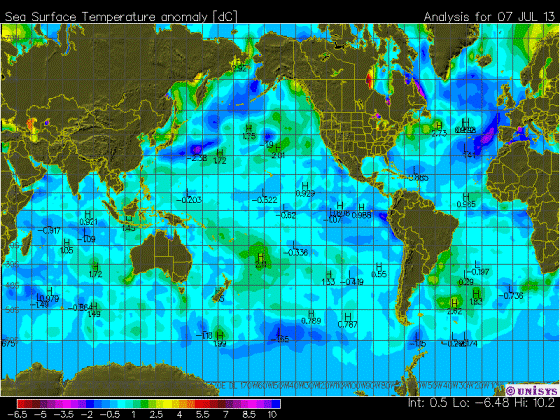
Figure 1
The direct link to that archived map is here.

The color-coding of the Unisys maps of course makes the data appear cool, but even so, the June 2013 sea surface temperature anomalies, based on the Reynolds OI.v2 data, are in fact cool off the southwest coast of Europe. As shown in Figure 2, the data for the coordinates of 35N-55N, 20W-5E haven’t been that cool since 1993-94.

Figure 2
But—there’s always a but—the sea surface temperature anomalies to the north and northwest of Europe (55N-75N, 20W-55E) are running on the warm side. Refer to Figure 3.

Figure 3
As a whole, though, the sea surface temperature anomalies for European coastal waters are pretty typical of the values for the last decade, as shown in Figure 4.

Figure 4
And of course, there’s nothing in the ocean heat content data and the satellite-era sea surface temperatures to indicate that manmade greenhouse gases were responsible for the warming of the global oceans. If that topic is new to you, refer to the illustrated essay “The Manmade Global Warming Challenge”.
A COUPLE OF CLOSING QUESTIONS
Figure 5 is a map that captures the June 2013 sea surface temperature anomalies for the portions of the Arctic Ocean, Mediterranean Sea and North Atlantic discussed in this post. While the warm anomalies at high latitudes are likely the result of a weather pattern, it almost appears as though Iceland is somehow responsible for part of the warming.

Figure 5
And that leads to my questions:
Has anyone ever seen a study of the impacts of volcanic ash and pumice on the optical properties of sea water and/or on sea surface temperatures? And has anyone seen a study of the impacts of volcanic ash from recent high-latitude eruptions on the albedo of sea ice?
SOURCES
The Sea Surface Temperature anomaly data used in this post is available through the NOAA NOMADS website:
http://nomad1.ncep.noaa.gov/cgi-bin/pdisp_sst.sh
or:
http://nomad3.ncep.noaa.gov/cgi-bin/pdisp_sst.sh?lite=
forgot to put in the word “me”.
From the Manmade Global Warming Challenge”>: “You’ll Often See Statements to the Effect of: 90% of the Manmade Global Warming Goes into Warming the Oceans.”
I don’t know about manmade global warming (and for serious reasons I don’t think there’s a significant “manmade global warming”, and definitely not anything like significant “manmade, warming of the oceans”) but in my opinion it is true that:
1. Even the oceans cover only a bit over 2 thirds of the Earths surface, almost 90% of the solar radiation reaching the Earth’s surface absorbed there and converted to heat is absorbed and converted to heat in the open oceans by solar radiation extinction in the so called epipelagic zone (where the solar irradiation shortwave spectra flux is still significant) of the ocean (0~200 m)
2. This is i.e. given by very low ocean reflectivity even at relatively high angles of insolation – i.e. due to ocean waviness – and also due to the fact the bulk of the open oceans is at latitudes below 65° (where the average water reflectance even at zero waviness is ~0.03).
3. Due to air/water interface refractive properties the ocean waviness considerably lowers the net ocean reflectivity near terminator, so with even slightly wavy ocean its net reflectivity goes considerably down at lower incidence angles when compared to waveless water. Effectively the mean wavines of the ocean causes that even at high angles of insolation incidence close to 0° the average water reflectivity closes to 0.5 (although for waveless water it would be close to 1) and so the average ocean reflectivity comes out considerably lower than the often mentioned ~0.08 – which is in fact the average reflectivity value for ~2-90° incidence angle. -But, I reiterate: the open ocean we find at 0-65° latitudes stripe, for which the average reflectivity is ~0.05. Which means unlike landmass the ocean absorbs well 95% of the solar radiation reaching its surface converting it mostly immediately to heat.
4. The solar irradiation is significantly reaching relatively deep (~up to the 200m depth) which is given by exceptional transparency of the water for solar spectra (unlike almost all the solids covering the landmass) including UV. So the sun directly and immediately warms the sea water to considerable depth of the ocean surface layer (unlike the solids covering the landmass, which are heated to depth much more by much slower heat conduction from the surface heated to relatively much higher temperatures). The ocean surface layer is moreover quite well mixed by turbulences and so although the intensity of the penetrating shortwave solar radiation diminishes exponentially with depth the surface layer has more or less same temperature.
5. On the other hand the water is order of million times more opaque to the mid-IR spectra at which the atmosphere radiates than to the solar spectra. Which means the atmospheric mid-IR radiation can’t significantly penetrate and warm the water deeper than order of tenth of milimeter of the ocean surface skin – where it mostly contributes heat to evaporation-water vapor (which then transports the latent heat up to the atmosphere by convection), and therefore a GHE, even if considerably enhanced by elevated CO2 concentration, can’t have a significant net direct warming effect on the oceans. (And it is physically impossible even indirectly by way of heating air and the heat conduction from the heated air-to water. -The surface atmosphere layer has lower average temperature than ocean surface and therefore can’t cause net heating of the ocean by conduction – such a conductive heat transfer would be direcly in violation of the 2nd law of thermodynamics.)
6. According to the Solanki TSI reconstruction the TSI (upward) trend for the 20th century was several hundreds of miliWatts per square meter per century (~0.69 W/m^2/century). And even it looks like a small number, if one calculates how much ocean heat content change the upward TSI trend would cause in the 100 years in the ocean surface layer (heat surplus ~0.4+ GJ per square meter of the ocean surface) and how much it would warm the ocean epipealgic zone (believe it or not, you can calculate it for yourself) the result is well in order of magnitude consistent with the observed sea surface/epipelagic zone temperature change in the 20th century – while the amounts of surplus heat at play are several orders of magnitude higher than in the atmospheric boundary layer, so one can conclude that the sun heating the surface layer of the ocean was in fact the chief factor causing the slight surface warming in the 20th century.
All this and especially the point 5. implies that the cited “90% of the Manmade Global Warming Goes into Warming the Oceans” is physically impossible – at least surely for the proposed GW mechanism of the anthropogenic CO2 causing allegedly the warming through the slight enhancing of the GHE.
About Iceland there have been a quite high quake and possible underwater vulcano acivity on the northeast corner of the country it have decreased latest month but before that there was a long period of activity ( This area) http://en.vedur.is/earthquakes-and-volcanism/earthquakes/tjornes-large/ im not sure at all how much energy thats released by this but it struck me that the heatsource seems related the activity area. Following link is a big event in April this year.
http://earthquake-report.com/2013/04/09/volcano-activity-of-april-8-2013/