By Steve Goreham
Originally published by The Washington Times

The US Department of the Interior announced the first offshore wind energy lease sale earlier this month. Interior plans a July auction of 164,750 acres off the southern coasts of Rhode Island and Massachusetts for commercial wind farms. But why are federal and state governments promoting expensive offshore wind energy?
The auction is a continuation of the “Smart from the Start” program for expediting offshore wind begun by former Energy Secretary Steven Chu and former Secretary of the Interior Ken Salazar in 2011. Sally Jewell, the new Secretary of the Interior, has embraced the program, stating, “This is history in the making as we mark yet another major milestone in the President’s all-of-the-above energy strategy. Today we are moving closer to tapping into the enormous potential offered by offshore wind to create jobs, increase our sustainability, and strengthen our nation’s competitiveness in this new energy frontier.”
Several governors joined the chorus for offshore wind. Massachusetts governor Deval Patrick supports the program, “The U.S. Department of Energy projects 20,000 jobs by 2020 in offshore wind. Why not host those jobs here in Massachusetts?” Maryland governor Martin O’Malley agreed, “Offshore wind is a potential win-win-win for Maryland. Today’s vote positions our State for greater job creation and opportunity, while moving us forward toward securing a more sustainable energy future.”
Governors also voicing strong support are Paul LePage of Maine, Pat McCrory of North Carolina, Bob McDonnell of Virginia, and even Ted Strickland of Ohio, who would place wind turbines in Lake Erie. In 2010, governors from ten states, Delaware, Maine, Maryland, Massachusetts, New Hampshire, New Jersey, New York, North Carolina, Rhode Island, and Virginia, signed a Memorandum of Understanding to establish the Atlantic Offshore Wind Energy Consortium to promote offshore wind development.
Unfortunately, offshore wind is enormously expensive. The US Department of Energy (DOE) estimates the levelized cost of wind-generated electricity at more than double the cost of coal-fired electricity and more than three times the cost of power from natural gas. For example, the proposed Cape Wind project off the coast of southeast Massachusetts will initially deliver electricity at 18.7 cents per kilowatt-hour with a built-in increase of 3.5 percent per year over a fifteen-year contract. This is more than triple the wholesale cost of electricity in New England.
Offshore wind is only possible because of generous subsidies, tax breaks, and mandates from government. Today, 38 states offer property tax incentives, 28 states offer sales tax incentives, and 24 states offer tax credits for renewable energy sources. Twenty-nine states have Renewable Portfolio Standards laws requiring utilities to buy an increasing share of electricity from renewable sources, including all ten states in the Offshore Wind Energy Consortium.
At the start of the year, the US government extended the Wind Energy Production Tax Credit (PTC), providing 2.2 cents per kilowatt-hour for electricity generated from wind. The PTC will cost taxpayers $12 billion this year. Look for the DOE to offer loan guarantees to offshore wind developers. Altogether, government incentives pay 30 to 50 percent of the cost of a wind installation.
The consumer pays twice for offshore wind. First, consumer taxes fund wind energy subsidies and tax breaks. Second, states like Massachusetts force utilities to buy high-cost offshore wind electricity, which then increase electricity rates so the consumer pays again.
At the same time, we’re in the midst of a hydrocarbon revolution. Advances in hydraulic fracturing and horizontal drilling will provide more than 100 years of natural gas at current usage rates. With electricity from natural gas at less than one-third the price of offshore wind, why the support for offshore wind from our political leaders?
Electricity from your wall outlet is standard voltage and current. No one can tell the difference between electricity from hydrocarbon sources or “green” sources such as wind. Would governors Patrick and O’Malley repurchase their current car at three times the price?
Wind energy backers claim that if the government subsidizes wind systems, the cost will come down. But that idea is false. Wind turbines are not new technology. After 25 years of installations, about 185,000 wind turbine towers were operating across the world at the end of 2011. Wind technology is already well down the cost learning curve.
In fact, data from the DOE shows that the installed cost of US wind systems has been rising, not falling. Installed costs have risen 65 percent over the last six years, from $1,300 per kilowatt in 2004 to over $2,100 per kilowatt in 2010.

Underlying the push for offshore wind is the ideology of Climatism, the belief that man-made greenhouse gases are destroying Earth’s climate. But anyone who believes that building offshore wind turbines will stop the oceans from rising, make the hurricanes less severe, and save polar bears needs to reconsider. Suppose we invest in cost-effective electricity sources, rather than offshore wind?
Steve Goreham is Executive Director of the Climate Science Coalition of America and author of the new book The Mad, Mad, Mad World of Climatism: Mankind and Climate Change Mania.
Talking with fire fighters using monsoon bucket filled in the sea. Every time the helicopter refuelled, they had to clean the blades. Why? because salt crystals on the blade reduce the lift by 400KG (880lbs) and this on a 4 seat helicopter. Not sure what % but it’s significant.
So what does this mean for offshore wind power? Big inefficiency because salt on the blades significantly reduce lift and therefore power generated. Wind turbines aren’t blown around, they use lift to power them. Reduce lift, reduce power for generation.
Who would have thought, salt crystals at sea?!
You folks seem to be confusing installed costs with generating costs. According to IEA http://www.iea.org/textbase/npsum/ElecCostSUM.pdf, installed costs estimates are coal, $1500/kWh, nuclear and (on shore) wind are estimated to have about the same installed cost ranging up to $2,000/kWh. Generating costs: coal $35-$60/MWh, Nuclear $30-$50/MWh, wind $45-$140/MWh. Natural gas is ~$800/MWh with generation costs are <$40-$60/MWh because of lower natural gas prices. Diesel-electric peaking can be installed for something in the neighborhood of $1000-$1500/kWh, but the costs are dependent on oil and right now are about $250/MWh. Renewable (other than wind) installed costs are all over the map. Landfill-gas-to-electricity projects can be installed for $700/kWh, but the preferred equipment runs the installed costs to $2500/kWh. Generating costs are somewhere around $30-$50/MWh. Most renewable energy have capacity factors that limit their usefulness and have a significant impact on costs. Also, generating capacity for renewables is quite low. I've been supported by renewable (landfill gas to electricity) for over a decade. As long as the gas is cheap energy, it probably works. I do not see the economics in wind and solar, nor do I see the viability of other renewable combustion. You cannot grow enough biomass to make these any more than interesting sideshows.
Offshore windmills? They’ll make great artificial fishing reefs when they collapse. However I think the better way to make the reefs would be to just take the windmills out to sea and dump them. All that erection cost is just so much wasted money. Let’s make this a cost effective boondoggle, eh? ;o)
(Cash) Cost is a concern, of course, but I would like to see cost-benefit analysis in CO2 cost (and CO2 benefit) terms published openly and in detai for any intended scheme, so that any flaws can be pointed out and the analysis corrected. My fear is that schemes which actually make things worse in CO2 terms may be undertaken.
Show me the jobs.
Hey Mosh,
These are the kind of freeloading subsidy takers you should really be pissed off at, not BIG OIL.
“Smart from the start”…Dumb from the gun!
Shona says:
running costs: well the average wind turbine (2-2.5MW Nominal capacity) will use 1-3kW per hour when idle (around 30% of the time). That is for on-shore turbines. In light variable winds an offshore wind farm can be a net user of electricity as yaw motor draws from the grid ( ref. Horns Rev 1)
They don’t take boats out for maintenance, as Richard Verney notes, you have to maintain when the weather is right or your turbine will be down for a long time. Usual is helicopter either landing, or winching maintenance men onto nacelle. Can’t help you on costs of helicopter (and wages of those willing to do job) but estimated in UK that maintenance absorbs 10% of revenue of on-shore turbines, and multiply by 2.5 times for offshore one (but allow for higher output). Also allow for much higher wear and tear on offshore units, hence shorter lifetime).
Re enthusiasm by various State Governors – to translate into USA speak a comment by former Australian Federal Treasurer “never stand between a State Governor and a big bag of money”.
Here’s a fact.
I live 10km from the Thanet Wind Farm – the biggest offshore project in Europe.
Plate capacity 300 MW. Cost $1.4 billion (£900 M).
It has bought exactly 25 jobs to Thanet all working for a foreign company.
25 jobs. Count ’em.
The really funny thing is that they seem proud of it.
“Smart from the Start”?
Please correct the typo, it should read stupid, not smart.
Wind farms can’t solve a non problem. This is worth watching.
Hopefully the link will post this time.
http://www.sunnewsnetwork.ca/video/wherersquos-the-warming/2451913929001
Wow, why wouldn’t you want to build vulnerable windmills in a corrosive environment that is difficult to maintain, costs huge money to build operate and maintain, requires on going operating subsidies for the life of the project, is unscalable, and destroys the open vistas of the ocean?
Joe Public says: June 8, 2013 at 1:12 am “Think of all that free power they’ll generate during a hurricane!” There is good evidence, post here recently, that these windmills will not withstand a hurricane. See the Pareto Distribution.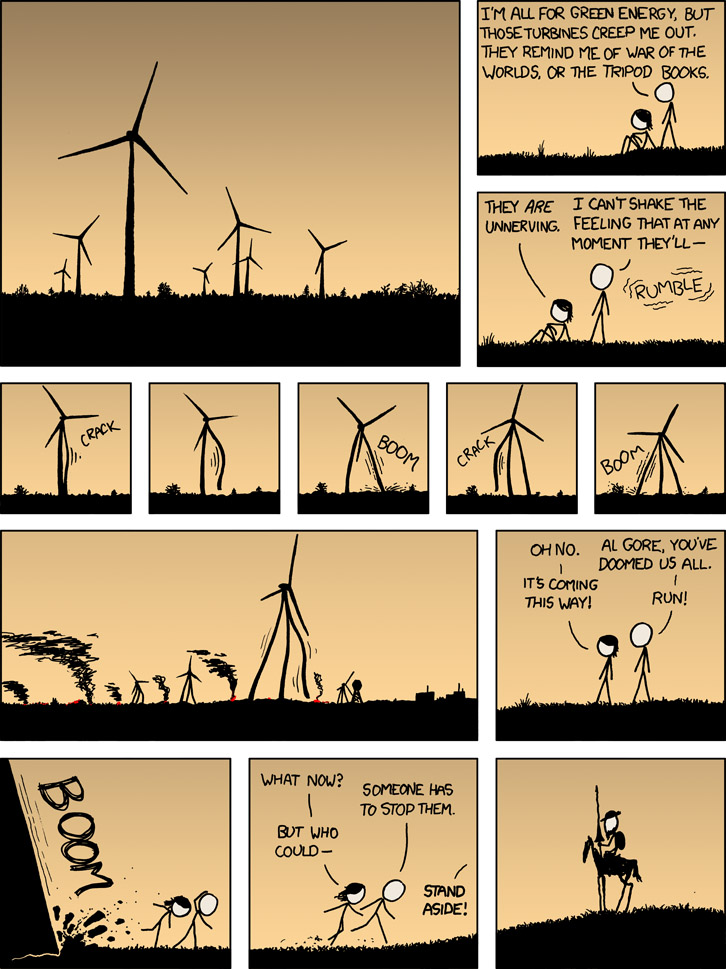
Post-modern windmills are a scam says Sancho PONZI squire to don Quixote.
richard verney has encapsulated the problems which I (as a retired mechanical engineer specialising in maintenance) have been banging on about for ages.
I seem to recall one of these ‘learned’ governors (I think it was the Governor of Maryland) enthusing about the fact that the turbines would be ‘between ten and thirty miles offshore’…
Now, I’m no expert in the weather of the North Atlantic – only insofar as us Brits ‘enjoy’ the tail-end of it – but I personally wouldn’t give a wind farm located in that area a cat-in-hell’s chance of surviving for more than five years…
Nope – classic example of political enthusiasm ignoring engineering reality…
There are consequences when the largest consumer economy does wasteful things
http://tinyurl.com/wind-babies
When the US Economy is dragged down by Ideological Climatism, other people pay the price.
From the state of the sea in the photo, no electricity is being produced.
Wind farms increase CO2 emissions. How? Well, the wind doesn’t blow all the time. So there has to be standby power available at very short notice. Stanby power is usually provided by a gas-fired power station. This will be running for around 30% of the time in standby mode (wind farm “efficiency” is about 30%) and such a mode emits more CO2 than if it were running at its normal rate. Thus windmills mean more CO2 emissions. Go figure!
………and there’s the massive amount of CO2 released in the production of the concrete to bed each turbine to the sea floor! Do the people that support this kind of idea really care about the environment?
I propose the program be renamed to “Buggered by Bastards”. Excuse the french.
So much for “the wind is free” arguments of yore.
Offshore wind farms have an enormous advantage over land based. Dead men tell no tales. Birds and bats killed by the farms are swept away by the currents and eventually sink out of sight.
I am not sure what is more troubling, the impact of wind on overall energy costs or the stupidity of Governors who embrace this nonsense.
Josh had an excellent cartoon last year of the bucolic view before and after wind farms are deployed.
http://www.epaw.org/images/Greening_the_land.png
The cost of a wind farm needs to include the cost of a dispatchable power plant with equivalent nameplate capacity. Same for solar PV farms.
I maintain that solar PV farms should be sited near natural gas pipelines, and include a natural gas plant with equivalent nameplate capacity on the same property.
Then to save capital costs, drop the solar PV part…
Hey, at least it may reduce the number of bird strikes … jeez
(that did get me thinking – do VAWTs have fewer bird strikes?)