
Image Credit: Bob Tisdale – bobtisdale.wordpress.com
By WUWT Regular Just The Facts
The recent Adjustments/Corrections to the HadCRUT4 and CRUTEM4 Temperature Data Sets by the Met Office Hadley Centre and Climatic Research Unit got me thinking about the cumulative impact of Adjustments/Corrections on our temperature records. Bob Tisdale then triggered the first vein of this analysis when he recently produced and provided the graph above, which compares the ICOADS (International Comprehensive Ocean-Atmosphere Data Set) v2.5 data set to HadSST3, HADISST and ERSST.v3b. ICOADS is the original unadulterated Sea Surface Temperature record. HadSST3, HADISST and ERSST.v3b, all include adjusted/corrected ICOADS data, e.g.:

[Note: Bold and non-link underlines below are mine. I am testing out a new three speed review approach, i.e. if you really want to know it, read it all, if you want an overview, read the underlines and non italics, if you want the key concepts, read the bold and non italics. Please let me know in comments if this approach works for you.]
HadSST3 The SST data are taken from version 2.5 of the International Comprehensive Ocean-Atmosphere Data Set, ICOADS (external web page), from 1850 to 2006 and on GTS observations from 2007 onwards. HadSST3 is produced (a slightly more detailed description) by taking in-situ measurements of SST from ships and buoys, rejecting measurements that fail quality checks, converting the measurements to anomalies by subtracting climatological values from the measurements, and calculating a robust average of the resulting anomalies on a 5° by 5° degree monthly grid. After gridding the anomalies, bias adjustments are applied to reduce the effects of spurious trends caused by changes in SST measuring practices. The uncertainties due to under-sampling and measurement error have been calculated for the gridded monthly data as have the uncertainties on the bias adjustments following the procedures described in the paper.
The HadSST3 page references this paper “Improved Analyses of Changes and Uncertainties in Sea Surface Temperature Measured In Situ since the Mid-Nineteenth Century: The HadSST2 Dataset“, Rayner, et al., 2005, as the basis for their adjustments/corrections. It states within that:
a. Bias correction and its uncertainties Seawater has been sampled for temperature measurement on board ship by various different means at different times. This change from using insulated (wooden) to uninsulated (canvas) to partly insulated (rubber) buckets, engine room intakes, and hull sensors, along with changes in ships speeds, has introduced changing relative biases into the database. Folland and Parker (1995) developed corrections to be applied to SST data between 1856 and 1941 to ameliorate the effect of these changes and to bring the older data into line with data from the modern mix of measurement methods. For details of the development of these corrections, the reader is referred to Folland and Parker (1995).
Here’s Parker, Folland, M. Jackson (1995) paper MARINE SURFACE TEMPERATURE: OBSERVED VARIATIONS AND DATA REQUIREMENTS Here are some of the adjustments/corrections detailed within:
“Overall global warming in SST between the 1860s and the 1970s is about 0.3 °C greater in the present analysis than in Folland et al. (1984), mainly owing toreduced early corrections applicable under the assumption of the predominant use of wooden buckets (Section 3).”
“The largest, positive corrections are in early winter (December) over the Gulf Stream and the Kuroshio, where warm water, cold dry air, and strong winds cause rapid evaporative heat loss from the buckets. The corrections approach 1 °C by 1940 in these regions in early winter. Corrections are also large (around 0.4 °C to 0.5 °C by 1940) in all seasons in the tropics because of the high rate of evaporation when SST is high. Some negative corrections are made in mid latitudes in summer, mainly where the mean air temperature around the bucket exceeds the mean SST.”
Here’s their Figure 7, which shows the impact of their adjustments/corrections.

“How do we know that these corrections are trustworthy? The agreement of SST anomalies with largely independently corrected NMAT anomalies (Section 7 and Figure 7) is the strongest support to the results, and suggests that the impacts of future refinements and reduction of uncertainties in this area will be small.”
So who do you think provided the “largely independently corrected NMAT” SST anomalies, which are “the strongest support to the results”? Wait for it…
“Folland et al. (1984) applied corrections to NMAT to compensate for the historical increases of the average height of ship’s decks. These rose from about 6 m before 1890 to 15 m by the 1930s and 17 m by the 1980s. The corrections, based on surface layer similarity theory, removed a spurious cooling of about 0.2 °C between the late nineteenth century and 1980. On the other hand, Jones et al. (1986) used anomalies (not actual values) of regional, mainly coastal, land surface air temperature to adjust anomalies of nearby MAT. This was possible because anomalies of MAT and nearby ‘coastal’ land surface air temperature are found to be similar in recent data over periods as long as a decade, even though the absolute values differ considerably. However, because Jones et al. (1986) used COADS summaries, they were unable to separate NMAT from day MAT which are affected by historically varying, on-deck solar heating: their corrections therefore differed from those of Folland et al. (1984). In both these early studies, about 0.5 °C was subtracted from MAT for 1942-5, a period of non-standard measurement practices owing to war. “
Yes, that Jones et al. (1986) reference is Phil Jones, and Tom Wigley too, at the Climatic Research Unit (CRU), University of East Anglia (UEA). And it turns out that Rayner, Folland and Parker all worked at the Hadley Centre, Met Office.
This 1992 Jones and Wigley paper “Corrections to Pre-1941 SST Measurements for Studies of Long-Term Changes in SSTs” appears to be a seminal work in the development of Sea Surface Temperature record adjustments/corrections:
Many factors can influence a sea surface temperature reading (Barnett, 1985; Jones et al., 1986; Bottomley et al., 1990; Jones et al., 1991). Some of these introduce random errors while others result in systematic, non- cancelling errors. The most important factor is the method of collecting the sample, with the two basic methods being to haul a sample on deck with a bucket, or to measure the temperature of the intake water used for engine cooling. Here, we are concerned with bucket measurements. These are affected by the kind of bucket used, the exposure of and physical conditions surrounding the bucket, how long the bucket was left before reading the thermometer, and ship speed.
In COADS we do not have detailed information concerning the methods of measurement, nor any indication of what method was used for the individual readings that make up the data. There is,nevertheless, strong evidence that readings before 1940 were predominantly bucket measurements, while those since 1945 were predominantly intake measurements (Jones et al., 1986). Furthermore, it is likely that the major difference between the data for these two periods is the non-climatic bias due to the evaporative cooling of the canvas bucket, an effect which would clearly cause pre-1940 data to be cooler than post-1945 data (Jones et al., 1991).
In order to derive correction factors for the bucket-derived temperatures, we have modified the model developed by Folland and Hsiung, 1987 and Bottomley et al., 1990, to estimate the cooling of an uninsulated canvas bucket. The main difference between our work and that of Folland and Hsiung (1987) is that we have solved the governing equations analytically. This makes application of the model less demanding computationally, and it allows us to perform a variety of analyses.
2. The bucket model
If you have not already, you really should take a look at Section 2. “The Bucket Model” within Jones and Wigley’s 1992 paper, as it is a classic work in gibberish…
Continuing…
4. Correcting SSTs using the bucket approach
4.1 Optimum exposure time
For 1905-40, SSTs may be corrected using the evaporating bucket model. Although average ship speed probably varied over this period, within the range of likely values ship speed does not noticeably affect the implied exposure time. We have used a ship speed of 7ms-1. Wind speeds of 60% of the anemometer speed produce slightly better results than the 40% reduction case, and lead to slightly lower optimum exposure times (by less than 1 minute on average) so we have used this value. As the most likely exposure time lies in the range 3-6 minutes, we use 4 1/2 minutes in making final corrections.”
“4.2 The final correction factors
Final correction factors depend on the location, month and year. These variations are summarized in Figures 3 to 5. Correction factors vary slightly from year to year depending on coverage changes. Figure 3 shows mean correction factors for the Northern Hemisphere. Southern Hemisphere mean corrections are shown in Figure 4. The transition from small corrections in the early decades to larger corrections after 1905 is due to the change from wooden (i.e., better insulated and assumed to require no correction) to un-insulated buckets. Correction factors are largest in the winter half year. Northern Hemisphere corrections show slightly larger season-to-season variations. Figure 5 shows how the “winter” (JFM) and “summer” (JAS) – using Northern Hemisphere seasonal labels – corrections vary with latitude. Correction factors are lower in higher latitudes in general, particularly in the 45-75°N band where the “summer” corrections are near zero.”
It appears that the Team that brought us Climategate, was hard at work adjusting/correcting the Sea Surface Temperature record back in the 80s and 90s…
Here Jones and Briffa team up to summarize the purported basis of the Sea Surface Temperature record adjustments/corrections in their paper, “Global Surface Air Temperature Variations During the Twentieth Century: Part 1, Spatial, Temporal and Seasonal Details“, P. D. Jones and K. R. Briffa, 1992.
“Problems with the homogeneity of sea surface temperature (SST) data arise due to differences in the method of sampling the sea water. Before the second world war the sea water was collected in an uninsulated canvas bucket. There was a delay of a few minutes between sampling and measuring the temperature. During this time the water in the bucket generally cooled slightly by evaporative means. Since the second world War most readings have been made in the intake pipes through which sea water is taken onboard ships to cool the engines. This change in measurement technique was quite abrupt at around 1941, although there are still significant numbers of bucket measurements (using plastic and thus better insulated buckets) made today and some intake measurements were made prior to the second world war.
Comparative studies of the two methods indicate that bucket temperatures are cooler by 0.3-0.7″C (James and Fox, 1972). Correcting the SST data for this measurement change may seem, at first, seem an intractable problem. Folland and Parker (1990; 1991) of the UK Meteorological Office, how- ever, have developed a method for correcting the canvas bucket measurements based on physical principles related to the causes of the cooling. The cooling depends on the prevailing meteorological conditions, and so varies according to the time of year and location. Although the cooling is therefore a day-to-day phenomenon, the various influences are basically linear, so cooling amounts can be calculated on a monthly basis. The main free parameter is the elapsed time between sampling and reading. This is generally unknown and must be estimated from the data. The primary assumption in this estimation is that there have been no major changes in the seasonal cycle of SSTs over the period of record. Since the amount of evaporative cooling has a strong seasonal cycle in many parts of the world, an optimum exposure time can be chosen; namely that which minimizes the residual seasonal cycle in the corrected data.As a check on the validity of the method, the implied optimum exposure time turns out to be quite consistent spatially (see Jones and Wigley, 1990; Jones et al., 1991 for more details).
The major problem with the technique is that it is not known with any certainty what types of buckets were used to take measurements during the nineteenth century. Assuming canvas buckets rather than wooden buckets (which are better insulated) leads to corrections which infer SSTs warmer than land temperatures by about 0.2″C. The discrepancy almost disappears if wooden buckets are assumed. Although there is documentary evidence to support wooden bucket use during the mid-nineteenth century, considerable doubt remains about the transition from wooden to canvas buckets. The seasonal-cycle elimination method is not precise enough to choose between the two possibilities. The corrections used here have been derived using the wooden bucket assumption in the nineteenth century (see Jones et al., 1991 for details).
“The major problem with the technique” and “The Bucket Model” are that they rely upon an array of assumptions and estimations, which are based on very limited empirical data, and were made by people like Phil Jones and Tom Wigley, who have apparent biases, and appear to have been working the propagate the Catastrophic Anthropogenic Global Warming narrative since the early eighties. It is interesting to note that the Jones et al. papers on Sea Surface temperature adjustments/corrections do not appear listed within the otherwise quite encompassing collection of Jones’ work on the UEA website.
Steve McIntyre has written extensively about bucket adjustments starting back in 2005, i.e. Changing Adjustments to 19th Century SST;
You may recognize Folland as a major IPCC author (Folland et al. [2001] is sometimes the citation). SST sampling is not homogeneous – it changed from buckets to engine inlets – engine inlet temperature ran a little hotter. Both canvas and wooden buckets appear to have been used. There are millions of SST measurements and how the measurement was done is not known for most measurements (as far as I can tell.) There are two main adjustments in Folland et al. The first is a one-time adjustment for from buckets to engine inlets in December 1941. This is premised on a comparison between the “corrected” NMAT temperature [ I haven’t checked what these “corrections” are] and the uncorrected SST temperatures.
Buckets and Engines, The Team and Pearl Harbor, Bucket Adjustments: More Bilge from RealClimate, Rasmus, the Chevalier and Bucket Adjustments, Did Canada switch from Engine Inlets in 1926 Back to Buckets?;
CA readers are aware that I discussed bucket adjustments on a number of occasions long before Thompson et al 2008, in particular, questioning the absurd IPCC assumption that all SST measurements switched from buckets to engine inlet on the day after Pearl Harbour. In March 2007, a year before Thompson et al 2007, in light of new historical information bucket usage, I provided a scoping estimate of the potential impact of a different changeover scenario, based on then-just-published Kent et al 2007. The direction of the impact is precisely the same as that shown in the present HadCRU estimates over 4 years later. The difference between the two appears to be that the present HadCRU estimate assumes that bucket changeover impact has ended by 1970, while, in my 2007 post (based on Kent’s evidence of widespread bucket usage in the 1970s), I presumed that the changeover continued until the 1990s.”
and HadSST3;
A new HadSST3 version has been recently published. It starts the process of unwinding Folland’s erroneous Pearl Harbour bucket adjustment, an adjustment that has been embedded in HadSST for nearly 20 years.
Folland’s erroneous adjustment had been originally criticized at CA in 2005 here and further discussed at length in March 2007 at CA here, a post in which I observed that no climate scientist had made any attempt to validate Folland’s bizarre adjustment and that correcting Folland’s error (through a more gradual and later changeover to engine inlets than the worldwide overnight change that Folland had postulated after Pearl Harbour) would have the effect of increasing SST in the 1950s, in turn, potentially eliminating or substantially mitigating the downturn in the 1950s that was problematic for modelers.]
However, not until Thompson et al 2008 (submitted Jan 2008; published May 2008) was the problem with the Folland adjustment clearly acknowledged by the “community”. The importance of Thompson et al in resolving the problems arising from the Folland adjustment were credited by Susan Solomon and Phil Jones in the commentary accompanying the Nature article.) Both lead author David Thompson and co-author Mike Wallace, though very prominent climate scientists, had negligible (or no) publishing history on the topic; as one commenter at James Annan’s blog put it, they came out of “left field”. Thompson was an ozone specialist. The other co-authors, John Kennedy of the Hadley Center and Phil Jones of CRU, were, of course, actively involved in the field.
Now over three years later, in a new SST edition (HadSST3), the Hadley Center has accepted and implemented Thompson et al’s criticism of Folland’s Pearl Harbour adjustment. Instead of implementing an overnight changeover to engine inlets in December 1941 as before, the changeover is now phased in through the mid-1970s. This results in changes to SSTs between 1941 and ~1975.
However, Steve does not appear to have dug too far into the pre-1945 adjustment/correction highlighted by Bob Tisdale’s graph.
One piece of this puzzle I can’t seem to find is the oft cited Bottomley et al., i.e.: Bottomley, M., C. K. Folland, J. Hsiung, R. E. Newell, and D. E. Parker, 1990: Global Ocean Surface Temperature Atlas. MIT Press, 20 pp. plus 313 plates. According to the Global Ocean Surface Temperature Atlas GOSTA:
This is the January 1993 version of the Global Ocean Surface Temperature Atlas (GOSTA) (Bottomley et al., 1990) referred to as ATLAS7 or MOHSST5. The data in this atlas are a compilation of marine observations from the United Kingdom Meteorological Office Main Marine Data Bank with some additional data from the US Fleet Numerical Oceanography Center. The Atlas includes the climatology of sea surface temperature (SST) and the difference between marine nighttime air temperature (NMAT) and SST. These climatologies are based on data collected between 1951 and 1980. Also included are SST and NMAT monthly anomalies from 1856 to 1991. The data were corrected to remove what are believed to be observational biases due to changes in instrumentation. These correction are based on scientific research summarized in the introduction to the hard-copy version of GOSTA (Bottomley et al., 1990). All data are presented on a 5 by 5 degree grid wherever data existed. The climatology of SST can be made available on a 1 by 1 degree grid.
The quality of marine observations is thoroughly discussed in the hard copy volume of GOSTA as well as in the references therein. The user should note that the data were collected using a variety of instruments and observational procedures aboard vessels of different shapes and dimensions.
Here is the GOSTA data, however I would like to see the “scientific research summarized in the introduction to the hard-copy version of GOSTA (Bottomley et al., 1990).” to understands what those adjustments/corrections are based on, but even Google Scholar comes up dry.
If anyone can find an electronic copy of Bottomley et al., 1990 and/or can offer additional information on the adjustments/corrections made to the to the Sea Surface record, please post them in comments.
Greg Goodman says:
May 26, 2013 at 2:26 pm
I would ask the same question of Darrin and Ferdinand in their respective services.
Depended of the type of vessel:
One was a finished oil products tanker: steam turbine with vacuum condensation. The water inlet temperature for the condensor was rather important for the yield calculations. That temperature (and resulting vacuum) was nicely reported (or questions were asked by the deck officers, why the calculations were rather odd). But even then, full load or ballast would have made a lot of difference in temperature profile.
Next was a cargo motor vessel, built in Germany short after WWII with what they called “ersatz” material (cheap replacements of dubious quality), more mechanical problems than we did like (but good to learn how to solve them without a repair shop around the corner). I even can’t remember if the inlet temperature was logged at all. But I suppose that it was done at least once each shift (of 4 hours).
Third was a banana boat (motor vessel too), where temperature control of the different compartiments was extremely important (within 0.5°C!). Water inlet temperature was just one of the many readings and logged with the rest every hour, thus well reported too.
In none of these I know of any bucket readings, but I am not sure of this. What I remember is a few speed controls the old fashioned way: with a knotted rope over board and counting… You know, that were the good old times before satellites and GPS networks or even computers less than the size of a room…
As mentioned by others too: quite different speeds:
Tanker: 16 knots.
Cargo: 12 knots (about zero with a strong storm in front in the Gulf of Biscay).
Banana boat: 23 knots.
About the depth of the inlet: no idea…, too long ago, but quite different depending of the load and type/size of the vessel.
Further, I suppose that temperatures were less different between surface and inlet with strong winds as the seawater was better mixed.
Greg Goodman says:
May 26, 2013 at 2:26 pm
I would ask the same question of Darrin and Ferdinand in their respective services.
Greg, I’m not aware of any bucket readings on modern war ships. What we did have in just my department is ~20 sea water temperatures taken per hour and entered into log sheets. Log sheets were broken down into watch stations, name of gauge and gauge number for identification. New log sheets were started every 24hrs. While Navy ships are not scientific vessels they do have a lot of data collection that can be used by scientist. Problem being not many are studious about taking as accurate logs as they can which was my earlier point. If asked watch standers up through the top brass will all tell you they are highly accurate records but in truth they are not.
I served on the USS Nimitz nuclear powered, steam driven air craft carrier. We used a lot of sea water for cooling.
Thanks for the replies.
Darrin , the bucket change over seems to have been mostly over by about 1970, so all it seems your service was more recent. However, as I suspected military vessels seem to be a lot more disciplined about the reading and logging of data.
Can you comment from your experience of USN on how likely it would be in the era of buckets that a watchstander would not take an outside reading if that was the procedure and would either make one up or take an ERI reading and mark it as having been taken outside as was required?
Global Ocean Surface Temperature Atlas (Gosta) M. Bottomley, C. K. Folland, J. Hsiung, R. E. Newell and D. E. Parker, Meteorological Office (Bracknell) and Massachusetts Institute of Technology, 1990. No. of Pages: iv + 20; No. of plates: 313
http://badc.nerc.ac.uk/data/gosta/intro.html#RTFToC6
So in Step 3 they estimated “the strength of the wind around the bucket” prior to 1942, based on climatological data” “derived from MOMMDB for 1951-80”, made “allowances for sheltering by the ship’s structure”, “assumed mean ship’s speed of 4 m s-1” and assumed “random ships’ headings relative to the wind”. Step 3 of the “Provisional Corrections” alone seems to offer enough estimates, allowances and assumptions to allow for any conclusion desired…
Greg Goodman says:
May 26, 2013 at 4:12 pm
Can you comment from your experience of USN on how likely it would be in the era of buckets that a watchstander would not take an outside reading if that was the procedure and would either make one up or take an ERI reading and mark it as having been taken outside as was required?
Greg, that would vary ship to ship depending on how a ships specific procedure for pulling buckets and the people doing the pulling. If procedure has a superior standing there watching it likely is going to happen every time. If there is no superior around or other watch standers visible then it boils down to how dedicated and honest that particular person is to doing their job. Human nature is such that some will do it right every time no matter what, others will never do it and most will fall somewhere in between.
JTF:Step 3 of the “Provisional Corrections” alone seems to offer enough estimates, allowances and assumptions to allow for any conclusion desired…
Yes, the bucket models and wind-tunnel stuff looks quite serious. It all falls apart because the rest of it has to be made up. Not knowing what buckets were used or even whether is was a bucket makes the rest a bit irrelevant. However it does show there could be an effect that may introduce a bias if we are looking tenths of a degree rise.
My main gripe is the reassigning of up to 30% of readings in some cells when the log specifically states which method is used. That is just rigging the data.
Global Ocean Surface Temperature Atlas (Gosta) M. Bottomley, C. K. Folland, J. Hsiung, R. E. Newell and D. E. Parker, Meteorological Office (Bracknell) and Massachusetts Institute of Technology, 1990. No. of Pages: iv + 20; No. of plates: 313
http://badc.nerc.ac.uk/data/gosta/intro.html#RTFToC6
1990 was a very busy year in bucketology, Folland and Parker (1990), Parker and Folland (1990), Bottomley et al. (1990) and IPCC AR1 (1990)…
“Refined correction” 1, assumes “that 25% of the buckets used in 1856 were wooden, and that this percentage decreased linearly to zero by 1905.” and “Refined correction” 3 assumes ships’ speed “to be 4 m s-1 (on average)” “whenever wooden buckets were used” and “mean ships’ speed was assumed to increase linearly with time from 4 m s-1 to 7 m s-1 for ships where canvas buckets were used.” So apparently wooden buckets result in a significant drag on boat speed, and canvas buckets somehow governed the pace of innovation on boat motors and propellers to linear growth between 1870 – 1940. However. “Provisional correction” 3 based the “strength of the wind around the bucket” “assumed mean ship’s speed of 4 m s-1, assuming random ships’ headings relative to the wind”. So apparently “random ships’ headings relative to the wind” somehow corrected for the linear increase of ships’ speed “4 m s-1 to 7 m s-1 for ships where canvas buckets were used”.?
Don’t change the data. Nuff said.
Global Ocean Surface Temperature Atlas (Gosta) M. Bottomley, C. K. Folland, J. Hsiung, R. E. Newell and D. E. Parker, Meteorological Office (Bracknell) and Massachusetts Institute of Technology, 1990. No. of Pages: iv + 20; No. of plates: 313
http://badc.nerc.ac.uk/data/gosta/intro.html#RTFToC6
Here’s a sweeping assumption on climatology:
Here is Figure 9c which shows the “corrections to SST and NMAT” compared to “those used by Parker and Folland (1990) and Newell et al. (1989)”: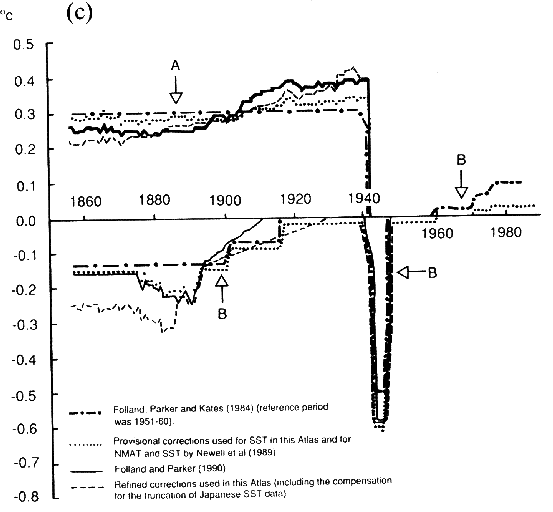 Bottomley et al. – IPCC – Click the pic to view at source[/caption]
[caption id="" align="alignnone" width="850"]
And here are the deck elevation corrections:
I am struck by the sheer number of assumptions that were made to “correct” the Sea Surface Temperature record.
The statement above was made in relation to surface energy flux fields, but it seems applicable to entire field of bucketology.
I don’t remember ever seeing glass thermometers marked with tenths unless the thermometers were specially calibrated for reading within a narrow range of degrees. Were the thermometers provided by the met office calibrated for reading a very narrow range, much like thermometers used for humans?
Greg: Coincidental alignment of averaged data from widely disparate sources scares me, especially when the alignment is to a completely different set of physically sourced data! The first question I always stutter is how and why? What is the mechanism that can take randomly collected temperature datums across wide oceans, but in very narrow sea lanes in all weather conditions and seasons and somehow the averages correlate? Those kind of graphs make me wonder just how one ship’s worth of data, un-averaged, aligns… Begin with the meta-data, sole point data and look for the correlations. Just saying, it’s the anal data miner in me.
One other comment about bucket samples. I occasionally use a bucket on my boat to wash the deck, and it is pretty difficult to get a full bucket of seawater on the deck of a boat, only about 5 ft above the surface of a calm sea, at ~4-5 kts. The bucket has a tendency to float on the surface unless it lands just right, so you have to tow it a bit till it takes a “bite” Once it does, it is effectively anchored in the sea while the boat/ship keeps moving, so you quickly run out of line, and have to snatch it up on deck. It is heavy, and if the boat/ship is moving quickly, it can be a bit dangerous to pluck it out of the sea. It NEVER really sinks below the surface – there is not enough time for that and the bucket materials are not dense, whether they are wood, canvas, or plastic.
I cannot conceive on anyone, military or commercial, using this technique from the deck of a modern ship, which has a freeboard MUCH greater than a small boat, when the engineers have SW temperatures available to them down below, inside the ship. When sailing ships were plying the oceans before the end of the 19th century they might have used this tecnique, but it would have been done when the ships were moving slowly, not at 14 kts (4 m/s). Those who suggest that you can pluck a bucket of water from the sea while 10m above the surface doing 14 kts are just plain nuts and have never actually tried it.
The sailing ships used to use a line to measure speed by throwing a small line with a piece of wood on the end overboard, and timing how far it ran out during a specified time. They really needed this information in order to calculate their position by dead reckoning, in the days before GPS and LORAN. SST would not really have been that important. When you cross the Gulf Stream, it is REALLY visible. I have done it on navy ships, as an engineer and deck officer, and on a sailboat, and you know RIGHT AWAY when you enter the Stream. The engineers see the injection temperature jump quite a bit, while the people on deck see the sea surface go from green to deep blue, and the humidity jumps. You don’t have to have a thermometer to detect it.
I believe that ALL of the temperatures on ships driven by machinery, from about 1860 to the present, are injection temperatures (from SW supply to the engines), not from buckets. Powered ships have always moved too fast to take bucket samples, and the availability of engine intake temperatures makes the use of buckets silly. So, this “methodology” for corrections rates a major FAIL from me.
The one temperature data from ships that I would be tempted to trust would be from the submarines, because they have a very strong interest in this sort of data, and the capability to get some really detailed values. And the data of interest would not be in the deck logs for the submarines, but in the sonar logs, which are not likely to be publicly available…
“For 1905-40 …. we have used a ship speed of 7ms-1. ”
It seems they don’t know much about nautical history. 7 ms-1 is equal to 13.6 knots which is certainly much too high as an average for the 1905-40 period. During WWII convoys were divided into “slow” and “fast”. The speeds required were 7 and 9.5 knots respectively. Ships that could make 15 knots or more (almost exclusively large passenger liners) were allowed to sail independently since U-boats (max surface speed c. 17 knots) were very unlikely to be able to get into a firing position for such fast-moving targets.
Incidentally this opens a simple way to check if there is a “convoy effect” in the WWII temperature anomaly. Temperatures taken by large passenger liners should be unaffected by it.
Greg Goodman says:
greg, in the merchant navy, for vessels in the voluntary observing fleet, it was the officer of the watch duty to take all measurements and update the ships log and every 6 hours write a METEO report (20 or so code groups) that I would send by morse code to shore stations.
The OOW would use a rubber bucket like this one: http://badc.nerc.ac.uk/data/gosta/figures/fig7.gif
from the bridge wing, irrespective of the distance to the sea surface. On the British ships I sailed on, it was always conscientiously carried out.
If it is your job to do it, and it is not arduous, you just get on with it.
Of course errors will creep in such as were the bucket is kept prior to being used, that should just increase error bars.
I do not know if the thermometer used was a short range one with the ability to be read to 0.1, I shall have to ask when back at work tomorrow.
When people started to use engine room sea water main inlet temperatures, I suspect initially that just a simple liquid in glass thermometer such as these:
http://www.tradekorea.com/sell-leads-detail/S00034031/V%20shaped%20industrial%20glass%20thermometer.html
They do not need to be accurate for ship board use, you are only recording a fact, nothing we can control in the engine room.
I will try to find out approximately what year(s) PT100s were introduced for this particular measurement.
Steve Richards says:
May 27, 2013 at 3:22 am
Steve is (as I recall) correct. I’m another ex British Merchant Navy Radio Officer who sailed on many OBS ships. Most ships officers/cadets carried out their 6 hourly OBS measurements conscientiously. Personally if I found a deck officer/cadet “fudging” the OBS there would be an almighty row ! Nor was I worried about complaining to the old man (Captain), if necessary. Basically if I have to send OBS every 6 hours (starting at 00:00 gmt) then the data was damn well going to be quality data !
ALL the equipment used for OBS was supplied by the Met Office, and occasionally would be checked by the local Port State Met service. Almost all (British ) OBS ships took their “voluntary” duties seriously – after all, your OBS helped generate the all important Weather Forecasts !
How good was the bucket temperature measurement ? On the ships I did OBS on ( large & small tankers, general cargo tramps & container vessels) between 1974 & 1987, pretty good ! Subject to the crudeness of the method. The detailed method is mentioned above.
Also noted above is the step change between currents etc. apart from the Gulf Stream there is also the Amazon River 200 odd (nautical ) miles off shore, the Indian Ocean/S Atlantic around Cape Agulhas, the entrance to the Baltic, currents at the entrance to the Med, etc etc .
I also remember spending 3 days doing 3 hourly OBS while we played “tag” with a hurricane in the Caribean.
There were some very dedicated people doing OBS
atheok says:
May 26, 2013 at 8:01 pm
“Auto says: May 26, 2013 at 11:50 am
… Read the temperature to the nearest tenth of a degree centigrade…”
I don’t remember ever seeing glass thermometers marked with tenths unless the thermometers were specially calibrated for reading within a narrow range of degrees. Were the thermometers provided by the met office calibrated for reading a very narrow range, much like thermometers used for humans?
Met Office thermometers that I used were graduated every 0.5 degree. Estimation was required. We managed to cope [and I dare say a ‘true ‘.24’ occasionally was recorded as ‘0.3’, and ‘.26’ as ‘.2’. I will lose no sleep over that.]
Auto
rxc says:
May 26, 2013 at 11:41 pm
One other comment about bucket samples. I occasionally use a bucket on my boat to wash the deck, and it is pretty difficult to get a full bucket of seawater on the deck of a boat, only about 5 ft above the surface of a calm sea, at ~4-5 kts. The bucket has a tendency to float on the surface unless it lands just right, so you have to tow it a bit till it takes a “bite” Once it does, it is effectively anchored in the sea while the boat/ship keeps moving, so you quickly run out of line, and have to snatch it up on deck. It is heavy, and if the boat/ship is moving quickly, it can be a bit dangerous to pluck it out of the sea. It NEVER really sinks below the surface – there is not enough time for that and the bucket materials are not dense, whether they are wood, canvas, or plastic.
I cannot conceive on anyone, military or commercial, using this technique from the deck of a modern ship, which has a freeboard MUCH greater than a small boat, when the engineers have SW temperatures available to them down below, inside the ship. When sailing ships were plying the oceans before the end of the 19th century they might have used this technique, but it would have been done when the ships were moving slowly, not at 14 kts (4 m/s). Those who suggest that you can pluck a bucket of water from the sea while 10m above the surface doing 14 kts are just plain nuts and have never actually tried it.
==
====
==
rxc – the deck wash bucket you refer to will be difficult get back aboard.
We’re not plain nuts, though, even if we’re seamen – Met Office ‘buckets’ were, and I guess still are, designed to get a small sample – outside diameter about 10 cm [4 inches], and length about 35 cm [14 inches], so did not need extraordinary strength to lift clear of the water.
My sampling was done at speeds between 8 or 9 knots and, perhaps, 16 knots, maximum, with freeboards from the lowest deck of between three metres [a small product tanker fully loaded] and perhaps nearly twenty metres [a VLCC -‘supertanker’ in ballast and flying light].
Auto
[BLAH, BLAH, BLAH warning — for real discussion, GO TO NEXT POST (at least)]
Dear WUWT Scholars and Commenters Above,
What a marvelously worthwhile discussion! The great depth and breadth of the knowledge shared along with the respectful collegiality you showed each other make this one of the finest threads WUWT will ever log.
The banter boiled down to two main themes, really, the painstakingly detailed detective work I’ll call “basic science” and the bigger picture, pragmatic, conclusions of what I’ll call “applied science”. Both, of course, are valuable. The basic science guys were stellar in their examination of all the relevant evidentiary issues and made excellent sense. The big picture men (I didn’t see even one female post), however, won the day as far as what to take away from this discussion that will help us defeat the Cult of AGW.
It reminded me of the height chart still carefully penciled and penned on the wall near the refrigerator in my parents’ house. I have younger brothers. For years, I was always the tallest. Then, as the record clearly shows, first one, then the other brother passed me by (and by a long ways!). Oh, sure, along the way, we argued, especially my two brothers who were closer in age to each other. Whether one was standing with one’s chin too high or what time of day it was or the thickness of the marker, etc…, were firmly and enthusiastically discussed. As the years went by, though, there was a trend. Whether the interim heights were accurate really didn’t matter to an applied science teenager who was now the tallest — ha!
To a basic science medical researcher, the fine details might prove interesting as he or she linked our relative growth rates to all sorts of interesting variables — and this data might one day lead to a discovery that could greatly improve the quality of life for humanity — definitely worthwhile. But, not to a teenager who just wanted to know that he was FINALLY taller than his older sister. (I didn’t yield easily — I stood on a stool and put a few fictitious data points high on the wall to show that I was far and away the tallest by leaps and bounds; but, my brother was a better data-adjuster than I and placed his last mark by standing on his tiptoes, right up against the ceiling. Hmm, any future anthropologists would come to some very incorrect conclusions about us based on that “data.”)
AGW likes to pretend that by using fantastically fine or numerous measurements they are coming closer to the truth. They are not. They are just delaying the inevitable with their smokescreen of minutiae. While meeting them on their own turf, proving, here, that the bucket adjustments are inaccurate (by tenths of a degree — but it adds up! — and I must add that for BASIC SCIENCE this is truly valuable, useful information, nevertheless…..), is a good thing, it is not the best thing for winning the disgusting-but-necessary political battle. Just as proving CO2 sensitivity is, say, only 1.7 instead of 2 or 3 is useful and good, it is not the best argument to the average person which is: THERE IS NO EVIDENCE THAT HUMAN (or any, really) CO2 CAUSES ANY SIGNIFICANT CHANGE IN CLIMATE. NONE. NO MEANINGFUL CAUSATION HAS EVER BEEN PROVEN.
So, too, here, the general trend of warming or cooling (for, all the positive and negative effects of differing places and people and instruments and methods would cancel each other out so that the general trend would be accurate), is all that matters for the older data.
The basic science work above is not fanciful and useless speculation like pondering the number of angels who could fit in a VW, it is adding truth to the picture, tiny brush strokes with a tiny brush. The big picture, what the temperature trend is, is clear (as Darrin said, “Are getting into warmer or cooler water.” (paraph)). THE BIG PICTURE WILL WIN THE WAR for truth in the political arena.
… so you’ll see this next as you scroll past the above to the next post, I’ll say it in bold and caps,
THANK YOU, ALL OF YOU, FOR THE EXCELLENT DISCUSSION ABOVE!
“Folland et al. (1984) applied corrections to NMAT to compensate for the historical increases of the average height of ship’s decks. These rose from about 6 m before 1890 to 15 m by the 1930s and 17 m by the 1980s. The corrections, based on surface layer similarity theory, removed a spurious cooling of about 0.2 °C between the late nineteenth century and 1980.
…
Folland and Parker (1990; 1991) of the UK Meteorological Office, how- ever, have developed a method for correcting the canvas bucket measurements based on physical principles related to the causes of the cooling. The cooling depends on the prevailing meteorological conditions, and so varies according to the time of year and location. Although the cooling is therefore a day-to-day phenomenon, the various influences are basically linear, so cooling amounts can be calculated on a monthly basis. The main free parameter is the elapsed time between sampling and reading. This is generally unknown and must be estimated from the data.
Why not just do some measurements?? Why talk about modelling only? Does the UK Met Office budget not extend to a couple of buckets (canvas, wood) and a thermometer? If you get your hand wet in some real measurements you will find that water has quite a high heat capacity, it takes quite a lot of heat to change its temperature. So this idea that a bucket of sea water will start rapidly cooling as soon as it is hauled up on deck is suspect, it looks like wishful thinking. What about heating of the bucket by sunlight? Why not just do an experiment and MEASURE it?? There is no need for all this freaky modelling.
Here’s what IPCC AR1 – Section 7.4.1.2 has to say on the subject:
http://www.ipcc.ch/ipccreports/far/wg_I/ipcc_far_wg_I_full_report.pdf