According to the ice breakup log, the latest the ice has ever gone out was May 20th, 1964 at 11:41 AM Alaska Standard Time. As of this writing there is about 28 hours to go to break that record.
Geophysicist Martin Jeffries at the University of Alaska, Fairbanks said in 2009,
The Nenana Ice Classic is a pretty good proxy for climate change in the 20th century.
If that’s true, it looks like we are headed to colder times. Here is the current live view which updates every 30 seconds.
Refresh to see the latest.

I’ve been watching over the past 12 hours and the tripod has drifted downstream slightly, rope slack changes gave the impression that the tripod had changed position, but that’s an artifact of wind, and there appear to be leads in the ice opening nearby, though it is hard to tell if they go through the ice or if it is simply water on the surface.
Here is what the image looked like on 5-15-13 (thanks to Willis):

They need a weather station there to go with the live image. Many people want to know what the temperature and wind conditions are like.
[UPDATE] I trust Anthony won’t mind my adding a blink comparator between the 16th at two in the afternoon, and the 19th at ten in the morning. Click on the image to see the comparison.

From my inspection, I’d say the tripod hasn’t moved … it looks like it’s tipped a bit, but I think that’s just the different sun angles, because the black-painted sections don’t seem to be moving.
It’s the most exciting slow-motion event I know of …
w.
Anthony Watts says:
May 19, 2013 at 11:21 am
I’m setting up a time lapse capture on one of my computers, with luck we’ll have the first ever movie of the event.
_________________
Cool- great idea. Lots of melt water accumulating, etc so it might happen any time.
1527AKDT 5/19/2013
Don B May 19, 2013 at 8:41 am
The record late breakup was in 1964, a leap year, so a new record could be set on May 21
It is the calendar year that moves. Perhaps a good reference point would be the equinox.
Maybe we should be plotting days after equinox is we want a proxy time series.
The ice went out in 1964 on May 20, at 11:41 AM (Alaska daylight savings time, UTC-8?). This corresponds to 19:41 May 20, UT, or Julian Date 2438536.32014
That year, the vernal equinox was on March 20 14:10 UT, Julian Date 2438475.09028. In 1964, the ice went out 61.22986 days after the Vernal Equinox.
In 2013 the Vernal Equinox occurred on March 20 at 11:02 UT, Julian Date 2456371.95972. The “latest ice” record, as measured by time since the Vernal Equinox, would be broken at Julian Date 2456433.18958, which is May 20, 16:33 UT, or May 21 00:33 Alaskan Daylight Savings Time.
http://www.onlineconversion.com/julian_date.htm
if anyone can point me to an easily accessible list of equinox dates for the the last 100 years, I may use that to adjust the plot.
http://climategrog.wordpress.com/?attachment_id=230
Seems this year has overstepped the mark for my AO index correlation 🙁
Watch out for snaps of the Hockey Team defending Mann’s graph with ice axes… 🙂
Wait, I added, should have subtracted. May 20, 16:33 UT is May 20, 08:33 Alaskan DST. UT must be later than Alaskan time, not earlier. So the record would be broken Monday morning at 08:33.
Ian Evans says:
May 19, 2013 at 10:53 am
Mind you, as last year was a leap year, we are still 3/4ths of a day ‘forward’ so one really only has to allow an extra 6 hours!
Thanks, why WUWT is so informative. A new record would be cool, pardon the pun.
“It was forty below, and out in the snow / “The hungry huskies moaned” (Robert Service). Trust that WUWT will blazon an alert when the Nenana tripod does begin to sag… this 28-hour home-stretch seems like a Triple Crown.
Good Idea Anthony – on the time lapse movie. You are always ahead of the curve as far as I can see. Will look forward to seeing that. Should be more entertaining than “watching paint dry”.
Greg Goodman says:
if anyone can point me to an easily accessible list of equinox dates for the the last 100 years,
That list is here: http://ns1763.ca/equinox/vern1788-2211.html
Robert Sheaffer, please see my earlier comment which you have now repeated. I think I got to the pole first…
Rich.
He was wrong last century.
He is wrong this century.
Why would he think that ice-melt is a good proxy for any one parameter?
~Air Temperature
~Precipitation (rain)
~Sunlight intensity (cloudiness)
~Biological effects (insectal, bacterial, fungal blooms)
~Local industry
~Groundwater release (tectonics)
How can we know that only one parameter is dominant?
How do we know we have thought of everything, anyway?
Willis
http://wattsupwiththat.files.wordpress.com/2013/05/tripod-tipping.gif
I think it tipped over slightly to the right, maybe two-three inch, probably due to the steady wind and the ice giving way under the pressure caused by that. But it also looks that the right site did not go down, but the left side came up. Obviously the higher ice is warmer, giving way easier.
That would explain why the poles are burried so deep.
Andre
“It’s the most exciting slow-motion event I know of …”
Certainly more exciting than this one: http://smp.uq.edu.au/content/pitch-drop-experiment
With respect to the calendar, our dates are arbitrary; designed to keep the calendar in line with the solar year. The rotation of the earth on it’s axis, and the rotation around the sun do not coincide. So deciding whether this year sets a record, assuming there is doubt, will be purely arbitrary. Who the authority is, I have no idea.
Jimmy Haigh. says:
May 19, 2013 at 11:03 am
I’ve been running frame capture on a 10-minute basis since the 16th, just a hacked-together R script that doesn’t even have error trapping … anyhow, here’s the relevant photos. First, they’re not concrete blocks, they look like bearproof trash containers. Here’s a photo for a sense of scale:
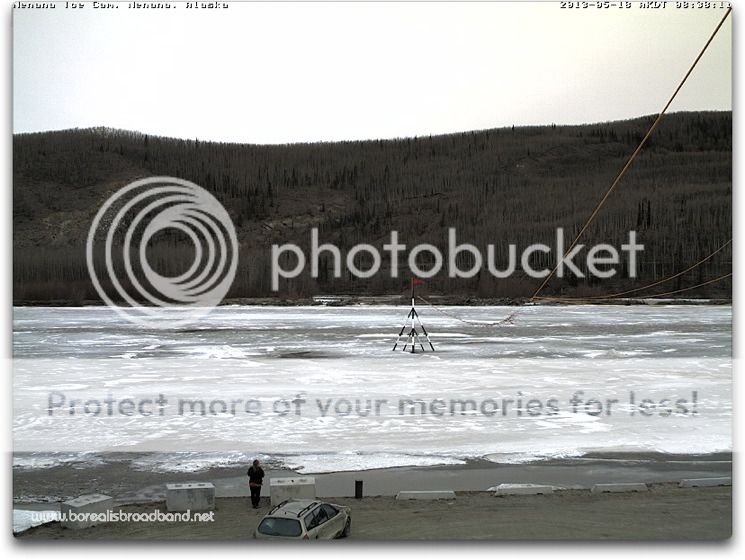
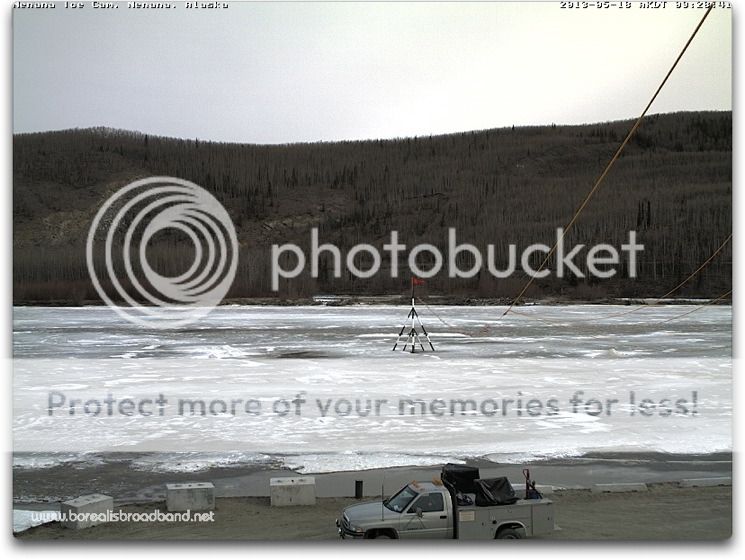
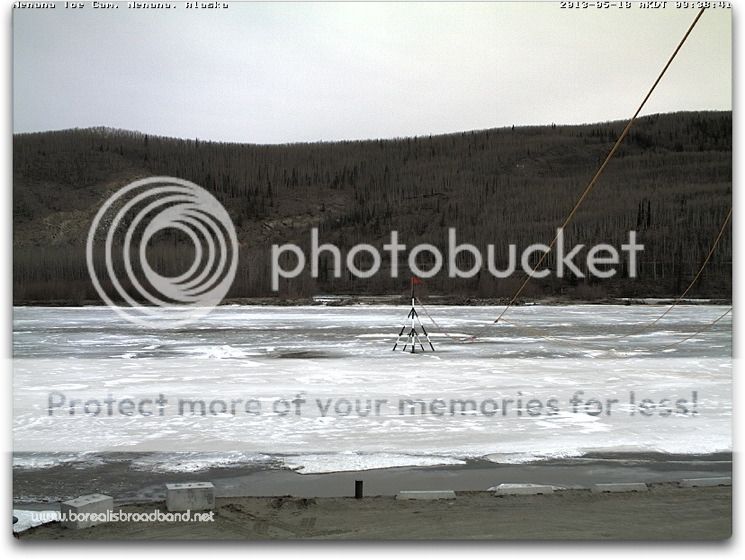
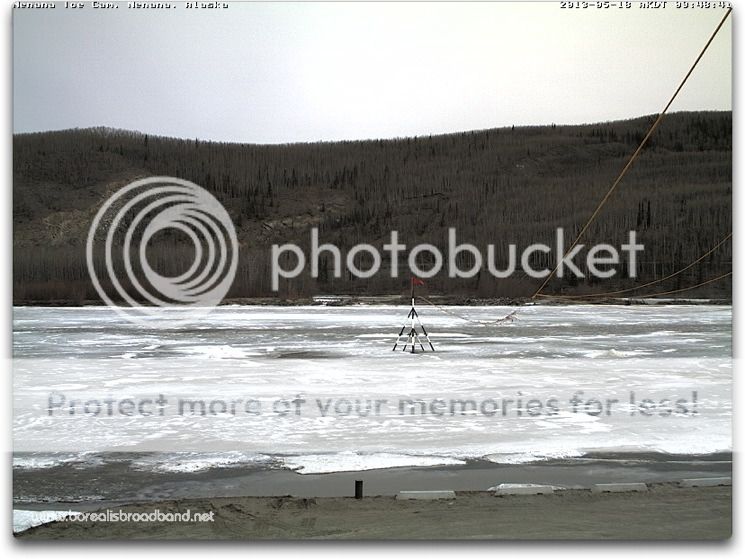
Here’s the closest frames. First one shows the likely culprit …
Next one, ten minutes later, shows one of the boxes has been picked up ….
And finally, another ten minutes and they’re gone …
Anthony, if you want my series of ten-minute-apart stills (mostly complete except one 8-hour stretch where my lack of error trapping kicked me off) you’re welcome to add it to your set. They have no frame, snagged directly from the feed. I was working on the first movie myself, but you have the industrial-strength hardware, software, and wetware for that job …
w.
Did you see the frame in which the guy runs out onto the ice with a hockey stick and attempts to chop away at the ice? He was driving a Prius with a Nittany Lion bumper sticker.
Willis – thanks for the detective work!
I’ve just watched the car drive away and it looks as if the lady who got into the back left her bag on top of the roof. So they might have to come back and pick it up sometime.
The car was an SUV so I hope it doesn’t hasten the melt and prevent the record…
Willis, I have a 30 second screencap setup running from just after noon today, so we should be able to get a sense of movement of the ice etc.
I think I’ll use some of your caps as a prelude…but not try to join them due to the date gap.
Robert Sheaffer says:
Greg Goodman says:
if anyone can point me to an easily accessible list of equinox dates for the the last 100 years,
That list is here: http://ns1763.ca/equinox/vern1788-2211.html
damn, me an my big mouth , that this evening blow out scratching my head about time zones and Julien and Pope Gregory.
Even has the exact hour, cool.
many thanks.
And what does the record breakup really mean? Using time from equinox sounds great, but there is a problem. It assumes the time of day when the breakup occurs is purely random. It isn’t. Below are the hours of the day when the breakup happened according to the log.
We find the times are more likely around midday. Not surprising really. Runoff is dependent on insolation, and increases during the daylight hours, then decreases overnight. When exactly the runoff peaks at a given location on a stream may depend on how long it takes for the water to arrive at the point where the flow is measured.
Thus, the calendar date and local time are more important than the astronomical time. These have been the basis of the record, and should remain so.
Hour Number
0 1
1 1
2 1
5 1
6 2
9 7
10 6
11 8
12 7
13 9
14 7
15 9
16 6
17 6
18 7
19 5
20 4
21 3
22 2
23 3
I’d say the Nenana ice classic is a proxy for two things:
1. Climate in a small part of Alaska.
2. In particular, the exit from spring, as opposed to winter cold.
The first freeze up will be a proxy for entry into winter in Alaska, however whether it’s -36 or -40C in January or February really won’t make great odds to the melt date.
People should be very careful in how they interpret things: Alpinists in Europe (by which I mean professional guides) have a mantra that ‘the snow which falls before the middle of January is the snow which lasts’. So, if you get heavy early snow and it consolidates, it lasts much longer than if you get loads of snow in March which melts much quicker before forming consolidated neve.
People should be very careful in interpreting the snow data of any one ski station, since anyone of knowledge knows that you can get inverse relationships between e.g. the Italian Alps and the northern Swiss Alps (since one gets mostly snow on NW winds, whereas the other gets most snow when a depression comes up from the south).
People should be careful in ascribing global cooling when it’s cooler in NW Europe. I wonder if it really is cooler in SE Europe right now??
It’s really important to find multiple measurement zones and obtain a complete picture rather than ascribing the fertility of one prize bull to all male cows on the planet…….
See – owe to Rich says:
May 19, 2013 at 10:12 am
A first cut would say that since 2013 is one year after a leap year, the equinox occurred about 6 hours later than in 2012, so instead of May 20th 11:41am we should set the target to be May 20th 5:41pm.
A year is 365 days, 5 hours, 48 minutes, 45 seconds. As has been pointed out, 1964 was a leap year but 2013 is not a leap year. So it would not necessarily have to be 24 hours later to be a record. 2013 and 2014 and 2015 would each have different times for a record to be established.
Does this affect your second cut numbers by 11 minutes and 15 seconds?
An informative article on the recent winters in Alaska – http://www.alaskadispatch.com/article/20130517/cold-hard-facts-new-century-frigid-alaska