UPDATE: Dr. Judith Curry’s transcript of her verbal testimaony is online here: http://judithcurry.com/2013/04/25/congressional-hearing-on-policy-relevant-climate-issues-in-context/
Skeptics outnumber alarmists at House of Representatives session today
Subcommittee on Environment Hearing – Policy Relevant Climate Issues in Context
Policy Relevant Climate Issues in Context
Purpose
On Thursday, April 25, 2013, (10AM ET) the Subcommittee on Environment will hold a hearing entitled Policy Relevant Climate Issues in Context. The purpose of the hearing is to provide Members a high level overview of the most important scientific, technical, and economic factors that should guide climate-related decision-making this Congress. Specifically, this hearing will examine the current understanding of key areas of climate science necessary to inform decision-making on potential mitigation options.
Background
Climate science—and climate-related regulatory actions informed by such science—are among the most complex and controversial issues facing policymakers. After several years of relatively quiet legislative and regulatory activity within Congress and the Executive Branch, climate policy is again receiving renewed attention.
Since winning re-election in November, 2012, President Obama has increasingly signaled his intention to propose significant, new executive actions and regulatory measures aimed at addressing climate concerns. At his inaugural address in January, the President stated:
We will respond to the threat of climate change, knowing that the failure to do so would betray our children and future generations. Some may still deny the overwhelming judgment of science, but none can avoid the devastating impact of raging fires and crippling drought and more powerful storms.
The President elaborated on this at last month’s State of the Union address, and indicated he would direct his Cabinet to propose specific actions for his consideration. Specifically, he stated:
But for the sake of our children and our future, we must do more to combat climate change. Yes, it’s true that no single event makes a trend. But the fact is, the 12 hottest years on record have all come in the last 15. Heat waves, droughts, wildfires, and floods – all are now more frequent and intense. We can choose to believe that Superstorm Sandy, and the most severe drought in decades, and the worst wildfires some states have ever seen were all just a freak coincidence. Or we can choose to believe in the overwhelming judgment of science – and act before it’s too late.
The good news is we can make meaningful progress on this issue while driving strong economic growth. I urge this Congress to pursue a bipartisan, market-based solution to climate change, like the one John McCain and Joe Lieberman worked on together a few years ago. But if Congress won’t act soon to protect future generations, I will. I will direct my Cabinet to come up with executive actions we can take, now and in the future, to reduce pollution, prepare our communities for the consequences of climate change, and speed the transition to more sustainable sources of energy.
While it is unclear what specific form the President’s proposals will take, it has been widely reported that new Environmental Protection Agency (EPA) regulations restricting greenhouse gas emissions from existing power plant facilities will serve as a centerpiece of the President’s climate efforts. In March 2012, EPA proposed greenhouse gas regulations for new power plants.1 While this rule has yet to be finalized, the Agency’s Regulatory Impact Analysis that accompanied this proposal emphasized some of the key challenges associated with incorporating uncertain scientific, technological, and economic information into such regulatory decisions:
When attempting to assess the incremental economic impacts of carbon dioxide emissions, the analyst faces a number of serious challenges. A recent report from the National Academies of Science (NRC 2009) points out that any assessment will suffer from uncertainty, speculation, and lack of information about (1) future emissions of greenhouse gases, (2) the effects of past and future emissions on the climate system, (3) the impact of changes in climate on the physical and biological environment, and (4) the translation of these environmental impacts into economic damages. As a result, any effort to quantify and monetize the harms associated with climate change will raise serious questions of science, economics, and ethics and should be viewed as provisional.2
This characterization is indicative of the likely challenges associated with future climate-driven regulatory proposals as well. Therefore, it is likely that Congressional review and response of such proposals will be heavily informed by the understanding of a combination of science, technological feasibility, and value judgments such as economic tradeoffs and opportunity costs.
1 http://yosemite.epa.gov/opa/admpress.nsf/79c090e81f0578738525781f0043619b/9b4e8033d7e641d9852579ce005ae957!OpenDocument
2 http://www.epa.gov/ttnecas1/regdata/RIAs/egughgnspsproposalria0326.pdf
The purpose of this hearing is to examine key factors that will guide these decisions, particularly as they relate to the understanding of climate change-related risks facing the country, associated probabilities and uncertainties, and the costs and benefits of various mitigation proposals.
Witnesses
Dr. Judith Curry, Professor, School of Earth and Atmospheric Sciences, Georgia Institute of Technology
Dr. William Chameides, Dean and Professor, Nicholas School of the Environment, Duke University
Dr. Bjørn Lomborg, President, Copenhagen Consensus Center
==============================================================
LIVE WEBCAST LINK:
http://mfile.akamai.com/65778/live/reflector:39667.asx?bkup=39949&prop=n
Watched the whole subcommittee hearing. The (Rep.) Members of the House get it. The Dem. members trot out the same old party line rhetorically. The division between parties is a yawning chasm.
The witnesses all ‘went along’ with the premise that CO2 is bad and its all anthropogenic. Almost as is to say otherwise would result in immediate excommunication, a lightening strike or worse.
Judith Curry’s testimony DID NOT offer any clarification on the sceptical side at all, IMO. It seems that the Climate Mafia have a much larger hold than we would care to admit. For the other side to trot out the whole bag of CAGW nonsense with impunity reinforced that.
The format did not lend itself to examination of any details and you obviously cannot get any admission of telling pork pies (lies) in cross examination, and clearly there were a few misdirections, deflections and reinterpretations that were deliberate politicking.
But overall the Rep. members are alive to all of it and in no mood to allow Americans to suffer from the impositions that would otherwise be piled upon them. More power to them.
Judith Curry’s “Truth in Testimony” disclosure cites the Federal grants, contracts, subgrants or subcontracts received by her or the entity she represents. They are: DOD, DOE, NASA, NSF, NOAA.
Lomborg’s disclosure cites “0”.
I’m a fan. He’s always articulate, energetic, and fresh, but in his effort to provide a role for big government spending (as though fearful to hurt BG’s feelings), always seems a bet wishy-washy. When he is asked, “So… do you think we should cut back on governmental subsidies to these (various energy) companies?” He answers “No. We should be smarter in how we fund them.” These are approximate quotes – from my memory.
But who says we need to incentivize the “right” technologies, either in their production or in their research and development? My hunch (unencumbered by personal experience) is that a new technology that solves big problems cheaply (such as fracking) eventually brings sufficient financial reward to grow and spread on its own. Such, I believe, is the point that Mr. Williams makes, above.
Marty Williams says:
April 25, 2013 at 12:46 pm
Lomborg’s testimony is up as well: http://lomborg.com/sites/default/files/Congress_testimony_April_2013_3.pdf
JC says “…as well as tactics used by both sides to try to gain political advantage in the debate”
Could someone fill me in on the “tactics” used by the skeptics ? Tactics like trying to get a legitimate debate going ?
Archived webcast: http://science.edgeboss.net/wmedia/science/sst2013/EV042513.wvx
@herkimer
‘ The warm air under higher pressure now radiates heat and sinks[under pressure], resulting in a mound of relatively warm air under high pressure to develop around the pole . ‘
What causes the pressure that makes the warm air sink? Normally warm (higher pressure) air rises so that it can expand and lower its pressure. Your scenario seems to want it to do the opposite…to move from a lower pressure to a higher pressure region. Like a child’s balloon spontaneously inflating itself…..
LATIMER ALDER
Here are two sources with slightly different explanations . I think the key is that SSW events seems to cause more cold Arctic air to seep to lower latitudes , something like the effect of negative AO but through a different mechanism.
”Major stratospheric warming events like these have a large impact on the weather. The warm air in the stratosphere radiates heat and sinks, then warms as it sinks by compressional heating. It causes a mound of relatively warm air and high pressure to develop around the pole. ”
http://www.dailykos.com/story/2013/01/16/1179397/-Sudden-Stratospheric-Warming-Split-the-Polar-Vortex-in-Two
“Another theory is that large storms in the lower part of the atmosphere (the troposphere) cause perturbations in the stratosphere and may allow the upper atmosphere to warm suddenly. When the stratosphere suddenly warms, it forces a large area of low pressure at the surface, known as the polar vortex, to weaken. According to Chief Meteorologist Elliot Abrams, “With the vortex no longer strong enough to contain the frigid surface air near the pole, the dam breaks and allows the cold air to start moving southward.” This occurred during the middle of January. It allowed some cold air to seep southward over the Canada Prairies, into the western U.S. for several days and intermittently into the northern Plains and northern New England. ”
http://www.accuweather.com/en/weather-news/evolution-of-an-arctic-outbrea/4721288
herkimer says: April 26, 2013 at 6:59 am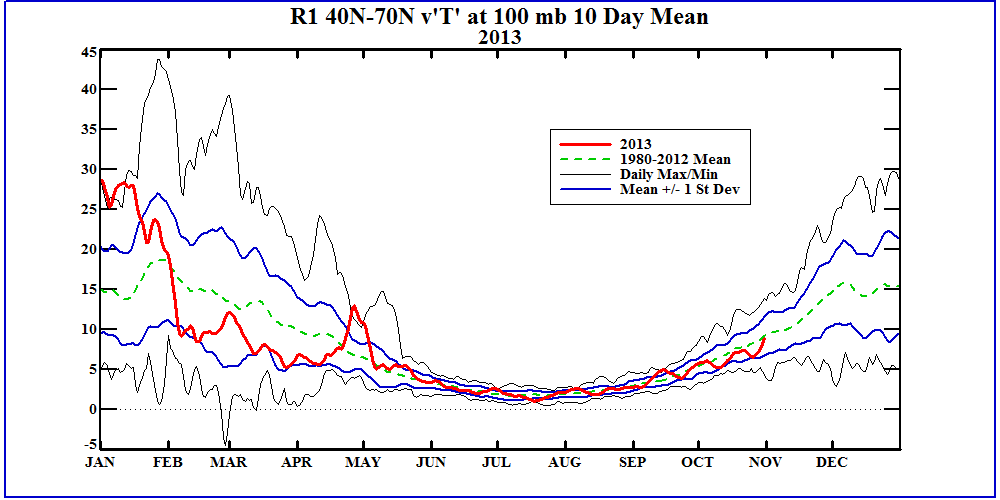 NOAA – National Weather Service – Climate Prediction Center – Click the pic to view at source[/caption]
“Another theory is that large storms in the lower part of the atmosphere (the troposphere) cause perturbations in the stratosphere and may allow the upper atmosphere to warm suddenly. When the stratosphere suddenly warms, it forces a large area of low pressure at the surface, known as the polar vortex, to weaken. According to Chief Meteorologist Elliot Abrams, “With the vortex no longer strong enough to contain the frigid surface air near the pole, the dam breaks and allows the cold air to start moving southward.” This occurred during the middle of January. It allowed some cold air to seep southward over the Canada Prairies, into the western U.S. for several days and intermittently into the northern Plains and northern New England. ”
http://www.accuweather.com/en/weather-news/evolution-of-an-arctic-outbrea/4721288
Eddy Heat Flux also plays a role, i.e. 10 day Averaged Eddy Heat Flux Towards The North Pole At 100mb:
[caption id="" align="alignnone" width="578"]
Also,
Here’s an animation of the Arctic Polar Vortex in Winter 2008 – 09, it’s break down and the resultant Sudden Stratospheric Warming :
[youtube=http://www.youtube.com/watch?v=mIXfYTSmBg0&feature=related]
and there are several more on this site including one where the Polar Vortex splits:
http://earthobservatory.nasa.gov/IOTD/view.php?id=36972