We discussed Dr. Roy Spencer’s post More on Trenberth’s Missing Heat in my recent post and in the cross post at WattsUpWithThat.
One of the points Roy made: a change in ocean heat content is presented in terms that look impressive: Joules times 10^22 or Joules with oodles of trailing zeroes. However, in terms that most people are familiar with, temperature, the warming of the global oceans since 1955 was a minute change. Roy wrote:
Because of the immense heat capacity of the deep ocean, the magnitude of deep warming in Scenario 3 might only be thousandths of a degree. Whether we can measure such tiny levels of warming on the time scales of decades or longer is very questionable, and the new study co-authored by Trenberth is not entirely based upon observations, anyway.
The NODC presents their ocean heat content data through their webpage here. There, they also include a link to the 2012 paper by Levitus et al that introduced their dataset for depths of 0 to 2000 meters World Ocean Heat Content and Thermosteric Sea Level change (0-2000 m),1955-2010. In the abstract, Levitus et al identify the change in temperature of the volume of water that makes up the global oceans to depths of 2000 meters, or about 6560 feet (my boldface):
We provide updated estimates of the change of ocean heat content and the thermosteric component of sea level change of the 0–700 and 0–2000 m layers of the World Ocean for 1955–2010. Our estimates are based on historical data not previously available, additional modern data, and bathythermograph data corrected for instrumental biases. We have also used Argo data corrected by the Argo DAC if available and used uncorrected Argo data if no corrections were available at the time we downloaded the Argo data. The heat content of the World Ocean for the 0–2000 m layer increased by 24.0 ± 1.9 × 10²² J (±2S.E.) corresponding to a rate of 0.39 W m−2 (per unit area of the World Ocean) and a volume mean warming of 0.09°C.
That’s right. According to Levitus et al 2012, the average temperature of the global oceans to depths of 2000 meters warmed a miniscule 0.09 deg C (or 0.16 deg F) from 1955 to 2010. Granted, the heat capacity of the ocean is much greater than the atmosphere, but that warming of 0.09 deg C strains believability. Are we able to sense such a small change?
Some might think Top Gear’s Jeremy Clarkson is correct with what he wrote in a June 2012 The Sunday Times article titled Kaboom! It’s my turn to play fantasy climate change:
Science fiction is thriving; only today it’s all being written by global warming enthusiasts.
(Just in case there’s a problem with the link above, Benny Peiser’s GlobalWarmingPolicyFoundtion has a copy of Jeremy Clarkson’s article here.)
Figure 1 is the same graph I presented in the introduction of More on Trenberth’s Missing Heat. Except in this graph I’ve scaled the data in deg C so that it creates the 0.09 deg C warming of the global oceans to depths of 2000 meters from 1955 to 2010 in the NODC data. As a reminder, the “unadjusted” ocean heat content data is represented by the UKMO EN3 data, and the corrected—tweaked, adjusted, modified, whatever—ocean heat content data is represented by the NODC data. Regardless of whether you find the unadjusted or adjusted data to be the more reasonable dataset, we’re still talking of a warming of about 0.09 deg C over a 55-year period.

Figure 1
Keep in mind, the global oceans cover a surface area of about 361 million square kilometers and the data is supposed to represent the average temperature of the oceans to depths up to 2 kilometers.
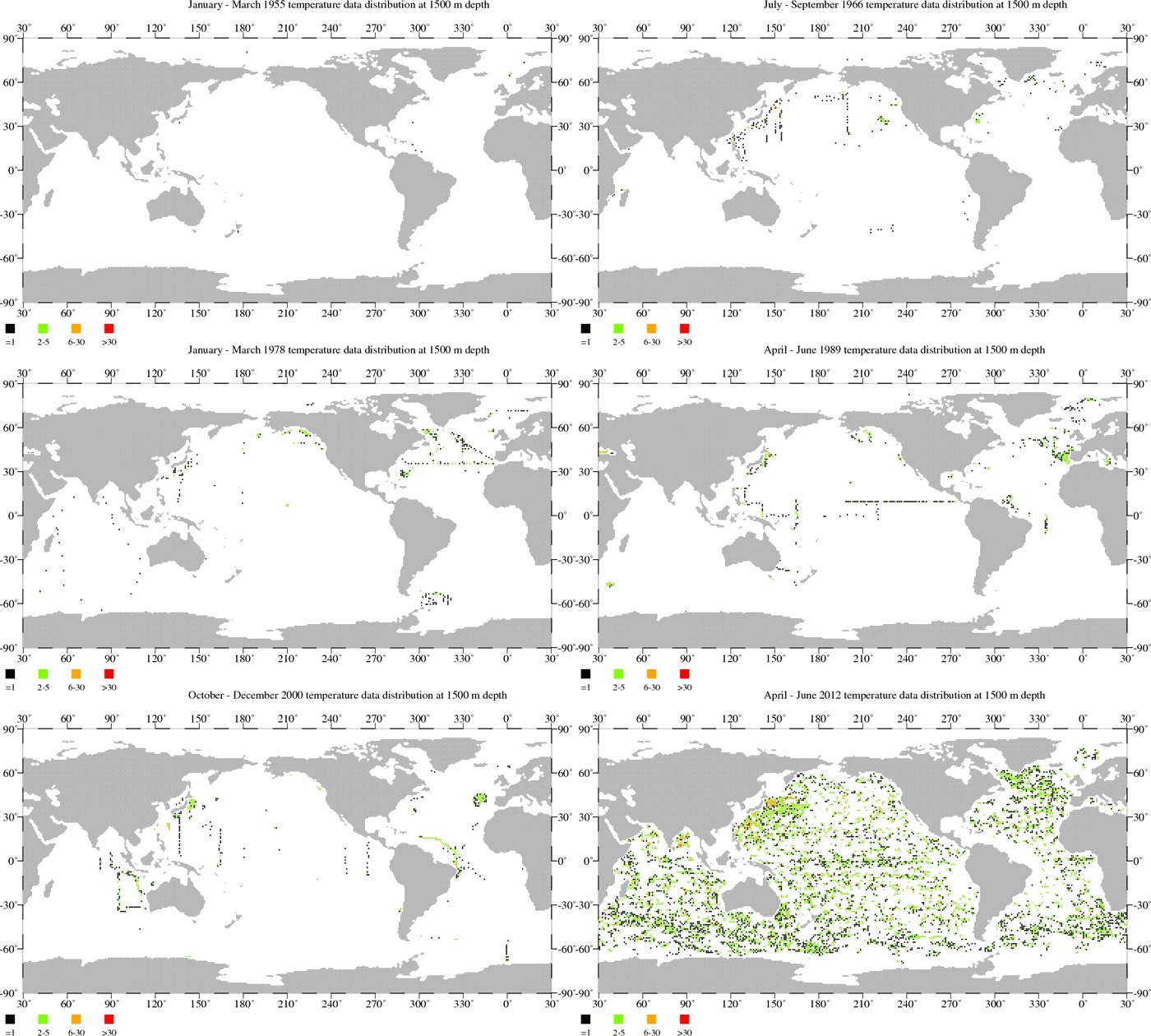
Now consider how few temperature samples there are at depths of 1500 meters before 2003/04 (Refer to gif animation of temperature sample maps here). 2003/04 is when the ARGO floats began to have reasonably complete coverage of the global oceans. It’s very difficult to find the dataset credible. A warming of 0.09 deg C in 55 years equals a linear trend of approximately 0.016 deg C per decade. That’s sixteen one thousandths of a deg C per decade.
Even during the ARGO era, the data has to be modified in order for it to come close to matching the warming trends simulated by climate models. I’ve shortened the term of the data in Figure 2 to the ARGO era (the period of 2003 through 2011) to give you an idea of just how small those corrections are in deg C. I’ve also included the linear trend lines for the sake of discussion. Also note that the larger annual changes in the two datasets are on the order of 0.005 to 0.006 deg C.

Figure 2
ONE MORE THING TO CONSIDER
Most of the warming occurred in the top 700 meters. But the warming at those depths has flattened in recent years.
Levitus et al 2012 also identifies the warming of the depths of 0 to 700 meters. They write in the abstract:
The heat content of the World Ocean for the 0–700 m layer increased by 16.7 ± 1.6 × 10²² J corresponding to a rate of 0.27 W m−2(per unit area of the World Ocean) and a volume mean warming of 0.18°C.
The depths of 0-2000 meters warmed 0.09 deg C from 1955 to 2010, but the warming of the top 700 meters was twice that amount. That means the warming of the depths of 700 to 2000 meters, where the warming is said to continue, was miniscule in terms of deg C.
ALARMIST REPORTS ABOUT THE CONTINUED WARMING OF THE OCEANS
In their attempts to overcome the flattening of surface temperatures trends, the alarmist community—SkepticalScience and Climate Progress in particular—have been very active recently with their reports about the continued warming of the global oceans. The most recent is Joe Romm’s April 16th post Reuters Ignores Its Own Accurate Reporting On Rapid Warming Of Oceans. If the alarmist community and the mainstream media presented the ocean warming to depths of 2000 meters in terms people understood (deg C) instead of the units meant to alarm (10^22 Joules), would the believers in manmade global warming find the ocean heat content data credible? Some would. Others wouldn’t. It really strains believability.
CLOSING
ARGO floats were introduced to allow researchers to sample the temperature and salinity of the global oceans to depth. According to the testimony of Raymond Schmitt when the ARGO program was looking for US funding, ARGO floats would permit scientists to “begin to understand this largest component of the global water cycle.” (Refer to the Woods Hole Oceanographic Institution webpage.) But can they realistically be used to find missing heat that’s supposed to be associated with human-induced global warming? Or are certain members of the climate science community still grasping at straws in efforts to keep their taxpayer-funded research afloat?
Estimates may not even be close to the truth.
For example, the surface seawater temperature in the North Atlantic Ocean was reported to be some 3 degrees Celsuis above normal in 2012. This is best explained by the submarine eruption of the El Hierro volcano located in the western Canary Islands from October 2011 to March 2012 (see http://en.wikipedia.org/wiki/El_Hierro_eruption).
The cause is therefore entirely natural. Heating of the seawater has nothing to do with greenhouse effect induced by man-made carbon emissions.
It is necessary to factor in submarine volcanic activity in the different oceans.
Wyss Yim says:
April 19, 2013 at 12:23 am
“Estimates may not even be close to the truth.”
“It is necessary to factor in…”
Necessary to proper understanding. Inconvenient to the simple minded in pursuit of results that support personal elevation and a desirable agenda.
Wyss Yim says: “For example, the surface seawater temperature in the North Atlantic Ocean was reported to be some 3 degrees Celsuis above normal in 2012.”
+3 deg C? That’s awfully high. They peaked at about 0.7 deg C:
http://bobtisdale.files.wordpress.com/2013/04/07-n-atl.png
The graph is from my most recent monthly sea surface temperature update:
http://bobtisdale.wordpress.com/2013/04/08/march-2013-sea-surface-temperature-sst-anomaly-update/
Wyss Yim says: “For example, the surface seawater temperature in the North Atlantic Ocean was reported to be some 3 degrees Celsuis above normal in 2012. This is best explained by the submarine eruption of the El Hierro volcano located in the western Canary Islands from October 2011 to March 2012…”
Actually, the warming last year in the low-to-mid latitudes of the Eastern North Atlantic is better explained as a natural response to the short-lived El Nino conditions:
http://bobtisdale.files.wordpress.com/2013/04/15-weekly-nino3-4.png
Regards
3 degrees Celsius above average is from http://www.nature.com/news/hurricane-sandy-spins-up-climate-discussion-1.11706.
Please also refer to NOAA: Record high ocean temperatures in North Atlantic published on Wednesday Sept. 19,2012 by Common dreams. Source URL: https://www.commondreams.org/headline/2012/09/19-3.
The timing of the the El Hierro submarine volcanic eruption from october 2011-march 2012 is convincing to me.
Its worth remembering that there is only one mechanism for transport of water from the surface to the ocean floor deeper than 2000 m, that is cold downwelling at well known locations such as the Norwegian sea. Deep cold water is dense and it takes super-cooled extra saline water formed during ice formation to have the density to sink to the ocean bottom. To propose that warm surface water can sink to the ocean bottom (as Trenberth is proposing in his desperation to salvage AGW) is the same as proposing that ice bergs can fly through the air.
The mechanisms of changing the deep water temperature profile are only two, change in the rate and pattern of downwelling and upwelling, and change in the depth of the thermocline.
It has been correctly pointed out that even with thousands of Argo floats, it is unlikely we have enough data for a true global picture of deep ocean temperature. What might be more useful and attainable by these floats is a picture of vertical temperature profile, indicating if globally there is any change in vertical mixing, any increase or decrease in upwelling and downwelling. Due to the strong vertical stratification of ocean temperature (warm at surface, very cold at depth even in the tropics) then any increase in vertical mixing over the whole water column will act to remove heat from the surface and cool the climate.